Maternidade, cuidados do corpo e "civilização" na Pastoral da Criança
Gabriele dos Anjos
Fundação de Economia e Estatística
Translated by Nina Adel and Miriam Adelman
Translation from Revista Estudos Feministas, Florianópolis, v.15, n.1, p. 27-44, Jan./Apr. 2007.
]]>
ABSTRACT
This paper is an analysis of how the Pastoral da Criança (Children's Pastoral), organization of the Catholic Church, seeks to define women's identities by disseminating practices related to the use and care of the body. The techniques utilized to examine and care for the body found in the handbooks of the Pastoral da Criança are used to develop women's self-identification as mothers among the women seen by the service and the "líderes" (leaders) as educators. This work enables the Pastoral da Criança to present an ideology opposed to feminist activities and compete with the latter in government spheres in which policies related to the use of the body are defined.
Key words: Feminine Identity; Catholic Church; Motherhood; Children's Pastoral.
RESUMO
Este texto é uma análise de como a Pastoral da Criança, organismo da Igreja Católica, procura definir identidades femininas pela difusão de práticas relativas ao uso e cuidado do corpo. As técnicas de exame e cuidado do corpo presentes nos manuais da Pastoral da Criança são usadas para desenvolver uma auto-identificação como mãe entre as atendidas e uma identificação das 'líderes' com o papel de educadoras. Este trabalho possibilita à Pastoral da Criança apresentar uma ideologia contraposta aos feminismos e concorrer com estes em fóruns governamentais em que são definidas políticas relativas ao uso do corpo.
Palavras-chave: identidade feminina; Igreja Católica; maternidade; Pastoral da Criança.
Introduction
]]> This article presents an analysis of how the Catholic Church, through the work of the Pastoral da Criança, seeks to define women's identities by disseminating practices related to the use and care of the female body to women of lower social classes in Brazil. The aim of this analysis is to specify the ways in which the Catholic Church has renewed the ideologies it offers in which motherhood is the feminine condition par excellence1 This offering is not made through abstract theological propositions, but through methods of care of medical origin which target the female body. Thus it is possible to become familiar with one of the many ways in which particular social institutions impose or establish identities through the mechanisms of the education of the body and the "somatization of the cultural arbitrary". 2The Pastoral da Criança is a structure within the Catholic Church linked to the National Conference of Bishops of Brazil (Conferência Nacional dos Bispos do Brasil) (CNBB), in which both laymen and professionals of the church participate: bishops, priests, women and men of different religious congregations. The work of these agents is carried out amongst the country's impoverished populations and is aimed basically at the dissemination of knowledge and techniques of healthcare for pregnant women and children as well as at attending to the health needs of children ages zero to six.3 Although the Pastoral does not aim to use only women to carry out its work, more than 90% of those engaged are women.4 This leads us to consider that the Pastoral mobilizes women through its offer of female roles and identitites.
The Pastoral da Criança bases its presentation of motherhood as female condition par excellence on techniques utilized in the relations between 'líderes'5 of the Pastoral and those women it serves, involving the examination and questioning of bodies and female relations and evoking the relationship between the individual and the "director of conscience".6 The texts of the Pastoral da Criança7 directed at its 'líderes' express the offer of female identities in accordance with Catholic principles. These texts propose a series of methods of intervention over women's bodies, aimed at turning them into mothers, the best of mothers. They propose, as well, an intervention over the bodies of their children so they will be "healthy" and have "a better life". That intervention is based on an amalgam of methods of care of medical origin and Catholic principles8 that establish a link between health and morality and between individual health and social health.
Those methods of intervention upon the female body can be considered "technologies of the self" or methods that
allow individuals to perform, on their own or with the help of others, a certain number of operations upon their bodies and souls, thoughts, conduct, or any form of being, achieving in this way self-transformation with the goal of reaching a certain state of happiness, purity, knowledge or immortality.9
In the Pastoral da Criança, thse methods of body care are linked to the methods of confession characteristic of Christianity and of Catholicism in particular, utilized to control and direct individuals10 This link between care and confession is what makes it possible for the Catholic Church to structure its offer of ideologies on the feminine around the family and private "women's issues" such as illness, domestic violence, control over sexuality and others. This forms an agenda which is distinct from other contexts of Church mobilization of lower-class women, notably the Comunidades Eclesiais de Base (CEBs) (Base Ecclesiastical Communities) and the "mother's clubs" in which these issues were not dealt with.11 The Pastoral's work was based on techniques that change the domain of life under examination: 12 from the "soul" that is exposed in confessions, to the body. This is realized through the appropriation of medical research and care techniques and their use as a kind of moral education. In this sense, the manuals used by the 'líderes' of the Pastoral have the same function as the old confessional manuals: to establish a frame of reference that serves as a guide on the topics to be discussed in confession and in the interpretation of the acts which are the objects of study.13
A detailed investigation of the self and of particular spheres of life, as well as a detailed report of the results of such investigation lead to a greater sense of personal subjectivity.14 In the case in point, this refers to a study of the body in motherhood as a biological condition that encourages a woman's self-identification as mother. Likewise, the methods of inquiry regarding children and family relations reinforce this identification. Such methods of research and self-presentation within a family framework are aimed as well at the effects of "civilization", or the growth of internal and external self-control through physical and psychological self-knowledge,15 in this case, in accordance with Catholic references in which identities are defined by the roles within the family. In the view of authors concerned with establishing the mechanisms involved in the "process of civilization", the latter, as control over drives, is tied to the techniques of body use and of hygiene. According to Elias,16 modern habits of hygiene are related principally to the imposition of standards for the use of the body meant to serve social expectations of respect and distance which are progressively absorbed by individuals in the form of shame. It is through a "greater sense of modesty and delicacy" or "progress in the level of embarassment and shame" in relations between individuals that manners and standards of conduct are developed which medicine currently ratifies as "hygienic".17 In the case of the Pastoral da Criança, it is a question of the inseparability of teaching of precepts of hygiene, of morals and precepts for the relations between mothers, fathers and children and of the "calming" or "pacification" of their spirits. It is a question of the standards of the use of the body related to a greater physical sensibility – with stricter criteria for "dirty" and "clean" and "sick" and "healthy" – and psychologically – control and discipline of the drives.
This dissemination of ideologies regarding the feminine through work on the body is carried out in competition with other agents and other ideologies of the feminine, notably those of contemporary feminism. In this sense, the female identities that are offered involves both working with lower class women and entering in direct confrontation with feminist approaches to the body. This opposition to feminism has an effect even on the way women's engagement in the Pastoral da Criança as 'leaders' is defined, referred to as the "promotion of the woman". It calls for access to "a better life" through the education of the women that are served and the specific resources that turn the women engaged by the Pastoral into "educators". The Catholic Church, thus, reestablishes an old definition of the employment of women in public space, and as professionals dedicated to physical care, an imitation of women's private space roles.
]]> Care of the Body and "Civilization"
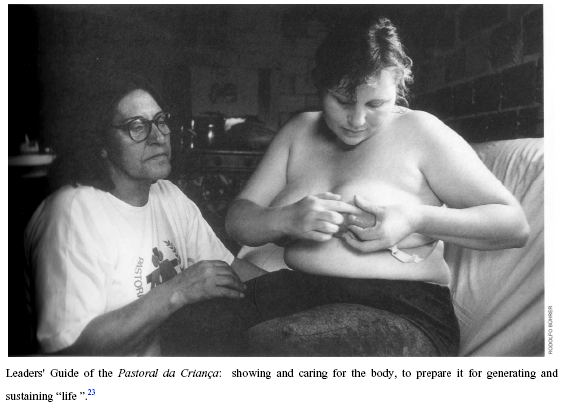
The Pastoral da Criança defines activities for the 'líderes' which can be understood as an investment in the body of woman as mother and as devoted to private relations. The bodies of women and their children must be examined, cared for and treated. This is accomplished through the care and attention that 'líderes' provide for pregnant women, their children and their families. The manual Guia do líder da Pastoral da Criança reveals how this aid must be carried out: it is based on visits to the families in the community to "discover who is pregnant, to direct her to a publicprenatal health clinic, and to care for the pregnant woman throughout pregnancy, listening to what she wants to talk about or ask, directing the conversation towards what she needs to know".18 It deals with the task of identifying physical symptoms, in which 'líder' and pregnant woman care for the body and explore it as a vehicle for motherhood. The leader's work with the pregnant woman consists of identifying risk factors in the pregnancy and treating he discomfort or problems: breast pain, lightheadedness, "complaints" about "gas, indigestion and heartburn",j "swelling of the feet, varicose veins and cramps",19 "high blood pressure and swelling in the body"20 and even "sleeping disturbances and worries".21 The manual indicates these signs as the principal focus of leaders' intervention on the body of the pregnant women they visit. From the beginnings of their pregnancies, women are "prepared for breastfeeding". There is an entire set of precepts regarding "the importance of breastfeeding for the health of the child" that the women following during pregnancy and after childbirth. Breastfeeding, although recommended by medical criteria, is anchored primarily in religion. The manual recommends that the leaders teach "that when [the mother] prepares herself with her heart and mind, she will feel more pleasure in breastfeeding and in so doing, transmit more love, affection and trust to the baby. Through nourishing the little one, the mother is tenderness, a gift. She is an expression of the love of God".22
It is this reconciliation of the medical and religious registries that allows the Church, through the work of the 'líderes' of the Pastoral, to invest in " mother love", the future mother's love for her child, which may also be understood as the imposition of a maternal identity on the woman who receives Pastoral aid. To prepare for breastfeeding,, "to converse with the pregnant woman about her problems, doubts and complaints" is also a slow preparation for motherhood: "from the beginning of pregnancy, it is good for the pregnant woman to start preparing her heart, mind and body for breastfeeding".24
The characterization and personification of the fetus, which "in the Pastoral da Criança, is referred to as 'baby' from the moment of conception", is also one of the ways to foment maternal love. This is done during the visits from the 'líder', when she and the mother talk about the'bebê'. The 'líder'is instructed to teach the parents to talk, sing and pray for the 'baby' "while still in its mother's belly". One of the methods used for this sweet imposition of maternity is to have the 'líderes' bring calling cards to the pregnant woman, from the first month of gestation to the first month of life of the child. These cards, which, as a set become a "memento of pregnancy" with the suggestive name "Bonds of Love", provide information about health and nutrition and give a voice to the 'baby': "Hello mommy! Soon we'll be able to see, touch and love each other even more!". On these same cards, motherhood is celebrated by the use of religious references: "Blessed is the fruit of your womb, as he is the symbol of the presence of our Lord God. Talk to your baby. Love him a lot"; "You are the richest fountain of the love of God. To be a mother is to be the presence of God".
The inquest of the body and the acquisition of knowledge relative to healthcare are represent the teaching of standards of behavior and attitudes. Methods of hygiene are geared toward the health of the pregnant woman and her 'baby', and of other children; it is in the name of health that instructions are provided on how to bathe, the use of clean clothing, oral hygiene (toothbrushing and the use of dental floss), the use of hygiene products, how to care for breasts in anticipation of breastfeeding, care of clothing, of feces, of urine, prevention of illness, immunizations. Mothers are also taught how to care for their children's nutrition: healthy foods and their properties, methods of preparation. This knowledge of the body and its effects value the woman as mother and in connection to her child. Care of the pregnant body, the body that nourishes and nurses, involves a woman who is considered worthy of attention and celebrated by the Church : the one who will become a mother, the pregnant woman, the mother.
The texts of the Pastoral intended for the dissemination of knowledge by the 'líderes' demonstrate a preoccupation with cultural forms of childraising, with the "loving welcome of the child into the family through pregnancy" or affectionate care, education through conversation and by example rather than through physical punishment. "To smile, to hug, to kiss are attitudes that reach people. Words like 'sorry', 'excuse me', 'thank you', 'good morning', 'I love you' also reflect our respect for others and help to maintain a healthier family atmosphere ".25 In particular, the manual entitled Peace Begins At Home (A Paz Começa em Casa) deals with methods of research and the identification of different forms of family violence, principally against children (physical, psychological and sexual violence), forming a way of sketching out good rules of behavior for dissemination.
]]> They also discuss the imposition of rules of conduct and body use which correspond to the acquisition of methods of control over drives, greater self-control and better physical and psychological sensibility.26 Notions of habits of hygiene which introduce or reinforce criteria for distinguishing between dirtiness and cleanliness and between health and sickness, bad and good, are seen alongside criteria for drawing lines between vigilance and neglect, self-control and aggressiveness, love and violence. Within the relationship of the 'líder' with the family, attention is also given to the father, as one who needs to express his anxieties in relation to fatherhood as well as to be taught to relate to the mother and child. 27 The guidlines for the actions of the 'líderes' with the families, as expressed in the Pastoral manuals, involve the observation of the behavior of the parents towards their children, and the latter, in turn, in relation to their parents and other people: "When the baby nurses, do he and the mother look into each others' eyes?";28 "do the parents put the baby on their lap to caress him, talk to and play with him even when he is not crying?"29 They involve, as well, the identification of all manner of family problems and the ways to move toward their resolution. This identification occurs, once again, through the inquiry of the 'líderes', through self-inquiry and through the sincere revelation of the problems by those who are receiving aid. In different texts of the Pastoral, the need for verbal expression of feelings is emphasized as fundamental for a good pregnancy and care of children. For this reason, "Even when the pregnancy was unwanted, it is better to converse about it with the baby [since] [...] little by little it helps the parents themselves accept the pregnancy and prepare themselves to better receive the baby".v It is a matter of speaking about oneself and listening; this implies the self-examination and confession that are necessary to guarantee civilization, in the form of self-control..30
Pastoral da Criança and Ideological Redefinition in the Church
In order to understand the work of the Pastoral da Criança, it is necessary to take into account its location within the framework of actions of the "progressive" sectors of the Catholic Church and the popular classes.31 Nonetheless, this occurs at a time in which the relationship of this sector of the Church to "politics" tends to marginalize the actions and vocabulary that are proper to the context of "redemocratization" 32 and moves closer to action of relations with the popular classes more along the nebulous lines of what is referred to as the "third sector". Thus, the work carried out by the Pastoral da Criança preserves the Church "option for the poor" in the Church, yet suspends its political demands.
In a text allusive to the 10 years of the Pastoral that presents "how our "líderes" work, it is emphasized that "knowledge and reflections on reality, discussion of the causes of infant mortality, illnesses and malnutrition", that which, in the symbolic "progressive" framework, defines "consciousness raising", preparing for the "struggles",33 in the Pastoral da Criança prepares for the "engagement in concrete actions". "It is not enough for women and men to say that the situation is bad or to shout out for their rights. This is good and necessary, but they also want concrete actions now, since deaths that could be avoided are occurring." There is a reinterpretation of the notion of 'release', or of the salvation offered, which does not elaborate on structural transformation, but rather the daily work of imposing practices relative to the private domain. Other social and religious problems which are not exactly "related to economics"'are considered, such as drug use, "family separation" and "violence against women and children," problems which threaten "cultural values, faith, brotherhood".34
That reinterpretation is reached through the reconciliation of two matrixes for conceiving social problems: one which attributes the "social" causes of problems such as unemployment, alcoholism and domestic violence to the lack of economic resources and one which assigns responsibility to the individual for the resolution of such problems. According to the manual A paz começa em casa [Peace begins at home] "the Community Leader of the Pastoral da Criança can help guiding the families that are unemployed by explaining that their situation is the result of a greater social problem and that it is not their fault that they haven't found employment". Yet it considers as well that income-generating projects including types of work outside the formal labor market follow a divine commandment: "When Jesus says: ' You must provide for your own food' (Mt 14,16), without a doubt he was indicating methods of teaching that the organization of the community brings justice and dignity to all who make an effort". The entire vocabulary of "social responsibility", "solidarity", "the growth of self-esteem", a "positive world view", and the "ability to improve the social fabric through our own efforts" is presented therein as a solution to social problems.35 This reconciliation allows the Pastoral to earn legitimacy before government and business sectors.36 In some way, it works as counterpoint to the arguments that are presented through demands for public policy on health, sanitation, education and employment as a solution to the lack of the all the latter, which has given the Pastoral its label as a mere charitable aid organization. This weakness has been the target of its critics both within and outside of the Church, as is recognized by the Pastoral da Criança's own creator when she says that "it teaches the people to prepare homemade serum [for treating dehydration], to carry the weight of the children in the community, instead of demanding that the government take care of basic sanitation and employment".37
The Pastoral da Criança also redefines social problems and social injustice using metaphors of "illness".‚ For example, the ill health of individuals and "poor" populations originates in the lack of "dignified life conditions and equal opportunity for all",38 crime and violence are caused by a "broken-down human fabric": "we must take care of the human being [...] 'uniting the forces of society and government, so that the human social fabric is preserved". Such biologization of social problems is linked to the absorption and channeling by the Church of the supply of work and knowledge by professionals in the field of healthcare (in areas such as pediatrics, mental health and public health ) and education (such as teachers) which creates a place for the work of disseminating and imposing principles of a world view through the acts of treatment, care and cure of women and children of "poor" populations. If it is possible to present an ideology of difference between men and women based in biology through the use if medical discourse, in this case "women's nature" is established as motherhood, accomplished by reconciling the vocabulary of preventative medicine with that of the Church. In the Guia do líder discussion on a good birth, for example, in points regarding "hygiene" and "well-prepared health professionals", it states that "a well-attended birth is a child welcomed with love [...] these also carry out God's plan for the woman and child ".39
The treatment of problems and issues related to the private sector such as the health of the pregnant woman, domestic violence and maternal and infant mortality through the medicalization of intervention is one of the Church's many ways of guaranteeing its preeeminence amongst the population of the lowest classes in relation to other cultural and ideological references, and particularly those belonging to feminism, which finds in these issues some of its principal "causes".40 The Pastoral da Criança, as well as the Church, consecrates woman as the generator of and one responsible for human life. This is questioned by different feminist groups and movements, which conceive of and defend women's condition as endowed with rights calling for respect for autonomy in the use of the body. These different conceptions of women's condition are expressed in issues like domestic violence, pregnant women's health, maternal mortality, amongst others, such as "sexual and reproductive rights". These in turn are objects of struggles over definition that are carried out different social spheres, especially the political sphere, in which agents of the Pastoral represent themselves as spokespersons for women as a result of their work with "poor families".
In making the first "progressive" causes– social injustice and human rights – equal to the relative problems of use of the body– such as the defense of the "right to life" – the Church can also, through the Pastoral, participate in governmental forums in which questions related to the management of populations are discussed, wherein entities and sectors geared towards the implementation of health policy become their interolocutors. Thus, members of the Pastoral position themselves within forums and spaces of decision and execution of policies relative to health and reproduction, such as the National Council of Health (Conselho Nacional de Saúde) (CNS) and the National Monitoring and Evaluation Commission of the National Pact on Reduction of Maternal and Neonatal Mortality (Comissão Nacional de Monitoramento e Avaliação da Implementação do Pacto Nacional pela Redução da Mortalidade Materna e Neonatal,) connected to the execution of the Federal Government's National Policy on Sexual and Reproductive Rights (Política Nacional dos Direitos Sexuais e Direitos Reprodutivos) of the Federal Government.
It is in these forums that the Pastoral da Criança's opposition to feminism and the political feminist forces which aim to implement the decriminalization or legalization of abortion in Brazil is clearly seen. The most recent government initiatives and discussions regarding the decriminalization of abortion in Brazil (such as the approval of the Resolution for recognition of the right to interrupt pregnancy in cases of fetal anencephalitis by the National Council of health (Conselho Nacional de Saúde)41 the existence, in the National Policy of Sexual and Reproductive Rights, of the technical norms intitled Humanized attention and prevention and treatment of appeals resulting from sexual violence against women and adolescents, which foresee dispensation of presentation of the police Incident Report (Boletim de Ocorrência) for conducting abortion in the case of rape;42 discussion and procedures of the Comission of Social Security and Chamber of Deputies of Law Project (Comissão de Seguridade Social e Família da Câmara dos Deputados do Projeto de Lei )1.135/91 regarding the decriminalization of abortion in Brazil and the National Secretary of Women's Policy (Secretaria Nacional de Política para Mulheres ) exclusion of the CNBB from the government comission which will review legislation that punishes abortion ) which bring the Pastoral da Criança, together with the CNBB - for which the Pastoral da Criança's founder is advisor - to become one of the principal entities to take a position against decriminalization. The CNBB launched a Declaration of Ethical Demands In Defense of Life,43 in which the bishops demand "Constitutional Powers" "which deny all projects that make an attempt against the dignity of life and of the family, particularly in what they say regarding the decriminalization of abortion", in which the Pastoral da Criança is presented as a "concrete" form to guarantee Church committment "in favor of life". Moreover, the founder and coordinator of the Pastoral da Criança is present in the various instances in which the Church pressures the government and its entities to act against abortion.44 After having obtained a postponement of the vote on the previously-cited National Council of Health resolution, so that the "experts opposed to abortion" would be heard, she provided one of the three votes against the resolution at that council.45 She also participated alongside the minister of the National Ministry of Policy for Women (Secretaria Nacional de Políticas para Mulheres) in a meeting to pressure to include the CNBB in the tripartite comission to discuss abortion legislation.46 Finally, the Pastoral da Criança and its creator launched three manifestos opposing abortion.47
]]> If it is possible to oppose an action in the political sphere based on pressure and confrontation and an action with the population that preaches love and brotherhood in the "community life", it is necessary to acknowledge that both presume a population that does not posess material and cultural resources for its own well-being or "salvation". This is what enables the Pastoral da Criança to take responsibility for them.48 And it is this conception that renews the supply of feminine identities that are constructed in direct opposition to feminism, of women as mothers charged with the care and education of children.
Female Engagement and the "Promotion of Women"
The Pastoral da Criança directs female engagement in the public spaces toward the care of the private spaces, to physical care and to civilization. The proposal of this form of engagement of women reactivates Catholic ideology in accordance with which a woman is as much an example of morality and spirituality as the one responsible for the physical care of the family, wherein this is not questioned but is reaffirmed as a value. This is understood as the "promotion of women". This notion, present in other forms of female engagement, opposes the feminist notion of "women's liberation" and refers primarily to those engaged as 'líderes', "poor women", "illiterate women", yet whom, through the work of the Pastoral and the training in methods of care, participation in training courses and "continuing education", "acquisition of basic health knowledge" and "involvement in community issues", are able to "transform themselves". In her autobiography, the physician who came up with the idea for the Pastoral da Criança cites various examples of 'líderes' who, from remote, obscure or peripheral locales "speak with great self-confidence" of their reality, "transform themselves with open eyes" through their engagement in the Pastoral. The 'líderes' of the first community to receive the Pastoral spoke of it in these terms: "What changed the most was ourselves. Before, when we saw a child fall ill or die, we would say that the mother was negligent.[...]. Today we help the mother, we guide her and do everything as if the child were our own".' This access to training in "basic" and "practical" methods is what makes the "promotion of women" possible. In a publication about the Pastoral, the greater value of the training causes a 'líder' to feel that "before the Pastoral da Criança, I was nothing. Today, I feel like a doctor".' Thus, the training in method of care as well as in observation and listening, methods of inquiry and exhortation, speaking and silencing, and resolving family problems are also technologies of the self that allow the women engaged by the Pastoral to perceive themselves as family educators and guides.
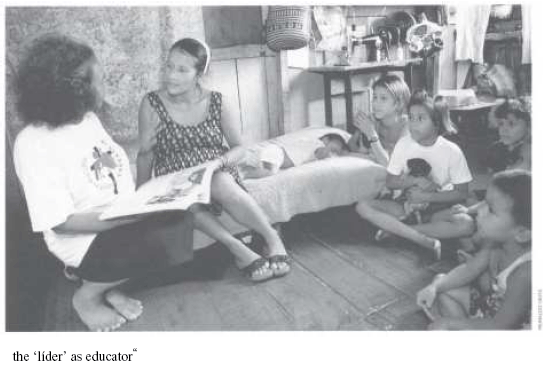
The notion of "promotion of women" is one way of viewing the actions of the 'líderes' that legitimizes the Pastoral da Criança and emphasizes the difference and the social distance between its formulators and idealizers – members of Catholic "leadership" and, principally, the physician founder of the Pastoral da Criança – and the 'líderes'. The narrative that this doctor offers of her performance in the Pastoral shows how much she perceives herself as educator of the women who become 'líderes' – a role to be reproduced and multiplied by these same 'líderes' and the women they attend and their children. In that sense, conditions and social trajectory turn her into a model for female religious performance in the public sector to which the 'líderes' adhere. In her biography, she is characterized as a doctor with"missionary spirit" who goes to the most hidden or socially abandoned places in the country – the northeastern 'sertão', Amazonian jungle, the zones of prostitution on the periphery of the large cities – to teach women "basic methods of health care". In this characterization, the state of ignorance of the women she visits and the change in their lives through access to the information she provides are emphasized. A 'líder', on learning "how fertilization occurred", declared that to be "the happiest day of my life", since she thought she "blew up" because she "washed clothes in the river [...] during the full moon". Her 'happiness' made her climb a tree and choose "the best fruit" to give as a gift to the coordinator of the Pastoral da Criança." The consecration of the civilizing heroine juxtaposed with the uninformed woman who climbs trees and repays with fruit the teachings she received is reinforced by the religious sense of her engagement in the causes of the Pastoral da Criança. A coordinator of the Pastoral was "very moved by so much simplicity" and considers that "the information given with love penetrated deeply the hearts of those people".•
The conception and implementation of the Pastoral da Criança is dependent on the uncommon dispositions that allow certain agents of the Church to mediate between Catholicism and the secular sciences, in this case, medicine.– The creator and coordinator of the Pastoral da Criança is a doctor whose professional path represents as much the influence of her participation in Catholic networks as her performance as administrator of health in the public sector. The Pastoral is the fruit of the reconciliation of her professional competence with the use of religious networks, and of her capacity, acquired along her professional path, for mobilizing different social actors working through the education of mothers and children towards preventative medical actions.
]]> The very relationship of the Pastoral da Criança coordinator to medicine is mediated by Catholicism and by a concept of feminine medical activity. With a strong religious reference in her early socialization (with religious brothers and sisters) and education in Catholic schools, having worked as catechizer, she conceives of her medical activity as care and education. During her medical studies, she volunteered in the "nursing service" in hospitals. "I used to go to the wards and I went to the patients that I judged to be suffering most. When there were no doctors nearby, I hummed for them and I stroked their heads or their hands".— Her piousness removed her somewhat from her curricular activities, since, "when I wanted to study, I was very tired". It is her Christian spirit that assigns new meaning to her medical activity: "I, in the exercise of Medicine, had much more education in the prevention of illnesses than in cures and rehabilitation".˜ Her conception of medicine causes her work in the Pastoral to oppose, on the one hand, religious agents who see the Pastoral da Criança as a kind of social work and herself as a middle class doctor, to doctors and other health professionals such as nurses and administrators, who emphasize the distance between doctors and medicine of the popular classes, alleging that the 'ignorance' and 'life conditions' of the latter block their access to medical knowledge. She, on the other hand, in her medical activity always "explained things well" to the mothers in her practice, and criticizes doctors that don't believe that "poor women", inspired by the "Christian mystique, "help save children's lives". It is from this Catholic concept of medicine made by women – for which this doctor's own mothers constitutes a prime example, since she took in and took care of the sick children of the women of the rural community in which she lived, or taught their mothers to take care of themš – that this doctor brought a series of images related to female attributes into the Pastoral da Criança. The 'líderes' are mothers of the community, who care for each child "as if they were her children"; They are also "practical" nurses or doctors, who utilize "simple methods of treatment". Finally, she and other women with greater academic resources, like the religious women engaged by the Pastoral, are educators who provide the dissemination of knowledge and information to "poor" women.Pastoral da Criança actions permit reflection on the forms of dissemination and reproduction of Catholic ideologies regarding women's feminine condition. The identity that the Pastoral offers is founded on investment in the care and education of the bodies of the women served, which the goal that they define themselves as mothers and as part of a family or as women geared towards the feminine activities of care and education . The appropriation of medicine and the causes of "health" and "life" make such performance completely legitimate, firstly amongst populations without material and academic resources connected to physical well-being, and in a more general way, within "society". It is this legitimacy which reinstates and empowers the Catholic Church in the space where competition over the definition of the feminine condition is carried out, principally in its opposition to and ideological confrontations with feminism.
This paper suggests that support for conceptions of the feminine condition is related to a continuous effort to impose practices directed towards the body. If this statement is valid, gender studies must take into account not only the processes and criteria of differentiation and the relations of power between men and women, but also the agents engaged in the imposition of specific definitions of women's condition and its forms of action.
Bibliographic References
ALVAREZ, Sônia. "Women's Participation in the Brazilian 'Peoples Church': A Critical Appraisal." Feminist Studies, v. 16, n. 2, 1990. p. 381-408. [ Links ]
ANJOS, Gabriele dos. "Mulheres todas santas": participação de mulheres em organizações religiosas e definições de condição feminina em igrejas cristãs no Rio Grande do Sul. 2005. Tese (Doutorado em Sociologia) – Programa de Pós-Graduação em Sociologia, Universidade Federal do Rio Grande do Sul, Porto Alegre. [ Links ]
ARNS, Zilda; PENNA, Dom Aloysio Leal. "Apelo da Pastoral da Criança ao Congresso Nacional em defesa da vida a propósito dos casos de aborto por estupro ou risco de vida para a mãe". Disponível em: <http://www.rebidia.org.br/noticias/saude/aborto.html>. Acesso em: 29 dez. 2005. [ Links ]
ARNS, Zilda. "Plebiscito para o aborto". Disponível em: <http://www.pastoraldacrianca.org.br>. Acesso em: 29 dez. 2005. [ Links ]
"BISPOS fazem firme declaração em defesa da vida". Disponível em: <http://providaanapolis.org.br/bisfazfi.htm>. Acesso em: 29 dez. 2005. [ Links ]
BOLTANSKI, Luc. As classes sociais e o corpo. Rio de Janeiro: Graal, 1979. [ Links ]
BROLHANI, Cristina Aparecida. Uma reflexão sobre a influência da Igreja Católica na sexualidade de mulheres participantes da Pastoral da Criança. Brasília, 2006. Texto não publicado. [ Links ]
BURDICK, John. "Gossip and Secrecy: Women's Articulation of Domestic Conflict in Three Religions of Urban Brazil." Sociological Analysis, v. 50, n. 2, 1990. p. 153-170. [ Links ]
"CNBB mantém pressão contra aborto". Disponível em: <http://www.pime.org.br/pimenet/noticias2005/noticiasbrasil189.htm>. Acesso em: 29 dez. 2005. [ Links ]
"CNS apóia aborto para anencéfalo". Diponível em: <http://noticias.cardiol.br/listanotsql.asp?P1=186736>. Acesso em 29 dez. 2005a. [ Links ]
"CNS adia debate sobre aborto de anencéfalo". Disponível em: <http://www.conasems.org.br/mostraPagina.asp?codServiço=11&codPagina=2138>. Acesso em 29 dez. 2005b. [ Links ]
DELLA CAVA, Ralph. "Política a curto prazo e religião a longo prazo: uma visão da Igreja Católica no Brasil (em abril de 1978)". In: RIBEIRO, Darcy et al. Encontros com a Civilização Brasileira. Rio de Janeiro: Civilização Brasileira, 1978. p. 242-258. [ Links ]
______. "A Igreja e a abertura, 1974-1985". In: STEPAN, Alfred (Org.). Democratizando o Brasil. Rio de Janeiro: Paz e Terra, 1988. p. 231-273. [ Links ]
______. "Transnacional Religions: The Roman Catholic Church in Brazil and the Orthodox Church in Rússia." Sociology of Religion, Winter 2001. Disponível em: <http://www.findarticles.com/p/articles/mi_m0SOR/is_4_62/ai_82477980>. Acesso em 8 ago. 2003. [ Links ]
DROGUS, Carol. "Reconstructing the Feminine: Women in São Paulo's CEBs." Archives des Sciences Sociales des Religions, n. 71, p. 63-74, juil.-sept. 1990. [ Links ]
ELIAS, Norbert. O processo civilizador: uma história dos costumes. 1. ed. Rio de Janeiro: Zahar, 1990. [ Links ]
FORMAÇÃO DE VOLUNTÁRIOS. "Pastoral da Criança: venha fazer parte desta rede de amor e solidariedade!" Curitiba, agosto 2005. [ Links ]
FOUCAULT, Michel. "Omnes et singulatim: hacia una critica de la 'razon politica'". In: FOUCAULT, Michel. Tecnologías del yo y otros textos afines. Barcelona: Paidós, 1990a. p. 95-140. [ Links ]
______. "Tecnologias del yo". In: FOUCAULT, Michel. Tecnologías del yo y otros textos afines. Barcelona: Paidós, 1990b. p. 45-94. [ Links ]
GOUDSBLOM, Johan. "Les grandes épidémies et la civilisation des mœurs". Actes de la Recherche en Sciences Sociales, n. 68, p. 2-14, juin 1987. [ Links ]
GRIGNON, Claude. "Sur les relations entre les transformations du champ religieux et les transformations de l'espace politique". Actes de la Recherche en Sciences Sociales, n. 16, p. 3-34, 1977. [ Links ]
GROSSI, Miriam Pillar. "Féminismes et nouvelles générations politiques des années 90 au Brésil". Cahiers du CEDREF, v .6, p. 169-190, 1996. [ Links ]
HAHN, Aloïs. "Contribution à la sociologie de la confesión et autres formes institutionnalisées d'aveu: autothématisation et processus de civilisation". Actes de la Recherche en Sciences Sociales, n. 62-63, p. 54-68, 1986. [ Links ]
HEWITT, W.E. "Religion and the Consolidation of Democracy in Brazil: The Role of the Comunidades Eclesiais de Base (CEBs)". Sociological Analysis, v. 50, n. 2, p. 139-152, 1990. [ Links ]
JOÃO PAULO II. "Carta às mulheres". SEDOC, n. 252, p. 130-139, 1995. [ Links ]
LOYOLA, Maria Andréa. "Cure des corps et cure des ames: les rapports entre les médecines et les religions dans la banlieue de Rio". Actes de la Recherche en Sciences Sociales, n. 43, p. 3-45, 1982. [ Links ]
MACHADO, Maria das Dores C.; MARIZ, Cecília L. "Mulheres e prática religiosa nas classes populares: uma comparação entre as igrejas pentecostais, as Comunidades Eclesiais de Base e os grupos carismáticos". Revista Brasileira de Ciências Sociais, v. 12, n. 34, p. 71-87, 1997. [ Links ]
MAINWARING, Scott. Igreja Católica e Política no Brasil 1916-1985. São Paulo: Brasiliense, 1989. [ Links ]
"MINISTÉRIO DA SAÚDE lança política nacional que amplia acesso ao planejamento familiar". Disponível em: <http://portal.saude.gov.br/portal/aplicacoes/noticias/noticias_detalhe.cfm?co_seq_noticia=13728>. Acesso em: 29 dez. 2005. [ Links ]
MUEL-DREYFUS, Francine. Vichy et l'éternel féminin. Paris: Seuil, 1996. [ Links ]
NEUMANN, Zilda Arns. "Pastoral da Criança: uma experiência consagrada". Cadernos Adenauer: Fé, Vida e Participação, São Paulo, n. 9, p. 83-98, nov. 2000. [ Links ]
______. Zilda Arns Neumann: ela criou uma rede de solidariedade que salva centenas de milhares de crianças brasileiras. Belo Horizonte: Leitura, 2003. Depoimento. [ Links ]
OLIVEIRA, Fátima. "Aguarde mais peripécias de um sobrevivente das Torres Gêmeas". Em: <http://www.afirma.inf.br/textos/2005_severino_cavalcanti.rtf>. Acesso em 29 de dez. de 2005a. [ Links ]
______. "Desinformação ameaça democracia e Estado laico". Em: <http://observatorio.ultimosegundo.ig.com.br/artigos.asp?cod=352OFC004>. Acesso em 29 de dez. de 2005b. [ Links ]
PASTORAL DA CRIANÇA. Pastoral da Criança: a serviço da vida e da esperança – 10 anos. Curitiba: s.n., 1993. [ Links ]
______. A paz começa em casa: como trabalhar as relações humanas para prevenir a violência contra a criança no ambiente familiar. Curitiba: Pastoral da Criança, 1999. [ Links ]
______. Guia do líder da Pastoral da Criança. 8. ed. Curitiba: s.n., 2004. [ Links ]
______. "Moção de apoio aos que defendem a vida". Disponível em: <http://www.pastoraldacrianca.org.br>. Acesso em: 29 dez. 2005. [ Links ]
Received in March 2006 and accepted for publication in September of 2006
1 See, for example, JOÃO PAULO II, 1995.
2 According to Francine MUEL-DREYFUS, 1996, p. 336. I thank Claudia Fonseca for suggesting the analytical problem springing from the material on which this text is based, which allows a deeper examination of the theme outlined in my thesis, and for her critique and suggestions of the same. ]]>
3 According to the Catholic doctor, founder and coordinator of the Pastoral da Criança, whose insertion in the Church is tied to her origin in a traditional Catholic family, her education in Catholic schools and her engagement in activities geared towards a religious formation, as catechism.. It was the existence of a Catholic social milieu geared towards the institution of Church– evidenced in its relations of friendship and connection, with five of her twelve siblings religious and one of them a bishop – which made it possible for her, without being a nun and having secular training to act in religious spaces, her performance in the church and as part of the Church. See Zilda Arns NEUMANN, 2000, p. 83-84; PASTORAL DA CRIANÇA, 1993, p. 7.
4 According to ARNS, 2005.Also NEUMANN, 2003, p. 118.
5 As the women engaged by the Pastoral da Criança are called.
6 Relation which assumes vigilance on the part of the director of conscience and complete revelation and heteronymy on the part of the individual. According to Aloïs HAHN, 1986, p. 65, e Michel FOUCAULT, 1990a, p. 115-116.
7 Diverse brochures, journals, books and texts produced by or about the Pastoral da Criança about the scope of the Church
8 The existence of this amalgam is observed in another study about the Pastoral da Criança: see Cristina Aparecida BROLHANI, 2006, p. 1 e p. 5-6.
9 FOUCAULT, 1990b, p. 48.
10 HAHN, 1986, p. 54.
11 According, for example, to, Maria das Dores C. MACHADO and Cecília L. MARIZ, 1997; John BURDICK, 1990; Sônia ALVAREZ, 1990.
12 Through the considerations of Aloïs Hahn methods of confession in HAHN, 1986, p. 54. ]]>
13 HAHN, 1986, p. 58.
14 According to HAHN, 1986, p. 55.
15 HAHN, 1986, p. 66.
16 Norbert ELIAS, 1990, p. 266-267; see also Johan GOUDSBLOM, 1987, p. 3-4.
17 Without negating the efficacy of such rules of hygiene, what these authors emphasize is the primacy of eminently social processes which determine the use of those rules.
18 PASTORAL DA CRIANÇA, 2004, p. 37.
19 PASTORAL DA CRIANÇA, 2004, p. 68.
20 PASTORAL DA CRIANÇA, 2004, p. 69.
21 PASTORAL DA CRIANÇA, 2004, p. 71.
22 PASTORAL DA CRIANÇA, 2004, p. 77. ]]>
23 PASTORAL DA CRIANÇA, 2004, p. 76.
24 Photo of Rodolfo Bührer in PASTORAL DA CRIANÇA, 2004, p. 115.
25 PASTORAL DA CRIANÇA, 2004, p. 57.
26 PASTORAL DA CRIANÇA, 1999, p. 55.
27 ELIAS, 1990, p. 266-267; GOUDSBLOM, 1987, p. 3-4.
28 See PASTORAL DA CRIANÇA, 2004, p. 29 and 102, and also PASTORAL DA CRIANÇA, 1999, p. 21.
29 PASTORAL DA CRIANÇA, 2004, p. 109.
30 PASTORAL DA CRIANÇA, 2004, p. 134.
31 PASTORAL DA CRIANÇA, 2004, p. 55.
32 According to HAHN, 1986, p. 66. ]]>
33 About this action see Scott MAINWARING, 1989; Ralph DELLA CAVA, 1978 and 1988.
34 According to DELLA CAVA, 2001; MAINWARING, 1989; W. E. HEWITT, 1990.
35 As was verified in the research paper, "struggle" it is a polysemic category which may signify the search for rights in relation to the State. In this case, it is much linked to the work of progressive religious agents, and is also an inherent part of the life conditions of the lower classes, as in the phrase "to be brave and face up to difficulties" (See Gabriele dos ANJOS, 2005, p. 199). Drogus identified a similar use of "struggle" amongst women of CEBs with whom she was engaged in research. (see Carol DROGUS, 1990, p. 68).
36 PASTORAL DA CRIANÇA, 1993, p. 8-9.
37 PASTORAL DA CRIANÇA, 1993, p. 8-9.
38 PASTORAL DA CRIANÇA, 1999, p. 52.
39 PASTORAL DA CRIANÇA, 1999, p. 51.
40 See the expressions regarding the work of the Pastoral da Criança in NEUMANN, 2003, p. 89.
41 The Ministry of Health and Education, the Lions Club and the Communications network Rede Globo are among the list of Pastoral da Criança partners, according to NEUMANN, 2003, p. 93.
42 In NEUMANN, 2003, p. 81. ]]>
43 Regarding the use of medical vocabulary in proposing explanations and solutions for social crisis and their effects on a policy of definition of the female condition,see MUEL-DREIFUS, 1996, p. 289-356.
44 See ARNS, 2005.
45 In Zilda ARNS and Dom Aloysio Leal PENNA, 2005.
46 See MUEL-DREYFUS, 1996, p. 292 and passim.
47 PASTORAL DA CRIANÇA, 2004, p. 83.
48 According to Miriam Pillar GROSSI, 1996, p. 180.
49 This organ is responsible for deliberating other policies of the national health system, Sistema Único de Saúde and accompanying the implementation of the Health Ministry budget. The creator and coordinator of the Pastoral da Criança is a member of this council, participating therein as a member of the CNBB, the Intersectoral Commission on Women's Health (Comissão Intersetorial de Saúde da Mulher). The coordinator of the Pastoral da Criança' investment against abortion and "for life" at this council is described in a negative form by a feminist opposed to the positions of the coordinator which has led her to criticizes her presence at the CNS; in her view, the founder of the Pastoral da Criança "has occupied this place for many years, unduly, although legally, in the name of the CNBB [...] a vacancy that should be left for religious representatives in the CNS". See: Fátima OLIVEIRA, 2005a.
50 CNS…, 2005a.
51 According to MINISTÉRIO DA SAÚDE…, 2005.
52 This declaration was written on the 16 of August,2005, during the 43ª General Assembly of the CNBB. Consult BISPOS..., 2005. ]]>
53 The opposition of the Pastoral da Criança to feminist positions is made clear in the thoughts of a feminist who is a medical doctor, executive secretary of theFeminist Health Network, member of political coordination of the Jornadas pelo Direito ao Aborto Legal e Seguro [Struggles for the Right to Legal and Safe Abortion] regarding the coordinator of the Pastoral da Criança and her actions against the bill [Projeto de Lei] which would decriminalize abortion. According to this feminist, the coordinator of the Pastoral da Criança, "a person more powerful than the majority of the bishops of the CNBB", and "in Brazil the only woman heard opening her mouth to speak in the name of the official church". In her view,the coordinator's manifesto against abortion adopts a "posture of infantilizing" (or is one of disdain for) women and pretends that women don't have abortions". See OLIVEIRA, 2005b.
54 According to CNS…, 2005a and 2005b.
55 According to CNBB…, 2005.
56 They are: Plebiscite for abortion (ARNS, 2005); Appeal of the Pastoral da Criança to the Congresso Nacional in defense of life with regard to cases of abortion due to rape or risk to the life of the mother (ARNS and PENNA, 2005); a Motion to help those who defend life (PASTORAL DA CRIANÇA, 2005).
57 From considerations regarding a form of exercise of power that Foucault calls –with no apparent relation to the Pastoral da Criança – "poder pastoral" (FOUCAULT, 1990a, p. 98 e 111).
58 NEUMANN, 2003, p. 75.
59 FORMAÇÃO DE VOLUNTÁRIOS, 2005, p. 10.
60 Photo of Reinaldo Okita in PASTORAL DA CRIANÇA, 2004, p. 37.
61 See NEUMANN, 2003, p. 87.
62 NEUMANN, 2003, p. 87. ]]>
63 On the agents of the Catholic Church , bearers of "a unique habitus" and their role in the renewal of Catholic ideas, see Claude GRIGNON, 1977, p. 20.
64 NEUMANN, 2003, p. 37.
65 NEUMANN, 2003, p. 40.
66 On how doctors perceive the possibilities for the popular classes to obtain access to and appropriate of medicine, see Luc BOLTANSKI, 1979, p. 44-45, and Maria Andréa LOYOLA, 1982, p. 6-8.
67 See NEUMANN, 2003, p. 23.