Diferenças regionais e o êxito relativo de mulheres em eleições municipais no Brasil
Luis Felipe Miguel; Cristina Monteiro de Queiroz
University of Brasília
Translated by Rita Ávila
Translation from Revista Estudos Feministas, Florianópolis, v.14, n.2, p.363-385, May/Sept. 2006
]]>
ABSTRACT
Why do women achieve better performance in economically underdeveloped regions in Brazilian local elections? This paper examines three possible explanations that have been suggested in debates regarding the issue: 1) the association of female candidates in these regions with right-wing parties; 2) the educational gap that benefits them; and 3) the greater number of women in the constituency. However, the data analysis leads to a rejection of all the above hypotheses, which indicates a need for further and more complex explanations for the phenomenon. The data also allows a better view of the limitations in the electoral quotas for women in the Brazilian legislation.
Key Words: gender and electoral participation; regional differences; local election; Brazilian policies.
RESUMO
Por que, nas eleições locais brasileiras, as mulheres apresentam um desempenho melhor nas regiões economicamente menos desenvolvidas? O artigo testa três possíveis respostas, eventualmente sugeridas nos debates sobre a questão: 1) a associação das candidatas dessas regiões com partidos de direita; 2) o gap educacional que as beneficia; e 3) a maior presença de mulheres no eleitorado. A análise dos dados, entretanto, leva à rejeição de todas essas hipóteses, concluindo-se que são necessárias explicações mais complexas para o fenômeno. Os dados permitem, também, observar as limitações da legislação brasileira de cotas eleitorais para mulheres.
Palavras-chave: gênero e participação eleitoral; diferenças regionais; eleições locais; política brasileira.
In a number of countries, among which is Brazil, women's political representation has become a highly significant issue over the past decades. At least half a century after conquering the right to vote, women still occupy a noticeably reduced portion in positions of power. Mainly after the 1970's, the feminist movement succeeded in showing that such an absence signaled a problem – not a confirmation of women's supposedly feeble inclination towards participating in public life, but rather as a symptom of exclusion, structurally based, that should be opposed.
]]> The endeavor towards a greater presence of women in decision-making spaces is inserted within a broader movement, which identifies, as one of the decisive hindrances to contemporary democracies, the political sub-representation of specific social groups. The governing body, in relation to the overall population, tends to be much more male, better educated, wealthier and whiter – an observation that goes for Brazil and for Western democracies in general. The expansion of the electoral franchise, with new groups such as women themselves, workers and illiterates being incorporated to political citizenship, did not substantially alter the situation. As Anne Phillips observed, it is not enough to do away with barriers to inclusion, as in the liberal model: it is necessary to explicitly incorporate the marginalized groups into the political body.1Defending the political relevance of social groups leads to a rupture with the abstract individualism that marks liberal thought (and, by means of it, the constitutional ordainment of Western democracies). The rupture with this tradition will be theoretically buttressed by a myriad of thinkers, who nonetheless range from those who extol group difference, foregoing any unifying perspective, such as Iris Marion Young, to those who pursue a commitment with civic republicanism, stressing the need for people to be aware of the limits of their own positions in the face of "the broader community to which we ultimately belong," a position upheld by Anne Phillips herself.2
Once the problem had been admitted, many states (first in Europe, then throughout the world) began to adopt policies that would expand the presence of subaltern groups in the representative sphere – mainly for women, given that biological sex is taken as a dichotomical and unequivocal variable, without ambiguities, eliminating the polemics concerning the beneficiary groups' frontiers (as with race, color, class, income). The most important measures involved the adoption of electoral quotas, entailing a minimum reserve of a determined contingent of women's candidatures.
There is a clear link between this perspective and that which, in her classic study, Hanna Pitkin describes (and criticizes) as "descriptive representation," which conceives parliament as a sort of map, which yields a perfect, albeit reduced, image of society. Hence, what representatives do is not as important as who they are; and one valuable aspect of political representation, the responsiveness of the elected towards their electors, is overlooked.3 In defending what she chooses to call "politics of presence" from Pitkin and others, Anne Phillips admits that she is driven by the deception with the expected responsiveness of representatives, which fails to protect minorities.4
According to what has been shown by the vast literature, quota efficacy is strongly associated with the electoral system. Firstly, the very feasibility of implanting quotas is denied in countries where the majority vote is adopted (uninominal circumscription), in which parties launch a single candidature per opening.
Moreover, even in countries that adopt forms of proportional representation, there are relevant peculiarities in the electoral system. Thus, it is important to consider the magnitude of circumscription. The general rule is: the bigger they are, the more efficiently the quotas will translate into seats in parliament.5 The most important element, however, is the nature of the list: whether it is open or closed. Closed, or blocked lists, – which do not allow the constituency to alter the order of the candidates – tend to produce a mechanical transfer of the proportion of women candidates to the proportion of women in parliament. In Argentina, for example, where the list is closed, the adoption of a 30% quota for women on party lists allowed the 5% female representation in the House to soar to almost 27%.6
Wherever lists are open, legislation is able to overcome only the initial barrier, which, from within the parties, prevented women from being launched as candidates. But the widespread discrimination among male and female voters has yet to be overcome, as it portrays the woman as being dislocated within the political sphere, outside her ‘natural' surroundings, thereby reducing her chances of being elected.
In the case of Brazil, additional difficulties due to the fragility of the quota legislation have accrued to problems inherent in the list system. Electoral quotas for women in Brazil were introduced according to law number 9100 of 1995, which regulated elections for city government and Municipal Chambers. Law no. 9504 of 1997, which regulated state and federal elections, extended the principal to the dispute for State Legislative Assemblies and for Congress (Chamber of Federal Deputies). Law no. 9100 determined that 20 % of the openings for town councilors were to be filled by women; law no. 9504 increased this number to 30%, a proportion upheld in all subsequent elections, both at the municipal as well as the state and federal levels.
However, this did not alter the fact that the openings for women are facultative, that is, parties may either fill them with female candidates or leave them open. In all elections carried out under the system of quotas, the effective percentage of women running, in the great majority of lists, was inferior to what was established by law. Furthermore, the legislation, in determining the reserve of openings, actually increased the total candidatures on each list. In other words, openings for women did not represent a decrease in the number of male candidates. Finally, the law is neglectful as to the distribution of campaign resources – among these, the time of exposition in party coverage on radio and TV, a crucial element in Brazilian elections –, which remains, by and large, monopolized by male candidates.
From the perspective of this paper, it is of utmost importance to address a highly relevant question, which is highlighted especially in studies on majority systems in Brazil, as well as in other countries where open lists are adopted: what leads the electorate to vote or not to vote for women?
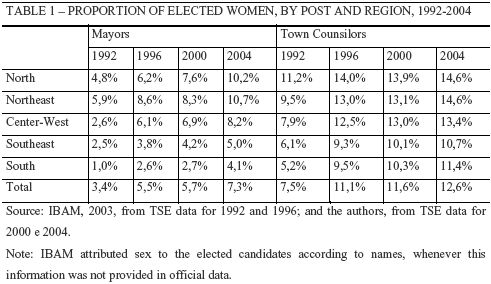
]]> Common sense and many studies on this issue have established a positive linear relation between level of development – be it either economic development or "human development" – and the feminine presence in spheres of representation: "world data on women in politics reveals a co-relation between the level of human development and the proportion of women in parliament and as ministerial workers."7 The driving force is modernization, understood as the process whereby traditional societal standards are surpassed, opening new spaces to women, previously obstructed, and politics would be one of them.However, the results of Brazilian municipal elections defy this rule. An analysis of three disputes that took place under the quota legislation (1996, 2000 and 2004) shows that the performance of women candidates is significantly superior in the less developed regions. The North, Northeast and the Center-West regions, being less educated and with worse social indicators, will always elect a higher proportion of women than the more developed Southeast and the South.8 It is not a tendency brought on by the quota policies, given the fact that the 1992 elections, previous to the reserves of candidatures, had produced similar results. Table 1 reveals an evolution of the overall picture, with quotas producing a rise in the number of elected town councilors – 3.6 percentual points within 1992 and 1996, with expressive growth in the subsequent rounds. There has also been an increase in the number of elected female mayors, which cannot be attributed directly to legislation, but which may reflect an expansion of the political feminine capital due to the reserves of openings. Such trends are quite noticeable throughout the regions in the country, notwithstanding the fact that the impact of the quotas has been more relevant wherever the proportion of elected women is smaller. Just as an example, in the Southern region, the percentage of female town councilors (vereadoras) grew 82.7% from 1992 to 1996, and over 20% in the following two elections, whereas in the Northern region, it increased 25% from 1992 to 1996 and another 4.3% in subsequent elections. But even if there has been a decrease, the disparity among the more and the less developed regions continues to be significant.
If before 1996 part of the difference in town councilor elections could be explained by the number of candidatures – with a higher proportion of female candidates in the North, Northeast and Center-West –, in 2000 and 2004 this factor had disappeared. Women made up 19.1% of the total number of candidates in 2000 and 22.1% in 2004, without any significant difference among the regions. (The distance remains, however, whenever the focus is on candidatures for mayor; in 2004, women totaled no more than 5.9% of candidates in the South and 7.9% in the Southeast, but exceeded 10% in the other three regions.) With no difference in the proportion of candidates, the bigger number of females elected reveals disparities in the success rate of women according to region.
A previous study concerning elections for the Federal Chamber showed that women's and men's success rates – calculated as the proportion of elected candidates divided by the total number of candidates – was very similar, but introducing quotas changed the situation.9 Although legislation does not demand that quotas be filled, the reserve of openings did lead many women to run in elections even without electoral viability. Hence, women's success rate plummeted to much lower levels than men's. On the other hand, the average success rate is inversely proportional to competitiveness in the electoral process. Both for women as well as for men, it is more difficult to win in large districts, where there will be a greater number of organized parties and running candidates. In other words, the mere indication that women's success rate is smaller in the Southeast than in the North, for example, says nothing about the specificity of women candidates in either region, given that it is a mere effect of the elections being, on average, more contentious in Southeastern than in the Northern municipalities.
Thus, in order to assess the weight of gender in electoral competitiveness, the feminine success rate ratio was created, calculated as the rate of feminine success divided by the rate of male success. Above 1 indicates that women were more successful than men, whereas below 1 indicates that their success was inferior to that of men, zero being the lowest possible number. Table 2 shows that, despite women's success being always inferior to men's, as already expected, the difference is greater in the Southeast and South regions. That is, the difference between male and female electoral competitiveness increases in the more developed regions of the country.
]]>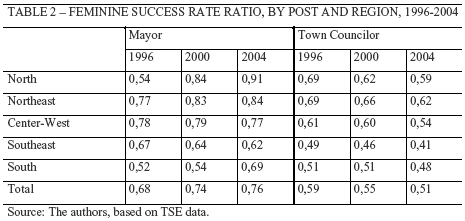
Here, and throughout the study, it is necessary to keep in mind that the numbers are not entirely reliable for the 1996 elections, considering that the TSE database has no information regarding the sex of 37.4% of the candidates. The problem is even worse in the South and Southeast regions, where roughly 45% of the candidates are not identified for sex. In the 1996 relative figures, candidates with no identification for sex were removed from the database, but were maintained for the 2000 and 2004 figures, since they were insignificant in number and did not affect the results. The absence of a query for "sex" on databases for candidates running for elections prior to 1996, in turn, prevented compiling the index for the 1992 elections.
As a general trend in the three elections analyzed, the feminine success rate ratio will increase in the elections for mayor and decrease in the elections for the town councilor chamber. It is worth pointing out that, especially in the less populated regions, the number of women candidates for mayor is significantly reduced and, therefore, the small number of results has a great impact on the feminine success rate and thereafter, on the above mentioned index. This trend ought to be interpreted cautiously.
In all elections, the contention for seats in the Municipal District Chambers, the feminine success rate ratio is remarkably superior in the North, Northeast, and Center-West regions; the pattern is repeated in elections for mayor, except for the North region in 1996. It is clear that, despite the persisting significant difference, in municipal elections in these regions, women come closer to men's electoral competitiveness levels
"Municipal elections" must be highlighted, given that the relative success of women in these regions will not necessarily be repeated at other levels of government. Table 3 indicates that, in the last four elections – two of them prior to the introduction of reserves for openings –, the Northeast elected a smaller percentage of women to the Federal Chamber than any other region.
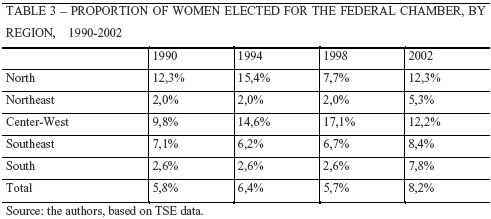
The feminine success rate ratio for the Federal Chamber is also always inferior in the Northeast – rising from 0.25 in 1990 to 0.49 in 2002, whereas the figure for the entire country was 0.95 in 1990 and 0.69 in 2002.10 With regard to the Legislative Assemblies, however, the only constant is the low proportion of women deputies in the Southern region. The Southeast renders the highest percentages in 1994 and in 2002; in 1998 it remains below the national average, with the Northeast in first place.11 That is: constraints to women's electoral success appears to be different, according to the post being attempted throughout the many Brazilian regions.
In regard to municipal elections, the focus of attention in this paper, the data confirm that there is a phenomenon to be elucidated. Contrary to what would be reasonable to assume, disputes for mayor and town councilor in Brazil yield better chances for women to win in less developed regions. It is possible to identify three hypotheses to explain the phenomenon. Because the explanations, whenever the problem is debated, are more often suggested than explicitly presented, the hypotheses will be developed here, and will be tested in the sections that follow.
The Traditional Politics Hypotheses
In the more backward regions, traditional standards of politics are practiced, entailing family-based and clientele politics. These are standards known to open certain spaces to women, who would eventually be elected not for their personal accomplishments or their associations with movements in civil society, but rather as representatives of their family clans. While analyzing 1998 election results for the Chamber of Deputies, Araújo identified a situation congruent with this hypothesis:
among the right- and center-wing parties, the election of women continues to predominate in the North and Center-West regions, usually buttressed by family bonds. The left predominantly elects candidates that represent associative movements, and this takes place mainly in the Southern and Southeastern states.12
This citation – which, it is worth repeating, does not refer to municipal elections, nor aims for generalizations, but only interprets the results for Federal Chamber elections – indicates only a differentiated profile of the elected women according to parties and regions. For the purpose of completing the argument that supports this hypothesis, it is necessary to explain the superior competitiveness of women contending for center and right-wing parties in less developed regions. One possibility is to assume that the female constituency's alleged bias for the right end of the political spectrum will be reproduced come the moment of the electoral dispute.
The feminine bias toward the more conservative parties has been observed for a long time by scholars, despite being defied by more recent studies. Based on data from 60 countries in the World Values Surveys project, Inglehart and Norris have identified a transformation in women's political bias: after 1990, women began to favor political positions to the left of men's preferences. Yet, the "modern gender gap," as they label it, is only observed in industrialized countries in Western Europe and North America. The post-communist world and the Third World render mixed results or the perpetuation of the "traditional gender gap," in which women are more conservative than men. The authors attribute the result to the "modernizing process."13
In believing this theory; women from the less developed regions in Brazil would remain confined to traditional standards of preference for the conservative parties. This affinity somehow affects the recruiting process of the political elite.
]]> The Hyperqualification HypothesisWomen, like members of other subaltern groups, on entering into the dispute for positions of power and prestige, find themselves pressed to compensate for the negative preconceptions they suffer upon displaying superior qualifications. Female hyper-qualification – in reference to women whose average educational background is above men's in similar positions – is detected within different social spaces, among which is politics.
Some studies indicate that the problem is mainly located at the level of women's introjections of preconceptions, which would determine that their level of political ambition be inferior to men's.14 Since the predisposition to dispute public posts increases in pace with education, a stronger educational background would have to make up for the negative gender bias. Academic diplomas would serve as a certificate, even for women themselves, of their competence to enter onto the political arena. (It is obviously doubtful, in this context, to speak of "ambition" or "predisposition for dispute." Women may compete less if they know their chances are smaller. Thus, the argument allows, but does not require, the introjections of the prejudice.)
Less education on average in the North, Northeast and Center-West regions would tend to amplify the weight of instruction level in electoral disputes, given the fact that scarcity enhances the value of each diploma. The positive effect of schooling would compensate for the negative gender bias and would open a window of opportunity for the more instructed women.
In addition, although there are more women than men enrolled in high school and college level courses throughout Brazil, the difference is noticeably sharper in less developed regions. According to the 2003 higher education data from the National Institute for Educational Studies and Surveys (Instituto Nacional de Estudos e Pesquisas Educacionais – INEP), the difference in enrollments in favor of women reached 10.7% percentual points in the South, 11 in the Southeast, 13.6 in the Northeast, 19.9 in the Center-West and 21.2 in the North.15 This reinforces the hypothesis that better qualification would accredit women candidates in the eyes of the electorate in these regions.
The Demographic Hypothesis
Although it is known that women themselves are not immune to gender prejudice, mainly the sort that would distance them from political life, some studies posit that female voters tend to vote for female candidates. Smith and Fox, based on surveys carried out in the United States, state that women prefer to vote for women, a tendency that is stronger in voters with a higher educational background, but that also exists in others.16 There is some controversy as to the reliability of this conclusion, given that there is data to the contrary, some produced by the same authors.17
Should it be accepted that female electors benefit female candidates, a portion of the difference in performance among regions might be explained by the sex distribution in the population. As it is known, there is an internal migratory pattern in Brazil, mainly from the Northeast to the Southeast direction, predominantly male – typically, the man migrates in search of better job opportunities, promising to bring the family as soon as he has established himself. In many Northeastern municipalities, there is a deficit of adult males – and, therefore, a more feminine electorate. This hypothesis states that women would win elections more easily in such municipalities.
In order to test this hypothesis, two models of regression were elaborated aiming to associate the number of elected female town councilors in each municipality with the proportion of women in the population and with the proportion of women in the constituency. Because the number of seats in the Town Council Chamber (Câmara de Vereadores) is defined by the magnitude of the municipality, a spurious positive correlation would be likely to emerge: wherever there are more women, there will be more women councilors, simply because there will be more openings to be filled, without any increase in feminine electoral competitiveness. In order to avoid the problem, the models were applied to percentuals – of women in the municipality, of women in the electorate and of elected women councilors.
]]> Gender and Ideological Spectrum
In order to test the first hypothesis, which affirms a bias to the right among the elected women in less developed regions, the distribution of candidates and of winners was observed, according to the variables sex, region and ideological slant. Given that it is not viable to define the self-attributed or imputed ideological position of each councilor or mayor elected in Brazil between 1996 and 2004, let alone of the candidates, the solution was to adopt the procedure, current in Brazilian political science, whereby parties are grouped according to their location on the right, center and left of the spectrum. Such a procedure implies a noticeable simplification, leveling out the internal differences within the parties, which are often quite deep, and ascribing them with more coherence than they actually possess. It is imposed, however, on account of practicality.
The parties were distributed on a left-right axis, following the usual distribution in literature.18 On the "left" were PT, PDT, PSB, PPS, PCdoB, PV, PMN, PCB, PSTU and PCO; in the "center", PMDB and PSDB; on the "right", PFL, PPB/PP, PTB, PL PRONA and all the other microparties. Attributing ideological position to the smaller platforms is more difficult since many play the role of a mere outlet for candidates who have no space in any other major party, or any programmatic orientation. Their impact on the overall figure, however, is small, since they are not organized in most of the municipalities and, wherever they do run, their lists are quite reduced.
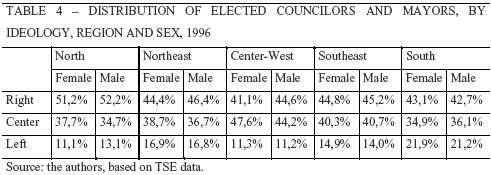
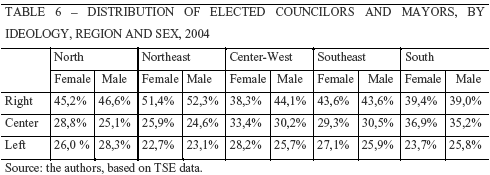
To confirm the hypothesis, there would have to be a smaller proportion of elected leftist women in the North, Northeast and Center-West regions. However, the data, summarized in Tables 4, 5 and 6, do not corroborate this prediction.
]]>
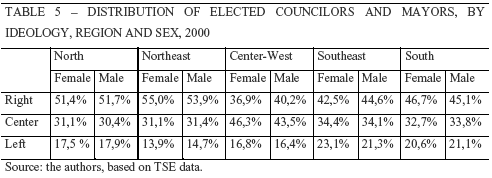
In 1996 there is no region showing any tendency whatsoever to differentiate the distribution of elected men and women on the ideological spectrum. In the Northern region, among women, there is a smaller percentual of elected leftist candidates as compared with men, but the situation is slightly inverted in the Northeast and the Center-West. And, if the North and the Center-West present a smaller proportion of elected left-wing mayors and councilors – though this goes for both sexes –, the Northeast has slightly higher percentages than the Southeast.
The results for the 2000 elections show significant changes. An expressive growth is seen for the left in the North and Southeast regions, mainly at the expense of the center parties; in the Center-West, the left also grows, but now at the expense of the right. In the Northeast, the right is strengthened, with a drop in the percentages of winners in the other two positions; and in the South, with a reasonably stable left, the center loses space in favor of the right. All of these movements affect both women and men equally. Although the greater presence of the left in the South and Southeast is very well established in 2000, the relation with the variable sex does not emerge in the data analysis.
The year 2004 sees the growth of the left throughout the country – a reflection of the presence of PT in the Federal Government. Since this growth was bigger in the North, Northeast and Center-West, regional differences were hardly apparent. Once again, data for men and women are on a par. In sum, in the three elections under analysis, in any region, sex does not contribute in predicting an elected mayor's or councilor's ideological position.
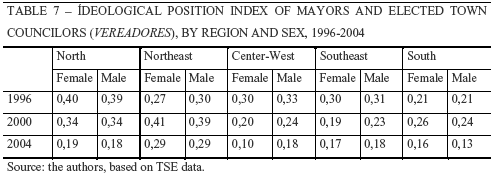
A new index allows the data on the previous tables to be summarized, so that the situation can be more clearly visualized. With the distribution of the parties – and hence their mayors and councilors – on the ideological spectrum, an ideological position index was constructed for the winners. A value of +1 is attributed to each elected right-wing candidate, 0 to the elected center candidates and -1 to elected left-wing candidates. Next, the average is calculated. The index for the ideological position will thus sway between +1, when all candidates are on the right, and -1, when all are on the left.
]]> Table 7 shows the evolution of the ideological position for men and women over the three elections. A general evolution of a right to left movement is seen for both males and females. The association between women and political conservatism does not hold; rather, there is a greater propensity to men's indexes – while the smaller differences do not follow a simple pattern. In five cases, women are seen to occupy positions slightly to the right of men, but the difference is never above 0.03. Three cases show an identical index and in seven others, women stand slightly to the left, with a more significant difference of 0.08 in the Center-West, in 2004.
Finally, it is possible to analyze the combined impact of region and ideological slant in the feminine success rate ratio – which, as seen above, is calculated as the success rate of female candidates divided by the success rate of male candidates. The hypothesis suggests that the female candidates of conservative parties would achieve a greater success rate, in relation to male candidates, than the female candidates on the left.
Table 8 shows the figures for elections for mayor. With only four exceptions – right-wing parties in the North region in 2000 and 2004, right-wing parties in the Center-West region in 2000, left-wing parties in the Center-West in 1996 –, the ratios remain below 1, that is, women's competitiveness is inferior to men's; in some cases, significantly inferior. In general, but not always, the ratio is smaller to the left and bigger to the right. In other words, in right-wing parties women's competitiveness in disputes for mayor is closer to men's and in left-wing parties, it is farther from men's.
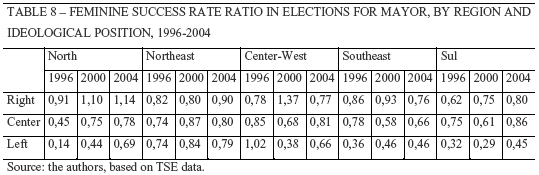
The difference between the regions, in turn, is not univocal. The wider gap between right and left ratios is in the Center-West region, in 2000; in the previous elections, however, this region had a more significant difference in the opposite direction (women's performance on the left being superior to performance on the right). The North region, in the three elections, shows major differences in favor of the right, whereas the Northeast is on the opposite end, with very close ratios in the three positions on the political spectrum.
The figures on Table 9 once again show feminine success rates ratios, but this time in disputes for seats at the Municipal Chambers. It is evident, firstly, that ratio fluctuation is much smaller than on the previous table. The limit values are 0.41 and 0.75, with a strong concentration around 0.56, which is both the mean as well as the median of the numbers on Table 9. Once again, this is explained by the number of cases. Because candidates for mayor are few, mainly female candidates, a single victory or defeat will strongly affect the outcome. For the Council Chambers, candidates are in thousands, so that the famous "law" of big numbers comes into practice.
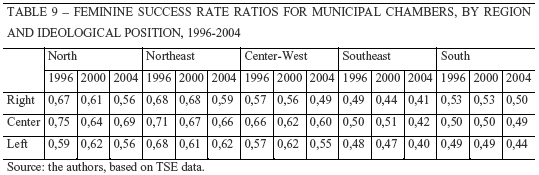
The difference in the feminine success rate ratios for councilors is in general insignificant, regardless of the focus of comparison – for ideological positions, for elections. Among all the regions, there is a consistent tendency towards smaller ratios in the South and Southeast, compatible with the fact that they elect fewer women, but the phenomenon is noticeable throughout the ideological spectrum.
The analysis of the electoral results shows that there is no support for the idea that elected female candidates (in municipal elections) in less developed regions might have a special affinity towards conservative parties. Therefore, the assumption on which the "traditional politics hypothesis" is based is invalidated, and the hypothesis, as a whole, must be deemed incorrect.
]]> Gender and Education
The second hypothesis to be tested here posits that the low average education in underdeveloped regions opens an opportunity for women with advanced schooling to engage in politics. Should a certain population have its educational level assessed – for example, by means of an index of the number of years in school attendance –, it is very likely that the average educational level of candidates will be higher than that of the entire population, that the level of elected candidates will be higher than that of candidates, that the education of winners of more important posts (mayors) will be higher than winners of less important posts (councilors), and that the educational background of female candidates and elected women will be higher than that of male candidates and elected men. The first differences reflect the social value bestowed on formal instruction; the latter, the set of prejudices that lead to women's hyper-qualification.
All of these inequalities in educational background are forecasted by the theory in any situation. In order to affirm that this is apt to lead to a viable explanation for women's unequal success according to the regions in Brazil, it is essential to demonstrate that the gap between male and female candidates' education is greater in the North, Northeast, and Center-West than in the South and Southeast.
The data from the Electoral Justice Department (Justiça Eleitoral) on candidates does not entail the time span they attended school. Rather, they are classified into seven categories, starting with "reads and writes" (given that illiterates are not entitled to run), and following on to "incomplete elementary level", "incomplete high school", "complete high school", "incomplete college", "complete college", the latter being the highest level taken into account. As expected, females' schooling is more thorough than males'. Of all the elected female mayors, 79.5% boasted at least a complete high school level in 1996, 81.6% in 2000 and 89.2% in 2004, whereas for male mayors, the percentuals were respectively 62.3%, 67.9% and 73.4% (the numbers refer to the set of municipalities in the country). The difference is even greater for town councilors. Among women, with the dividing line still drawn at the complete high school level, 59.4% are at the higher levels of schooling in 1996, 67.1% in 2000, and 72.3% in 2004. Among men, the figures are 35.6% in 1996, 43.1% in 2000 and 47.8% in 2004.
Two trends are very clear. First, an obvious expansion of the elected candidates' education for both sexes and both posts, election after election. Second, the fact that, despite this change, the gap between women and men remains constant.
In order to visualize the figures more clearly, this study has chosen to build a scale, on which the value of 0 corresponds to "reads and writes", 1 to incomplete elementary level, and so forth, with 6 corresponding to "complete college". For each situation, the average educational background of the population was calculated, fluctuating between 0 (all individuals only read and write) and 6 (all individuals have completed college).Table 10 shows the averages of the educational level index for female and male candidates running both for mayor and for town councilor, in the different regions.
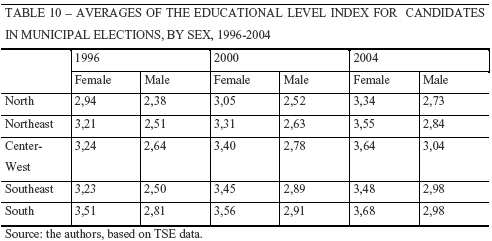
]]> In all regions, in all elections, the average educational level of female candidates is greater than men. As a general tendency, the indexes are greater in the South and smaller in the North region. In comparison, Table 11 shows the averages for the educational background of elected females and males.
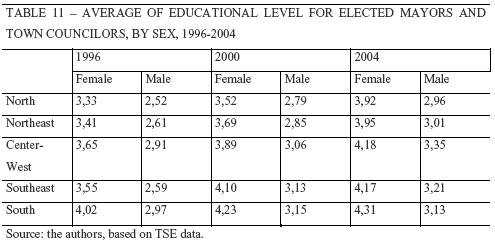
In all elections, for both sexes, the smaller indexes are in the North region, followed, almost always – by the Northeast. But what matters for the hypothesis' approval is the magnitude of the rift in schooling between the sexes, that is, the difference between the female and male schooling averages. A positive value indicates higher female schooling; an unusual negative value, though not found in the study, would indicate, on average, a higher level of education. Table 12 provides the figures.
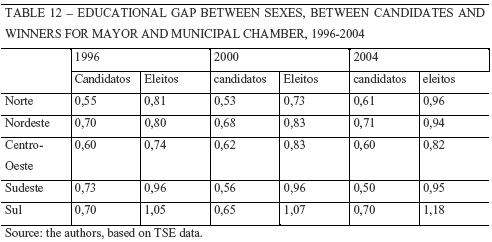
]]> The gap is at its widest when the focus is concentrated on the winners, reinforcing the perception of feminine hyper-qualification. That is, in order to run at all, women must already flaunt a differential background in schooling in relation to men; in order to be elected, such a differential must be even be greater. This is so in all elections and in all regions, without exceptions.
However, contrary to what the "hyper-qualification hypothesis" described above requires, the educational gap tends to be wider in the South region, followed in most cases by the Southeast region. That is, female candidates (mainly those elected) in the less developed regions do not present a greater educational differential than in other regions – on the contrary. And the difference among regions is always small, seldom exceeding three tenths. Therefore, the data do not allow us to posit that there is a window of special opportunity for more educated women in the North, Northeast and Center-West.
Election and Migration
The demographic hypothesis test entails the correlation calculations between the female population in each municipality, according to the demographic census in 2000 and the number of elected women. A linear regression model was used and Student's test t was applied, which indicates whether the independent variable coefficient (here, the female population) is statistically different from zero – and, therefore, if there is any impact on the dependent variable (the number of elected women). Since electing women is natural when there are many openings to run for and more councilors are elected in more populated municipalities, a positive correlation may arise without the hypothesis being confirmed. In order to avoid this problem, the model was applied on the percentage of women in each municipality and on the percentage of elected females for town councilor.
Using the census data, instead of using only the number of registered voters, is justified by the fact that the electoral enrollment may be much less sensitive to internal migration. In a number of cases, migrants do not update their electoral address – they remain enlisted as a voter in one town while they reside in another. On the other hand, the census data includes children, of both sexes, who – according with the standards of male migration described above – remain with the mother. Thus, it is necessary to consider that the proportion of women in the real constituency, in the migrants' municipalities, tends to be bigger than on the Electoral Justice's list (due to electoral addresses not being updated) and also greater than the census proportion (which includes children).
A lesser problem, but nevertheless noteworthy, is the incompatibility between parts of the data base of IBGE, the census agency, and of the Electoral Justice, which has led to the exclusion of a small portion of municipalities – 2.3% of the total in 1996, 1.7% in 2000, and 1.2% in 2004.
For 1996, the correlation between the percentuals of women in the population and women elected for the Municipal Chambers was extremely low (r2 = 0.0011), with a significance test t = -2.18. This means that the impact of the proportion of women in the population is small and inverse to the expected: the percentage of elected women increases with the decrease in the proportion of women in the population assessed in the census.19 Regardless of the statistical tests, in data interpretation it is more reasonable to assume that, in 1996, the bigger or smaller female presence in the population had no repercussion in the success of women's candidatures for Councilor Chamber.
For 2000, the result was nil (r2 = 0, with t = 0.19), a repetition of the 2004 data (r2 = 0, with t = 0), that is, in both of these elections, the impact of the proportion of women in the population on the proportion of elected women is statistically inexistent. Therefore, these results also lead to rejection of the hypothesis. The relative success of women candidates is not explained by a greater proportion of women in the population.
The second model aimed to correlate the percentual of female voters in the municipality with the percentual of female councilors elected there. Results were no different. In 1996, the correlation was very low (r2 = 0.0001) and the significance test amounted to nil (t = -0.68). In 2000, the correlation appeared as the highest of all (r2 = 0.0928), with t = 24.05, yet insufficient to explain more than an extremely reduced part of the phenomenon. The statistical evidence indicates that the variance in percentage of women in the constituency would explain only 0.09% of the variation in percentage of elected women. In 2004, the model had to use the data from the 2002 electorate, the most recent data available, but this hardly had an expressive impact on the results. With r2 = 0.0002 and t = 1.09, the 2004 result is considered statistically equal to zero. In conclusion, the hypothesis is rejected.
]]>Conclusions
The study shows that the causes for relative success of women in municipal disputes in less developed regions in Brazil requires, in all likelihood, more complex explanations, and that the simple analysis of election results and of other additional data is unable to provide. It would be necessary to observe the sources of political capital of elected female councilors and mayors, relating these sources to the associative patterns and the political party structure in each town.
Throughout this paper, the focus has been on women's relative success, so it is worth underscoring the adjective "relative". Women make up more than half of the constituency; the quota legislation reserves them only 30% of the openings on candidate lists; the parties do not accomplish the percentual established by law; and, ultimately, even in regions that most elect females, more than 85% of the Municipal Chambers are still made up of males. The feebleness of Brazilian law strongly strains the possibility for an expressive expansion in the short term, of female presence in the spheres of power.
What the law is able to propose, ultimately, is a sort of pedagogical approach to the partisan leadership. In the mid- and long-term, the parties' leaders would realize that the idle openings for women, or those filed pro form, do not aggregate more votes to their lists and thus, there will be benefits for whoever is able to launch competitive candidates.20 Some simple measures could reinforce the impact of quotas The most obvious would be to determine to what extent filing the quota is mandatory, but perhaps it would be more effective to reduce the total number of openings. Prevented from launching into dispute all the male candidates they would like to, the parties would be able to turn their attention to female candidates. All the more if, as Deputy Luiza Erundina has proposed, the parties were obligated to reserve for women not only 30% of the list but also 30% of the campaign resources and 30% of the radio and television electoral coverage time.
The expansion of feminine presence in the sphere of power will represent the correction of a major distortion in Brazilian representative democracy. Yet it is but a step amidst others in the same direction. It is necessary to have more female town councilors, mayors, deputies (congresswomen), governors, senators. But it is also necessary that there be more black women and men, more women and men from the working class. To focus attention on who is getting elected may help to explain the central issue of this paper – the better electoral outcome of women in Northern and Center-Western municipalities – which will certainly shed light on the upcoming challenges towards improving political representation in Brazil.
Referências bibliográficas
ARAÚJO, Clara. "As cotas por sexo para a competição legislativa: o caso brasileiro em comparação com experiências internacionais". Dados, v. 44, n. 1, p. 155-194, 2001. [ Links ]
AVELAR, Lúcia. Mulheres na elite política brasileira. 2. ed., revista. São Paulo: Fundação Konrad Adenauer/Editora Unesp, 2001. [ Links ]
FERNANDES, Luis. "Muito barulho por nada? O realinhamento político-ideológico nas eleições de 1994". Dados, Rio de Janeiro, v. 38, n. 1, p. 107-144, 1995. [ Links ]
Fox, Richard L., and LAWLESS, Jennifer L. "Entering the Arena? Gender and the Decision to Run for Office." American Journal of Political Science, Malden, v. 48, n. 2, 2004. p. 264-280. [ Links ]
FOX, Richard L., and SMITH, Eric R. A. N. "The Role of Candidate Sex in Voter Decision-Making." Political Psychology, Malden, v. 19, n. 2, 1998. p. 405-419. [ Links ]
GODINHO, Tatau; Ristoff, Dilvo; Fontes, Ângela; Xavier, Iara Moraes; Sampaio, Carlos Eduardo Moreno (Orgs). Trajetória da mulher na educação brasileira, 1996-2003. Brasília: INEP, 2005. [ Links ]
IBAM – Instituto Brasileito de Administração Municipal. Participação feminina na construção da democracia: um levantamento do resultado das eleições municipais (1992 a 2000) e estaduais e federais (1996 a 2002). 4. ed., revista e atualizada. Rio de Janeiro: IBAM, 2003. [ Links ]
INGLEHART, Ronald, and NORRIS, Pippa. "The Developmental Theory of Gender Gap: Women's and Men's Voting Behavior in Global Perspective." International Journal of Political Science, Thousand Oaks, v. 21, n. 4, 2000. p. 441-463. [ Links ]
MIGUEL, Luis Felipe. "Teoria política feminista e liberalismo: o caso das cotas de representação". Revista Brasileira de Ciências Sociais, São Paulo, n. 44, p. 91-102, 2000. [ Links ]
______. "Política de interesses, política do desvelo: representação política e ‘singularidade feminina'". Revista Estudos Feministas, Florianópolis, v. 9, n. 1, p. 253-267, 2001. [ Links ]
______. "Participação eleitoral e gênero no Brasil: as cotas para mulheres e seu impacto". Paper apresentado no II Congresso da Associação Latino-Americana de Ciência Política (ALACIP). Cidade do México, 29 de setembro a 2 de outubro, 2004. [ Links ]
PHILLIPS, Anne. "Must Feminists Give up on Liberal Democracy?" In: Held, David (ed.). Prospects for Democracy: North, South, East, West. Stanford: Stanford University Press, 1993. p. 93-111. [ Links ]
______. The Politics of Presence. Oxford: Oxford University Press, 1995. [ Links ]
______. Which Equalities Matter? Cambridge: Polity, 1999. [ Links ]
PITKIN, Hanna Fenichel. The Concept of Representation. Berkeley: University of California Press, 1967. [ Links ]
QUEIROZ, Cristina Monteiro de. Mulheres nas eleições municipais do Brasil (1996-2004). Monografia apresentada ao bacharelado em Ciência Política da Universidade de Brasília. Brasília: IPOL-UnB, 2005. [ Links ]
RODRIGUES, Leôncio Martins. Partidos, ideologia e composição social. São Paulo: Edusp, 2002. [ Links ]
SCHMIDT, Gregory D., and SAUNDERS, Kyle L. "Effective Quotas, Relative Party Magnitude, and the Success of Female Candidates." Comparative Political Studies, Thousand Oaks, v. 37, n. 6, 2004. p. 704-724. [ Links ]
SMITH, Eric R. A. N., and FOX, Richard L. "The Electoral Fortunes of Women Candidates for Congress." Political Research Quarterly, Sacramento, v. 54, n. 1, 2001. p. 205-221. [ Links ]
YOUNG, Iris Marion. Justice and the Politics of Difference. Princeton: Princeton University Press, 1990. [ Links ]
]]> 1 PHILLIPS, 1999, p. 35.