"Mulher sem-vergonha" e "traidor responsável": problematizando representações de gênero em anúncios televisivos oficiais de prevenção ao HIV/AIDS
Dagmar Estermann MeyerI; Luis Henrique Sacchi dos SantosII; Dora Lúcia de OliveiraIII; Daniela Montano WilhelmsIV
IFederal University at Rio Grande do Sul
IILutheran University of Brazil
IIIFederal University at Rio Grande do Sul
IVGrupo Hospitalar Conceição
ABSTRACT
From the perspective of community health agents who work in the Family Health Program in the periphery of Porto Alegre, RS, this article discusses Public Service Announcements that were part of official HIV-AIDS prevention campaigns implemented in Brazil from 1994-2000. The purpose is to contribute to a critical reading of this type of material, considering the gender relations they present. The paper analyzes, from a cultural-analysis focus, discourses that institute two representations: that of "the shameless woman" and of the "responsible cheater". It argues that representations such as these are produced by the information that supports the prevention campaigns and wind up reiterating gender and sexual behaviors and practices that the campaigns intend to transform or change.
Key words: health education, cultural and gender studies, prevention of HIV/AIDS, gender representations.
RESUMO
O artigo discute, a partir da ótica de agentes comunitários/as de saúde que trabalham no Programa de Saúde da Família na periferia de Porto Alegre/RS, anúncios televisivos que integraram campanhas oficiais de prevenção ao HIV/aids implementadas no Brasil (de 1994 a 2000) com o objetivo de contribuir para uma leitura crítica desse tipo de material, considerando as relações de gênero ali representadas. Analisam-se, sob o enfoque da análise cultural, discursos que instituem duas representações: a de 'mulher sem-vergonha' e a de 'traidor responsável'. Argumenta-se que representações como essas são produzidas, entre outras instâncias, pelo próprio conhecimento que dá suporte às campanhas de prevenção e que elas acabam reiterando comportamentos e práticas de gênero e sexuais que pretendem transformar ou romper.
Palavras-chave: educação em saúde; estudos culturais e de gênero; prevenção de HIV/aids; representações de gênero.
1 Places, looks and actions that demarcate the text
This article is based on a study1 that analyzed televised Public Service Announcements (PSA) that were part of official HIV-AIDS prevention campaigns implemented by Brazil’s Ministry of Health from 1994-2000.2 From among the PSAs broadcast during the period, we selected three aimed at women and two at men. After approval of the research project by the Ethics Committee of the Porto Alegre Municipal Government, the PSAs were discussed in two focus groups, with 12 Community Health Agents (CHA) each, 22 women and two men, for six weeks (in July and August of 2002), totaling 12 meetings. These meetings were recorded, transcribed, codified and processed with the use of Nvivo software.3 The participating CHAs were affiliated to one of the 24 Family Health Clinics in the three District Health Administrations of the municipality and most had worked for more than one year in the Family Health Program (FHP). Their participation in the study took place because of the individual interest of each one, and was later approved by their entire staff and made official with the signing of an informed term of consent.
Based on the presentation and discussion of these five PSAs with these CHAs who work in health clinics located in the periphery* of Porto Alegre, RS, the study proposed to produce elements to reconsider this mode of prevention, particularly concerning the gender relations they present, considering some of the ways the CHAs expressed themselves when speaking of these relationships.4
The study is in the field of Feminist and Cultural Studies that has been realizing a critical articulation with the post-structuralist perspective of Michel Foucault, and considers five basic presumptions. The first, allows conceiving culture as a field of struggle and contestation in which are produced both the meanings as well as the subjects that constitute the different social groups in their singularity.5 A second, emphasizes that language, in the broad sense, is the privileged means by which we attribute meaning to the world and to ourselves and for this reason, constitutes a central element in social and cultural organization.6 A third, allowed working with the notion of education, considering it as the set of processes by which individuals are transformed or become transformed into subjects of a culture. To become a subject of a culture involves a complex set of forces and learning processes that today include, with special emphasis, the mass communication media, in which TV occupies an important role.7 A fourth allows resignifying the concept of representation, understanding that it encompasses practices of linguistic and cultural signification and symbolic systems through which the meanings (which allow women and men to understand their experiences and identify modes of being and living) are constructed.8 The fifth allows arguing that gender studies should go beyond a discussion of roles and functions of women and men, to include an analysis of all forms of social, cultural and linguistic construction implied in the processes that distinguish women from men, including those processes that produce, separate and distinguish bodies, bestowing them sex, gender and sexuality.9
These presumptions allow us to operate, methodologically, with a cultural analysis approach to describe and analyze overlapping discourses that constitute the representations that allow the CHAs to express themselves in the way that they did. Through the concept of discourse, Foucault10 refers to the set of knowledge and practices "that systematically forms the objects of which they speak" or that is, the discourses that would supposedly be describing a pre-given reality, are in fact, implied with the production of this reality and of its subjects. In this direction, Beatriz Fischer11 indicates that, "in discourses, there is a certain place and void that can be occupied by different individuals" and it can be considered that it is based on these places that individuals become capable of thinking, speaking and acting, in certain ways, in specific circumstances. From this perspective, through cultural analysis, we seek to recognize and describe some of the positions of the subject that the CHAs occupy when they speak of themselves and of the people that they attend. We also seek to understand how and what discourses about health, STDs and HIV-AIDS and the "suitable" forms of living gender and sexuality cross through and institute meanings and prevention practices that are shared by these social groups.
To adopt a theoretical-methodological approach, which presupposes the discoursive production of culture and of its subjects, does not imply, therefore, neglecting the material existence of people, things and events. It implies sustaining that these "things" only signify and become real within, or through the articulation of certain discourses enrooted in particular and localized contexts. In this sense, it is thus argued that it is discourse (medical, common sense, religious, moral, etc) and not an individual (CHA) a health program (FHP) or an isolated social institution (Ministry of Health) that announces or presents, that produces that which we recognize, for example as suitable modes of living gender and sexuality, in a given moment and context. Individuals and institutions, which are always subjects of certain discourses, can produce "particular texts", but they operate within the regimes of truth of a specific epoch and culture, which makes these texts possible and necessary.12
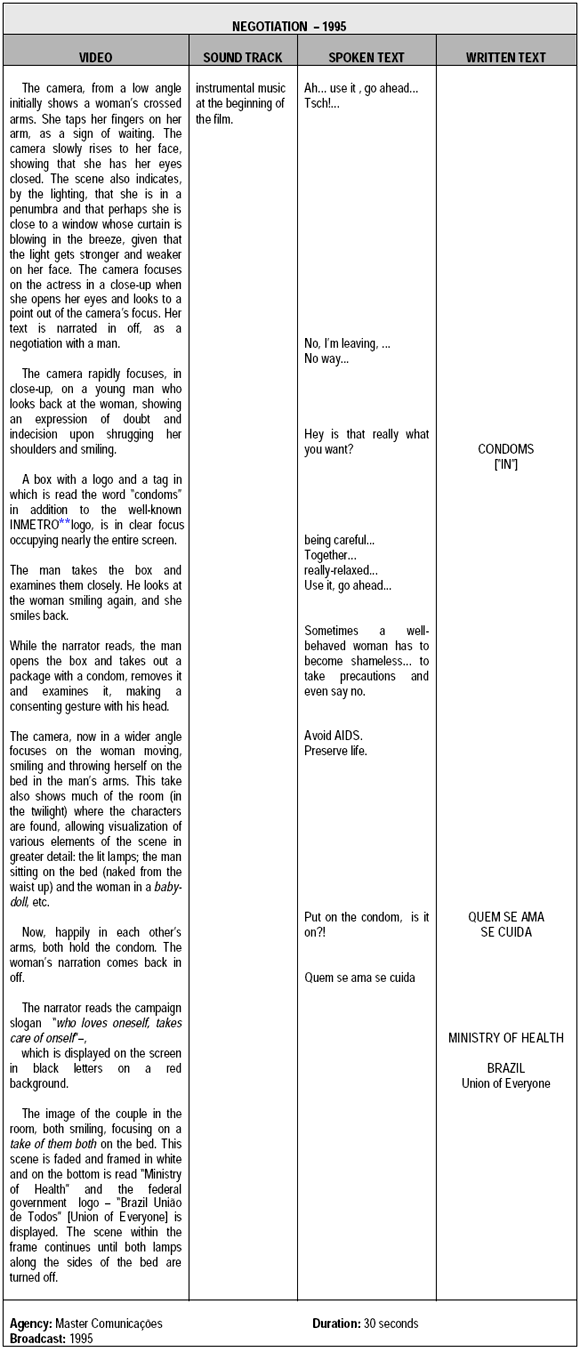
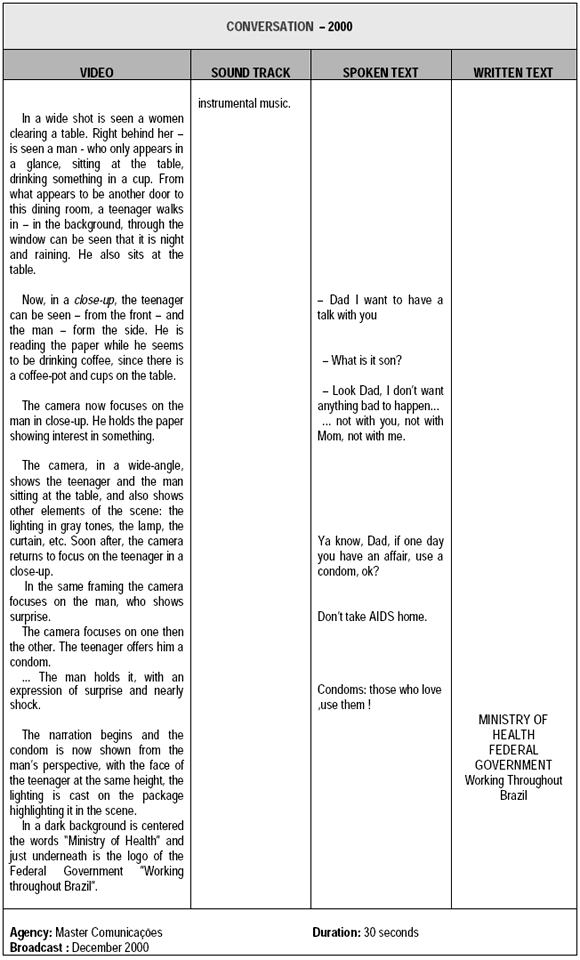
The announcements were thus considered as pedagogical artifacts which, in addition to teaching (or not) how to prevent HIV-AIDS, by using condoms, they also incorporate, reproduce or present multiple, unstable and conflicting representations of gender. Among the representations of women and men that emerged during the study, two of them that run through and institute the discourses are analyzed in this paper: that of "the shameless woman", associated to the slogan "Quem se ama se cuida" [Who loves oneself takes care of oneself], and of the "responsible cheater", with which it is affirmed that "quem ama usa" [One who loves, uses (condoms)]. The analysis of these representations uses as a reference the discussion generated by the Public Service Announcements entitled Negociação [Negotiation] and Papo (Discussion), described below.
]]>
These Public Service Announcements were produced and broadcast in a context in which researchers, government agencies and NGOs came to emphasize the growing social vulnerability of low-income heterosexual, Brazilian women, who had stable sexual-emotional relationships, to infection from HIV-AIDS.13 The data from the most recent epidemiological bulletins have indicated that this trend has not been reversed, despite investments in educational actions that have been taken in the past decade. This has led different authors to suggest that efficient strategies for prevention of HIV-AIDS need to be supported more by studies that incorporate gender theories. These studies argue that this will allow understanding not only the behavior of women and men, but, above all, "how it is created and what feeds it", to support alternatives to be developed concomitantly, with different segments of the population and also with various focuses of intervention.14
In this sense, in addition to looking at interpersonal relations between men and women, we also analyze representations that position and define actions to promote health and prevention of disease as feminine attributes, which are produced or assumed and reinforced by the very knowledge and policies that guide and legitimate these actions, above all in the realm of Family Health Program.15 We also sought to map mechanisms and strategies for empowerment16 and those to encourage social responsibility that operate in the discourses about prevention and care for oneself and the other, to discuss how women and men are positioned in them, based on representations of gender, that the announcements incorporate, broadcast, resignify or help maintain.
With this analysis we intend to defend two arguments. The first is that representations such as the "shameless woman" and "the responsible cheater" are produced or revived by the very information that bases the conception and implementation of the prevention campaigns such as the educational-assistance actions related to them – as well as other factors. In addition, these representations wind up repeating some of the relationships, behaviors and gender and sexual practices that the campaigns intend to transform or break.
]]> 2 Empowerment and social responsibility under the lenses of a gender approach
The statements17 of the Community Health Agents (CHAs), from which we selected excerpts that guide our discussion in this article, become possible in the context of certain discourses about health, gender and sexuality whose fragments circulate, daily and recurringly, in multiple instances and artifacts of our culture. Presented as if they were part of the "nature" of women and men, particularly those men and women defined as heterosexuals, the attributes and values that these discourses institute – about what it is to "be a woman" or "to be a man" and about the way through which women and men live their gender and their sexuality – are already common sense.
Common sense is composed of fragments of discourse that are "articulated during the history of a people or highlighted from discourse [such as that of education and healthcare] in a given political and social situation".18 It needs to be considered in studies such as this, not only for its "enormous capacity to give meaning to daily life" and for its "enormous potential to be articulated to different world views", but also because within this articulate set of fragments of discourse – a supposed unity that comes to function as common sense – scientific discourse nearly always appears as "synonymous with knowledge and authority".19 Many of these fragments of discourse re-appear or are repeated in a multiplicity of educational processes, at the interior of which women and men are taught to care and relate with their bodies and their sexuality in a "healthy manner". Their strength resides exactly in the multiple, subtle and always renovated possibilities for their repetition. Considered from this point of view, education and healthcare are two discoursive practices that produce, up-date, transform and incessantly repeat, what women and men are, can or should be and also, how they should or could live their lives in a more healthy manner. It is exactly their "scientific authority" that gives sustainability and legitimacy to the processes of naturalization and universalization of these definitions.
Constituting a broad majority of the professionals who should establish direct and daily contact with the families, in the realm of the Family Health Program, the CHAs are described "as women who discuss, understand and accompany the problems and concerns of thousands of other women who are in the homes visited and often confront similar problems".20 They constitute themselves as women (and also men), healthcare professionals, precisely in the conflicting articulation of these (and of other) discourses and it is from this context of discourse that their statements thus need to be understood and analyzed.
2.1 One who loves oneself takes care of oneself and for this reason can even be ... a shameless woman?
| CHA 4 (woman): We see that [...] things change, [...] woman are going to work, but other things stay the same. Most women are submissive, they don’t go out because their husbands don’t let them. |
The statements of the CHAs and the announcements that provoked them suggest that women continue to be described and positioned, in most of the programs for prevention of STDs and HIV-AIDs, as submissive, dependent and gullible beings, who are not able to impose their will on their emotional and sexual relationships ( they give in; they don’t go out because their husbands don’t let them).21 In the context of this study, considering both the advertisements presented as well as the initial discussions that they stimulated, feminine submission was nearly always referred to in the singular, as if all the women live subordinated in the same way, at any time, situation and place. To the degree that the discussion advanced, however, this homogeneous and unitary category, defined as the submissive woman, became fragmented. Distinctions appeared such as "this woman from the ad", "there in my community: "the younger girls", "the older woman" the "married woman", "the working woman", "the woman who stays home all day and does nothing", "the rotten girl".
The multiplication of the possibilities of living as a woman, experienced by the CHAs in the daily contact with the communities in which they work, however, appear not to be translated, to the same degree, in the need for complexification and pluralization of their modes of implementing actions to prevent HIV/AIDS. The sole modality of prevention referred to, and which should be adopted by all the women, preferably by their own initiative, is the use of the male condom in all sexual relations.
Generically, in discussing issues linked to sexuality, feminine submission was qualified as a lack of self-esteem or "lack of shame" and with this focus, it was translated as an individual problem and at the same time, inherent to "being a woman":
Women at times settle for very little, only because the man brings home rice and beans. From what I see, I think they should be more assertive and I think they are too accepting, at least the large majority.
]]> Feminine subordination, qualified as a lack of self-esteem, was also understood and raised in these discussions (perhaps because of the PSAs) as being the great barrier to be overcome to guarantee the effectiveness of the prevention programs: I think that the woman doesn’t respect herself. I think its not a social question, I blame the woman herself. I think that they do not respect themselves, they are submissive.These are some of the factors upon which can be analyzed the discourse articulated in the representations of the woman presented for example in the PSA Negotiation, as well as some of its effects. Associated to the slogan "Who loves oneself takes care of oneself" (which functions as a closing for a set of announcements through which the Ministry of Health invested in the strengthening of the self-esteem of this subordinated woman), sought with these PSAs to encourage changes in some of the "ways of being" that configure this subordination, based on a perspective that, even if criticized,22 appears to continue to be very active in the context of current public policies and programs.
The recognition that throughout history in the majority of known societies and cultures, women were, and continue to be inserted in positions of subordination and inequality, to which they assume very specific contours in the power relations that define conjugality or sexual partnership, was one of the most important guiding forces of the contemporary feminist movement that we cannot nor wish to contest. On the other hand, it must be also be emphasized that it was the need to qualify possible forms of political intervention, with which they intend to change these conditions, that required more consistent investments in production of knowledge and systematic development of studies that have as an objective not only recognizing and criticizing, but above all, breaking with the homogeneity and linearity with which the social subordination and the political invisibility of women, in the plural, has come to be narrated.
In this demand is found the proposal for the use of the concept of gender which, considering what interests us here, would allow: arguing that differences and inequalities between women and men are socially, culturally and discoursively constructed and not biologically determined, to shift the focus of attention from the "dominated woman per se", to the relationship of power in which these differences and inequalities are produced and legitimated; to "break" from the homogeneity, the essentialization and the universality contained in the terms woman, man, masculine domination and feminine subordination, among others, and thus, to make visible the power mechanisms and strategies that institute and legitimate these notions; to explore the plurality and the conflictive nature of these processes that establish the possibilities of defining and living gender and sexuality in each society, in its different cultural and social segments.23
These forms of theorizing and of operating with the concept of gender imply important theoretical and political developments in the various fields of study that are involved in their analyses. The field of healthcare is more recently one of the fields in which these developments can be evaluated. In an article that mapped the state of the discussion about relations of gender and health in Brazil, Sônia Correa24 indicated that the broad theme that encompasses "health, gender, reproduction and sexuality" today constitutes an established field of study in Brazil and from her perspective, this consolidation is expressed, in particular, in the studies about reproductive rights, sexuality and HIV/AIDs. She indicates that, even so, "it is still not possible to maintain that gender... has been definitively and solidly incorporated to the references of the studies in healthcare"; precisely for this reason, she suggests an expansion of focus and of the repertoire of questions that guide the studies that operate with the concept in this field. This suggestion takes us back to the statements by the Community Health Agents and the PSAs that introduced this section.
In this sense, one of the points that we want to discuss is that, at the same time at which subordination was repeatedly "attached" to the woman (they are submissive), it was also insistently approached as a problem that can and must be changed and the strategy of learning to "love oneself" was considered suitable for this ( this is something for women; they have to love themselves more). That is, a paradox is expressed here that, simultaneously reiterates and contests the presumption of existence of a "subordinated feminine nature", given that one can and must intervene in it, to modify it radically.
This paradox also directly crosses most of the educational programs committed to the modification of the subordination. Such programs are increasingly supported by presumptions that institute the strengthening of feminine self-esteem as an important strategy to propitiate this modification. In the specific case of HIV/AIDS prevention, the strengthening of self-esteem must allow a woman not only to recognize the need, but to become capable of persuading her partner, in various forms, to use a condom, or, if not, to not have sexual relations. With this perspective, the self-esteem approach focuses the educational action on an abstract woman, disconnected from the context in which she lives her emotional and sexual experiences, by provoking behavioral changes that are also individual. That is, to remove the woman from the position of subordination involves, in the context of these educational programs, supplying technical information about the virus and the disease, about the functioning of her body (and perhaps that of her partner) and training her to make proper use of this information.
Thus, there is a lack of recognition that the behavior of individual men and women is always produced in the social and cultural context in which they are immersed. It also loses sight of the fact that the greater or lesser susceptibility of certain groups of women (and of men) to the HIV-Aids infection results from a set of individual and collective social, cultural and political conditions that increase or decrease the chances that they have to defend themselves from the disease.25
Clarice Traversini discusses,26 in a suggestive manner, how the emphasis on the elevation of self-esteem functions as a government strategy,27 in the realm of the Solidarity Literacy Program (PAS), and her analysis provides some insights to consider this emphasis in the context that we are analyzing. It can be argued, for example, that since subordination is understood and described as a problem located in "the woman", the prevention action that the Public Service Announcement in question suggests, concentrated precisely on the modification of these forms of being a woman (for example instead of being subordinated, "there are times when a well-behaved girl has to become a shameless woman"). Thus, the slogan "One who loves oneself takes care of oneself", at the same time that it incites the woman to behave independently and safely (one way of doing that is suggested here, by the resignification of the term "shameless"), also acts in the sense of reinforcing her centrality in the implementation of the practice of safe sex, which is reduced, in this and in all PSAs, and also for the CHAs, to the use of the male condom – in all sexual relations. This slogan also represents any man, in any type of affectionate-sexual relationship, as a "potential risk" for a woman’s health.
Carole Campbell28 and Karin Giffin29, in different forms, argue that approaches such as these do not break the woman’s dependent relationship with the man, but transform it into another type of dependence – that of cooperation from the partner. From the perspective of these approaches, it is up to the woman to achieve adhesion from the partner, taking the initiative to propose the introduction of the condom in the relationship, convincing him by using seduction, which after all is a also a feminine attribute, (as the PSA Negotiation suggests) or with information, as one CHA said: [after I learned] I spoke with him ... we kept going and going, for three years I have used it all the time. Or even, at the extreme, asking him, at least in the street, with other women, for him to use the condom, to not bring disease home, as another said, about her brother-in-law – a perspective that is incorporated and repeated in the teenager’s speech in the PSA Conversation, which is analyzed in the following section. In this sense, "who loves oneself takes care of oneself" invests in the "strengthening" of the woman, without (and perhaps precisely not to) question the presumption that the woman is the main agent of promotion of safe sex, and that the empowerment strategy may be contributing to prolonging this representation.
]]> It should be registered that even operating with the presumption of the subordinated woman, for various reasons the CHAs do not see themselves or the woman with whom they work, in the woman presented in the PSA Negotiation.30 They describe the PSA as being "out of touch with the reality" in which they work, and as such, the CHAs in a certain way show that they are skeptical about the effectiveness of the negotiation – by seduction – that it suggests. In this way, cracks are identified both in the representations of woman and of man that run through and modulate their practice, both in the forms with which they describe the relations of subordination which, are (or can be) lived and experienced...I continue to defend this thesis, a that married woman, in our situation, in our work life, does not ask her husband to use a condom, or does not ask him to get tested, because she is submissive to the man.. and there is the difference, the age range of married people and singles, there is a difference.Above all, the counterpoint that the PSA makes, playing with conflicting meanings of the notions of a well-behaved girl and a shameless woman, was questioned by the CHAs. By emphasizing that [in our community] a shameless woman has no place and that men think that if a woman has a condom it is because she is a whore, the CHAs reiterate the strength of a given form of morality found in the "popular" classes, which sets strict borders between the representations of a girl or woman who is worthy and who is not worthy, which has been analyzed and studied in works such as those of Daniela Knauth,31 Claudia Fonseca32 and also, Carmen Dora Guimarães.33 The "woman who is worthy" is exactly one who has a stable relationship, who "respects herself" and who in this position has "her reasons to resist certain types of information [such as the imperative of using a condom] which can interfere in the most intimate space of their lives", placing in risk these qualities of respectability.34 Whether because of her condition of subordination (much more accepted and promoted), or because of the cultural specificity that, in this case, shifts the woman from a position of helpless victim to another in which she actively participates in the definition of a given form of living conjugality (an approach barely considered in the conception of the prevention programs), the fact is that, from the perspective of the CHAs (and also of the health policies) it is this woman who would be more exposed to risk of contracting the virus.
What is little explored, in the discoursive context which makes these statements possible, is that this "respectful woman" can also have other motivations, beyond subordination or of her way of living a given form of morality, to not want to use a condom (at times proposed by the man and rejected by the woman). They can want, for example, to give him a child, to indicate that we are family, to maintain a relationship. The importance of maternity in the production of the identities of woman and of this notion of "giving a child" to her partner, in the dynamic of functioning of families of certain cultural and social segments, is one of the dimensions of the ways of living sexuality and conjugality that need to be much more explored in the conception and implementation of healthcare education programs.35 In general, the meanings of maternity are worked with in a naturalized and normative form, only in the programs aimed at the maternal-infantile population.36 In the HIV-AIDS prevention programs women-mothers and maternity are raised as issues, above all, when it involves investing in the reduction of vertical infection. This involves directing the focus on the importance of exams and pre-natal care to allow the birth of a healthy baby, in a situation in which the women is already infected, without considering precisely those social processes that produce maternity as a desire or as a need, even in the condition of soro-positivity.
The "young kid" or "reckless woman" or who is not worthy is presented in these statements as young girls who like to get pregnant in order to get a man ... like what happened to my son, or those in cases in which the man goes out to work, the woman stays home and has the men in the neighborhood who stay home because the woman goes out to work and there are male neighbors who stay to take care of the house, and the children and that’s how it happens ...they get back at him [and also cheat]. There are also those who do not like to use condoms because they like for the man to ejaculate inside them to feel the sperm or even the girls who want sex...its not the boys who ask, its they who ask and if they don’t go along...they begin to call them other things, like faggot, or even, those that have five, six children, each with a different father, some who don’t know the father... this is an irresponsible woman, because she doesn’t think of the future of the child.
These statements suggest that, as members of these communities, the CHAs confront and (recognize) different ways of being a woman: one who is not always submissive (because she "gets back") or who doesn’t want to use a condom for many different reasons (she wants children to guarantee the relationship or thinks that the condom decreases pleasure); those who have different ages and play with "values and risks" when they invest in a given configuration of their relationships (they want to "get a husband" or avoid the risk of "losing" respectability).
At the same time, when they speak as health professionals, these men and women focus much more on the lack of respect, on the dependence and the subordination of the woman. In addition, their references to the strategy of strengthening self-esteem as a means to make them capable of imposing the use of the condom –understood as one of the "center-pieces"37 of the educational activities – does not consider the specificities mentioned. That is, they appear to operate with the presumption of the existence of a universal woman who must take the initiative and the responsibility for the negotiation, which the healthcare discourses, among others, produce, reinforce and circulate. Given that "being a woman" is defined not only in relationship to "being a man", in a given time and place, but also in relation to the different possibilities of defining and experiencing femininity in our times and places (or in others), what needs to be most analyzed, in relation to this point, is exactly the effects of this on the prevention work that is conducted in these communities.
One of these effects is that, in this multiplication of forms of being a woman and of living ones sexuality, a movement of particularization is delineated, not only of the woman and of the subordination to which the CHAs refer, but above all a movement which establishes who is the woman it is important (or more important) to reach when it involves taking preventive action against HIV-AIDS. In this articulation which is established between the discourses of the healthcare field (that inform and run through the format of the PSA and which also prepares these individuals as healthcare professionals) with the discourse of common sense, which normatizes the morality in these communities, systems of classification of women stand out38 that suggest that the woman presented in the PSA is a representation that does not allow including all women in healthcare activities, in the same way and with the same intensity.
Thus, it can be argued that the meanings produced by the slogan "Who loves oneself, takes care of oneself", when linked to the representation of a "shameless woman", reiterates the existence of a subordinated woman, narrated in the singular, which needs to be strengthened and modified, and which continues, at the same time, to be positioned as a central element of the promotion of safe sex. The effects of this, as we see, are multiple and conflicting. Using as a reference a binary opposition that positions the man as the dominator and the woman as the dominated, the narration of the subordinated female, in the singular, focuses on only one of the terms of this relationship. In this way, it also makes difficult a visibilization of the understanding of the effects of power that processes of differentiation and hierarchization between women exercise on the prevention activities – some of which we seek to discuss in this section. At the same time, it fails to inscribe this subordination in the processes that institute the masculine as domination. In this sense, the same movement that "naturalizes" subordination as an attribute of the feminine which, faced with the threat of HIV-AIDS, needs to be modified, defines domination as an intrinsic characteristic of the masculine which is not modifiable and, for this reason, needs to be controlled, as we discuss below.
2.2 Who loves uses [condoms] ... to protect whom?
| CHA 8 (woman): In the first place, the man does not respect the woman for the following reason: he has affairs in the street, with girls who are 14, 15, 16 and he doesn’t want to know if she is clean or not, what is important is that she is young and better than the woman he has at home. He goes there, gets contaminated and contaminates the woman he has at home...he may have had relations less than half an hour before with a rotten girl, but he won’t be concerned with his wife, because she is old, is everything... ]]>
... |
One of the theoretical-political implications of the use of the concept of gender concerns its relative character, which leads to the presumption that the analyses and interventions taken in this field of study should consider, or at least use as a reference the power relations – and the many social and cultural forms that, in an interdependent and inter-related manner, educate men and women as "gender subjects".39 Conceptual and analytical concepts such as these, however, were not necessarily incorporated to the studies that discuss the relationships between gender and health, not even when they involve the relationship "health, gender, reproduction and sexuality", highlighted by Correa40 as being one of the themes in which its insertion is more visible and well analyzed in the field of healthcare. An attentive eye would probably allow us to perceive that, in many cases, the term woman is simply substituted for the term gender, without having incorporated in the analysis the implications stemming from the shift from the field of women studies to gender studies.
In this direction, there are still few studies like those of Wilza Villela,41 who contemplates, for example, the relationship between health and production of masculinities – in particular heterosexual masculinities – or studies that seek to analyze the mode in which knowledge and practices, produced or implemented in this field, are involved with (or promote) the institution, up-dating or presentation of representations of gender and sexuality.
The statements of the CHAs and mainly the PSAs that stimulated them are indicative that the same statements that allow that women to be narrated and positioned, in most of the STD and HIV-AIDs prevention programs, as the submissive woman whose self-esteem needs to be activated and strengthened, also allows heterosexual men to be presented and described as being, by nature bestowed of a sexual impulse that they cannot control. Nevertheless, when the texts generated in the focus groups are analyzed, it is found that the unit of this representation of masculinity was less fragmented or multifaceted during the discussions. That is, this sexual impulse that is difficult to control, reiterated by the discourse of healthcare and common sense, is linked to a form of living heterosexual masculinity that appears to subsume the multiplicity of modes of being a man, in the realm of these communities.
In the daily life of the CHAs, this essentialization appears to function as a mechanism that translates (and justifies) men’s "cheating" as an "inherent incapacity to be faithful" (100% of men cheat; the man who doesn’t cheat already did) or as an unstoppable need to have various partners at the same time (her husband plays around; because if you cheat on me it’s not because you want to leave me) or even, as a need for self-affirmation (I bet on him. Without money they’re nothing, later they find a job and find themselves). The problematization of the linear relations that are established between a woman that is not able to negotiate the use of the condom and a man incapable of controlling his sexual impulses, as well as the strategies that are presented to "resolve" or control this "impasse" in the context of the HIV-AIDS prevention programs, allow identifying some paradoxes in the statements of these health professionals.
]]> These paradoxes can be translated into some simple and direct questions, such as: if we are facing a feminization of the epidemic that particularly involves heterosexual women, who supposedly42 have stable emotional-sexual partners, can it not be said, in the same way, that we are facing a masculinzation of the epidemic, which affects with the same intensity, the groups of men with whom these women relate? Above all, if we consider that for these women to be contaminated by their partners doesn’t it mean that these men are already infected with HIV? Villela43 indicates this when he reports, for example, that one fourth of the AIDS cases registered among men who are not drug users in the late 1990’s involved heterosexual men. As a function of this discoursive network that recognizes the heterosexual man as a transmission vehicle without approaching him, with the same intensity, as a subject vulnerable to infection? What are the effects of this on the way that prevention actions are conceived and implemented?It is clear that it would be pertinent, here, to consider that based on the theoretical perspective that we have adopted, statistical data (such as that cited above) do not faithfully "reflect" a reality that is external and predates the data, but are implicated with its production.44 In the same way, to work with the presumption that identities – including gender and sexual identities – are always multiple, provisory and unstable, it is necessary to deal carefully with strict identity borders that are established between homo, hetero or bisexual men, above all when it involves "data" obtained from information given by these men, in a sociocultural context that classifies and places masculine subjects in an hierarchy, as it inscribes them in certain sexual identities (if the men don’t...the women begin to call them ...fags).
The arguments developed by Villela45 are, therefore, extremely important, because they place us before another text – that of the "heterosexual masculinization" of the epidemic – which functions as a barely visible reference of this discourse of feminization. "Since the most accessible form of protection today is the male condom, a massive investment on men could be expected, in order to stimulate them to protect themselves from the infection";46 nevertheless, "the heterossexual male population has been the focus of few HIV prevention projects".47
This affirmation allows identifying another paradox in the context of the approach to prevention that we are examining: the slogan "Those who love use [condoms]" invests in men who occupy the subject position of the partner in a stable heterosexual relationship – a position in which it is expected that he takes responsibility for the sexual health of a very specific other: his partner and mother of his children (if he cheats he has to use it or, as the teenage son said in the PSA, Look Dad, if one day you have an affair, use a condom). The notion of the transmission chain that sustains this approach would involve, in the strict sense, the relationship of at least three equally necessary variables, which would be: another already infected person, the male partner who contaminates himself with this person in a relationship and the stable woman, whose health he places in risk with his infection. What draws attention, considering that we are dealing with preventive health actions, is that this operation is presented to us as if the chain of transmission would only need to be broken when the final link in the chain is placed in risk.
In this sense, in his analysis of the official PSAs for HIV-AIDS prevention, Santos48 argued that, in opposition to a certain unit of discourse that institutes the subordinated women whose self-esteem needs to be strengthened, "for men there is no discourse that could be identified or defined as acting in the same direction". In this perspective, men were positioned in the PSAs that he analyzed either as closeted homosexuals or as a characteristic Brazilian type – the "untrustworthy philanderer" from the series of PSAs "Live with pleasure, have safe sex" (Viva com prazer, viva o sexo seguro) (1995) – or, more recently, as "transmission bridges of the virus for women" in the case of the PSA Conversation, which is being analyzed here. Considering what we have been arguing and also the analysis developed by Santos, perhaps we could indicate as a point of convergence in this "lack" of direction:
[that, in the health promotion campaigns, men] are not positioned as subjects who should receive orientation in the sense of care for their own health, understood as something that would be, in principle, good for themselves, but as subjects that threaten, through their practices ( in this case, especially the sexual) the health of women and their families, transmitting diseases to others...or taking them into their own house.49
Thus, the same discourse for health promotion and of the prevention of diseases that reiterates and revives the centrality of women in the implementation of actions of care for themselves and for all of their family members (he has to be more careful: I have my children to raise) acts in the sense of representing the man, in the singular, as someone who is not, or may not be, concerned with his health (he doesn’t want to know if she is clean or not). More importantly, however, these discourses position him as an agent that upsets this care (he goes there, contaminates himself and contaminates the woman he has at home) and this justifies the strategy for empowerment which invests in feminine self-care. One of the dangerous effects of this discourse is that it can come to work with the presumption that, in this position of subject that threatens or disturbs, the man must accept the responsibility for this attitude (if he gets AIDS, he gets it. So be it, he was looking for it).
It must also be considered that a given representation of masculinity is in play here incorporated not only to the common sense discourse, but also to the discourses that train the CHAs as health professionals, teaches that a "normal" heterosexual man would not only have difficulties to control or dominate his sexual impulses, but also, that these impulses need to be immediately satisfied (even the mothers think that their sons have to sleep with all of them). Two distinct and concomitant movements are articulated in this discoursive operation: male sexuality is naturalized as being an uncontrollable impulse which is translated as an imperious need that must be satisfied. At the same time, the imperative of satisfying this basic need affirms a heterosexual masculinity that makes sexual risk a modality of life. This is a characteristic that, in the case of STDs and HIV-AIDS, would prevent men from taking care of themselves or of their partners (he has flings in the street with 14,15,16 year old girls and doesn’t want to know if they are clean or not).
Curiously, the same discourses that establish subordination as being a mark of being a woman that can be modified by the strengthening of self-esteem appear to reiterate the inexorability of the existence of a male sexual instinct that can, at most, be limited. An operation that is expressed emblematically, not only in the PSA, but also in the statement that names one of the representations analyzed here: In relation to what we are talking about...the cheater or the cheated upon. There is cheating, there is the cheater and the responsible cheater, who will go out, have sex with another woman, with a condom. Of course there are!
]]>3 The woman has to be careful, but men as well...
The excerpt in the title of this final section of the article is one of the few that explicitly reveals the incorporation of the discoursive fragments that place in check central elements of the final representation analyzed here: It seems like the videos have to be for women, and the men agree with this. I don’t think so. I think that, its true that a woman has to be careful, but men also have to be careful. He has to be careful.
When the representations of the "shameless woman" and "responsible cheater", are related, as they were described in this investigation, it is possible to perceive that many of the discourses that legitimate the imperative of using a condom in all sexual relationships incorporate, without questioning, elements of hegemonic dominant representations of male sexuality, such as for example: infidelity as a rule; sex as an uncontrollable instinct and as a basic biological need; the separation between sex and love, sex as a threat, etc.
On the other hand, this notion conflicts with important dimensions of the dominant notion of conjugality, which are more strongly associated to the feminine in the culture in focus. In particular, monogamy (even in the perspective of having one partner after another, but not two at the same time) as well as love and trust can be cited as requirements for sexual relationships. Represented as barriers for the adoption of the condom, modes considered "feminine" of living sexuality have been discredited in prevention campaigns addressed to women.50 That is, the PSAs unquestioningly incorporate hegemonic representations both of femininity as well as masculinity, but take the second as an unchangeable reference, to invest in the "transformation" of ways of being and of living sexuality, defined as feminine. Representations of male sexuality thus continue to function as regulators of sexual relations and of gender in the realm of these healthcare discourses and inform, in an important manner, the prevention actions undertaken by the CHAs with segments of the population who today are the most vulnerable to the expansion of the AIDS epidemic.
If we return to the theoretical-methodological presumptions that we assumed in this analysis, particularly to the notion that education involves the set of processes through which individuals are transformed or transform themselves into specific men and women in the realm of a culture; if we also consider that the systems of representation encompass practices of linguistic and cultural meaning and symbolic systems through which the meanings – which allow women and men to understand their experiences and identify modes of being and living – are constructed, we would have to ask: how is this language of prevention programs educating us? Moreover, these presumptions should lead them to ask if these representations are sufficiently inclusive to deal with the challenges that the AIDS epidemic raises for contemporary societies or if they may be contributing to increase the risks experienced by those men and women who are not included in their descriptions.
The discussions held with the CHAs are indicative of the complexity of relations of gender power that act to configure, in determined manners, the networks of social relations and institutions involved with the HIV-AIDS prevention actions. These networks, at the same time in which they educate to prevent, also produce, regulate and control forms and "places" in which specific women and men live their joint or separate lives; forms by which they relate on different professional and political levels; the ways by which they live and regulate their love, their sexuality, their conflicts and their confrontations. In this way, their statements also indicate that individual, social, cultural and political dimensions must be much more considered in the conception and implementation of the prevention practices that intend to manage this complexity.
Bibliographic references
AYRES, José Ricardo de Carvalho Mesquita et al. "O conceito de vulnerabilidade e as práticas de saúde: novas perspectivas e desafios". In: CZERESNIA, Dina.; FREITAS, Carlos M. (Orgs.). Promoção da saúde: conceitos, reflexões, tendências. Rio de Janeiro: FIOCRUZ, 2003. p.117-140. [ Links ]
BASTOS, Francisco Inácio. A feminização da epidemia de AIDS no Brasil: determinantes estruturais e alternativas de enfrentamento. Rio de Janeiro: ABIA, 2001. (Saúde sexual e reprodutiva, n. 3). [ Links ]
CAMPBELL, Carole. "Male Gender Roles and Sexuality: Implications for Women’s AIDS Risk and Prevention." Soc. Sci. Med., v. 41, n. 2, p. 197-210, 1995. [ Links ]
CORREA, Sônia. "Gênero e saúde: campo em transição". In: BRUSCHINI, Cristina; UNBEHAUM, Sandra (Orgs.). Gênero, democracia e sociedade brasileira. São Paulo: FCC/ Editora 34, 2000. p. 357-388. [ Links ]
FISCHER, Beatriz D. "Foucault e histórias de vida: aproximações e que tais". História da Educação, ASPHE, v. 1, n.1, p. 5-20, abril 1997. [ Links ]
FISCHER, Rosa Maria B. Televisão e educação: fruir e pensar a TV. Belo Horizonte: Autêntica, 2001. [ Links ]
FONSECA, Claudia. Família, fofoca e honra: etnografia de relações de gênero e violência nos grupos populares. Porto Alegre: Ed. da UFRGS, 2000. [ Links ]
FOUCAULT, Michel. Arqueologia do saber. 3. ed. Rio de Janeiro: Forense Universitária, 1987. [ Links ]
GIFFIN, Karin. "Beyond Empowermente: Heterosexualities and the Prevention of AIDS." Soc. Sci. Med., v. 46, n. 2, p. 151-156, 1998. [ Links ]
GUIZZO, Bianca; OLIVEIRA, Dora Lúcia de; KRZIMINSKI, Clarissa. "O software QSR Nvivo 2.0 na análise qualitativa de dados: ferramentas para a pesquisa em ciências humanas e da saúde". Revista Gaúcha de Enfermagem, Porto Alegre, v. 1, p. 53-60, 2003. [ Links ]
GUIMARÃES, Carmen Dora. AIDS no feminino: por que cada dia mais mulheres contraem AIDS no Brasil? Rio de Janeiro: Editora da UFRJ, 2001. [ Links ]
HALL, Stuart. Representation: Cultural Representations and Signifying Practices. London: The Open University/Sage Publications, 1997. [ Links ]
KNAUTH, Daniela. "O vírus procurado e o vírus adquirido: a construção da identidade entre mulheres portadoras do vírus da AIDS". Revista Estudos Feministas, IFCS/UFRJ, v. 5, n. 2, p. 291-301, 1997. [ Links ]
______. "Subjetividade feminina e soropositividade". In: BARBOSA, Regina M.; PARKER, Richard. (Orgs.). Sexualidades pelo avesso: direito, identidades, poder. São Paulo: Editora 34; Rio de Janeiro: IMS/UERJ, 1999. p. 121-136. [ Links ]
LOURO, Guacira. "Gênero: questões para a Educação". In: BRUSCHINI, Cristina; UNBEHAUM, Sandra. (Orgs.). Gênero, democracia e sociedade brasileira. São Paulo: FCC/ Editora 34, 2000. p. 225-242. [ Links ]
MAIA, Denise. "Persistência e coragem: a mulher no contexto saúde da família". Promoção da Saúde, ano 3, n. 6, p. 63-65, out 2002. [ Links ]
MEYER, Dagmar. Identidades traduzidas: cultura e docência teuto-brasileiro-evangélica no Rio Grande do Sul. Santa Cruz do Sul, RS: EDUNISC/Sinodal, 2000. [ Links ]
______. "Gênero e educação: teoria e política". In: Louro, Guacira; Neckel, Jane F.; Goellner, Silvana V.(Orgs.). Corpo, gênero e sexualidade: um debate contemporâneo na educação. Petrópolis: Vozes, 2003. p. 9-27. [ Links ]
MEYER, Dagmar; OLIVEIRA, Dora. "Breastfeeding Policies and the Production of Motherhood: a Historical-Cultural Approach." Nursing Inquiry, v. 10, n. 1, Mar. 2003. p. 11-18. [ Links ]
MEYER, Dagmar et al. Educação, saúde, gênero e mídia: um estudo sobre HIV/AIDS-DSTs com Agentes Comunitários/as de Saúde do Programa de Saúde da Família em Porto Alegre, RS. Porto Alegre: UFRGS, 2003. Relatório de Pesquisa. Faculdade de Educação, Universidade Federal do Rio Grande do Sul. [ Links ]
NICHOLSON, Linda. "Interpretando o gênero". Revista Estudos Feministas, v. 8, n. 2, p. 9-42, 2000. [ Links ]
OLIVEIRA, Dora Lúcia de. Adolescent Women Talk about HIV/AIDS Risk: Reconceptualising Risk Sex: What Implications for Health Promotion? London: University of London, 2001. Unpublished PhD thesis. [ Links ]
OLIVEIRA, Dora Lúcia de et al. "It’s Time for Schocking: Sexuality and Pedagogies of Fear in Brazilian Televised AIDS Campaigns." In: Congreso Mundial de Sexología, 16, 2003, Havana. Anais... Havana: SOFTCAL, 2003a. CD-ROOM. [ Links ]
OLIVEIRA, Dora Lúcia de et al. "Negociar o sexo… seguro para quem?: com a palavra agentes comunitárias de saúde do Programa de Saúde da Família de Porto Alegre/RS". In: MEYER, Dagmar et al. Educação, saúde, gênero e mídia: um estudo sobre HIV/AIDS-DSTs com Agentes Comunitários/as de Saúde do Programa de Saúde da Família em Porto Alegre, RS. Porto Alegre: UFRGS, 2003b. Relatório de Pesquisa. Faculdade de Educação, Universidade Federal do Rio Grande do Sul. [ Links ]
PAIVA, Vera, "Sexualidades adolescentes: escolaridade, gênero e o sujeito social". In: PARKER, Richard; BARBOSA, Regina (Orgs). Sexualidades brasileiras. Rio de Janeiro: Relume Dumará, 1996. . p. 213-234. [ Links ]
PIMENTA, Maria Cristina et al. "Passagem segura para a vida adulta: oportunidades e barreiras para a saúde sexual dos jovens brasileiros". Saúde Sexual e Reprodutiva, Rio de Janeiro: ABIA, n. 1, p. 7-52, 2001. [ Links ]
PINTO, Céli Regina Jardim. Com a palavra o Senhor Presidente José Sarney ou como entender os meandros da linguagem do poder. São Paulo: HUCITEC, 1989. [ Links ]
SANTOS, Luís Henrique Sacchi dos. Biopolíticas de HIV/AIDS no Brasil: uma análise dos anúncios televisivos das campanhas oficiais de prevenção (1986–2000). 2002. Tese (Doutorado em Educação) – Programa de Pós-Graduação em Educação, Universidade Federal do Rio Grande do Sul, Porto Alegre. [ Links ]
SANTOS, Luis Henrique Sacchi dos et al. "Os anúncios televisivos das campanhas oficiais de prevenção ao HIV/AIDS deveriam mostrar uma realidade mais próxima da nossa, dizem as/os Agentes Comunitárias/os de Saúde do Programa de Saúde da Família de Porto Alegre/RS. In: MEYER, Dagmar et al. Educação, saúde, gênero e mídia: um estudo sobre HIV/AIDS-DSTs com Agentes Comunitários/as de Saúde do Programa de Saúde da Família em Porto Alegre, RS. Porto Alegre: UFRGS, 2003. Relatório de Pesquisa. Faculdade de Educação, Universidade Federal do Rio Grande do Sul. [ Links ]
SEFFNER, Fernando. AIDS e (é) falta de educação. In: SILVA, Luís Heron (Org.). A escola cidadã no contexto da globalização. Petrópolis: Vozes, 1998. [ Links ]
SILVA, Tomaz Tadeu da. O currículo como fetiche: a política e a poética do texto curricular. Belo Horizonte: Autêntica, 1999. [ Links ]
______. "A produção social da identidade e da diferença". In: ______. (Org.). Identidade e diferença: a perspectiva dos Estudos Culturais. Petrópolis: Vozes, 2000. p. 73-103. [ Links ]
TRAVERSINI, Clarice. Programa Alfabetização Solidária: governando a todos e a cada um. 2003. Tese (Doutorado em Educação) – Programa de Pós-Graduação em Educação, Faculdade de Educação, Universidade Federal do Rio Grande do Sul, Porto Alegre. [ Links ]
VILLELA, Wilza. "Homem que é homem também pega AIDS?" In: ARILHA, Margareth et al. (Orgs.). Homens e masculinidades: outras palavras. São Paulo: ECOS/Ed. 34, 1998. p. 129-142. [ Links ]
WOODWARD, Kathryn. "Identidade e diferença: uma introdução conceitual". In: SILVA, Tomaz Tadeu. (Org.) Identidade e diferença. A perspectiva dos estudos culturais. Petrópolis: Vozes, 2000. p. 7-72. [ Links ]
[Recebido em novembro de 2003 e aceito para publicação em maio de 2004]
* Periphery broadly refers to the low income outskirts of Brazil's cities. ]]>
** TN INMETRO is the Brazilian product standards agency
1 Study financed by the National Coordinating Commission of Sexually Transmitted Diseases and AIDS (CN DST/AIDS) and the United Nations Educational, Science and Cultural Organization (UNESCO), undertaken from May 2002- July 2003. The team of researchers also involved the research assistants Bianca Salazar Guizzo, Clarissa Krizminsky, Anelise Schütz and Ileana Wenetz.
2 Luís Henrique dos SANTOS, 2002, based on an analysis of televised Public Service Announcements from the prevention campaigns presented by the Minsitry of Health betwen 1987 and 2000, established that, from 1994-2000, the "discovery" of women as one of the segments in which HIV infection was growing fastest, had as an effect an increased number of prevention-oriented PSAs aimed at women, which emphasized self-esteem and empowerment.
3 GUIZZO et al., 2003.
4 Dagmar MEYER et al., 2003.
5 Cf. Tomaz SILVA, 1999.
6 Cf. Stuart HALL, 1997.
7 Cf. HALL, 1997, and Rosa Maria FISCHER, 2001.
8 Cf. Kathryn WOODWARD, 2000, and SILVA, 2000.
9 Cf. Linda NICHOLSON, 2000; Guacira LOURO, 2000; and MEYER, 2003. ]]>
10 FOUCAULT, 1987, p. 56.
11 FISCHER, 1997, p. 17.
12 Cf. MEYER, 2000.
13 Cf., for example, Carmen GUIMARÃES, 2001; Francisco BASTOS, 2001; and SANTOS, 2002.
14 Simone Monteiro, in a statement to Maria Cristina PIMENTA et al., 2001, p. 31.
15 Cf. as this occurs, for example, in Denise MAIA, 2002.
16 Recognizing the complexity of this concept for affirmative pedagogies of different social and political movements, here it refers to the strategies focused on the individual which, without considering the conditions in which the different groups live, seek to promote the strengthening of their self-esteem (cf. for example, the criticism of Vera PAIVA, 1996, of this strategy). With this focus, the HIV/AIDS prevention campaigns intend to assure that the woman comes to know herself, respect herself and become capable of negotiating the use of a condom in her sexual relations.
17 These excerpts were taken from planned discussions, triggered by the presentation of PSAs that allowed debating certain themes and issues. Their presentation outside of this context, in the form of small dialogs or isolated statements, can decrease or increase their impact or suggest other interpretations. Considering the impossibility of reproducing the entire group of statements in the body of the article, this is a risk that we must accept.
18 Céli Regina PINTO, 1989, p. 44.
19 PINTO, 1989, p. 45. ]]>
20 MAIA, 2002, p. 65.
21 In the body of the text, the excerpts of the statements of the CHAs are in italics, without identification.
22 Cf. SANTOS, 2002; GUIMARÃES, 2001; Dora OLIVEIRA, 2001; Karen GIFFIN, 1998; and Carole CAMPBELL, 1995.
23 MEYER, 2003.
24 CORREA, 2000, p. 362.
25 José Ricardo AYRES et al., 2003, and Fernando SEFFNER, 1998.
26 TRAVERSINI, 2003.
27 In the sense that it is given in Foucaultian theory.
28 CAMPBELL, 1995.
29 GIFFIN, 1998. ]]>
30 Cf. OLIVEIRA et al., 2003a; and SANTOS et al., 2003.
31 KNAUTH, 1997 e 1999.
32 FONSECA, 2000.
33 GUIMARÃES, 2001.
34 GUIMARÃES, 2001, p. 53.
35 Cf. FONSECA, 2000.
36 MEYER and OLIVEIRA, 2003.
37 For the Community Health Agents, this strategy is less effective than the "pedagogy of terror' whose effects are much more immediate and long lasting (cf. Oliveira et al., 2003b).
38 Who is worthy, who is not worthy, the responsbile, the irresponsible, the one who cheats, the one who is faithful, the one who wants to grab a husband, the one who is the breadwinner, the clean one, the rotten one etc.
39 MEYER, 2003. ]]>
40 CORREA, 2000.
41 VILLELA, 1998.
42 With the use of the term supposedly the intention is to destabilize a bit the certainty within this affirmation, since some CHAs indicate that in my community the women cheat more and not the men or that women now are more liberal, in this sense of also cheating.
43 VILLELA, 1998.
44 SANTOS, 2002.
45 VILLELA, 1998.
46 VILLELA, 1998, p. 129, highlight ours.
47 VILLELA, 1998, p. 130.
48 SANTOS, 2002, p. 152.
49 SANTOS, 2002, p. 152 ]]>
50 GIFFIN, 1998.