Os circuitos dos jovens urbanos
José Guilherme Cantor Magnani
Translated by David Alan Rodgers
Translation from Tempo Social, São Paulo, v.17, n.2, p.173-205, Nov. 2005.
This article presents the results of a research project on young people and their cultural and leisure practices, and their networks of sociability and exchange (including conflictual relations) in the urban context of São Paulo city. After introducing and discussing the terms 'urban tribes and youth culture,' I propose another term, 'youth circuits,' as an alternative approach to the theme. Instead of emphasizing the fact that they are young - thereby supposedly linking a wide range of different manifestations to a common denominator - the idea is to highlight their insertion in the urban scenario through an ethnography of the spaces where they circulate and meet, the occasions where conflict erupts, and the partners with whom they establish exchange relationships. By adopting this approach, I intend to connect two elements that are present in this dynamic: firstly, behaviours; and secondly, the urban spaces, institutions and installations. The idea is to call attention to (1) sociability, rather than consumption and styles of expression linked to the generational issue; (2) to permanence and regularity, rather than fragmentation and nomadism.
Keywords: Youth Circuits; Youth Culture; Metropolis; Urban Ethnography.
RESUMO
Este artigo apresenta os resultados de um trabalho sobre o tema dos jovens e suas práticas culturais e de lazer, redes de sociabilidade e relações de troca (e também de conflito) no contexto urbano da cidade de São Paulo. Após a apresentação e a discussão dos termos "tribos urbanas" e "cultura juvenil", proponho outra denominação, "circuitos de jovens", para a abordagem do tema. Em vez da ênfase na condição de "jovens", que supostamente remete a diversidade de manifestações a um denominador comum, a idéia é privilegiar sua inserção na paisagem urbana por meio da etnografia dos espaços por onde eles circulam e onde se encontram, e das ocasiões de conflito e dos parceiros com quem estabelecem relações de troca. Com isso, busca-se articular dois elementos presentes nessa dinâmica: os comportamentos e os espaços, instituições e equipamentos urbanos. O que se pretende é chamar a atenção (1) para a sociabilidade, e não tanto para pautas de consumo e estilos de expressão ligados à questão geracional, e (2) para as permanências e as regularidades, em vez da fragmentação e do nomadismo.
Palavras-chave: Circuitos de jovens; Cultura juvenil; Metrópole; Etnografia urbana.
Introduction
This article presents the results of a research project on young people, focusing on their cultural and leisure practices, as well as their networks of sociability and exchange (including conflictual relations), in the context of a large urban metropolis, the city of São Paulo. The research providing the basis for the present text was undertaken as part of the activities of the Urban Anthropology Research Group (NAU/USP),1 although many of the student texts produced on the Field Research in Anthropology course, run by myself on the degree program in Social Sciences of the FFLCH of the University of São Paulo, have also contributed to a lot of the ideas.2 Students on this course are initiated into the ethnographic arts, from the choice of study object and discussion of the theme, to the elaboration of the project and trips to the field, and finally the completion of the final report. Many postgraduate research projects (and academic careers) have begun and received their first encouragement on this course.
]]> It is precisely some of these undergraduate scientific training and master's degree research projects developed as a continuation of undergraduate studies, which are presented here in order to explicate the theme and the form in which it has been examined in urban anthropology.The first observation to be made is precisely on the more general question of 'youth' connecting this text to the others presented in this journal edition. A tradition exists in the social sciences - found in both anthropology and sociology - concerned with delimiting and conceptualizing what we could call this stage of a process. This stage may be marked both by biopsychological factors and by rites of passage, changes in status and incorporation into specific spheres, such as the work market, the constitution of a family, group belonging, and so on.3 However, this was not the focus adopted by the research studies developed in the NAU Research Group: in these cases, 'being young' was taken less as a explanatory category and more as an empirical starting point for the selected topics.
In justifying this decision, we considered that important explanatory dimensions capable of being revealed by ethnography would be lost were we to reduce the multiplicity visible in the urban setting to a standard behaviour dictated by a particular age group selection, thereby losing sight of a broader set of topics with very different concerns - leisure, sociability, affirmative stances, religiosity, political action, transgression, musical tastes, and so on - linked to segments that present themselves in generic form to researchers as young people. Hence, abandoning the variable that has traditionally been taken as the common denominator, the option was to search for another point of connection among apparently disconnected themes and topics.
Urban tribes versus youth circuits
Reviewing the contemporary literature on young people, the first thing to be mentioned from the outset is the term by which their presence, behaviour and practices, especially in the big cities, are commonly named: 'urban tribes.' The expression, disseminated mainly due to the influence of the book Le Temps des tribus, by Michel Maffesoli (1988), is appealing and is immediately recognizable, especially in the media. In this work, the French sociologist analyzed the behaviour of youths living in urban centres through the notions of nomadism, fragmentation and a certain type of consumption. His central point was to show the 'affective' side of microgroups characterized as a kind of emotional community: these are ephemeral, inscribed locally and disorganized. Taking this stance, the author introduced into social analysis a perspective that at the time defined a series of transformations taking place in the fields of literature, architecture, fashion, communications, cultural production as 'postmodern.' In the case of the emergence of these small, volatile and highly differentiated groups, their novelty lay in their opposition to the homogeneity and individualism typical of mass society, as well as the clearly defined identities of modernity.
[...] neotribalism is characterized by fluidity, momentary gatherings and dispersal. And this is how we can describe the street spectacle in modern megapolises. Joggers, punks, followers of the retro look, 'good people,' street entertainers, invite us to an incessant travelling. Successive sedimentations lead to formation of this aesthetic ambience. And it is as part of this ambience that, sporadically, these 'instantaneous condensations' (Hocquenghem-Scherer) can occur, fragile yet, while they last, infused with a strong emotional involvement.(Maffesoli 1987:107.)4
It is worth remembering that almost two decades have passed since Maffesoli's text was first published; hence, a re-reading of his pioneering insight is perhaps demanded. In a work called 'Urban tribes: metaphor or category?,' from 1992,ii I produced a critique of the utilization of this expression, showing the analytic limitations of its primarily metaphoric, rather than conceptual, usage. This does not mean that the term cannot be productively employed, only that we need to be aware of the limits and particularities inherent in this form of use of terminology. One of these limitations derives from the potential misunderstanding between the meaning given to the term 'tribe' in traditional ethnological studies - which indicates a set of wider alliances between clans, segments, local groups and so on - and its use to designate groups of young people in metropolitan settings, which evokes precisely the opposite: we immediately think of small, clearly defined groups with specific rules and customs, in contrast to the uniform style of living usually attributed to the large cities. Neither can we ignore, moreover, the latent prejudice found in readings that see gang disputes as 'tribal conflicts.'5
As well as the newspaper articles, television reports and film documentaries on life in the cities in which the expression 'urban tribes' is generally used in a univocal and non-critical form, it can also be found, employed with various degrees of sophistication, in academic theses, books and articles.6
Recently, the Spanish anthropologist Carles Feixa referred to 'urban tribes' in the introduction to a special issue of Revista de Estudios de Juventud (No. 64, 2004), which unites texts mostly produced by researchers from the Iberian peninsula,7 contrasting this term with another expression, 'youth cultures,' which mark out different lines of interpretation. At the same time as we can observe, since the 1960s, the massive presence in the media of the youth theme, in the form of punks, mods, skinheads, nuevaoleros, heavies, rockers, grunge fans, and so on, there was no equivalent theme in academic research, which remained confined to structural aspects - school, work, family - or to classical themes such as associationism, participation and political attitudes. On the other hand, quantitative methodologies pushed ethnography-based approaches into the background.
]]> Feixa also argues that this period did include empirical studies and even some theoretical works, but these were not sufficiently well divulged. Over the last few years, this situation has tended to change and the theme of 'urban tribes' has begun to awaken a more systematic interest in the academic world. The idea of the special issue of Revista de Estudios de Juventud was to re-approach the question and propose a new perspective in dealing with the topic, summarized in the issue's title: 'From urban tribes to youth cultures:'The first term (urban tribes) is the most popular and widespread, although it is strongly marked by its media origin and by its stigmatizing contents. The second term (youth cultures) is the one most used in the international academic literature (normally linked to cultural studies). This terminological shift also implies a change in the way in which the problem is faced, transferring the emphasis from marginality to identity, from appearances to strategies, from the spectacular to daily life, from delinquency to leisure time and from imagery to agency.(Feixa 2004:6).
The author continues by noting that the term 'youth cultures' emphasizes the forms in which young people's experiences are expressed in a collective manner, through distinctive lifestyles, taking free time as its primary reference point.8 These 'distinctive styles' - identified through the consumption of particular products of mass culture, such as clothing, music, adornments, leisure forms and so forth - refer to the idea of 'subcultures,' a favourite theme of the tradition inaugurated by the Centre for Contemporary Cultural Studies,9 a compulsory reference point for today's cultural studies. On the other hand, still within this tradition, the experiences within these subcultures were seen as rituals of resistance to domination by a hegemonic culture; hence the 'shocking' and challenging nature of the presence, look and actions of the skinheads, for example, a phenomenon taking as paradigmatic of a typical youth subculture (cf. Hall & Jefferson 1976).
With the objective, though, of offering an alternative to these approaches, thereby allowing a dialogue with them in the form of contraposition and/or complementarity, I propose another term, 'youth circuits,' and another starting point for approaching the theme of young people's behaviour in the big urban centres. Rather than emphasizing the condition of 'youths,' which supposedly refers to the diverse manifestations of a common denominator, the idea is to focus on their insertion in the urban landscape through the ethnographic description and analysis of the spaces where they circulate, where they meet and when they enter into conflict, and the partners with whom they form exchange relationships.
More concretely, the aim of this approach is to discover a viewpoint that allows us to connect two elements present in this dynamic: behaviours (covering the aspects of mobility, passing fashions, etc., emphasized in the studies on this sector) and urban spaces, institutions and equipment that, on the contrary, present a greater (and more differentiated) degree of permanence in the landscape - from the more particularist 'turf' to the 'patch,' which supposes broader access with greater visibility. The intention in using the term 'youth circuits' is, therefore, to call attention (1) to sociability, rather than patterns of consumption and styles of expression linked to the generational issue that vitalizes 'youth cultures;' and (2) to forms of permanence and regularities instead of fragmentation and nomadism, more emphasized in the so-called 'urban tribes' perspective.
This proposal is based on a previous reflection, formulated in an article published in the Revista Brasileira de Ciéncias Sociais (Magnani 2002; English version 2005), on the need to delimit and differentiate an 'urban anthropology' within the vague and fairly unworkable expression 'anthropology of complex societies.' The idea was to take into account both the social actors with their specificities (structural determinations, symbols, signs of belonging, choices, voices, etc.), and the space with which they interact -not as a mere setting, but as the product of the accumulated social practices of these agents, and also as a factor determining their practices, thereby guaranteeing (visibly and publicly) their insertion in urban space.10
The choice of circuit from a set of related categories stems from the term being the most inclusive of this group, since it simultaneously enables the identification and construction of analytic totalities more consistent and coherent with their study objects, and allows spatial boundaries to be exceeded, even in the metropolis, permitting the study of areas that extend beyond its territory. Since these categories will appear in various parts of this article, it is worth briefly examining them as a whole.
The term turf designates the intermediate space between the private (home) and the public, where a basic sociability develops, wider than that founded on family ties, but more dense, meaningful and stable than the formal and individualized relations imposed by society. Patches are contiguous areas of urban space, possessing installations that marks their limits and enables - each with its own competing or complementing specificity - a predominant activity or practice. This category was proposed to describe a particular kind of spatial arrangement, more stable in the urban landscape compared, for example, with the category of 'turf,' which is more closely tied to the dynamic of the group with which it is identified. At any moment, the members of a turf may choose another space as a reference point and meeting place. In contrast, the patch - the outcome of the relationship between a variety of establishments and installations, and the source of its public's affluence - is more rooted in the landscape than the people who might frequent it. The identification of the latter with the patch is not the same as that perceived between the turf and its members. The patch is more open, aggregates a larger and more diverse number of users, and rather than providing them with a space for belonging, offers particular goods or services that enable people to meet on the basis of uncertainty and the unexpected: it is impossible to be certain what or who people will meet at the patch, although they may have an idea of the type of goods or services offered there and the consumption and taste patterns of the frequenters.
The term route emerged primarily from the need to categorize a different form of using space from that described by the turf category. While the latter refers to a territory that functions as a point of reference - and that, in the case of neighbourhood life, evokes the permanence of family ties, neighbourliness, origins and so on - route applies to the fluxes recurring in the wider space of the city and within the urban patches. It is the extension and, above all, the diversity of urban space beyond the local neighbourhood that makes it necessary for people to travel to distant and non-adjacent regions.
Finally, the term circuit refers to a category that describes the exercise of a practice or the offer a particular service through the use of establishments, equipment and spaces with no relation of spatial contiguity; it is recognized as a whole by its habitual users. The notion of circuit also designates a use of space and urban equipment - thereby enabling socialization through meetings, communication and the manipulation of codes - but in a more independent form in relation to space, not limited to contiguity, as occurs in the patch and the turf. Nonetheless, it also has an objective and observable existence: it can be identified, described and localized.11
]]> Having outlined the framework and established the basic line of thinking for the analysis, we can proceed to examine the various youth circuits as they appear in the ethnographies presented here in summarized form.
The ethnographies
Straight edge
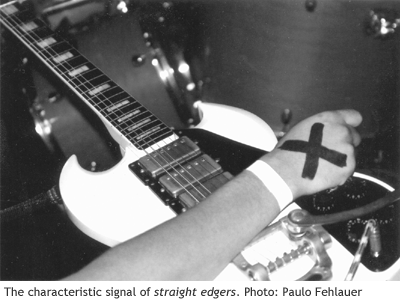
Analyzed by Bruna Mantese in her master's dissertation, the straight edgers were included in the 'Metropolitan Pathways' research project due to their particular form of using space and the exchanges they maintained with other urban groups and figures. Rather than comprising an exotic group, isolated and confined in some ghetto (as a common sense view would tend to think), they have, on the contrary, a strong visible presence in the urban setting and participate actively in its dynamic. Of course, their behaviour is fairly distinctive and differs from what might be commonly expected from a group of young people. Originally a variant of the punk movement (with which it still shares its musical style and something of its 'aggressive' look), they present significant differences, however: against the consumption of drugs and alcohol and opposed to sexual permissiveness and homophobia, their most marked trait is commitment to vegetarianism and, in some cases, a more radical version, veganism.
The latter variant prohibits not just eating meat, but also the consumption of any product of animal origin or any product that is linked during its production and/or research process to any kind of use of domestic or wild animals. In compliance with this principle, the group's festivities are called verduradas (veggie barbecues) - in opposition to the more typical churrascadas (barbecue parties)or cervejadas (beer parties). It is precisely this commitment that explains the apparently paradoxical link which the straight edgers maintain with nor more or less than Hare Krishna followers, very often responsible for the food served at their parties.
The young people identified with this movement comprise a good example of surprising exchanges and meetings: as well as the contact with Hare Krishna devotees, they frequent spaces linked to the anarchist and environmentalist movements as a political choice. Nonetheless, they have preferential locations for parties, meetings, and even places to live that are known to everyone and spread through direct contacts and internet discussion lists. The field research conducted by Bruna shows the existence of an extensive circuit frequented by the group, formed by vegetarian restaurants, ice cream parlours, record stores, shops selling natural and organic products, show venues, anarchist cultural spaces, and so on.
]]> Among the various aspects to consider in relation to the straight edgers, we can highlight those that justify their inclusion in the research - two examples of relationships with city spaces and installations with which they establish bonds and where they can better express the particularities of their lifestyle. The first of these examples shows the occupation of an already existing institutional space - in this case, the Associação de Grupamento de Resgate Civil, whose head office, rented by for the green parties (verduradas) became governed for the duration of the event by the group's norms and values: only vegan food was eaten, while alcoholic drinks, drugs and cigarettes avoided; no bouncers were hired; and the tapes, CDs, books and other items being sold were clearly identified with the group's values.The second example of relation, which enabled an interesting ethnographic accompaniment, shows the transformation of a commercial establishment without any prior link to the ideals of the group into a reference point for them. This was the Soroko ice cream parlour, on Augusta street, which, as the straight edgersstarted to frequent it, began to sell ice creams without the interdicted ingredients - principally milk, which was replaced by soya - and ended up becoming a 'point' for the group members not only from the São Paulo capital but from all over, including abroad. Augusta street, where the ice cream parlour is located, has turned into a hot patch for the straight edgers, in part because of the relatively low price of flat rental, in part because of the location itself, which allows easy and rapid access to two central urban areas of interest to youths from the movement: the city centre properly speaking (with its supply of vegetarian restaurants, products from the shops in the Grandes Galerias shopping mall, better known as the 'Galeria do Rock,' and the budget prices of many consumer items) and the Avenida Paulista.
In sum, the straight edgerscomprise a clearly defined circuit in the city, establish links with other circuits and their frequenters, and in their movement through these circuits, describe various routes that allow them to discover one aspect of the city's dynamic, appropriate for a youth sector that, instead of dissolving into overarching and redundant categories, mark their presence and lifestyle in a public and visible form in the metropolis's landscape.
'Black' parties and samba circles
The fieldwork on this theme was began by Márcio Macedo on the 'Field research in anthropology' course run by myself on the undergraduate degree in Social Sciences at FFLCH/USP. This study was later taken up again by Márcio, who looked to trace the history of the black presence in the city centre and, based on this occupation, describe routes within a specific circuit of young black people in the São Paulo night.
'The centre is black, man!,' and this is no recent phenomenon. Remaining close at home and taking as a reference only the occurrence of dance halls, it is possible to go back to prior to the era of the Frente Negra Brasileiraiii (FNB) in the 1930s, with their social balls in the moulds of the recreational and social clubs of immigrants or the São Paulo elite: around 1910, there were already reports of the expression 'ballroom black' to designate club goers who, in family events and home dances, stood out through their more refined manners and attire, acquired in the city centre's dance halls.
The ethnographic exercise proposed by Márcio for the research project 'Metropolitan Pathways' was focused initially on the significant presence of black youths in the city centre at the end of the work on Fridays, gathered at a samba circle colloquially named 'Bandit Samba' or 'Dom José Samba' (a reference to Dom José Gaspar Street, the location for the event), and from this event, traced the black circuit across a number of different regions of the city. This meeting point in the centre - on the pavement of one of the streets taken over during the day by street vendors and their products of dubious origin (clothing, trainers, baseball caps, DVDs and so on) who slowly give way to sellers of rap, R&B and samba CDs, and drink carts - is located in front of a unnamed snack bar. And the street boils! It comprises a kind of happy hour for the young workers of the region and a starting point for the night that, in its black version, promises to be good...
Three venues were studied, each differing in terms of its surroundings, the type of music and dancing, the clothing used by frequenters, their purchasing power and the proportion of black and white youths. The first, called 'Sala Real,' is found in the Boca do Lixo (a red-light district), in the city centre; the door tickets are cheaper, most of the clientele is black, there is a strong presence of hip-hop and the music is predominantly international. The other is 'Sambarylove,' in Bixiga: the public is also mainly black, coming from all over the city as well as the interior of the state (brought by excursion coaches); the musical options are more varied: samba, samba-rock, axé music, rap, R&B, raggamuffin and 'melodia' (slow). While in the Sala Real, the sound is considered underground, here it is more 'commercial.' The third venue is the 'Mood Club,' in the Pinheiros district: more middle-upper class, it provides valet parking and has its own web site. The public is mostly young and white. Although the interaction between black and white clubbers is slight, the consensus is that the venue's attractions include the possibility of inter-racial encounters and flirting and more refined music, described as 'underground.' The music played -R&B, rap and raggamuffin - is largely international, there is no pagode or slow music. Another attraction of Mood, targeted at middle class black youths, is that spaces such as this club can be associated with a notion of 'distinction' à la Bourdieu, or in other words, they aim to create a lifestyle representative of a class condition. Within this logic, being in a more refined, expensive, comfortable, and racially heterogenic location makes total sense.
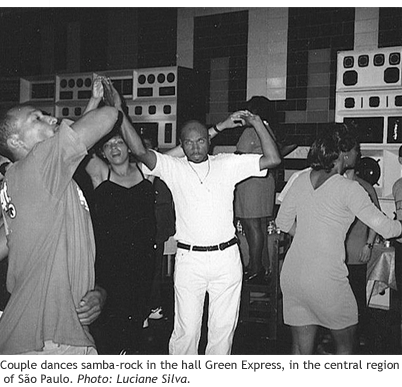
Vila Madalena properly speaking does not feature any venues identified with black music: some of them offer this style on certain days of the week - and, in this sense, also make up part of the black youth circuit -for a more diverse public. Something very interesting observed in this circuit was the tension between a posture of 'affirmation' and the appropriation of the internationalized black style on the part of a wider public, which in some ways enables encounters and contacts.
But it should not be forgotten that leading the circuit and establishing specific routes in the 'black night' is the 'Bandit's Samba,' which relates not only to a historic occupation of the city centre by black youths, but also a type of affirmation that refers doubly to stigma: the danger attributed to the overwhelming presence of black people and, to a lesser degree, the samba, just one more item (and not always the most valorized) in the black youth scene and in their forms of affirmation.
B.boys and streeteiros (street dancers) at the Conceição metro station
There were two points of interest for including the theme - developed by Fernanda Noronha, Renata de Toledo and Paula Pires - in the 'Metropolitan Pathways' project: firstly, the occupation of the Conceição metro station in the south zone of São Paulo, following the Paulistano hip-hop tradition which initially, in the 1980s, occupied the São Bento station in the central region. In both cases, these stations provided an ideal space for the practice sessions/displays typical to this form of manifestation. The other aspect is the contact and exchanges between two groups - japas and manos - which, judging by their background, social class, aesthetic tastes, routes through the city, would seem unlikely to establish any link.
The japas are street dance practitioners, while the manos perform breakdance; the first are middle class, descendents of Japanese immigrants, private school students; the second group are from the south zone's outskirts, already in the work market.
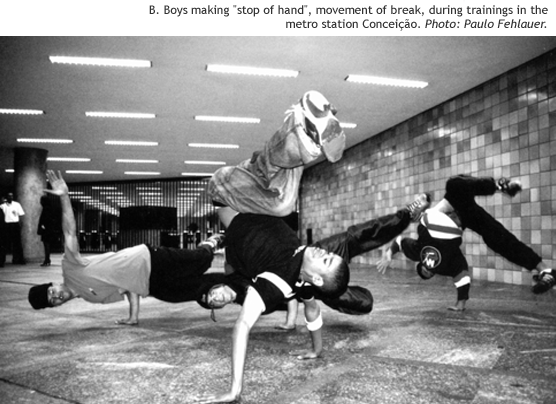
The manos, or b.boys, who have been performing for over five years in the Conceição metro station, practice the breaking (broken beat) dance style linked to hip-hop. This style demands greater physical exertion, including warm-up exercises, and the presentations are more individualized, culminating in the rachas or duels. The b.boys criticize the streeteiros, whose dance in their view is no more than a mixture of styles without the rigour of breaking; furthermore, they lack the 'knowledge', a fundamental element of the hip-hop style.
]]> The streeteiros, who have been frequenting the Centre for three years now, perform a more group choreographed dance, which demands less physical fitness and strength, but greater synchronization of movements: the mirrors of the Centro Empresarial play a key role in perfecting this kind of dance performance. They usually rehearse on Saturday mornings and afternoons before taking part in competitions in student residence events. They do not identify with the style that they themselves call japinhaiv (backcombed fringes, coloured hair locks, shaven napes), preferring the 'big' trousers, Pixa-In Hip Hop Wear t-shirts, tags and so on, identified with the hip-hop aesthetic. The girls from the group, however, still use fluffy animals and pendants on their back packs, and stylized mobile phones are the rule.Nevertheless, they share the same space - and the inevitable tensions with security guards and employees due to the noise and the use of the facilities in a space where the public and private lack any clear boundaries - as well as the same generic name of 'street dancing.' In addition to those already highlighted, the differences are related to the ways they travel through the city, the school calendar and holidays, the length of the working day.
But the specificity of this topic resides in the fact that the Conceição metro station is a point of intersection between two circuits that in principle would have little reason to meet. However, their actors share the same space, enter into contact and establish ties. The relationship is hierarchical but opposite to the one that would be expected on the basis of social indicators for typical income, school education and so on: here, the japas recognize the superior technique of the b-boys and learn street dance manoeuvres and fashions from them.
The Vila Olímpia leisure patch
The interest of this research topic, chosen by Clara Azevedo and Ana Luíza Borges, resides in its description of a typical patch and the dynamic of spatial occupation in a remodelled, middle class district. It provides a counterpoint to Bixiga district, the first patch studied by the NAU - which remains in place, now more focused on the theatre and restaurants. The party migrated: in the 1990s, Vila Madalena district became the hot patch, joined more recently by Vila Olímpia. There is a striking difference between the former and the latter: following the tradition of the district, a well-known enclave of young university students, underground artists and hippies in general during the 1970s, in Vila Madalena the atmosphere is 'intellectual,' or cult, cool, roots... Vila Olímpia, on the other hand, is more popular with people who are into shopping malls, fashion shows, clothing and top-brand accessories, and new cars.
In 1995 the entire region was included in an urban revival project that altered and extended Faria Lima Avenue, with the aim of opening a new business and commercial centre, which obviously awoke the interest of the real estate sector. In fact, the 'new' Faria Lima became a business centre - with shiny office buildings, and designer brand stores - which transformed at night: at the end of the avenue and in the nearby area, there are around fifty establishments providing leisure and entertainment activities, as well as places to meet.
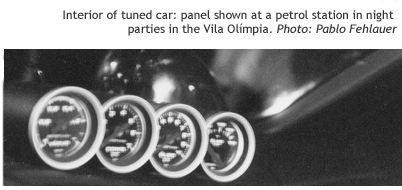
Passing through the area by foot, car or motorbike, parading and taking in the movement is fundamental. The street thereby turns into a space of friendly sociability that intensifies with the bustle in front of the nightclubs. The line for buying door tickets itself provides an occasion for being seen, observing and checking each other out, and means much more than the wait to enter the club: if the line is long and slow-moving, it is a sign that the club is doing well, 'bombando.' piping hot. Cars are a key element in this process of being noticed, whether they are imported from other countries or 'tuned,' that is, visually modified: the open windows - a flagrant inversion of the logic of security that dominated in the city during the daytime - allow the first contacts, flirts and chats.
]]> The clubs present a kind of ephemeral stability, opening and closing in a rhythm that recalls the seasonality or programmed obsolescence: they last two or three years and then close or change their name. Inside the establishments, with their expensive admission and drink prices, a number of special figures stand out such as the promoters and the VIP guests, who ensure the 'social level' of the club. Distinction begins with clothes; on the websites and flyers, there is usually a clear reference to the ban on people wearing football shirts or sleeveless tops, flip-flops, baseball caps. In the web chats and even in media articles, this distinction takes the form of a clear stigmatization: the 'flip-flop baianada,'v the 'povão,'vi and the 'ambient polluters,' in contrast to the 'select few,' the 'well-born' folk.
However, this patch includes a particular feature: the presence of a petrol station at the intersection of the Juscelino Kubistchek Avenue and Brigadeiro Faria Lima. In contrast to what one would usually expect from this type of establishment - a place for filling up the car or stopping quickly to by something in the convenience store - it transformed into a meeting point and even a place to hang out. For many, the balada, or 'party,' in Vila Olímpia begins and ends at the petrol station. The 'Station Mafia' gang, for example, have their special car parking privileges: the station is their turf, with their own shared codes, norms and rules.
In sum, as statedin the Blog Vila Olímpia, this is not just 'the' local place, but also 'the place for those in the know' about what is hot party-wise in São Paulo. Signs of distinction, prejudices and mechanisms of exclusion/inclusion occur both within the night clubs and outside, in the queues, cars and petrol station: as the ethnography shows, the strategies of differentiation through which identities are constructed and delimited can range from friendly to violent. All in all, we are faced with an impressive setting, a 'hot patch in movement,' since, as the research study's authors took care to describe, its borders are already encroaching on other districts, incorporating sections of adjacent roads.
Galeria Ouro Fino, a pre-rave meeting point
Galeria Ouro Fino, the shopping mall studied by Carolina Abreu - a reference and meeting point for a specific circuit, the rave scene - can be seen both as an example of permanence and renewal. The mall located on Rua Augusta (itself an icon for pioneering fashion and behaviour) is situated in the middle of a patch in the Jardins area that also includes Rua Oscar Freire, whose sophisticated design label shops establishes a clear contrast with the shopping centres. Galeria Ouro Fino, opened up at the end of the 1960s, can also be considered a patch for a different crowd: the young public of Galeria do Rock, located in the city centre.
After a period of decline and stagnation in the 1980s, from 1995 on, the mall has become a reference point for people interested in the rave parties that started to take place in Brazil, following aesthetic, behavioural and musical movements acquired in London, Paris and New York. Raves are music and dance festivals that last roughly fourteen hours, fuelled by electronic music and psychoactive drugs. Despite being frequented by urban youths, these events usually take place in rural areas (ranches or farms with a lot of greenery, waterfalls, beaches and lakes) or in disused warehouses rented on the outskirts of big cities. In these spaces, stages are assembled to host a variety of activities: music and dance, chill out areas and places where friends can gather, the whole aiming to create an effervescent communal atmosphere.
While raves repeatedly choose new spaces for the festivals, revealing their fairly ephemeral nature, a fixed spatial reference point is maintained in Galeria Ouro Fino, which enables the mobility of the festivals and sustains the circuit. The mall is the place to pick flyers, find accessories, clothing and admission tickets for the raves; it is also the departure point for the convoys of coaches heading to the festival site. There - and there only - it is possible to find under the same roof clothing with psychedelic fluorescent designs, lightsticks, platform shoes, vinyl records of electronic music, pick-up needles, juggling equipment, glitter makeup, designer sunglasses, body piercing services, tattoos, hair dyeing, as well as hook up with some of the friends who will be dancing together in the latest rave, not to mention the djs who perform at the festivals.
Although Galeria Ouro Fino has become a reference point for the electronic 'scene' over the last ten years, in general, it is not the exclusive territory of electronic music followers. As mentioned b local shop clerks, the place is frequented, in fact, by a wide range of figures: stylists beginning their career, clubbers, trance music fans, techno fans, cybermanos (suburban clubbers who walk or hitchhike to the raves), neighbourhood residents, long-term clients, artists, gays, people from the fashion industry, and, more recently, rockers and the hip-hop crowd - Not only did the mall come to be a shopping mall but it is also a convenience centre for the gathering of diverse people who are usually associated with the adjective 'modern' representing the avant-garde in fashion and lifestyle, dictated by global trends.
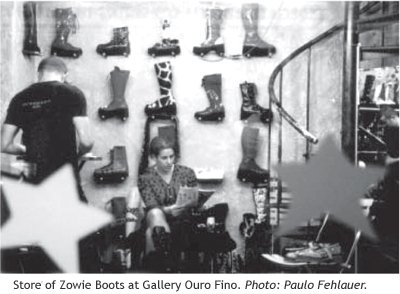
In sum, the mall belongs to the 'fashion world' and comprises one of the points on the global electronic music circuit among today's big cities. It is also a fixed reference point for the itinerant raves and their specific - and equally global - circuit, which includes locations as diverse as Ibiza,Trancoso and Goa.
University forró
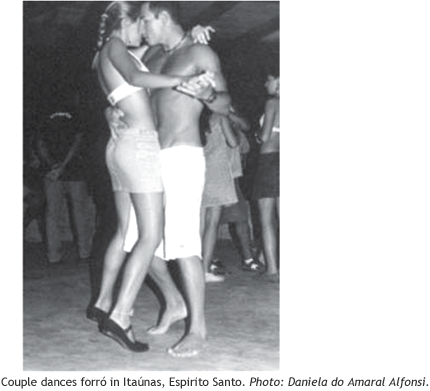
Daniela Alfonsi has been studying this topic since her time as an undergraduate, first with a Fapesp Scientific Training grant. Now on her master's course, funded by another grant from the same institution, she has expanded her empirical subject matter. The university forró was included in the set of research studies grouped in the 'Metropolitan Pathways' project due to its focus on a particular space of the city, configuring a patch, at the same time that, as a circuit, it expands and extends beyond São Paulo to include other regional capitals and cities of Brazil's southeast, beaches in the south of Bahia and the north of Espírito Santo, especially Itaúnas, where, as one of the versions on the origins of university forró states, 'everything began...'
This is an example of the invention of behavioural patterns involving musical tastes, entertainment places and dancing, which is widely dispersed among middle class college and high school public between 15 and 20 years old, and is seen as a case of appropriating and glamourizing the musical tradition of migrants from Brazil's northeast, who continue with their own forró halls, such as Tropical Dance, Patativa, the North-eastern Traditions Centre, and so on.
It is interesting to note the way in which middle class youths ended up adopting this tradition, 'discovered' as a leisure option at holiday and summertime resorts on beaches in the south of Bahia and the north of Espírito Santo, and later cultivated in a number of top universities and schools in São Paulo city and which went through a number of adaptations, gaining recognition from musicians, producers and the wider public as a new form of enjoying dance and music, which does not deny its origin but modifies it.
The places in São Paulo city where this type of entertainment can be found are located at the Largo de Pinheiros, in the west zone, a popular and busy commercial centre, and a point of intersection for buses and street vendors. Here there are - or in some cases, used to be - a number of forró clubs (Tropical Dance, Sandália de Prata, Asa Branca) frequented by the migrant North-eastern population, but which receive little approval from the middle class residents of the region who see these clubs as catering mostly for 'doorkeepers' and 'housemaids.' They accept the 'university' version of this dance style, 'the kind your mother lets you go to,' but not the infamous 'risca-faca' (literally, 'risk-a-knifing') dance halls. This new version of forró emerged in the 1990s and took the form of a patch at the intersection of the Teodoro Sampaio and Cardeal Arcoverde roads, which featured and still feature the main forró clubs in São Paulo city, such as the extinct Projeto Equilíbrio and Elenko KVA Cultural Centre and the present-day Remelexo Pinheiros and Canto da Ema.
The dances begin at 11pm, when the patch's roads are filled with trailers and vendors selling accessories and drinks - xiboquinha (a spiced sugarcane rum liquor), catuaba (bark extract), pinga (sugarcane rum) with honey, cipó-cravo (a cocktail made from sugarcane rum, liana and cloves) - and the groups are already rehearsing their dance steps. Inside the clubs, the music is played by a band or trio, and a distinctive form of dancing is cultivated, different to that practiced at the North-eastern Traditions Centre clubs for example: lots of turns, spins, twirls, mixed with samba-rock, gafieira and salsa steps. Typical female clothing includes small bags tied with shoulder straps that do not to be removed while dancing and 'Chinese' style dance slippers made from cloth with shallow soles that, according to the frequenters, facilitate dancing.
However, the university forró does not stand out in the São Paulo youth circuit just because of its creation of spaces for the dances, its specific ways of dancing or its typical clothing. Behind these elements, there is a discourse concerning what is supposedly the true origin of forró,vii the 'root' forró, which according to producers, musicians and dance hall goers has been 'rescued' by university forró. New bands, formed by young people, emerged to defend this idea, once again distancing themselves from the 'risca-faca' forrós popular with migrants from the northeast and the population with lower incomes.
A fundamental aspect in terms of the shaping of this set of ideas concerning the origins of true forró is the link between the dances in São Paulo and the coastal village of Itaúnas in the north of Espírito Santo. Visiting Itaúnas, dancing and playing on its beaches and forró dance floors is an important value for those who enjoy this style of forró. There, young tourists coming from the big cities of the Southeast, like Rio and São Paulo, meet and swap information, music and dance steps. Through these encounters, the balls of Itaúnas, as well as those of the home cities of these tourists, are also modified.
In São Paulo, the apparent homogeneity of the dances conceals subtle differences that configure different routes within the city, as Daniela describes:
[...] if the person is interested in clubs that play forró and reggae, he or she would definitely frequent the KVA on Fridays and Saturdays, which hosts a reggae disco in the so-called 'Our Minister Room,' as well as forró in the 'Reboco Room' next door. Fans can also frequent a 'balada' called Jamming, which has taken place since June 2002 every Friday at the Ipé Club, in the Ibirapuera district. This venue features a disco and presents reggae and forró bands, or, to be precise, 'forreggae' bands. And they very probably also frequented the Projeto Equilíbrio, which also specialized in this dance style before closing its doors during the first half of this year.
Others routes are traced in accordance with the degree of 'authenticity' attributed by the forrozeiros to the forrós with which they come into contact. Consequently, the dissemination of the genre and its appropriation by the market provoked the tendency for some people who hold dances for invited guests only to recover the forró 'of the past' as a form of warding off vulgarization and commercialization. Contact is made by e-mail only to 'well-known people,' 'those who really like forró;' the dances take place in unconventional spaces, such as friend's houses or halls rented for just one night.
In conclusion, the research into the university forró shows how the category of patch functions (in the study based in São Paulo city) as well as those of route (likewise, São Paulo based) and circuit, which includes São Paulo, Rio de Janeiro, Belo Horizonte, Brasília, Vitória, Campinas, Caraíva (BA), and Itaúnas (ES). Using these categories, the author shows the relations at work between the different forms of dancing forró in São Paulo practiced by the 'north-eastern migrants' or the 'university students.'
Young instrumentalists
The Scientific Training research project conducted by Camila Iwasaki, now concluded, on sociability among a particular group of young people, based on musical and leisure tastes, emphasized the category of circuit and highlighted the spatialization and the insertion of the practice in question in a patch - material which allowed her, in turn, to describe a distinct lifestyle, combining leisure and work.
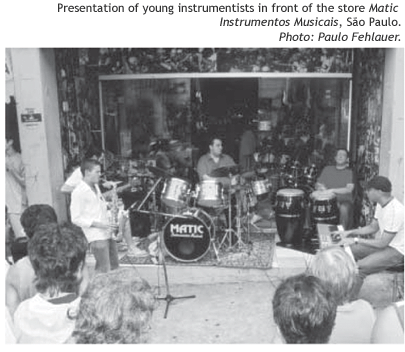
Saturday afternoon, Teodoro Sampaio Street, the Pinheiros district, west zone of São Paulo city: on an improvised stage on the pavement in front of a musical instrument store, Matic, a special kind of instrumental music 'goes down,' heavily improvised. The protagonists are young people who devote themselves individually (they do not form bands) to instrumental music and turn to into a source of leisure and socialization, and a means of living. The presentations in this location are playful in nature and marked by particular rules: accompanied by girlfriends or wives, they busk for themselves and friends; it is their moment of leisure, of building ties and getting to know other musicians from this circuit. Nearby in the Benedito Calixto square on the same day, increasing the agitation, a heavily-disputed and traditional antiques fair is taking place. The store is a reference point and meeting place for these young people aged between 19 and 30, for whom instrumental music is a source of pleasure, a means of living and a lifestyle. They are guitarists, drummers, pianists, double bass players, and saxophonists who reveal a paradox: they are young people yet they appreciate and practice a form of music many consider to be 'old people's.' They give lessons, perform in night clubs and, precisely because they earn very little in these presentations, not enough to provide for themselves and their families, they play professionally in groups that provide backing support to singers with a highly visible media profile, like Fábio Junior, Família Lima, Vanessa Camargo and others. However, they nurture a profound disdain for this type of music, which they consider commercial, mawkish, and of low quality: in this case, it is a question of work, not leisure.
]]>
In general, they begin to become interested in purely instrumental music as a hobby in their spare time, but end up being absorbed by the practice: many even abandon their secondary schooling to devote themselves full time to what they call 'good quality music' that is difficult to play, complex and demands dedication. They form small groups, guided by hierarchies (they have their select few, the 'best,' positioned at the top of the pyramid), with codes of etiquette that determine the order of presentation, the jam session players' and the invites.
As well as the Matic store, other reference points making up this circuit can be found in this pacth formed by lutheries and shops that sell sheet music, CDs, instruments, accessories and so on, such as the Souza Lima conservatory, and other establishments such as bars and night clubs, the Supremo Musical, The Hall (Jardins), Blen Blen Brasil (Vila Madalena), Villaggio Café (Bixiga), and Garoa (Moema). This circuit expands at state level (Tatuí, Campinas), as well as national and even international level, which is where the 'best' players (Egberto Gismonti, Airto Moreira, Hermeto Pascoal) work and are recognized.
As members of a recognizable group in the metropolitan landscape, the young instrumentalists studied in the research display common features in their behaviour that go beyond their musical practice, although they depend on the latter. They live and off the night, including for everyday activities and needs, such as studying, making purchases in 24-hour stores, using cash machines, frequenting gyms and so on; São Paulo allows this day/night inversion more easily.
Hence, the combining of work and leisure, centred on their music, and the use of urban installations shape a particular lifestyle marked by a day-to-day unpredictability that demands improvisation in response - just as these musicians do in their style of playing. But even in this unpredictability, there is a guiding thread: music.
The taggers
The tagging phenomenon, a topic studied by Alexandre Barbosa Pereira from his undergraduate work to master's degree, was included in the set of studies covered by NAU's 'Metropolitan Pathways' project due not only to the use of the circuit, route and turf categories, but also the identification of two native categories - the 'ponto' (point) and the 'quebrada' ('plot') - and the first attempts to analyze them in more depth.
This is a highly visible topic - tags are found painted on the facades of buildings, monuments, windows and walls across the city - and that generates a variety of (always negative) reactions, as well as attempts to explain the phenomenon, ranging from its reduction to acts of pure and simple vandalism to their interpretation as a display of adolescent rebellion. Typified by the absence of messages intelligible to the rest of the population, the tags - whether they are protests, declaration of love, or whatever - consist of the painting of names and nicknames with stylized letters that are difficult to comprehend, preferentially in locations that are widely visible but difficult to access. As well as the author's signature and a reference to the region of the city where they came from (ZO, zona oeste, 'west zone,' for example), the tag also possesses a 'grife' (or 'brand label'), a mark of belonging to a wider group of taggers.
]]> An element correlated to tagging is graffiti, which, however, is seen as a form of art, not as dirt or pollution. Both forms trace their origins to New York in the 1970s. In São Paulo, the same decade saw the appearance of the interventions of Alex Vallauri, while in the 1980s 'American' style graffiti started to predominate, linked to the hip-hop aesthetic. Although most analyses emphasize the contrast between these two forms of urban intervention, the relations between graffiti and tagging are much closer and much more complex.The main meeting point for São Paulo taggers is the São Paulo Cultural Centre, a facility run by the municipal Culture Office, which is located next to the Vergueiro metro station. Its range of functions - library, spaces for studying, rehearsal and theatre shows, a meeting place for RPG players, among other activities - certainly were not planned to include providing a meeting point for taggers. Until 2000, the 'point' for the taggers was situated on the Memória hillside, a location that became impossible for them to use due to the constant presence of the police after this area underwent a restoration project.
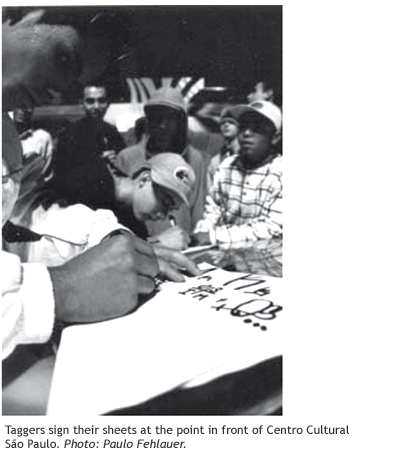
The youths therefore migrated initially to Rodrigues Alves square and later to the vicinities of the Cultural Centre, locations close to the Vergueiro metro station. This use of public spaces associated with metro stations is common on the part of young people linked to street activities such as hip-hop; in this sense, the São Bento station is a reference point and, more recently, the Conceição station, where the b-boys and streeteiros meet. The taggers, in changing location, found the space of the square already occupied by the artisans - the 'alternatives,' as they call themselves - with their forró, MPB and rock, with whom they began to share the space, drink and also marijuana.
At the 'point,'etiquette is marked by an attitude of 'humility,' which means shaking hands with everyone and swapping 'folhinhas' (sheets kept in folders with 'signatures,' including those of famous taggers), and by appreciating collections of articles and newspaper reports on facts linked to tagging, which are exhibited as de facto trophies. It is here that they arrange the 'rolés' (collective trips to tag at a particular point of the city), recount their deeds, establish alliances around 'grifes' ('labels'), argue their differences and resolve conflicts, generally caused by 'atropelo' ('running over') that is, the act of tagging on top of another tag. The origin of the conflict between two famous 'labels,' the 'Registereds' (RGS) and the 'Dirtiers,' for example, lies in a 'running over' whose narrative circulates in various versions among the taggers. They also hold birthday parties that are held in the neighbourhood. The paint material they use is purchased in the mall on 24 de Maio street, a well-know meeting place for many groups and members of a wide variety of youth 'scenes.'
The best place to tag, according to the youths, is the city centre, since taggers from all regions pass through this area: 'it gets more viewers,' they explain. The sociability of these youngsters starts in the neighbourhood - more precisely, in the 'quebrada,' a spatialization something similar to the turf - and extends to the whole city in different routes. The term 'quebrada' carries a connotation of both belonging and danger, and an invitation to tag in the other's quebrada is seen as a friendly gesture.
Hence, the tag circuit is constituted by the central 'point,' the regional 'points', the quebradas, the mall and the events, within which the Vergueiro 'point' is the place where this circuit is connected and from where various routes depart. And it is indeed true that the meaning of the tags is unintelligible for anyone not from the turf since, as the taggers themselves explicitly confirm, they have no wish to communicate with the rest of the world, only among themselves: the tags are for people who 'know how to read the wall.'
]]> Closing the circuit
Due to size limitations, the summaries of two research studies had to be left out: one on the circuit of festivals and dance spaces of young Evangelical and Charismatic believers (the latter linked to the Catholic Church), which, were it not for the explicit mention of biblical terms or references to saints in the music lyrics, would be no different to any other 'balada' of the São Paulo nightlife.12 The other study is on goths and focused on the group's web presence through discussion lists and e-magazines that comprise what the author calls 'electronic turfs.'13
The first thing that the ethnographies show when read in conjunction is that the circuit encompasses the other categories, and that the latter appear in combined rather than independent form, thereby capturing the complexity of the cultural practices studied. It could be seen that the application of these categories took an innovative form: instead of the isolated use of one or the other, the project aimed to capture the connection among many of them, enabling each group to be seen in a wider form and in relation to others. It is not enough, for example, to identify a turf of the goths or the patch of the university forró: their manifestations and the use that their frequenters make of the city take the form of a broader set of strategies and choices. Furthermore, these groups cannot be seen independently, closed in their enclaves or confined to some areas, since their routes through the urban landscape enable them to establish a more varied spectrum of connections and contacts.
This is the dynamic of the youth circuits: neither pulverized or isolated, nor adrift in the city. Hence, we move from the categories considered individually (turfs, patches, routes etc.), to arrangements that articulate and hierarchize two or more of them in stable, recognizable patterns: in some cases, exchange regimes between a variety of social actors and, in others, patterns in their insertion in space and circulation through it, or in the use of installations, or in frequenting meeting places and even in the outbreaks of conflicts.
In many studies on young people, the city - taken as a background for their cultural practices - is presented either as an undifferentiated setting for their flows, or in atomized form, divided into fragments. In both cases, the city emerges as an inhospitable environment for wider forms of exchange and communication. Now, what the protagonists of the different practices described in this article clearly show is the occurrence of ways of using space that are not limited to a local inscription, nor abandoned to the whim of directionless movements through the city. For the purposes of our analysis, it would be little use listing the so-called 'tribes' - taggers, punks, goths, skaters etc. - in an open list, linked to this or that spatial landmark (street, alley), or wandering in aleatory form like addressless nomads. On the contrary, what the field research itself revealed seems highly significant: that these groups make the city suitable for themselves and use its installations in accordance with norms and values that provide the basis for very precise choices.
One example, among others, can be seen in the ethnography on the straight edgers and their routes, which include certain vegetarian restaurants, ice cream parlours (which do not use ingredients interdicted by vegan ideals), stores selling pesticide-free products or known for their budget prices (which complies with their anti-consumerist stance), events, show venues and cultural centres - varying between the Sesc Pompéia or the Centro Cultural Vergueiro - when artists or bands linked to their aesthetic-musical taste are playing. This is an 'arrangement,' a set of choices that are far from aleatory and that is concretized in routes worked out in detail and followed in collective form.
Moreover, the straight edgers enter into exchange patterns with Hare Krishna followers (the element in common is the diet without ingredients of animal origin) and with anarchists (they identify with their political proposals and read their literature), and do so in a number of specific points - that can be considered 'bonds' - where different circuits interconnect, as Bruna Mantese showed in her study. In other words, what from a hasty 'outside' viewpoint may look like another example of sporadic contacts, reinforcing the stereotyped exoticism associated with this group, actually has its own logic and reason for being, since it matches the principles governing the ethos of the straight edgers.
The same occurs with the 'japas' and b-boys, each with their own circuit: the 'point' of the Conceição metro station is, however, a 'bond' in the intersection between the groups, who are, it should be noted, fairly hostile in relation to one another. In this shared place, where a hierarchized pattern of exchanges is established, each group cultivates its turf, as could be seen in the ethnography of Renata Toledo, Paula Pires and Fernanda Noronha.
The same applies to the goths, the taggers, the Evangelicals and/or Catholics identified with the gospel style, the young instrumentalist musicians, the forró dancers, the black balada folk, the cybermanos, the descolados, etc.: all of them have their own circuits but circulate - with due care - through the 'points' of other groups that function as nodes in a wider network; these are known routes, sometimes involving treta (fights) following undesired and inconvenient encroachments on the turfs of others. Nothing, though, equivalent to a behaviour taken as spontaneous, free and loose: instead, there are regularities and actions with foreseeable outcomes, as we have been able to ascertain in each of the presented ethnographies.
Thus, based on the data on this movement - exchange regimes, wandering through related circuits and even conflicts between some groups - we can now suggest a classificatory framework in accordance with two axes: relations of approximation and avoidance.
]]>Approximation relations
1. Through affinity of lifestyle and/or social class, and also through affinity of specific interests: this is the case of the Evangelicals from distinct denominations in gospel events or between Evangelicals and young Charismatic Catholics.
2. Through affinity of lifestyle and/or social class, but with differences in specific interests. For example: taggers/skaters/hip-hoppers: the look, musical tastes and even the slang used are very similar, but each group is dedicated to a different practice; another example is the relation between trance music fans and followers of techno music.
3. Through affinity of specific interests, but with differences in lifestyle and/or social class: japas (street dance) and b-boys(breaking); the descolados and cybermanos, at raves; straight edgers and Hare Krishna followers; straight edgers and anarchists; black youths (for whom the black balada [party] is a place of social affirmation) and white youths (who frequent these parties because they enjoy black music).
Avoidance relations
1. Without confrontation: 'the select' versus 'the 'flip-flop baianada,' at the Vila Olímpia patch, exposing the prejudice involved; young instrumentalists versus commercial music, which they detest, but with which they are forced to enter into contact due to questions of work and survival; 'pé-de-serra' forró versus electronic forró; commercialized forró versus 'old-style' forró.
2. With confrontation: skinheads versus straight edgers; skinheads versus goths; taggers from rival grifes, 'labels,' resulting from 'running over' their tags.
This is a provisional schema emerging from reading the ethnographies as a whole, but shows that, despite the ethnographic investment found in each of them in search of the specificity of their arrangement, it is possible to transcend the particularities and aspire to more general models.
Finally, it should be mentioned that as well as using one or more categories in each ethnography,14 the studies identified new terms being used natively. This applies to terms such as point, rolé ('turn' or 'trip'), quebrada ('spot') and cena ('scene'). Some of these appear in the speech of various of the groups studied (such as point, cena, rolé); another, quebrada, appears in one particular group, the taggers, who furthermore attribute a specific meaning to the term rolé - a collective trip to paint in a particular point of the city. Alexandre Barbosa, author of the latter ethnography, indicates some of the features relating to quebrada: this term alludes to a form of belonging fairly similar to the turf, and carries a connotation of danger associated with the suburb.
]]> As a result, quebrada may have two readings: one that points to distance, lacks, the difficulties intrinsic to life in the suburb, but also one that allows recognition, the display of bonds connecting people this or that locality, neighbourhood, town. The allusion to danger, for its part, somewhat surprisingly carries a positive connotation, since it is not just anyone who can risk the quebradas of life. To face the quebrada requires 'humility,' 'due procedure' and the forging of relations, and this sense is present among the taggers, in rap lyrics, in the speech of followers of the various modalities of hip-hop, as a form of valorizing their lifestyles, surpassing the stigmatism of poverty, delinquency and violence generally associated with the suburb.The term point (in English), which appears in several ethnographies, is always used to refer to a single installation, generally large in scale and occupied by various groups, serving as a 'bond' between them, such as the Galeria do Rock, the Galeria Ouro Fino, the São Paulo Cultural Centre, Sesc Pompéia, the Conceição metro station, and so on.
In relation to the term cena ('scene'), we should first note the proximity to circuit, a category with which we can draw a parallel: both suppose a spatialization that extends beyond any clearly localized spatial insertion. In the case of circuit, although it is constituted by physical installations (stores, clubs), it also includes accessing and frequenting virtual spaces such as on-line chats, discussion groups and forums, as well as events and celebrations. As pointed out earlier, what distinguishes circuit from patch is the fact that the first does not present physical boundaries that delimit its range of sociability.Cena, however, despite sharing with circuit this feature of independence in relation to spatial contiguity, is more wide-reaching, since it primarily denotes aesthetic and ideological attitudes and choices connected in and through the circuits. While the latter are formed by installations, institutions and concrete events, the cena is constituted by the set of behaviours (patterns of consumption, tastes) and by the universe of meanings (values, rules) displayed and cultivated by those who know and frequent the 'right' places of a particular circuit. In sum, one can 'frequent' a circuit, but 'belong' to a cena; while the former alludes to networks, the latter refers to social actors, who carry their signs of belonging with them as choices visible in the person's body, clothing and discourse; one is identifiable in the landscape, while the other is manifested in attitudes.15
Conclusion: the modulations of public space
The ethnographies presented in this article have not only shown some of the forms through which young people relate with each other and with the city, they also enable us to consider, in general, how the different social actors present themselves in urban space, circulate through it, make use of its installations and, in this process, establish patterns of exchange and encounters in public areas.
In contrast to analyses that take the public versus private opposition as a classificatory principle, this text shows that we cannot reduce the diversity of young people's destinations and occupations to this dichotomy as though it operates in a clear and univocal form: in fact, both terms have their nuances and modulations. For example, if we take 'home and street' as concrete representations of this dichotomy, 'home' can be seen to pass through a series of gradations; within the house itself, we can distinguish veranda/living room/bedroom/kitchen/yard as different positions between the public/private poles: the living room, for example, is the most public space within the house (cf. Da Matta, 1979). Equally, the street sometimes becomes home, as Carlos Nelson Ferreira dos Santos et al. demonstrate very clearly (1985). I believe, though, that we are not faced with fixed points on a continuum, but positions within a relationship; losing sight of this relational nature of the opposition signifies reifying it, and hence rendering it inoperable as a classificatory principle.
The same occurs with 'street:' despite its emblematic character where through antonomasia it manifests the 'public' as a value, the latter does not exhaust its meaning. Neither should we declare the disappearance or retraction of this value in the context of today's large cities by arguing that the street has become increasingly inhospitable, impeding conviviality and circulation. Or that it has been replaced by other variants:
The very scale of a megacity imposes an alteration in the distribution and the form taken by its public spaces, in its relations with private space, in the role of collective spaces and in the different ways through which agents (residents, visitors, workers, employees, organized sectors, excluded groups, 'deviants' etc.) use and appropriate each of these modalities of spatial relationship. Beyond the nostalgia for the 'old modern road' of Berman (1989:162) or the 'sidewalk ballet' of Jane Jacobs (1992:50), we clearly need to ask whether the exercise of citizenship and the urban practices and rituals of public life do not acquire, in the context of the large contemporary cities, other settings: if so, we need to determine these through the application of an appropriate strategy. (Magnani 2002:15; English version: 2005).
The categories suggested for putting this strategy into practice point towards other forms of manifesting public space, different from those usually associated with the traditional (and restrictive) idea of street. Circuits, routes, patches and even turfs (the latter with their more particularist ties, in the style of a community) comprise distinct modulations of using and enjoying public space: they are different versions of 'street' as a support for the attribute 'public.' Each of these arrangements corresponds to a specific form of making oneself visible, establishing ties, marking differences, making choices, situating oneself, in sum, in the urban landscape face-to-face with others and in relation to them. The experience of the links that these categories describe is not restricted to inside closed groups or ghettoized and protected spaces; rather it is, in various degrees, metropolitan, cosmopolitan (with all the restrictions that various structural factors impose on living conditions in huge cities like São Paulo).
]]> And as is already customary at the end of every article, book or collected writings focusing on urban questions, we find the famous dichotomy 'anthropology in or of the city' (sometimes with the inescapable obligation to ally with one or other of these alternatives) - but why not take a risk and... accept both? Perhaps more exercises like those presented in this article, clearly identified with the perspective of an anthropology in the city - due to their coverage, spatializations etc. - but connected to more general questions on the contemporary urban dynamic, would enable us to move with more securely towards an anthropology of the city that extends beyond the latter's political-administrative boundaries.
Bibliography
Abramo, Helena W. (1994), Cenas juvenis: punks e darks no espetáculo urbano. São Paulo, Página Aberta. [ Links ]
Berman, Marshall. (1989), Tudo que é sólido desmancha no ar. São Paulo, Companhia das Letras. [ Links ]
Cardoso, Ruth & Sampaio, Helena. (1995), Bibliografia sobre juventude. São Paulo, Edusp. [ Links ]
Da Matta, Roberto. (1979), Carnavais, malandros e heróis: para uma sociologia do dilema brasileiro. Rio de Janeiro, Jorge Zahar. [ Links ]
Feixa, Carles. (1998), De jóvenes, bandas y tribus: antropología de la juventud. Barcelona, Ariel. [ Links ]
_____. (2004), 'Los estudios sobre culturas juveniles en España - 1960-2004.' Revista de Estudios de Juventud, 64, March, Madrid. [ Links ]
Ferreira dos Santos, Nelson et al. (1985), Quando a rua vira casa: a apropriação de espaços de uso coletivo em um centro de bairro.São Paulo, Projeto Editores Associados/Ibam. [ Links ]
Goldman, Márcio. (1999), Alguma antropologia. Rio de Janeiro, Relume-Dumará [ Links ].
Guerreiro, Goli. (1994), Retratos de uma tribo urbana: rock brasileiro. Salvador, Centro Editorial e Didático da UFBA. [ Links ]
Hall, Stuart & Jefferson, Tony (eds.). (1976), Resistance through rituals: youth subcultures in post-war Britain. London, Hutchinson. [ Links ]
Jacobs, Jane. (1992), The death and life of great American cities. New York, Vintage Books, Random House. [ Links ]
Maffesoli, Michel. (1987), O tempo das tribos: o declínio do individualismo nas sociedades de massa.Rio de Janeiro, Forense Universitária. [ Links ]
Magnani, José Guilherme C. (1992), 'Tribos urbanas, metáfora ou categoria?.' Cadernos de Campo - Revista dos alunos de pós-graduação em Antropologia. Departamento de Antropologia, FFLCH/USP, São Paulo, 2 (2). [ Links ]
_____. (2002), 'De perto e de dentro: notas para uma etnografia urbana.' Revista Brasileira de Ciéncias Sociais, 17 (49): 11-29. English version: 'From close up and within: notes for an urban ethnography'. Rev. bras. Ci. Soc. vol.1 no.se São Paulo (2005) (http://socialsciences.scielo.org/scielo) [ Links ]
Magnani, José Guilherme C. & Torres, Lílian. (2000), Na metrópole: textos de antropologia urbana. 2. ed. São Paulo, Edusp/Fapesp. [ Links ]
Nilam, Pam. (2004). 'Culturas juveniles globales.' Revista de Estudios de Juventud, 64, March, Madrid. [ Links ]
Pais, José Machado & Blass, Leila (eds.). (2004), Tribos urbanas: produção artística e identidades.São Paulo, Annablume/Capes. [ Links ]
Text received and approved on 9/9/2005.
]]>
José Guilherme Cantor Magnani is Professor at the Department of Anthropology of USP, coordinator of the Urban Anthropology Research Group (NAU/USP) and a member of the editorial board of Revista de Antropologia. E-mail: jmagnani@usp.br
i This article is composed of two chapters (initial and final) which I wrote for the collection edited by Bruna Mantese and myself, entitled Jovens na metrópole, in press, and the summary of some of the ethnographies making up this collection, used here to help develop the argument of the text.
ii [TN] Original title: ‘Tribos urbanas: metáfora ou categoria?’.
iii [TN] the Brazilian Black Front.
iv [TN] Diminuitive – and hence, in this context, somewhat dismissive – form of ‘japa’ (slang for Japanese).
v [TN] ‘Baianada,’ literally a group of people from Bahia. However, this term is used in São Paulo in a stereotyped and prejudiced way for migrants from the Northeast of Brazil and for native Paulistanos employed in service sector jobs – such as maids, drivers, garbage collectors, and so on – considered subaltern by some middle/upper class groups. As a result, people perceived to allude to this universe are pejoratively labelled ‘baianos’ by certain groups. The documentary film ‘Tem que ser baiano?’ (director: Henri Gervaiseau, Brazil, 1993, colour, 32 min.) provides an emblematic expression of the dissemination and pejorative connotation of the term ‘baiano’ in São Paulo.
vi [TN] ‘Povão,’ a crowd of people, generally used to refer to poorer sections of Brazilian society.
vii Forró enthusiasts often comment on the origin of the term. Two versions exist. The first, made official by dictionaries, states that the expression is a corruption of forrobodó, meaning wild revelry, a popular festival. The second, unofficial version, though sung by musicians and widely known, claims that forró is a merging of ‘for’ and ‘all.’ The story goes that at the start of the 20th Century, British engineers stationed in Pernambuco to build the Great Western railway held dances open to the public, advertised with the words ‘for all.’ Thus, the English expression became forró in the Northeastern vocabulary (the closest pronunciation).
1 They form part of my research project ‘Metropolitan Pathways,’ conducted with funding from the CNPq Research Productivity grant. ]]>