Do social networks matter for the access to goods and services obtained outside markets?
As redes importam para o acesso a bens e serviços obtidos fora de mercados?
Est-ce que les réseaux importent pour l'accès aux biens et services obtenus en dehors des marchés?
Eduardo Marques
Translated by David Rogers ]]>
Translation from Rev. bras. Ci. Soc., vol.24 no.71, São Paulo, Oct. 2009.
ABSTRACT
This article discusses the role of social networks and sociability in poor people's access to goods and services obtained from outside the markets. The article uses qualitative information from research into social networks of poor individuals living in segregated places in São Paulo, as well as a control group of middle-class individuals. The results show the importance of networks and suggest that the help that mediates such access depends upon the types of ties and trust involved, as well as the cost of providing the help. The observed processes tend to reiterate inequalities, establishing circularities of poverty reproduction.
Keywords: Poverty; Sociability; Social networks; São Paulo.
RESUMO
Este artigo discute o papel das redes sociais e da sociabilidade no acesso a bens e serviços obtidos por indivíduos pobres fora de mercados. São utilizadas informações qualitativas de uma pesquisa sobre redes de indivíduos pobres que habitam locais segregados em São Paulo, além de indivíduos de classe média utilizados como controle. Os resultados comprovam a importância das redes e sugerem que as ajudas que medeiam os acessos são dependentes dos tipos de relação e confiança envolvidos, assim como dos custos de ajudar. As dinâmicas observadas tendem a reiterar desigualdades, constituindo circularidades de reprodução da pobreza.
Palavras-chave: Pobreza; Sociabilidade; Redes sociais; São Paulo.
RÉSUMÉ
]]> Cet article aborde le rôle des réseaux sociaux et de la sociabilité dans l'accès aux biens et services obtenus par des individus pauvres en dehors des marchés. Nous avons, pour cela, utilisé des informations qualitatives d'une recherche à propos des réseaux d'individus pauvres qui habitent des quartiers ségrégés à São Paulo, outre les individus de classe moyenne, utilisés comme contrôle. Les résultats confirment l'importance des réseaux et suggèrent que les aides qui assurent la médiation aux accès sont dépendantes des genres de relation et de la confiance qui sont engagés, ainsi que des coûts de cette aide. Les dynamiques observées tendent à réaffirmer les inégalités et constituent, de ce fait, des circularités de reproduction de la pauvreté.Mots-clés: Pauvreté; Sociabilité; Réseaux sociaux; ão Paulo.
This article presents the results of a recent study on the social networks of poor individuals living in segregated areas of São Paulo, Brazil. Social networks are analytical representations of contexts and relationship patterns that surround a given social situation. In the case of this study, the patterns in question are those related to the everyday sociability of individuals. The study addressed the social networks of 209 residents from seven underprivileged neighborhoods of São Paulo, with varying conditions of segregation, and a control group of thirty middle-class individuals. The aim was to investigate, through qualitative and quantitative analyses, the characteristics and variability of the social networks of these subjects and their effects upon urban poverty. These effects were gauged from the impact the networks had in terms of facilitating (or not) access to goods obtained from the markets (Marques, 2008), and also to those goods and services important to processes of social reproduction in situations of poverty and obtained through help and social exchange extraneous to the logic of the markets (Marques, 2010). In doing so, social networks produce and enhance social and political inequalities, even amongst the poor.
In this article I will discuss the role networks play in ensuring access to goods and services obtained from outside the markets. The information used herein was collated from in-depth interviews conducted with 20 interviewees from the original pool, and covering a range of types of network and sociability. I presented the interviewees with their networks as previously drawn up and asked them to discuss how they mobilize those networks in order to obtain varied forms of assistance in their everyday lives. Questions were asked concerning migration (including intra-urban moves), house-building, small-scale repairs, help looking after children or the house, aid in times of ill health, the lending of provisions and money, trust and emotional support, match-making, help finding work and information on politics, services and public policies.
I begin the article by establishing certain conceptual platforms required for the construction of my argument. I will then describe the main research procedures adopted and provide a summary of previous results. The third section will discuss the types of help provided by and to individuals, with special reference to personal networks. The results reveal the existence of patterns of network mobilization in the act of obtaining social and political assistance. The text will elaborate on these patterns, though all of the names used herein are aliases. By way of conclusion, I will then summarize the main patterns identified throughout the study.
Exchanges, help and trust
In this section I conceptually define the core elements involved in these assistance relations, namely: exchange, trust, reciprocity and intimacy. The aim is not to conduct a detailed conceptual discussion of these categories within the social sciences, or to discuss at length the types of relationship that underpin given social situations, but rather to establish the conceptual bedrock required to understand the subsequent analysis. On the other hand, the study did not attempt to arrive at native categories, but merely to analyze these important processes whilst taking into account the interviewees' own interpretations, without any pretension towards reproducing them.
]]> The assistances analyzed here consist of acts of exchange. In the sense suggested by the classic contribution of Homans (1958) "social behavior is … exchange", but not necessarily based only on rewards and costs and certainly involving only intentionality. These exchanges are intrinsically social (Polanyi, 1980) and involve the swapping of material and immaterial elements, as well as possessing certain symbolic dimensions. Social help and support automatically involve exchange, as they hinge upon the logic of reciprocity, just like those originally studied by Marcel Mauss. In the sense underscored by the anthropological tradition of gift, the elements involved in these exchanges shape whole conjuncts of ample social and symbolic meanings that, in their original formulations, provided interpretive keys to wide-reaching societal elements (Mauss, [1923] 2003).In a more specific sense, these exchanges differ amongst themselves in terms of their more or less impersonal character, spanning a continuum that goes from generalized or impersonal exchanges to the most personalized, restricted and non-transferable (Uehara, 1990; Nunes, 1997), in which the attributes of those involved in the transaction are key. Mercantile exchanges, which can be mediated by money or some other 'currency', are the most intensely impersonal, even if they always involve social relations and, as such, are mediated by a bevy of social, material and symbolic processes (Weber, [1922] 1999; Polanyi, 1980). It is reasonable to assume that, in contexts of poverty, in which diverse types of informality abound in mercantile exchange, the level of impersonality should be lesser. In which case, the economy of exchanges should prevail in the exchanges of the economy1.
Most of the conditions of life in the city involve mercantile exchanges, which leads to the obvious conclusion that those with lower incomes (less well-positioned on the jobs market) encounter greater difficulty in obtaining and maintaining good social conditions. The relationship between the networks and the elements that mediate mercantile exchanges (mainly income and employment) have been treated elsewhere (Marques, 2008; 2010) and will not be discussed here anew. However, assistance-based forms of exchange can improve the living conditions and resolve the quotidian problems of low-income individuals, those who do not have the economic means to buy goods and services through normal market channels.
These transactions involve the exchange of both material goods, such as money, provisions, tools, and other such items, and immaterial goods, such as information, affection, solidarity, emotional support, etc. Furthermore, all such transactions clearly possess symbolic dimensions, such as recognition and prestige. These exchanges do not always involve similar goods or services, and may not necessarily be immediate, which factors indebtedness into the equation of social reciprocity. In a sense, relational patterns are always exchange networks, not only because of what can be channeled through these relationships, but also through the reciprocity involved and the levels of trust and intimacy that sustain them over time. Additionally, the status of these relations can also be transformed by the changing dynamics of exchange, reciprocity and trust, as we shall see further on.
On the other hand, all types of help come at some species of cost to the giver. This cost may include material resources, such as money and goods, but will also involve the time spent in rendering assistance, as well as the operational and emotional investments that entails. Obviously, the costs incurred through these practices are mediated by the existing conditions of reciprocity and can be mitigated, in part, by the types of tie involved. In this sense, the more costly the assistance rendered, the more dependent it will be upon the existence of certain types of tie and levels of trust capable of mediating that reciprocity (offering greater or lesser assurance that one can rely on future payback). However, as I shall show further on, the presence of social reciprocity and trust does not necessarily exclude monetary payments. Â
By trust I understand the surety that one's expectations regarding a given relationship will be met, whatever they may be. For some interviewees, homophily2 is a condition of trust - with individuals claiming only to trust those who share their attributes (or behaviors). For others, there are different types of trust, associated with specific social situations. Analysis of the cases suggested that, depending on the situation; expectations vary according with types of tie, with each requiring its own amount of trust. Of these types, three were identified: personal, professional and political/associative.
The first of these is the most common and concerns how dependable the ego considers its contacts to be with regard to matters of a personal nature. This is associated with intimacy, but only depends on it in relations of trust, as we shall see. Professional trust is the surety the ego has that its contacts will uphold their part of the bargain in professional activities. This type of trust featured heavily in interviews with small business owners and others who rely on regular work colleagues. Finally, political/associative trust, which appeared less frequently than the other two, involves the assurance that one's contacts will deliver on promises made in relation to activities, alliances and political disputes. In all of these cases, trust may occur in horizontal or vertical relations, being compatible with disparities of power and hierarchy.
Different degrees of trust, in turn, are usually associated with different forms of reciprocity. Most of the time, low-trust assistance is associated with the moral and impersonal reciprocity typical of group belonging, as per what Blokland (2003) calls attachments (after Weber [1922] 1999) - i.e., non-instrumental relationships based on rationality and the value of belonging to groups circumscribed within shared identities. It is also associated with more instrumental relationships based on reciprocity via direct barter; or what Luciano, an interviewee from the Jaguaré shantytown, called 'give-and-take' relationships. Whilst the relationships that bind the former are linked with both rationality (deliberate and conscious action) and values, the latter are based on rational, goal-oriented actions in a manner similar to that defined by Blokland (2003), after Weber ([1922] 1999). At the other end of the spectrum, relations that involve high levels of trust are associated with specific exchanges and reciprocity that may be distributed over time and involve different material and immaterial goods. In this case, the reciprocity is wholly personalized and underpinned by a specific type of personal tie.
Intimacy, on the other hand, also rests upon the assurance that the other will uphold his/her part of the bargain, but its focus is on matters of a personal nature that require confidentiality derived from a high degree of trust. In the words of João, a resident of the Cidade Tiradentes housing complex, "intimacy is an open game". Unlike trust, intimacy can only feature in relationships in which differences in hierarchy or power remain slight.
In addition to the different costs of providing assistance, other factors that influence access to help - and therefore to the impact it can have on living conditions and poverty - are the array of types of tie and degrees of trust present in relationships.
]]>Design of the study and earlier results
The study traced the personal networks of 209 individuals living in poverty and of thirty middle-class individuals by way of comparative control. In order to study the effects of spatial segregation upon social networks I chose seven very different locations in terms of distance from the center, degree of consolidation, construction/real estate patterns and levels of State intervention, taking earlier studies on poverty in São Paulo as a base (CEM/SAS 2004) in making this selection. I opted to study personal networks as opposed to community or ego-based networks3, as I believe that a significant portion of the sociability that influences poverty does not take place near the ego's immediate surroundings4.
Thirty interviews were conducted per locale between September 2006 and August 2007. The study areas included central slums, four shantytowns - Vila Nova Jaguaré, Paraisópolis, Vila Nova Esperança and Guinle - one irregular settlement in Jardim Ângela, and the Cidade Tiradentes housing block. A middle-class control group was also interviewed, though at no specific location. In fact, the localization of the middle class indicates a high degree of concentration around the expanded center of the metropolis, though the individual networks can range much further afield and do not include neighbors, configuring what Wellman (2001) calls "personal communities".
The interviews used a semi-open questionnaire and a name generator and interviewees were selected at random during visits to the study locations, made both on weekdays and at weekends5. The middle-class participants were selected from a wide spectrum, seen as the sole aim in their inclusion was to serve as a standard of comparison in the analysis of the other networks.
This data was handled using social network analysis tools, resulting in 239 personal networks6. After running the statistical analyses, I intentionally chose a set of twenty personal networks to comprise the qualitative part of the study, combining types of network, locale and interviewee profile7.The present article explores this qualitative information, revealing patterns associated with the networks and sociability that mediate the access of these individuals to goods and services obtained from outside the markets.
Before we go any further, however, I will briefly present the main results from the earlier stages of the study, so as to better position the reader.
First of all, when compared with the middle-class networks, the personal networks of the poor tended to be smaller, more local and less varied in terms of sociability. Inter-relations between different social and income groups practically do not exist. This is one of the core characteristics of the reproduction of poverty and social inequality, but does not derive from the networks themselves, but rather represents a relational facet of Brazilian social structure.
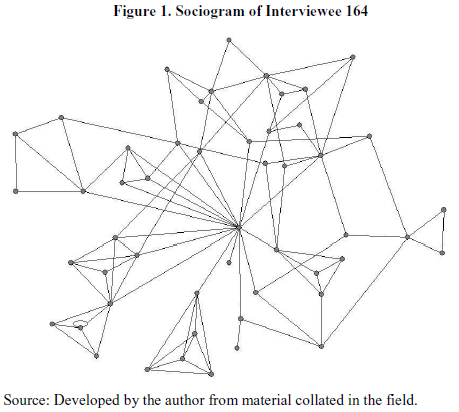
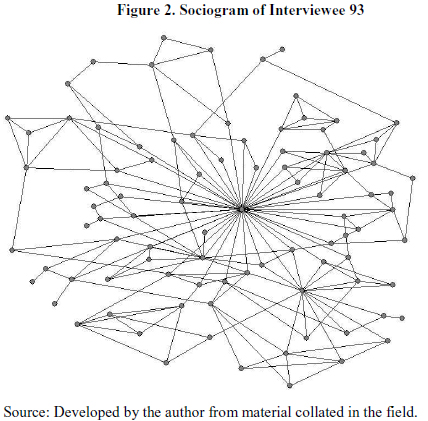
By way of illustration, the following sociograms present the networks of two women, one poor (Figure 1) and the other middle-class (Figure 2), that serve as representative examples of each group. Sociograms are graphic representations of tie patters, in which entities (people, groups, companies, organizations) feature as nodes and relations (of any type) as lines (the ties). As we can see, the first network is smaller, simpler, less clustered and more ego-centered than the second.
]]>
The analysis showed that there are no direct connections between socioeconomic variables and relationship patterns. The networks are influenced by such conditioning socio-economic factors as sex, age, educational level, income, migration, church membership or association and segregation itself, albeit in an indirect and combined manner, generating an intricately complex pattern8. These conditioning factors tend to make themselves felt through circularities that perpetuate social situations and relationships and reproduce inequalities in a way that is persistent but not necessarily categorical in Tilly's sense of the word (2005).
Considering the variability encountered among these networks, I developed two basic typologies of the networks and of the sociability patterns. The findings suggest that, while the networks of poor individuals are generally smaller, more local and less varied than those of their middle-class counterparts, they nonetheless vary greatly amongst themselves. If, on one hand, many of these networks present patterns of sociability both highly local and based on primary ties (of family, neighborhood and friendship), a considerable portion also presents a less local sociability, largely generated within organizational or institutional environments (work, church, union). The overlapping of these heterogeneities suggests the existence of ampler relational patterns, with varied sociability and potentially lower homophily.
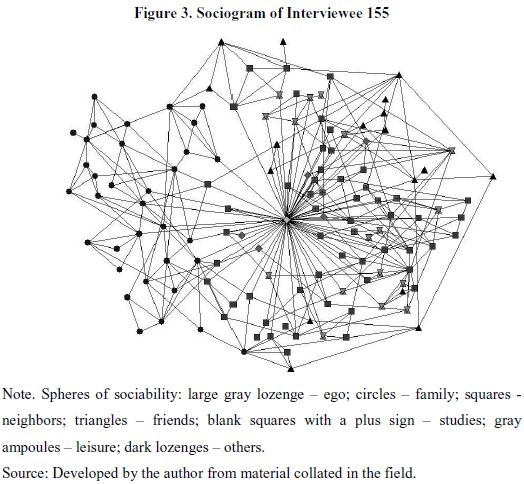
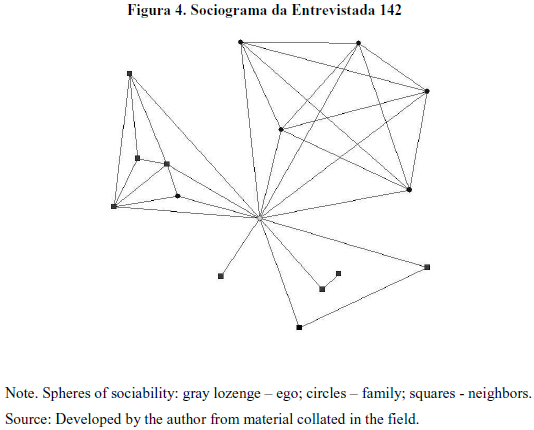
]]> So, in addition to major differences between the group averages, networks and sociability patterns also varied considerably within each group. The following sociograms illustrate the networks of two poor individuals that reveal widely different relational patterns. In Figures 3 and 4, the symbology of the nodes and clusters shows the spheres of sociability in which the ego meets with each individual member of the network.
The analysis that followed specified the impacts the networks had on social and economic conditions. It became clear that employment, including jobs with greater levels of protection, and the absence of social precariousness, tend to be positively influenced by less local and less primary patterns of sociability, unlike more traditional variables, such as levels of schooling, age and income, which did not feature as significant. In addition, alongside the traditional variables, networks and sociability help to explain individual revenues. The results of the multivariate analysis revealed the significance of such factors as household size and educational level. In addition, however, three other network variables associated with networks also showed themselves to be relevant, namely: 1) the type of network and sociability (average, varied networks with not so local and less primary sociability); 2) network size; and 3) variability of sociability; items 2 and 3 interacting, respectively, with stable incomes and segregation. Average-sized networks with less local or primary sociability have positive effects on income (Marques, 2009; 2010). In the case of some segregated individuals, this effect is strengthened by the presence of varied sociability, which helps combat the social isolation produced by segregation.
]]> Nevertheless, it remained to be better understood how these individuals in their daily lives mobilized these networks, since networks are passive structures that are mobilized differently by individuals and considering situations and cirscunstances. The following section, which is based on the qualitative material collated by the study, makes progress in this direction by exploring the use and mediation of sociabilities and networks in the individuals' access to goods and services obtained outside the markets.
Access to assistance
Information drawn from the interviews suggest that the assistance that mediates access to both markets and social support can be grouped according to an overlap between trust, cost and type of reciprocity. Depending on the situation, the reciprocity and trust involved assume a range of shapes and aspects, and the exchange can be more or less personalized. On the other hand, in the specific case of returning each specific favor, the costs, obviously not restricted to monetary dimensions, acquire distinct contents, often mixing prestige, affection, expectation of retribution and money. Another relevant dimension to these costs is the time and personal availability spent in providing the help, as well as its frequency or perpetuity. As such, while relatively little wealth circulates in the world of the poor, the provision of high-cost assistance is very common.
There is an often tenuous line between what is purely a market-structured purchase and what constitutes exchange via social reciprocity, albeit also involving cash payments. In the first case, even though the individuals may know each other, the transaction is purely the purchase of a good or service that could just as well be procured elsewhere. On the other hand, we have social exchanges that may also involve payment, even between very close individuals. In this case, the money is simply one of the dimensions involved in the exchange, which is not generalized, but specific and personalized by the ties of trust involved. Apparently, these cash payments constitute retributions that help reduce the cost of the favor rendered, in addition to such other factors as increased prestige and affection or pay-back for, or the promise of, assistance past or future, in the context of reciprocity.
Considering these dimensions, there are basically three types of observable help: immediate, low-cost help; more constant and costly help; and help involving trust and intimacy. In what follows I will discuss each in detail, illustrated, wherever possible, with examples from the interviews. In general terms, as we move from type one to type three, the required level of trust and tie strength increases, as does the cost incurred. Each type of help is associated with a specific form of reciprocity.
More immediate, low-cost forms of help that require low trust investment
This type include help in times of ill-health, the lending of tools and provisions, looking after someone's home while they are away, as well as the passing-on of information about services and jobs. Â It is typically associated with ties of acquaintance, in which contact is frequent but superficial; the kind Luciano from the Jaguaré shantytown describes as "Hi, how's it going" relationships. In general, this kind of help occurs in relationships with a low degree of personalization and only distant reciprocity. Most of the ties involved are neighborhood-based and easily broken, especially through changes of residence. However, they are also easy to replace at the new residence, though the interviewee may express a preference for those at one locale or the other. The ties that sustain this kind of help basically function as impersonal supports for relations of reciprocity in the provision of everyday assistance. As such, they do not require trust, and the reciprocity is tenuous.
At the root of this type of help lies a diffuse sense of solidarity. If we consider that all types of solidarity are associated with identities, in this case we would be talking about a loose identity or sense of belonging to a large group, such as "we of the community", "the poor", "the brothers of faith" or even just "the human race". The discourse that emerges from the interviews to justify this kind of aid is associated with this sense of belonging to a wider group. As João from the Cidade Tiradentes housing complex puts it, "when it comes to being sick, even your enemies have compassion". Health crises are a perfect illustration for this kind of situation, in which one can often count on the help of neighbors, who might lend a car or drive the sick person to hospital, as in cases related by Lúcia, David, Luciano and Rafaela, from the slums and shantytowns of Paraisópolis, Jaguaré and Vila Nova Esperança, respectively. The ties that channel this kind of aid are normally those that Blokland (2003) calls attachments.
Even though this type of help does not require a base of prior trust, it can be withheld from those who have failed to provide the minimal requirements of reciprocity in the past, whether in a personalized or a generalized form. In the words of João, from Cidade Tiradentes, "I always used to lend tools, but I don't do it anymore, because people don't return them". Conversely, the provision of assistance during a health crisis can serve to deepen the relationship between individuals, boosting one's trust in the person who came to one's aid and perhaps even establishing a higher degree of intimacy. So while neither trust nor intimacy are required in order for someone to provide this type of assistance, given its practically impersonal character, both can be positively (or negatively)Â impacted by the provision (or not) of such help.
]]> Passing on information about employment opportunities can be associated with all three types of help, but it is often conveyed via ties equipped for only immediate, low-cost assistance, especially when it comes to more local vacancies. In its most extreme form, such information can even come from complete strangers. In the case of João, for example, the information that led to his getting a job was given to him in a park by someone he had never met before, while for Ednalva, from the Paraisópolis shantytown, it came from someone she met on the bus. Maria, an unemployed woman from the Jaguaré shantytown, who used to collect recyclables to make ends meet, secured a cleaning job thanks to information from an acquaintance she made when she started to attend a new church. It costs nothing to convey this kind of information and it can be propagated through the weakest possible connections and sometimes even by chance encounters, in a manner similar to the weak ties described by Granovetter (1973).Specifically in this respect, certain locations where information circulates more freely tend to generate potential intersections between the networks of individuals who barely know each other, if at all. In this case, it is not the effect of the network of any given ego, but rather of specific shared spaces that make it possible to tap the networks of people outside one's own network. Antonio's hairdresser's is a case in point. Antonio is also a pastor and the director of a community organization in Paraisópolis. According to the interviewees, that particular space represents an important venue for information exchange and serves as a point of convergence. The same may occur around individuals who are known to have extensive networks. Rafaela, from Vila Nova Esperança, and Antônio and Jorge, from Paraisópolis, say they are often approached by people, sometimes even strangers, looking for information about job vacancies. All three are, incidentally, community leaders with involvement in associative activities.
However, it is important here to highlight a key difference in relation to the results of Granovetter's influential work. The author's arguments about the importance of weak ties to the job-seeker are based on the idea that if a given ego has been unemployed for a certain amount of time, any job that does eventually come his way will not come via strong ties - because if these had such potential, he would probably not have remained unemployed for so long. Technically speaking, the argument derives from an empirical regularity observed by Granovetter and dubbed the "forbidden open triad": if a given ego has a strong relationship with A and another with B, it is highly unlikely that A and B should have no relationship at all. New information is therefore far more likely to reach you through weak ties than through strong ones9.
In apparent contradiction of Granovetter's findings, a significant number of the higher-quality jobs found by the interviewees came via strong ties, even family ties. However, the evidence largely refers to the first jobs of newly-arrived migrants or first-time job seekers. It all comes down to the fact that, when these individuals draw for the first time upon the networks that absorb them (or integrate young adults into the labor market), new information about job opportunities comes from both strong and weak ties.10Â This effect tends to be particularly strong for low-skilled individuals on the brink of survival, for whom virtually any job can make all the difference.
Examples of such cases are Ana Luiza, Luciano, João, Rafaela, Lúcia and David, who obtained jobs at important times thanks to information channeled through relatives. In the case of the first four, these jobs were secured when they arrived in São Paulo from the Northeast11, while for David and Lúcia, it was when they began their working lives in São Paulo in their late teens.
Despite having this point in common, their trajectories (and their consequences) are very different. With the help of a relative, Ana Luíza found a steady job in a clothes shop selling brideswear in the center of São Paulo, but what she really wanted was to become self-employed. After some time working, she learned how to make wedding garlands with the help of some friends and left her job. She has been working from home ever since, drawing upon contacts she made during her time at the shop. In addition to her higher income, she now has control over her own work and no longer needs to commute each day from Vila Nova Esperança to the city center. The case of Luciano is also worthy of mention. After working with his brothers at a bakery in a middle-class neighborhood near Vila Nova Jaguaré, he too started his own business. After a critical period during which he had to contract heavy debts and sell his house to pay them off, he now finds himself in a highly prosperous situation in relative terms. João, from Tiradentes, also got his first job in São Paulo through a relative - a brother-in-law working at a carpenter's shop. However, João's future turned out to be far less prosperous than those of Ana Luíza and Luciano. Lastly, Rafaela, from Vila Nova Esperança, was helped into work by an aunt at two key moments: first, when she arrived in São Paulo from the Northeast, only to move back a year later; and again when her pendular migration brought her back to São Paulo.
The effects for first-time job seekers in São Paulo would appear to be rather similar. David fell out with his father during his late teens and left the family home in Paraisópolis. He secured his first job, in a photography store, with the help of his sister. Lúcia's two sons got their first jobs at a car tire mechanic's workshop near Vila Nova Esperança thanks to an uncle.
The first two cases - those of Ana Luízia and Luciano - show that future planning can also play an important role in the individual's ability to milk the relational opportunities that arise. The presence or otherwise of this planning is associated with the cultural mindsets through which the individual sees society and his/her situation, in the sense of Lamont and Small (2008, p. 8), i.e.: "an interpretive schema that simplifies and condenses the social reality, selectively choosing and codifying objects, situations, events, experiences, and sequences of action". In both of the abovementioned cases, the interviewees planned their insertion in accordance with the situations in which they found themselves, and this enabled them to use the knowledge acquired in the bakery and clothes shop to start their own businesses as owner and autonomous professional, respectively.
On the other extreme we find people who adopt a far more passive posture before their futures; a situation well illustrated by João, from Tiradentes, who had long and important relationships with people who were out of work but did little to improve their lot. In his own words, his partner from a nine-year relationship "didn't fight". For João, many people "have no ambition, or maybe it's a lack of gumption or plain laziness. I mean normal ambition, to have a house, a wardrobe to hang your things in". Yet it is not exclusively a matter of effort, but also one of planning: these people "only remember to eat when they're hungry. That's not how it works; that you just remember to plant when you're already hungry". I believe that this behavior can be viewed not simply as the product of choices, but also as the adaptive cognitive result of an accumulation of precarious situations experienced over the course of certain peoples' lifetimes, thus reducing their degree of freedom and choices.
Another aspect worth mentioning is help in gaining access to public services and policy benefits. The information does not suggest the existence of personalized help involving electoral reciprocity in obtaining public services and policy benefits, contrary to what is asserted in the vast literature on political clientelism. Confirming the results of earlier studies on access to public services and policy benefits in São Paulo (Figueiredo, Torres & Bichir, 2006), there was no evidence of intermediation, whether personal, political or of any other form, associated with relations of electoral reciprocity.
]]> This tendency is connected with the universalization of access to the most basic public services and policy benefits in the recent Brazilian history since the return to democracy, as already demonstrated in specific studies on the theme (Figueiredo, Torres & Bichir, 2006; Figueiredo et al., 2005, for example). However, that does not mean that social exchanges associated with such access do not exist, but rather indicates, in counterpart, that such benefits have been reformulated as rights as opposed to electorally negotiable currency. This distinction is conceptually important, as the tradition of studies in this area is to assume the presence of political clientelism wherever access to these benefits involves some form of exchange. As we know, social relations always involve exchanges, which paints as somewhat naive the interpretation of the institutionalization of public policies as a social unraveling of the relations between the State and society. Suffice it to recall all the social dimensions involved in the implementation of public policies through street-level bureaucracy as enumerated by Lipsky (1980).12The crux of the matter is what circulates in exchanges associated with policy access, not how socially "disincarnate" those exchanges may or may not be. Clientelism is defined by the establishment of relations in which help toward access to policy benefits is exchanged for electoral support. And it is precisely this dimension that is affected by the universalistic expansion of access to public policy benefits, seen as the electoral value of this support plummets when the benefits are understood to be - and more importantly, are felt to be - rights of the citizen.
As such, even in the absence of electioneering in the classical sense, the interviews frequently presented cases of institutional referrals that were personal in character. One such case was that of Carlos, a young resident from a São Paulo slum, and his school headmistress, who had him transferred to a better school. This also occurred with Marta, another resident of the slums, who managed to get onto a computer course thanks to the mediation of the director of the municipal crèche attended by her son. Along similar lines, policy technicians can serve important functions with regard to other public initiatives, explaining procedures and forwarding people for attendance, as in the case of community health agents (Lotta, 2006). Furthermore, contacts with community networks and associations also help channel this kind of assistance, especially in the personal networks of the poor or elderly. In one of the study areas, the local parish priest doubled as a powerful social and political leader, occupying the role of mediator between the local sphere and the formal universe of the institutions.
As these exchanges involve reciprocity, individuals that produce such mediation frequently achieve projection and distinction, especially among the poor and the elderly, who depend more on this kind of support. However, in all of these cases, it is more a case of making information available and providing assistance with red tape (which can pose a huge obstacle to this social group) than of intermediation in the classical sense, associated with forms of reciprocity with some electoral return.
More constant, crucial and costly help
This type of help includes chronic situations of ill-health that require constant attention; daily child care; housework; help with migration; and loans of small sums. In all of these cases, it amounts to a relatively costly (though not necessarily financially so) activity for the provider. The cases studied indicate that there is often payment involved, even for people very close to the recipient (siblings, parents, good friends, etc). I see these payments as a way of mitigating the burden of cost incurred by the helper, but such exchanges should not be misconstrued as any old mercantile transaction, as they involve reciprocity and depend upon trust. In this sense, the provision of this kind of assistance in a purely mercantile and de-personalized form constitutes something quite different. In the case of the middle class, such costly help is frequently sourced from the market, through crèches, nannies, nurses, builders and bank loans. In the case of the poor, market-mediated hirings are limited to specialist construction services. All other forms of assistance are provided socially and in accordance with the logics of reciprocity and trust.
Looking after the kids while the parents go out to work is a service usually rendered by family members, including elder siblings or neighbors, with or without cash payment. In the case of Jorge, from Paraisópolis, the task was always a paid one carried out by a sister-in-law, while for Maria, from the poorest area of Jaguaré, it was her neighbors who took care of the kids, also on a paid basis. Maria once remarked: "no-one does that for free". Jorge and his wife never needed anyone to look after the children on a daily basis, but his sister-in-law does the school-run in return for a monthly payment. On the other hand, some cases did relate unpaid childcare by neighbors, though with not infrequent accounts of mistreatment. Hence trust is such an important dimension in this kind of assistance, although many people have nobody in a position of trust to assume the task.
Care for the seriously ill also involves high costs and levels of trust. The same can be said of post-natal care for women with newly-born children. In these cases, it is almost always the family that provides the support. When a post-natal mother lives far away from her family and does not have a strong personal network to draw from, she tends to move back to the family temporarily, even if this means going to worse living conditions. In a case reported by Carlos, his sister, who lives in a good house outside the slum, moved back to the family shack during the later stages of a high-risk pregnancy, sharing a room with the interviewee, his brother and their mother.
It has to be noted that, contrary to the process of self-help construction widely narrated in the literature during the 70s and 80s (Kowarick, 1979), no cases arose of mutual community help in house-building. While some interviewees said their houses were originally built in this way (partially or completely), the vast majority of these descriptions, and all descriptions of more recent events, indicates the hiring of builders or some collective, but not community effort. By collective process I understand the assistance of a small but select group based on personal reciprocity, which is quite different from community processes, which involve the participation of a large number of people and rest on the fundamental principle of identity or solidarity. In most of the cases identified by the study, the construction was carried out by family members and close friends, with some payment being made, especially to those rendering specialist services (electrics and plumbing), though these were almost always hired from the market at local prices and in an impersonal manner. The cases of Jorge, Lúcia and Rafaela are illustrative. Jorge, a community leader in Paraisópolis, received help from only his wife's uncle and his brother-in-law when building his house, but he had to pay them. Lúcia also received help from in laws and her son, while Rafaela had only her husband and brothers to help her build their wooden shack in Vila Nova Esperança. Rafaela has since sold the shack to her sister and now lives in a brick house purchased with what she managed to save of her pay as a cleaner.
One of the aspects to feature most regularly in the results is assistance with migrations, particularly taking people in and helping them find their first job in the new city. Sometimes the person receiving the migrant, usually a member of the family or close friend from the old hometown, actually covers the costs of the migration, whether on condition of repayment or otherwise. Some people specialize in this type of help. Lúcia, from Vila Nova Esperança, spoke of how her brother-in-law regularly received migrants arriving at the neighborhood, both on a paid basis and free of charge. He even built some housing units at the back of his lot so he could rent them out. Other people, such as the aunt of Rafaela from Vila Nova Esperança, do not charge for this assistance. This aunt, once a recipient of such help herself, has put up various other members of the family. Her house is a "kind of hostel", says Rafaela.
]]> The accounts also showed that pendular migrations are fairly common. For example, Luciano, from Jaguaré, José, from the slums, and Rafaela, from Vila Nova Esperança, all migrated between São Paulo and their hometowns on various occasions. Numerous other interviewees spoke of returning migrants. José, from the slums, and João, from Tiradentes, told of relatives who had come down to São Paulo only to fail to adapt and return home. In João's words, they "don't settle here, because south of the Northeast it's another country. It's all very different". ÂThere were also many cases of intra-city moves, often involving assistance from friends or relatives in other parts of the city. These moves may be spurred by conflicts with the family that had originally taken the migrant in, or by the pursuit of better urban and professional insertion. However, the migrant's first base would seem to be pivotal in determining professional direction and developing an urban employment track-record and an initial personal network.
Finally, there are also small cash loans, with interviewees mentioning having lent or borrowed sums of between R$1.00 and R$10.00 (0.5 and 6 US$). Most of the time these loans are made by and to family members or close friends, be they from the neighborhood, work or church. Obviously, "you ask those you know can afford it", says João from Tiradentes. In other words, the lenders are close ties who are slightly better off financially. There may also be a certain sense of shame involved. João, who lives alone and has no family support to draw from, said that he has sometimes preferred to go to loan sharks than run the risk of "being turned down by someone I love, which would be the death of me".
In the case of shop owners, these requests would appear to be relatively common, but Luciano, from Jaguaré, says that he only lends to "sound family men and women with well-consolidated families. Basically, only to decent folk". The practice is therefore subject to a moral filter, otherwise "the money might go on drink, gambling or to feed addictions". Many of the interviewees said the borrowers always pay the money back, therefore maintaining the lender's trust and keeping the doors open for future assistance. For shop owners who lend money, the main interest seems to be in keeping good relations with the clientele. According to Luciano, "that person is a client, and you don't want to upset the pie", but there is also a very specific reciprocity, as "they are there in the day-to-day, helping out", buying products. One important symbolic dimension here is the distinction and respect earned by the regular lender. Jorge, who is a community leader in Paraisópolis, as well as a shop owner, says that "getting the money back varies a lot from person to person. There are debts I don't even call in". In this case, there is clearly an intrinsic asymmetry of relations (and in some cases even of hierarchy), based on a reciprocity in which the formation and preservation of prestige play a central role.
As this type of help involves trust and is personalized, individuals who provide it are hard to replace. As such, severed or reduced contact with them (increased physical distance, a shrinking economy of ties or various forms of rupture) can result in a deterioration of conditions of support and create social vulnerability (in extreme cases, even ostracism). Newly-arrived migrants also tend to suffer from the difficulties experienced in securing this kind of help, given their low degree of social insertion. The interviews revealed that this was one of the prime benefits to be gained from taking in migrant relatives. In addition to the proverbial "wanting the best for one's family", as in the case of João from Tiradentes, who said he "brought [a relative] down, because I saw, and still see, a lot of progress in São Paulo", the formation of a physically expanded nuclear family can make life a lot easier, affording not only emotional comfort, but also access to this kind of help, and that described in the following section.
Help that involves trust and intimacy
This type of help involves loans of large sums of money, serving as a confidant, or providing emotional and political support (for those involved in politics or unions). The ties that channel this kind of assistance hinge upon trust and intimacy. Most of the time, this level of trust involves social, political or even moral homophily.
Some interviewees involved in commercial activities mentioned loans of significant sums of money. In these cases, the loans had a strong mercantile motivation, despite being interest-free, as they were associated with the purchase of a stake in partnerships. However, there was clearly a strong aspect of trust involved, as is common in commercial partnerships, especially given the degree of informality characteristic of this particular social sphere, where ties in the economy are pervaded by the economy of ties. This trust rests upon a homophily of behavior, as described by McPherson et al. (2001). The ego will not necessarily lend money to those who are close to him, but largely only to those with a similar character to his own, and who can therefore be considered trustworthy in matters of commerce and employment. Hence many of these cases are devoid of intimacy, involving people whose only interaction is within the public sphere.
For confidences and emotional support in more personal matters, the situation is rather different. These cases generally involve what Luciano from Jaguaré describes as "spicy" themes, or the kinds of moment Lucia from Vila Nova Esperança termed "times of precision". The first dimension of homophily in these matters is gender - women confide in women and men in men. The exception would appear to be among the young, where friends will sometimes have confidants of the other gender. However, the highly selective nature of this support means only very few individuals will qualify as providers of this kind of assistance, even among those closest to us.
Another requisite for the establishment of relationships of extreme confidence is the absence of asymmetry, as it would seem that only very balanced relationships allow for this sort of help. In this sense, relationships of confidence with certain family members may be out of the question, as the kind of proximity may actually disqualify them as possible confidants or providers of emotional support (though there are exceptions). An example of where this may not be viable is between parents and children in traditional or patriarchal families, in which hierarchy and authority are pillars of the relationship grammar. That said, confidant relationships between mothers and teenage or adult daughters would seem to be very common and a key source of emotional support for both. As already discussed, while trust may be present in relationships of authority, intimacy is not, tending, therefore, to be the preserve of equals. I believe this dimension is not exclusive to the social group analyzed here.
]]> An additional element worth underscoring in relation to issues of secrecy and emotional support is behavioral homophily, or, to use the words of João from Tiradentes, "when you see eye to eye". To quote Luciano from Jaguaré: "for me, trust is when someone has the same habits as you, likes the same things as you, has the same fiber as you, frequents the same places as you and has the same tastes as you". Hence it is far more likely that we will deposit trust in people who share our beliefs, behaviors and practices. Examples of this abounded, including youths confiding in peers with whom they had a lot in common, homosexuals confiding in other homosexuals, evangelical Christians in other evangelical Christians, and so on. This selectiveness seems to be connected with the fact that, as these issues are often of a personal nature, they will involve moral judgments mediated by the existence of a homophily of behaviors and ideas. This homophily potentizes a sharing of languages and repertoires that makes it easier to understand the issues under discussion.13For those interviewees involved in union or political party life, there was another specific form of trust - political trust -, leveraged by a homophily of ideas based on shared political views. These relationships are sometimes hierarchized, such as between a leader and the members of the group he or she leads. While there will often be trust in these relationships, there will rarely be personal trust or intimacy. As David, a young man from Paraisópolis, explains: "when it comes to politics I find it hard to bring up [personal] matters, as these people expect you to show a certain capacity, a certain strength, and so I keep it to myself, as I wouldn't feel comfortable about them knowing my weaknesses". The grammar of hierarchical relationships is less than compatible with intimacy.
In the case of more costly, trust-based help, depletion in the number of people in one's network capable of providing such assistance can create even more dramatic problems than in the other two categories dealt with above. This whittling may occur due to changes of address, but also due to a breach of trust or loss of intimacy, leading to a reduced base of support, especially of the emotional variety. In extreme cases, this can even occur within the family environment. This is exactly what happened to Cristina, a 24 year-old unemployed mother of three from Tiradentes. At the time of our first interview, she was living with her husband's family. A year later, she had been beaten by her husband, fallen out with her in-laws and moved back with her parents, along with her third child. Her two other children, now aged 9 and 11 (by other fathers), had already been raised by her mother, but, in this case, it was not so much a matter of help with childcare as de facto adoption, with Cristina having relinquished all say over the kids' upbringing.
Cristina claims that her family can't stand her husband, the father of her third child, an unemployed gang member who frequently beat her. Whenever she was beaten by him, her brothers would do the same to her husband, but she always ended up going back to him. After this had happened several times, she lost all moral credit with her family, leaving the ties unbroken but drained of the contents she (and the family) would have expected of them. And so, today, even though she lives in the family home, the interviewee is not on speaking terms with most of the family members, who treat her with visible disdain. For a person in a situation like this, ties capable of channeling emotional support and trust-based assistance are practically obliterated. Cristina is basically on the threshold of despair. As she says herself, the only person who continues to help her is a resident of the same building who took pity on her (diffuse and depersonalized solidarity). Nevertheless, the bonds of family have proved so strong that her parents continue to feed her and give her a home.
The content of the ties in a given personal network can also increase the number of potential providers of costly, trust-based assistance. This can even occur as the product of help previously rendered. One case recounted by Joana, a mother of two who lives in a slum, illustrates the situation. Her neighbor, recently moved in with no connections in the slum, had three small children and no-one to look after them when she went to work. As she left the kids locked in a room all day, one of the other neighbors called child support and the police arrived to investigate. The interviewee went to fetch the kids from the room and hid them from the police, saying that the denunciation was a hoax. Since that day, the interviewee and the mother of the children have become very close friends and help each other reciprocally.
Conclusion
Considering the complexity of the pattern identified, in this conclusion I will summarize the main dimensions involved. In general, the information suggests that help varies according to the costs involved (material and immaterial) and the trust required, understood here as the assurance that the other will meet one's expectations, whatever they may be.
At one end of the scale, we have low-cost assistance that can be provided via relationships that require little by way of trust, based merely on a diffuse and impersonal solidarity. This group includes coming to someone's aid during a health crisis, lending tools or provisions, keeping an eye on someone's house while he/she is away and passing on information about jobs and services. This type of help is usually channeled through relationships of acquaintance and does not require any real levels of trust.
On an intermediary level we have personalized assistance that involves significant and/or constant cost and effort and a considerable amount of trust. In these cases, cash payments are not infrequent, even to family members or close friends, as a means of reducing the costs involved. As this is personalized aid, those who provide it are hard to replace, and those with a low degree of social insertion may face severe difficulties in securing this kind of assistance, thus creating a vicious circle of inequality production.
]]> Lastly, we have high-cost, high-trust and highly personalized assistance. The key issue here is support based on personal, professional or political trust. As the relationships strong enough to provide this kind of help are relatively rare, their absence may leave the individual in a position of serious vulnerability.This whole dynamic is somewhat circular and individuals with more precarious levels of social insertion experience enormous difficulties in mobilizing more costly forms of assistance, thus perpetuating social inequalities. On the other hand, the provision of help at important times can actually change the content of relationships, boosting trust and recalibrating ties for the provision of more costly and intimate assistance.
Bibliography
Blokland, T. (2003), Urban bonds. London, Basil Blackwell.
CEM/SAS. (2004), Mapa da vulnerabilidade social da população da cidade de São Paulo. São Paulo, CEM/Cebrap; SAS/PMSP; SESC. [ Links ]
Figueiredo, A.; Torres, H. & Bichir, R. (2006), "A conjuntura social brasileira revistada". Novos Estudos Cebrap, 75: 173-184. [ Links ]
Figueiredo, A.; Torres, H.; Limongi, F.; Arretche, M. e Bichir, R. (2005), "Relatório final, Projeto BRA/04/052 - Rede de Pesquisa e Desenvolvimento de Políticas Públicas: REDE-IPEA II" (mimeo.).
]]>Granovetter, M. (1973), "The strength of weak ties". American Journal of Sociology. 78 (6): 1360-1380. [ Links ]
Guimarães, N. (2009), Desemprego, uma construção social: São Paulo, Paris, Tóquio. Belo Horizonte: Argumentum Ed.
Hanneman, R. & Riddle, M. (2005), Introduction to social network methods. Riverside, CA, University of California. [ Links ]
HOMANS, G. (1958). Social Behavior as Exchange. American Journal of Sociology, 63, 597-606.
Kowarick, L. (1979), A espoliação urbana. Rio de Janeiro, Paz e Terra. [ Links ]
Lammont, M. & Small, M. (2008), "How culture matters for the understanding of poverty: enriching our understanding", in D. Harris e A. Lin, The colors of poverty, Nova York, Russell Sage Foundation. [ Links ]
]]>Lanna, M. (1995), A dívida divina: troca e patronagem no Nordeste brasileiro. Campinas, Editora da Unicamp. [ Links ]
Lipsky, M. (1980), Street-level bureaucracy: dilemmas of the individual in public services. Nova York, Russell Sage Foundation. [ Links ]
Lotta, G. (2006), Saber e poder: agentes comunitários de saúde aproximando saberes locais e políticas públicas. São Paulo, dissertação de mestrado, Fundação Getúlio Vargas. [ Links ]
Marques, E. (2008), "Do social networks matter for poverty?". Artigo apresentado no Encontro Anual do Research Committee 21 da Internationbal Sociological Association (ISA) em Tóquio, Japão. [ Links ]
_________. (2009), "Como são as redes de indivíduos em situação de pobreza no Brasil urbano?". Artigo apresentado no Encontro da Associação Nacional de Pesquisa e Planejamento Urbano e Regional (Anpur) realizado em Florianópolis, Brasil. [ Links ]
]]> Marques, E. (2010). Redes sociais, segregação e pobreza em São Paulo. São Paulo, Ed. Unesp.Mauss, M. ([1923] 2003), "Ensaio sobre a dádiva: forma e razão da troca em sociedades arcaicas", in _________, Sociologia e antropologia, São Paulo, Cosac & Naif. [ Links ]
McPherson, M.; Smith-Lovin, L. & Cook, J. (2001), "Birds of a feather: homophily in social networks". Annual Review of Sociology, 27: 415-444. [ Links ]
Nunes, E. (1997), A gramática política do Brasil. Brasília, Enap/Zahar. [ Links ]
Polanyi, K. (1980), A grande transformação. São Paulo, Campus. [ Links ]
Tilly, C. (2005), Identities, boundaries and social ties. Boulder, Paradigm. [ Links ]
Vilela, J. (2001), "A dívida e a diferença: reflexões a respeito da reciprocidade". Revista de Antropologia, 44 (1): 85-220. [ Links ]
Wasseman, S. & Faust, K. (1994), Social network analysis: methods and applications. Cambridge, Cambridge University Press. [ Links ]
Weber, M. ([1922] 1999), Economia e sociedade: fundamentos da sociologia compreensiva. São Paulo, UnB/Imprensa Oficial. [ Links ]
Wellman, B. (2001), The persistence and transformation of community: from neighborhood groups to social networks. Toronto. Consultado no site http://www.chass.utoronto.ca/~wellman/publications/lawcomm/lawcomm7.PDF. [ Links ]
UEHARA, E. (1990), Dual Exchange Theory, Social Networks, And Informal Social Support. American Journal of Sociology 96: 521-557.
]]>
1 I owe the observation of this dimension and its formulation to my conversations with Encá Moya and Valéria Macedo, to whom I extend my thanks.
2 Homophilic relations are those between people with the same attributes.
3 Or, technically, at least one step from the ego.
4 This decision proved well-taken, as the networks identified by the study range from 5 to 148 nodes.
5 By random we do not mean statistically so, seen as the probability of any two residents from the same community being chosen is not the same (to say nothing of those from other underprivileged places of residence). It must also be considered that we neither covered the entirety of each study location, nor adopted a systematic leap-frog approach in selecting the interviewees. Unlike what would occur in the composition of a random sample of the poor (or the poor in the study areas), the research combined intentional choice of location with a chance-based approach to resident selection.
6 There is not enough space in the present article to present the techniques employed. However, briefly put, the relational data collated from the interviews was processed as contiguity matrices that allowed us to generate relational measurements of centrality, intermediation, range and distances, as well as of ego-centered networks and network structure. For more detail, see Marques (2010) and, for technical references on networks, see Wasseman & Faust (1994) and Hanneman & Riddle (2005).
7 For a description of the interviewees and a comparative discussion of their attributes and those of the set of individuals from the study areas, see Marques (2010).
8 Considering the complexity of the pattern of influence of these determinants, I opted not to present them in this article. Those interested should see Marques (2010). ]]>