Representação política e organizações civis: novas instâncias de mediação e os desafios da legitimidade
Représentation politique et organisations civiles: les nouvelles instances de médiation et les défis de légitimité
Adrián Gurza Lavalle; Peter P. Houtzager; Graziela Castello
Translated by Roberto Cataldo
Translation from Revista Brasileira de Ciências Sociais, São Paulo, v.21, n.60, p. 43-66. Feb. 2006.
SUMMARY
This article examines the new forms of political representation civil organisations are constructing in their relation with the State, and some of the possible consequences for the quality of democracy. There are no historical or theoretical established models of representation which enable one to explore how civil organisations, in the absence of the elections or formal membership, can construct their political representativeness. For this reason, political representation by civil organisations has received little attention despite its growing importance. Extensive fieldwork in São Paulo, Brazil, reveals that political representation by civil organisations is closely connected to the dynamics of institutions of representative democracy. Furthermore, it reveals that alongside notions of representation that are clearly irreconcilable with democratic standards, a new notion of representation is emerging among civil organisations which is specifically political and compatible with democracy.
Keywords: Political representation; Civil society; Policy councils; Participation; Deepening democracy.
RESUMO
Este artigo visa a iluminar a emergência de formas de representação política realizada por organizações civis e algumas de suas possíveis conseqüências para a ampliação da democracia. Não existem modelos decantados histórica ou teoricamente para pensar como organizações civis podem construir uma representatividade de índole política e por isso a questão tem recebido pouca atenção a despeito da sua crescente importância. Resultados de pesquisa ampla realizada em São Paulo mostram que as dinâmicas de representação no terreno das organizações civis ocorrem em estreita conexão com os canais tradicionais da representação política. Mais: ao lado de noções de representação que encarnam dissonâncias irreconciliáveis com a democracia, há evidências do surgimento de uma nova noção de representação propriamente política e compatível com a democracia no seio das organizações civis.
Palavras-chave: Representação política; Sociedade civil; Conselhos gestores de políticas; Participação; Reforma da democracia.
RÉSUMÉ
]]> Cet article a pour but d'expliquer l'émergence des formes de représentation politique, mises en place par les organisations civiles, et certaines de leurs possibles conséquences pour l'élargissement de la démocratie. Il n'existe pas, du point de vue historique ou théorique, de modèle suffisamment décanté pour penser de quelle façon les organisations civiles peuvent construire une représentativité politique. C'est pourquoi cette question reçoit peu d'attention, malgré son importance croissante. Les résultats d'une recherche menée à São Paulo démontrent que les dynamiques de représentation, en ce qui concerne les organisations civiles, ont lieu en étroite connexion avec les voies traditionnelles de représentation proprement politique et compatible avec la démocratie au sein des organisations civiles.Mots-clés: Représentation politique; Société civile; Conseils de gestion; Participation; Réforme de démocratie.
Introduction
Numerous countries see now an opening in the executive branch of government to participation of societal actors – civil organisations1 – legally invested as representatives of certain segments and interests of the population in the design, implementation and oversight of public policies. Similarly to what happened in the early decades of the 20th century, when political representation institutions were broadened along democracy itself through the emergence of mass political parties, those processes that reconfigured representation including the Executive might lead to new broadening of democracy. Political organisations are playing a new active role – de facto and de jure – in political representation, which differs from the role played by parties and labour unions – thus creating dilemmas about their representativeness. In contrast with such institutions, most organisations neither use electoral mechanisms to establish their representativeness nor work based on membership.
There are no historically and theoretically established models to reflect on how civil organisations could build political representativeness rather than through those mechanisms. Actors, therefore, are not waiting for theoreticians. Nowadays, there is a variety notions of representation partially constructed in civil organisations. Some of those notions have contents that are compatible with broadening democracy; others, in turn, have essentially antidemocratic contents.
This article aims at shedding light on political representation by civil organisations and some of its possible consequences for extending the boundaries of democracy. The analysis identifies organisations based in São Paulo, Brazil, which assume representation commitments and focus (i) on factors that increment their propensity to see themselves as representing the people with or for whom they work, as well as (ii) the most relevant features of the distinct notions of representation that coexist within those organisations. The findings are the result of a survey conducted in the city of São Paulo in 2002. A total of 229 organisations were interviewed. Selection criteria favoured civil organisations that are active with disenfranchised segments of the population, thus rendering the findings shown here particularly timely for the debate on extending democracy. It should be clarified that São Paulo is considered as a exemplary case that reflects the horizon for democracy reform. There is no ambition to generalize empirical descriptions as if they were valid in other contexts; rather, the exemplary case suggests trends and elucidates weak points in the literature, indicating the plausibility of arguments such as those put forward in this article.
There are two literature corpora that deal with the phenomenon studied here, focusing sometimes on the political system and on reconfiguring representation, sometimes on the so-called civil society and participatory institutional innovations. In both cases, even though for different reasons, the political representation exercised by civil organisations has been neglected. The results, based on the universe of São Paulo's civil organisations, display remarkable consistence and challenge those literatures in multiple ways. Firstly, the support provided by civil organisations to candidates for public office is by far the most accurate predictor of the organisations' propensity to assume the position of representative of their beneficiaries. Other factors also point out the centrality of interrelations between civil and political institutions, suggesting that dynamics of political representations in the field of civil organisations take place not in parallel or alternatively to the traditional channels of politics, but rather closely connected to them.
Secondly, when justifications or congruence arguments used by civil organisations to sustain their representativeness are analyzed, it becomes clear the heterogeneity of modes of representation within that universe of societal actors. Among congruence arguments compatible with democratic standards, we found evidence of the emergence of a new notion of political representation within civil organisations. That notion acknowledges the relevance of the political representations exercised by those organisations not as an alternative and genuine channel before traditional institutions of political representation, but rather as an intermediation effort oriented to connecting poorly or underrepresented segments of the population to the State and the circuit of electoral politics. As will be discussed, such notion of representation by mediation condenses the combined effects of recent decades of institutional innovation and State reform experienced in Brazil, showing that the very dynamics of representation within civil organisations have changed and acquired explicitly political features. However, there are other widespread notions of political representation that embody serious limitations and dissonances irreconcilable with democracy.
]]> There are surely good reasons to express reservations about the potential undemocratic effects of political representation exerted by civil organisations. Besides the non-existence or weakness of accountability mechanisms between civil organisations and the social segments they represent (Przeworski, 2002), the boundaries of the public and private divide in the roles played by those organisations are ambivalent, pointing out the fact that they could be serving the logic of privatization and redistribution of responsibilities between society, the State and the market (Houtzager et al., 2002; Cunill, 1997; Dagnino, 2002). Other remarks are called for: the possible proliferation of claims based on substantive representations – race, gender – that are strange to the formal and universalist logic of modern political representation;2 the engagement of civil organisations in pluralising the State into multiple agencies and participatory spaces that dilute its configuration as interlocutor of social protests (Chandhoke, 2003); or yet the lack of acknowledgment and expectations about civil organisations by the population as a whole (Harriss, 2004).Nevertheless, we believe that it is prudent to call off the verdict resulting from those reservations and others, since the arguments available for critique are referenced on the traditional configuration of political representation or electoral mandate. Civil organisations are not – neither could they be – responsive to or bearing such a mandate. Therefore, to directly judge them by such reference is not very productive at the cognitive level. The bottom line is that delimitation, scope and restraints of the notion of representativeness existing within civil organisations are currently under political dispute. Suspending the reservations expressed above allows us to continue reflecting and shows analytical challenges that demand responses for which there are still few conceptual and empirical grounds in literature. Our approach – centred initially in the self-definition of the explicit and public commitment to representing beneficiaries, members, or publics – aims at bypassing the absence of models to reflect on civil organisations' role in reconfiguring political representation and broadening democracy, thus suggesting an alternative for advancing in the area of empirical knowledge without an a priori normative model for representation – which would clearly lead to judge the (il)legitimacy of those organisations with no major cognitive gains.
Argumentation is presented in five sections. Section 2 succinctly points out the major literatures with which we dialogue; Sections 3 and 4 lay down a proposed approach to advance in empirically understanding the political representation conducted by civil organisations and discloses relevant methodological information. In the two following sections, findings are descriptively presented. Probabilistic models show relevant factors that increase civil organisations' odds to assume representation of their beneficiaries. An empirical typology of congruence arguments existing in civil organisations is also built. Finally, the core findings are interpreted in the light of their implications for understanding relations between civil organisations and politics in the Brazilian post-Constitutional Assembly scenario, as well as for the contemporary debate about the reconfiguring of representation and deepening democracy. Some final comments close this article.
Reconfiguration of representation and democracy reform
In Latin America, democracy has always been thought of and built with an eye on historical processes and institutional crystallizations in Europe and the United States. Perhaps for the first time in history, democracy and its possible horizon for reform started to be conceived of in the Northern Hemisphere after experiences in the Southern Hemisphere. It is a far-reaching trend.3 In that regard, Brazil is a major laboratory from where not only the most renowned participatory experiment comes – the Participatory Budget – but also constitutional mandatory implementation of policy management councils at the three levels of the government's federative structure. The changes in the state structure favouring the introduction of social controls in public management have been both a stimulus to and a result of the protagonism of civil organisations, now invested with political representation functions. Therefore, in the last decade the country has become an essential reference in the international debate about democracy reform as a result of a wave of new participatory experiences in the design of public policies, initially framed within the 1988 Constitution or in municipal administrations under the Workers' Party (Partido dos Trabalhadores, PT).4
Even though civil organisations play de facto and de jure political representation roles here and elsewhere – sometimes intermediating public resources on behalf of distinct social groups, sometimes legally invested with representation functions in the new participatory institutional arrangements – the problem of political representation by such organisations has received little attention by the literatures on the reconfiguration of political representation and democracy reform.5
Political representation through civil organisations and the occasional emergence of new notions of representation cannot be fully understood under the analytical logic of institutions of the electoral system and the legislative branch of government. Today's transformation of representation is a result of displacements and rearrangements in the workings of traditional institutions of representative government, but it also embodies the broadening of the locus and functions of political representation. However, literature dedicated to investigate the reconfiguration of political representation offers interpretations of an ongoing change in the political party system, where there would be a redefinition of the relationship between elected-representatives and citizens-represented by the loss of political parties centrality6 as organizers of voters' preferences and the personalization of politics driven by mass media.7 From that perspective, representation is entirely condensed in electoral processes and therefore occasional political representation functions exercised by civil organisations should not even be considered. Pointing out the lack of representativeness of civil organisations – sometimes for their absence of identifiable mandates and authorization devices (vote), sometimes by their evasion of control and sanction mechanisms (electoral accountability – is a stance that avoids rather than facing the problem under examination here (cf. Przeworski, 2002; Chandhoke, 2003).
Those studying democracy reform, in turn, have focused on institutional innovations aimed at including several forms of participation in the design and implementation of public policies, but without paying any attention to the problem of representation.8 The issue of political representation within civil organisations is clouded by the emphasis on "civil society" and "citizen participation" as foundations for democracy reform. In the former case, because it conceives civil society actors as emerging in continuity with or driven by a genuine connection with lifeworld. That supposed continuity tends to dissipate the formulation of questions such as whom civil organisations represent or through which accountability mechanisms that representation takes place. After all, separation between representatives and those represented is a constitutive characteristic of modern political representation.9 In the latter case, because citizen participation cancels – by referring to the direct presence of persons that might be affected or benefited by public decisions – the very idea of representation. That happens in spite of institutional innovation experiences for participation in the design and management of policies having set off intense participation by civil organisations, driving unprecedented processes of political representation with those organisations as protagonists (Houtzager et al., 2003, p. 25; Gurza Lavalle et al., 2005a; Wampler, 2004).
Paradoxically, the literature exploring democracy reform implicitly assumes both (1) the existence of satisfactory answers to the connection between the actors of the so-called civil society and the general population and (2) the fact that such connection is qualitatively superior to the distant and increasingly tenuous relations between representatives and those represented in the scenario of traditional political representation. Indeed, just in few exceptions a connection has been explicitly formulated between the processes of reconfiguration of political representation and changes in the roles played by civil society actors in the lasts decades of the 20th century10.
]]> In sum, those literatures react distinctly to the same dilemma. The legitimate model available for political representation – representative mandate resulting from elections – has been historically built by actors, and to play roles that do not coincide whatsoever with the profile of civil organisations. Therefore, the absence of models seems to lead to silence in democracy reform debates, while in the literature on reconfiguration of representation it seems to lead to an implicit conclusion: if political representation practices by civil organisations do not fit the institutions of representative government – namely parties – they cannot even be considered.
Assumed representation
Given the absence of models, the option for an inductive strategy seems useful. The strategy consists of displacing issues of representativeness or legitimacy from the "real realm" to the "symbolic realm", focusing attention on the representative's representational commitment, in both his or her identification with those represented and (self)perception about representativeness itself. Therefore, the choice was to seriously consider and carefully analyse actors' discourse about justifications or the congruency arguments they invoke to publicly sustain the genuine character of their commitment to representing – representativeness.11
Public assumption to represent someone does not equal his or her effective representation, even when empirically founded on carrying out activities that, in principle, would suppose exercising some modality of political representation. However, the commitment to interests represented is a vital component of representation that cannot be reduced to institutional devices. According to Burke (1942 [1774]), the best device to assure authenticity of representation – i.e., its representativeness – would be the existence of a genuine representational commitment. Meanwhile, given the contingency of such subjective component, institutional mechanisms become both unavoidable and desirable. Even though the subjective dimension of representation has been systematically downplayed within the field of democracy theories, as pointed out by Sartori – acknowledging Burke's keen intuition regarding the importance of that dimension – institutional rules and designs have become impotent when representatives are not driven by or sensible to a "representation feeling" or commitment (Sartori, 1962). More precisely, if representation is not reducible to mere assumed representation, representativeness cannot do without the commitment to represent, which is strongly present in civil organisations.
The challenge of the inductive strategy adopted here resides in working with civil organisations' assumed representation and identifying the different notions those actors have of their representativeness. Civil organisations face daily representational tasks and are politically challenged by the difficulty to take those tasks without representation models to assert themselves as legitimate representatives. Thus the assumption of representativeness tends to be formulated and verbalized based on largely stabilized arguments, not only verisimilar or reasonable, but also publicly defensible.12 As will be seen, assumed representation by the actors studied is far from a mere rhetorical expression, and results to be examined are consistent enough to dissolve any doubts about that.
The approach outlined above certainly determines the main limitations and scope of the research's findings; notably the inability to explore any problem within the realm of effective or actual representation of interests. Such restraints, however, are compensated by consistent cognitive gains.
Survey, stages, and techniques of the analysis
Assumed representation and the different congruency arguments that justify it, as well as the set of independent variables tested in this article, were generated by a survey conducted with civil organisations in the city of São Paulo in 2002, during six months of fieldwork. A total of 229 organisations based in São Paulo were interviewed and chosen to build the sample by the snowball technique.13 In 1-hour-long interviews, organisations answered a questionnaire that asked for information about their foundation, mission, formalization level, working themes, members and/or beneficiaries, relations with other societal actors and government institutions. In the battery of questions on the organisations' members or beneficiaries, interviewees – board members or leaders –were asked questions to specify the group of people for which the organisation worked and if it considered itself a representative of that group; only then – and in case of affirmative answer – the motives for the organisation to claim it represented the interests of their members or beneficiaries were inquired. After examining and codifying the last open-ended question it was possible to establish the congruency arguments used as plausible justification to assume representation. In turn, affirmative answers constitute the self-perception of interviewed actors about their status as representative of their beneficiaries – assumed representation.
]]> Assumed representation was treated as a dependent variable using inferential statistics, specifically through probability estimates – relative risk ratios (RRR) and logistic regressions (LR).14 Descriptive statistics and simple indexes were used in the analysis of congruency arguments. RRR allow the identification of which factors influence a civil organisation's perception, increasing or reducing its chances to assume itself as a representative of its beneficiaries – assumed representation.15 LR raise results obtained with RRR to a more refined analytical threshold by allowing to understand how assumed representation relates to a group of independent variables – and not only to a specific characteristic. At this point in the analysis it becomes possible to built empirical models to combine variables and to define, through probability, which of them is a better predictor of the presence or not of assumed representation within civil organisations. Finally, congruency arguments invoked by civil organisations as plausible justification for their assumed representation are explored16. Arguments were carefully systematized as an empirical typology that allowed us to explore the types of organisations and activities linked to each argument. Only general results of the final probabilistic model (principal model – PM) and the typology of congruency arguments will be presented here.
Conditioning elements of assumed representation (findings I)
A total of 166 (72.8%) civil organisations in the sample defined themselves as representatives of their beneficiaries. Having accepted the reservations against transferring assumed representation for the realm of effectively represented interests, it is possible to show a clear relationship between defining itself as representative and the exercise of political representation practices. We consider four types of activities where political representation practices are often present, sometimes routinely: (i) participation in new representation bodies within the Executive branch, specially management councils for public policies and/or participatory budgeting; (ii) direct exercise of demand intermediation before specific State agencies; (iii) influence on politics through traditional electoral channels, here seen as support to candidates for public office; and (iv) influence on politics by resorting to the Legislative, considered as advancement of demands in the City Council. By simply adding up, and after defining activities as dichotomised variables, an index was built of occurring political representation practices, which was used to carry out a comparison between civil organisations that accept and those that refuse representation of their beneficiaries.
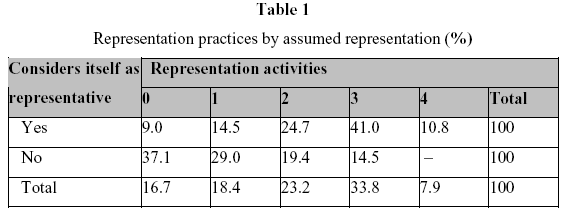
As shown in Table 1, assumed representation is clearly associated to the exercise of political representation practices. While 66% of civil organisations that state that they do not represent their beneficiaries carry out one or none of the four activities described above, 77% of those that define themselves as representatives perform two or more of those activities. However, only 17% of all organisations keep membership ties with their beneficiaries – where, in principle, the "right of exit" would apply. The vast majority of organisations sustains more ambiguous relations as to the type of representation that could be associated to them: 30% defined their beneficiaries as "the community" and 44% have them as their "target population".17
For all civil organisations – whether or not they claim to represent their beneficiaries – over 90 independent variables were explored through probability estimates (RRR), covering distinct dimensions of their practices, characteristics, and inter-institutional links: public, ties to other societal actors and to traditional political actors, working themes, beneficiaries' involvement in their activities, advancement of demands at distinct levels of public authorities, electoral participation by supporting candidates for public office, financial capacity, public (legal) institutionalization, and presence in the new participatory spaces for management of public policies – among other dimensions covered by the analysis.
]]> After numerous tests, the final result or Principal Model (PM) ended up including three variables: (i) the organisation's support to candidates for public office; (ii) being registered as a public interest organisation; and (iii) carrying out activities of mobilization and demand before government programmes, agencies, or bodies.The fourth column in Table 2 presents the results of logistic regression (LR), which can be interpreted as propensities, that is, as the probability of a (dependent) variable to be associated with another (independent) variable or as changes in the probabilities that a phenomenon will occur (assumed representation) when introduced to the presence of a given factor. There are increments in the probability of the phenomenon in question to occur when the result is higher than 1; in turn, figures lower than 1 indicate that the independent variable at hand has negative effects and reduces the chances that the phenomenon will occur.18
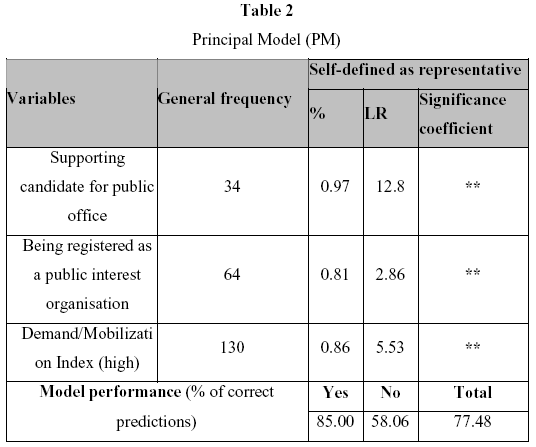
In that case – and always controlling the other variables of the PM – the fact that a civil organisation supports candidates for public office is by far the variable that best predicts assumed representation, increasing more than tenfold the chances of an organisation to take on the role of representative of its beneficiaries. Secondly, civil organisations that resort to mobilization to raise demands and claims to distinct government bodies are five times more likely to hold assumed representation. With sensibly lower effects – but consistent in all tests – comes the variable "being registered as a public interest organisation", which doubles the chances of assumed representation. There remain no doubts regarding the statistical significance of those data. Still on Table 2, the fifth column indicates the reliability or significance of LR results for the three PM variables. According to statistical conventions, the two asterisks denote highly reliable results, at a 5% reliability level. Results have received careful analytical treatment in the section dedicated to interpretation.
New (and some old) notions of representation (Findings II)
Justifications are an inherent part of assumed representation. The commitment of representing someone, even when it is conceived without the consent of those represented, performs discursively in such a way that reasons are then called upon to support the assumed representation; otherwise, it would be difficult to give that assumption meanings that distinguish it from mere rhetoric. It should be pointed out that those are the motives and reasons effectively invoked by civil organisations to deal with the delicate issue of their representativeness. The range of arguments that can be invoked brings out the criteria that form the basis for the authenticity of that self-definition, from the perspective of that actor. Therefore – and although at the symbolic level of self-perception, the reasons invoked bring to the fore the issue of representativeness.
]]> The arguments different civil organisations make have a broad range of meanings and the typology of congruency arguments condenses this broad range and categorises their key elements. Therefore the typology is a result of the research. It disregards normative conceptual elements and does not say anything about the way in which civil organisations should construe their roles of political representation. In the next section, where the findings presented here will be interpreted, there will be an opportunity to reflect on these consequences. For the time being, we will stick to the presentation and description of the main findings.In building the typology, representation combines three components: those represented, always people whose will is bound together in a way that is to a greater or lesser degree direct and concrete (vote, demand, petition) or in a way necessarily indirect and abstract (nation, tradition, common good); the representative, mediator and guardian of interests of those represented, whose role lies in diverse levels of institutionalisation, authority, and duty to those represented; and the locus, which is simultaneously the jurisdiction where representation is exercised and the interlocutors to whom it is exercised – notably, but not only, other elected politicians and public authorities.
In this case, where the figures of traditional political representation prove to be inadequate, those represented tend to coincide with the publics of the organisations, usually outlined in quite broad terms such as "the excluded", "the poor", "community", and "citizens". The representative corresponds to the civil organisation which is authorised as such by self-definition, and the locus, only implicitly specified in the majority of cases, by and large centres on the public authority and less frequently on other social institutions and before other societal interlocutors. Each argument constituted a particular modality of arrangement of relations between those three elements, the distinguishing mark of which lies in the emphasis placed by the civil organisations on the part and content of those relationships which are used by them as proof of the authenticity of their assumed representation – that is, as the fundament of their representativeness.
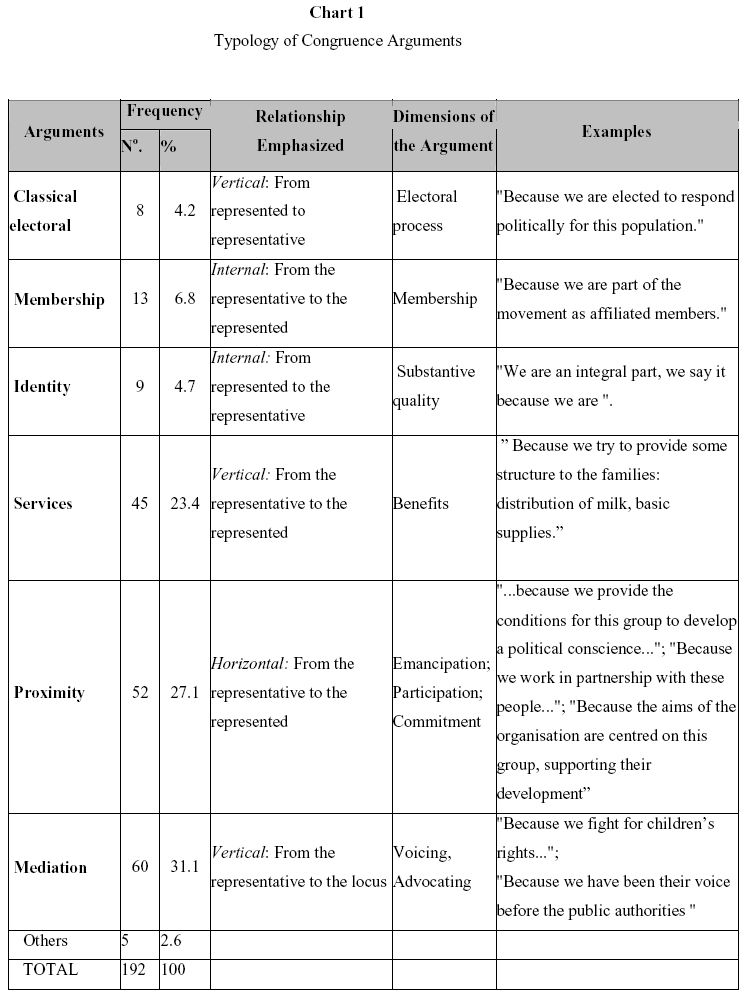
Six congruency arguments are identified in the reasons furnished by the civil organisations: classical-electoral, membership, identity, services, proximity, and mediation. The three first arguments are either familiar or an integral part of the history of modern democracy, and are usually treated in the field of theories and debates on representation; however, they appear in a clearly secondary position as arguments employed to justify the genuine character of representation assumed by the civil organisations in the sample – varying from 4% to 7% (Chart 1). The arguments most often mentioned to sustain representativeness, in turn, are partly foreign to and not necessarily compatible with democracy (service, 23%; proximity, 27%; mediation, 31%).
The electoral argument19
Civil organisations cite the existence of electoral mechanisms for selecting leaders or their board of directors as evidence of their representativeness. It is largely a de facto justification of formal/procedural character, which avoids the issue of representativeness, since selection processes are used that are synonymous with democracy and representative government.20 Because they are using a widely accepted mechanism, it is possible for the actors to "ensure" the legitimacy of their representation exercised, avoiding specificities about its content. (Chart 1 has examples of answers encompassed in the classical-electoral argument as well as in other arguments). State agencies make up the locus implicit as a backdrop.
The membership argument21
Civil organisations that use membership as evidence of their representativeness emphasise the simultaneous genesis of the actor and of the matter to be represented. That is, we are not only talking about organisations specifically created to represent the individuals or actors involved in their creation but in particular civil organisations that represent interests that were institutionalised and laid down only by means of the respective organisation being founded. In this way the represented and the representative are produced by the same process. Here again, the appeal is to reasons of fact and, in this respect, the similarity to the classical-electoral argument is not coincidental. It has a close relation to the historically established practice of corporatist representation of interests in labour unions, largely used in the 20th century. The locus is an indispensable component of the argument as the creation of an actor with representative purposes only makes sense in the presence of predefined interlocutors and institutions which in the majority of cases, although not exclusively, is the public authorities.
The identity argument22
Civil organisations appeal to substantive like-mindedness between representative and those represented as the hinge of representativeness. The representative mirrors the will of those represented by virtue of existential qualities that are usually impossible to renounce such as gender, race and ethnic origin, which would bear, to a higher or lower degree, a clear definition of the interests to be represented. In other words, representativeness is identity-based and supposes, through the mediation of that identity, the elimination of differences between those represented and the representative – women represent women, blacks represent blacks, and so forth. Again in this case the locus is vaguely implicit.
]]> The service argument23The emphasis falls on the relationship between the civil organisation that assumes the role of representative and those it represents although in a very different sense from that of the proximity argument (bellow). In this case, the organisation points delivering benefits as the foundations of its representativeness, that is, its actions for the improvement of people's lives, usually by providing services – from medical treatments to distribution of staple foods and including skills training, scholarships, moral support and other various forms of assistance. If in the majority of the arguments the locus is somewhat hazy, here it is omitted entirely and is not even hinted at.
The proximity argument24
Civil organisations emphasise their relationship to their beneficiaries, citing linkages characterised by closeness and horizontality as a demonstration of their genuine interest and role as representatives. Such proximity takes on distinct features: emancipation, or the commitment to enhancing the ability of members to organise themselves and fostering their protagonism; empathy, or a profound commitment to beneficiaries by affinity, solidarity, and real identification with their problems and needs; openness, or the disposition to welcome and stimulate their public's direct participation and opinions in the planning and direction of the organisation's work. Although it does not necessarily coincide with the public authority, there is a clear implicit locus in the argument, since favouring the protagonism, demand making and problem-solving capacity of beneficiaries points to an assumed interlocutor.
The mediation argument25
Of the six arguments, this one is exceptional in that the civil organisation bases its representativeness not on the relationship with beneficiaries but on the locus of representation. By definition, all representation assumes using means of mediation, but this is not the same as making mediation itself the fundamental basis for authenticating the role carried out by the representative. Nonetheless, this is precisely where the emphasis of the argument lies: the mediation roles played by the organisation open up access to public decision-making institutions, which otherwise would remain inaccessible. The interlocution capacity of the actor with different public institutions is used in a legitimate manner – from the point of view of the actors' argument – for claiming rights rather than bargaining for gifts or favours. Finally, the actor's relationship to the represented rather than to the locus is left unspecified in this case.
Once the typology has been exposed, the first interesting piece of information to be mentioned regards the use of a single argument by civil organisations that took up assumed representation of their beneficiaries: only 1% of those actors resorts to three arguments to justify their representativeness, 5% use two arguments, and the overwhelming majority (94%) focuses their reasons on a single argument.26
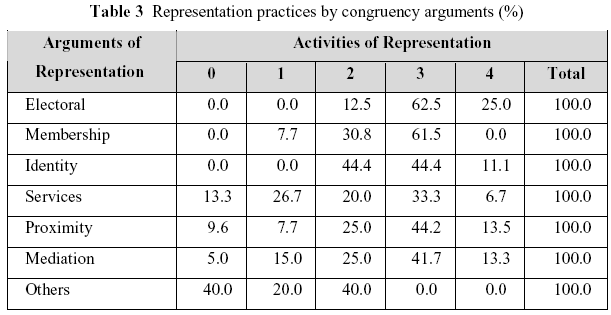
Therefore, it is worthwhile to explore those arguments in the light of political representation practices carried out by different civil organisations. As has been pointed out, cautioun is warranted as to the possibility of verifying the connection between representation arguments and practices. Let us return to Table 1 to examine whether or not there is any relationship between the four political representation practices and the six representation notions. According to Table 3, the classical-electoral and membership arguments, corresponding to representation expedients recognized in mass democracies, are raised by organisations that actually reach the highest punctuation by concentrating activities that might be linked to political representation; the identity representation, in turn, behaves in a similar way, even though with lower figures. Most organisations that invoke such arguments carry out at least three representation activities. At the other end, only the arguments of mediation, proximity, and service are invoked by civil organisations that carry out none of those activities related to political representation practices; more: the congruence argument based on service provision displays the worst performance, being used by actors that mostly (60%) conduct only up to two activities. In turn, about 80% of civil organisations that resort to the mediation and proximity arguments carry out more than two representation activities.
In sum, arguments familiar to democracy show relations consistent with representation practices while the service argument is ambiguous to the point of being invoked in 40% of occasions by civil organisations that carry out only one or none of those practices. The two most interesting arguments from the point of view of reconfiguring representation and broadening democracy – proximity and mediation, as will be argued below – present some ambiguity but coincide with representation activities.
]]> Civil Organisations, Representation and Democracy: An Interpretation
The processes of State reform and especially the wave of participatory institutional innovations around the world in recent years increased the political protagonism of civil organisations. Virtually three quarters of civil organisations in São Paulo, collected in the sample of the most active associational universe that works with or for poor people, claim the assumed representation of their beneficiaries. More: the commitment to representing, when examined from the perspective of the distinct practices of political representation available to civil organisations, is shown to have empirical basis, that is, assumed representation is clearly associated to the eventual exercise of political representation practices. The reverse relationship is equally consistent: the exercise of few or none representation practices coincides with civil organisations' refusal to define themselves as representatives.
Connection between civil organisations and the circuit of traditional politics
The fact that a civil organisation states that it represents its beneficiaries is closely linked, in São Paulo, to its relations with the traditional structures of politics. More precisely, supporting political candidates is by far the best predictor of assumed representation, followed at a certain distance by two other attributes, namely, registration as a public interest organisation and carrying out mobilization and presenting demands before public authorities. Supporting candidates regards the engagement of civil organisations in the campaigns of specific candidates for public office in the last five years, possibly in exchange for commitment to work for the causes advocated by the organisation. Mobilization and demand activities before government programmes, agencies or bodies speak for themselves and do not require further explanation, since it is a familiar strategy of external pressure on public authorities in charge of decision making. Registration as a public interest organisation responds to the logic of the law applicable to civil organisations in São Paulo and implies, by definition, the purpose of the respective organisation to preserve an interface with the State in order to allow its mission and objectives by obtaining public benefits such as tax exemptions, subventions, and public funds, contracts for provision of decentralised public services or participation in the administration and in the design of public policies, as well as licences for lotteries (Szazi, 2001, pp. 89-110; Landim, 1998a, pp. 79-83).
The close connection between assumed representation and regular politics raises at least two sorts of considerations that directly challenge the contemporary debate about the reconfiguration of political representation and democracy reform. Firstly, as shown in the beginning of this article, the debate about the reform of democracy and its emphasis on the potential of the so-called civil society have curiously not been followed by systematic studies that examine the issue of representation underlying a large part of the analytical assumptions underpinning this potential – starting by the existence of a 'natural' continuity or connection between society and civil society. The inattention to an issue so crucial to the agenda of democracy reform may reflect at least in part the fact that it is a sensitive issue – the representativeness of civil organisations – taken as external to societal actors dynamics for it is part of the historical and intellectual field of democracy's political institutions. The approach developed here shows not only the relevance of exploring the problematique of political representation within civil organisations, but also the possibility of advancing in this challenge without prematurely arriving at a peremptory conclusion that these organisations lack representativeness. The approach also shows that the commitment to representing by organisations studied in São Paulo is fundamentally shaped at the interface with electoral campaigns and their candidates. This reveals both a wealth of interactions to be examined and the analytical costs of maintaining a rigid distinction – common to this debate – between the so-called civil society and political institutions.27
Second, if civil organisations can effectively translate assumed representation into actual political representation, this seems to occur not only at the margins of or in opposition to traditional forms of political representation – the political system – but mainly as a result of and in close connection to these traditional forms. Therefore, contrary to alarmist warnings about the risks that historically crystallised institutions of political representation shouldn't be usurped by civil organizations, the evidence from São Paulo suggests that the reconfiguration of representation runs through the emergence of new societal mediators that interact in a complementary, although not necessarily harmonious manner, with the institutions of representative government. The complementary interaction with electoral processes occurs through the political candidates, which suggests important amendments to the verdict of a growing disconnection between political actors in electoral processes and their constituencies or social niches.
There is no a priori guarantee that political representation dynamics active within the universe of civil organisations will be representative simply because this form of representation is constructed within 'society' – i.e. local communities, grassroots level, lifeworld, etc. If they function as effective new channels of mediation between the population and electoral processes or, as occurs in Brazil, between the population and public administration in the design and implementation of policies, civil organisations can only contribute to democratisation of democracy if they themselves are representative, or if they are able to maintain the core tension in the relationship between representatives and the represented. Clientelism and patrimonialism of various kinds, for example, also tend to occur within this kind of organisational activities. However, in order to evaluate the representativeness of civil organisations, there are no crystallized empirical models in the realm of political representation institutions, neither reasonably accepted nor widespread theoretical models.
Self-recognition of the political roles of societal mediation
The congruency arguments articulate the justifications used by the different civil organisations to publicly defend their role as representatives, even if and precisely because lack of sine qua non components of the model of political representation recognised in democracies – notably elections. The fact that the overwhelming majority of organisations (94%) used only one congruency argument supports an interpretation according to which the justifications invoked are relatively stabilized views.28 An identical analysis in Mexico City, for example, showed that 20% of organisations in the sample use more than one argument and over 10% of them use three or more arguments (Gurza Lavalle et al., 2005c). In São Paulo, in turn, only 1% of the sample resorts to three arguments.
Marginal arguments were found in the discourse of civil organisations (electoral, membership and identity), and they were clearly in agreement with democratic political representation. There was also a widespread argument not compatible with the normative democratic standards (services), but we fond equally widespread arguments, which allow to think from a more promising perspective upon the role of civil organisations in democracy reform and in reconfiguring political representation (proximity and mediation). In these last arguments it is possible to see a relevant historical displacement: criticisms to political representation and notions of genuine non-representative politics, typical of Brazilian civil organisations during dictatorship and transition years, have given way to new views that clearly embody the process of reconfiguration of political representation through the expansion of its loci and its functions to the realm of design, implementation, and oversight of public policies. Thus, the major novelty found in the congruency arguments, potentially impregnated of consequences for democratic reform and the reconfiguration of political representation, lies in the relationship between the proximity and the mediation arguments.
]]> The findings presented certainly challenge interpretations that develop single representation models within civil organisations, characterized by supposed common features such as network functioning, flexibility, and adaptability of their institutional designs or the presence of deliberative or dialogical dynamics (cf. Chalmers et al., 1997). The single treatment often given to the diverse world of civil organisations under the title of "civil society" hides trivial facts: actors in the societal word follow distinct logics that are not necessarily compatible with any analytical or practical effort to reform democracy.The following analysis will approach the congruence arguments invoked by civil organisations in terms of their historical "novelty", of their implications for democracy reform and reconfiguration of political representation, and of – when applicable – the specific context that allows the interpretation of those implications. Strictly, not all arguments operate under the logic of assumed representation, since some of them, although in lower quantity, reproduce at the societal level mechanism of authorization and accountability typical of political representation of 20th-century democracies. The electoral, membership, and identity arguments correspond to the first minority group and, in distinct ways, each of them resorts to representation devices that are essential to or largely present in the history of democracy.
Similarly to the consecrated model of political representation, the electoral argument finds its fundament in elections. Elections and representativeness are far from being synonyms, as shown not only by the several instances where parties' impotence to solve the representational deficit in contemporary democracies has been denounced (Chalmers et al., 1997; Friedman e Hochstetler, 2002; Roberts, 2002), but also because of sharp assessments about the limitations of the vote and parliament as locus of representation to guarantee the responsiveness of and control over elected representatives (Sartori, 1962; Manin et al., 1999b). However, elections offer sanction mechanisms about representatives (accountability) and tend to encourage their sensibility before the demands and the needs of those represented (responsiveness). While elections within civil organisations lack public scrutiny and formalization that are typical of political electoral processes, they follow the same legitimacy logic and criteria. Civil organisations subjected to electoral mechanisms in their relationship to their beneficiaries could revitalize political representation when incorporated as mediation instances in the processes of designing and implementing public policies, or simply in channelling demands and responses through the spheres of electoral politics.
The membership argument is also clearly pointed out by a minority and it bases the representativeness of those who evoke it on the coincidence between the creation of the corresponding civil organisation and the act of instituting the interests to be represented. As a key element of labour structures for representing interests in mass democracies, it coexisted with the predominant model of political representation along the 20th century, even though its lineage is older, dating back from the medieval association of rights to specific social categories, well-established in guilds, corporations, and land circumscriptions subjected to monarchic suzerainties (Marshall, 1967; Bendix, 1996; Pitkin, 1989). Whether through membership quotas, through participation in the election of leaders, or by other mechanisms of sanction and control often associated to the notion of membership (like the right to exit), the argument admits mechanisms to define and maintain the relationship between the organisation and its beneficiaries – mechanisms actually known and largely used in the last century. Civil organisations, whose representation practices respond to their membership, even though they are a minority, could contribute to reinvigorate political representation when connected to traditional political actors or when they are present in the processes of design and oversight of public policies.
The identity argument rests on the effects attributed to existential or substantive similarities. Its marginal position may come as a surprise, particularly if one considers that the so-called politics of difference has deserved increasing attention in political theory for its implications that alternately counter or favour citizenship.29 Representation dynamics within civil organisations in São Paulo and arguably in other Brazilian cities seem to be little or not at all identity-oriented. In principle, the identity argument does not need control and sanction mechanisms, since the existential similarity covers everything the representative must be in order to act as expected by those represented. Even so, when the assumption of the coincidence between representatives' existential characteristics and their choices or actions is relaxed enough, it becomes conceivable to attribute them a viewpoint or a perspective (Young, 2002, pp. 121-153) – of gender or race, for instance – that loosely, that is, without assuming predefined interests or opinions, corresponds to some substantive quality or attribute seen as undesirably underrepresented. Therefore, even though with minimal weight, civil organisations driven by identity logics could contribute to correcting systematic exclusions in political representations or in the design and management of public policies.
The service argument – as a justification for assumed representation – resorts to benefits of services provided by the respective civil organisations to their beneficiaries. Somehow, within that argument equivalence or identification operates between the ability to distribute or produce real benefits and the sincerity of the commitment to represent for the good of people. Obviously, also in that case there is an underlying criticism to political representation for its inability to guarantee an effective relationship between the action of the representative, on the one hand, and the solution of problems and needs or the fulfilment of expectations of those represented one the other. Hence effectiveness comes out as a key element for that argument. Despite the implicit criticism, the solution offered to the shortcomings of political representation, however, is particularly vulnerable if its consequences are evaluated from the point of view of democratic standards. In the other five arguments (i) the locus of representation remains implied, but it is not omitted; (ii) although with different levels of formalisation and with uncertain results, there are mechanisms for bringing the representative and those represented closer together, normally accompanied by some form of accountability; and, (iii) whatever these mechanisms and their effectiveness may be, they presuppose that they can influence the way the representative acts in the locus of representation. The justification of the service argument lies in the direct provision of benefits, thus the mediating function is cancelled out and therefore the locus too. There is no consideration of any accountability mechanisms. The absence of the locus and of mediation between beneficiaries and the original source of the benefits eliminates the essence of representation itself. Leaving aside for now the merits of organisations that provide services and/or charities, especially in societies divided by gross inequality such as Brazil, there are no elements in the argument compatible with the minimum normative democratic principles. The argument's projection into the political arena is, from the vantage point of democratising democracy, clearly not desirable.
The proximity argument has an underlying implicit criticism: it accuses the distortions caused by institutions, unable to accurately transmit the voice and concerns of the population. It juxtaposes this institutional failure to a genuine commitment and a set of practices that aim to enable people to act and speak for themselves or to represent their authentic interests. The high frequency of proximity argument is not entirely surprising – it is the second most common – because we are dealing with societal actors that are not strictly political and because of the particular historical origin of a considerable number of these actors in Brazil. The argument reveals the lasting impact of the extraordinarily influential role Catholic Church has had in the symbolic and material construction of civil organisations, as well as the intense participation of activists of the left who sought refuge in grassroots community activism from their political proscriptions under the military regime (Sader, 1988; Doimo, 1995; Landim, 1998b; Houtzager, 2004). In the case of the first, the canons of what the liberation theology-inspired Church saw as the correct form of social intervention are clearly visible – renouncing to protagonism, empathy (compassion), and silent work alongside the oppressed. In the second case, the focus is on emancipatory convictions and the strong belief in the identification of the real interests of the poor. In both cases the value placed on direct participation and, consequently, on experiences of direct democracy are readily visible. Participation and physical proximity constitute, in principle, conditions that are favourable to reinforcing the relationship between representative and represented, allowing some forms of control or sanction. Civil organisations which are close to their public and open to that public's participation are certainly preferable over those which are distant or hermetically sealed when it comes to reinvigorating political representation. However, regardless of its merit – derived from its solidarity-based content – the argument revives old dilemmas of direct democracy: whether the extreme emphasis on direct participation voids the idea of representation itself, since they cancel mediation at its source (Pitkin 1967: 209-240; Sartori 1962); as participation grows large in scale in the definition of interests to be represented, it becomes representation in its own right – and as such, incomprehensible as a faulty surrogate for participation.
In the mediation argument, the distinctive emphasis links those represented and the locus of representation through explicit acknowledgment of the importance of mediating interests with the State, in opening up channels through which claims can be made that normally do not have a channel to be expressed. The importance conferred to mediation before the State is worth mentioning: the argument's point of departure is the need to remedy an inequality which is not directly related to income, but to access to the state. It presupposes occupying a privileged position in this unequal distribution of access to the state and having a commitment to giving voice to those who otherwise would not be heard. The argument coincides partly with the concept of advocacy, common in the literature on NGOs and even in that on representation, as well as their intersection (Fox, 2000; Urbinati, 1999; Sorj, 2005). The criticism implicit in the argument is not directed at traditional representation institutions per se, for any distortions they produce in the concerns of the represented. However, the argument points to a deficit in their ability to hear interests and respond to the right claims of diverse 'politically excluded' segments of the population, and takes on the role of connecting these segments to the State and the political-electoral arena. There is no sign in the argument of any mechanisms that could strengthen the relation between representative and represented – the organisations and their publics – and this brings to the fore the dilemmas of representation of interests by civil organisations.
On the other hand, if we remember that during Brazil's dictatorship and transition the discourse of a significant number of civil organisations was strongly opposed to the State, along with a strong commitment to grassroots anonymous work – evident in the proximity argument – the mediation argument appears fresh and novel. A decade and a half after the military left power, the most used justification by civil organisations in São Paulo for assumed representation focuses on the capacity to mediate relations with the State. Thus it seems reasonable to argue that while the proximity argument remains relevant to the dominant logic of societal actors during the dictatorship, the mediation argument reflects both the institutional innovation of recent years and the medium-term dynamics of the reconfiguration of representation. In fact, there emerges the connection between the processes that are reconfiguring political representation and the changes in the profile of civil organisations in the context of State reform implemented in recent years.30
]]> Closing remarks
The approach taken in this paper has enabled us to take analytical and empirical steps towards understanding the problem of political representation by civil organisations. Both the factors that alter the propensity of civil organisations in São Paulo to strengthen their roles as representatives of their beneficiaries and the congruency arguments used by the these organisations bear relevant findings for the ongoing debates about democracy reform and reconfiguration of political representation – starting by the fact that it becomes evident that the relationship between political representation and civil organisations has been neglected in literature. In the former case, despite the focus on societal actors, the emphasis on the notion of participation and the assumption of a natural connection or continuity between society and civil society conceals the perception of representation phenomena where the literature identifies the process of improvement of democracy through the incorporation of direct democracy mechanisms. In the latter, rich and nuanced reconstructions of reconfiguration of political representation become tenuous regarding the evaluation of the consequences of such reconfiguration for democracy. If the literature on the reconfiguration of political representation is correct, parties are losing their central role in organising the preferences of the electorate and in the construction of representable identities, giving way to the pre-eminence of candidates with intimate links with the population, made possible by the mass media.
However, the evidence examined here allows us to claim that in São Paulo, and conceivably in Brazil, civil organisations play an active role – although not inherently a positive one – in the reconfiguration of representation both in traditional politics and in the arenas opened up by innovative participative institutions. On the one hand, the unstoppable gap between political parties and their social niches identified in literature might be counterbalanced by reconnection strategies in which civil organisations operate as mediators between parties and distinct segments of the population. The interrelationship between societal and political actors per se would not be surprising were it not for the rigid divisionary lines drawn between them in literature. Parties and candidates invest in the connecting with societal actors as part of their political strategy and civil organisations cultivate alliances in order to carry out their objectives. It is precisely the civil organisations involved in this reconnection that take on the assumed representation of their publics.
Confirming the relationship between civil organisations and the reconfiguration of political representation says nothing about its positive or negative consequences for the quality of democracy. This, of course, brings into play the difficult question of the representativeness of civil organisations and the challenges of evaluating this representativeness with a notion of political representation that fulfils democratic requirements. The evidence examined here indicates that one should avoid constructing single stylized theoretical models of representation for civil organisations, as diverse models of representativeness are used by civil organisations as justifications for the authenticity of their assumed representation. Undoubtedly, a substantial number of civil organisations conceive the legitimacy of their representation in terms that have perverse consequences if they are projected into the political arena. Nevertheless, we found congruency arguments reconcilable with democratic requirements as well including a new notion of representation that is explicitly political and in tune with the processes of reconfiguration of representation. It condenses the experiments of participatory institutional innovation and State reform in Brazil in recent years, showing that within both phenomena, the very dynamics of representation in civil organisations have changed and took on openly political features. Faced with traditional institutions, the set of civil organisations invoking mediation argument do not claim any form of authenticity or genuine representation as frequently occurs in the discourse of societal actors, but declares its commitment to a mediating role aimed at connecting representatives with those represented, that is, poorly or under-represented segments of the population on the one hand and the State and electoral politics on the other. What is being discussed therefore is an argument that situates civil organisations as a new form of mediation between traditional representatives – politicians and political parties – and those represented – their publics. In other words, relevant portion of the organisations studied see themselves not as an alternative to traditional institutions of political representation, but rather as a new level of societal mediation able to connect the needs and demands of certain segments of the population to public decision-making bodies.
In spite of growing participation by societal actors in the design and oversight of public policies there are no well-established legitimating criteria to sustain the democratic relevance acquired by new practices, channels, and actors involved in political representation tasks. Such inexistence is contingent and should not be taken as an uncontroversial diagnosis; rather, it seems more prudent to assume that the construction of such legitimacy criteria, regardless of its success, is and will be an object of political dispute in the near future.
BIBLIOGRAPHY
ARATO, Andrew. (2002), "Representação, soberania popular e accountability". Lua Nova, 55/56 – Cenários de Direitos. [ Links ]
ATKINSON, Rowland & FLINT, John. (2003), "Accessing hidden and hard-to-reach populations: snowball research strategies". Social Research Update, 33 (www.soc.surrey.ac.uk/sru/ SRU33.html). [ Links ]
AVRITZER, Leonardo. (1994), "Modelos de sociedade civil: uma análise específica do Caso Brasileiro", in _________ (org.), Sociedade civil e democratização, Belo Horizonte, Del Rey. [ Links ]
_________. (2003), Democracy and the public space in Latin America. Princeton, Princeton University Press. [ Links ]
AVRITZER, Leonardo & NAVARRO, Zander. (2003), A inovação democrática no Brasil. São Paulo, Cortez. [ Links ]
BENDIX, Reinhard. (1996), Construção nacional e cidadania. São Paulo, Edusp. [ Links ]
BURKE, Edmund. (1942 [1774]), "Carta a los electores de Bristol", in _________, Textos políticos, México, Fondo de Cultura Económica. [ Links ]
_________. (1792), "An extract from letter to Sir Hercules Langrishe, on the subject of The roman Catholics of Ireland", website http://www.ourcivilisation.com/ smartboard/shop/burke/extracts/chap18.htm. [ Links ]
CAMPILONGO, Fernandes Celso. (1988), Representação política. São Paulo, Ática. [ Links ]
CHALMERS, Douglas A.; MARTIN, Scott B. & PISTER, Kerianne. (1997), "Associative networks: new structures of representation for the popular sectors?", in D. A. Chalmers, Carlos M. Vilas et al., The new politics of inequality in Latin America: rethinking participation and representation, Oxford, Oxford University Press. [ Links ]
CHANDHOKE, Neera. (2003), "Governance and the pluralisation of the State: implications for democratic practices in Asia", University of Dehli (mimeo. [ Links ]).
CHAUDHURI, S. & HELLER, P. (2002), "The plasticity of participation: evidence from a participatory governance experiment". Columbia University, Department of Economics (mimeo. [ Links ]).
COHEN, Jean & ARATO, Andrew. (1992), Civil society and political theory. Massachusetts, MIT. [ Links ]
COSTA, Sérgio. (2002), As cores de Ercília: esfera pública, democracia, configurações pós-nacionais. Belo Horizonte, Editora da UFMG. [ Links ]
CROWLEY, J. E. & SKOCPOL, T. (2001), "The rush to organize: explaining associational formation in the United States, 1860s-1920s". American Journal of Political Science, 45 (4). [ Links ]
CUNILL, Grau Nuria. (1997), Pensando lo público a través de la sociedad: nuevas formas de gestión pública y representación social. Caracas, Nueva Sociedad/CLAD. [ Links ]
DAGNINO, Evelina. (2002), "Sociedade civil, espaços públicos e a construção democrática no Brasil: limites e possibilidades", in _________, Sociedade civil e espaços públicos no Brasil, São Paulo, Paz e Terra. [ Links ]
DOBROWOLSKY, Alexandra & JENSON, Jean. (2002), " Shifting patterns of representation: the politics of 'children', 'families,' 'women'". Haliffax, St. Mary's University. [ Links ]
DOIMO, Ana Maria. (1995), A vez e voz do popular: movimentos sociais e participação política no Brasil pós-70. Rio de Janeiro, Relume Dumará/Anpocs. [ Links ]
FERNANDES, Rubem César. (2002), Privado, porém público: o terceiro setor na América Latina. Rio do Janeiro, Relume Dumará/Civicus. [ Links ]
FRIEDMAN, Elisabeth Jay & HOCHSTETLER, Kathryn. (2002), "Assessing the third transition in Latin American democratization: representational regimes and civil society in Argentina and Brazil". Comparative Politics, 35 (1), out. [ Links ]
FOX, Jonathan. (2000), "Civil society and political accountability: propositions for discussion", Santa Cruz, University of California (mimeo. [ Links ]).
FUNG, Archon. (2004), Empowered participation: reinventing urban democracy. Princeton, Princeton University Press. [ Links ]
FUNG, Archon & WRIGHT, Eric Olin. (2003), "Thinking about empowered participatory governance", in _________ (eds.), Deepening democracy: institutional innovation in empowered participatory governance, London, Verso. [ Links ]
GAVENTA, John. (2004), "Representation, community leadership and participation: citizen involvement in Neighbourhood Renewal and local governance". Work presented at the Neighbourhood Renewal Unit Office of Deputy Prime Minister, Feb. (mimeo. [ Links ]).
GRINDLE, Merilee S. (1999), Audacious reforms: institutional reform and democracy in Latin America. Baltimore, Johns Hopkins University Press. [ Links ]
GURZA LAVALLE, Adrián. (1999), "Crítica ao modelo da nova sociedade civil". Lua Nova, 47. [ Links ]
_________. (2003a), "Sem pena nem glória: o debate da sociedade civil nos anos 1990". Novos Estudos, Cebrap, 66. [ Links ]
_________. (2003b), "Cidadania, igualdade e diferença". Lua Nova, 59. [ Links ]
GURZA LAVALLE, Adrián; ACHARYA, Arnab & HOUTZAGER, Peter. (2005a), "Beyond comparative anecdotalism: lesson on civil society and participation from São Paulo, Brazil". World Development, 33 (6), Jun. [ Links ]
GURZA LAVALLE, Adrián; HOUTZAGER, Peter & CASTELLO, Graziela. (2005b), "In whose name? Political representation and civil organisations in Brazil". Working Paper 249, IDS – Institute of Development Studies, University of Sussex. [ Links ]
_________. "The political construction of civil organisations", IDS, Institute of Development Studies, University of Sussex (mimeo. [ Links ]).
_________. (2006), "Democracia, pluralização da representação e sociedade civil". Lua Nova, 67. [ Links ]
GUTMANN, Amy. (1995), "A desarmonia da democracia". Lua Nova, 36: 5-37. [ Links ]
HABERMAS, Jürgen. (1993), "La soberanía popular como procedimiento: un concepto normativo de lo público", in María Herrera (coord.), Jürgen Habermas: moralidad, ética y política: propuestas y críticas, México, Alianza Editorial. [ Links ]
_________. (1995), "Três modelos normativos de democracia". Lua Nova, 36. [ Links ]
_________. (1998), Facticidad y validez: sobre el derecho y el Estado democrático de derecho en términos de teoría del discurso. Madri, Trotta. [ Links ]
HARRISS, John. (2004), "The 'New Politics' of the urban poor in contemporary India". Work presented at the Institute of Common Wealth Studies, University of London. [ Links ]
HELLER, Patrick. (2001), "Moving the State: the politics of democratic decentralization in Kerala, South Africa, and Porto Alegre". Politics & Society, 29 (1). [ Links ]
_________. (in press), "Reinventing public power in the age of globalization: the transformation of movement politics in Kerala", in R. Ray e M. Fainsod Katzenstein (eds.), Social movements and poverty in India. [ Links ]
HOUTZAGER, Peter. (2003), "Introduction: from polycentrism to the polity", in Peter Houtzager and Mick Moore (eds.), Changing paths: international development and the new politics of inclusion, Ann Arbor, Michigan University Press. [ Links ]
_________. (2004), Os últimos cidadãos: a modernização no Brasil rural, 1960-1995. São Paulo, Globo. [ Links ]
HOUTZAGER, Peter; HARRISS, John; COLLIER, Ruth & GURZA LAVALLE, Adrián. (2002), "Rights, representation and the poor: comparisons across Latin America and India". LSE Working Paper Series nº 02-3, London School of Economics. [ Links ]
HOUTZAGER, Peter; GURZA LAVALLE, Adrián & ACHARYA, Arnab. (2003), "Who participates? Civil society and the new democratic politics in São Paulo, Brazil". IDS Working Paper nº 210, Institute of Development Studies/University of Sussex. [ Links ]
_________. (2004), "Atores da sociedade civil e atores políticos: participação nas novas políticas democráticas em São Paulo", in Leonardo Avritzer (org.), Participação política em São Paulo, São Paulo, Editora da Unesp. [ Links ]
KEANE, John. (1988), Democracia y sociedad civil. México, Alianza Editorial. [ Links ]
_________. (1992), La vida pública y el capitalismo tardío: hacia una teoría socialista de la democracia. México, Alianza. [ Links ]
KYMLICKA, Will & NORMAN, Wayne. (1997), "El retorno del ciudadano: una revisión de la producción en teoría de la ciudadanía". La Política, 3: 5-39, Oct. Barcelona, Paidós. [ Links ]
LANDIM, Leilah. (1996), "Notas para um perfil das ONGs", in Leilah Landim e Letícia Ligneul Cotrim, ONGs: um perfil, São Paulo, Abong/Iser. [ Links ]
_________. (1998a), "The nonprofit sector in Brazil", in H. K. Anheier e S. Lester (eds.), The nonprofit sector in the developing world, Manchester, Manchester University Press. [ Links ]
_________. (1998b), "'Experiência militante': histórias das assim chamadas ONGs", in _________ (org.), Ações em sociedade: militâncias, caridade, assistência, etc., Rio do Janeiro, Iser/NAU. [ Links ]
MANIN, Bernard. (1997), The principles of representative government. Cambridge, Cambridge University Press. [ Links ]
MANIN, Bernard; PRZEWORSKI, Adam & STOKES, Susan. (1999a), "Elections and representation", in _________ (eds.), Accountability, and representation, Cambridge, Cambridge University Press. [ Links ]
_________(1999b), "Introduction", in _________ (eds.), Accountability, and representation, Cambridge, Cambridge University Press. [ Links ]
MARSAHLL, T. H. (1967), Cidadania, classe social e status. Rio de Janeiro, Zahar Editores. [ Links ]
MIGUEL, Luis Felipe. (2003a), "Representação política em 3-D: elementos para uma teoria ampliada da representação política". Revista Brasileira de Ciências Sociais, 51, fev. [ Links ]
_________. (2003b), "Impasses da accountability: dilemas e alternativas da representação política". Work presented at XXVII Congresso Anual da Anpocs, Caxambu, Oct. [ Links ]
NOVARO, Marcos. (2000), Representación y liderazgo en las democracias contemporáneas. Rosario, Homo Sapiens Ediciones. [ Links ]
OLVERA, Alberto J. (2003), Sociedad civil, esfera pública y democratización en América Latina: México. México, Fondo de Cultura Económica/Universidad Veracruzana. [ Links ]
PANFICHI, Aldo. (2003), Sociedad civil, esfera pública y democratización en América Latina: Andes y Cono Sur. México, Fondo de Cultura Económica/Universidad Veracruzana. [ Links ]
PERUZZOTTI, Enrique & SMULOVITZ, Catalina. (2002), "Accountability social: la otra cara del control", in _________, Controlando la política: ciudadanos y medios den las nuevas democracias latinoamericanas, Buenos Aires, Temas. [ Links ]
PINTO, Céli Regina Jardim. (2004), "Espaços deliberativos e a questão da representação". Revista Brasileira de Ciências Sociais, 19 (54), fev. [ Links ]
PITKIN, F. Hanna. (1967), The concept of representation. Berkeley, University of California Press. [ Links ]
_________. (1989), "Representation", in Terrence Ball, James Fare e Russell L. Hansen (eds.), Political innovation and conceptual change, Cambridge, Cambridge University Press. [ Links ]
PRZEWORSKI, Adam. (2002), "Accountability social en América Latina y más allá", in Enrique Peruzzotti e Catalina Smulovitz, Controlando la política: ciudadanos y medios en las nuevas democracias latinoamericanas, Buenos Aires, Temas. [ Links ]
PREZEWORKSI, Adam; STOKES, Susan & MANIN, Bernard. (1999), Accountability and representation. Cambridge, Cambridge University Press. [ Links ]
ROBERTS, Kenneth M. (2002), "Party-society linkages and democratic representation in Latin America". Canadian Journal of Latin American and Caribbean Studies, 27 (53). [ Links ]
ROBERTS, Kenneth M. & WIBBELS, Erick. (1999), "Party systems and electoral volatility in Latin America: a test of economic, institutional, and structural explanations". American Political Science Review, 93 (3), Sept. [ Links ]
SADER, Eder. (1988), Quando novos personagens entram em cena. São Paulo, Paz e Terra. [ Links ]
SÀNCHEZ-MEJORADA, Fernández Cristina & ÁLVAREZ, Enríquez Lucia. (2002), "La política gubernamental en materia de participación ciudadana en el gobierno del Distrito Federal". In F. C. Sànchez-Mejorada; E. Lucia Álvarez; Huerta Trujillo Ma. Concepción e Carlos San Juan Victoria (coords.), ¿Una ciudad para todos? La Ciudad de México, la experiencia del primer gobierno electo, México, UAM/Conaculta/Inah. [ Links ]
SANTOS, Boaventura de Sousa. (1998), "Participatory budgeting in Porto Alegre: toward a redistributive democracy". Politics & Society, 26 (4). [ Links ]
_________. (2002a), "Para ampliar o cânone democrático", in _________ (Ed.), Democratizar a democracia: os caminhos da democracia participativa, Rio de Janeiro, Civilização Brasileira. [ Links ]
_________. (2002b), Democracia e participação: o caso do orçamento participativo de Porto Alegre. Porto, Edições Afrontamento. [ Links ]
SARTORI, Giovanni. (1962), "A teoria da representação no Estado representativo moderno". Revista Brasileira de Estudos Políticos, 22. [ Links ]
SCHATTAN, Vera & NOBRE, Marcos (orgs.). (2004), Participação e deliberação: teoria democrática e experiências institucionais no Brasil contemporâneo. São Paulo, Editora 34. [ Links ]
SORJ, Bernardo. (2005), "Civil societies North-South relations: NGOs and dependency". Working Paper 1, Nov., Edelstein Center for Social Research. [ Links ]
SZAZI, Eduardo. (2001), Terceiro setor: regulamentação no Brasil. São Paulo, Peirópolis. [ Links ]
TATAGIBA, Luciana. (2002), "Os conselhos gestores e a democratização das políticas públicas no Brasil", in Evelina Dagnino, Sociedade civil e espaços públicos no Brasil, São Paulo, Paz e Terra. [ Links ]
URBINATI, Nadia. (1999), "Rhetoric and representation: the politics of advocacy". Political Theory Workshop, University of Chicago. [ Links ]
WAMPLER, Brian. (2004), "Delegation, authority, and co-optation: Brazil's participatory democracy". Work presented at the American Political Science Association Conference, Chicago. [ Links ]
YOUNG, Iris Marion. (2002), Inclusion and democracy. Oxford, Oxford University Press. [ Links ]
ZERMEÑO, Sergio. (1990), "El regreso del líder". Revista del CLACSO, 56, abr., Buenos Aires. [ Links ]
_________. (2003), "La ley de participación ciudadana del gobierno del Distrito Federal". México (mimeo. [ Links ]).
1 We use the term "civil organisations" rather than "civil society" because the latter is commonly defined in normative terms and is anchored in a series of highly contested analytic assumptions. Our use of the concept of "civil society" is limited to references to a general perspective found in the literature and never to the empirical actors. For these, we use the term "civil organisations", which is more neutral and certainly less stylized and less normatively charged.
2 For a critical analysis of authors sustaining that view, see Young (2002, pp. 81-120).
3 Among other cases are the Local Government Code in the Philippines; the Law of Popular Participation in Bolivia; and New Localism in England (Gaventa 2004); the Law of Citizen Participation in Mexico City (Zermeño, 2003; Sánchez-Mejorada e Álvarez, 2002); Constitutional Amendments 73th and 74th in India – and especially the well-known People's Planning Campaign in the southern state of Kerala (Chaudhri e Heller, 2002); For a review of different reforms that granted power to local participation units in Latin America, see Grindle (1999).
4 Examples of the presence of those experiences in the debate on democracy reform are Heller (2001), Fung & Wright (2003) and Santos (2002a; 1998).
5 Gurza Lavalle et al. (2006) developed a careful analysis of both literatures. ]]>
6 For an analysis of different indicators of loss of centrality by parties from the point of view of reconfiguring representation, see Miguel (2003a) and Roberts (2002), as well as the renowned work by Manin (1997, pp. 193-234). For an examination of the distinct perspectives that provide explanatory reasons for such loss of centrality, focusing alternately on socio-structural, political-institutional or economic performance factors, see the work of Roberts (1999).
7 Relationship between representatives and those they represent has been deeply studied in the Unites States, focusing attention on the possible connections between decision making – at the Legislative – by elected politicians and voters' interests or preferences. Here we are referring to a smaller and more recent set of works, resulting from the debates on reconfiguration of political representation: Manin (1997); Przeworski, Stokes & Manin (1999); Novaro (2000); Miguel (2003a; 2003b), among others.
8 Research agendas focused on democracy reform include literature centred on deepening democracy, social accountability, empowered participation, deliberative democracy, and the contributions by civil society literature to improving democracy. For the literature on deepening democracy, see the works of Heller (2001, in press), Fung (2004), Fung & Wright (2003), Santos (2002b); for approaches on social accountability, see Arato (2002), Peruzotti & Smulovitz (2002); for the empowered participation approach, see Fung & Wright (2003); for the deliberative democracy perspective, see Habermas (1993, 1995, 1998), Gutmann (1995) an the works in Schattan & Nobre (2004); civil society literature is much larger and sometimes is also associated to radical criticism of democracy (cf. Keane, 1988), but here it refers fundamentally to the work of Cohen & Arato (1992), and scholars linked to that perspective in Latin America such as Avritzer (1994), Olvera (2003), Panfichi (2003). Still within the literature on civil society, but from a Habermasian viewpoint, see also the 1990 works by Costa (2002). Somehow also the most recent work by Avritzer (2003), centred on the idea of participatory publics.
9 Critical appraisals on the civil society literature were developed by Gurza Lavalle (2003a, 1999). For empirical criticism of the cognitive costs of both emphases – on participation and on civil society – for the issue of representation, see Houtzager et al. (2004) and Gurza Lavalle et al. (2005a); see, also Pinto (2004) for similar criticism centred on associative democracy and participation.
10 See the works published in Chalmers et al. (1997), particularly the chapters by Chalmers himself, Martin and Piester. See also the works by Roberts (2002), Friedman, and Hochstetler (2002) and Houtzager et al. (2002).
11 The Congruence Model is the most influential approach in empirical analysis of political representation carried out in the second half of the 20th century, particularly in the field of political science (Campilongo, 1988). As implied by its title, the model posits that representation can be evaluated in terms of greater or lesser congruence – representativeness – between the behaviour of the elected representatives and their electorate, where the behaviour of the former is verifiable by means of the production of legislated political policies, whilst the preferences of the latter are condensed into electoral results or in opinion surveys. Despite the criticisms against the model over the years, the essence of the concept of congruence seems indisputable without threatening the basis of political representation itself.
12 In sum, the point is somehow discussed in what Edmund Burke (1792) called virtual representation in his classic dissertations in the form of correspondence. The meaning of the word "virtual" has changed in the recent wave of the expansion of digital technology as well as frequently being intuitively understood as something that is limited to potential but not real effects. The term coined by Burke, although validated in the field of political representation, runs the risk of evoking the more intuitive senses of the "virtual" and therefore will be avoided here.
13 There are good reasons to choose the snowball technique instead of more common options in the literature on civil society, such as lists or case studies (cf. Houtzager et al., 2003). Of course there are biases inherent to the samples produced by such non-random procedure, but differently from what happens with the lists, they can be controlled and even designed to serve the purposes of the research. One of the most ambitious case study projects in recent times was funded by Ford Foundation: "Civil Society and Governance Project". Its results for Latin America can be accessed in the work organized by Dagnino (2002), Olvera (2003) and Panfichi (2003). For the use of lists in Latin America, see Fernandez (2002); Landim (1996).
14 The use of probabilistic models does not imply distribution of probabilities over a universe (inaccessible in the case of civil organisations) represented in the sample. The snowball sampling technique, if properly controlled, creates self-delimitated sets able to elucidate characteristics of populations that are hidden or difficult to reach (Atkinson & Flint, 2003). In that case, the make up of the sample was determined by saturation criteria and designed so as to favour civil organisations active with poor segments of the population. A detailed presentation of the sample design, including criteria for managing chain referrals (interviews flow), can be consulted in Houtzager et al. (2003).
15 For instigative results of the use of RRR in political historiography, see the analysis of the determining factors of the associative boom following the American Civil War, by Crowley & Skockpol (2001) ]]>
16 At this point, the correct procedure would be multinomial logistic regressions, but the number of cases in the sample, when it was divided into the several types of arguments, made that option impossible.
17 To make up 100%, add organisations that work with "other organisations" (6%) and the residual category "others" (3%).
18 As shown in Table 3, the performance of the model regarding the total of correct predictions in the values observed in the sample is 77%; its performance reaches a more satisfactory threshold in determining the values with positive effects in the assumed representation – 85%, compared to 58% in the case of the variables that have a negative influence. The performance of the model is the relationship between the predictions it makes and the cases correctly classified in the values observed.
19 For obvious reasons, that argument falls on a well-defined field on the literature specialized on themes such as representative government, representative mandate, electoral accountability, concept of 'acting for' representation, congruence model or modern political representation.
20 Procedural arguments are not necessarily formal, as shown by the models of deliberative democracy (Habermas, 1998, pp. 363-403; Gutmann, 1995). Formal justifications dissolve the issue of representativeness into the existence of formal mechanism for authorization and control (Pitkin, 1967, pp. 14-59), but it is known that the mere existence of such mechanism in itself does not assert the representativeness of representation (Manin et al., 1999a; Sartori, 1962).
21 The membership argument also corresponds to a set of representation phenomena treated in literature, even though they are not always positively associated to democracy: functional, corporatist or associative democracy, as well as the idea of membership in associative democracy proposals are examples of those approaches.
22 The identity argument also resonates in literature in several forms: the concept of 'standing for' representation, minority representation, mirror or descriptive representation, identity-based representation, and even representation in the logic of stances that historically defended proportional representation as a criterion to build a parliament.
23 That argument could be classified in Pitkin's partial conceptions of representation as a peculiar notion of "acting for" (Pitkin,1967, pp. 112-143).
24 This argument is closer to the socialist criticism against representation than to non-electoral notions of representation, such as those examined above.
25 It is a very innovative argument. On the one hand, as an electoral argument, it clearly corresponds to the family of conceptions of representation as 'acting for' (Pitkin, 1967, pp. 112-143), but, differently from that, on the other hand, it lacks accountability mechanisms. In a certain way, this argument coincides in part with the idea of representation by advocacy. ]]>
26 Data differ slightly from those presented in Gurza Lavalle et al. (2005b), since the arguments underwent minimal adjustments to make them compatible with an identical study for Mexico City's civil organisations. This issue is revisited later.
27 See footnote. 9.
28 Likewise, although not explored here, there is a clear coincidence between certain types of argument and types of civil organisations. The development of a public identity and the acceptance of a certain shared organisational profile is not always easy for civil organisations and at times follows tortuous routes, as attested to by the history of NGOs in Brazil (Landim 1998b) or by the conflicts and constant complaints of the so-called civil society's councillors about their representative nature (Tatagiba 2002).
29 Assessments and critiques of this debate are available in Kymlicka (1997) and Gurza Lavalle (2003b).
30 Dobrowolsky and Jenson (2002) analysed a similar connection, although with a negative tendency, in the case of political representation carried out by gender organisations in Canada. This connection was also analysed in the works published in Chalmers, Vilas et al (1997) and in Houtzager (2003).