<?xml version="1.0" encoding="ISO-8859-1"?><article xmlns:mml="http://www.w3.org/1998/Math/MathML" xmlns:xlink="http://www.w3.org/1999/xlink" xmlns:xsi="http://www.w3.org/2001/XMLSchema-instance">
<front>
<journal-meta>
<journal-id>0102-6909</journal-id>
<journal-title><![CDATA[Revista Brasileira de Ciências Sociais]]></journal-title>
<abbrev-journal-title><![CDATA[Rev. bras. ciênc. soc.]]></abbrev-journal-title>
<issn>0102-6909</issn>
<publisher>
<publisher-name><![CDATA[Associação Nacional de Pós-Graduação e Pesquisa em Ciências Sociais - ANPOCS]]></publisher-name>
</publisher>
</journal-meta>
<article-meta>
<article-id>S0102-69092006000200007</article-id>
<title-group>
<article-title xml:lang="en"><![CDATA[Residential segregation and public policies: São Paulo in the 1990's]]></article-title>
<article-title xml:lang="pt"><![CDATA[Segregação residencial e políticas públicas: São Paulo na década de 1990]]></article-title>
<article-title xml:lang="fr"><![CDATA[Ségrégation résidentielle et politiques publiques: São Paulo dans les années 1990]]></article-title>
</title-group>
<contrib-group>
<contrib contrib-type="author">
<name>
<surname><![CDATA[Torres]]></surname>
<given-names><![CDATA[Haroldo da Gama]]></given-names>
</name>
</contrib>
<contrib contrib-type="author">
<name>
<surname><![CDATA[Tomesani]]></surname>
<given-names><![CDATA[Ana Maura]]></given-names>
</name>
</contrib>
</contrib-group>
<aff id="A">
<institution><![CDATA[,  ]]></institution>
<addr-line><![CDATA[ ]]></addr-line>
</aff>
<pub-date pub-type="pub">
<day>00</day>
<month>00</month>
<year>2006</year>
</pub-date>
<pub-date pub-type="epub">
<day>00</day>
<month>00</month>
<year>2006</year>
</pub-date>
<volume>2</volume>
<numero>se</numero>
<fpage>0</fpage>
<lpage>0</lpage>
<copyright-statement/>
<copyright-year/>
<self-uri xlink:href="http://socialsciences.scielo.org/scielo.php?script=sci_arttext&amp;pid=S0102-69092006000200007&amp;lng=en&amp;nrm=iso"></self-uri><self-uri xlink:href="http://socialsciences.scielo.org/scielo.php?script=sci_abstract&amp;pid=S0102-69092006000200007&amp;lng=en&amp;nrm=iso"></self-uri><self-uri xlink:href="http://socialsciences.scielo.org/scielo.php?script=sci_pdf&amp;pid=S0102-69092006000200007&amp;lng=en&amp;nrm=iso"></self-uri><abstract abstract-type="short" xml:lang="en"><p><![CDATA[The article aims at assessing the evolution of residential segregation in the metropolitan area of São Paulo, Brazil, in the 1990's, which saw a significant increase of socioeconomic segregation. In addition to interpreting the phenomenon, the article proposes a discussion on the reasons the residential segregation should be considered a fundamental issue for the formulation of social urban policies.]]></p></abstract>
<abstract abstract-type="short" xml:lang="pt"><p><![CDATA[Este artigo pretende medir a evolução da segregação residencial na região metropolitana de São Paulo na década de 1990. Os resultados obtidos indicam que a segregação socioeconômica aumentou substancialmente em São Paulo ao longo dessa década. Além de interpretar esse fenômeno, propomos uma discussão a respeito do por quê a segregação residencial deve ser considerada um elemento fundamental para a formulação de políticas sociais urbanas.]]></p></abstract>
<abstract abstract-type="short" xml:lang="fr"><p><![CDATA[Cet article analyse l'évolution de la ségrégation résidentielle dans la région métropolitaine de São Paulo dans les années 1990. Les résultats obtenus indiquent que la ségrégation socio-économique a substantiellement augmenté à São Paulo tout au long de cette décennie. Dans cet article, nous interprétons ce phénomène et proposons également une discussion à propos de la raison pour laquelle la ségrégation résidentielle doit être considérée comme un élément fondamental pour la formulation de politiques sociales urbaines.]]></p></abstract>
<kwd-group>
<kwd lng="en"><![CDATA[Urban sociology]]></kwd>
<kwd lng="en"><![CDATA[Segregation]]></kwd>
<kwd lng="en"><![CDATA[Urban planning]]></kwd>
<kwd lng="en"><![CDATA[Poverty]]></kwd>
<kwd lng="en"><![CDATA[Social unevenness]]></kwd>
<kwd lng="pt"><![CDATA[Sociologia urbana]]></kwd>
<kwd lng="pt"><![CDATA[Segregação]]></kwd>
<kwd lng="pt"><![CDATA[Planejamento urbano]]></kwd>
<kwd lng="pt"><![CDATA[Pobreza]]></kwd>
<kwd lng="pt"><![CDATA[Desigualdade social]]></kwd>
<kwd lng="fr"><![CDATA[Sociologie urbaine]]></kwd>
<kwd lng="fr"><![CDATA[Ségrégation]]></kwd>
<kwd lng="fr"><![CDATA[Planification urbaine]]></kwd>
<kwd lng="fr"><![CDATA[Pauvreté]]></kwd>
<kwd lng="fr"><![CDATA[Inégalité sociale]]></kwd>
</kwd-group>
</article-meta>
</front><body><![CDATA[ <p><font face="Verdana, Arial, Helvetica, sans-serif" size="4"><b>Residential    segregation and public policies: São Paulo in the 1990's </b></font></p>     <p>&nbsp;</p>     <p><font face="Verdana, Arial, Helvetica, sans-serif" size="3"><b>Segrega&ccedil;&atilde;o    residencial e pol&iacute;ticas p&uacute;blicas: S&atilde;o Paulo na d&eacute;cada    de 1990 </b></font></p>     <p>&nbsp;</p>     <p><b><font face="Verdana, Arial, Helvetica, sans-serif" size="3">S&eacute;gr&eacute;gation    r&eacute;sidentielle et politiques publiques:S&atilde;o Paulo dans les ann&eacute;es    1990</font></b></p>     <p>&nbsp;</p>     <p>&nbsp;</p>     <p><font face="Verdana, Arial, Helvetica, sans-serif" size="2"><b>Haroldo da Gama    Torres</b></font></p>     <p><font face="Verdana, Arial, Helvetica, sans-serif" size="2">Translated by Ana    Maura Tomesani    <br>   Translation from <a href="http://www.scielo.br/scielo.php?script=sci_arttext&pid=S0102-69092004000100003&lng=en&nrm=iso" target="_blank"><b>Revista    Brasileira de Ciências Sociais</b>, S&atilde;o Paulo, v.19, n.54, p.41-55, Feb.    2004</a>.</font></p>     ]]></body>
<body><![CDATA[<p>&nbsp;</p>     <p>&nbsp;</p>     <p>&nbsp;</p> <hr size="1" noshade>     <p><font face="Verdana, Arial, Helvetica, sans-serif" size="2"><b>ABSTRACT</b></font></p>     <p><font face="Verdana, Arial, Helvetica, sans-serif" size="2">The article aims    at assessing the evolution of residential segregation in the metropolitan area    of São Paulo, Brazil, in the 1990's, which saw a significant increase of socioeconomic    segregation. In addition to interpreting the phenomenon, the article proposes    a discussion on the reasons the residential segregation should be considered    a fundamental issue for the formulation of social urban policies.</font></p>     <p><font face="Verdana, Arial, Helvetica, sans-serif" size="2"><b>Keywords: </b>Urban    sociology; Segregation; Urban planning; Poverty; Social unevenness.</font></p> <hr size="1" noshade>     <p><font face="Verdana, Arial, Helvetica, sans-serif" size="2"><b>RESUMO</b></font></p>     <p><font face="Verdana, Arial, Helvetica, sans-serif" size="2">Este artigo pretende    medir a evolu&ccedil;&atilde;o da segrega&ccedil;&atilde;o residencial na regi&atilde;o    metropolitana de S&atilde;o Paulo na d&eacute;cada de 1990. Os resultados obtidos    indicam que a segrega&ccedil;&atilde;o socioecon&ocirc;mica aumentou substancialmente    em S&atilde;o Paulo ao longo dessa d&eacute;cada. Al&eacute;m de interpretar    esse fen&ocirc;meno, propomos uma discuss&atilde;o a respeito do por qu&ecirc;    a segrega&ccedil;&atilde;o residencial deve ser considerada um elemento fundamental    para a formula&ccedil;&atilde;o de pol&iacute;ticas sociais urbanas.</font></p>     <p><font face="Verdana, Arial, Helvetica, sans-serif" size="2"><b>Palavras-chave:    </b>Sociologia urbana; Segrega&ccedil;&atilde;o; Planejamento urbano; Pobreza;    Desigualdade social.</font></p> <hr size="1" noshade>     <p><font face="Verdana, Arial, Helvetica, sans-serif" size="2"><b>R&Eacute;SUM&Eacute;</b></font></p>     ]]></body>
<body><![CDATA[<p><font face="Verdana, Arial, Helvetica, sans-serif" size="2">Cet article analyse    l'&eacute;volution de la s&eacute;gr&eacute;gation r&eacute;sidentielle dans    la r&eacute;gion m&eacute;tropolitaine de S&atilde;o Paulo dans les ann&eacute;es    1990. Les r&eacute;sultats obtenus indiquent que la s&eacute;gr&eacute;gation    socio-&eacute;conomique a substantiellement augment&eacute; &agrave; S&atilde;o    Paulo tout au long de cette d&eacute;cennie. Dans cet article, nous interpr&eacute;tons    ce ph&eacute;nom&egrave;ne et proposons &eacute;galement une discussion &agrave;    propos de la raison pour laquelle la s&eacute;gr&eacute;gation r&eacute;sidentielle    doit &ecirc;tre consid&eacute;r&eacute;e comme un &eacute;l&eacute;ment fondamental    pour la formulation de politiques sociales urbaines.</font></p>     <p><font face="Verdana, Arial, Helvetica, sans-serif" size="2">Mots-cl&eacute;s:    Sociologie urbaine; S&eacute;gr&eacute;gation; Planification urbaine; Pauvret&eacute;;    In&eacute;galit&eacute; sociale.</font></p> <hr size="1" noshade>     <p>&nbsp;</p>     <p>&nbsp;</p>     <p><font face="Verdana, Arial, Helvetica, sans-serif" size="3"><b>Introduction</b></font></p>     <p><font face="Verdana, Arial, Helvetica, sans-serif" size="2">The majority of    the Brazilian sociological and urban literature takes residential segregation    as an unquestionable fact. On the one hand, the strong heterogeneity of income    and social conditions in neighborhoods and districts of Brazilian metropolises    gives logical sanction to this proposition (Villaça, 2001; Taschner and Bógus,    2000; Ribeiro and Telles, 2000). On the other, the large amount of people living    in shantytowns and their increase in recent periods also inspire the argument    that segregation would be a real and growing phenomenon. From another perspective,    the increase in the number of the so-called gated condominiums, coupled with    that of security and exclusion displays in high-income buildings and neighborhoods,    have also been used as evidence of a growing residentially segregated society.</font></p>     <p><font face="Verdana, Arial, Helvetica, sans-serif" size="2">Paradoxically,    the existing residential segregation in Brazilian cities has almost never been    measured in empirical terms, albeit the long international tradition of measuring    this phenomenon, particularly in the United States (Massey and Denton, 1993;    Mingione, 1999; Wilson, 1990)<a href="#_ftn1" name="_ftnref1" title=""><sup>1</sup></a>. The lack of interest for this sort of comparison may    be explained by the fact segregation studies in North America typically focuses    on racial issues, whereas in Brazil the debate has always targeted general housing    and socioeconomic aspects. Meanwhile, this type of empiric study has become    frequent in other Latin American countries, such as Chile (Sabatini, 2001) and    Mexico (Schteigart, 1987), which suggests that segregation metrics that allow    comparative analyses may provide a more precise notion of the existing segregation    levels in each country and their recent evolution.</font></p>     <p><font face="Verdana, Arial, Helvetica, sans-serif" size="2">In this context,    this article is organized around two main objectives. First, we intend to discuss    why the residential segregation is important from the social policies perspective.    Second, we aim at measuring the evolution of residential segregation in the    Metropolitan Area of São Paulo during the last decade. We will work with the    dissimilarity index, an indicator widely employed in studies of residential    segregation (Massey and Denton, 1993; Briggs, 2001; Sabatini, 2001), and use    different geographic scales (census tracts and districts) in order to try distinguishing    how the so-called micro and macro segregation varied during the period<a href="#_ftn2" name="_ftnref2" title=""><sup>2</sup></a>    .</font></p>     <p><font face="Verdana, Arial, Helvetica, sans-serif" size="2">In the first section,    we present a discussion on the meaning of segregation for public policies, as    well as on the problem of how to measure the phenomenon. Next, we present different    alternatives to estimate the dissimilarity index in São Paulo, for the scales    of both districts and census tracts of the Brazilian Statistical Bureau (IBGE).    We will show that residential segregation has substantially increased, taking    as reference the gap between families with heads of household earning 0-3 minimum    wages/month and those earning 20 minimum wages or more<a href="#_ftn3" name="_ftnref3" title=""><sup>3</sup></a> . We then observe how    the phenomenon occurs across the Metropolitan Area of São Paulo, to finally    draw out some analytical consequences of these results.</font></p>     <p><font face="Verdana, Arial, Helvetica, sans-serif" size="2"><b>Segregation    and Social Policies</b></font></p>     ]]></body>
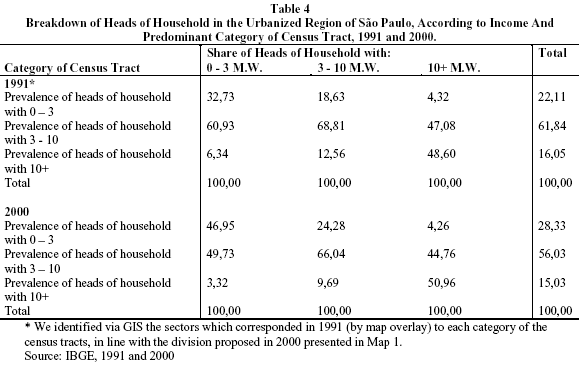
<body><![CDATA[<p><font face="Verdana, Arial, Helvetica, sans-serif" size="2">What is residential    segregation? In general terms, it is the degree of agglomeration of a social    / ethnic group in a given area<a href="#_ftn4" name="_ftnref4" title=""><sup>4</sup></a> . Therefore, the development of gated, high-income condominiums    – such as Barra da Tijuca (Rio de Janeiro) or Alphaville (São Paulo) could be    considered a way of self-segregation.</font></p>     <p><font face="Verdana, Arial, Helvetica, sans-serif" size="2">Peter Marcuse (2001)    defends a more rigorous definition of the phenomenon, considering it as the    process by which a share of the population is involuntarily forced to concentrate    in a given area<a href="#_ftn5" name="_ftnref5" title=""><sup>5</sup></a> . Among the components that would induce    this forced agglomeration would be market mechanisms – that lead to real estate    valorization or devaluation in certain areas –, institutional instruments (taxation,    public investments, shantytown removals, etc.), and effective practices of discrimination    (i.e., by real estate brokers).<a href="#_ftn6" name="_ftnref6" title=""><sup>6</sup></a>    </font></p>     <p><font face="Verdana, Arial, Helvetica, sans-serif" size="2">This definition    also considers the sometimes neglected fact that segregation is, after all,    a relational phenomenon: the segregation of a group only exists when another    group segregates it or is segregated by it. This is the relational component    in which the segregation metrics will be based in an attempt to measure the    degree of isolation of a given social group in relation to another.</font></p>     <p><font face="Verdana, Arial, Helvetica, sans-serif" size="2">It is also convenient    to conduct a more in-depth discussion on the reasons why residential segregation    is important from the social policies point of view. Overall, six main elements    may be presented as evidence of the contribution of residential segregation    for the perpetuation of poverty<a href="#_ftn7" name="_ftnref7" title=""><sup>7</sup></a> :</font></p> <ul type=disc>       <li>          <p><font face="Verdana, Arial, Helvetica, sans-serif" size="2"><i>Poor housing        quality, </i>environmental and health risks: Low-income families tend to        deal with the competition for urban space in the land market by searching        for devaluated housing and/or areas, which translates into small spaces,        with less urban infrastructure, and often subjected to several risks related        to lack of sanitation and environmental problems such as floods and landslides<a      href="#_ftn8" name="_ftnref8" title=""><sup>8</sup></a> . Evidence from other        countries indicate that the direct costs associated to the loss of working        hours due to illnesses, as well as the expenses with medicine and medical        procedures substantially contribute to the reduction of available income        for consumption, enhancing poverty and the economic instability of the family        (Yinger, 2001). In Brazil, health expenses are regressive, impacting more        effectively upon the poorest (<a href="#gra1">Graphic 1</a>). In other words,        health risks resulting from housing conditions contribute to render the        situation more accute.</font></p>   </li>     </ul>     <p><a name="gra1"></a></p>     <p>&nbsp;</p>     <p align="center"><img src="/img/revistas/s_rbcsoc/v2nse/a07gra01.gif"></p>     ]]></body>
<body><![CDATA[<p>&nbsp;</p> <ul type=disc>       <li>          <p><font face="Verdana, Arial, Helvetica, sans-serif" size="2"><i>Disproportional        housing costs</i>: Poorer families generally spend more with housing (considering        the proportion of the income) than high- and middle-class households. According        to the Family Budget Survey (POF-96) of IBGE, for example, housing expenses        in families with income of less than to 2 minimum wages correspond to 24.9%        of their ordinary budget. This share declines as the income increases, reaching        17.7% for the families with income of 30+ minimum wages/ month (Graph 1).        As a result, the income available to spend with food and other goods and        services is proportionally smaller, contributing to the relative impoverishment        of these families. In other words, contrary to popular assumptions, on average,        the segregation of the population in shantytowns and peripheral areas does        not contribute to counterbalance the regressiveness of housing costs, probably        due to the scarcity of available space (at affordable prices for such families)        and the consequent increase in its relative cost<a href="#_ftn9"      name="_ftnref9" title=""><sup>9</sup></a> .</font></p>   </li>     </ul> <ul type=disc>       <li>          <p><font face="Verdana, Arial, Helvetica, sans-serif" size="2"><i>Neighborhood        effects</i>: Several studies show that being raised in neighborhoods with        high concentration of poverty negatively affects people in terms of educational        development, employment, teenage pregnancy and criminal activity (Duralauf,        2001; Briggs, 2001; Cardia, 2000). Although mechanisms to explain the relation        between worst educational performance and residing in places with high concentration        of poor people, for example, are not well-known, it is clear that the worst        performance in these fields contribute to perpetuate and replicate poverty        in the long term. On the other hand, much as the social network of an individual        or family contribute to his/her/their access to jobs and public services,        the existing social isolation in these segregated areas tends to significantly        contribute to reduce the opportunities available for families that reside        in these locations.</font></p>   </li>     </ul> <ul type=disc>       <li>          <p><font face="Verdana, Arial, Helvetica, sans-serif" size="2"><i>Distance        between residence and job: </i>This phenomenon, identified in the international        literature as <i>spatial mismatch, </i>addresses the lack of jobs available        in low-income regions (Kasarda, 1993). In the case of the Metropolitan Area        of São Paulo, for instance, the majority of jobs in the dynamic sector of        commerce and services is concentrated in a restrict number of downtown districts        and in those along the south-southwest corridor of the city (Jardim Paulista,        Itaim, Pinheiros, Moema and Vila Mariana), whose inhabitants are mostly        of medium- and high-income profiles (Emplasa, 1994). Moreover, the spatial        dislocation between jobs and residences was further stressed by the significant        loss of industrial jobs in the East Side of São Paulo and towns of the ABC        area<a href="#_ftn10"      name="_ftnref10" title=""><sup>10</sup></a> . As a result, living in distant        peripheral areas and  commuter towns, besides increasing the costs of transportation        – with impacts on the available income and comfort of the dwellers – also        affects the access to information on available job positions, and substantially        increases the costs of searching for a job.</font></p>   </li>     </ul> <ul type=disc>       ]]></body>
<body><![CDATA[<li>          <p><font face="Verdana, Arial, Helvetica, sans-serif" size="2"><i>Irregular        housing</i>: The irregular ownership of land in shantytowns or illegal settlements        leads to a precarious access to public services, since their provision in        such places tends to be problematic at best.  In many cases, the supply        of these services depend on the existence of State-owned land (or on those        that can be acquired by the State) to become available for the construction        of schools, urban infrastructure and other social facilities.</font></p>   </li>     </ul> <ul type=disc>       <li>          <p><font face="Verdana, Arial, Helvetica, sans-serif" size="2"><i>Residence        as an instrument of income generation</i>: For many reasons, the residence        may be also understood as an instrument for income generation. Residential        space may be used for productive purposes: rooms can be rented, products        can be stockpiled; the house can be the <i>locus </i>for the production        of clothes, food and services; or else be used as a sales point. Additionally,        in some circumstances, the house can be used as a loan guarantee, which        may be later used for productive purposes<a href="#_ftn11" name="_ftnref11"      title=""><sup>11</sup></a> . All of these possibilities are less frequent        in highly segregated places due to the fragility of the local market, the        lack of available space, the precariousness and illegal status of residences.</font></p>   </li>     </ul>     <p><font face="Verdana, Arial, Helvetica, sans-serif" size="2">In short, the literature    presents plenty of evidence that, by different mechanisms, spatial segregation    contributes for the replication of poverty and social problems – particularly    in terms of employment, education, housing, health, transportation, income generation    and public safety. This justifies the centrality of the issue for the metropolitan    debate in Brazil, and the importance of measuring the phenomenon to understand    how it evolves over time.</font></p>     <p><font face="Verdana, Arial, Helvetica, sans-serif" size="2"><b><i>Segregation    Metrics </i></b></font></p>     <p><font face="Verdana, Arial, Helvetica, sans-serif" size="2">In general, the    segregation concept leads to two dimensions: the spatial concentration patterns    of given social groups in specific areas and the degree of social homogeneity    found in such areas (Torres, 2004; Sabatini, 2001)<a href="#_ftn12" name="_ftnref12" title=""><sup>12</sup></a> . These dimensions    are measured via indicators based on the population composition in each of the    studied areas. The dissimilarity index is likely to be the most employed indicator    in this field – albeit other metrics, such as the so-called “isolation indexes”,    are also used (Sabatini, 2001; Massey and Denton, 1993).</font></p>     <p><font face="Verdana, Arial, Helvetica, sans-serif" size="2">The dissimilarity    index measures the share of the population in a given social group that would    have to move in order to create a distribution of social groups within an area    similar to the distribution existing in the city as a whole<a href="#_ftn13" name="_ftnref13" title=""><sup>13</sup></a> . In general, a 0-30% index indicates light segregation;    a 30-60% moderate segregation; and a 60% + severe segregation (Massey and Denton,    1993; Briggs, 2001). This indicator is rather limited and may be criticized    for two reasons:</font></p>     ]]></body>
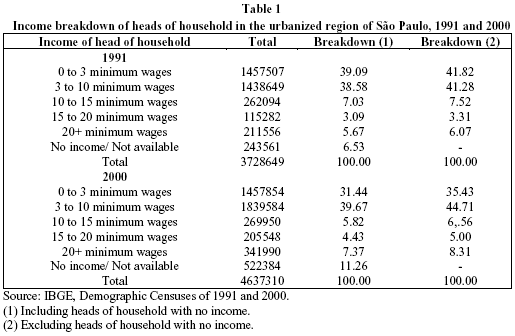
<body><![CDATA[<blockquote>        <p><font face="Symbol" size="2">·</font><font face="Verdana, Arial, Helvetica, sans-serif" size="2">&nbsp;      The indicator does not capture segregation within the regions used as units      of analysis (districts, neighborhoods, etc.). The population of a given social      group may either live inside one single condominium or be spread across the      district, but the indicator will be the same for that district.</font></p>       <p><font face="Symbol" size="2">·&nbsp;&nbsp;</font><font face="Verdana, Arial, Helvetica, sans-serif" size="2">&nbsp;&nbsp;The      indicator varies according to the size of the unit of analysis. The level      of dissimilarity is typically lower for large areas (such as districts) than      for smaller areas (such as census tracts), which results in the so-called      <i>grid</i> problem (Sabatini, 2001)<a href="#_ftn14" name="_ftnref14" title=""><sup>14</sup></a>      .</font></p> </blockquote>     <p><font face="Verdana, Arial, Helvetica, sans-serif" size="2">In order to address    such problems, we will adopt two main procedures: working with the smallest    unit of analysis (in this case, the census tract), so that we minimize the problem    of population distribution within each area; and calculating the dissimilarity    indexes for census tracts and districts, thus taking into account the <i>grid</i>    problem.   </font></p>     <p><font face="Verdana, Arial, Helvetica, sans-serif" size="2">In spite of these    difficulties, this index has been widely employed, indicating, for example,    the high level of residential segregation between black and whites in all large    American cities, with its highest peaks found in Chicago, Detroit and Kansas    City (Massey and Denton, 1993). By using census tracts as units of analysis,    it was possible to observe that this form of segregation remained high between    the years of 1940 and 1990 – the only exception being the relative decrease    seen in the city of San Francisco. In the following sections, we present the    results observed in São Paulo in 1991 and 2000, taking as reference the so-called    socioeconomic segregation, rather than the racial one<a href="#_ftn15" name="_ftnref15" title=""><sup>15</sup></a>    .</font></p>     <p>&nbsp;</p>     <p><font face="Verdana, Arial, Helvetica, sans-serif" size="3"><b>Evaluation of    the residential segregation in São Paulo</b></font></p>     <p><font face="Verdana, Arial, Helvetica, sans-serif" size="2">Here, we will try    to measure here is the evolution of the residential segregation in the 90s based    on the difference between families whose heads of household have low and high    income, and between families whose heads of household have low and high schooling.    We will calculate this metric for both districts and census tracts for the years    of 1991 and 2000.</font></p>     <p><font face="Verdana, Arial, Helvetica, sans-serif" size="2">Before we present    the results themselves, it would be worth discussing how the indicators of income    and schooling – available for census tracts – varied during the period in the    21 cities that make up the urbanized region of São Paulo considered in the analysis<a href="#_ftn16" name="_ftnref16" title=""><sup>16</sup></a>    . We present the evolution of the income for heads of household in the 90s on    <a href="#tab1">Table 1</a>. We can observe that the share of heads of household    with 0-3 mw/month decreased substantially, going from 41.8 to 35.4%, while that    of heads of household with 15+ and 20+ mw/month slightly increased. This evolution    is probably underestimated in real numbers, as the minimum wage underwent some    appreciation after <i>Plano Real</i> (1994 stabilization plan)<a href="#_ftn17" name="_ftnref17" title=""><sup>17</sup></a> . This comparison should be carefully    considered due to the different criteria employed to gather information on the    “no income” individuals in the censuses of 1991 and 2000<a href="#_ftn18" name="_ftnref18" title=""><sup>18</sup></a>    .</font></p>     <p><a name="tab1"></a></p>     ]]></body>
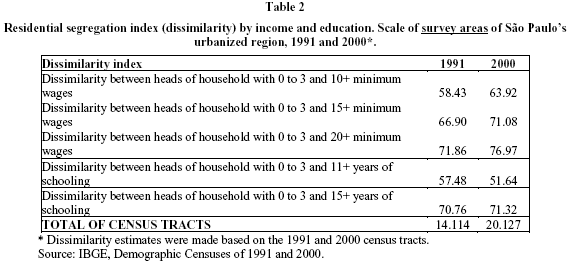
<body><![CDATA[<p>&nbsp;</p>     <p align="center"><img src="/img/revistas/s_rbcsoc/v2nse/a07tab01.gif"></p>     <p>&nbsp;</p>     <p><font face="Verdana, Arial, Helvetica, sans-serif" size="2">The census data    also indicate that the share of heads of household with less than 3 years of    schooling decreased from 24.5 to 19.3% during the 1990s. The share of heads    of household with 11+ years of schooling (secondary school) went up from 24.7    to 31%, even though the share of those with university degree (15+ years of    schooling) remained virtually stable – from 10.61 in 1991 to 11.32% in 2000.</font></p>     <p><font face="Verdana, Arial, Helvetica, sans-serif" size="2">In other words,    during that decade, the low-income, low-schooling population seems to have decreased    significantly in the urban region of São Paulo. Such data is consistent with    more general educational and income indicators available from other sources    and based on sample data, such as PED (Employment and Unemployment Survey),    PNADs (National Household Sample Survey) and PME (Monthly Employment Survey).</font></p>     <p><font face="Verdana, Arial, Helvetica, sans-serif" size="2">However, a reduction    in the proportion of poor people does not always imply a decline in segregation.    Massey and Denton (1993), for instance, argue that residential segregation increased    sharply in the US between 1910 and 1940, albeit the substantial increase in    income levels. In the case of São Paulo, when considering income dissimilarity    indexes between heads of household with 0-3 and 20+ mw/ month (scale of census    tracts), it is possible to observe a substantial increase in segregation – from    71.9 in 1991 to 77.0 in 2000 (<a href="#tab2">Table 2</a>)<a href="#_ftn19" name="_ftnref19" title=""><sup>19</sup></a>    .</font></p>     <p><a name="tab2"></a></p>     <p>&nbsp;</p>     <p align="center"><img src="/img/revistas/s_rbcsoc/v2nse/a07tab02.gif"></p>     <p align="center">&nbsp;</p>     ]]></body>
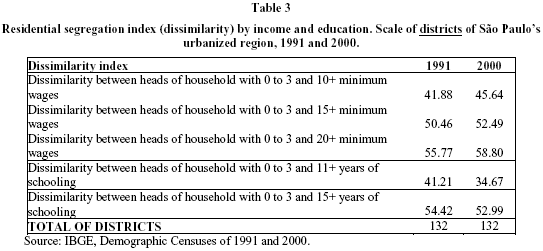
<body><![CDATA[<p><font face="Verdana, Arial, Helvetica, sans-serif" size="2">Besides the importance    of the increase in segregation as an indicator for the deterioration in social    relations in the city during the 90s, it should be noted that observed levels    are very impressive, and higher than the dissimilarity between blacks and whites    in New York in the 80s (Massey and Denton, 1993), even though we should be careful    with such a comparison<a href="#_ftn20" name="_ftnref20" title=""><sup>20</sup></a>    . Moreover, when we consider dissimilarity for other income groups, as for the    0-3+ and 10+ minimum wages, we can observe that, also in this case, the levels    are increasingly high (indicating severe segregation) over the 90s. In other    words, the phenomenon of social isolation seems not to have been restricted    only to the fringes of the income distribution range, but also to the middle-class    intermediary groups.</font></p>     <p><font face="Verdana, Arial, Helvetica, sans-serif" size="2">Segregation data    by schooling strata nevertheless provide us with different information. The    segregation slightly increased between families in which the heads of household    had a university degree (15+ years of schooling) and in those in which the heads    had low schooling levels (less than 3 years). But it dropped substantially –    from 57.5 to 51.6 – in the comparison between heads of household with less than    3 years of schooling and those who reached the secondary school (11+ years of    schooling)<a href="#_ftn21" name="_ftnref21" title=""><sup>21</sup></a> .</font></p>     <p><font face="Verdana, Arial, Helvetica, sans-serif" size="2">On the one hand,    residential segregation increases when we take income for reference; on the    other, it is reduced when the reference is schooling. This phenomenon seems    to result from the substantial increase in the education coverage that took    place in the Metropolitan Area of São Paulo during the 90s (Alesp, 2000), with    people schooled up to the secondary school level residing in popular neighborhoods.    However, this expansion was not translated into an effective change in the socioeconomic    segregation patterns measured by income.</font></p>     <p><font face="Verdana, Arial, Helvetica, sans-serif" size="2">When measuring    segregation following the scale of districts, we observe similar outcomes. Segregation    increases according to income, and decreases according to schooling (<a href="#tab3">Table    3</a>). As expected, the segregation levels are lower in this case due to the    variation in the scale of observation. It should be noticed that districts are    large spatial units and thus may include relevant spatial heterogeneity within    their perimeter (i.e., shantytowns), which cannot be captured by measurements    at such a scale<a href="#_ftn22" name="_ftnref22" title=""><sup>22</sup></a>    . Observed levels nevertheless remain relatively high, mainly if we consider    the dissimilarity between heads of household with 0-3 and 20+ minimum wages.</font></p>     <p><a name="tab3"></a></p>     <p>&nbsp;</p>     <p align="center"><img src="/img/revistas/s_rbcsoc/v2nse/a07tab03.gif"></p>     <p align="center">&nbsp;</p>     <p><font face="Verdana, Arial, Helvetica, sans-serif" size="2">Contrary to the    situation of Santiago (Sabatini, 2001), where macro segregation fell while the    micro one increased, the segregation measured by income has increased in São    Paulo for both scales. Such indicators suggest a growing social isolation not    only when comparing large areas, but also locally, within the district area.    Results also indicate the extension and depth of this phenomenon.</font></p>     <p><font face="Verdana, Arial, Helvetica, sans-serif" size="2">In short, these    results point out to a complex evolution of the “social situation” of São Paulo    in the 90s. While poverty and the share of heads of household with very low    schooling are reduced, when income is taken as reference, it is possible to    observe a substantial increase in residential segregation.  This phenomenon    is not so unexpected in the Metropolitan Area of São Paulo. In fact, the 90s    have always been rather contradictory in terms of other social indicators –    i.e., the significant improvement of education and sanitation, for instance,    and the relevant deterioration of unemployment and violence (Alesp, 2000).</font></p>     ]]></body>
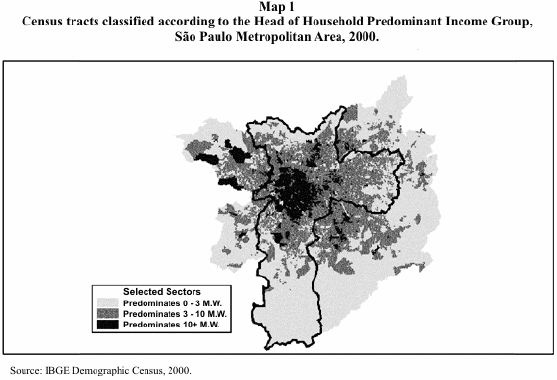
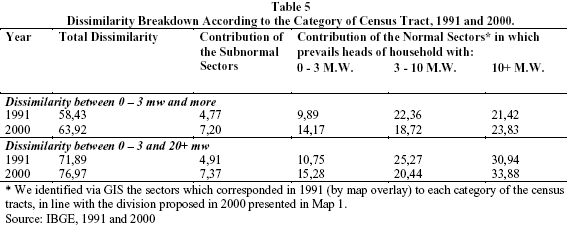
<body><![CDATA[<p>&nbsp;</p>     <p><font face="Verdana, Arial, Helvetica, sans-serif" size="3"><b>Assumptions    regarding the evolution observed in the 90s</b></font></p>     <p><font face="Verdana, Arial, Helvetica, sans-serif" size="2">Based on the available    literature, three different and non-excluding assumptions can be developed to    justify the increase in segregation observed in 1990s, namely:</font></p>     <blockquote>        <p><font face="Symbol" size="2">·</font><font face="Verdana, Arial, Helvetica, sans-serif" size="2">&nbsp;      <i>Increment of the self-isolation pattern in high-income groups: </i>This      assumption can be derived, for instance, from the work of Caldeira (2000),      which points out to the impact of the development of condominiums and gated      areas, above all in the Western portion of the Metropolitan Area<a href="#_ftn23" name="_ftnref23" title=""><sup>23</sup></a>      ;</font></p>       <p><font face="Symbol" size="2">·</font><font face="Verdana, Arial, Helvetica, sans-serif" size="2">&nbsp;      <i>Higher degree of isolation in the shantytowns population: </i>This argument      was used by Kowarick (2001), for example. However, it is important to consider      that the demographic growth in shantytowns cannot <i>per se</i> be used as      an indicator of segregation. If this growth comes along with increased social      heterogeneity in shantytowns, for example, it may result from reduced segregation,      at least vis-à-vis the dissimilarity index<a href="#_ftn24" name="_ftnref24" title=""><sup>24</sup></a> .</font></p>       <p><font face="Symbol" size="2">·</font><font face="Verdana, Arial, Helvetica, sans-serif" size="2">&nbsp;      <i>Continuity of the peripherization process: </i>This process can be observed      by the consistent increase in the population of districts farther from the      downtown area (Villaça, 1999). This has been a current phenomenon since 1950,      but from the 1970s onwards, central districts started to show negative statistics      of growth, while the urban peripheral districts continued to present rising      rates<a href="#_ftn25" name="_ftnref25" title=""><sup>25</sup></a> . However, it should      be noted that demographic growth is not always related to more segregation.</font></p> </blockquote>     <p><font face="Verdana, Arial, Helvetica, sans-serif" size="2">In order to further    discuss these aspects, below we present the distribution of census tracts in    the Metropolitan Area of São Paulo (<a href="#map1">Map 1</a> and <a href="#tab4">Table    4</a>), classified according to the predominant income group of heads of household    in a given area<a href="#_ftn26" name="_ftnref26" title=""><sup>26</sup></a> .</font></p>     <p><a name="map1"></a></p>     <p>&nbsp;</p>     ]]></body>
<body><![CDATA[<p align="center"><img src="/img/revistas/s_rbcsoc/v2nse/a07map01.gif"></p>     <p align="center">&nbsp;</p>     <p><a name="tab4"></a></p>     <p>&nbsp;</p>     <p align="center"><img src="/img/revistas/s_rbcsoc/v2nse/a07tab04.gif"></p>     <p align="center">&nbsp;</p>     <p><font face="Verdana, Arial, Helvetica, sans-serif" size="2">From a spatial    point of view, we can observe that the families whose heads of household have    an income of 10+ mw are located in the center of the city, consistent with the    center-periphery model (Villaça, 2001). However, it is also possible to notice    an important heterogeneity due to the expressive presence of higher income nucleus    in the neighborhoods of Santana and Tatuapé, as well as in some parts of ABC    cities, Guarulhos and condominiums located in western cities of the Metropolitan    Area (Marques and Bitar, 2002).</font></p>     <p><font face="Verdana, Arial, Helvetica, sans-serif" size="2">Likewise, intermediary    income groups are located in an intermediary ring, while lower income ones spread    along the whole peripheral ring. It is also important to highlight the significant    presence of low income areas throughout the intermediary ring, which can be    explained by the occurrence of subnormal areas (shantytowns) in this ring, as    well as in the peripheral one.</font></p>     <p><font face="Verdana, Arial, Helvetica, sans-serif" size="2">The division of    the Metropolitan Region into these three groups of census tracts leads us to    a deeper reflection on the subjacent processes related to the increase in segregation    observed in the last section. These results may be observed in <a href="#tab4">Table    4</a>.</font></p>     <p><font face="Verdana, Arial, Helvetica, sans-serif" size="2">When comparing    1991 to 2000, the share of heads of household with +10 mw living in areas predominantly    occupied by families of this income group went up from 48.6 to 50.9%. In other    words, the richest areas became a little more “exclusive” in this period, given    the decrease in the share of families with heads of household earning 3-10 mw.    These results seem consistent with the hypothesis proposed by Caldeira (2000),    which relates to the increase of self-segregation among the richest<a href="#_ftn27" name="_ftnref27" title=""><sup>27</sup></a> .</font></p>     ]]></body>
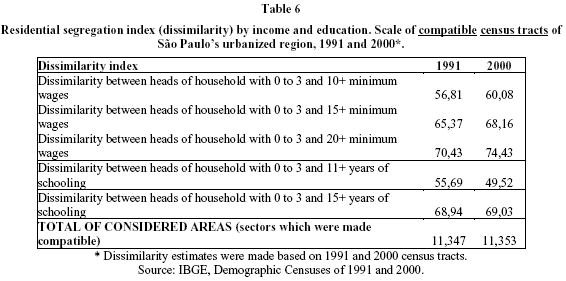
<body><![CDATA[<p><font face="Verdana, Arial, Helvetica, sans-serif" size="2">On the other hand,    in areas predominantly occupied by families with heads of household earning    0-3 minimum wages, the share of the poorest families substantially increased    - going from 32.7 to 46.9%<a href="#_ftn28" name="_ftnref28" title=""><sup>28</sup></a>    , which indicates that areas predominantly occupied by very poor people became    less socially diverse. Thus, these data demonstrate that the demographic growth    observed in the periphery contributed to the increase in the share of poor people    in this kind of area, according to the hypothesis suggested by Villaça (1999).</font></p>     <p><font face="Verdana, Arial, Helvetica, sans-serif" size="2">For a better interpretation    of such results, we present below the same problem in terms of the dissimilarity    index (<a href="#tab5">Table 5</a>). For that, we employed the so-called “contribution    of each area for the dissimilarity”<a href="#_ftn29" name="_ftnref29" title=""><sup>29</sup></a>    .</font></p>     <p><a name="tab5"></a></p>     <p>&nbsp;</p>     <p align="center"><img src="/img/revistas/s_rbcsoc/v2nse/a07tab05.gif"></p>     <p>&nbsp;</p>     <p><font face="Verdana, Arial, Helvetica, sans-serif" size="2">&nbsp;In fact,    when we take – in subnormal sectors – the dissimilarity index for the two extremes    of the income distribution range, the contribution for the segregation of the    predominantly poor sectors has increased between 1991 and 2000, as did the contribution    for the segregation in predominantly rich sectors. When we isolate the subnormal    sectors (shantytowns), we can observe that this group also contributed for the    increase in residential segregation during this period.</font></p>     <p><font face="Verdana, Arial, Helvetica, sans-serif" size="2">In absolute terms,    census tracts with a high share of richer families are the greatest contributors    to dissimilarity. Nevertheless, we observed a higher increase in the degree    of social isolation within the populations living in shantytowns or peripheral    areas, which further stresses its relevance for the explanation of rising residential    segregation levels in the Metropolitan Region of São Paulo during the 90s. Areas    of intermediary income, defined here as those occupied mostly by families with    3-10 mw (<a href="#map1">Map 1</a>), are still important to explain the high    levels of segregation – even though their impact has been reduced in the past    decade.</font></p>     <p>&nbsp;</p>     <p><font face="Verdana, Arial, Helvetica, sans-serif" size="3"><b>Conclusion</b></font></p>     ]]></body>
<body><![CDATA[<p><font face="Verdana, Arial, Helvetica, sans-serif" size="2">To some extent,    the results presented here allow us to include the segregation issue within    the debate about the “lost decade”. Several authors discussed the paradox concerning    the improvement of social indicators during the 80s vis-à-vis the negative dynamics    of the Brazilian economy<a href="#_ftn30" name="_ftnref30" title=""><sup>30</sup></a>    . This phenomenon was explained as a consequence of the social movements and,    above all, as a result of the inertial character of the urban social policies    (Marques and Najar, 1995; Torres, 1997). Apparently, segregation data may show    the same paradox for the 90s.</font></p>     <p><font face="Verdana, Arial, Helvetica, sans-serif" size="2">In other words,    albeit State action has contributed during the last decades for the reduction    of the inequality in terms of public services access – particularly education    and sanitation –, those interventions did not contribute to significantly reduce    the degree of isolation between the different social groups of  São Paulo. Segregation    levels were already high in 1991, and further increased during the past decade.</font></p>     <p><font face="Verdana, Arial, Helvetica, sans-serif" size="2">A consistent social    housing policy is likely to be the only one capable of fighting against residential    segregation, although it may also aggravate the problem (Briggs, 2001).<a href="#_ftn31" name="_ftnref31" title=""><sup>31</sup></a> Unfortunately, this policy seems not    to have been a priority in either the national or the local agenda during 90s<a href="#_ftn32" name="_ftnref32" title=""><sup>32</sup></a> .  While a significant amount of resources was allocated    to Health and Education via constitutional reforms, the resources for Housing    were relatively restricted, particularly due to problems observed in the FGTS    (Employees Fund which is used for financing social housing) during the period.</font></p>     <p><font face="Verdana, Arial, Helvetica, sans-serif" size="2">Generally speaking,    housing policies – especially those focusing on lower income groups – should    be subsidized. This element, coupled with the high housing deficit<a href="#_ftn33" name="_ftnref33" title=""><sup>33</sup></a> , may have discouraged large housing programs, particularly    in a context of severe budget restrictions. In any event, we still need to fully    understand why housing policies have developed so slowly during the 90s, whereas    other social policies presented more significant results.</font></p>     <p><font face="Verdana, Arial, Helvetica, sans-serif" size="2">In an article published    in the press, for example, the president of Caixa Econômica Federal (CEF) during    Fernando Henrique Cardoso’s government (Emílio Carazzai) argued that non-subsidized    credit mechanisms were not adequate for families with less than 3 mw. Moreover,    neither could the most important public program in this field (Residencial Leasing    Program – PAR) be properly implemented in metropolitan areas, since the financing    value was not compatible with the high costs of land.</font></p>     <p><font face="Verdana, Arial, Helvetica, sans-serif" size="2">In thesis, budget    restrictions could be partly solved by non-conventional housing policies, i.e.    urbanization of shantytowns, land use regulation and remodeling of flophouses.    Because they are much cheaper and involve communitarian development aspects,    such policies could lead to significant impact. However, their contribution    to the decrease in residential segregation would be limited due to their inability    to produce a more comprehensive population mix.</font></p>     <p><font face="Verdana, Arial, Helvetica, sans-serif" size="2">In summary, the    need for a housing policy capable of fighting against residential segregation    and its consequences seems to be an obvious priority for a metropolitan area    such as São Paulo’s, where the increasing feeling of collective malaise, violence    and urban degradation is the most evident manifestation of this phenomenon.    And yet, during the past decade the institutional and financial conditions required    for such a policy to be taken as a priority seem not to have been in place.    </font></p>     <p>&nbsp;</p>     <p><font face="Verdana, Arial, Helvetica, sans-serif" size="3"><b>BIBLIOGRAPHY</b></font></p>     <!-- ref --><p><font face="Verdana, Arial, Helvetica, sans-serif" size="2">ALESP, (2000),    <i>Cadernos do fórum São Paulo: século XXI</i>. São Paulo, Alesp.</font><!-- ref --><p><font face="Verdana, Arial, Helvetica, sans-serif" size="2">BONDUKI, N. &amp;    ROLNIK, R. (1982), "Periferia da Grande São Paulo: reprodução do espaço como    expediente de reprodução da força de trabalho", <i>in</i> E. Maricato (org.),    <i>A produção capitalista da casa (e da cidade) do Brasil industrial</i>. São    Paulo, Alfa-ômega.</font><!-- ref --><p><font face="Verdana, Arial, Helvetica, sans-serif" size="2">BRIGGS, Xavier    S. (2001), "Ties that bind, bridge, and constrain: social capital and segregation    in American Metropolis". Trabalho apresentado no International Seminar on Segregation    and the City, Cambridge, Lincoln Institute of Land Policy, jul. (<a href="http://www.lincolninst.edu" target="_blank">www.lincolninst.edu</a>).    </font><!-- ref --><p><font face="Verdana, Arial, Helvetica, sans-serif" size="2">CALDEIRA, Teresa,    P. (2000), <i>A cidade dos muros. </i>São Paulo, Editora 34/Edusp.</font><!-- ref --><p><font face="Verdana, Arial, Helvetica, sans-serif" size="2">CARDIA, N. (1999),    "Os impactos da exposição à violência: aceitação da violência ou horror continuado?    O caso de São Paulo". Trabalho apresentado no Encontro "Culture, Citizenship    and Urban Violence", México, Cuernavaca. </font><!-- ref --><p><font face="Verdana, Arial, Helvetica, sans-serif" size="2">_________. (2000),    "Urban violence in São Paulo". <i>Comparative Urban Studies Occasional Papers    Series</i>, 33, Washington, D.C., Woodrow Wilson International Center for Scholars.</font><!-- ref --><p><font face="Verdana, Arial, Helvetica, sans-serif" size="2">CEPAL. (2002),    <i>Panorama social de América Latina, 2000-2001</i>. Santiago, Cepal.</font><!-- ref --><p><font face="Verdana, Arial, Helvetica, sans-serif" size="2"><i>DIÁRIO Oficial    do Município de São Paulo</i>. (1995), "Favelas na Cidade de São Paulo". <i>Diário    Oficial</i>, edição especial, 101, 31 mar.</font><!-- ref --><p><font face="Verdana, Arial, Helvetica, sans-serif" size="2">DURLAUF, S. N.    (2001), "The membership theory of poverty: the role of group affiliations in    determing socioeconomic outcomes", <i>in</i> S. H. Danziger e R. H. Haverman,    <i>Understanding poverty</i>, Nova York, Russell Sage, pp. 392-416.</font><!-- ref --><p><font face="Verdana, Arial, Helvetica, sans-serif" size="2">EMPLASA. (1994),    <i>Plano metropolitano da Grande São Paulo. </i>São Paulo, Emplasa.</font><!-- ref --><p><font face="Verdana, Arial, Helvetica, sans-serif" size="2">FARIA, V. (1992),    "A conjuntura social brasileira: dilemas e perspectivas". <i>Novos Estudos Cebrap</i>,    33.</font><!-- ref --><p><font face="Verdana, Arial, Helvetica, sans-serif" size="2">FJP. (2000), <i>Déficit    habitacional no Brasil. </i>Brasília, Secretaria Nacional de Políticas Urbanas/PNUD    (<a href="http://www.pbqp-h.gov.br/deficit2000/apresentacao.htm" target="_blank">www.pbqp-h.gov.br/deficit2000/apresentacao.htm</a>).</font><!-- ref --><p><font face="Verdana, Arial, Helvetica, sans-serif" size="2">KAPLAN, Robert     D. (1996), <i>The end of the earth: a journey at the dawn of the 21<sup>st</sup>    century. </i>Nova York, Random House.</font><!-- ref --><p><font face="Verdana, Arial, Helvetica, sans-serif" size="2">KASARDA, J. D.    (1993), "Inner-city poverty and neighborhood distress: 1970-1990". <i>Housing    Policy Debate</i>, 4 (3): 253-302.</font><!-- ref --><p><font face="Verdana, Arial, Helvetica, sans-serif" size="2">KOWARICK, L. (1979),    <i>A espoliação urbana</i>. Rio de Janeiro, Paz e Terra.</font><!-- ref --><p><font face="Verdana, Arial, Helvetica, sans-serif" size="2">_________. (2003).    "Sobre a vulnerabilidade socioeconômica e civil: Estados Unidos, França e Brasil".    <i>Revista Brasileira de Ciências Sociais</i>, 51.</font><!-- ref --><p><font face="Verdana, Arial, Helvetica, sans-serif" size="2">LOGAN, J. (2000),    "Still a global city: the racial and ethnic segmentation of New York", <i>in</i>    P. Marcuse e R. Kempen, <i>Globalizing cities: a new spatial order?</i>, Londres,    Blackwell.</font><!-- ref --><p><font face="Verdana, Arial, Helvetica, sans-serif" size="2">MARCUSE, P. (2001),    "Enclaves yes, ghettoes, no: segregation and the State". <i>International Seminar    on Segregation and the City</i>, Cambridge, Lincoln Institute of Land Policy.</font><!-- ref --><p><font face="Verdana, Arial, Helvetica, sans-serif" size="2">MARICATO, E. (1996),    <i>Metrópole na periferia do capitalismo: ilegalidade, desigualdade e violência</i>.    São Paulo, Hucitec.</font><!-- ref --><p><font face="Verdana, Arial, Helvetica, sans-serif" size="2">MARQUES, E. &amp;    BITAR, S. (2002), "Grupos sociais e espaço". <i>Novos Estudos Cebrap</i>, 64:    123-131 (Dossiê Espaço, Política e Políticas na Metrópole Paulistana).</font><!-- ref --><p><font face="Verdana, Arial, Helvetica, sans-serif" size="2">MARQUES, E. &amp;    NAJAR, A. (1995), "Espaço e mortalidade no Rio de Janeiro da década de 1980".    <i>Anais do VI Encontro Nacional da Anpur</i>, Brasília.</font><!-- ref --><p><font face="Verdana, Arial, Helvetica, sans-serif" size="2">MASSEY, D. S. &amp;    DENTON, N. A. (1993), <i>American apartheid: segregation and the making of the    underclass</i>. Cambridge, Harvard University Press.</font><!-- ref --><p><font face="Verdana, Arial, Helvetica, sans-serif" size="2">MENEZES-FILHO,    N. A. (2002), "A evolução da educação no Brasil e seu impacto no mercado de    trabalho. São Paulo", FEA/USP (mimeo). </font><!-- ref --><p><font face="Verdana, Arial, Helvetica, sans-serif" size="2">MINGIONE, Enzo.    (1999), "Urban poverty in the advanced industrial world: concepts, analysis    and debates", <i>in</i> E. Mingione (ed.), <i>Urban poverty and the underclass</i>,    Nova York, Blackwell.</font><!-- ref --><p><font face="Verdana, Arial, Helvetica, sans-serif" size="2">RIBEIRO, L. C.    &amp; Telles, E. (2000), "Rio de Janeiro: emerging dualization in a historically    unequal city", <i>in</i> P. Marcuse e R. Kempen, <i>Globalizing cities: a new    spatial order?</i>, Londres, Blackwell.</font><!-- ref --><p><font face="Verdana, Arial, Helvetica, sans-serif" size="2">ROLNIK, R. (1997),    <i>A cidade e a lei: legislação, política urbana e territórios na cidade de    São Paulo</i>. São Paulo, Nobel/Fapesp.</font><!-- ref --><p><font face="Verdana, Arial, Helvetica, sans-serif" size="2">SABATINI, F. (2001),    "Residencial segregation pattern changes in Chile's main cities: scale shifts    and increasing malignancy". <i>International Seminar on Segregation and the    City</i>, Cambridge, Lincoln Institute of Land Policy.</font><!-- ref --><p><font face="Verdana, Arial, Helvetica, sans-serif" size="2">SANTOS, C. (1982),    <i>Processo de crescimento e ocupação da periferia</i>. Rio de Janeiro, Ibam/CPU.</font><!-- ref --><p><font face="Verdana, Arial, Helvetica, sans-serif" size="2">SANTOS, W. G. (1987),    "A trágica condição da política social", <i>in</i> S. Abranches; W. dos Santos    e M. Coimbra, <i>Política social e combate à pobreza</i>, Rio de Janeiro, Jorge    Zahar.</font><!-- ref --><p><font face="Verdana, Arial, Helvetica, sans-serif" size="2">SCHTEINGART, M.    (1987), "Estrutura urbana y la diferenciación socio-espacial en la zona metropolitana    de la Ciudad de México (1970-1980)". <i>Revista Del Colégio de México</i>, s.    n.</font><!-- ref --><p><font face="Verdana, Arial, Helvetica, sans-serif" size="2">SILVA, L. (org.).    (1992), <i>O que mostram os indicadores sociais sobre pobreza na década perdida</i>.    Rio de Janeiro, Ipea (relatório de pesquisa).</font><!-- ref --><p><font face="Verdana, Arial, Helvetica, sans-serif" size="2">SMOLKA, M. (1987),    "Para uma reflexão sobre o processo de estruturação interna das cidades brasileiras:    o caso do Rio de Janeiro". <i>Espaço e Debates</i>, 21.</font><!-- ref --><p><font face="Verdana, Arial, Helvetica, sans-serif" size="2">TASCHNER, S. P.    (1992), "Degradação ambiental em áreas de invasão no município de São Paulo".    <i>Anais do VIII Encontro Nacional de Estudos Populacionais</i>, São Paulo,    Abep.</font><!-- ref --><p><font face="Verdana, Arial, Helvetica, sans-serif" size="2">TASCHNER, S. P.    &amp; BÓGUS, L. (2000), "A cidade dos anéis: São Paulo", <i>in</i> L. C. Queiroz    (ed.), <i>O futuro das metrópoles: desigualdades e governabilidade</i>, Rio    de Janeiro, Revan/Fase.</font><!-- ref --><p><font face="Verdana, Arial, Helvetica, sans-serif" size="2">TELLES, E. (1994),    "Residencial segregation by skin color in Brazil". <i>American Sociological    Review</i>, 57 (2): 186-197, abr.</font><!-- ref --><p><font face="Verdana, Arial, Helvetica, sans-serif" size="2">_________. (1995),    "Structural sources of socioeconomic segregation in Brazil". <i>American Journal    of Sociology</i>, 100 (5): 199-223.</font><!-- ref --><p><font face="Verdana, Arial, Helvetica, sans-serif" size="2">_________. (2003),    "U.S. Foundations and racial reasoning in Brazil". <i>Theory, Culture &amp;    Society</i>, 20 (4).</font><!-- ref --><p><font face="Verdana, Arial, Helvetica, sans-serif" size="2">TORRES, H. (1997),    <i>Desigualdade ambiental em São Paulo</i>. Tese de doutorado, Campinas, IFCH.</font><!-- ref --><p><font face="Verdana, Arial, Helvetica, sans-serif" size="2">TORRES, H. (2002),    "Social policies for the urban poor: the role of population information". <i>Working    Papers Series CST/ LAC</i>, 24, UNFPA Country Support Team for Latin America    and the Caribbean.</font><!-- ref --><p><font face="Verdana, Arial, Helvetica, sans-serif" size="2">TORRES, H. &amp;    MARQUES, E. (2002), "Tamanho populacional das favelas paulistanas: ou os grandes    números e a falência do debate sobre a metrópole". Trabalho apresentado no encontro    Nacional de Estudos Populacionais, Ouro Preto, Abep.</font><!-- ref --><p><font face="Verdana, Arial, Helvetica, sans-serif" size="2">_________. (2001),    "Reflexões sobre a hiperferiferia: novas e velhas faces da pobreza no entorno    metropolitano". <i>Revista Brasileira de Estudos Urbanos e Regionais</i>, 4.</font><!-- ref --><p><font face="Verdana, Arial, Helvetica, sans-serif" size="2">VALLADARES, L.    &amp; COELHO, M. (1995), "Urban research in Brazil and Venezuela: towards an    agenda for the 1990s", <i>in</i> P. Stren (ed.), <i>Urban research in the developing    world - Latin America</i>, Toronto, Center for Urban and Community Studies.</font><!-- ref --><p><font face="Verdana, Arial, Helvetica, sans-serif" size="2">VILLAÇA, F. (1999),    "Efeitos do espaço sobre o social na metrópole brasileira", <i>in</i> M. A.    Souza (ed.), <i>Metrópole e globalização: conhecendo a cidade de São Paulo</i>,    São Paulo, Cedesp.</font><!-- ref --><p><font face="Verdana, Arial, Helvetica, sans-serif" size="2">_________. (2001),    <i>Espaço intra-urbano no Brasil. </i>São Paulo, Nobel/Fapesp.</font><!-- ref --><p><font face="Verdana, Arial, Helvetica, sans-serif" size="2">WILSON, William.    (1990), <i>The truly disadvantaged: the inner city, the underclass and public    policy</i>. Chicago, University of Chicago Press.</font><!-- ref --><p><font face="Verdana, Arial, Helvetica, sans-serif" size="2">WORLD BANK. (1999),    <i>Entering the 21<sup>st</sup> century: world development report, 1999-2000</i>.    Oxford, Oxford University Press.</font><!-- ref --><p><font face="Verdana, Arial, Helvetica, sans-serif" size="2">YIENGER, J. (2001),    "Housing discrimination and residential segregation as causes of poverty", <i>in</i>    S. H. Danziger e R. H. Haverman, <i>Understanding poverty</i>, Nova York, Russell    Sage, pp. 359-391.</font><p>&nbsp;</p>     <p>&nbsp;</p>     <p><font face="Verdana, Arial, Helvetica, sans-serif" size="2">Article received    in February/2003     <br>   Approved in November/2003</font></p>     ]]></body>
<body><![CDATA[<p><font face="Verdana, Arial, Helvetica, sans-serif" size="2"> </font></p>     <p>&nbsp;</p>     <p><font face="Verdana, Arial, Helvetica, sans-serif" size="2"><a href="#_ftnref1" name="_ftn1" title=""><sup>1</sup></a> The work of Edward Telles (1994,1995 and     2003) may be considered exceptions.    <br>   <a href="#_ftnref2" name="_ftn2" title=""><sup>2</sup></a> Macro segregation refers to a wider spatial    scale, such as neighborhoods or districts, whereas micro segregation relates    to a detailed geographic scale – i.e., blocks or census tracts as units of analysis.    An important distinction may be observed between the two phenomena in empirical    terms: macro segregation may be reduced in a given urban area, while the micro    one increases, as it was recently the case in Santiago, Chile (Sabatini, 2001).    <br>   <a href="#_ftnref3" name="_ftn3" title=""><sup>3</sup></a> The family income <i>per capita</i> would    be the most adequate variable to measure the socioeconomic dimensions of residential    segregation. Unfortunately, IBGE (Brazilian Institute of Geography and Statistics)    does not publish this variable in the scale of census tracts, therefore preventing    its usage as a measure of micro segregation.    <br>   <a href="#_ftnref4" name="_ftn4" title=""><sup>4</sup></a> In Latin America, this concept has often    been used loosely, assuming that the spatial segregation is nothing more than    a reflection of social differences. The term segregation is also taken as a    synonym for inequality, exclusion and even poverty (Sabatini, 2001).     <br>   <a href="#_ftnref5" name="_ftn5" title=""><sup>5</sup></a> “Segregation is the    process through which the population is forced – thus involuntarily – to concentrate    on a specific area, a ghetto. It is the process of formation and maintenance    of this ghetto” (Marcuse, 2001).    <br>   <a href="#_ftnref6" name="_ftn6" title=""><sup>6</sup></a> Regardless of how interesting that definition    may be, it is almost impossible to identify how forced or involuntary the segregation    is in a certain area with the conventional metrics of the phenomenon. It is    unavoidable to use ethnographic data to identify, for instance, whether the    families that live in a particular location remain there because they have no    other options.  In other words, the segregation metrics usually based on aggregated    data by area allow us to observe the levels of segregation and its variation    over time, but not to qualify its nature (forced, self-segregation, etc.).    <br>   <a href="#_ftnref7" name="_ftn7" title=""><sup>7</sup></a> This discussion is partly based on Yinger    (2001).    <br>   <a href="#_ftnref8" name="_ftn8" title=""><sup>8</sup></a> For example, a significant share of the    shantytowns in São Paulo is located in places with environmental risks (Taschner,    2002).     ]]></body>
<body><![CDATA[<br>   <a href="#_ftnref9" name="_ftn9" title=""><sup>9</sup></a> This effect would    be even worse if the illegal occupation of space (such as in shantytowns) did    not exist.    <br>   <a href="#_ftnref10" name="_ftn10" title=""><sup>10</sup></a> We call ABC the    group formed by three important industrial metropolitan cities that surround    São Paulo: Santo <b>A</b>ndré, São <b>B</b>ernardo and São <b>C</b>aetano. Sometimes    we may also refer to this group as “ABCD”, which includes the city of <b>D</b>iadema.     <br>   <a href="#_ftnref11" name="_ftn11" title=""><sup>11</sup></a> This possibility is less frequent in    Brazil because of the legislation that prevents families that own only one house    from being evicted.    <br>   <a href="#_ftnref12" name="_ftn12" title=""><sup>12</sup></a> Massey and Denton (1993) also mention    other dimensions, such as concentration (measuring the density of poverty) and    centralization (measuring its location vis-à-vis the downtown area). We consider    such elements to be less relevant for the Brazilian debate    <br>   <a href="#_ftnref13" name="_ftn13" title=""><sup>13</sup></a> Formally, the dissimilarity index may    be described as ID = 0,5 <font face="Symbol">å</font> ÷ Xi - Yi÷, where Xi refers    to the share of X group members living in i district (in relation to the total    of the X group population in the city), and  Yi refers to the share of Y group    members living in i district (in relation to the total of the Y group population    in the city).    <br>   <a href="#_ftnref14" name="_ftn14" title=""><sup>14</sup></a> This last pattern    usually increases the complexity of inter-area comparisons – for the comparison    to be adequate, the type of unit of analysis must be relatively homogeneous    in both observed locations.     <br>   <a href="#_ftnref15" name="_ftn15" title=""><sup>15</sup></a> Unfortunately,    IBGE does not publish racial data in the scale of census tracts.    <br>   <a href="#_ftnref16" name="_ftn16" title=""><sup>16</sup></a> Due to data availability, we have taken    into consideration the 21 cities that make up the urbanized region of São Paulo    and account for more than 92% of the total population of the Metropolitan Area.    In general, we have excluded small cities of a more rural nature – i.e., Santa    Isabel, Juquitiba and Salesópolis. All large cities such as São Paulo, Osasco,    Guarulhos and the ABCD have been considered.    <br>   <a href="#_ftnref17" name="_ftn17" title=""><sup>17</sup></a> The <i>Plano Real</i>    wage profits were compromised from 1998 on. However, the observed levels in    2000 were significantly higher than the 1991 ones, mainly if we consider the    decrease in inflation.    <br>   <a href="#_ftnref18" name="_ftn18" title=""><sup>18</sup></a> When considering data from the Employment    and Unemployment Survey (PED-Seade/Dieese) – for which there is no variation    in the information gathering for the “no income” individuals – the share of    heads of household with 0-3 minimum wages dropped from 44.4% in September 1991    (Census date) to 31.0% in July 2000    ]]></body>
<body><![CDATA[<br>   <a href="#_ftnref19" name="_ftn19" title=""><sup>19</sup></a> The number of census tracts is not identical    in the two Censuses, thus leading to some degree of distortion in this comparison.    In Attachment 1 we present the same data for comparable census tracts in both    Censuses. The trends observed were very similar, pointing out to the same direction.    <br>   <a href="#_ftnref20" name="_ftn20" title=""><sup>20</sup></a> In this study, the authors also consider    the scale of North American census tracts to produce the indicators of segregation.    However, North American census tracts are larger than Brazilian ones, with around    4,000 inhabitants per area. Moreover, racial and socioeconomic segregation are    not necessarily comparable in a direct way.     <br>   <a href="#_ftnref21" name="_ftn21" title=""><sup>21</sup></a> These data are consistent with recent    studies. There is evidence showing that the main obstacle for the educational    ascension in the Brazilian school today, particularly in São Paulo, is now the    progress from the secondary school to the university (Menezes-Filho, 2002).    <br>   <a href="#_ftnref22" name="_ftn22" title=""><sup>22</sup></a> See the discussion about the <i>grid    </i>problem in the section “Segregation and public policies” of this article.    <br>   <a href="#_ftnref23" name="_ftn23" title=""><sup>23</sup></a> This assumption    seems to suggest an increase in micro segregation (in the scale of census tracts),    but not necessarily in the macro one.    <br>   <a href="#_ftnref24" name="_ftn24" title=""><sup>24</sup></a> Although figures in this area are controversial,    mainly because of the super estimation of the shantytown population made by    the Foundation for Economic Research - Fipe (<i>Diário Oficial do Município    de São Paulo</i>, 1995), the evidence indicates that there has been a consistent    increase in the share of the population that effectively live in shantytowns    since the 1970s (Torres and Marques, 2002). Between 1991 and 2000, the population    living in the so-called subnormal census tracts – following IBGE’s shantytown    concept – expanded 3.7% per year, in contrast with the increase of 0.9% for    the city as a whole.    <br>   <a href="#_ftnref25" name="_ftn25" title=""><sup>25</sup></a> Districts of Grajaú, Jaraguá and Cidade    Tiradentes grew more than 4% a year between 1991 and 2000.    <br>   <a href="#_ftnref26" name="_ftn26" title=""><sup>26</sup></a> By “predominant 0-3 minimum wages”, for    instance, we understand that this sector has a greater number of heads of household    with 0-3 m.w. than with 3-10+ m.w.    <br>   <a href="#_ftnref27" name="_ftn27" title=""><sup>27</sup></a> This result is affected by the special    cut adopted. In a similar exercise, where we adopted another special cut that    simultaneously considered family income and demographic growth rate, the share    of the richest population who live in predominantly high-income group areas    remained stable.    <br>   <a href="#_ftnref28" name="_ftn28" title=""><sup>28</sup></a> The proportion of families in predominantly    poor areas went from 22.1 to 22.8% of the total area of the Metropolitan Region.    ]]></body>
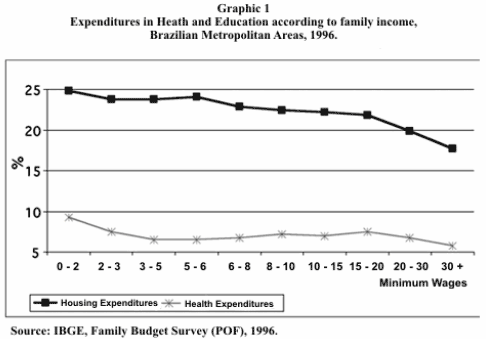
<body><![CDATA[<br>   <a href="#_ftnref29" name="_ftn29" title=""><sup>29</sup></a> In mathematical    terms, ID = 0,5 <font face="Symbol">å</font> ÷ Xi - Yi÷ for a given sub-region    of the city. See “Segregation and Public Policies” section.    <br>   <a href="#_ftnref30" name="_ftn30" title=""><sup>30</sup></a> See Faria (1992)    and Silva (1992), for instance.    <br>   <a href="#_ftnref31" name="_ftn31" title=""><sup>31</sup></a> The policies of    urban zoning and land taxation can also, in thesis, be employed.    <br>   <a href="#_ftnref32" name="_ftn32" title=""><sup>32</sup></a> A possible exception    may have been the government of Luiza Erundina in São Paulo.    <br>   <a href="#_ftnref33" name="_ftn33" title=""><sup>33</sup></a> The Brazilian    housing deficit was estimated at 6 million houses in 2000 (FJP, 2000). </font></p>     <p>&nbsp;</p>     <p>&nbsp;</p>     <p><font face="Verdana, Arial, Helvetica, sans-serif" size="3"><b>Appendix 1</b></font></p>     <p><font face="Verdana, Arial, Helvetica, sans-serif" size="2">This appendix presents    the 1991 and 2000 dissimilarity indexes for groups of census tracts that are    compatible in both censuses. In order to ensure compatibility, we used a geographic    information system adopting a criterion of minimal comparable areas   </font></p>     <p align=center><font face="Verdana, Arial, Helvetica, sans-serif" size="2"><b>&nbsp;</b></font></p>     ]]></body>
<body><![CDATA[<p align=center><img src="/img/revistas/s_rbcsoc/v2nse/a07tab06.gif"></p>      ]]></body><back>
<ref-list>
<ref id="B1">
<nlm-citation citation-type="book">
<collab>ALESP</collab>
<source><![CDATA[Cadernos do fórum São Paulo: século XXI]]></source>
<year>2000</year>
<publisher-loc><![CDATA[São Paulo ]]></publisher-loc>
<publisher-name><![CDATA[Alesp]]></publisher-name>
</nlm-citation>
</ref>
<ref id="B2">
<nlm-citation citation-type="book">
<person-group person-group-type="author">
<name>
<surname><![CDATA[BONDUKI]]></surname>
<given-names><![CDATA[N.]]></given-names>
</name>
<name>
<surname><![CDATA[ROLNIK]]></surname>
<given-names><![CDATA[R.]]></given-names>
</name>
</person-group>
<article-title xml:lang="pt"><![CDATA[Periferia da Grande São Paulo: reprodução do espaço como expediente de reprodução da força de trabalho]]></article-title>
<person-group person-group-type="editor">
<name>
<surname><![CDATA[Maricato]]></surname>
<given-names><![CDATA[E.]]></given-names>
</name>
</person-group>
<source><![CDATA[A produção capitalista da casa (e da cidade) do Brasil industrial]]></source>
<year>1982</year>
<publisher-loc><![CDATA[São Paulo ]]></publisher-loc>
<publisher-name><![CDATA[Alfa-ômega]]></publisher-name>
</nlm-citation>
</ref>
<ref id="B3">
<nlm-citation citation-type="confpro">
<person-group person-group-type="author">
<name>
<surname><![CDATA[BRIGGS]]></surname>
<given-names><![CDATA[Xavier S.]]></given-names>
</name>
</person-group>
<source><![CDATA[Ties that bind, bridge, and constrain: social capital and segregation in American Metropolis]]></source>
<year>2001</year>
<conf-name><![CDATA[ International Seminar on Segregation and the City]]></conf-name>
<conf-loc>Cambridge </conf-loc>
</nlm-citation>
</ref>
<ref id="B4">
<nlm-citation citation-type="book">
<person-group person-group-type="author">
<name>
<surname><![CDATA[CALDEIRA]]></surname>
<given-names><![CDATA[Teresa, P.]]></given-names>
</name>
</person-group>
<source><![CDATA[A cidade dos muros]]></source>
<year>2000</year>
<publisher-loc><![CDATA[São Paulo ]]></publisher-loc>
<publisher-name><![CDATA[Editora 34Edusp]]></publisher-name>
</nlm-citation>
</ref>
<ref id="B5">
<nlm-citation citation-type="confpro">
<person-group person-group-type="author">
<name>
<surname><![CDATA[CARDIA]]></surname>
<given-names><![CDATA[N.]]></given-names>
</name>
</person-group>
<source><![CDATA[Os impactos da exposição à violência: aceitação da violência ou horror continuado? O caso de São Paulo]]></source>
<year>1999</year>
<conf-name><![CDATA[ Culture, Citizenship and Urban Violence]]></conf-name>
<conf-loc>Cuernavaca </conf-loc>
</nlm-citation>
</ref>
<ref id="B6">
<nlm-citation citation-type="journal">
<person-group person-group-type="author">
<name>
<surname><![CDATA[CARDIA]]></surname>
<given-names><![CDATA[N.]]></given-names>
</name>
</person-group>
<article-title xml:lang="en"><![CDATA[Urban violence in São Paulo]]></article-title>
<source><![CDATA[Comparative Urban Studies Occasional Papers Series]]></source>
<year>2000</year>
<volume>33</volume>
<publisher-loc><![CDATA[Washington ]]></publisher-loc>
<publisher-name><![CDATA[Woodrow Wilson International Center for Scholars]]></publisher-name>
</nlm-citation>
</ref>
<ref id="B7">
<nlm-citation citation-type="book">
<collab>CEPAL</collab>
<source><![CDATA[Panorama social de América Latina, 2000-2001]]></source>
<year>2002</year>
<publisher-loc><![CDATA[Santiago ]]></publisher-loc>
<publisher-name><![CDATA[Cepal]]></publisher-name>
</nlm-citation>
</ref>
<ref id="B8">
<nlm-citation citation-type="journal">
<article-title xml:lang="pt"><![CDATA[Favelas na Cidade de São Pa]]></article-title>
<source><![CDATA[Diário Oficial]]></source>
<year>31 m</year>
<month>ar</month>
<volume>101</volume>
</nlm-citation>
</ref>
<ref id="B9">
<nlm-citation citation-type="book">
<person-group person-group-type="author">
<name>
<surname><![CDATA[DURLAUF]]></surname>
<given-names><![CDATA[S. N.]]></given-names>
</name>
</person-group>
<article-title xml:lang="en"><![CDATA[The membership theory of poverty: the role of group affiliations in determing socioeconomic outcomes]]></article-title>
<person-group person-group-type="editor">
<name>
<surname><![CDATA[Danziger]]></surname>
<given-names><![CDATA[S. H.]]></given-names>
</name>
<name>
<surname><![CDATA[Haverman]]></surname>
<given-names><![CDATA[R. H.]]></given-names>
</name>
</person-group>
<source><![CDATA[Understanding poverty]]></source>
<year>2001</year>
<page-range>392-416</page-range><publisher-loc><![CDATA[Nova York ]]></publisher-loc>
<publisher-name><![CDATA[Russell Sage]]></publisher-name>
</nlm-citation>
</ref>
<ref id="B10">
<nlm-citation citation-type="book">
<collab>EMPLASA</collab>
<source><![CDATA[Plano metropolitano da Grande São Paulo]]></source>
<year>1994</year>
<publisher-loc><![CDATA[São Paulo ]]></publisher-loc>
<publisher-name><![CDATA[Emplasa]]></publisher-name>
</nlm-citation>
</ref>
<ref id="B11">
<nlm-citation citation-type="journal">
<person-group person-group-type="author">
<name>
<surname><![CDATA[FARIA]]></surname>
<given-names><![CDATA[V.]]></given-names>
</name>
</person-group>
<article-title xml:lang="pt"><![CDATA[A conjuntura social brasileira: dilemas e perspectivas]]></article-title>
<source><![CDATA[Novos Estudos Cebrap]]></source>
<year>1992</year>
<volume>33</volume>
</nlm-citation>
</ref>
<ref id="B12">
<nlm-citation citation-type="book">
<collab>FJP</collab>
<source><![CDATA[Déficit habitacional no Brasil]]></source>
<year>2000</year>
<publisher-loc><![CDATA[Brasília ]]></publisher-loc>
<publisher-name><![CDATA[Secretaria Nacional de Políticas UrbanasPNUD]]></publisher-name>
</nlm-citation>
</ref>
<ref id="B13">
<nlm-citation citation-type="book">
<person-group person-group-type="author">
<name>
<surname><![CDATA[KAPLAN]]></surname>
<given-names><![CDATA[Robert D.]]></given-names>
</name>
</person-group>
<source><![CDATA[The end of the earth: a journey at the dawn of the 21st century]]></source>
<year>1996</year>
<publisher-loc><![CDATA[Nova York ]]></publisher-loc>
<publisher-name><![CDATA[Random House]]></publisher-name>
</nlm-citation>
</ref>
<ref id="B14">
<nlm-citation citation-type="journal">
<person-group person-group-type="author">
<name>
<surname><![CDATA[KASARDA]]></surname>
<given-names><![CDATA[J. D.]]></given-names>
</name>
</person-group>
<article-title xml:lang="en"><![CDATA[Inner-city poverty and neighborhood distress: 1970-1990]]></article-title>
<source><![CDATA[Housing Policy Debate]]></source>
<year>1993</year>
<volume>4</volume>
<numero>3</numero>
<issue>3</issue>
<page-range>253-302</page-range></nlm-citation>
</ref>
<ref id="B15">
<nlm-citation citation-type="book">
<person-group person-group-type="author">
<name>
<surname><![CDATA[KOWARICK]]></surname>
<given-names><![CDATA[L.]]></given-names>
</name>
</person-group>
<source><![CDATA[A espoliação urbana]]></source>
<year>1979</year>
<publisher-loc><![CDATA[Rio de Janeiro ]]></publisher-loc>
<publisher-name><![CDATA[Paz e Terra]]></publisher-name>
</nlm-citation>
</ref>
<ref id="B16">
<nlm-citation citation-type="journal">
<person-group person-group-type="author">
<name>
<surname><![CDATA[KOWARICK]]></surname>
<given-names><![CDATA[L.]]></given-names>
</name>
</person-group>
<article-title xml:lang="pt"><![CDATA[Sobre a vulnerabilidade socioeconômica e civil: Estados Unidos, França e Brasil]]></article-title>
<source><![CDATA[Revista Brasileira de Ciências Sociais]]></source>
<year>2003</year>
<volume>51</volume>
</nlm-citation>
</ref>
<ref id="B17">
<nlm-citation citation-type="book">
<person-group person-group-type="author">
<name>
<surname><![CDATA[LOGAN]]></surname>
<given-names><![CDATA[J.]]></given-names>
</name>
</person-group>
<article-title xml:lang="en"><![CDATA[Still a global city: the racial and ethnic segmentation of New York]]></article-title>
<person-group person-group-type="editor">
<name>
<surname><![CDATA[Marcuse]]></surname>
<given-names><![CDATA[P.]]></given-names>
</name>
<name>
<surname><![CDATA[Kempen]]></surname>
<given-names><![CDATA[R.]]></given-names>
</name>
</person-group>
<source><![CDATA[Globalizing cities: a new spatial order?]]></source>
<year>2000</year>
<publisher-loc><![CDATA[Londres ]]></publisher-loc>
<publisher-name><![CDATA[Blackwell]]></publisher-name>
</nlm-citation>
</ref>
<ref id="B18">
<nlm-citation citation-type="journal">
<person-group person-group-type="author">
<name>
<surname><![CDATA[MARCUSE]]></surname>
<given-names><![CDATA[P.]]></given-names>
</name>
</person-group>
<article-title xml:lang="en"><![CDATA[Enclaves yes, ghettoes, no: segregation and the State]]></article-title>
<source><![CDATA[International Seminar on Segregation and the City]]></source>
<year>2001</year>
<page-range>Lincoln Institute of Land Policy</page-range><publisher-loc><![CDATA[Cambridge ]]></publisher-loc>
</nlm-citation>
</ref>
<ref id="B19">
<nlm-citation citation-type="book">
<person-group person-group-type="author">
<name>
<surname><![CDATA[MARICATO]]></surname>
<given-names><![CDATA[E.]]></given-names>
</name>
</person-group>
<source><![CDATA[Metrópole na periferia do capitalismo: ilegalidade, desigualdade e violência]]></source>
<year>1996</year>
<publisher-loc><![CDATA[São Paulo ]]></publisher-loc>
<publisher-name><![CDATA[Hucitec]]></publisher-name>
</nlm-citation>
</ref>
<ref id="B20">
<nlm-citation citation-type="journal">
<person-group person-group-type="author">
<name>
<surname><![CDATA[MARQUES]]></surname>
<given-names><![CDATA[E.]]></given-names>
</name>
<name>
<surname><![CDATA[BITAR]]></surname>
<given-names><![CDATA[S.]]></given-names>
</name>
</person-group>
<article-title xml:lang="pt"><![CDATA[Grupos sociais e espaço]]></article-title>
<source><![CDATA[Novos Estudos Cebrap]]></source>
<year>2002</year>
<volume>64</volume>
<page-range>123-131</page-range></nlm-citation>
</ref>
<ref id="B21">
<nlm-citation citation-type="confpro">
<person-group person-group-type="author">
<name>
<surname><![CDATA[MARQUES]]></surname>
<given-names><![CDATA[E.]]></given-names>
</name>
<name>
<surname><![CDATA[NAJAR]]></surname>
<given-names><![CDATA[A.]]></given-names>
</name>
</person-group>
<source><![CDATA[Espaço e mortalidade no Rio de Janeiro da década de 1980]]></source>
<year>1995</year>
<conf-name><![CDATA[VI Encontro Nacional da Anpur]]></conf-name>
<conf-loc>Brasília </conf-loc>
</nlm-citation>
</ref>
<ref id="B22">
<nlm-citation citation-type="book">
<person-group person-group-type="author">
<name>
<surname><![CDATA[MASSEY]]></surname>
<given-names><![CDATA[D. S.]]></given-names>
</name>
<name>
<surname><![CDATA[DENTON]]></surname>
<given-names><![CDATA[N. A.]]></given-names>
</name>
</person-group>
<source><![CDATA[American apartheid: segregation and the making of the underclass]]></source>
<year>1993</year>
<publisher-loc><![CDATA[Cambridge ]]></publisher-loc>
<publisher-name><![CDATA[Harvard University Press]]></publisher-name>
</nlm-citation>
</ref>
<ref id="B23">
<nlm-citation citation-type="book">
<person-group person-group-type="author">
<name>
<surname><![CDATA[MENEZES-FILHO]]></surname>
<given-names><![CDATA[N. A.]]></given-names>
</name>
</person-group>
<source><![CDATA[A evolução da educação no Brasil e seu impacto no mercado de trabalho: São Paulo]]></source>
<year>2002</year>
<publisher-name><![CDATA[FEA/USP]]></publisher-name>
</nlm-citation>
</ref>
<ref id="B24">
<nlm-citation citation-type="book">
<person-group person-group-type="author">
<name>
<surname><![CDATA[MINGIONE]]></surname>
<given-names><![CDATA[Enzo]]></given-names>
</name>
</person-group>
<article-title xml:lang="en"><![CDATA[Urban poverty in the advanced industrial world: concepts, analysis and debates]]></article-title>
<person-group person-group-type="editor">
<name>
<surname><![CDATA[Mingione]]></surname>
<given-names><![CDATA[E.]]></given-names>
</name>
</person-group>
<source><![CDATA[Urban poverty and the underclass]]></source>
<year>1999</year>
<publisher-loc><![CDATA[Nova York ]]></publisher-loc>
<publisher-name><![CDATA[Blackwell]]></publisher-name>
</nlm-citation>
</ref>
<ref id="B25">
<nlm-citation citation-type="book">
<person-group person-group-type="author">
<name>
<surname><![CDATA[RIBEIRO]]></surname>
<given-names><![CDATA[L. C.]]></given-names>
</name>
<name>
<surname><![CDATA[Telles]]></surname>
<given-names><![CDATA[E.]]></given-names>
</name>
</person-group>
<article-title xml:lang="en"><![CDATA[Rio de Janeiro: emerging dualization in a historically unequal city]]></article-title>
<person-group person-group-type="editor">
<name>
<surname><![CDATA[Marcuse]]></surname>
<given-names><![CDATA[P.]]></given-names>
</name>
<name>
<surname><![CDATA[Kempen]]></surname>
<given-names><![CDATA[R.]]></given-names>
</name>
</person-group>
<source><![CDATA[Globalizing cities: a new spatial order?]]></source>
<year>2000</year>
<publisher-loc><![CDATA[Londres ]]></publisher-loc>
<publisher-name><![CDATA[Blackwell]]></publisher-name>
</nlm-citation>
</ref>
<ref id="B26">
<nlm-citation citation-type="book">
<person-group person-group-type="author">
<name>
<surname><![CDATA[ROLNIK]]></surname>
<given-names><![CDATA[R.]]></given-names>
</name>
</person-group>
<source><![CDATA[A cidade e a lei: legislação, política urbana e territórios na cidade de São Paulo]]></source>
<year>1997</year>
<publisher-loc><![CDATA[São Paulo ]]></publisher-loc>
<publisher-name><![CDATA[Nobel/Fapesp]]></publisher-name>
</nlm-citation>
</ref>
<ref id="B27">
<nlm-citation citation-type="confpro">
<person-group person-group-type="author">
<name>
<surname><![CDATA[SABATINI]]></surname>
<given-names><![CDATA[F.]]></given-names>
</name>
</person-group>
<source><![CDATA[Residencial segregation pattern changes in Chile's main cities: scale shifts and increasing malignancy]]></source>
<year>2001</year>
<conf-name><![CDATA[ International Seminar on Segregation and the City]]></conf-name>
<conf-loc>Cambridge </conf-loc>
</nlm-citation>
</ref>
<ref id="B28">
<nlm-citation citation-type="book">
<person-group person-group-type="author">
<name>
<surname><![CDATA[SANTOS]]></surname>
<given-names><![CDATA[C.]]></given-names>
</name>
</person-group>
<source><![CDATA[Processo de crescimento e ocupação da periferia]]></source>
<year>1982</year>
<publisher-loc><![CDATA[Rio de Janeiro ]]></publisher-loc>
<publisher-name><![CDATA[Ibam/CPU]]></publisher-name>
</nlm-citation>
</ref>
<ref id="B29">
<nlm-citation citation-type="book">
<person-group person-group-type="author">
<name>
<surname><![CDATA[SANTOS]]></surname>
<given-names><![CDATA[W. G.]]></given-names>
</name>
</person-group>
<article-title xml:lang="pt"><![CDATA[A trágica condição da política social]]></article-title>
<person-group person-group-type="editor">
<name>
<surname><![CDATA[Abranches]]></surname>
<given-names><![CDATA[S.]]></given-names>
</name>
<name>
<surname><![CDATA[Santos]]></surname>
<given-names><![CDATA[W. dos]]></given-names>
</name>
<name>
<surname><![CDATA[Coimbra]]></surname>
<given-names><![CDATA[M.]]></given-names>
</name>
</person-group>
<source><![CDATA[Política social e combate à pobreza]]></source>
<year>1987</year>
<publisher-loc><![CDATA[Rio de Janeiro ]]></publisher-loc>
<publisher-name><![CDATA[Jorge Zahar]]></publisher-name>
</nlm-citation>
</ref>
<ref id="B30">
<nlm-citation citation-type="journal">
<person-group person-group-type="author">
<name>
<surname><![CDATA[SCHTEINGART]]></surname>
<given-names><![CDATA[M.]]></given-names>
</name>
</person-group>
<article-title xml:lang="es"><![CDATA[Estrutura urbana y la diferenciación socio-espacial en la zona metropolitana de la Ciudad de México (1970-1980)]]></article-title>
<source><![CDATA[Revista Del Colégio de México]]></source>
<year>1987</year>
</nlm-citation>
</ref>
<ref id="B31">
<nlm-citation citation-type="book">
<person-group person-group-type="author">
<name>
<surname><![CDATA[SILVA]]></surname>
<given-names><![CDATA[L.]]></given-names>
</name>
</person-group>
<source><![CDATA[O que mostram os indicadores sociais sobre pobreza na década perdida]]></source>
<year>1992</year>
<publisher-loc><![CDATA[Rio de Janeiro ]]></publisher-loc>
<publisher-name><![CDATA[Ipea]]></publisher-name>
</nlm-citation>
</ref>
<ref id="B32">
<nlm-citation citation-type="journal">
<person-group person-group-type="author">
<name>
<surname><![CDATA[SMOLKA]]></surname>
<given-names><![CDATA[M.]]></given-names>
</name>
</person-group>
<article-title xml:lang="pt"><![CDATA[Para uma reflexão sobre o processo de estruturação interna das cidades brasileiras: o caso do Rio de Janeiro]]></article-title>
<source><![CDATA[Espaço e Debates]]></source>
<year>1987</year>
<volume>21</volume>
</nlm-citation>
</ref>
<ref id="B33">
<nlm-citation citation-type="confpro">
<person-group person-group-type="author">
<name>
<surname><![CDATA[TASCHNER]]></surname>
<given-names><![CDATA[S. P.]]></given-names>
</name>
</person-group>
<source><![CDATA[Degradação ambiental em áreas de invasão no município de São Paulo]]></source>
<year>1992</year>
<conf-name><![CDATA[VIII Encontro Nacional de Estudos Populacionais]]></conf-name>
<conf-loc>São Paulo </conf-loc>
</nlm-citation>
</ref>
<ref id="B34">
<nlm-citation citation-type="book">
<person-group person-group-type="author">
<name>
<surname><![CDATA[TASCHNER]]></surname>
<given-names><![CDATA[S. P.]]></given-names>
</name>
<name>
<surname><![CDATA[BÓGUS]]></surname>
<given-names><![CDATA[L.]]></given-names>
</name>
</person-group>
<article-title xml:lang="pt"><![CDATA[A cidade dos anéis: São Paulo]]></article-title>
<person-group person-group-type="editor">
<name>
<surname><![CDATA[Queiroz]]></surname>
<given-names><![CDATA[L. C.]]></given-names>
</name>
</person-group>
<source><![CDATA[O futuro das metrópoles: desigualdades e governabilidade]]></source>
<year>2000</year>
<publisher-loc><![CDATA[Rio de Janeiro ]]></publisher-loc>
<publisher-name><![CDATA[Revan/Fase]]></publisher-name>
</nlm-citation>
</ref>
<ref id="B35">
<nlm-citation citation-type="journal">
<person-group person-group-type="author">
<name>
<surname><![CDATA[TELLES]]></surname>
<given-names><![CDATA[E.]]></given-names>
</name>
</person-group>
<article-title xml:lang="en"><![CDATA[Residencial segregation by skin color in Brazil]]></article-title>
<source><![CDATA[American Sociological Review]]></source>
<year>1994</year>
<volume>57</volume>
<numero>2</numero>
<issue>2</issue>
<page-range>186-197</page-range></nlm-citation>
</ref>
<ref id="B36">
<nlm-citation citation-type="journal">
<person-group person-group-type="author">
<name>
<surname><![CDATA[TELLES]]></surname>
<given-names><![CDATA[E.]]></given-names>
</name>
</person-group>
<article-title xml:lang="en"><![CDATA[Structural sources of socioeconomic segregation in Brazil]]></article-title>
<source><![CDATA[American Journal of Sociology]]></source>
<year>1995</year>
<volume>100</volume>
<numero>5</numero>
<issue>5</issue>
<page-range>199-223</page-range></nlm-citation>
</ref>
<ref id="B37">
<nlm-citation citation-type="journal">
<person-group person-group-type="author">
<name>
<surname><![CDATA[TELLES]]></surname>
<given-names><![CDATA[E.]]></given-names>
</name>
</person-group>
<article-title xml:lang="en"><![CDATA[U.S. Foundations and racial reasoning in Brazil]]></article-title>
<source><![CDATA[Theory, Culture & Society]]></source>
<year>2003</year>
<volume>20</volume>
<numero>4</numero>
<issue>4</issue>
</nlm-citation>
</ref>
<ref id="B38">
<nlm-citation citation-type="">
<person-group person-group-type="author">
<name>
<surname><![CDATA[TORRES]]></surname>
<given-names><![CDATA[H.]]></given-names>
</name>
</person-group>
<source><![CDATA[Desigualdade ambiental em São Paulo]]></source>
<year>1997</year>
</nlm-citation>
</ref>
<ref id="B39">
<nlm-citation citation-type="journal">
<person-group person-group-type="author">
<name>
<surname><![CDATA[TORRES]]></surname>
<given-names><![CDATA[H.]]></given-names>
</name>
</person-group>
<article-title xml:lang="en"><![CDATA[Social policies for the urban poor: the role of population information]]></article-title>
<source><![CDATA[Working Papers Series CST/ LAC]]></source>
<year>2002</year>
<volume>24</volume>
<publisher-name><![CDATA[UNFPA Country Support Team for Latin America and the Caribbean]]></publisher-name>
</nlm-citation>
</ref>
<ref id="B40">
<nlm-citation citation-type="confpro">
<person-group person-group-type="author">
<name>
<surname><![CDATA[TORRES]]></surname>
<given-names><![CDATA[H.]]></given-names>
</name>
<name>
<surname><![CDATA[MARQUES]]></surname>
<given-names><![CDATA[E.]]></given-names>
</name>
</person-group>
<source><![CDATA[Tamanho populacional das favelas paulistanas: ou os grandes números e a falência do debate sobre a metrópole]]></source>
<year>2002</year>
<conf-name><![CDATA[ encontro Nacional de Estudos Populacionais]]></conf-name>
<conf-loc>Ouro Preto </conf-loc>
</nlm-citation>
</ref>
<ref id="B41">
<nlm-citation citation-type="journal">
<person-group person-group-type="author">
<name>
<surname><![CDATA[TORRES]]></surname>
<given-names><![CDATA[H.]]></given-names>
</name>
</person-group>
<article-title xml:lang="pt"><![CDATA[Reflexões sobre a hiperferiferia: novas e velhas faces da pobreza no entorno metropolitano]]></article-title>
<source><![CDATA[Revista Brasileira de Estudos Urbanos e Regionais]]></source>
<year>2001</year>
<numero>4</numero>
<issue>4</issue>
</nlm-citation>
</ref>
<ref id="B42">
<nlm-citation citation-type="book">
<person-group person-group-type="author">
<name>
<surname><![CDATA[VALLADARES]]></surname>
<given-names><![CDATA[L.]]></given-names>
</name>
<name>
<surname><![CDATA[COELHO]]></surname>
<given-names><![CDATA[M.]]></given-names>
</name>
</person-group>
<article-title xml:lang="en"><![CDATA[Urban research in Brazil and Venezuela: towards an agenda for the 1990s]]></article-title>
<person-group person-group-type="editor">
<name>
<surname><![CDATA[Stren]]></surname>
<given-names><![CDATA[P.]]></given-names>
</name>
</person-group>
<source><![CDATA[Urban research in the developing world - Latin America]]></source>
<year>1995</year>
<publisher-loc><![CDATA[Toronto ]]></publisher-loc>
<publisher-name><![CDATA[Center for Urban and Community Studies]]></publisher-name>
</nlm-citation>
</ref>
<ref id="B43">
<nlm-citation citation-type="book">
<person-group person-group-type="author">
<name>
<surname><![CDATA[VILLAÇA]]></surname>
<given-names><![CDATA[F.]]></given-names>
</name>
</person-group>
<article-title xml:lang="pt"><![CDATA[Efeitos do espaço sobre o social na metrópole brasileira]]></article-title>
<person-group person-group-type="editor">
<name>
<surname><![CDATA[Souza]]></surname>
<given-names><![CDATA[M. A.]]></given-names>
</name>
</person-group>
<source><![CDATA[Metrópole e globalização: conhecendo a cidade de São Paulo]]></source>
<year>1999</year>
<publisher-loc><![CDATA[São Paulo ]]></publisher-loc>
<publisher-name><![CDATA[Cedesp]]></publisher-name>
</nlm-citation>
</ref>
<ref id="B44">
<nlm-citation citation-type="book">
<person-group person-group-type="author">
<name>
<surname><![CDATA[VILLAÇA]]></surname>
<given-names><![CDATA[F.]]></given-names>
</name>
</person-group>
<person-group person-group-type="editor">
<name>
</name>
</person-group>
<source><![CDATA[Espaço intra-urbano no Brasil]]></source>
<year>2001</year>
<publisher-loc><![CDATA[São Paulo ]]></publisher-loc>
<publisher-name><![CDATA[Nobel/Fapesp]]></publisher-name>
</nlm-citation>
</ref>
<ref id="B45">
<nlm-citation citation-type="book">
<person-group person-group-type="author">
<name>
<surname><![CDATA[WILSON]]></surname>
<given-names><![CDATA[William]]></given-names>
</name>
</person-group>
<source><![CDATA[The truly disadvantaged: the inner city, the underclass and public policy]]></source>
<year>1990</year>
<publisher-loc><![CDATA[Chicago ]]></publisher-loc>
<publisher-name><![CDATA[University of Chicago Press]]></publisher-name>
</nlm-citation>
</ref>
<ref id="B46">
<nlm-citation citation-type="book">
<collab>WORLD BANK</collab>
<source><![CDATA[Entering the 21st century: world development report, 1999-2000]]></source>
<year>1999</year>
<publisher-loc><![CDATA[Oxford ]]></publisher-loc>
<publisher-name><![CDATA[Oxford University Press]]></publisher-name>
</nlm-citation>
</ref>
<ref id="B47">
<nlm-citation citation-type="book">
<person-group person-group-type="author">
<name>
<surname><![CDATA[YIENGER]]></surname>
<given-names><![CDATA[J.]]></given-names>
</name>
</person-group>
<article-title xml:lang="en"><![CDATA[Housing discrimination and residential segregation as causes of poverty]]></article-title>
<person-group person-group-type="editor">
<name>
<surname><![CDATA[Danziger]]></surname>
<given-names><![CDATA[S. H.]]></given-names>
</name>
<name>
<surname><![CDATA[Haverman]]></surname>
<given-names><![CDATA[R. H.]]></given-names>
</name>
</person-group>
<source><![CDATA[Understanding poverty]]></source>
<year>2001</year>
<page-range>359-391</page-range><publisher-loc><![CDATA[Nova York ]]></publisher-loc>
<publisher-name><![CDATA[Russell Sage]]></publisher-name>
</nlm-citation>
</ref>
</ref-list>
</back>
</article>