Os partidos no eleitorado: percepções públicas e laços partidários no Brasil
Les partis dans l'électorat: perceptions publiques et liens politiques au Brésil
Maria D'Alva Kinzo
Translated by Maria D'Alva Kinzo
Translation from Revista Brasileira de Ciências Sociais, São Paulo, v.20, n.57, p.65-81. Feb. 2005.
ABSTRACT
This article examines the impact of party politics on the Brazilian electorate. An important indicator of the consolidation of the party system is the emergence of image and party ties among voters. As the party system tends to stabilize, we suppose that voters start fixing the profiles of parties and express party preference or loyalty. It meant that electoral volatility, high in the beginning, would tend to decrease along the time and that, the main parties at least, would create their identity, working as shortcuts for voters in their search for information about the political options in the electoral contests. The main concern of this analysis it to verify at what level such knowledge and party identity construction process have occurred in Brazil, taking as empirical basis a research carried out in the São Paulo city's metropolitan area during the 2002 pre-election period.
Keyword: Parties and party systems in Brazil, electoral volatility, party identification; political cognition, party loyalty, electoral system.
RESUMO
Este artigo examina o impacto da política partidária sobre o eleitorado brasileiro. Um indicativo importante da consolidação do sistema partidário é a criação de imagem e vínculo partidário junto aos eleitores. Na medida em que o sistema partidário tende a se estabilizar, supõe-se que os eleitores passem a fixar os perfis dos partidos e a criar preferência ou lealdade partidárias. Isso significa que a volatilidade eleitoral, inicialmente elevada, tenderia a decrescer ao longo do tempo e que pelo menos os principais partidos construiriam sua identidade, servindo assim como "atalho" para a obtenção de informação sobre as diversas candidaturas e para a decisão eleitoral. A preocupação principal desta análise é verificar em que medida esse processo de conhecimento e de construção de identidade partidária tem ocorrido no Brasil, tomando como base empírica uma pesquisa realizada na área metropolitana de São Paulo no período pré-eleitoral de 2002.
Palavras-chave: Partidos e sistema partidário brasileiro, Volatilidade eleitoral; Identificação partidária, Conhecimento político, Sistema eleitoral.
RÉSUMÉ
Cet article étudie l'impact des options des partis politiques sur l'électorat brésilien. Un indicatif important de la consolidation du système politique est la création d'une image et d'un lien politique avec les électeurs. Dans la mesure où le système politique tend à se stabiliser, les électeurs tendent à fixer les profils des partis et à créer des préférences ou des loyautés politiques. La volatilité électorale, initialement très élevée, tendrait donc à décroître. Les principaux partis pourraient, ainsi, construire leur identité et servir de "raccourci" en vue de l'obtention d'informations à propos des diverses candidatures et pour la décision électorale. Le principal but de cette analyse est de vérifier dans quelle mesure ce processus de connaissance et de construction de l'identité politique a lieu au Brésil. Pour cela, nous nous sommes fondés sur une recherche développée dans la région métropolitaine de São Paulo pendant la période préélectorale de 2002.
]]> Mots-clés: Partis et système politique brésilien, Volatilité électorale, Identification politique, Connaissance politique, Système électoral.
Introduction
Political parties are institutions that have emerged as a result of the work of political actors in the decision-making and electoral arenas; therefore the Brazilian party system must be reviewed as to both its efficiency in maintaining democratic governability and its capacity to structure the electoral competition. As for the latter, it is worth highlighting the party's role as an agent that organizes the electoral process. This article looks at parties from this point of view. More specifically, we examine how the electoral strategies formulated by the party elites impact on the voter. Thus, our main question is to what extent parties make a difference from the voters' point of view. In other words, even if one admits that parties and the party system in Brazil have had a satisfying performance both in the government and in accomplishing the political elite's electoral goals, one question remains to be examined: how effective are their role in guiding citizens in the vote-decision process. Assuming that in democratic regimes parties are important both as structurers and facilitators of electoral choice, the basic condition to make them a guiding instrument of the voting decision is that they have sufficient visibility in the electoral context. Their visibility, together with their continuous participation in elections allows the emergence of party loyalty, which might develop throughout the democratic political experience.
Therefore, by focusing on parties in the electoral arena, we will examine to what extent Brazilian parties are entities capable of offering voters political options which are distinctive enough to build their identities, create loyalty and serve as a shortcut in the act of voting.
For that, we will first try to examine the indices of electoral volatility. Although they were exhaustively analyzed by Nicolau (1998), Peres (2002) and Braga (2003), the argument I present here differs a little, mainly in the conclusions I reached in the last two studies, which suggest a tendency to stabilization of party preferences. Considering the significant alterations in the correlations of forces of the parties in recent elections, we think it is too early to define a trend towards the stabilization of the party system. Second, we analyzed — based on sampling research data1 —some empirical evidence that suggests that Brazilian parties, as a whole, have had difficulty in fixing their image in the voters' minds.
Party competition and partisanship (sub 1)
An important indicator of the consolidation of a party system is the stabilization of the party competition so as to have some predictability about the main contenders and about the results related to their previous support. If it is true that democracy results in political uncertainty, it is also true that its consolidation means the emergence of a somewhat stable contest pattern. In young democracies, the more lasting the party competition pattern is, the more likely that the voters will build party images and will create partisanship. In Brazil, the restoration of the civilian government in 1985 was accompanied by the emergence of a multiparty system whose main components are the same, except for the creation of the PSDB, (Social Democratic Party) in 1988. After more than a decade and a half, in which there have been 11 electoral disputes, one could expect the main parties to have built their image so as to gain a foothold in the elections. If this had happened, the high levels of electoral volatility, that were present in the first years of the new regime, would have tended to decline significantly as competition would have stabilized around the main contenders. Growth could also be expected in the levels of party identification, because, as suggested by Downs (1957), voters tend to use parties as a shortcut to reduce the burden of the electoral decision, which becomes more pressing in multiparty contexts such as Brazil's. It is clear that this reasoning depends on how political elites devise their strategies to give visibility to parties and make them distinguishable entities. It seems to us, however, that in Brazil, the type of strategy used by the elites to deal with the complex set of rules that regulates the elections has produced a different pattern.
]]> Aggregate data: Index of electoral volatility (sub 2)A first sign of the difficulty of stabilizing the party system is shown by the index of electoral volatility, which measures the differentials in the distribution of the electoral support among the parties between one election and the next (Pedersen, 1990; Bartolini and Mair, 1990). The lower the electoral volatility, the more likely the established parties will have a role in determining the preferences, irrespective of the appeal of a particular party candidate, of specific political issues or any other unexpected event. In contrast, persistent high levels of volatility are a sign that parties were not able to fix themselves in the voters' minds so that they could guarantee a reasonable level of popular support. This would be a sign of lack of party system stability.
As Nicolau (1998) has highlighted very well, from a comparative perspective, electoral volatility in Brazil is among the highest ones in the world. Among the consolidated democracies, according to Pedersen's index, the level of volatility varies from one nation to the next, but it rarely reaches the high Brazilian rates.2 Data calculated by Nicolau (1998) indicate that from 1982 to 1998, on average, about 30 percent of the voters changed their vote from one party to another in consecutive elections. A more detailed analysis of electoral volatility was made by Braga (2003), who calculated the indices both for the Chamber of Deputies and state legislatures using the municipality by municipality electoral results for the period between 1990 and 2002. These numbers are even more surprising: the average for the country, considering the three pairs of elections, is 38.3 percent for the Chamber of Deputies and 36.7 percent for the state legislatures. More recently, the electoral volatility stopped rising (Braga, 2003), although it has stabilized at a very high level — over 30 percent. This suggests that in Brazil, a definitive pattern of party support has not been established yet. If at the beginning of the 1990s the high indices of volatility could be explained by the rise of an important new party — the PSDB — this can no longer justify these indices nowadays.
There is no doubt that one of the causes has to do with the transformations in the electoral environment, which have occurred throughout the world. We refer to the impact of the television era on the electoral campaign, resulting in a contest focused much more on personalities than on parties (Wattemberg, 1998 and 2000; Dalton, 2000). In our opinion, in the Brazilian case, the fact that the party game and democracy itself are young institutions, plus the structure of incentives under which the political actors compete for votes, contribute to dissipate the distinctions among the parties, making party loyalty difficult. More specifically, the strategies adopted by candidates and parties to maximize their gains — in elections for executive and legislative offices, under the majority and proportional systems — create a situation which not only stimulates the personalization of the competition, but also makes the party contest blurry. Since parties have less visibility than candidates, they are not able to fix their images in the voters' minds, which makes the creation of voter identification and ties with parties difficult. We will develop this argument by examining the issue of the party identification at the individual level.
Party attachments in Brazil (sub 1)
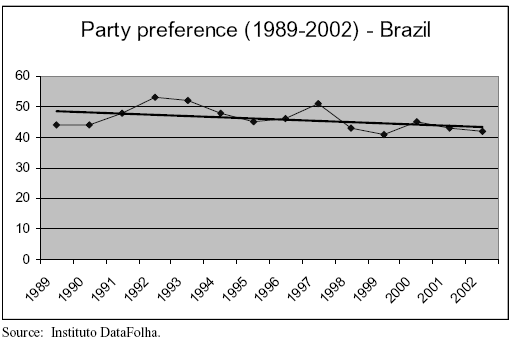
The first condition for political parties to be able to perform the function of guiding the voting decision has to do with the capacity of connecting with voters by creating relatively stable support. If this capacity is acquired through the continuous experience of elections, in which the same parties are the main contenders, we should expect a rise in the party loyalty, even if in a small proportion. However, this does not seem to be happening in Brazil nowadays. Graph 1 with data from national studies presents the longitudinal variation of party preference for the period between 1989 and 2002.3 Party preference did not rise in this period, and moreover, showed a tendency to decline. For the period as a whole— that comprehends the years between the first and the last national election — the average percentage of party preference reached only 46 percent.4 This value is low in comparison not only with the international pattern (Dalton, 2000), but also with the rates seen in Brazil in the last years of the democratic regime before the 1964 military coup. As Lavareda pointed out, data from studies carried out in 1964 showed a rate of 64 percent of party identification (Lavareda, 1989, 1991).
It is worth remembering that in the years in which there were elections — 1994, 1998 and 2002 — when it is supposed that the parties were important references for the voter, preference rates decreased instead of increasing. This is a clear indication that electoral campaigns — both for executive and legislative offices — are not focused on parties as distinctive actors. During the campaign, voters are exposed to competition mainly between individual candidacies (and many times between party alliances), which makes it unlikely the development of strong ties between parties and voters.
Based on the disaggregated data by party and the year average shown in Table 1, we can observe the longitudinal variation of party preferences over this period and we can, therefore, stress some points.5 First, a party in government (mainly in the national sphere) – a condition which would in theory grant it greater public exposure – does not seem to have the asset to the establishment of party attachments: the rates of party preferences are low for all parties in central government. The PMDB (Brazilian Democratic Movement Party), which had built its reputation as an opposition movement to the military rule and headed the first civilian government (1985-1990) together with the PFL (Liberal Front Party), has held the first place in the electorate preferences until recently. Its best rate (in 1993), however, did not reach 20 percent, and it also lost its leading position to the PT (Worker's Party), declining 9 percent in the preference ratings. The PFL and the PSDB (Brazilian Social Democratic Party), which remained in the federal government over a long period (the former from 1985 until 2002 and the latter from 1994 until 2002), have also presented insignificant rates of party preferences. Second, being in opposition is not a factor that necessarily leads to party loyalty. Parties such as the PPB (the Brazilian Progressive Party) and the PDT (Democratic Labour Party) – both having opposing ideological orientations - have not been able to attract a significant number of supporters. The only exception has been the PT whose preference rate has increased significantly: from 10% in 1989, to 18% in 2002.
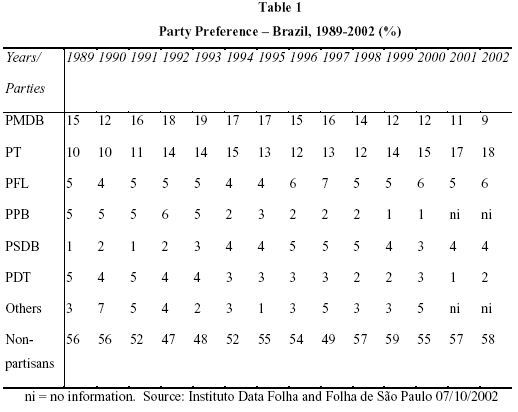
In sum, these data help to confirm that an incentive structure that does not lead to the development of party attachments accounts for the lack of a sharp increase in the rates of party identification in Brazil over the current democratic experience.
However, if this is the case, how can we explain the fact that a significant part of the electorate (about 42% in 2002) expressed some party preference? How can one explain the case of the PT, whose rates increased over the period? These questions deserve a thorough examination.
First, the organizational factor helps to understand the unique feature of the PT in the Brazilian party system, i.e., a typical mass party which emerged in the early 1980s and helped to create a solid organization and a clearly visible left-wing partisan image. Its ability to stand out from other parties was a result of a political strategy which aimed at taking a clear opposition stance towards the government and which highlighted the political principles of the party. This could be observed in the party's refusal to build up alliances with other parties over its first years of existence, and such attitude was later replaced by a strategy of forming alliances solely with parties that stand on the same ideological spectrum.6
The second factor that may explain why part of the electorate shows party attachment has to do with the different levels of information about the parties, which certainly depends on the population's level of education, a problem widely discussed in the literature.7 Higher educated voters are more likely to understand the available information on the political party game, especially the complex and confusing context in which the electoral arena works in Brazil. However, voters also depend on the information they obtain on the parties, i.e., on the extent parties and their leaderships are exposed to the electorate. The organizations that managed to develop a party-oriented strategy to reach the electorate, differentiating themselves as political entities, which was the case of the PT, were able to outstand in the political process, and attracted more voters. The visibility of a party and its capacity to construct a political image are, in fact, the bases for the development of the cognitive component to party identification.8
]]> In order to support this argument, we analyzed the data of a survey held in 2002 in the metropolitan area of São Paulo.9 Although it is the setting of a case study, this is the largest metropolitan area in Brazil and was, until recently, the destination for migrants from all regions of the country, which made it nearly a sample of the Brazilian demographic formation. Besides that, it is where the main parties have been able to elect a significant number of office holders for different levels and branches of the government. This area is also the place where the PT was founded, whose insertion as a mass party into the political contest could have led, in this specific context, to a more partisan-oriented pattern in the electoral competition, as a result of its impact on other parties' strategies.Table 2 shows the distribution of party preference according to the schooling level in the metropolitan region of São Paulo (RMSP), as the results of our survey indicate. Numbers are revealing. First, one should note the position of the PT in the rank: no less than 31 percent of the interviewed people expressed their preference for this party. This is a significant rate if compared to the 18 percentage points recorded in the country as a whole (compared to the average rate of four nationwide surveys carried out in 2002). This is certainly a clear indication of the party's capacity to establish roots in the area which provided it with the initial basis of electoral support.
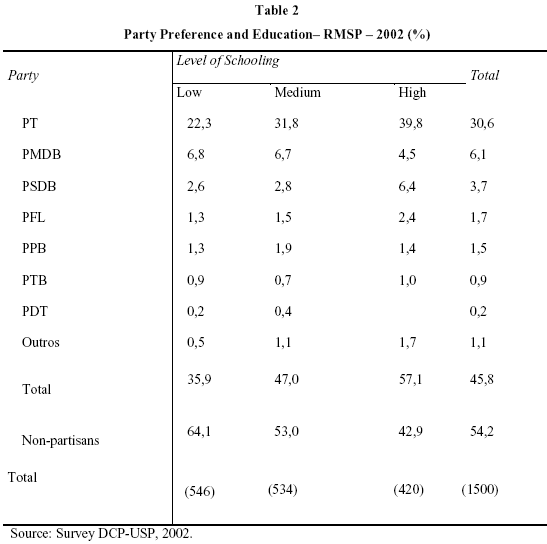
The insertion of PT as a prominent party in the electoral game, however, did not result into a different pattern of party politics in this specific region, that is, a type of dispute in which alternative parties – opposing to the PT – would attract the preference of the electorate. In fact, the preference rates for other parties are rather low, even in the case of the PMDB, which has already had in this area one of its most important supporting bases (Lamounier and Muzinsky, 1983; Sadek 1984). Such difference from the PT makes the party preference resulting rate of 46 percent similar to the average rate observed in the nationwide surveys in the same year (42 percent).
Second, the numbers in table 2 also show the impact of schooling level over party preference, a finding already reported in prior studies (Balbaschevsky, 1992; Moisés, 1992; Carreirão and Kinzo, 2002). As it can be observed, party preferences tend to be higher among higher educated voters, and such correlation is especially visible in the case of PT: among the higher educated, the preference rating for the PT reaches 40 percent. This tendency, however, is not observed in the PMDB's preference ratings, which are higher among the least educated. Based on it, a positive but weak correlation has been recorded: Spearman's r = .171.10
The existence of a positive correlation between levels of schooling and party preferences – even if not very high – suggests the hypothesis that the complexity and low intelligibility of the Brazilian electoral game demand from voters a strong willingness to obtain political information, and such attitude is more likely to be found among higher educated voters. If this is true, one should know, first of all, how well informed voters are about the parties that make up the Brazilian party system.
In order to know in detail how much information voters get about the parties, some questions were included in the questionnaire of the survey that we carried out in the RMSP. The data shown in tables 3 and 4 are quite revealing.
]]> When asked about which parties they know or have heard of, the answers of the interviewed show that the parties have very few rooted impressions in the voters' minds. With the exception of the PT and the PMDB, which were mentioned respectively by 80 percent and 59 percent of the interviewed, more than half of RMSP voters did not mention the other important parties (such as PSDB, PFL, PPB, PTB and PDT) that make up the Brazilian party system.What is more surprising is that a considerable number of the interviewed do not know to what parties the main political leaders of the country are affiliated, as table 4 shows. Again, with the exception of the PT, whose main leader — Luis Inácio Lula da Silva – and its outstanding representative in the Senate — Eduardo Suplicy – are mentioned as members of the PT by the majority of the interviewed, the other party leaders have not been able to make roots among the voters for their parties. The lack of information about party affiliation of popular politicians is impressing, especially those who were then the presidents of their parties (which is the case of Jorge Bornhausen, Michel Temer, José Anibal, Leonel Brizola and even José Dirceu) or who were important congressional leaders (such as Antônio Carlos Magalhães): the ratings of the interviewed who did not give the right answer when they mentioned to what party such politicians are affiliated varied from 76 percent to 97 percent One could argue that, as congressmen, such politicians were less exposed to the part of the electorate (in fact, the majority) who do not follow up their daily political actions. What is also surprising, however, is the small number of respondents who knew to what party Fernando Henrique Cardoso belonged, the then president of the Republic: only 29 percent of voters gave the correct answer.
Such evidence support the previously mentioned hypothesis that the low rating in party identification found in the Brazilian party system may be a consequence of insufficient information about the parties, which is expected in a setting that faces low schooling levels and high complexity in the electoral contest. In other words, if one of the main factors which prevent the development of party identification is the low visibility rating of parties, which makes them little known by the electorate, it is expected that voters who have more access to political information and can therefore gather more information about the parties will be more likely to develop some attachment with one of the main parties. Thus, it is expected to find a positive correlation between the level of information about the parties and party preferences.
In order to test this hypothesis it is important, however, to consider other factors that may affect the constitution of partisan ties, especially those that concern the PT. In other words, it is necessary to measure the impact of the informational variable together with some structural variables, such as schooling and working situation, since in a complex partisan-electoral setting the level of political recognition depends on the availability and ability to obtain information (which are higher among the more educated) and on the exposure to the political information (which is higher among those who work outside their homes). We have also included another political variable – a pro-democracy index – based on the assumption that voters who are more inclined to develop partisan ties are those who get more information about parties and who are more likely to support democratic values (such as the defense of democracy as the best political regime, party pluralism and other fundamental institutions of representative democracy).
In this way, the initial hypothesis was supplemented by other three, which are: a) the greater the schooling level, the more inclined the voter will be to express preference for some of the parties that make up the Brazilian party system; b) voters who work outside their homes are prone to have party preferences; and c) voters who have a higher level of pro-democracy stand are more likely to develop partisan ties.
In order to test these hypotheses, we have used a binomial logistic regression model11, which took the party preference12 as a dependent variable and included the following independent variables:
1. Index of party cognition: resulting from the creation of an information scale about the parties, whose items are described in the annex. This index measures the level of information about the parties and can have low, medium and high values.
2. Schooling: classified in three levels – low (up to primary school, 36% of cases); medium (middle school 36% of cases) and high (high school or above, 28% of cases).
3. Work situation: a dummy variable, with a 1 value for those who work outside the home and 0 for those who do not.
4. Index of pro democracy stand: can be low, medium or high according to the classification on a scale of pro-democracy values, whose items are described in the annex.
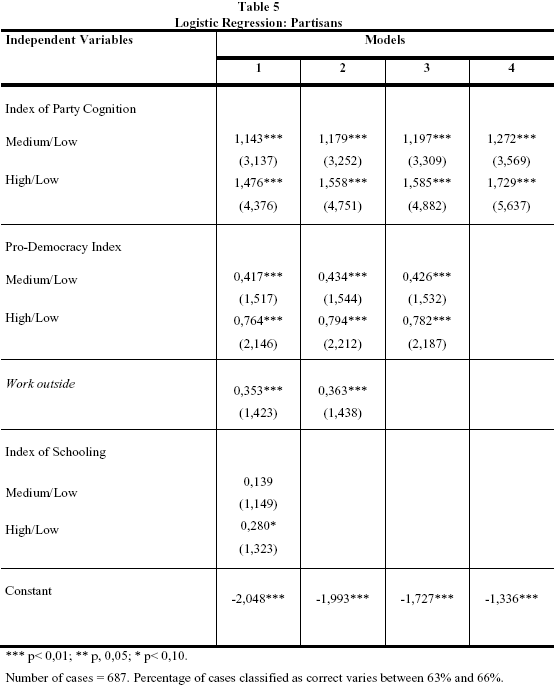
]]> Table 5 presents the results of the regressions. First, it shows that when the four variables are included in the analysis (model 1), coefficients are positive and have a high level of significance, thus confirming our hypotheses, with the exception of the hypothesis related to schooling, whose coefficients, although positive, are much lower and only become significant when compared to high and low schooling ratings. Secondly, one notes that the political party cognition variable has an explanatory effect on party preference, which is much higher than the other variables, whether taken alone (model 4) or associated with the pro-democracy variable (model 3), or when the two correlated structural variables are included – level of schooling and working outside the home (models 1 and 2). This means that (taking the values in parentheses which are the odds ratios) among those who have a higher rate of party cognition, the chance of showing a preference for a party is 3 times higher (if the level is medium) and 4 times greater (if the level is high). Another variable that proved to be relevant is the pro-democracy index, which shows that the chance of expressing a party preference is 1.5 times higher among those who have been classified as medium level on the pro-democracy index and twice as high among those classified in the high level.
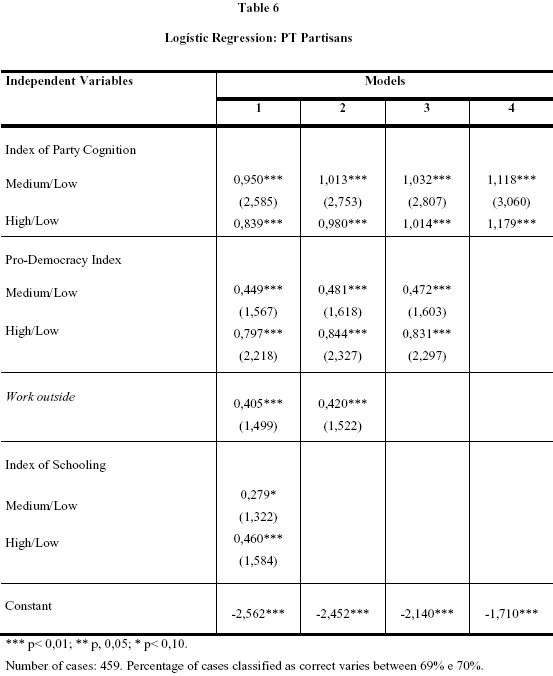
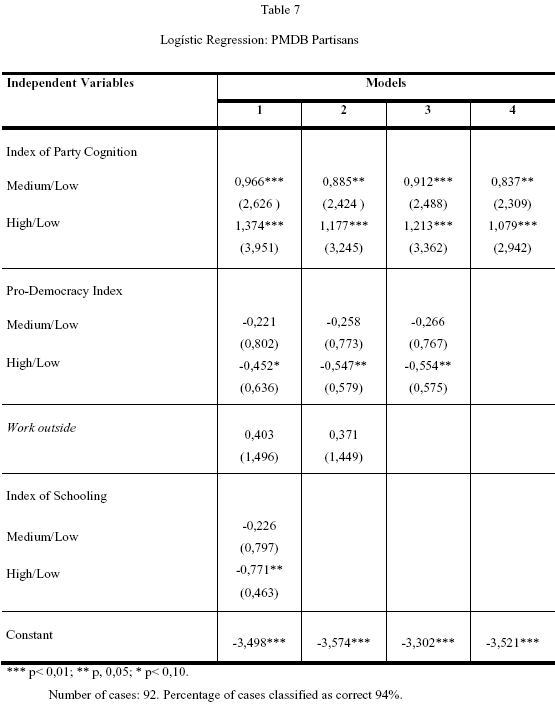
Since those who are identified with the PT and the PMDB constitute a larger number of cases, we tested our hypothesis for these groups separately, using the same statistical analysis procedure. Tables 6 and 7 show the data for the group interviewed which showed a preference for the PT13 and the PMDB14, respectively.
]]>
Since PT supporters are the largest group among those declaring a party preference, it was to be expected that the most relevant factor to explain party preference in general – party cognition – would also be the variable to have the strongest effect on the preference for the PT. Even so, the results for the group of PT supporters reveal some interesting differences. First, the coefficients for the party cognition index are lower than those recorded in the analysis of party supporters as a whole; second, the values for the odds ratio for a preference for the PT with an increase in the level of party cognition rise from the medium to high category only when this variable is considered in isolation (model 4); in the other models, which include the other variables, the associated values and thus the odds ratio, drop or remain unchanged. This means that the weight of the other variables for the PT group is relatively greater than the one found in the total group with party ties, which is especially evident with respect to the schooling variable. Thus, in contrast to what was seen in analyzing the set of parties, schooling level has a significant level when compared to both the high and low categories (level of significance < 0.01), as well as the medium to the low categories (< 0.1). That is, the probability of a voter with an average level of schooling showing a preference for the PT is 1.3 times greater than a voter with a low level, and this probability rises to 1.6 times in the case of those with a high level of schooling.
The profile of PMDB backers is very different from the PT group, as revealed by the results of the regression analysis with the dependent variable being preference for the PMDB (Table 7).
It is true that the most important variable in this case continues to be the rate of party cognition and the chance of being a PMDB supporter becomes almost four times greater among those who have a high rate of information on the parties, when we include the four selected variables in the analysis. But what we want to highlight is the fact that the other hypotheses have not been confirmed, whether because the results were not statistically significant for all categories of the variables in question or because they showed negative correlation. This is the case of the schooling variable which shows a negative correlation with a preference for the PMDB, even though only the coefficient resulting from the comparison between the high level and low level of schooling had reached statistical significance. Even so, this allows us to affirm that the chance of a voter with a high level of schooling showing a preference for the PMDB is only 48% if compared to voters with a low level of schooling. While refuting the originally formulated hypothesis, this result makes sense in the case of the PMDB, taking into account the fact that this party is the oldest and its history – especially under the military rule – led to the creation of a party identification with the poorest segments of the population, an outstanding trait in the large urban centers such as São Paulo (Lamounier, 1975 and 1980; Reis, 1978) The negative sign observed in the case of the pro-democracy index is, however, more difficult to explain, since a positive association with PMDB supporters was to be expected, given the history of this party in the struggle for democratization of the country. Perhaps the PMDB long standing identity crisis - for more than a decade and a half - has dissipated the party's image to the point that its supporters no longer associate it with the defense of democratic values.
In sum, the results of the regression analysis, suggest that the cognitive element is the most important factor in explaining political party preference in the Brazilian political context, and especially the preference for the PT. In other words, the results explain why the majority of voters did not develop ties to the parties. The lack of a minimum level of information necessary to differentiate the parties that make up the Brazilian party system results in the absence of party loyalty or ties.
The low rate of partisanship in Brazil has much more to do with the low cognition level associated with the electoral dispute than with any antagonistic feelings for party politics. Despite party preference being directly linked to a more pro-democratic stance, the data from the same study reveal that 73% of those interviewed believe in the power of influence of their vote over the Brazilian context. Moreover, even though 60% of respondents believe that the parties are not concerned with the needs of the population, 57% of them consider the parties necessary for the functioning of politics and 67% are in favor of a party system with at least two parties.15 It is evident, therefore, that citizens' perceptions of democratic institutions, such as political parties and elections, are not negative, at least within the reference of the universe in which this study is based.
]]> Final considerations (sub 1)
After almost twenty years of democratic political party competition, loyalty has been highly unstable and has developed very slowly in Brazil. As we have seen, this tendency has to do with at least two factors: on the one hand, the structure of incentives which constrains politicians and parties in the electoral arena; and on the other hand, the parties' organizational resources. Adopting a complex set of electoral rules – the majority system, a system of proportional representation with an open list system and permission to make alliances among parties – combined with a presidentialist federative structure and a highly fragmented party structure, have contributed to obscuring the intelligibility of party competition, and thus discouraging the development of party identity. Even though the strategies used by politicians and their respective parties in order to increase gains in the context of disputes have been successful, the consequences for the electorate are far from positive. Voters have difficulty in identifying parties as distinct political actors, that is, as entities that structure electoral choices and create identities. In other words, in a situation of intense fragmentation, and with the lack of clarity of the party system as a result of the practice of electoral alliances – not to mention the practice of coalition government – it is hard for the average voter to fix an image of the parties in their minds, to distinguish their leadership and proposals and thus to establish party loyalty.
Under these circumstances, party visibility, which is essential to developing party identification, can occur only if the parties are very well organized and have a clear strategy for creating a differentiated profile. As the only mass organization in the Brazilian party system, the PT could benefit from its singular exposition, making roots in the electorate. In order to compensate for the fluidity of the structure of the electoral competition and to affirm itself as an important actor in the electoral arena, the PT strengthened its organization and presented itself at the polls as an effective opposition and left-wing party. In maintaining this strategy, avoiding mixing with electoral partners on the other end of the ideological spectrum, the party managed to fix its image and to create ties among a significant portion of the electorate, especially in the Greater São Paulo Metropolitan Region, this important region of the country, where our study was carried out. This certainly explains the growth in the numbers of PT supporters. Its present experience in federal power, which has given it a new position in the political process – and it is well to remember the imperative need to form a broad and heterogeneous government coalition – will be an important test of the ability of the PT to retain its supporters.
Notes
* This article is the result of a thematic project “Parties and Political Representation: the impact of parties on the structure of electoral choice in Brazil”, funded by Fapesp (Research Foundation of the State of São Paulo). A preliminary version was presented at the 27th Annual Meeting of Anpocs (National Association of Graduate Studies and Research in Social Sciences), Caxambú, from 21 to 25 October, 2003. I thank Leandro Piquet Carneiro and Ivan Borin for their help in the statistical analysis.
1 Data from a survey carried out in the Metropolitan Área of the São Paulo City as well as from nation-wide surveys carried out by Institute Data Folha (1989-2002 period).
2. Just for comparison: Pedersen's index average for the European countries, which have grown, between 1985–96, were 11.0 (Cf. Nicolau, 1998). On electoral volatily see especially Bartolini and Mair (1990) and Mair (1997)
3. The data used in the Graph 1 as well as in Table 1 are from national surveys carried out by the institute DataFolha. The figures presented are the year average of several surveys held in each year. A more detailed analysis is found in Carreirão & Kinzo (2002)
4 We refer to party preference instead of party identification (which is the usual concept in the literature) given the fact that surveys in Brazil do not work with the question usually used to measure party identification (such as “do you usually think yourself as a Democrat, a Republican, etc or as a Conservative, a Labour, etc) (Miller and Traugott, 1989). The wording adopted in all surveys in Brazil is: “what party do you prefer?”, a wording, which suggest a much weaker kind of partisan attachment.
]]> 5 The year average resulted from rates observed in about four surveys held in each year by the same opinion poll institute ( Data Folha).6. Lately this strategy has changed considerably. Actually, in the 2002 elections, when the PT's presidential candidate won, its electoral strategy was to form alliance even with the right.
7 See especially Converse's seminal work (1964).
8. On the affective and cognitive components of party identification, see especially Richardson, 1991.
9 This survey, held in May 2002, used a probabilistic sample of 1500 cases, and is part of a research project financed by Fapesp and CNPq. The selection of the cities to be part of the sample was made according the following procedure: a) São Paulo city was included as a self-representative case (61,1% of the electorate); b) the remaining municipalities of the metropolitan region were grouped in 2 clusters according to the size of the electorate; c) from cluster 1, that sums 28,5% of the electorate, three cities were randomly selected (Moji das Cruzes, Guarulhos and Carapicuiba) and from Cluster 2 (10,4% of the electorate) just one city was chosen (Cotia); d) the number of interviews in each of the cities was distributed proportionally to their electorate and the quotas distributed by education, gender and age in proportion to their distribution in each case. I want to thank Leandro Piquet Carneiro for his help in the definition of the sample.
10 Significance level: .01.
11 This statistics allows us to measure the impact of an independent variable, discounting the effect that other variables could cause. That is, in order to measure the sole effect of a given variable it simulates to keep constant the effect of the remaining ones.
12 .This is a dummy variable whose value 1 is scored for those who have a party preference and value 0 for those who do not have.
13 Dummy variable: value 1 is scored for those who indicate PT preference and value 0 for the remaining interviewed.
14 Dummy variable: value 1 is scored for those who indicate PMDB preference and value 0 for the remaining interviewed.
]]> 15. Interesting to note that 55% are in favour of a party system which has less parties than the current one.
Bibliography
BALBACHEVSKY, Elizabeth. (1992), “Identidade partidária e instituições políticas no Brasil”. Lua Nova, 26. [ Links ]
BARTOLINI, Stefano & MAIR, Peter. (1990), Identity, competition, and electoral availability: the stabilisation of European electorates. Cambridge, Cambridge University Press. [ Links ]
BRAGA, Maria do Socorro. (2003), O processo partidário-eleitoral brasileiro: padrões de competição política (1982-2002). Tese de doutorado, São Paulo, Universidade de São Paulo (mimeo.). [ Links ]
CARREIRÃO, Yan de Souza & KINZO, Maria D'Alva. (2004), “Partidos políticos, preferência partidária e decisão eleitoral no Brasil (1989-2002)”. Dados, 47 (1): 131-168. [ Links ]
CONVERSE, Phillip. (1964), “The nature of belief systems in mass publics”, in David Apter (ed.), Ideology and discontent, Nova York, Free Press. [ Links ]
_________. (1969), “Of time and partisan stability. Comparative Political Studies, 2. [ Links ]
DALTON, Russel J. (2000), “The decline of party identifications”, in R. J. Dalton, I. McAllister e M. Wattemberg (eds.), Parties without partisans: political change in advanced industrial democracies, Oxford, Oxford University Press. [ Links ]
DOWNS, Anthony. (1957), An economic theory of democracy. Nova York, Harper & Row Publishers. [ Links ]
LAMOUNIER, Bolivar. (1975), “Comportamento eleitoral em São Paulo”, in B. Lamounier e F. H. Cardoso, Partidos e eleições no Brasil, Rio de Janeiro, Paz e Terra. [ Links ]
_______________. (1980), Voto de desconfiança. São Paulo, Símbolo. [ Links ]
LAMOUNIER, Bolivar & Muzynski. (1983), “São Paulo, 1982: a vitória do (P)MDB”. São Paulo, Textos Idesp (mimeo.). [ Links ]
LAVAREDA, Antônio. (1989), “Governos, partidos e eleições segundo a opinião pública: o Brasil de 1989 comparado ao de 1964”. Dados, 32 (3). [ Links ]
____________. (1991), A democracia nas urnas: o processo partidário-eleitoral brasileiro. Rio de Janeiro, Iuperj/Rio Fundo Editora. [ Links ]
MAIR, Peter. (1997), Party system change: approaches and interpretations. Oxford, Clarendon Press. [ Links ]
MILLER, Warren E. & TRAUGOTT, Santa. (1989), American national election studies data sourcebook, 1952-1986. Cambridge, Harvard University Press. [ Links ]
MOISÉS, José Álvaro. (1992), “Democratização e cultura política de massas no Brasil”. Lua Nova, 26: 5-51. [ Links ]
NICOLAU, Jairo Marconi. (1998), “A volatilidade eleitoral nas eleições para a Câmara dos Deputados brasileira (1992-1994). Trabalho apresentado no XXII Encontro Anual da Anpocs (mimeo.). [ Links ]
PEDERSEN, Mogens. (1990), “Electoral volatility in Western Europe: 1948-1977”, in P. Mair (ed.), The West European party system, Oxford, Oxford University Press. [ Links ]
PERES, Paulo S. (2000), “Sistema partidário, instabilidade eleitoral e consolidação democrática no Brasil”. Trabalho apresentado no II Encontro Anual da Associação Brasileira de Ciência Política (ABCP), mimeo. [ Links ]
REIS, Fábio Wanderley (ed.). (1978), Os partidos e o regime. São Paulo, Símbolo. [ Links ]
RICHARDSON, B. M. (1991), “European party loyalties reviseted”. American Political Science Review, 85 (3). [ Links ]
SADEK, Maria Tereza. (1984), Concentração industrial e estrutura partidária: o processo eleitoraL no ABC (1966-1982). Tese de doutorado, São Paulo, USP (mimeo.). [ Links ]
WATTENBERG, Martin. (1998), The decline of American political parties, 1952-1996. Cambridge, Harvard University Press. [ Links ]
_________. (2000), “The decline of party mobilization”, in R. J. Dalton e M. Wattenberg (eds.), Parties without partisans: political change in advanced industrial democracies, Oxford, Oxford University Press. [ Links ]
Appendix (sub 1)
]]> The Index of party cognition (made up of three categories: low, medium and high) is a result from the creation of a scale of party information, based on five indicators:a)The number of parties that those interviewed know; a greater value has been attributed to the more important parties and the lesser value attributed to the less important ones.
b)The degree of information on the party affiliation of the main political leaders, with a grade attributed to each respondent for the number of correct responses with respect to knowledge about political leaders.
c)The degree of information on the position of the main parties on the right-left political spectrum, with a grade given to each respondent according to the number of correct responses regarding the classification of the main parties. It is worth remembering that the number of non-responses to these questions is very high.
d)Knowledge of the party affiliation of the state governor.
e)Knowledge of the party affiliation of the town mayor. This as well as the previous variable are dummies, with the value 1 for those who know and 0 for those who do not know.
By classifying respondents according to their scores for each indicator we had them ranked in a 0 to 10 scale the result of which was as follow:
| 0 | 1 | ]]> 2 | 3 | 4 | 5 | 6 | 7 | 8 | 9 | 10 |
| 6,5 | ]]> 21,3 | 27,1 | 21,5 | 11,3 | 5,9 | 3,4 | 2,0 | 0,9 | – | – |
Index of pro-democratic values (low, medium and high): result of the creation of a scale in which those interviewed were classified according to the grade obtained from the sum of answers in agreement with the questions below (1 point for each question)
a)Are you in favor of the existence of political parties in Brazil?
b)Do you believe “that political parties in Brazil are necessary for the functioning of politics”?
c)Do you believe that “whatever the situation, a democratic rule is always preferable to a non-democratic government”?
d)Are you against the president prohibiting strikes?
e)Are you against the president being able to intervene in unions?
f) Are you against the president outlawing a particular party?
g)Are you against the president censuring newspapers, TV and radio? ]]>
h)Are you against the president being able to close the national congress?
i) Are you against the president being able to outlaw elections?