A criação de municípios após a Constituição de 1988
La Création de communes après la Constitution de 1988
Fabricio Ricardo de Limas Tomio
Translated by Plinio Dentzien
Translation from Revista Brasileira de Ciências Sociais, São Paulo, v.17, n.48, p.61-89, Feb. 2002.
ABSTRACT
This article examines the decision process in states governments and the political-institutional context (intergovernmental flow of funds, competences of governmental entities in federation, legislatives proceedings) that produced, between 1988-2000, the proliferation of 1,438 new municipalities in Brazil (25% from total of municipalities). The approach emphasizes the role of institutional mechanisms on direction of actors' political strategies and determination of politics outcomes. The interpretation and empiric research produced the following hypothesis to explain this political process: 1) the new municipalities' proliferation process is resultant from mechanisms (institutional arrangement) which shaped a favourable situation to decisions that created the municipalities; and 2) the state variation in process shall have resulted from: (a) how the regulations changed the available quantity of localities/towns to be able to turn municipalities, (b) kind of interaction between executive/ legislative, (c) size/type of government coalition in state parliament and (d) existence of legal provision (about initiative and procedure of legislative proposition in the state parliament) which enlarged the autonomy of state parliament on decision process to create municipalities.
Keywords: Executive/legislative interaction: New municipalities; federation; Political institutions; State decision process.
RESUMO
Este artigo analisa o processo decisório estadual e o arranjo institucional (transferências fiscais, competências dos entes federativos e procedimentos legislativos) que geraram, entre 1988 e 2000, 1.438 novos municípios no Brasil (25% do total). A abordagem enfatiza o papel dos mecanismos institucionais na orientação das estratégias dos atores e na determinação dos resultados políticos. A interpretação e os dados empíricos fundamentam duas hipóteses explicativas: 1) o processo emancipacionista é resultante dos mecanismos (arranjo institucional) que moldaram um ambiente favorável às decisões de criação de municípios; e 2) a variação estadual resultaria: (a) de como a regulamentação alterou a disponibilidade de localidades emancipáveis; (b) da natureza da interação entre o executivo e o legislativo; (c) do tamanho/tipo da coalizão governista e (d) da existência de dispositivos legais (sobre a iniciativa e a tramitação da proposição) que ampliaram a autonomia do legislativo estadual nesse processo decisório.
Palavras-Chave: Relações executivo-legislativo; Emancipações municipais; Federação; Instituições políticas; Processo decisório estadual.
Cet article analyse le processus de décision régional (au niveau des États de la Fédération) et l'arrangement institutionnel (transferts fiscaux, compétences des organes fédératifs et procédures législatives) engendré entre 1988 et 2000 par 1.438 nouvelles communes au Brésil (1/4 du total des communes existantes). Notre approche met l'accent sur le rôle des mécanismes institutionnels dans l'orientation des stratégies des acteurs et dans la détermination des résultats politiques. L'interprétation et les données empiriques permettent l'élaboration des hypothèses explicatives suivantes: 1) le processus d'émancipation résulte de mécanismes (arrangement institutionnel) qui ont formé un environnement favorable aux décisions qui ont créé les communes; et 2) les variations régionales résulteraient: (a) de la manière dont la réglementation a modifié la possibilité de localités émancipables, (b) de la nature de l'interaction exécutif/législatif, (c) de la taille/type de coalition au sein du gouvernement, et; (d) de l'existence de dispositifs légaux (par l'initiative et le cheminement bureaucratique de la proposition) qui ont augmenté l'autonomie du législatif régional dans ce processus décisionnel.
Mots-clés: Intéraction exécutif/législatif; Nouvelles municipalités; Féderation; Institutions politiques; Processus de décision régionales.
Introduction
The process of re-democratization of the Brazilian State during the 1980s deeply transformed the country's political and institutional environment. Besides political liberalization, the increase in electoral competition and that of civil liberties – outcomes of a long political transition with the gradual adoption of the typical mechanisms of democratic regimes – there was a redefinition of the institutional role of the different power levels. Such reorientation of the Brazilian federative structure favored the sub-national units, both by reestablishing competences usurped by the dictatorial regime and by the creation of new mechanisms of political autonomy, primarily in the case of municipalities.
The main institutional mark of such political transformation was the promulgation of the 1988 Constitution. Originating in it, an entire juridical structure was built, consolidating the new democratic arrangement. The transformations were radical to de point that they generated a new federative order: the constitution makers not only established the bases of a democratic state but also instituted a new "federative pact".
]]> The redefinition of the political competence of the federative entities was notable by the increasing scope of action of states and municipalities; in fact, municipalities won the largest political autonomy they ever had along republican history1. In spite of the fact that it was mentioned as an autonomous political organization in almost all republican constitutions (the exception was that of 1937), it was only in 1988 that the municipality conquered a full autonomy, obtaining de facto the status of a federative entity. That situation is very peculiar: it is not identified in other countries with federative organization. In most federations, or at least in the best known, municipalities or other levels of local government are administrative divisions of the federated units that assign different degrees of autonomy to local governments.Another institutional change that enhanced the increasing political autonomy of sub-national units was the new fiscal and tributary arrangement. The fiscal decentralization process began, however, in the mid seventies, proceeding along with democratization. The promulgation of the new constitution consolidated the offer of fiscal resources and tributary competences to states and municipalities.
Political and fiscal decentralization were important characteristics of Brazilian re-democratization. They were legitimized in a given political culture generalized among political groups of different ideological tinctures, a culture that associated democratization to decentralization, treating both almost as synonymous. Even if not totally elucidated, the impacts, limits and directions of the process in a democratic political environment have been studied by different authors in different areas of the social sciences2. One aspect of this new institutional arrangement, however, has attracted only marginal attention. It is the process of fragmentation of Brazilian municipalities. A process that, between 1988 and 2000, generated 1438 new municipalities – 25% of all municipalities today existing in Brazil.
In the specific thematic literature, the approach to this political phenomenon has generally followed normative orientations3. Because of this, it tends to concentrate more in normative aspects and in consequences than in the identification of causes. The most common findings relate the performance, proliferation and strengthening of local governments, on the one hand, or the fiscal unbalance, the unplanned dynamics of territorial division and the weakening of higher government spheres, on the other, to the vitality and quality of the country's democracy. When they were not simply forgotten, explanations of the causes and historical interpretations of that political process were extremely biased.
This paper aims to partially fill this gap through the identification of causes and the description of mechanisms that determined the general dynamics and the state level variation in the process of creation of municipalities in Brazil. The approach to the object privileges, on the one hand, the investigation of the institutional arrangement responsible for the environment that made possible the political decisions that generated the unfolding of new municipalities from within existing ones [emancipação**]; and, on the other, the interaction itself of the relevant political actors that produced, through related, yet distinct, decision processes the two main outcomes of those decisions: the creation of new municipalities (through ordinary laws) and the institutional transformation in the regulation of emancipations either to enhance them or to make them difficult (complementary laws+).
The elaboration of the problematic related to municipal emancipations has a theoretic and methodological foundation supported by methodological individualism and by neo-institutionalist models that approach the phenomenon through the definition of political institutions as "rules of the game" that shape strategic interaction and determine the possible choices of the political actors that decide the creation of a new municipality4.
The analysis is limited to a specific sphere of political decision, the state level, where the rules and decisions have an immediate effect on the emancipation of localities. However, for the historical understanding of the process, it is interesting to incorporate both the institutional mechanisms of the other levels to the general explanatory model and the perception of the interaction among political actors in the three power spheres (federal, state and municipal) in the determination of the political phenomenon under scrutiny.
The comparative study of the processes of emancipation aims at two specific objectives: the identification of institutional mechanisms that, as independent variables of the process, determine the environment for the political decision that, on the one hand, generated the contemporary "municipal boom" and, on the other, allowed that phenomenon to take on different forms in the different states; and the interpretation of the logic of the process of political interaction, especially among the state executive and legislative members, determining that political decisions for or against emancipation won in each state.
Municipal emancipations in the 1980s and 1990s
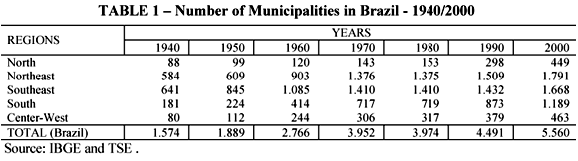
]]> In the last two decades, more than a thousand municipalities were created in Brazil, most of them after the promulgation of the 1988 Constitution. The intensive creation of municipalities is not a recent phenomenon. In the last fifty years, the number of municipalities almost quadrupled. Although it is a constant trend, however, emancipations did not occur at the same pace in the whole period. As can be seen in Table 1, between 1950 and 1970 the process was more intense than in the last two decades and in the 1970s very few municipalities were created.
The superposition of these data to contemporary Brazilian political history allows a direct association of political regime and creation of municipalities. In other words, democratic periods, as the populist republic (1945-1964), the new republic (the eighties) and the last period (1990 to 2000) are characterized by a political, institutional and fiscal decentralization that favored municipal emancipations. In contrast, the dictatorship period, the military regime (1964-1985), due to its centralizing characteristics, inhibited the creation of a great number of municipalities. This kind of correlation is limited for it is very generic and does not present the specific political and institutional mechanisms that contributed in each political regime to the "waves" or "surges" of the creation of municipalities5. There is, undoubtedly, a coincidence between pace of municipality creation and political regime. The relationship is correct when it identifies dictatorship periods with political and administrative centralization. It would have been odd if, in the Brazilian case, dictatorships had promoted the opposite dynamics, incorporating fiscal and political decentralization to their political agenda. The error is in attributing the opposite dynamics to democratic situations. In this sense, any democratic state, including Brazil, would show a single bias in the distribution of the fiscal "cake" (in favor of local government instances); it would also show an intrinsic instability in its political and administrative organization and territorial division. None of these conditions seems to be necessary; they are contingent on other, more specific, political and institutional factors. Besides, that relationship between political regime and emancipations has a fatalist sense and is incapable of explaining the variation in the pace of municipality creation among Brazilian states.
Such pace difference among states generated other explanations of the process that often are less plausible than the one that draws the direct linking to the political regime. These attempts at elucidating the problem are founded in different aspects of the emancipation process (social and political causes) and they vary in terms of the theoretic and methodological approach adopted. However, in most cases, they simply to not resist to a logical evaluation or to a more elaborate empirical test6.
The emancipationist wave was not an entirely national phenomenon; it was concentrated in some States (see Table 2). In proportional terms, most States in the North and Center-West stand out, but in absolute terms emancipations in these regions are not very relevant. The small number of municipalities in 1980, the frontier characteristics and the creation of new States probably determined, in addition to institutional factors, the very high proportion of emancipations in these regions.
]]>
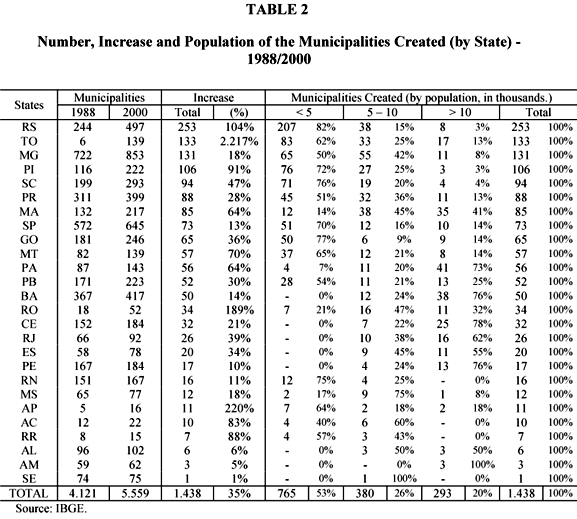
Another verifiable characteristic is the similarity, in terms of the relative increase of emancipations, of States with diverse socio-economic situations: Rio Grande do Sul and Piauí doubled the number of municipalities; Maranhão showed a high proportion of emancipations; Santa Catarina, Espírito Santo and Rio de Janeiro stand above the country's average. States with lower indices presented also a similar socio-economic diversity – as, for instance, Sergipe and São Paulo. In general, these data reinforce the objections to the explanatory hypotheses founded exclusively in social aspects or in some kind of functionalist teleology.
Political decentralization derived from the 1988 Constitution determined the transference of the regulation of emancipations from the Union to the States. The States' institutional autonomy in the regulation and political decision was the main factor in the different pace in the creation of new municipalities. Before 1988, because of restrictive federal laws, there were few districts legally eligible for emancipation outside the colonizing areas in the North and Center-West. In addition, in the second half of the 1980s, due to what seems to have been a legitimacy crisis of the institutions generated from the military government, many municipalities were created, in clear disrespect of the legislation. The juridical effectiveness of the Complimentary Federal Law 01/67 was characterized only when the emancipation of some of these municipalities was cause for disputes in court. When the process happened without appeal to the courts, municipalities were created7.
Another relevant aspect of the question is the frequency of municipalities created with small population (around 74% of the municipalities created in the last two decades had less than 10 thousand inhabitants). In the Southern region, they are more than 90% of the total. Recent municipal emancipation is, fundamentally, related the very small far-off municipalities. The relaxation of the requirements for municipal emancipation in the State Laws, together with other institutional components, is directly related to the creation of municipalities for approximately 75% of these new federative entities could not have been created within the legal frame previous to the last Constitution.
Actors and strategies in the emancipation process
In order to understand the political decision process involved in municipal emancipations I will identify some assumptions in terms of brief ideal schemes about the preferences, choices and strategies of the actors directly involved in the creation of municipalities. The first general assumption, implicit in that interpretative scheme, asserts that actors: 1) are individuals aware of their preferences and act rationally (choose among alternatives and define strategies in interaction with other actors as a function of their expectations as to the future) in order that the outcomes of political decisions fulfill their interests; 2) determine the nature of their choices in terms of their individual advantages (winning elections, maximizing fiscal resources, monetary profits, public policy improvements and/or increase, etc);8 3) and define their strategies, in interaction situations, constrained by the rules (institutions) and by their expectations relative to the choices of other political actors involved in the decision process.
The second assumption suggests that political institutions determine individual choices in two ways: 1) institutions constrain the actors' choices, shaping their strategies as "rules of the game" that regulate their interaction with other actors participating in the decision process; 2) the institutional dynamics itself determines not only strategies but may also change political actors' preferences and interests. This would happen through a continuous feedback process. That is, the form in which political actors perceive, negatively or positively, the consequences of political outcomes, and the institutions' regulatory role interfere in the successive decision process as well as in the transformation of the actors' interests.
Many actors at all federative levels (from the president and state ministers to councilmen and voters in far-off small towns) were involved in political decisions that generated new municipalities and the institutions that regulated the legal process of municipal emancipations. The analysis will be restricted, however, to the actors at the state level, for it is in this governmental sphere that the creation of municipalities is defined.
]]> In the state level decision process, there are four types of political actors that participate in the process, with more or less capacity to determine municipal emancipation. There are local political leaders, individuals living in town that, in most States, are the ones that initiate the legal emancipationist process. Before the interests at play (increase in the offer of fiscal resources and attribution of political autonomy to the emancipated locality)9, these leaders' strategy vis a vis the other actors is: a) to mobilize the local voters to cooperate, voting for emancipation in the plebiscite and helping in the pressure on the political representatives; b) with respect to State Representatives: i) when there is no need of the signature of one Representative in the petition for the calling of the plebiscite and/or in the legal project creating the municipality, pressure on the Representatives to vote for emancipation, with threats of electoral retaliation and ii) when there is the need of the Representative's signature, the promise of compensation through electoral support (votes) to the Representative assuming the emancipationist initiative10.Then, there are the voters participating in the plebiscite. If they are interested in the emancipation, the strategies for the interaction with other actors are similar to those described for the local leaders.
There are also the state representatives that, because of the existing rules, have a number of instruments to control the legislative process of emancipations and effectively participate in all phases of the process, interacting with other actors and having the formal right to break-off the emancipation at any phase of the process. The majority of the representatives do not have significant interests in each manifestation of the legislative. For that majority there is not a fundamental interest either in the approval or in the rejection of the municipality's emancipation. Because of this, I assume that the main interest of the majority of representatives is the continuation of their political career. Individually, each representative defines his strategy and chooses the one that maximizes his chance of reelection or occupation of other political offices.
Besides that, as legislative decisions are collective, the state representatives' individual choices depend primarily on the interaction with their peers and on the possibility that the majority (required in each vote in the process) of the assembly members expects more benefits than costs from the choices made. As the interests of local leaders and voters tend to be mostly in favor of emancipation, state representatives' individual strategies depend on institutional constraints and on the strategy adopted by the State's executive. If the executive either favors or is indifferent to municipal emancipations the main individual strategy on the part of state representatives would be to cooperate with the local leaders, voting for the municipal division. Because of the perspective of patronage gains (part of a patron-client electoral logic)11 and/or of the building up of a physiological network with political allies in the new municipality,12 there would be a positive reinforcement of the expectations of future electoral success. If there are not mechanisms binding representative to emancipation (as the signature in the project), even if the future electoral gains are seen as marginal, the individual representative's vote tends to favor emancipation, for the vote against emancipation tends to generate exclusive losses for the representative, because of the expectation of electoral retaliations he would incur in the locality attempting emancipation.
On the other hand, the state executive simple opposition to emancipations does not alter the representatives' strategies. Only when there is a solid governmental coalition (either programmatic or not), with an absolute majority within the assembly, there is space for a third individual strategy on the part of the representatives. In that case, representatives tend to cooperate with the state executive, either by partisan compromises or by fear of future losses (firing of allies from offices, canceling of investments in areas of the representatives' interests, cuts in the finances of their electoral campaigns, threats of expulsion from the party, loss of votes among voters that support the government's program, etc), in spite of the expected electoral retaliation by voters in the locality attempting emancipation.
The fourth political actor, the state executive, may express different preferences, all of them consistent within this deductive basis. The executive may be pro, indifferent or against emancipations, and it is not possible either to determine a priori its dominant interest or to define what is its rational choice. In the interaction with voters and state representatives, the governor could plausibly support emancipations, first, for electoral reasons, for instance, in states with small electorate, when emancipations involve a significant part of the electorate or in the light of the expectation of sharp competition in future elections, if the electorate of the localities attempting emancipation had a significant weight. Second, to keep majorities in the legislative, in situations where the support of clientelist laws could benefit representatives of the government's base. Third, for political and ideological reasons.
The executive could also oppose emancipations, attempting to prevent them through threats of negative sanctions against representatives of its supporting coalition or through its right to veto that required an absolute majority for its reversal. This opposition could happen for pragmatic reasons, having to do, for instance, with budgetary restrictions; or for political and ideological reasons, as the government party's and/or programmatic principles. The state government can also be simply indifferent to emancipations for the most varied reasons, acting neither for nor against territorial fragmentation. In this case, and also if the government was favorable, there would result a great autonomy of the legislative power, and that would result in a sequence of decisions favorable to emancipations.
All four types of actors participate in the decision process on the creation of new municipalities. Without the local leaders' initiative (in the cases this is required for the legislative process) or the vote in the plebiscite the municipal division would be impossible. However, once the process is initiated, the decision center is displaced to the state's executive power and to the state representatives, and the outcome comes to depend on the strategies deployed by these actors (Figure 1).
]]>
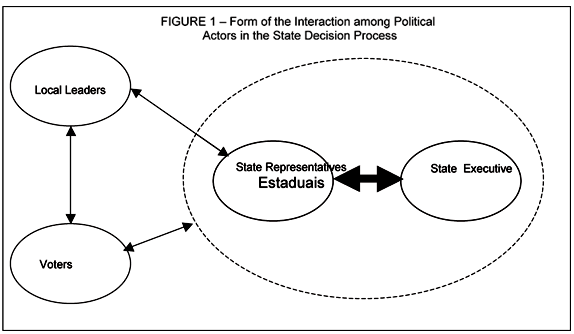
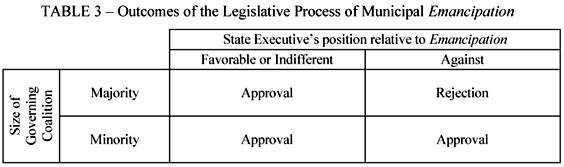
Then, if the actors interact according to the rationality described above, with state representatives voting for emancipations, the variation in the state executive's strategy and its capacity of implementing it (measured by the size of the governing coalition, either a majority or a minority) would determine the emancipationist intensity in each state (Table3).
Political and institutional mechanisms in the emancipationist process
The general form in which the institutional context determines the emancipation process and its variation across States may be viewed in Figure 2. In this scheme, different sets of institutions have specific roles in the shaping of the environment of the political decisions that generated the laws creating municipalities. The historical configuration established between the institutional arrangement and the political actors' choices has as an outcome either a larger or a smaller intensity of the phenomenon in each of the federation's units.
]]>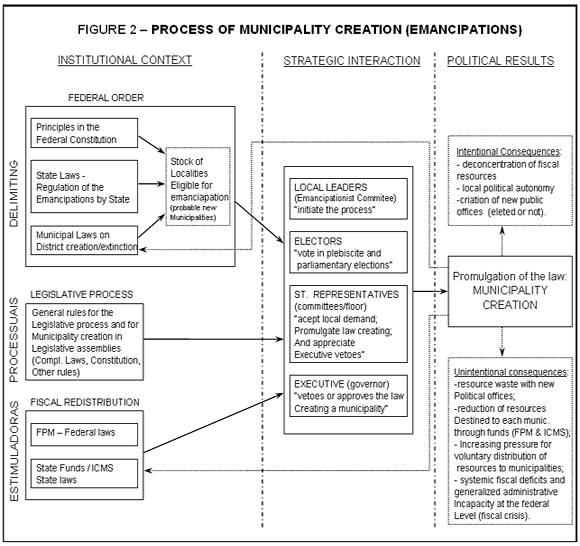
There are three different kinds of institutions in the emancipationist process: delimitating institutions (federal, state and municipality levels) that define the stock of localities that are eligible for emancipation, that is, localities or districts that may be legally emancipated; stimulating institutions (laws that regulate the transference of resources to the municipalities, FPM (Municipalities Participation Fund) and State funds formed by the ICMS, a kind of sales tax) that increase the interests of political leaders and voters of the localities in question, especially from the 1980s on, due to the increase in the transference of fiscal resources to municipalities; and procedural institutions (Federal Constitution, federal and state laws and internal rules of the state assemblies) that determine both the form the legislative process ought to follow until the promulgation of the law and the possibility of interference of each political actor during the process, either "vetoing" or "levering" the creation of municipalities.
The delimitating institutions are the rules in the constitutional provisions and in complementary and ordinary laws that define which communities have a right to demand their transformation in municipalities. The relevance of this kind of rule in the decision process lies in its highly restrictive character, that determines the stock of localities eligible for emancipation in each State and who has to express approval (plebiscite) in order for emancipation to occur.
In this arrangement, each federative level's institutional role is not equivalent: there has been even a reorientation of the decision center in the last two decades. From 1988 on, federal delimitations followed two fully distinct paths. Initially, following the re-democratization's general decentralizing tendency, there were only two constitutional restrictions: the preservation of the "historical and cultural unity and continuity of the urban environment" and the requirement of a plebiscite for the "directly interested population's" vote (Brasil, 1988, p. 21).
In 1996, in what seems to have been a reaction to the emancipationist pace, the National Congress (following an initiative of the federal executive) promulgated an amendment to the Constitution (n. 15) that gave a new centralizing character to the question, drastically restricting the recently conquered states' autonomy. The federal sphere called to itself the prerogative of regulating the able period for emancipations. In addition, the constitutional norm came to demand a "viability study" of the new municipality and, what was even more restrictive, to extend the plebiscite to the voters of all municipalities involved (Noronha, 1996, pp. 111-112).
On the other hand, the municipal delimiting mechanism remained unaltered during the whole period. The municipalities and their government have the jurisdiction to decide, through municipal laws, on the creation or extinction of districts in their territory. Such mechanism is marginal relative to the emancipationist process. But it is not irrelevant, at least in States where the regulation (complementary law) only allows the emancipation of municipal districts.
The most extensive and substantial role in the regulation of emancipations was, until 1996, that of the States.13 The ability to legislate over the regulation of emancipations through complementary laws was one of the main mechanisms that generated the conditions for the recent emancipationist wave, and, to a great extent, determined its distinct pace across States. This was especially true because the permissive character of most state regulations, when compared to the restrictions imposed by the Federal Complementary Law 01/67, increased the stock of localities eligible for emancipation.
In a different way, stimulating institutions possess the fiscal distributing mechanisms that endow the municipalities with a minimum of resources, regardless of the existence of revenue sources in these municipalities' territory. Municipal fiscal resources originate from four sources: 1) resources from its own collection of service fees, duties and some taxes under the municipal jurisdiction like the Buildings Tax (IPTU), Inter Vivos Transfer Tax and Services Tax; 2) transference of resources from State and Federal Taxes when the source of the revenue is in the municipality's territory, corresponding to specific rates, like the taxation of actions of municipal officials (100%), rural territorial tax (ITR, 50%), vehicles tax (IPVA, 50%), goods and services tax (ICMS, 18.75%) and part of what goes to the State as a compensation of the manufacturing tax (IPI, 1,875) lost as a consequence of exports exemption; 3) resources transferred from funds originating in state (ICMS) and federal (Municipalities' Participation Fund, FPM) taxes, without a counterpart in the tax generation;14 and 4) voluntary transference of resources (conventions, works etc.).
]]> Most municipalities created in the last two decades directly depend on federal transferences in order to function. Their own tributary revenue is not sufficient to maintain the political offices generated by the emancipation (mayors, councilmen, municipal secretaries).15 In addition, generally economic activities in these municipalities are just beginning and do not have tax generating sources; the municipalities direct share in state and federal taxes are, thus, inexpressive. Therefore, the Federal Municipalities Participation Fund (FPM) is the survival guarantee for most of the emancipated units. That is the reason why we shall here consider only the third kind of revenue as an institutional mechanism that stimulates municipal emancipations.Among the local actors (leaders and voters), the guarantee of the FPM resources is probably one of the major stimuli to emancipations. Formed by a part of federal taxes (22.5% from both manufactures tax and income tax), the resources for this fund are increasing after 1970: from 1975 to 1993 they more than quadrupled.16 Of the sum total of the fund, 10% are destined to the State Capitals, 3.6% form an additional fund to other large population (more than 156,216 inhabitants) municipalities and the remainder 86.4% goes to all interior municipalities.17
The distribution of the fund to interior municipalities follows two parameters. The first is population. Municipalities are divided in eighteen layers that are granted a participation coefficient. The smallest coefficient is 0.6, attributed to municipalities with less than 10,188 inhabitants; the largest coefficient is 4.0, for municipalities with more than 156,216 inhabitants.18 This was the only criterion existing until 1990, and this equalized the FPM resources transference for all Brazilian municipalities in each population layer.
However, legislation regulating the FPM transfers was altered, certainly due to the concentration of emancipations in some States. Congressmen changed the criteria for the FPM distribution, creating fixed indices for each State.19 This closed the interstate losses and gains circuit, generated by the emancipationist waves of the eighties. In the following decade the zero sum game (for the partition of the FPM through emancipations) was restricted to the set of municipalities within each State.
Even with the expectation of the reduction of the FPM transferences to municipalities in States with large numbers of emancipations, creating new municipalities continues to be a big deal for the small in land localities. The fund assures the fragmentation in small municipalities without losses to the one that was dismembered, for the onus (the zero sum game) is distributed among all the State's municipalities. In most cases, proportional gains (increase in the per capita FPM) generate little opposition to emancipation in the municipality's seat, when thinking in each individual case, for there are only benefits for the municipal actors, both in the new locality and in the municipal seat.
Finally, the third set of institutions (procedural) possess the mechanisms endogenous to the functioning of the state parliaments and the rules that delimitate the interaction among the political actors in the legislative process of creation of a new municipality or of alteration of the State regulation on the minimal criteria required for emancipation. These mechanisms shape political interaction, constraining political actors' strategies in the different decision moments until an emancipation law or complementary law is promulgated.
Some procedural mechanisms originate in the Constitution and determine both the general lines of the emancipationist process and the basic norms of the States legislatives' functioning. As these mechanisms are the same across States (the need of absolute majority for the approval of complementary laws and veto rejection, or simple majority for ordinary laws, the right to total or partial veto on the part of the State's legislative and the fact that the state legislative is unicameral) they do not explain the pace and intensity differences in the creation of municipalities; neither they explain the States' institutional dynamics.
There are also many common characteristics in the decision process that were instituted by States' complementary laws (Table 4 and Figure 3). The most relevant is the difference of veto opportunities attributed to political actors. The state representatives prerogatives exceed those of all other actors, thus maximizing, especially in the situations where there is a convergence in the preferences of most representatives, the ability of the members of the legislative to fulfill their interests.
]]>
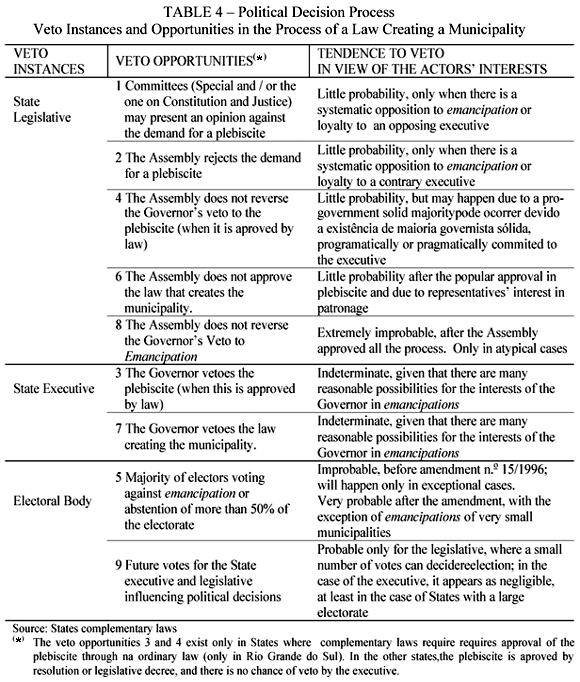
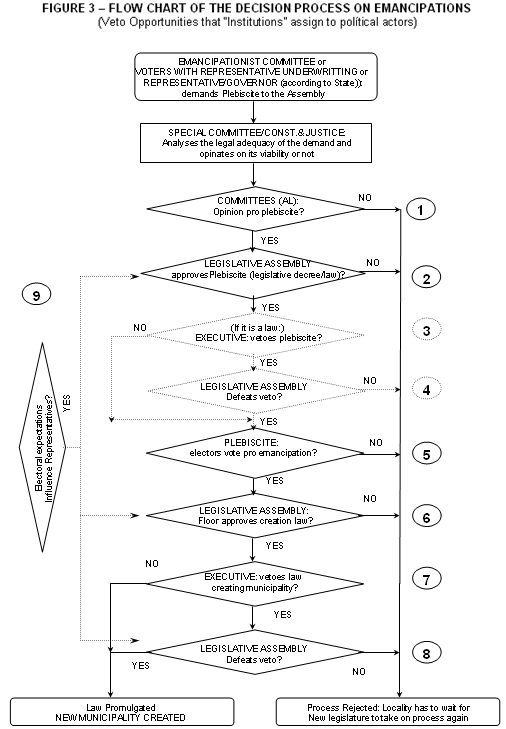
There is, therefore, a great institutional disadvantage of the State executive. As it only possesses a reactive option (vetoing), while the State representatives control all the steps of the process, if the executive is against emancipations it will need a solid and trustful parliamentary majority and a great capability of external control over this majority, in order to reduce the probability of decisions pro-emancipations. Voters have a direct veto power (plebiscite) and another one bound to the representatives' electoral expectations; the operation of this last power maximizes the representatives' autonomy, favoring the creation of a kind of electoral patronage, where representatives operate as policy brokers
When the executive opposes emancipations, the existence of a pro-government parliamentary majority conditions the Assembly's opposition. However, the condition is not a sufficient one. Non-trustworthy majorities and procedural mechanisms, whose occurrence in state complementary laws is variable, could determine an autonomy, if relative, of the legislative. The most important comparative variable of this kind lies in the initiative of the legal process of emancipation. In opposition to ordinary laws whose initiative depends either on the representatives, committees or the executive, some States' complementary laws determine that local actors initiate the process of municipality creation. In such cases, the legislative proposal would only initiate its course after a demand by a certain number of voters from the locality in question.20
The opportunity, or even the requirement, that a representative underwrites the law creating the municipality make it dependent, in order to be approved, on parliamentary logrolling, for the law would be understood as a patronage measure both by the representative who underwrote it and by his peers. In case the executive opposes emancipation, with a pro-government majority, the political opportunity costs, both of the presentation of the law and of the bargain for its approval, would greatly increase to the point of becoming unacceptable. To approve the law in this situation would be next to impossible, for the representative in question would have to distribute benefits to his peers in order to compensate the executive's probable retaliation. In addition, the expectation of retaliation among the pro-government representatives would inhibit even the underwriting of the laws creating municipalities.
On the other hand, when the underwriting is forbidden both initiative and bargaining costs do not exist; as threats of retaliation against individual representatives also do no exist. As the representatives do not control the initiative and they cannot refuse to accept the demands for emancipation, the number of such demands will depend on the local leaders. Their course and approval by the Assembly would depend on the representatives' individual calculation about the electoral advantages of supporting either the executive or the emancipations and about the cost of possible retaliations both by the executive and by the local electorate. The cost of such retaliations is zero for representatives in the opposition and small, in the case of a fragile governmental majority, especially if many representatives are inclined to refuse support to the executive's position. In this sense, the rule forbidding the representatives' initiative is a mechanism both limiting the executive's sanctions and increasing the possibility of the political autonomy of the legislative, particularly when the demand for emancipation involves the interests of many pro-government representatives.
]]>Definition of hypotheses and operational definition of variables for the comparative study
The institutional arrangement generated by the 1988 Constitution, as was seen, attributed a central role to the state legislative in the decision over municipal emancipations both by the displacement of the regulation to the State sphere and by the formal control of the decision process, due to the veto opportunities given to state representatives. In addition, the state emancipationist process has a wider scope than just the decision on emancipation laws. It includes from state regulation (institutionalization) to the definition of minimum requirements for the creation of municipalities and to the course of the legislative process. Together with the outcome of the interaction between legislative and executive, these delimiting and procedural institutions' dynamics determine the pace and intensity of emancipation in the States.
Such dynamics involves also the continuity of the events and decisions that resulted in the creation of municipalities and alterations in the rules for emancipations. As can be seen in Figure 4, the political outcomes and their consequences (either intentional or not) have a feedback effect on the definition / transformation of the interests of the political actors and, therefore, on how new choices will be made in later moments.
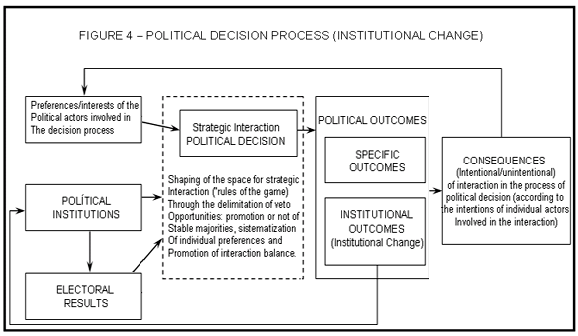
This could be exemplified by changes in strategy adopted by the executive. Following the rationale previously developed, the executive did not have a logically deducible dominant interest, therefore depending on how its expectations are altered by the consequences of political outcomes. In a situation where the process consequences were very sharp, there would be even a possibility of redefinition of interests and strategies on the part of some representatives.
Thus, contradictory decisions made by the same actor in the course of a process would not necessarily be a sign of that actor's irrationality or even of his choice among equally acceptable situations, but perhaps the decisions resulted from a new rationality that brought about a change in the choices and strategies adopted. This would allow the at times radical transformation of some institutions (State regulations) without the substitution of actors or changes in the pro-government coalition. These changes could obviously occur when electoral results changed the actors in the decision process.
]]> In this way, the comparative study of the emancipationist process in the States – the explanation of its causes, of the variations in its pace and intensity and of the institutional dynamics – proceeds through a set of hypotheses that relate propositions on the political actors' instrumental rationality, institutional mechanisms, electoral results and the policy feedback. The first and second hypotheses try to determine the variation of the emancipationist process (Figure 5).
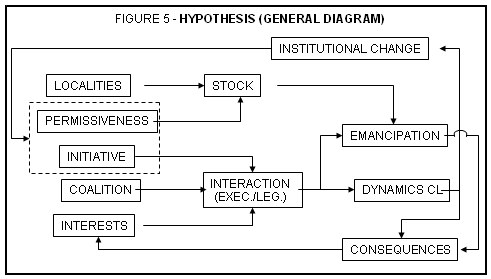
The more pro-emancipation the State's position (resulting from the force relations in the executive / legislative interaction) and the larger the stock of localities eligible for emancipation, the larger the relative occurrence of municipal emancipations in the State.
The institutionalization / alteration of the regulation and its direction (either to ease or to hinder emancipations) will depend both on the interaction between the State executive and legislative and on the size / consistency of the pro-government coalition within the State legislative (coalition built from electoral results or through later alliances):
The institutionalization / alteration of the regulation and its direction (either to ease or to hinder emancipations) will depend both on the interaction between the State executive and legislative and on the size / consistency of the pro-government coalition within the State legislative (coalition built from electoral results or through later alliances):
(a) if the coalition is a minority, the promulgated law tends to ease emancipations, (relatively to the status quo); (b) if it is a majority, with strong support, the law's direction will depend on the executive's interest in easing / hindering emancipations; (c) when it is a majority, with weak support, the law's direction will depend on punctual bargains between executive and legislative.
The third and fourth hypotheses specify the determination of institutional and historical constraints on the political decisions about the emancipationist process and on the availability of localities eligible for emancipation. The third relates the institutions' variations to the actors' strategies in the legislative / executive interaction and, as a result, to the predominant political position on emancipations.
]]> The expectation of the Assembly's autonomy is greater when the local leaders have the exclusive initiative for the creation of municipalities; it is also greater if, either a minority or a majority, the pro-government legislative coalition is weak.The stock of localities eligible for emancipation will vary according to the permissiveness of the rules on emancipations and to the number of localities (districts, small towns, hamlets) that were not emancipated.
The three remaining hypotheses describe the effects of both electoral results and ensuing alliances on pro-government coalitions; the effects of the feedback of political outcomes on institutions; and how the consequences of the process change de actors' choices.
The more negatively the political actors (especially the executive) perceive the consequences (both intentional and non-intentional) of the outcomes of political decisions the greater the probability that they will oppose the creation of new municipalities.
When the outcomes of political decisions alter the institutional context of emancipations there may be changes in the balance of forces between legislative and executive (either for or against emancipations) due to the variation in the institutional mechanisms that constrain the interaction process.
The size and kind of the pro-government coalition (State representatives supporting the government) will be determined by electoral results and by the moment of its definition: (a) majority and strong, when the absolute majority of the representatives that supports the government followed party negotiations prior to electoral results; (b) majority and weak, when the absolute majority followed political alliances after the election; (c) minority, when the Assembly's majority does not participate of the coalition supporting the executive.
The empirical test of the hypotheses is conducted through a set of variables and indicators of the historical process, of the political outcomes, of institutional mechanisms and of the motivation of the actors relative to emancipations. The description of the variables, their values and the characterization of their variation are presented in Table 5.21
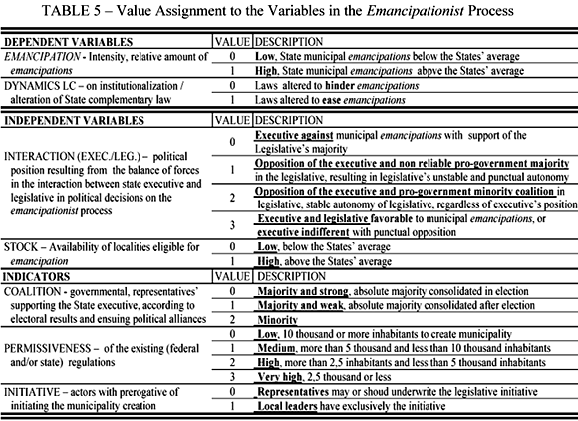
Values are assigned in an increasing manner (according to the expectation of an increasing intensity of the State's emancipationist process): the lower the value assigned to the dependent variables, the smaller the outcomes or the less permissive the regulation created or the orientation of its possible transformations; the lower the value assigned to the independent variables, the less probable the occurrence of the phenomena described by the dependent variables. Therefore, the hypotheses will have more explanatory power, in face of the empirical evidences from the units of analysis (States), when dependent and independent variables vary in the same direction.
Hypotheses testing
The test of hypotheses will be developed in two phases. In the first phase, with data from all Brazilian States, we will partially evaluate the validity of the first hypothesis through the correlation between the stock of localities eligible for emancipation and the intensity of emancipations in the States. In the second phase, through information collected in case studies from five of the federation units (Bahia, Pernambuco, Rio Grande do Sul, Santa Catarina and São Paulo),22 we will complete the evaluation of the explanatory power of the four hypotheses previously presented. In both the Brazilian emancipationist process will be divided in periods corresponding to the years when municipalities were created – the period after the promulgation of the Constitution (1988-1990) and the periods before municipal elections (1991-1992 and 1993-1996).
The first hypothesis asserts that the relative intensity of municipal emancipations shall increase the larger the relative availability of localities eligible for emancipation and also the more favorable the State's political position resulting from the interaction between the State's executive and legislative. Taking one of the independent variables in isolation, availability (STOCK),23 it is possible to see that, despite its limited explanatory power (when dissociated of the executive / legislative interaction), the correlation is not a spurious one, given that most of the emancipationist surges follow its directives (Figure 6).
By the end of the 1980s, most States had not promulgated their complementary laws regulating emancipations. In the absence of such laws, the federal complementary law (LC 01/67) ruled over the question. Only Santa Catarina, Ceará, Tocantins, Bahia, Rondônia and Acre had approved their own laws in that decade, and the last three defined requirements similar to those of the military dictatorship and did not increase their stocks of districts eligible for emancipation. Discrepant data from that period, not considering the States in the north and center-west, with their atypical characteristics of colonization frontiers, refer to three States: Rio Grande do Sul, São Paulo and Rio de Janeiro. In Rio Grande do Sul, the federal law was simply forgotten, that is, in its decision process in the eighties the delimitation of the stock eligible for emancipation was not determined by the existing rules (the military regime's institutional legacy), but solely by the interests of the actors (executive, legislative and local leaders). Therefore, municipalities were created regardless of institutional restrictions. This fact, that explains the discrepancy of its classification, occurred also in other States, but in none of the cases with the same intensity as in Rio Grande do Sul.
The States of São Paulo and Rio de Janeiro also show in all three periods (1990 / 1992 / 1996) the availability of a great number of localities eligible for emancipation without the corresponding relative intensity of municipal emancipations, regardless of the laws or of the relations between executive and legislative; these two states do not atypical instances, but they are examples of an explanatory limitation of the fourth hypothesis (on the determination of the stock eligible for emancipation). This, in its turn, reveals the difficulty of treating the unequal probability of emancipation of large urban districts and rural districts in small municipalities. In contrast to the majority of the Federation units, most of the districts in Rio de Janeiro and São Paulo belong to the first type. What occurs, therefore, is the availability of a large number of districts eligible for emancipation with low probability of emancipation. However, as all are legally able to be emancipated it is not possible to exclude the urban districts from the eligible stock in these states.
In the next two periods (1992 / 1996), when all States had regulated emancipations and, therefore, irregularities were perceptibly reduced, other diverging characteristics were still observed both with regard to States with a concentration of urban districts and to the extremes and to the volatility of the States of the northern region. On the other hand, the comparison of the three periods indicates relevant elements in the historical dynamics of emancipationist surges.
First, we notice the depletion of the stock of localities eligible for emancipation in the States, both because of restrictive changes in the States complementary laws, as in the cases of Santa Catarina, Pará, Tocantins, Ceará and Mato Grosso (Table 6), and because of the simple decrease of the stock as a function of the transformation of districts into municipalities, as in Mato Grosso do Sul, Goiás, Paraná and even Rio Grande do Sul; and also because of both factors. The reverse is also true: the law was changed to ease emancipations, increasing the number of localities eligible for emancipation, as was the case of Mato Grosso, Maranhão and Paraíba.
]]>
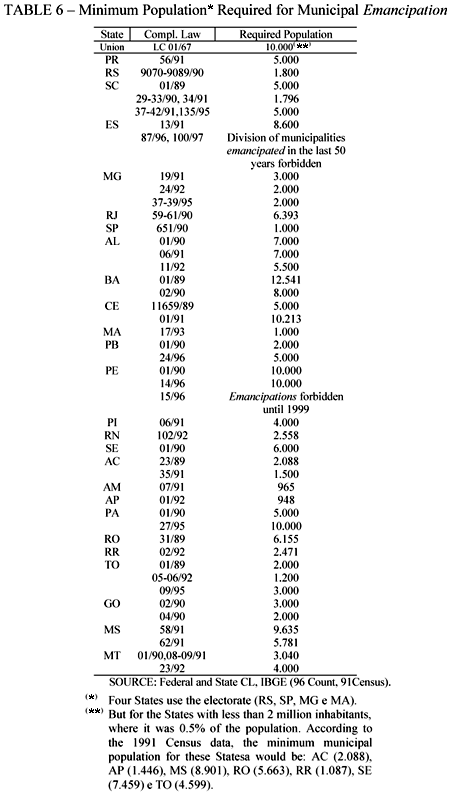
Second, even if it is not possible to directly show the relationship between the variables, we can deduce the fluctuation in the State political decisions on municipal emancipation and, therefore, in the executive legislative interaction both by institutional change and by the drastic difference in emancipationist intensity along the different periods in the same State.
Third, the correlation between stock and emancipations becomes less evident as the emancipationist movement moves during the nineties. As the resistance of political actors against emancipations grows, the smaller is the capacity of converting the stock eligible for emancipation in the States into new municipalities. In this sense, the fundamental determination of the State emancipationist intensity lies in the interaction of State executive and legislative and in the mechanisms that define the legislative process. The stock size is both an outcome of that interaction (in face of the incidental alteration of complementary laws) and a delimitation of each State's emancipationist potential.
These aspects of the dynamics of the emancipationist surges and of the state regulations (complementary laws) indicate that the hypotheses about the policy feedback allow us to deepen the understanding of decision processes, especially in the more detailed State level analysis. The perception political actors have of the consequences of political outcomes and institutional transformations leads to the reshaping of their interests with regards to municipal fragmentation, especially in the case of the executive. I do not believe that it is a case of either irrationality or incommensurability in the actors' choices, but of a rationality revision through preference – or the preference ordering – alteration of some actors involved in the decision process.
This can be better shown in the test of the first three hypotheses with the data from the States sample (Pernambuco, Bahia, São Paulo, Santa Catarina and Rio Grande do Sul). According to the first hypothesis, the emancipations' relative intensity is determined by the political position resulting from the State executive / legislative interaction, within the limits posed by the availability of localities eligible for emancipation in each State. That is, without favorable political decisions, the availability of localities eligible for emancipation does not result in the creation of new municipalities. The existence of a favorable position, however, would not be sufficient, unless there were localities to be emancipated.
A State's position against emancipation is described when none, or proportionally few, emancipations result of the executive's opposition followed by the agreement of a pro-government majority in the Assembly. A position is favorable (in differing degrees) when (a) the executive supports or is indifferent to emancipations; (b) is against, but does not have a pro-government majority; (c) or has a majority, but it does not follow the executive's position (see the data distribution in Table 7).
]]>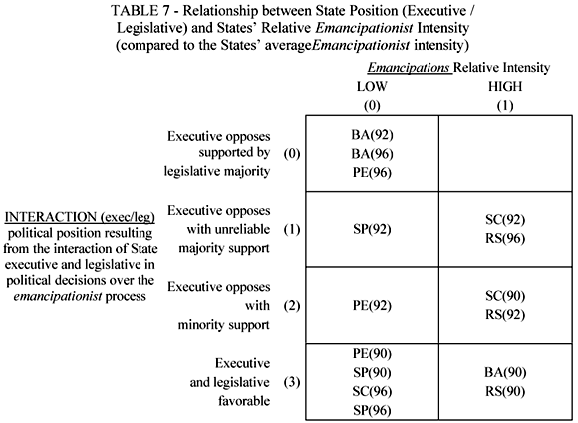
The joint effect of the two independent variables (stock and executive / legislative interaction) on the State's emancipationist intensity is shown for Pernambuco, Bahia, Santa Catarina and Rio Grande do Sul. In these States, when there was not opposition on the part of the executive, or when its opposition was ineffective, there was always a great emancipation intensity – as in Bahia (1990), in Rio Grande do Sul (1990, 1992 and 1996) and in Santa Catarina (1990 and 1992). The same did not happen when the availability of districts eligible for emancipation was low – case of Pernambuco (1990 and 1992) and Santa Catarina (1996). When the executive opposed emancipation and was supported by the representatives – Bahia (1992 and 1996) – not a single municipality was created, even in face of local demands, support by some representatives and references in the State Constitutions to some districts' emancipations. That was also the case of Pernambuco (1996) that, however, created a few municipalities, possible due to the weakness of the pro-government coalition.
In addition, variations in the State position favorable to emancipations, indicated by the size variation of the pro-government coalition and in the executive's attitude, show explanatory relevance. That relation is identifiable by the reduction in emancipationist intensity as the executive's resistance increases. This is true both for States with a relative stability in the State regulations (Bahia, Pernambuco and Rio Grande do Sul), and for States, as Santa Catarina, where the alterations in the complementary laws in subsequent periods eased emancipations in 1990, when the executive had a minority support, and hindered them in 1991, when it was supported by a majority.
In São Paulo, as in the correlation with the availability of districts eligible for emancipation, the favorable position resulting from the executive / legislative interaction also did not determine a relatively high intensity of municipal emancipations. Therefore, in this case we cannot empirically show the explanatory power of the first hypothesis. But, as already mentioned, there is a limitation in the fourth hypothesis, for the availability of districts eligible for emancipation does not specify the emancipation probability. In this sense, data on the stock eligible for emancipation in this State suggest a high emancipationist expectation that never occurred, in spite of the fact that the State legislative decided favorably to municipality creation disregarding the executive's opposition. Thus, the decision process was not the factor restricting the increase in the number of municipalities in the State. Because in São Paulo the emancipation initiative belongs exclusively to local leaders and most of the eligible districts are in very populous municipalities, especially in the capital city, the lack of fiscal stimuli probably hindered emancipationist demands in the Legislative Assembly.
On the other hand, in the relationship between States political decisions and number of emancipations the third hypothesis was found adequate: the State legislative tends to political autonomy when local leaders retain exclusively the legislative initiative (parliamentary underwriting forbidden) and the pro-government coalition is weak. Whenever the two conditions occur at the same time – in Santa Catarina (1992), São Paulo (1992), Rio Grande do Sul (1996) – the pro-government majority did not follow the executive's opposition. In the absence of both conditions – Bahia (1992 and 1996) – the executive was in no difficulty to sustain his opposition to emancipations. In the absence of the first condition – Parnambuco (1996) – the executive limited the legislative's autonomy, if in a weaker manner.
This seems to show that the more difficult it is to associate the law creating a municipality to a representative's individual initiative, the higher the probability of desertions in the pro-government coalition, at least when it is weak. That is, when it was formed after the electoral results, following what came to be known as pro-government rule (regra do situacionismo). However, in the absence of such institutional mechanism, the relative weakness of the pro-government coalition would not be enough for part of the representatives to ignore the executive's retaliation threats. Such prohibition of representatives' initiative in emancipation transforms the logrolling among representatives into a cooperation where there are not expectations of individual electoral gains. When representatives approve this type of emancipation law, not accepting the executive's pressures, they respond to a local initiative backed by popular sovereignty through a plebiscite.
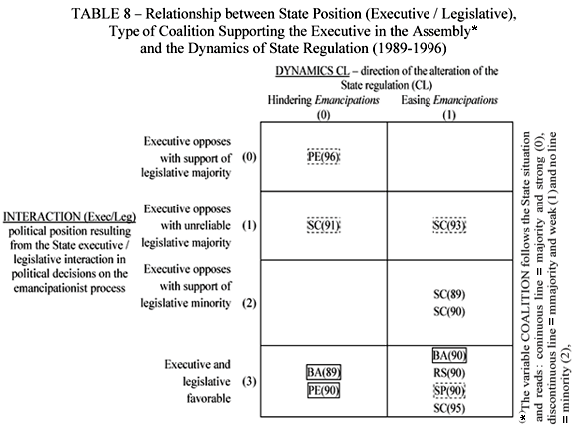
Finally, there is a last aspect of the State emancipationist process approached within the set of explanatory hypotheses but bound to a decision process different from the previous one: the dynamics of the State regulation of municipal division. The second hypothesis asserts that the production / alteration of the State complementary laws, as well as their normative direction depends on how the pro-government coalition's size and consistency in the Assembly determine the balance of forces between the State's executive and legislative (Table 8). The stability or change of these institutions play a fundamental role in the States' emancipationist potential through the definition of the availability of localities eligible for emancipation. As the Assembly's absolute majority is required to approve the regulation, the alteration of the complementary law (either to ease or to hinder emancipations) requires a reshaping of the State position on municipality creation and a great investment on the part of the power that takes the initiative of the alteration, especially when there is no coincidence between the executive's position and that of the parliamentary majority about the change.
]]>
In two States in the sample studied a single complementary law was approved after the constitutional transfer of jurisdiction over regulation to the States. In Rio Grande do Sul and São Paulo, the first law was approved in 1990 with extremely permissive criteria if compared to federal Complementary Law 01/67. In the two States, the Assembly had the legislative initiative in situations where there was a position favorable to emancipations in both the executive and the legislative, and the executive did not meet the required conditions (majority pro-government coalition) or simply did not want to define stricter criteria. In Rio Grande do Sul, the executive had a minority legislative pro-government coalition and in São Paulo the pro-government coalition was formed in post-election negotiations.
In the following emancipationist periods, the executive in both States opposed the creation of new municipalities, but the absence of a solid majority did not allow for restrictive alterations in the regulations. This was more evident in Rio Grande do Sul where the executive's proposals of complementary laws were systematically rejected. Institutional stability, both in this State and in São Paulo, resulted from the executive's incapacity (with a weak majority in the legislative) to pass restrictive alterations and from the preference of most representatives in maintaining the permissive status quo.
For Santa Catarina, where there were successive alterations in the complementary laws, it is also possible to show the hypothesis' explanatory power. The first edition of the State's regulation was more permissive than the federal law, but, as it produced a limited stock of localities eligible for emancipation, State representatives altered the complementary laws increasing the laws' permissiveness. In spite of the executive's opposition, its minority status at the Assembly made possible the successive emancipations.
In the following period, after the 1990 State elections, through the executive's initiative, the law was again altered, this time in the direction of the governor's opposition to emancipations, in a restrictive sense. However, even if it succeeded in approving the restrictive rule, this was continuously subjected to legal casuistry that emptied emancipations of their stricter criteria. A weak majority coalition could explain the bargains between executive and legislative that ended up improving the position in favor of municipality creation. In the last alteration of complementary laws, during the following legislature, representatives again eased emancipations that in fact were never hindered. That last change was not opposed by the executive that, at this moment, was supported by the Assembly's minority.
In Bahia and Pernambuco, alterations of the law happened in situations where the government was supported by a parliamentary majority. Possibly due to the executive's control over the pro-government coalition in both States the first change defined criteria as strict, or even stricter, than the Federal Complementary Law 01/67. In Bahia, where there was an early permissive change, the law still restricted the availability of localities eligible for emancipation in a way similar to that of the federal law.
In Pernambuco, the sole change of the federal law increased difficulties for the emancipation process. Possibly, as at the moment the executive was supported by a majority (even if weak) coalition, the governor, in spite of his overt opposition to emancipations, bargained with the legislative the creation of some municipalities for the approval of a complementary law forbidding any emancipation in the ensuing four years. Such strategy allowed the executive to prevent the representatives to yield to the temptation, in a later moment, to desert from the executive's support, approving the creation of new municipalities. In Bahia, on the other hand, the existence of a solid and reliable pro-government coalition in all legislatures throughout the 1990s, rendered legal innovations to restrict emancipations unnecessary when the executive opposed the creation of new municipalities.
In all States in the sample it was possible to verify some relationship between the size / type of the pro-government majority and the direction of institutional change: easing emancipations when there was a minority pro-government coalition in the State's Assembly; depending on the executive's position when there was a majority's support; and bargaining over the results when the majority support for the executive was weak. However, the explanatory power of the hypotheses must be taken with reservations, due to the limitation of the analysis to the sample and to the qualitative character of the values assigned to the explanatory variables.
]]>Conclusion
The research on the emancipationist process indicates that the intense Brazilian municipal division was possible only due to the institutional arrangement resulting from the 1988 Constitution. Jointly, a number of mechanisms promoted the bases favorable to the multiplication of municipalities: the consolidation of fiscal decentralization stimulated local demands for emancipation on the part of small far-off localities; the transfer of the minimum requirements for municipal emancipations to the State level, at a time when the resources of the Municipality's Participation Fund were nationally distributed and when democratization and decentralization were treated ideologically as synonymous favored, in the relation between executive and legislative, the position that wanted more permissive laws for municipal creation, increasing the availability of localities eligible for emancipation; the procedures required for the promulgation of laws creating municipalities assigned a central role to the State legislators that, due to their electoral expectations, approved most of the local demands for emancipation.
In addition, the comparative study of the States showed that, in most States, the emancipationist intensity varies according to the availability of localities eligible for emancipation, the relation of forces between State executive and legislative, and existence of institutional mechanisms enhancing the autonomy of the legislative. That is, the interruption of the emancipationist surges was only possible in face of the depletion of the State's real emancipationist capability, of the opposition of an executive with a (solidly supported ) majority coalition and / or the absence of institutional restrictions to patronage (lack of incentives to parliamentary cooperation), because of the fiscal incentives to voters and local leaders in the small municipalities and of the representatives' expectations as to the future of their political careers.
The historical fluctuation of majority and minority pro-government coalitions in the States eventually generated permissive mechanisms for the creation of municipalities (through complementary laws) and this kept constant a high index of emancipations in Brazil. That is, the interruption of the process in one State (because of the depletion of the availability of localities eligible for emancipation or because political positions against emancipation) was normally followed by new emancipationist surges in other States (through alterations in the complementary laws and / or through a new balance between executive and legislative). This led the federal government, as in the military period, to intervene in the process to hinder the creation of new municipalities. Without altering the political regime, the re-centralization of the rules (amendment 15/96) altered the institutional arrangement that favored municipal emancipations.
However, as most fiscal stimuli to the creation of municipalities were kept and the representatives' expectations about the future may generate new favorable decisions, new emancipationist surges are possible in the future, maybe with a lesser intensity. Given the imposition on the plebiscite, territorial divisions shall possibly be limited to small and very small far-off municipalities (the weakest and most dependent on the Municipalities Participation Fund), exactly the situation least preferred by the public actor that formulated the constitutional amendment – the federal executive.
Notes
1 On the institutional character of municipalities in Brazilian federalism, see Montoro (1974), Mello (1993), Ataliba (1987) and Affonso e Silva (1995).
2 On the relationship between decentralization and democratization in Brazil it is interesting to know: Arretche (1996) that studies the confusion in the use of both terms, discussing their binding in the literature; the question is also present in the works by Tobar (1991) and Uga (1991); the debate on fiscal decentralization and the municipalities' weakness, in Gomes and Macdowell (2000); the relationship between citizenship and local government structures in Fischer (1993), that presents relevant sociological elements to the debate; the heterogeneity of the decentralization process of social policies is analyzed by Castro (1991), Arretche (1998) and Almeida (1995); the increasing political power of State governments in Abrucio (1998) Melo (1993 on the municipalist ideology; and the defense of emancipations in the relevant works by Ibam/RJ and Cepam-FPFL/SP, like Bremaeker (1991, 1993), Jacobi (1990, 1991) and Mello (1991, 1992).
]]> 3 The alignment of positions observes the following pattern: federal ministers and technical personnel in institutes related to the Union and States have generally and anti-emancipation position – see, for instance, Gomes and Macdowell (2000), Paraíba (1994), São Paulo (1991); regional politicians (associated to the legislative) and NGOs (Ibam/RJ and Cepam/SP) tend to be pro-emancipationist – see, for instance, Bremaeker (1991, 1993, 1996), Gasparini (1990), Mello (1991, 1992, 1993), Noronha (1996), Mincarone (1991) and Nunes (1992). Among academic works, there are studies pro-emancipations, like those by Klering (1991, 1998) and Vizzotto (1997), and others without ideological alignment, like Shikida (1998), Mesquita (1992) and Tomio (1998).4 On the foundations of the neo-institutional approach, see Limongi (1994), Crawford and Ostrom (1995), Immergut (1996), Lowndes (1996), Marques (1997), Hall and Taylor (1997).
5 This kind of explanation that defines political regime as an independent variable affecting emancipation intensity is that of Carvalho (1957), Gasparini (1989) and Mazzilli (1993). The best construction and argument are developed by Gomes and Masdowell (2000). In a similar way, Shikida (1998) relates the Brazilian federalism's structure to the emancipationist phenomenon, through the concept of "non-rigid budgetary restriction". In democratic regimes, governmental transferences (Municipalities Participation Fund) stimulate actors to favor emancipations in situations where it is possible to increase resources for emancipated localities.
6 There are explanations oriented by a functionalist approach, like Bremaeker's, according to whom municipal emancipations responded to an "extremely rational logic" (1991, p. 33). A similar explanation is developed by Mesquita. Using a systemic approach, the author asserts that the modernization process is the ultimate cause of municipal emancipations (Mesquita, 1992, p. 170). There are other explanations for the phenomenon, like the presentation of institutional causes in Mello (1992); the explanation of emancipations through local actors' motivations (Bremaeker, 1993; Noronha and Cardoso, 1995; Klering, 1991,1998); and Abrucio's hypothesis, asserting that the multiplication of municipalities is a product of the existence of a "predatory hobbesian model in the Brazilian federation.
7 The case of the municipality São João de Polêsine – RS, a former district of Dona Francisca-RS exemplifies this kind of event. The municipality that presented a population of 2,583 inhabitants in IBGE's "1996 Count" achieved emancipation only in 1992, in terms of the criteria defined by the State's complementary law 9070/90. In 1986, the municipality already demanded emancipation that was declared unconstitutional, due to an appeal before the Supreme Court (STF). In the same year, however, other municipalities in the same State were created, with a population bellow that required by federal complementary law LC 01/67 (10 thousand inhabitants). There was no appeal in any of these cases (Vizzotto, 1997, p. 70).
8 This does not mean to exclude the possibility that some actors are motivated, eventually or always, by political and ideological values or social norms, orienting their choices through a non-instrumental rationality. In the same way, irrational behaviors could also occur during the decisions in the emancipationist process. However, according to this work's presumptions, egoist, rational and instrumental behavior is resorted to when the actor interprets deductively the motives of other political actors that interact in the decision process on municipal emancipations.
9 Using formulae for the value of transferences added to the municipalities when they divide (having as variables the municipal population, the emancipated locality's population, and the FPM coefficient), Shikida created a deductive model that determined: 1) the local interest in favor of emancipation whenever the sum of transferences from the FPM in the new situation is larger than that in the status quo; 2) "[...] each municipality's best response to another municipality's emancipationist action is to adopt the emancipationist strategy" (1998, pp. 23-30).
10 In most States, the regulation promulgated after the 1988 Constitution reproduced the rule existing in the previous federal law (LC 01/1967). In these States, the initiative of the legal emancipationist process was restricted to local popular demand. However, in some States (MA, BA, RN, AP, GO and MS) the new legislation created the requirement of underwriting of the initiative by a representative, while in other States (PB, PE and AC), the members of the legislative were allowed to initiate the process without the previous demand by the locality's population.
11 The motion of "electoral patronage" is different from that of traditional patronage, where the "links" between patrons and clients, for historical, economic and cultural reasons, are extremely strong. In the electoral kind, the patronage through concentrated public resource allocation is directly related to the electoral result, and the clients have the right at least to choose the patron it will elect. That way, electoral patronage is not only compatible with democratic rules and their instability as to future political outcomes, but it also requires that situation for its reproduction and legitimacy. For more details on the relationship between patronage and elections, see Avelino (1994, p. 228), Castro (1988, pp. 65-68) and Santos (1995).
12 Physiologism is here taken as different from patronage practices. As defined by Couto, "what characterizes physiologism [in the relations executive/legislative] is the fact that political bargain happens through resource transference directly to the representatives' control, while patronage is based on the resource transference to the representatives' politico-electoral base". Physiologism is a mechanism that, in a second moment, may serve the representatives' patronage through the use of resources under their control (Couto, 1998, pp. 48-49).
]]> 13 In Brazil, except for the periods from 1967 to 1988 (military regime) and after 1996 (amendment 15/96), the States were always the governmental level in charge of the regulations on municipal emancipations (Barreto, 1971).14 Resources from State funds come from the Tax on the Circulation of Goods and Services (ICMS) – 6.25% of the total collected – and its distribution among the municipalities follows State criteria (population, area, economic activity etc.). Such fund's stimulus to emancipations varies according to the distribution criteria and, especially the State's level of economic development. But in no State the value transfers from that tax were as high as those from the Municipalities Participation Fund.
15 According to Gomes and Macdowell (2000), on the average, Brazilian municipalities with less than 10 thousand inhabitants generate less than 10% of their revenue through their own fiscal efforts.
16 The history of the Municipalities Participation Fund begins in the 1940s. The 1946 Constitution, in the 4th paragraph of the article 15, determined the transfer of 10% of the collection of the Income Tax, "in equal parts" to inland municipalities. Constitutional amendment nº 5, 1961, increased to 15% the municipalities' share in that tax and added to the fund 10% of the revenue from the Sales Tax. The military regime, through Constitutional amendment nº 18, 1965, created a new budgetary order creating the Municipalities Participation Fund (FPM), reducing the municipalities' share to 10% of both the Income Tax and of the Manufactures Tax, and determining the mode of application of most of there resources. In 1969, through the new imposed Constitution, the Municipalities Participation Fund was reduced to 5% of the same taxes. From the mid seventies on, the share of the FPM in those taxes was gradually increased until 22.5% in 1993, according to the norm established in the 1988 Constitution (Barreto, 1971; Brasil, 1988).
17 That division of the FPM was determined by federal law 5,172 (October 25/1966) and by decree-law 1,881 (August 27/1981).
18 There were other coefficients (0.2 and 0.4) corresponding to smaller municipalities. They were eliminated in 1981 (through decree-law 1,881) and this increased resources destined to very small municipalities.
19 The State shares in the FPM were created by federal complementary law 62 (December 28, 1989).
20 Some representatives may stimulate initiatives to emancipation by local leaders and a good many representatives may try to get in favor with local voters either by publicly asserting their pro-emancipation position or by binding a pro-emancipation decision to their parliamentary action. This, however, does not exclude the exclusive role of local leaders in the emancipation initiative, in order either to restrict the executive's sanction capability over their supporting coalition, or to formally unbound the law creating the municipality from the patronage laws approved by the legislative.
21 We did not assign values to four variables described in the hypotheses' general diagram. To the INTERESTS indicator for it describes, in a simplified way, the model of expectations on the rationality of choices of political actors involved in the decision process. This way, unless there is evidence to the contrary, we will ascribe to the representatives' majority the dominant pro-emancipation interest, while the executive's interest will depend primarily on these actors' perception of the consequences of the emancipationist process. This can only be shown in the case of the States sample (BA, PE, RS, SC and SP) where the emancipationist process was studied in more detail. The variable LOCALITIES is a continuous quantitative indicator of district, village or hamlet availability in the States, while the other two variables (INSTITUTIONAL CHANGE and CONSEQUENCES) express the feedback from political outcomes (institutional dynamics and actors' perception of consequences) on their causes (institutional mechanisms and preferences of political actors), involving the emancipationist process. As such, these variables, as well as the hypotheses associated to them, complement the explanation of the phenomenon. Indicators derived from these variables serve to the historical interpretation of the emancipationist process, especially in the case studies that may help to deepen the understanding of municipality creation that is not this work's objective.
22 The States sample was selected in 1998, at the beginning of the empirical data collection for my doctoral thesis, through the cross tabulation of two variables: relative emancipationist intensity (bellow / above the national average) and dynamics of State complementary laws (easing / keeping the status quo / hindering emancipations). Six groups of States resulted from the criteria, and one state was selected from each group for the empirical study (conducted from 1998 to 1990) with the exception of one combination (bellow average / complementary law altered to ease emancipations) for no State corresponded to the combination.
]]> 23 In the list, only municipal districts (recorded by IBGE) were defined as localities, for that was the onl available datum. However, in most States, the law does not require that the locality to be emancipated be a legally constituted district.
REFERENCES
ABRÚCIO, Fernando, (1998). Os barões da federação. São Paulo, Hucitec/DCP-USP. [ Links ]
AFFONSO, Rui de Britto & SILVA, Pedro. (1995), A federação em perspectiva. São Paulo, Fundap. [ Links ]
ALMEIDA, Maria H. T., (1995). Federalismo e políticas sociais. RBCS, 28: 88-108. [ Links ]
ARRETCHE, Marta. (1996), Mitos da descentralização e mais democracia e eficiência nas políticas públicas? RBCS, 11 (31) 44-66. [ Links ]
_________. (1998). O processo de descentralização das políticas sociais no Brasil e seus determinantes. Unpublished doctoral thesis. IFCH/Unicamp. [ Links ]
ATALIBA, Geraldo. (1987) Regime federativo, in R. Faoro et al., Constituição e constituinte. São Paulo, Editora Revista dos Tribunais. [ Links ]
AVELINO, George Filho, (1994). Clientelismo e política no Brasil e revisitando velhos problemas. Novos Estudos Cebrap, 38. [ Links ]
AZZONI, Carlos Roberto, and ISAI, João Yo, (1993). Censo demográfico, novos municípios e reforma tributária: impacto sobre as finanças municipais. Revista de Administração Pública, 27 (3) 50-61. [ Links ]
BARRERA, Aglas Watson, and ROARELLI, Maria Liz de Medeiros, (1995). Relações fiscais intergovernamentais, in R. B. Affonso & P. L. B. Silva (orgs.), Reforma tributária e federação. São Paulo, Ed. Unesp. [ Links ]
BARRETO, Carlos Eduardo, (org.), (1971). Constituições do Brasil. São Paulo, Edições Saraiva. [ Links ]
BRASIL, (1988). Constituição: República Federativa do Brasil. Brasília, Senado Federal. [ Links ]
BREMAEKER, François E. J., (1991). Os novos municípios brasileiros instalados entre 1980 e 1990. Rio de Janeiro, Ibam. [ Links ]
_________, (1993). Os novos municípios: surgimento, problemas e solução. Revista de Administração Municipal, 40 (206) 88-99. [ Links ]
_________, (1996). Limites à criação de novos municípios: a emenda constitucional. n. 15. Revista de Administração Municipal, 43, 219:118-128. [ Links ]
CARDOSO, Daria, and PROSERPIO, Renata, (1993). Quadro territorial do Estado da Bahia: evolução e situação atual. Bahia Análise e Dados, 2 (4) 96-100. [ Links ]
CARVALHO, Orlando M., (1957). A multiplicação dos municípios em Minas Gerais. Rio de Janeiro, Ibam. [ Links ]
CASTRO, Maria Helena Guimarães de, (1988). Governo local, processo político e equipamentos sociais: um balanço bibliográfico. BIB, 25. [ Links ]
_________, (1991). Descentralização e política social no Estado de São Paulo e tendências e perspectivas. Revista Cepam, II, 1. [ Links ]
COUTO, Cláudio G., (1998). Negociação, decisão e governo: padrões interativos na relação executivo-legislativo e o caso paulistano, in R. C. Andrade (org.), Processo de governo no município e no Estado. São Paulo, Edusp. [ Links ]
CRAWFORD, Sue, and OSTROM, Elinor, (1995). A grammar of institutions. American Political Science Review, 89 (3) 582-600. [ Links ]
DUCHACEK, Ivo D., (1988). State constitutional law in comparative perspective. Annals AAPSS, 496: 128-139. [ Links ]
ELSTER, Jon. (1994), Peças e engrenagens das Ciências Sociais. Rio de Janeiro, Relume- Dumará [ Links ].
FIGUEIREDO, Argelina Cheibub, and LIMONGI, Fernando, (1994). O processo legislativo e a produção legal no congresso pós-constituinte. Novos Estudos, 38: 24- 37. [ Links ]
_________, (1999). Executivo e legislativo na nova ordem constitucional. Rio de Janeiro, Ed. da FGV. [ Links ]
FISCHER, Tânia (org.), (1993). Poder local & governo e cidadania. Rio de Janeiro, Ed. da FGV. [ Links ]
GASPARINI, Diógenes, (1989). Criação de municípios na Constituição Estadual. São Paulo, CEPAM. [ Links ]
_________, (1990). A criação de municípios em São Paulo. Revista CEPAM, I, 2. [ Links ]
GOMES, Gustavo Maia, and MacDOWELL, Maria Cristina, (2000). Descentralização política, federalismo fiscal e criação de municípios. Brasília, Ipea, (Texto para Discussão n. 706). [ Links ]
HALL, Peter, and TAYLOR, Rosemary, (1997). La Science Politique et les trois néoinstitutionnalismes. Revue Française Science Politique, 47, (3-4) 469-496. [ Links ]
IMMERGUT, Ellen, (1996). The normative roots of the new institutionalism: historical institutionalism and comparative policy studies. Baden-Baden. [ Links ]
JACOBI, Pedro, (1990). Descentralização municipal. Revista CEPAM, I, 3. [ Links ]
_________, (1991). Os municípios e a participação: desafios e alternativas. Revista de Administração Municipal, 38 (198) 32-38. [ Links ]
KLERING, Luís Roque, (1991). Desempenho dos novos municípios e emancipações políticas do RS na década de 80: razões, histórico e diretrizes, in M. Mincarone, Emancipação: liberdade para prosperar. Porto Alegre, Assembléia Legislativa. [ Links ]
_________, (1998). Experiências recentes em municípios brasileiros e os novos municípios e as conquistas da autonomia, in R. Fachin & A. Chanlat (org.), Governo municipal na América Latina: inovações e perplexidades. Porto Alegre, Sulina/Ed. da Universidade/UFRGS. [ Links ]
LEVI, Margaret, (1991). Uma lógica da mudança institucional. Dados, 34 (1) 79-99. [ Links ]
LIMONGI, Fernando, (1994). O novo institucionalismo e os estudos legislativos. BIB, 37. [ Links ]
LOWNDES, Vivien, (1996). Varieties of new institutionalism: a critical appraisal. Public Administration, 74:181-197. [ Links ]
MARQUES, Eduardo C., (1997). Notas críticas à literatura sobre Estado, políticas estatais e atores políticos. BIB, 43. [ Links ]
MAZZILLI, Antônio C., (1993). O processo de emancipação dos municípios na Assembléia e suas conseqüências. Belo Horizonte, Encontro dos Municípios Mineiros. [ Links ]
MELLO, Diogo Lordello de, (1991). Descentralização, papel dos governos locais no processo de desenvolvimento nacional e recursos financeiros necessários para que os governos locais possam cumprir seu papel. Revista de Administração Pública, 25 (4) 199-217. [ Links ]
_________, (1992). A multiplicação dos municípios no Brasil. Revista de Administração Municipal, 39 (203) 23-38. [ Links ]
_________, (1993). O governo municipal brasileiro: uma visão comparativa com outros países. Revista de Administração Pública, 27 (4) 36-53. [ Links ]
MELO, Marcus André B. C. de, (1993). "Municipalismo, nation building e a modernização do Estado no Brasil. RBCS, 23. [ Links ]
MESQUITA, Zilá, (1992). Emancipações no RS: alguns elementos para reflexão. Análise Conjuntural, 20 (3) 169-184. [ Links ]
MINCARONE, Marcelo, (1991). Emancipação: liberdade para prosperar. Porto Alegre, Assembléia Legislativa. [ Links ]
MONTORO, Eugenio Augusto Franco, (1974). A organização do município na federação brasileira. Unpublished doctoral thesis, PUC/SP. [ Links ]
NORONHA, Rudolf de, and CARDOSO, Elizabeth D., (1995). Emancipações municipais: como ficam os municípios de origem? Revista de Administração Municipal, 42 (214) 67-80. [ Links ]
NORONHA, Rudolf de, (1996). Criação de novos municípios: o processo ameaçado. Revista de Administração Municipal, 219. [ Links ]
NUNES, Jorge C. P., (1992). Criação de municípios no novo Estado do Rio de Janeiro. Rio de Janeiro, Alerj. [ Links ]
ORLOFF, Ann Shola, (1993). A comparative analysis of Britain, Canada, and the United States, 1880-1940. Wisconsin, The University of Wisconsin Press. [ Links ]
PARAÍBA. SEPLAN, Instituto de Desenvolvimento Municipal e Estadual da Paraíba. (1994), A criação de novos municípios e sua repercussão na distribuição do FPM. João Pessoa, Seplan/Ideme. [ Links ]
RIBEIRO, Carlos A. C., (1993). Crise fiscal em municípios: uma discussão teórica a cerca de suas causas, indicadores e instrumentos. Planejamento e Políticas Públicas, 9. [ Links ]
SANTOS, Fabiano Guilherme M., (1995). Microfundamentos do clientelismo político no Brasil: 1959-1963. Dados, 38, 3: 459-496. [ Links ]
SANTOS, Fabiano & PATRÍCIO, Inês, (1996). Um modelo de produção legislativa em diferentes contextos institucionais. Paper presented to the 20th meeting of Anpocs, Caxambu. [ Links ]
SANTOS, Maria Helena de Castro, (1997). Governabilidade, governança e democracia: criação de capacidade governativa e relações executivo-legislativo no Brasil pósconstituinte. Dados, 40 (3) 335-376. [ Links ]
SÃO PAULO. Secretaria do Governo/Secretaria de Planejamento e Gestão, (1991). Estudo de viabilidade de emancipação dos Distritos. São Paulo. [ Links ]
SEI. Superintendência de Estudos Econômicos e Sociais da Bahia, (1998). Classificação dos municípios baianos. Salvador, SEI. [ Links ]
SHIKIDA, Cláudio Djissey, (1998). Emancipação de municípios em Minas Gerais (1995): uma abordagem Novo-Institucionalista e de Escolha Pública. Unpublished masters thesis, FEA/USP. [ Links ]
TAVARES, Íris, (1997). O município brasileiro: sua evolução histórico-cultural. R. Dir. Adm., 209: 169-187. [ Links ]
THELEN, Kathleen, and STEINMO, Sven, (1992). "Historical institutionalism in comparative politics", in S. Steinmo et al. (eds.), Structuring politics: historical institutionalism in comparative analysis. Cambridge, Cambridge University Press. [ Links ]
TOBAR, Federico, (1991). O conceito de descentralização: usos e abusos. Planejamento e Políticas Públicas, 5. [ Links ]
TOMIO, Fabricio Ricardo de Limas, (1998). Explosão municipal: notas de uma pesquisa, in J. R. A. Flôres & M. O. Natividade (orgs.), Política, cultura & sociedade. Santa Maria, UFSM/PRE/DSP. [ Links ]
TSEBELIS, George, (1997). Decision making in political systems: veto players in presidentialism, parliamentarism, multicameralism and multipartyism. British Journal of Political Science, 25: 289-325. [ Links ]
UGA, Maria Alicia D., (1991). Descentralização e democracia: o outro lado da moeda. Planejamento e Políticas Públicas, 5. [ Links ]
VIZZOTTO, Assis Roque, (1997). A emancipação e divisão política de Faxinal do Soturno, causas e conseqüências. Unpublished maters thesis, UFSM. [ Links ]
* This is a modified version of a paper originally presented at the 2nd. Meeting of the Associação Brasileira de Ciência Política – ABCP [Brazilian Political Science Association], held at PUC – São Paulo, November 20-24, 2000. I thank the observations of panel IP4 ("Federalism, municipalization and local government") participants, the comments by RBCS anonymous reviewers and, especially, Argelina Figueiredo, for her detailed reading and elucidating comments. Errors and inconsistencies are my own.
** In Portuguese, emancipação has a generic meaning equivalent to emancipation in English. Additionally it is used to describe the process of acquisition of autonomy of part of a municipality to form a new municipality. Instead of using the Portuguese term, I shall use, in the remainder of the text, emancipation to refer to this process.
+ "Complementary laws" are complementary to the State Constitution: they specify the Constitution's content. They are thus higher order laws than ordinary laws, and therefore require for their approval the vote of an absolute majority of the State Assembly.
