A política da Igreja Universal e seus reflexos nos campos religioso e político brasileiros
La politique de l'Église Universelle et son impact dans les domaines religieux et politique brésiliens
Ari Pedro Oro
Translated by Enrique J. Romera
Translation from Revista Brasileira de Ciências Sociais, São Paulo, v.18, n.53, p.53-69, Oct. 2003.
ABSTRACT
The paper analyses the insertion of the Universal Church of the Kingdom of God (UCKG) in the national politics scenario and its effects in the religious and political fields. Due to the efficacy of its institutional charisma, the Universal Church of the Kingdom of God (UCKG) has given, within its own religious group, a new meaning to the specific act of voting and to the general perception of politics in general, putting both of them in its own religious logic. This is an important explanatory key for the high level of loyalty in voting and the growing political success verified in every new election. Furthermore, the political practice of the UCKG is producing a mimetic effect on other evangelic churches, which tend to imitate its way of doing politics. Its political insertion, mainly through the Liberal Party, has not remained unnoticed by the political parties, making the fact a relevant actor in the current Brazilian political conjuncture.
Key words: Universal Church of the Kingdom of God; Brazilian political field; Brazilian religious field; Evangelicals in Politics; Pentecostalism
RESUMO
Este texto versa sobre a inserção da Igreja Universal do Reino de Deus (IURD) na política nacional e seus efeitos nos campos religioso e político. Em razão da eficácia de seu carisma institucional, a Universal procedeu, dentro do próprio grupo religioso, a uma ressemantização do ato de votar em particular e da percepção da política em geral, inscrevendo-os em sua lógica religiosa. Isso é uma importante chave explicativa para o elevado grau de fidelidade de votos e o êxito político cada vez maior constatado nas últimas eleições. Ademais, a prática política da Universal está produzindo um efeito mimético em outra igrejas evangélicas, que tendem a imitar seu modelo de fazer política. Sua inserção política, sobretudo por intermédio do Partido Liberal, não passa despercebida pelos partidos, constituindo-se, assim, em um ator relevante na atual conjuntura política brasileira.
Palavras-chave: Igreja Universal do Reino de Deus; Campo político brasileiro; Campo religioso brasileiro; Evangélicos na política; Pentecostalismo.
RÉSUMÉ
Ce texte se rapporte à l'insertion de l'Église Universelle du Royaume de Dieu (EURD) dans la politique nationale et de ses effets dans les domaines religieux et politique. Du fait de l'efficacité de son charisme institutionnel, l'Église Universelle du Royaume de Dieu a procédé, à l'intérieur de son propre groupe religieux à une nouvelle interprétation de l'acte de voter et, de façon plus globale, de la propre perception de la politique, en les inscrivant dans sa logique religieuse. Cela peut expliquer le taux élevé de fidélité électorale et le succès politique croissant que l'on a pu constater lors des dernières élections. En outre, la pratique politique de l'Universelle est en train de produire un effet mimétique à l'extérieur de l'Église, surtout dans d'autres églises évangéliques qui imitent sa façon de faire de la politique. Parallèlement, l'insertion politique de l´EURD, en particulier par le Parti Libéral, ne passe pas inaperçue aux autres partis politiques et transforment cette église en un nouvel acteur politique de la scène politique brésilienne.
]]> Mots-clés: Eglise Universelle du Royaume de Dieu; Domaine politique brésilien; Domaine religieux brésilien; Evangéliques dans la politique; Pentecôtisme.
This text is about the Igreja Universal do Reino de Deus, IURD - Universal Church of the Kingdom of God's (UCKG) entry into Brazilian politics and its effect on religion and politics. My arguments are the following: firstly, the electoral success that this church has achieved so far, relates basically to the Church's institutional charisma, associated with the extensive and intensive use of the media and with a discourse that transfers important symbolic elements from religion to politics. Secondly, the political success of the Universal Church echoes in religion producing a mimicking effect in other churches and religions, which likewise try to operate in the political and institutional fields. It also influences the political scene, enticing other political parties to form alliances with it.
The Universal Church of the Kingdom of God and politics.
The UCKG entered politics in 1986 with the election of a member of the federal Congress to the Constituent National Assembly. In 1990 six federal Congress men and 6 state Congressmen were elected. In 1994, the number of Members of Congress in the Federal Congress doubled and the number of Members of Congress for the State legislative assemblies increased to eight. In Rio de Janeiro that year, a UCKG member was elected Secretary for Labor and Social Action and a candidate ran for the senate achieving a total of five hundred thousand votes (Freston, 2000). In the 1998 elections, the Universal Church elected 26 Members of Congress to the State legislative assemblies in eighteen States around the country (Fonseca, 1998, p. 20) and seventeen federal Members of Congress (fourteen former members of the Curch itself in different States and three Members of Congress supported by the church), attaining 1,400,000 votes, "[…] comparable to parties of average size such as the PTB and PDT" (Conrado, 2000, p. 26).
In the year 2000 elections, the UCKG elected dozens of city councilors in states all over the country. In the 2002 elections, sixteen federal Members of Congress were elected from the Church, two more than in the previous legislature, and nineteen state Members of Congress, representative of ten states within the country. In these same elections according to information given to newspaper Folha de São Paulo by Bishop Rodrigue, the main political coordinator of the UCKG, the Church helped to elect another four federal Members of Congress not belonging to the Church (Folha de São Paulo, 10/10/2001). The election of the first senator from the Church was an important event. Bishop Marcelo Crivella, member of the PL in Rio de Janeiro, was electrd with 3.235.570 votes, beating long standing politicians such as Arthr de Távora and Leonel Brizola, as well as minister Manoel Ferreira, from the Assembly of God.
Of the fourteen federal Members of Congress from the UCKG in the 1998-2002 legislature, ten were re-elected to the Federal Congress in the 2002 elections. The other four did not run for re-election. The question that remains is whether they did not run for office voluntarily, or if the Church took the decision for them not to run. With regard to the proportional elections for the state legislatures, in the same elections of 2002, the UCKG faced an unexpected problem, The problem was that Members of State Congresses supported by the church or former church members in previous elections, but who did not recieve support from the Church in the last elections, ran "spontaneously" for re-election. This happened for example in Rio de Janeiro, in Ceará and in Rio Grande do Sul. Instead of supporting them, the Church presented and supported other candidates, most of whom were elected, unlike those who stood as candidates on their own accord and suffered a terrible defeat as we will see later.
Everything indicates that the withdrawal of support to those Members of Congress owed to the fact that they either did not follow the orientation established by the political spokesmen of the Church, or did not act in accordance with expectations incited by them.
]]> Currently, the UCKD forms part of the alliance that supports the Lula government. Their senator and some of the Members of Congress in the Federal Congress are members of the PL, a political party allied to the PT since the electoral campaign. However, as some of the Members of Congress from the UCKG belong to other political parties, even those opposing the federal government, it is difficult to foresee unilateral support from the Church given that its congressmen would have to choose at each vote, even if this is not always possible, between party orientation and the interests of the Church, which are not necessarily the same. As it happens, the same situation occurred during FHC's second term of office (1999-2002) when the UCKG, for symbolic and instrumental reasons, opposed the central government. However, at that time, as Fonseca points out, the Universal Church's move towards the opposition did not reflect directly in the Members of Congress' votes, which means that there was not a "Universal Church vote" in the National Congress. Quoting him exactly: "the voting within the congress does not reflect a real Universal block vote. In general the Members of Congress follow their parties.[… ] "(Fonseca, 1998, p. 20). This fact, however, instead of showing a lack of political capacity on the part of the UCKG or a difficulty in agreement between *UCKG congressmen, appears at first to show a "sophisticated" political characteristic by the church, where church congressmen are distributed within different parties to achieve better bargaining power, but this does not mean that in certain situations the interests of the Church may surpass those of the political parties.It appears that the growing presence of representatives of the UCKG in the National Congress has contributed substantially to the increase in size of the so-called "evangelical block". During the 1998-2002 legislature, there were 53 Members of Congress belonging to thirteen churches (Época, 10/2/2000). . The Evangelist block became stronger in the elections of 2002. According to Folha de São Paulo, "the evangelist block of elected federal Members of Congress has at least sixty congressmen, who gained 5.1 million votes ", these being 23 Congressmen members of the Assembly of God, 22 from or supported by the Universal Church, eight Baptists and the remainder from other denominations, which means an increase of about 25% in relation to the previous Evangelist block (Folha de São Paulo, 10/10/2002). There was also an increase in the number of evangelist representatives in the Senate. There were two (Iris Rezende and Marina Silva) and now there are four (Marina Silva, Bishop Crivella, Magno Malta and Paulo Otavio).
However, the "evangelist block" did not make up a cohesive political group. According to Fonseca, it is rare for there to be a singular theme or vote, which demonstrates a unified evangelist group. Such a block only appears when voting moral issues, for example the debate on abortion or on marriage among homosexuals. Therefore, Fonseca continues, "an analysis of the behavior of the evangelist congressmen shows that this 'block' is a myth" (Fonseca, press). The magazine Ecclésia also supports this idea when saying that "the congressmen linked to the evangelist people [… ] follow the party line or personal interests rather than the Churches that elected them". (Ecclésia, 81, Sept. 2002).
As it is, there is no such thing as an "evangelist vote", nor a Universal Church vote", except in certain special cases. Neither could one sustain that there is a political-ideological stance supported by an "evangelist block". Generally seen as "right-wing and conservative", in truth, as A. Corten emphasized, the evangelist block is no more conservative than the average population. And specifically on pentecostalism, "[…] it is neither more nor less conservative than the Catholic Church" (Corten, 1997, p. 18). For instance, a study carried out by Fonseca in mid - 2001 concerning the party allegiance of the evangelist members in the National Congress, showed that they were evenly distributed throughout the right-wing and the left-wing. More specifically, "25 evangelist congressmen belonged to opposition parties and 32 to pro-government parties "(Fonseca, press).
The political effectiveness of institutional charisma
How does the Universal Church proceed in order to achieve such success in the political field? It happens as a result of their own way of operating politically, which since 1997 has adopted on a national scale the corporative model of "official candidacy", where the number of candidates for specific electoral posts depends on the number of voters available. Therefore, before the elections, a campaign is launched for 16 year-olds to obtain their voting cards and a sort of "census" of Church members is carried out, where their electoral data appears. Such data is presented to the regional bishops who, in turn send on the data to Bishop Rodrigues. Together they deliberate on how many candidates to launch in each city or state, depending on the type of election, based on the electoral quotient of the parties and on the number of 'evangelist voters' on the lists elaborated by the local churches. Once the candidates have been announced, Church services, mass concentrations of people and their own media (television, radio, newspapers ) are all used in accordance with the electoral legislation to promote the candidates.
In the 2002 elections, the UCKG presented some new features in relation to previous elections. As in previous ones, at the end of more important Church services, as well as at other religious gatherings, especially the Sunday service, not only were the names and numbers of the Church candidates mentioned, but sometimes, the very candidates themselves were presented to the congregation, or if they could not show up personally, the bishops or ministers would erect banners with photos of the candidates on the "stage/altar". Besides these events, in Porto Alegre, in 2002, one month before the elections, a huge banner was placed at the rear of the "cathedral of faith " displaying: "let us pray for our representatives" (the names followed), after which appeared a quotation from the Book of Proverbs 29:2: "When the righteous are in authority, the people rejoice: but when the wicked beareth rule, the people mourn." Furthermore, on some Sundays a banner showing an electronic ballot box was placed on the altar. With this in place, the bishop or the minister who presided over the service would tell the congregation in no uncertain terms, to vote for their candidates. Again, in Porto Alegre, on Sunday 15th of September, 2002, an electronic ballot box from the polling station was placed on view to the congregation in the entry hall of the cathedral for anyone wanting to practice their vote.
All this pedagogical devotion, which took place and was elaborated in other forms in other state capitals and cities within the country, perhaps elevates the Universal Church to the unique position of being the main Brazilian institution at present to be busy in applying themselves so intensely to the awareness and orientation of its members’ votes. But, the political rationality of the Church goes still further and has already been demonstrated on other occasions. Depending on the election, the Church distributes its candidates according to different neighborhoods, cities or regions so as to be supported separately by the different local churches. However, I repeat, that in the UCKG the choice of candidates is the sole and exclusive choice of the regional and national leaders of the Church, according to their own calculations and interests. There is no democratic consultation with the members of the local churches. At an opportune moment, they receive a name or the names of those they should support. Often the candidates are not well known by the "brothers of faith" or congregation. This does not however make an election victory impossible. This was the case of Valdir Caetano, a former metal worker from São Paulo’s industrial suburbs who, in the elections of 2000, although having moved to Porto Alegre only three and a half years previously, and having become a minister a year and a half before, was elected councilor with almost eleven thousand votes (Zero Hora, 3/10/2000, p. 35), This was also the case of Almerindo Filho, who in the same elections had been a minister for five years and who before being candidate for councilor in Porto Alegre, even though he lived in that city, was minister for the neighboring city of Viamão, twenty kilometers away from the capital of Rio Grande do Sul.
Due to these procedures taking place within the Universal Church, occasionally its elected candidates, to various political positions, are also people unknown to the general public and the press specializing in politics, making them "the surprise" of the elections. .
]]> But it is not just anyone who can be a candidate of the Universal Church. He must have the "religious and political habitus", to use Jean Séguy's expression (1982), and this is how the Church's leaders see things. Conrado published a study on the subject in the journal Folha Universal about what the Church considers to be a suitable profile for a politician: "people not concerned about personal interests"; "to have the exclusive desire to glorify the good name of Our Lord Jesus Christ [… ]"; to possess "character" and "commitment to the people of God"; to worry about the "abandoned, poor and the needy", "with no inner vanities and no selfishness [… ] "(Conrado, 2000, pp. 76-77).In practice, as P. Freston observed, the main characteristics required by candidates of the Universal Church are the same as those who will become "ministers who appear in the media " (Freston, 2000, p. 299). That is, candidates would not be recent arrivals to the Church nor anyone completely unknown to the congregation. However, such requirements are not sufficient to guarantee anyone's election. The number of votes that they receive can be as much as a staggering 95% of the total congregation of the UCKG, as shown in the Novo Nascimento research, carried out by the ISER, in 1994. Such results derive from the fact that the candidates were chosen, indicated and/or supported by the leaders of the Church as "men of God", favored by the "UCKG apparatus".
Therefore, Paul Freston is right in saying that within the Universal Church there is a complementary relationship between institutional charisma and the personal qualities of the candidates (Freston, 2000, p. 299). . However, I believe that the former quality is more important than the latter one, and this is due to the ecclesiastical charismatic structure, which is centralized, non- participative (Carneiro, 1998) and prevailing in this church. . It is recognized as such by Bishop Rodrigues himself, when he affirms: "Our force lies in the fact that we have a hierarchy, a hierarchy that is followed rigorously [… ] "(Jornal do Brazil, 29/10/2001), which means to say that the power of the institution prevails over that of the individual, be it either ministers or the simple congregation. This power reaches the point where, according to Conrado, the elected minister does not 'own" his mandate. On the contrary, "the politician elected by the UCKG has his mandate in the hands of the Church, and he follows its orientation in matters of interest to the Church. The legitimacy of its representation comes from an ' act of institution ', which the organization authorizes "(Conrado, 2000, pp. 54-55).
Evidently, it is impossible not to notice that behind the institutional charisma there is a small but powerful group of individuals, led by Bishop Rodrigues, who exercise their power when the UCKG is active politically. It is up to them, on the one hand, to choose the candidates "representatives of the Church", according to the type of election in question, as well as distributing them among the different political parties, and on the other hand, to guide the local bishops and ministers in order to pledge the votes of the congregation.
Unlike other missionary churches, the Universal Church's leadership appoints ministers for services abroad. On the other hand, in other churches the "inner calling" constitutes an important motivating element for missionary activity, but in the UCKG this is not the reason for someone to serve overseas. Moreover, the same procedure is used for the regular transfer of ministers within Brazil.
It is clear that the success of institutional charismatic authority in the politics of the church is not imposed oppressively on its followers. It is made legitimate by means of the mobilization of several practical and symbolic elements. On the one hand, the Church makes good use of its well mounted media and electronic network, as well as its network of assistance, which was strengthened in 1994 by the creation of the Christian Beneficent Association (Christian) (CBA), an association that concentrates social action and runs several Church assistance projects. . But, on the other hand, it introduces doctrinal elements and its own discourses to the political field and to its political representation, reproducing a common procedure among evangelists which is, "to religionize the politician ".
In fact, the UCKG takes recourse to millenarist principles, whose intensity somehow relates to the news coming from the national press concerning corruption in politics. Therefore, the more the media prints stories of scandals, the more the Church appeals and adopts the millenarist approach, which is expressed in this phrase by Bishop Rodrigues: a great reform has become necessary "a great spiritual reform in the lives of the Brazilian people" (Rodrigues, 1998, p. 27), from which, new public morals and new ethics within politics can come about. He continues, it is the "role of the Church of Our Lord Jesus Christ: to announce the truth, to give to those who suffer and to demand from our authorities, the practice of the principle ethics and morals of our people, in accordance with the very Constitution of the country "(Idem, p. 29). Therefore, it is up to the people of God to elect "God fearing men and women [… ]" (obviously evangelists). .
However, for the UCKG, and other Pentecostal or reformed churches, corruption is the antithesis of the principles of Christian community values, of the common good and of brotherhood, and is found within the enemy of the people's well-being. Corruption justifies and legitimizes political practice, once the Church consider itself a sort of "moral reserve" within society.
I reiterate that the discourse for ethics in politics is recurrent in the evangelist churches in general. However, as R. Mariano said, the experience has shown that in their political practice "several Pentecostal parliamentarians, members of churches and conservative parties, have been involved in a variety of scandals, involving embezzlement of public funds, and have admitted to having a physiological voracity that differs in no way from the worst of the non-believers "(Mariano, 2000, p. 61).
However, as for the conduct of the parliamentarians, members of the UCKG, F. Conrado points out that they were not involved in scandals of this sort. Bishop Rodrigues also wrote about this in 1998 and this is not something new.
]]> [… ] in the midst of so many swindles and cons [which are alive in the politics of the country ] the men and women who carry the name of God [ meaning the UCKG parliamentary group] did not allow themselves to be contaminated by the common practice of corruption. Our candidates have shown in practice what ethics in politics truly are (1998, pp. 7-8).And defense of ethics and combat against corruption will continue to be the church's objectives in politics, the afore-mentioned Bishop declared in the newspaper Folha Universal, soon after his re-election:
My commitment is to maintain ethics, fulfilling my mandate in favor of the poor and of the nation. I want to fight against corruption, to fight for the protection of the environment, for the tax reforms, for a better distribution of wealth, a better division of the land, reducing social injustice (Folha Universal, edition 550, 19/10/2002).
However, the construction of another society and other politics, meaning the victory in the spiritual war in which the Church is situated. That is to say, not only the UCKG, appeals directly to the discourse of " invisible forces " which are found within politics (Corten and Mary, 2000). . More specifically, the devilment symbolization, according to Barros, forms "[…] the axis from which the symbolic universe of this church is built "(1995, p. 1) is the key by which the Universal Church calls upon its followers to take part in politics so as to defeat the devil. "Do not vote for politicians who are at the service of the devil, who do not want the work of God to prosper ", said the bishop of the Universal Church who presided over the service on 22nd of September last year in Porto Alegre. "The spirits that operate within politics, said Bishop Rodrigues recently, are the dominating spirits , the princes of darkness "(Jornal do Brazil, 29/10/2001). On another occasion the same bishop affirmed: "the devil is lodged inside the National Congress, creating unjust and wrongful laws "(Folha Universal, 302, 18/1/1998). "The majority of politicians are at the service of the devil ", ministers and bishops repeated this message on Sundays preceding the election of 6th of October 2002.
If, therefore, the devil operates within politics causing corruption and illicit and anti-ethical behavior, the Universal Church says that it is capable of freeing it from the power of this evil. To do this, it issues an invisible but powerful resource, the force which purifies everything, including politics: the "force of the Holy Spirit ", the "power of the Lord Jesus", " the father of light who wins over the power of darkness ", according to the word of the UCKG ministers.
The consequence of this speech means that for the followers of the UCKG to vote, is not only an exercise in citizenship. It also means that it is an almost-religious act, which is fulfilling also. It is an act of exorcism of the devil who is found within politics, and of his release, so that the space can be occupied by "people who fear the Lord Jesus", according to what Bishop Rodrigues expressed. In other words, during the pre-election period, the UCKG discourse and its charisma provokes the followers to add more meaning to the act of voting, one which is beyond civic duty. The act of voting acquires the feeling of a rejection of the evil present within politics and its substitution by good, or, by people converted to evangelism, "true Christians ", by "men of God".
The symbolic significance of voting for UCKG followers was well characterized in the elections of 6th of October 2002. From Sunday 22nd of September onwards, all visitors to the Universal Church received a small envelope containing a thirteen centimeter long, staff, made of hard cardboard, with the words "the 10 days of liberation ". In truth, this was a "campaign" which had begun on 27th of September and which (not by coincidence) finished on 6th of October. As in all the campaigns promoted by the Church, this one was also based on the Bible, more precisely from John 8:36, which said "If the Son therefore shall make you free, ye shall be free indeed". ", and from Exodus 14, which tells of Moses and the crossing of the Red Sea.
When explaining this campaign in the "Cathedral of Faith ", in Porto Alegre, on 22nd of September, bishop Alfredo Paulo added: "on the 6th of October we are going to vote with our staffs". And explained:
Just as the Lord said to Moses: raise your staff, hold your hand over sea, and the Red Sea parted, so we too will press the numbers on the electronic ballot box with our staffs and open the sea of Evangelism, electing the men of God. Let us elect the men of God who will work for the workmanship of God.
As you can see, the Universal Church mobilizes beliefs, values, symbols and overall visions of its symbolic universe in the political sphere, and thus, it renews the semantics of voting, placing it "in a cosmological logic, in the perspective of the holy war "(Semán, 2001, p. 96). .
]]>The mimicking effect produced by the Universal Church
The political success of the UCKG seems to be producing a mimicking effect in the religious field. For example, one sector of the Assembly of God sees the UCKG as a church that needs to be imitated. That was what the minister João Ferreira Filho, president of the Assembly of God , declared in Rio Grande do Sul, the day after the municipal elections in 2000, when he saw the electoral failure of his Church, which had presented four candidates in Porto Alegre for councilor, none of whom were elected, unlike the UCKG, which presented two candidates, both of whom were elected. He stated: "I admire the Universal Church very much, we must immitate it ". The well known minister Silas Malafaia of the Assembly of God follows the same line: "We want to praise the wonderful example of the Universal Church, which promotes its representatives very effectively to the legislature. The other denominations should copy it [ … ] "(apud Machado, 2001, p. 7). And this is not only the position of one or other of the ministers of the Assembly of God. In this Church’s national convention, it was decided that in the 2002 elections the church would indicate to its followers the candidates for members of Congress, senators, governors and president (Zero Hora, 16/10/2001).
However, the imitation of the UCKG by the Assembly of God only goes up to a certain point. In the 2002 elections, the orientation given by the General Convention of the Assembly of God was not to exert any "pressure or direct orientation on the followers ". Before this, the minister João Ferreira Filho affirmed, in a declaration to the newspaper Zero Hora, of Porto Alegre, "we make it clear that each follower is free to opt for whichever candidate he chooses "(Zero Hora, 2/1/2002 (cad. Jornal da Eleição, p. 10).
So in Rio Grande do Sul, in the 2002 elections, the Assembly of God officially supported two candidates for state member of Congress, both of whom were already members of Congress and Assembly of the Church of God, Eliseu Santos and Edmar Vargas, the latter also a minister, who was re-elected, with 49.574 votes, while Eliseu Santos, with 37.640 votes, appeared as first substitute. The Assembly officially supported a single candidate for federal member of Congress who had no political history, minister Milton Cardias. With a return of 40.802 votes, he also was the first PTB substitute, the same party of all the aforementioned candidates. However, due to the filling of positions in the State government's first ranks, both candidates who were first substitutes occupied their parliamentary seats.
The religious leaders of the Assembly of God recognize, however, that the difficulty in choosing "official" candidates, owes to the fact that other members of the Church also stand as candidates, therefore dividing, the votes of their fellow brothers. .
As can be seen, the politics of the Assembly of God consist of the indication and declaration of some candidates by the local church leadership, but it gives its followers the freedom to vote for who they want to, and does not dissuade other followers from presenting their own names for electoral office.
Another Pentecostal church that, in the recent years, at least in Rio Grande do Sul, has launched itself more directly into politics, is the Igreja do Evangelho Quadrangular- Church of the Quadrangular Gospel. Since the 2000 elections, it has also been run in a similar way to the Universal Church, however only in part. In effect those elections, as well as the proportional elections of 2002, saw the Quadrangular Church operate in all the cities where research regarding its political potential was carried out. Afterwards it could decide whether to nominate "official" candidates from the Church itself or not, or to support other candidates. Thus, in the 2000 elections, the church in Porto Alegre nominated minister Nilo Sergio dos Santos official candidate for the City Council. He ran for the PTB with a return of 2,333 votes, but was not elected. In the 2002 elections, a primary election carried out within the Church in June of 2002, indicated the already member of Congress Manoel Maria, from the PTB, as the official Church candidate, and as candidate for Congress, minister Reinaldo Santos e Silva, also from the PTB. Both were elected, the former with 38,361 votes and the latter with 43.716 votes.
As such, the political practice of the Quadrangular Church differs from both the Assembly of God and the Universal Church. While these churches do not carry out primaries, the Quadrangular Church does so in a manner similar to political parties. Or rather, this Church implements a democratic process for choosing "official" candidates, with more effective results than the system used by the Assembly of God.
Therefore, the Assembly of God "imitates" the Universal Church just as much as the Quadrangular Church does. However, they do not share the vertical authority of the Universal Church and recognize the freedom of followers to choose their own candidates, be he/she evangelist or not, even if indicated by the churches. The way in which the two traditional Pentecostal churches approach the orientations of the Brazilian Evangelical Association which, in a document entitled "Ethical Vote", published for the 2002 elections, sustained among others things, in its Evangelist Decalogue, that "No Christian should feel obliged to vote for a candidate for the simple fact that he/she professes to be an evangelist Christian" (VI commandment), and that "Ministers should be obeyed in all things they teach on the Word of God, in accordance with it. Nonetheless, in relation to party politics, the ministers’ opinion should only be listened to as opinions of common citizens, and not as divine prophecies"(X commandment).
]]> Even the Catholic Church seems to react to the political involvement of the evangelists in general and the UCKG in particular. Nonetheless, a direct relation between the two facts cannot be established because, as it is known, this Church has taken part in national politics throughout history, although with varied intensity according to circumstances.However, in recent years we have observed a more strenuous catholic effort in relation to politics. Firstly, we can observe in different instances, such as city councils, state legislatures and even the National Congress, an arrangement between catholic politicians and members of the institutional hierarchy aiming at guaranteeing, as Dom Antonio Cheuiche, emeritus bishop of Porto Alegre says, a "new space where the parliamentarians may congregate to pray, to improve their spiritual lives and to deepen their awareness and knowledge on the Christian political commitment "(Nova Versão journal, 18-24/10/2001, p. 5). Such arrangements have resulted in the formation of the so-called 'Catholic block' in certain cities and states, as well as in the Natinal Congress.
The second way in which the Catholic Church has become more actively involved in politics over the last few years has been by distributing political booklets among voters. The CNBB has repeatedly distributed these booklets, as was the case in 2002, with the document entitled "Elections 2002", launched at the Itaici meeting, in the beginning of April that year. The fact that "regional" booklets were also distributed, shows the Catholic Church’s increased interest in the elections.
This was what occurred in Rio Grande do Sul, where the archbishop of Porto Alegre, Dom Dadeus Grings, launched "his" orientation booklet for the "conscious vote" of Christians in March 2002. In it, he states that "the church should not opt for a political party or for a candidate" and that the electoral period is a "high time to thoroughly ponder about the true sense of patriotism, civil rights, citizenship, and the struggle for the common good" (Versão Semanal, journal 21st to 27th of March, 2002).
Finally, the Catholic Church takes part in politics through the presence of members of the clergy who are electoral candidates. Hence, the Vocations and Ministries sector of the CNBB claimed that for the 2000 elections, it had an increase in religious candidacies for public office. A study by Moreira de Oliveira carried out together with 176 Brazilian dioceses, corresponding to 65.67% of the total number, showed that in the elections mentioned, the number of Presbyterian candidates "surpassed the total of one hundred priests" (Moreira de Oliveira, 2002, p. 263), with about 70% of them running for mayor, followed by vice-mayor, then councelor. The research data showed that 41% of the priests who were candidates, represented the PT, followed by the PMDB with 12%, and the PSDB with 9%. The research also revealed that 44.77% of the candidates were elected (Idem, pp. 264-265).
In the 2002 elections, in the State of Rio Grande do Sul, two members of the catholic clergy were candidates for the State legislature, both of them representing the PT. Already a member of Congress and a priest, Roque Grazziotin, who in the elections of 1998 received 29,113 votes, now obtained 23,409 votes, remaining as second substitute; e Sergio Goergen, member of the Ordem dos Frades Menores in the state of the Rio Grande do Sul, was elected with 44.633 votes. During the Olívio Dutra PT government, Goergen worked, for two years in the Secretary of Agriculture as a coordinator for the Agrarian Reform.
We can see that unlike the Pentecostal churches, the Catholic Church does not carry out primary elections, nor does it support the candidacy of its members who run for elective office as official. Rather, it is a personal matter of any clergyman who, after authorization by the bishop and/or the provincial, is excused of his religious activities, allowing him to engage temporarily in politics. Generally, the authorization is a difficult process, and is not always successful, as it depends on the theological and ideological positions of the bishop of the diocese, or the provincial of the Religious Order.
Finally, the federations and the members of the Afro-Brazilian religions have also tried to enter the political sphere, under the banner of "reprisal" and confrontation against evangelist opponents. In Rio Grande do Sul, however, this discourse has not had positive results. In the 2000 elections, in Porto Alegre, four important cult leaders or pais-de-santo, ran for city councilor, but they had such a small vote that adding all their votes together would be insufficient to elect any single one of them. Before this, in the 1998 legislative elections, another famous pai-de-santo ran as candidate, and expected to obtain 30 thousand votes, but had a return of 3.425. Due to these and others failures, the federations and terreiros, locations where cult and worship take place, did not present any candidates in the last elections.
I believe that the political failure of the Afro-Brazilian religions relates to their organizational structure, formed by a variety of federations and a huge number of dispersed terreiros (places for Afro-Brazilian cult and worship), where all of them are autonomous and rivals at the same time. There is no single religious hierarchy within Afro-Brazilian religions, nor a centralizing religious authority unifying religious centers. However, this ethos characterized by permanent dispute, rivalry and mutual disqualification, as Prandi points out, makes the possibility of union among terreiros and groups very remote, even when advantages for the religion are at stake (Prandi, 1991, p. 163).
However, despite these considerations, political results were better for the Afro-Brazilian religions in other states of the country in the 2002 elections. In São Paulo, for example, Folha de São Paulo published the article "Os atabaques vão a forra," – "Drums Seeking Reprisal" on 3rd of October, stating that the "Afro-Brazilian religions are organizing themselves to elect parliamentarians to oppose the evangelist block "(Folha de São Paulo, 3/10/2002). The political candidate Sebastião Arcanjo, Tiãozinho, councilor for the PT in Campinas, was elected as state member of Congress with 57,174 votes.
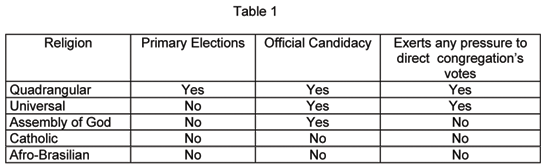
]]> . Table 1 regards the electoral behavior of churches and religions in Rio Grande do Sul during the elections of 2002. It shows the styles of political participation of each of the religious segments mentioned herein and it shows the greater or lesser electoral effectiveness of each one of them, according to the adopted model. As we can see, in terms of elected candidates nominated and supported by the churches, the Quadrangular Church obtained the highest rate, followed by the Universal Church and the Assembly of God.
It is evident that the mimicking effect on the other churches and religions produced by the entry of the Universal Church into politics does not mean there is a direct relationship of "cause and effect". Therefore, it is possible to interpret this phenomenon from the Girardian theory.
According to René Girard, mimicry expresses rivalry and a mediated desire for the other. In this case, Universal Church , playing the role of mediator, present in the field of politics, awakens the same desire of entering politics in other churches and religions. That is, according to this theory, the desire (to enter politics) develops within the other Evangelist Churches, the Catholic Church and Afro-Brazilian religions, because the Universal Church entered politics successfully first. Thus, these are competing groups. However, Girard continues, the groups which had this desire awakened by the other tend to hide this fact, affirming that "their own desire existed before that of their rival ". Besides, "everything coming from the mediator is systematically disregarded even though it is secretly desired", and even, "secretly venerated" (Girard, 1961, pp. 25-27).
The Universal Church, the political parties and the candidates
If, in the religious field, the political advance by the UCKG tends to produce a "mimicking effect", in the political field, it does not go unnoticed. Or as Flavio Conrado affirms, the political parties are well aware of the political force attained by the Universal Church today in Brazil, (Conrado, 2000, p. 77), and among evangelists, I would add. Thus, some would say that behind the persistence of the PT in sealing an alliance with the Liberal Party in the 2002 elections with the intention of gathering the business sector around José de Alencar, the successful entrepreneur and senator who was critical of the economic policies of the FHC administration, it would also appear, that the PT guarded interest was to have the Universal Church (and its captive votes) on its side.
]]> A. Fonseca also maintains "the Workers Party prefers to see negotiations (with the PL) as not being with the UCKG but only with the PL "(Fonseca, press).Be it as it may, the PT and the Universal Church had already established alliances in other elections and, in recent years, have kept good relations in the federal congress. However, let us remember that in the first round of the presidential campaign in 2002 the Universal Church also supported evangelist candidate Anthony Garotinho, of the PSB. This even occurred in the states where the Church nominated their own candidates for member of Congress and senator running for the PL, a political party allied to the PT. In this case the fact that Garotinho is an evangelist, was decisive, as were the alliances established by candidates form the Universal church with the governor elect.in the State of Rio de Janeiro
In the runoff presidential elections, however, the Universal Church and the PL declared their support for Lula. "We are obliged to enter head first into Lula’s campaign", said Bishop Rodrigues to CBN Radio. "Our congressmen, now they are elected, must pledge themselves to mobilizing their bases ". Bishop Rodrigues spoke as national vice-president of the PL and as the Universal Church political spokesman. In addition, the option of supporting Lula was determined by the leadership of the Universal Church, and also of the PL, in the hope that he would lead a government, which would help the poor, as in the words of the bishop,
[… ] we are all tired of ideology. The population wants to know how the transport, education and health problems are going to be resolved, and how poverty is going to be reduced. Therefore we are going to adopt a new form of politics. It is called socialism of results (Jornal do Brazil, 13 / 10/2002).
Also, Anthony Garotinho declared his support for Lula in the runoff election. According to the press, both Rodrigues and Garotinho played important roles as mediators together with other Evangelist churches, to obtain support for Lula in the elections of 27th of October 2002. Thus, on the 15th of October of that year the Renascer em Cristo – Reborn in Christ Church expressed its support for Lula's candidacy and, on the 17th, the candidate joined with about 900 people from different churches in Rio de Janeiro, who all showed their support for him. Among the churches present were: the Methodist church; the Baptist church, the Sara Nossa Terra or Heal Our Land Church, as well as the Universal Church and the ministers of the Assembly of God, who did not follow the decision made in their two main conventions supporting the opposition candidate Serra.
In fact, candidate José Serra acted personally to get the support of the Assembly of God, as well as that of the Quadrangular Church. On the 10th of October 2002 he received the support of the National Convention of the Assemblies of God (Conade) and, on the 16th of October, the support of the General Convention of the Assemblies of God in Brazil (CGADB), and the support of the Quadrangular Church. .
It is worth noting that similar interest for evangelist support occurred in most of the state elections. For example, in Rio Grande do Sul, on the 27th of September 2002, the candidate for governor Tarso Genro launched the Religious Committee for Support of the Popular Front, in Cachoeirinha, situated in the metropolitan region of Porto Alegre. There were representatives of 36 Evangelist churches present. On the 19th of October, both candidates for governor of the state, T. Genro, from the Popular Front, and G. Rigotto, from the Union for Rio Grande, appeared in Porto Alegre at the headquarters of the Assembly of God, which was commemorating its 78th anniversary in the city. Also, in Brasilia, according to newspaper Correio Braziliense, on the 14th of October, 2002, the two candidates who were to dispute the runoff election in the Federal District, tried to attract the votes of the evangelist electorate.
It is evident, however, that the support declared by the evangelist leaders, even when they say they have consulted their "constituencies", cannot be guaranteed directly as votes at the poll, be it for any particular candidate. This is because, as we know, at the decisive time of voting other variables enter the frame, i.e. the controversy which exists, whether it be in the hierarchy or the laity of these churches, in relation to the question of taking part or not in politics of giving unanimous and full support to a certain candidate.
Firstly, during the first round of the presidential elections the majority of evangelists leaned towards the candidacy of Garotinho, whereas in the runoffs, there was a division of their voting intention between the candidates Lula and Serra. Secondly,. there has never been in Brazilian republican history such a close relationship between politics and religion and such great interest in and dispute over evangelist votes. This is to say that the candidates and their parties realise that nowadays, the evangelists form an important force in politics, which can in fact even swing an election. This was the way of thinking/warning made by J. Burity, in 1997: "the parties and candidates who do not consider the religious groups in their discourses and strategy, run the serious risk of complicating or ruining their electoral possibilities"(1997, p. 46).
As I have already mentioned, the alliance between the PT and the Universal Church is not a novelty and it had already taken shape in many cities and states in the elections of 2000. At that time, the common denominator between the party and the Church was the discourse on ethics within politics. During the runoff phase of the electoral campaign in 2000, Bishop Rodrigues appeared in Porto Alegre, at a PT electoral rally, highlighting PT's "ethics in governing", and finished his speech with the phrase: "Vote for who governs with ethics. Vote for the PT." At the same time, during the PT's political campaign throughout Brazil for the same elections two standpoints were constant; on the one hand, denunciations against the lack of ethics on the part of the authorities and politicians who supported the federal government politically, and on the other hand, the unquestionable moral conduct of the PT: "we arrived at this campaign [from 2000] without having been the target of a single accusation of corruption ", affirmed Lula (Isto É, 11/8/2000, p. 4). That is, the friendly talks between the Universal Church and the PT were then based on the idea of "purifying politics " and of "ethics in politics". In the 2002 elections, another discourse was added to this one, which brought the party and the Universal Church closer together, this was aiding the poor, and enacting social welfare programs.
]]> It is necessary to consider however, as I have already analyzed in another article (Oro, 2001), the important ideological differences existing between the party and this church regarding the defense of ethics in politics. For the PT it concerns a principle of respect of and giving value to civil rights, where politicians must run the country and all things public (not satisfying personal or corporative interests) with responsibility, transparency, social justice and the participation of the people. Moreover, usually PT voters consider civil rights with a different rationale from that which prevails among Universal Church voters. For them, the discourse for moralization fits into the scope of the spiritual battle, which triggers an appeal to "invisible forces", which would be present in politics. In other words, politics is a "dirty" business, it is "corrupt" and "dishonest", according to the Church, due to the presence of the devil.Nevertheless, the idea of moralizing politics, found in both discourses, needs to be analyzed as a component of these two institutions’ political imaginary, which does not alone guarantee empirical achievement. Therefore, it is necessary to verify up to what point political practice is exempt from corruption and the preeminence of personal and corporative interests.
Conclusion: religion, politics and democracy
The involvement of the UCKG in particular and of evangelists in general in national politics gives rise to two important theoretical questions. One is concerned with the frontiers between the religious person and the politician, and the other with the consequences that the entrance of evangelists into politics could have on democracy and Brazilian political culture.
Despite the official separation between church and state, the history of relations between politics and religion in Brazil suggests a continuity, a working together, a compromise, a getting along, rather than autonomy and opposition between the two camps, which makes it difficult to draw up clear boundaries. J. Burity suggests that presently in Brazil we can notice "a relaxing of the distinction between religion e politics "(1997, p. 77), or, according to J. J. de Carvalho, a struggle "[…] to extend the religious influence into public life rather than secularize it" (1999, p. 16). This situation certainly relates to Brazilian culture itself and the role of religion within it. In fact, our country, as several authors have already pointed out, despite the advance of modernity, is significantly influenced by the religious imaginary (Ribeiro, 2000), where "the domain of the 'supernatural' appears as fundamental "(Velho, 1991, p. 31), then, Brazil is a country that never stopped being "religious" (Giumbelli, 2002, p. 54). Consequently, Regina Novaes sums up that nowadays there is a "very delicate relationship between religion e politics "(2002, p. 64).
On the other hand, we can ask ourselves if the clouding over, displacement or fluctuation of boundaries between religion and politics, to which the recent involvement of the Evangelist churches has contributed, does not show, as Renato Janine Ribeiro suggests, incredulity or even deception in politics on the part of important strata of our society and also in other Latin American and African countries. . Therefore, would there not be a "new energy" pulsating in areas that do not have a tradition in politics, as for example, the religious sphere? religion? (Ribeiro, 2002). André Corten also discusses this idea, when suggesting that there is a form of politics outside the traditional political arena but the researcher’s "extreme timidness" harms his understanding in this respect, given that he still overestimates "institutional politics " (Corten, 2001, p. 159).
Eventually, Ribeiro continues, these new energies "[…] transfer to the political field or they are absorbed by it "(2002, p. 104). The problem here is knowing "why this energy, which transfers to the political field becomes sterile" (Idem, ibidem). A similar observation is made by Corten when he affirms that Pentecostalism on the one hand, can be considered an institutionalizing factor of society by producing collective identities; but on the other hand, it is not an institutionalizing factor of politics because it does not forge a distinguishing mark on its political practice (Corten, 2001). This situation would occur, according to Mariano, in relation to the evangelist parliamentarians in Brazilian politics, due to their acceptance and consequent submission to democratic norms in vigor and the rule of law, which regulate the running of institutions, political parties, Congress, etc. This would impose, limitations on all and any ambitions of religious, theological or even theocratic order within politics (Mariano, 2000). In other words, religious politicians would be put into a kind of straight-jacket: to act in the political arena they need to observe rules, but once they do that, they find little space for any kind of differentiated political practice.
If this hypothesis is confirmed, we could state that, so far, the effect exerted by the presence of the UCKG in politics, is more noticeable in the religious field, where, directly or indirectly, the Universal Church instigates other churches and other religions to also take part in politics.
As to the relationship with democracy, as Dodson sustains, different trends can be observed: some authors have emphasized the social consequences of Pentecostal expansion; others have highlighted the political effects of Pentecostalism, particularly the stimulation of democratic values and practices. Others remain skeptical about the possibility of a beneficial relation between religion and politics (Dodson, 1997, pp. 25-26). Be it as it may, it is worth spotlighting some points. First of all, the evangelists follow and accept the rules of democratic life and of the established political scene; . secondly, the fact of their presence in politics confirms that democratic participation is possible; thirdly, as Alexander B. Fonseca outlines, evangelists, through their critical discourse against anti-ethical political practices and their denunciation of the predicament faced by large sectors of society, effectively contribute, although indirectly, to the consolidation of democracy in Brazil (Fonseca, press); finally, in fourth place, evangelists are a source of political mobilization within the less privileged sectors of society. Fonseca says that for many people, to belong to a church such as the UCKG means their first experience of "talking about politics" and of valuing the vote (Fonseca, 1997). Thus, certain social segments do not experience politics via traditional means, such as unions, cooperatives and political parties. Consequently, as long as new ethnographic data and empirical information are not available, I understand as Regina Novaes, that today "being an evangelist" "[…] has become a new variable in the game of relations between politics and religion "(Novaes, 2002, p. 91) and a good epistemological outlook would be neither to underestimate the evangelist entry into politics (in Brazil and Latin America), reducing it to a simple manifestation of a corporative religious culture, nor to overvalue it, seeing it as a potentiality for the democratization of Brazilian political culture.
]]>NOTES
. Although this text intends to have a heuristic national coverage, the illustrative examples result, above all, from Rio Grande do Sul, where I carried out field research in a longer and systematic basis on the subject in question.
. Four from Rio de Janeiro, three from Sào Paulo, two from Minas Gerais, and one from each of the following States: Bahia, Espírito Santo, Maranhão, Ceará, Rio Grande do Sul, Pernambuco and Paraná and the Federal District (Machado, 2001).
. These are: Almeida de Jesus (Ceará), Oliveira Filho (Paraná), Jorge Pinheiro (Brasília), João Paulo (Minas Gerais), Paulo Gouvea (Rio Grande do Sul), Reginaldo Germano (Bahia), Heleno (Sergipe), Bispo Wanderval (São Paulo), Bishop João Batista (São Paulo), Edna Macedo (São Paulo), Marcos Abrahão (São Paulo), Bishop Rodrigues (Rio de Janeiro), Bishop Vieira Reis (Rio de Janeiro), Bishop João Mendes (Rio de Janeiro), Divino (Rio de Janeiro) and Marcos de Jesus (Pernambuco).
. They are: Ronaldo (Ceará), Edson Praczyk (Paraná), George (Minas Gerais), Sergio Peres (Rio Grande do Sul), Marcio Marinho (Bahia), Madoqueu (Sergipe), Souza (São Paulo), Maria de Jesus (São Paulo), Roberot (São Paulo), Milton Vieira (São Paolo), Wagner Salustiano (São Paolo), Bishop Caetano (Rio de January), Bishop Jodenir (Rio de Janeiro), Bishop Leo Vivas (Rio de Janeiro), Armando José (Rio de Janeiro), Ely Patrício (Rio de Janeiro), Edna Rodrigues (Rio de Janeiro), Dilma Lins (Pernambuco) and Odete de Jesus (Santa Catarina).
. Bishop Rodrigues was elected federal member of Congress for Rio de Janeiro for the PFL, with 76,000 votes, in 1998. He was re-elected in the election of 2002 with 192,640 votes the fourth biggest returns within the group of candidates from the State of Rio de Janeiro for Congress. Today he is vice-leader of the Liberal Party (PL) in Congress. He founded the Universal Church in Argentina and Spain and worked in Portugal, Angola, South Africa and Mozambique before dedicating himself full-time, in 1996, to the post of political coordinator of the Church. Conrado attributes the electoral success of the UCKG, among others factors, to the leadership of this bishop who, since the presidential campaign of 1989, co-ordinates candidacies and defines the political strategies of the Church, as well as heading the political action of the parliamentarians on questions that are of interest to his religious institution, in Congress.
. The newspaper Folha de São Paulo (15-21 Sept. 2002) published a note clarifying that Members of Congress and candidates for re-election to the State legislature of Rio de Janeiro, Mário Luiz and Magaly Machado, as well as former-minister Eriberto Da Silva Faria, also candidate for state member of congress in Ceará, "do not count on the support of the members of the Universal Church of the Kingdom of God". The same occurred in Rio Grande do Sul, with the minister Paulo Moreira.
. For an analysis of the formation of the evangelist block in the 1988 Constituent Assembly, see Pierucci and Prandi (1996). For a more general analysis of the evangelist block in Congress, see Freston (1996 and 2000).
. The newspaper Zero Hora referred to the election of the minister Valdir Caetano from the Universal Church as the "surprise of the election last Sunday " (3/10/2000, p. 35).
]]> . This research stated that "the followers of the Universal Church concentrate their votes (95%) on candidates from the Universal Church "(Fernandes et al. , 1998, pp. 146-147).. As we know, for Weber, charisma is an extraordinary quality recognized as such by a social group, which characterizes certain individuals (prophets, shamans, military leaders, "demagogues"), but also institutions. The Church, for example, possesses a charisma of function, or of institution, derived from the appropriation of a personal founding charisma (prophetic), made routine (Weber, 1971, p. 249). According to J. Séguy, "[…] for Weber, function charisma represents an institutional derivation from personal charisma. when this is made routine and in the process, assumes new meanings and functions. Personal charisma, in turn, characterizes the prophet (in the religious domain), or the ' demagogue ' (in the political domain), or even the war leader with exceptional qualities (in the military domain)"(1988, pp. 14-15). The relation between personal charisma and institutional grace, says Bourdieu, is the struggle for the monopoly of the legitimate exercise of religious power. Or that, the church, "is unconditionally hostile to ‘personal’ charisma that is prophetic, mystical or ecstatic, which leads to an original path in the direction of God "(Bourdieu, 1987, p. 95). At the same time, the religious institution preaches that its employees (priests or ministers) "should subordinate to institutional grace under punishment of condemnation [… ] "(Séguy, 1982, p. 33); they should reproduce the obligations established by the institution withholding functional charisma (Idem, p. 40).
. That is, an institution where "charisma is the only element which organizes power, from the local church to nationwide organization, forming an institution not so favorable to the participation of followers in matters of the Church "(Carneiro, 1998, p. 187).
. As is known, the Universal Church is today present in eighty countries, spread throughout all the continents, and the majority of ministers who preach are Brazilians.
. As A. Corten emphasized: "[…] the charity work allows [Pentecostal churches] to form electoral constituencies (1997, p. 29).
. Here is the complete statement by Bishop Rodrigues: "I summon the people of God to unite around our ideals and let us not be afraid to take part in the political process, electing men and women who fear the Lord Jesus, so that our society can be transformed and guided, according to true Christian principles "(Folha de São Paulo, 6/08/2000). The sociologist and Methodist theologist Leonildo Campos reminds us that the dream of a new social condition, of a socio-political reconstruction, is very much alive within Brazilian Protestantism, and expresses itself in the motto: "Brazil will be a different country when a man of God is at its helm "(2000, p. 21). For a current analysis of the Pentecostalism millenarism, see A, Corten (1995).
. For these authors, Pentecostalism gives continuity to a diabolical process carried out by the missionaries, thus contributing, to the globalization of forces-of-evil imaginary (Corten and Mary, 2000, p. 19).
. On the other hand, it is implicit that for the followers of the Universal Church the act of voting, forms the expression of their relationship of identity with the Church, more intensively than with any politician or political party. Or, hence, to some extent the very Church becomes their political party. This fact together with the prevailing conception within Brazilian culture, where, according to M. Palmeira, "the vote is not associated to exercising an individual right, but to adhering to one ' side ' (faction) of society "(Palmeira, 2000, p. 11), in this case, a religious and political group identity.
. A typical example of this occurred in Porto Alegre in the elections of 2000 for councilor, when the Assembly of God officially supported two candidates, but did not prevent two others candidates from presenting themselves independently. The result was that neither one was elected, thus a seat was lost, which had been held over the two previous legislatures.
. According to Folha Online (18/10/2002), in exchange for support Jose Serra (PSDB) committed himself to not sponsoring any project or law that would upset the principles and interests of the evangelists, such as: homosexual marriage, income taxation on Evangelist churches and the law of silence.
]]> . Therefore, the newspaper Zero Hora, of Porto Alegre, on the day of the runoff elections, was ironic in saying that the dispute would not be between Lula and Serra, but between the Universal Church of the Kingdom of God and the Assembly of God (27/10/2002, Jornal da Eleição, p. 10).. For an up to date overall vision of Pentecostalism in Latin America and Africa, see Corten and Mary, 2000.
. So wrote Bishop Rodrigues: "the Brazilian people want true politics to establish isonomy, bringing into existence the democracy forgotten since the times of Ancient Greece "(Rodrigues, 1998, p. 8).
BIBLIOGRAFIA
BARROS, Mônica do Nascimento. (1995), A batalha de Armagedom. Dissertação de mestrado, UFMG, Belo Horizonte. [ Links ]
BOURDIEU, Pierre. (1987), A economia das trocas simbólicas. 2 ed. São Paulo, Perspectiva. [ Links ]
BURITY, Joanildo. (2000), Religião e política na fronteira: desinstitucionalização e deslocamento numa relação historicamente polêmica. Trabalho apresentado no VIII Congresso Latino-americano de Religião e Etnicidade, promovido pela Associação Latino-americana para o Estudo das Religiões, Pádua, Itália, 27 jun.-5 jul. [ Links ]
_________. (1997), Identidade e política no campo religioso. Recife, IPESPE, Editora Universitária/UFPE. [ Links ]
CAMPOS, Leonildo Silveira. (2000), "Composições e recomposições do poder espiritual e político". Tempo e Presença, 22 (313): 20-23, set.-out. [ Links ]
CARNEIRO, Leandro Piquet. (1998), "Cultura cívica e participação política entre evangélicos", in Fernandes et al., Novo nascimento: os evangélicos em casa, na igreja e na política, Rio de Janeiro, Mauad, pp. 81-110. [ Links ]
CARVALHO, José Jorge de. (1999), "Um espaço público encantado: pluralidade religiosa e modernidade no Brasil". Série Antropologia, UnB, 249. [ Links ]
CONRADO, Flávio César dos Santos. (2000), Cidadãos do Reino de Deus: um estudo da Folha Universal nas eleições de 1998. Dissertação de mestrado defendida junto ao Programa de Pós-graduação em Sociologia e Antropologia da Universidade Federal do Rio de Janeiro. [ Links ]
CORTEN, André. (1997), "Pentecôtisme et politique en Amérique Latine". Problèmes d'Amérique Latine, 24: 11-32, jan.-mar. [ Links ]
_________. (1995), Le pentecôtisme au Brésil: émotion du pauvre et romantisme théologique. Paris, Karthala (título em português, Os pobres e o Espírito Santo, Petrópolis, Vozes, 1996). [ Links ]
_________. (2001), "O pentecostalismo transnacionalizado no contexto teológico-político". Horizontes Antropológicos, Porto Alegre, PPGAS, pp. 149-160. [ Links ]
CORTEN, André & MARY, Andre. (2000), "Introduction", in _________, Imaginaires politiques et pentecôtismes, Afrique/Amérique Latine, Paris, Karthala, pp. 11-33. [ Links ]
CORREIO BRAZILIENSE, Brasília, edição de 14/10/2002. [ Links ]
CORREIO DO POVO, Porto Alegre, edição de 21/05/2001. [ Links ]
DODSON, Michael. (1997), "Pentecostals, polítics, and public space in Latin America", in Edward L. Cleary e Hannah W. stewart-Gambino (eds.), Power, polítics and pentecostals in Latin America, Boulder, Westview Press, pp. 25-40. [ Links ]
ECCLÉSIA, São Paulo, 81, set. 2002. [ Links ]
ÉPOCA, 142, 2 out. 2000. [ Links ]
FERNANDES, R. C. et al. (1998), Novo nascimento: os evangélicos em casa, na igreja e na política. Rio de Janeiro, Mauad. [ Links ]
FOLHA DE SÃO PAULO, edições de 28/10/2000, 3/10/2002 e 10/10/2002. [ Links ]
FOLHA UNIVERSAL, edições de 10/1/1998, 16/11/1999, 6/8/2000, 13/10/2002 e 19/10/2002. [ Links ]
FONSECA, Alexandre Brasil. (1998), "A maior bancada evangélica". Tempo e Presença, 302: 20-23, nov.-dez., São Paulo, Cedi. [ Links ]
_________. (1997), Evangélicos e mídia no Brasil. Dissertação de mestrado, IFCS, Universidade Federal do Rio de Janeiro. [ Links ]
_________. (no prelo), Religion and democracy in Brazil (1998-2001): a study of the leading evangelical politicals. [ Links ]
FRESTON, Paul. (2000), "The political evolution of Brazilian Pentecostalism, 1986-2000", in André Corten e Andre Mary (orgs.), Imaginaires politiques et pentecôtisme: Afrique et Amérique, Paris, Karthala, pp. 287-306. [ Links ]
_________. (1996), "The protestant eruption into modern Brazilian Politics". Journal of Contemporary Religion, 11 (2): 147-168. [ Links ]
GIRARD, René. (1961), Mensonge romantique et vérité romanesque. Paris, Bernard Grasset. [ Links ]
GIUMBELLI, Emerson. (2002), O fim da religião: dilemas da liberdade religiosa no Brasil e na França. São Paulo, Attar Editorial, CNPq/Pronex. [ Links ]
HERVIEU-LÉGER, Danièle. (1997), "Croire em modernité: au-delà de la problématique des champs religieux et politique", in Patrick Michel (ed.), Religion et démocratie, Paris, Albin Michel, pp. 361-381. [ Links ]
ISTO É, edição de 8/11/2000. [ Links ]
JORNAL DO BRASIL, Rio de Janeiro, edição de 29/10/2001. [ Links ]
MACHADO, Maria das Dores Campos. (2001, inédito), Religião e política: evangélicos na disputa eleitoral do Rio de Janeiro. [ Links ]
MARIANO, Ricardo. (2000), "Islâmicos e evangélicos na arena política". Veredas, I: 49-64, ago., Belo Horizonte. [ Links ]
_________. (1999), Neopentecostais: sociologia do novo pentecostalismo no Brasil. São Paulo, Loyola. [ Links ]
MOREIRA DE OLIVERIA, Jose Lisboa. (2002), "A candidatura de presbíteros a cargos políticos". Eclesiástica Brasileira, 246: 259-296, abr. [ Links ]
NOVAES, Regina. (2002), "Crenças religiosas e convicções políticas: fronteiras e passagens", in Luis Carlos Fridman (org.), Política e cultura, século XXI, Rio de Janeiro, ALERJ/Relume Dumará, pp. 63-98. [ Links ]
_________. (1999), "Pentecôtisme à la brésilienne: des controverses en cours". Archives des Sciences Sociales des Religions, 105: 125-143, jan.-mar. [ Links ]
NOVA VERSÃO, Porto Alegre, edições de 18-24/10/2001 e 21-27/3/2002. [ Links ]
ORO, Ari Pedro. (2001), "Religião e política nas eleições 2000 em Porto Alegre (RS)". Debates do NER, 3: 9-70, set., PPGAS/UFRGS, Porto Alegre. [ Links ]
_________. (2000), "Pentecôtisme et politique au sud du Brésil", in André Corten e Andre Mary (orgs.), Imaginaires politiques et pentecôtismes, Afrique/Amérique Latine, Paris, Karthala, pp. 307-320. [ Links ]
PALMEIRA, Moacir. (2000), "Eleição municipal, política e cidadania". Tempo e Presença, 311: 7-15, maio-jun. [ Links ]
PIERUCCI, Antonio Flavio & PRANDI, Reginaldo. (1996), A realidade social das religiões no Brasil. São Paulo, Hucitec. [ Links ]
PRANDI, Reginaldo. (1991), Os Candomblés de São Paulo. São Paulo, Hucitec/Edusp. [ Links ]
RIBEIRO, Renato Janine. (2002), "Religião e política no Brasil contemporâneo", in Luis Carlos Fridman (org.), Política e cultura, século XXI, Rio de Janeiro, ALERJ/ Relume Dumará, pp. 99-110. [ Links ]
COUTO, José Geraldo. (2000), "Entrevista com Renato Janine Ribeiro", in _________, Quatro autores em busca do Brasil, Rio de Janeiro, Rocco, pp. 57-87. [ Links ]
RODRIGUES, Bispo Carlos. (1998), A igreja e a política. Rio de Janeiro, Ed. Universal. [ Links ]
SANCHIS, Pierre. (1998), "Comentário sobre a pesquisa", in Fernandes et al., Novo nascimento: os evangélicos em casa, na igreja e na política, Rio de Janeiro, Mauad, pp. 150-168. [ Links ]
SÉGUY, Jean. (1988), "Charisme de fonction et charisme personnel: le cas de Jean-Paul II", in SEGUY et al. Voyage de Jean-Paul II en France, Paris, Cerf, pp. 11-34. [ Links ]
_________. (1982), "Le clergé dans une perspective sociologique ou que faisons-nous de nos classiques?". Trabalho apresentado no VI Colloque du C. S. P., Prêtres, pasteurs et rabbins dans la société contemporaine, Paris, Cerf, pp. 11-58. [ Links ]
SEMÁN, Pablo. (2001), "A Igreja Universal do Reino de Deus: um ator e suas costuras da sociedade brasileira contemporânea". Debates do NER, 3: 87-96, set., PPGAS/UFRGS, Porto Alegre. [ Links ]
VEJA, edição de 3/11/1999. [ Links ]
VERSÃO SEMANAL, edição de 21-27 de março de 2002. [ Links ]
VELHO, Gilberto. (1991), "Indivíduo e religião na cultura brasileira: sistemas cognitivos e sistemas de crença". Novos Estudos CEBRAP, 31: 121-129, out., São Paulo. [ Links ]
WEBER, Max. (1971), Economie et société. Paris, Plon. [ Links ]
ZERO HORA, RBS, Porto Alegre, edições de 3/10/2000, 12/11/2000, 16/10/2001, 2/1/2002, 15-21/9/2002 e 27/10/2002. [ Links ]
]]>
Article received on outubro/2002.
Approved in April/2003
. The first version of this text was presented at the XXVI Annual Meeting of Anpocs, in Caxambu, MG, between 22nd and 26th of October of 2002, in the GT Religion and Society, co-ordinated by Lísias Negrão, Maria das Dores Machado and Joanildo Burity.
]]>