Democracia cosmopolita: déficits conceituais e equívocos políticos
Démocratie cosmopolite: déficits conceptuels et équivoques politiques
Sérgio Costa
Translated by Enrique J. Romera
Translation from Revista Brasileira de Ciências Sociais, São Paulo, v.18, n.53, p.19-32, Oct. 2003.
ABSTRACT
Both the appeal to some universal ethics and the evocation of a global civil society constitute the core of the "cosmopolitan democracies" theories, presented as either reality data or political desideratum. The paper aims at showing that in the terms formulated by the cosmopolitan democrats both ideas rely on evolutionist presuppositions. Institutions, values, and cultural ways of life effective on societies situated in the northern hemisphere end up being regarded as both per se superior and models for general application. Against such reorganization of the world, the paper indicatively cites necessary precautions in order to have both the international cooperation of social actors and the globalisation of human rights contribute towards overcoming particularisms in the several regions, taking into consideration, at the same time, the cultural particularities of the different regional contexts.
Key words: Cosmopolitan democracy; World civil society; Human rights.
RESUMO
Dois componentes apresentados, ora como dado da realidade, ora como desiderato político, constituem o núcleo das teorias da "democracia cosmopolita": o apelo a uma ética universal dos direitos humanos, a evocação de uma sociedade civil global. Procura-se mostrar que, nos termos formulados pelos democratas cosmopolitas, ambas as idéias apóiam-se em pressupostos evolucionistas. Instituições, valores e formas culturais de vida vigentes nas sociedades situadas na região do hemisfério norte acabam por ser tratadas per se como superiores e como modelos de aplicação geral. Contra tal re-hierarquização do mundo, o artigo nomeia, de maneira indicativa, cuidados necessários para que a cooperação transnacional de atores sociais e a globalização dos direitos humanos contribuam para a superação de particularismos nas diversas regiões, levando em consideração, ao mesmo tempo, as particularidades culturais dos diferentes contextos regionais.
Palavras-Chave: Democracia cosmopolita; Sociedade civil mundial; Direitos humanos.
RÉSUMÉ
L'appel à une éthique universelle des droits de l'Homme et l'évocation d'une société civile globale sont deux composantes qui constituent le cerne des théories de la "démocratie cosmopolite " et qui sont présentées soit comme une donnée de la réalité, soit comme une aspiration politique. L'article cherche à démontrer que, suivant la formulation des démocrates cosmopolites, les deux approches s'appuient sur des présupposés évolutionnistes. Les institutions, les valeurs et les formes culturelles de vie en vigueur dans les sociétés situées dans l'hémisphère nord finissent par être traitées per se en tant que supérieures et comme modèle d'application général. Contre cette nouvelle hiérarchisation du monde, l'article cite, de forme indicative, les soins nécessaires pour que la coopération transnationale d'acteurs sociaux et la globalisation des droits de l'homme contribuent à surpasser les particularismes dans les diverses régions, tout en considérant les particularités culturelles des différents contextes régionaux.
]]> Mots-clés: Démocratie cosmopolite; Société civile mondiale; Droits de l'Homme.
Früher wurden in Revolutionen Bahnhöfe besetzt, heute besetzen wir Begriffe.
[In the old days, during revolutions train stations were occupied, today we occupy concepts].
Heiner Geißler1
The deep wounds inflicted on world order by the terrorist attacks in New York, Madrid and London will still take a long time to heal. In fact, the latest moves and the occupation of Iraq have deepened the threats of rupture of the fragile consensus in favor of the maintenance of peace, generating an insurmountable gap between peoples and cultures.
The political scenario has turned gloomy, revealing the implausibility of some tendencies that were becoming the mainstream of contemporary political theory. However different their theses might be, these contributions agreed on pointing out a confluence towards a long-lasting peace process in terms of a cosmopolitan world order. The recent events have made evident that the theories on cosmopolitan democracy are analytically rooted on a fragile set of interpretations. Politically, they are based upon extreme wishful thinking, which transforms the categorical imperative of a cosmopolitan order into empirical materiality, and the must-be of justice beyond borders into the abstract existence of altruistic peoples and national States.
The most optimistic defenders of cosmopolitan democracy proclaimed, within the paradigm of reflexive modernization, the accomplishment of the modern project. According to authors such as Giddens (2000) and Beck (1999, p. 319), "the cage of modernity opened" freeing the reflexive spirit, which would govern the world under the patronage of universal ethics."2
]]> Since the 1990's the thesis on cosmopolitan democracy has been expressed under very different formulas. It would not do any justice to the encompassment and complexity of these standpoints to summarize and discard them generally, not taking into consideration their internal links and the differences between them.In this essay, firstly we will briefly outline the theoretical projects on cosmopolitan democracy. Secondly, we will focus on two recurring elements present in different contributions; these are, the bet on a "global civil society" and on universal human rights ethics. Our intention is to show that these standpoints are based on a problematic premise: in both cases, explicitly or implicitly, we observe the presence of an ontological and historical a-priori, the so-called North Atlantic societies producing the cosmopolitan order; as if such societies monopolized the production of the basic factors of world democracy. Such a thesis is empirically unfounded and politically inconvenient.
Cosmopolitan democracy: brief outline.
The fears and suspicions felt until recently by various authors and political leaders, regarding the opinions on the need to diminish the principle of national sovereignty in favor of a transnational view of politics as actually being an ideological stratagem paving the way to new forms of imperialism, seem to have finally faded away. Fortunately, there are very few scholars who still believe that viewpoints on global human rights or environmental policies are nothing less than rhetoric traps created to maintain and legitimate the uneven North/South relations, where poor countries are exploited by rich ones. It was understood that regardless of possible ideological uses, factual transformations that have taken place, have led to the need of revising the so-called Peace of Westfalia, which consolidated the Nation-State order in the XVII century (see McGrew, 1997).
These transformation processes affect variably but inevitably all demographic groups and all social strata everywhere in the world.
Regarding world economy, it is well known that interpenetrations among different parts of the world started by the discovery of America or even earlier, depending on the historical perspective adopted. The significant dimensions of international trade and financial flows observed by the turn of the century XIX to XX, coinciding with the so-called pax Britannica, are also well known. However, it is only in recent years that what we may call world economy took form. Such a concept has a precise meaning: not only the different countries exchange products, services and capital, but the whole surface of the planet, except for a few regions, has become the basis for capitalistic accumulation and reproduction, not just financially but also concerning productive capital. This means that Nation-State borders are not any longer relevant for determining investments; what matters now is the relation risk/revenue observed in different business opportunities – wherever they are located. Nevertheless, Nation-States have not entirely lost their regulating functions of the economy, after all, they continue keeping the control on a factor that despite all innovations, is still critical for the production of goods and services, that is, labor. At the very least, the State is present when building barriers, sometimes even physical ones, against the globalization of work force. Even so, the possibility of imposing factual regulations upon capital, so that effective redistributive policies are possible no longer exists. When cornered by restrictions and regulations, capital will migrate generating unemployment and devoiding of legitimacy the national governments it seeks to control.
Such changes in the economy, plus the factual and discoursive construction of global threats (environmental destruction, terrorism, wars, etc.) have lead to the displacement and even complete fading of the borders between internal and external politics (Beck, 1998). It has became evident that no single National State can guarantee its population's security and well being, if it cannot influence international conditions to ensure them.
Nation-States are also undergoing deep internal transformations. The homogenizing pressure of a global culture leads to the emergence of regional movements of cultural resistance that reactively revive local identities and establish connections with the rest of the world beyond national mediations.4 Furthermore, increasing migrations from the south to the north are reconfiguring "old" democracies. In successful cases, societies are confronted with a new type of plurality, in problematic cases; these societies experience regressive chauvinistic and segregationist social tendencies.
It is worth remarking that contemporary migratory movements are different in character from those that took place previous to the World Wars, when millions of Europeans moved to the Americas. The latter meant practically a definitive interruption of relations with the country of origin, in a context where policies of complete assimilation into the new country, even by means of mere coercion, were accepted as legitimate5. Nowadays, we observe all types of pressures against assimilation policies; the promotion and reinvention of differences mold cultural policies in various countries. At the same time, new communication possibilities enable permanent contact with the countries of origin, making assimilation of migrants into the new societies not compulsory any longer.
]]> The third factor favoring cultural plurality within Nation-States are the transnational social movements and the communication exchanges between social groups in different regions of the world. The increase in both material and symbolic exchanges beyond the borders of the nation has led to a spreading out of new lifestyles and political viewpoints , as well as to the displacement or deterritorialization of cultural manifestations from their loci of origin. Thus, in much the same way as youngsters in the outskirts of Sao Paulo in Brazil, for instance, recreate hip-hop music, in Mozambique, the incipient women's movement fights for gender equity, following the example of European and American feminists who have conquered a number of civil rights.In a nutshell, this wide reconfiguration of economic, political and social relations, which do not necessarily make the Nation –State become obsolete, but redefine it functionally, constitutes the empirical basis for the defenders of the cosmopolitan democracy project. Such a complex displacement of economic, cultural and political boundaries has given rise to the recent attempt to find ways of "governing beyond the borders of the Nation-State", according to the suggestive title by Zürn (1998).
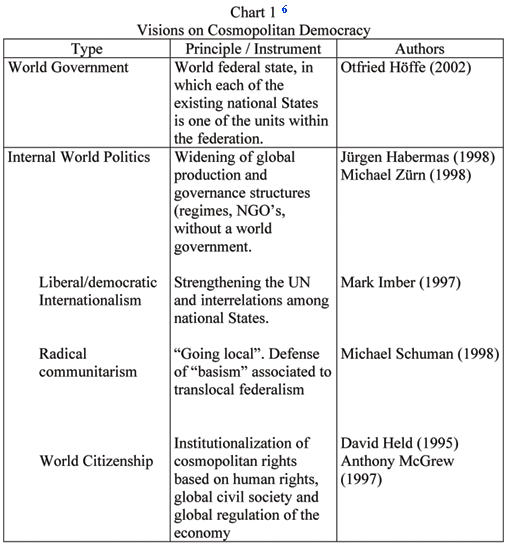
This common diagnosis of current transformations leads to cosmopolitan democracy projects, which are, as aforementioned, very varied, including from the mere strengthening of multilateral organisms to trans-localisms aiming at creating a fair cosmopolitan world order on the basis of communitarian ethics.
Roland Roth (2001) has collected the different contributions to the cosmopolitan democracy issue in a preliminary classification, which we have completed and reorganized in Chart 1, so as to offer an approximate idea of the diversity and multiplicity of the terms currently under debate.
The different currents and principles identified in the chart do not exclude each other: there are instruments that appear in various interpretations as well as authors combining elements from different tendencies here treated as distinct. The purpose of the chart above is to merely differentiate emphases.
]]> This is the reason why we do not explain its terms in great detail. To serve our purposes, it is more relevant to see in detail some implications of the models.
Global civil society: implausible and undesired
Civil society in the national constellation.
The concept of civil society has evolved theoretically and politically in a remarkable way over the last few years. . In general, as shown by Dubiel (2001, p. 135), this concept has been able to "encompass a multiplicity of interpretative models and narratives as well as normative expectations, which a weakened Marxism" could no longer decode.
Thus, since the late 70's, the polysemic term civil has allowed the concept of civil society to become a synonym of "something contrary to the agents of war", particularly in countries enduring civil war, such as sub-Saharan Africa and Central America (Center for African Studies, 2002). In many cases, the rhetoric on civil society permitted bringing together irreconcilable enemies to discuss peace-making programs. (Kurtenbach, 2000).
In South America, the term civil was regarded as opposed to the military, and functioned as a link gathering unlikely allies in their fight against the military dictatorships, such as businessmen and union leaders, progressive sectors of the Catholic church and gender movements, or ethnic movements and left-wing nationalists (Costa 1997). In Eastern Europe, the term civil meant non-state. Civil named the few social sectors and activities, which remained apart from the influence of the omnipresent socialist State. Thus, in these cases civil society did not mean much more than private life and religion (Cohen and Arato, 1992, pp. 32 ss.).
In the United States,the term civil acquired in both liberal and communitarian versions the sense of public virtue, meaning the minimum degree of altruism necessary to maintain the reproduction of the liberal order and its plurality of values. (Walzer, 1991; Shils, 1991). Regarding the European democracies, the term gained a distinct feature, by meaning the opposite of the bureaucratic welfare State, which civil society was to reform (Keane, 1988).
At the theoretical level , the reconstruction of the concept follows an independent and decentralized logic too. In accordance with political objectives to be attained and on the basis of the theoretical body available in each context, that reconstruction took sometimes recourse to Hegel and Marx, or to Tocqueville and Durkheim, or else to Gramsci and Arendt - every particular case adopted the most suitable definition of civil society.
Only in the late 80's, due to the contribution by Cohen and Arato, the concept of civil society gained a predominant interpretation, which sought to establish a dialog with the various versions that tried to reinvent the term in previous years. Let us briefly recall Cohen's and Arato's reinterpretation of J. Habermas' two-level model of society. Their reinterpretation is important in order to clarify my own criticism on global civil society defenders.
]]> Cohen and Arato proposed a definition, according to which, civil society corresponds to the institutional dimension of the life-world (in contrast with its linguistic-symbolic dimension) and encompasses the structures "whose task is the preservation and renewal of traditions, solidarities and identities" (1989, p. 495). Habermas integrates these authors' definition to his discoursive model of democracy, attributing a double role to civil society. In cultural terms, civil society acts defensively, as a locus for building a public opinion, which is rooted in the life-world... In political terms, besides defining legislation, civil society plays, an offensive role as a decoder that translates demands deriving from every-day life into the systemic language of institutionalized politics.Civil society- worlwide
According to cosmopolitan democrats, global civil society is empirically feasible due to the emergence of large numbers of non-state players who gather in Porto Alegre, Seattle or Genoa to discuss issues that cannot be associated to a particular national constellation, such as demands for global social justice or the preservation of biodiversity. From the point of view of political and normative expectations, global civil society plays different roles..7
In its most moderate version, the role to be played by civil society is restricted to its participation in the already existing or to be globally instituted advisory and deliberative forums, creating international "regimes" (agreements on climate, biodiversity, drugs, etc.). The representatives of the "global civil society" would defend the interests and viewpoints of world society as a whole in such forums, as opposed to particularist standpoints of corporations and Nation-States (Vieira, 2001).
A more emphatic version of cosmopolitan democracy sustains that global civil society actors are capable of exerting a democratizing impulse in world politics, similar to that which national civil societies accomplished in various countries. According to such a vision, global civil society would be capable of reinforcing global social integration at a time when the world is systemically becoming one (Habermas, 2001, pp. 17 ss.; Brunkhorst, 2002, pp. 171 ss.).
The political importance of the new forms of international activism is indisputable. However, to compare them to national civil societies seems to be for various reasons an inappropriate procedure. When considering the aforementioned bidimensional nature of civil society, it is evident that global civil society lacks the cultural-defensive dimension. Actually, there is no anchorage in the life-world, which is the characteristic that ensures the democratic and democratizing character of civil society within national contexts. That is to say, if civil society maintains and reproduces a catalog of traditions, solidarities and identities inside the nation, we should pose the following question: which values and representations will global civil society preserve? There is no such thing as a global life-world, where a global civil society may detect common problems in order to translate them into a worldwide public sphere.
Both civil society and public sphere, previous to being categories of the democratic theory, are concepts coined in factual social history and refer to a specific and own history in each particular national context.
As it is known, civil societies (and public spheres) have taken shape through extremely complex processes that were concomitant with the appearance of modern nations as "imagined communities" and were closely associated to the emergence of nation-wide communication systems (trans-local communication media, unified school systems, etc.), as well as to great narrations (wars, history, etc.) that culminate in the formation of a national public with shared interests (Costa, 2003a).
Obviously, we did not and do not verify a similar process at the global level. Rather than a global civil society, transnational activism by non-state agents consists of a varied range of fragmented thematic networks. The issues discussed there do not merge into the establishment of global communication involving a worldwide public. In contrast, issues are discussed in these transnational, segmented communicative spaces, to which only the international elites of activists have access.
The issues discussed transnationally by an exclusive group of activists, only attain repercussion by means of national public spheres.. For example, when a summit conference takes place, certain issues are incorporated into the agenda of various national public spheres at the same time. Then, we do not observe any communicative exchanges among peoples from different part of the world. Rather, we verify an exchange of information and experiences among a limited number of political activists, who will make these issues, discussed with colleagues from different countries, circulate in their respective national public spheres. However, such issues are discussed within each country according to particular dynamics determined by national factors, such as the degree of organization of social actors responsible for publicizing the issue, the extent of international integration of the domestic media, the national government's interest in incorporating the particular issue into its agenda, etc. The concept of global civil society is misleading because it suggests that a social agenda built on the basis of experiences accrued in various world regions is taking shape. Moreover, such an agenda would be subject to agreements come upon in a porous and democratic worldwide public sphere. Actually, rhetoric on cosmopolitan democracy puts a veil on the uneven distribution of power and chances in the world's Realpolitik. As Roth sustains:
]]> "The discourse about networks and knots cannot hide the fact that, in terms of transnational cooperation among NGO's and even within transnational NGO's, the distribution of influence, power, resources, staff and issues show a clear North-South asymmetry [...] This is true not only regarding personnel and decision-making structures, but also regarding the choice of campaigns, which are tailored to satisfy the desires of the 'generous' OEDC public." (2001, p. 9).This passage gives an answer to the aforementioned question about the traditions, identities and solidarities that an alleged global civil society should preserve. As a matter of fact, the new global social agenda basically derives from the experience of a few national civil societies that dominate the world of NGO's. Hence, there is a serious risk run by a cosmopolitan democratic program based upon global civil society, which is to globally spread and make public the experiences, perceptions and values of just half a dozen specific civil societies. This abstract risk becomes clearer in the way various authors justify the implementation of a worldwide human rights policy.
The universality of human rights
When declaring his unrelenting war against the "axis of evil", Bush disclosed, due to his political negligence, some of the theoretical frailties found in the ideas of a cosmopolitan democracy. Thus, the symbolic declaration of war divided the world in two parts, establishing from the start, as if it were an ontological truth, the part that represents the good and the part that represents the evil. The cause of establishing the Western catalog of human rights all over the world, as constructed by the theoreticians of cosmopolitan democracy, even though less coarse, does not differ essentially from Bush's standpoint. In both cases a teleological history is constructed, where the group of pioneering societies that first became industrialized constitute the bastion of values, institutions and lifeforms morally more advanced. Hence, there are no reasons to deprive the four fifths of the world that inhabit "other" regions from such ineluctable evolution (see Habermas, 1998; for a criticism see Costa, 2003b).
Habermas takes this vision to the extreme, when discussing against critics opposed to universalizing human rights on behalf of the imperative preservation of cultural particularities. According to the author: "At present, other cultures and religions of the world are exposed to the challenges of social modernity, in the same way as Europe was, , when human rights and the democratic state were, in a certain way, invented". (1998, p. 181)"
According to this, the catalogue of human rights would represent a sort of humanitarian aid for poor countries, allowing them to skip phases of moral development by shortening the time the populations were to suffer when deprived of their access to "universal" rights. It is just a matter of following the example of the more advanced societies.
The similarity between such a vision and a theory of modernization à la Parsons, mainstream up to the 70's, is obvious. As it is known, this theory characterized the northern societies as a sort of destination of modern history. Thus, the "rest" of the world had to remodel their institutions and structures following such an example, so that all could have access to material progress and axiological rationality, which supposedly thrive in the northern hemisphere.8 At present, the cosmopolitan democratic visions prescribe an even deeper reform and a more direct intervention in "backward" regions: modernization must affect the moral basis of such societies.
The most recurrent argument against the feasibility of universalizing human rights, in the terms proposed by cosmopolitan democrats, is the one put forward by the "realistic" tendency in the field of international affairs (Giesen, 2000). According to these authors, human rights cannot be set apart from the real interplay of asymmetric power relations at the international level. In other words, the disputes among countries configure a Hobbesian order, in which each Nation-State seeks to impose its own interests, opportunistically taking recourse, if that were the case, to the rhetoric on universal values.
An additional realistic argument emphasizes the influence exerted by the industrial-military complex in international relations, which makes " humanitarian military interventions", regardless of their true inevitability, be presented as inescapable. (Roth, 2001, p. 7). That is, the "war machine" would have its own imperative systemic dynamics: it does not wait for political reasons to be triggered, quite the opposite, it triggers politics so that the latter builds up arguments to legitimize yet another "just war".
]]> The military interventions on behalf of the defense of human rights, since the Gulf War in 1991, seem to have confirmed the suspicions expressed by the realists. After all, in every case, be it Kosovo, Afghanistan or more recently Iraq, it is possible to identify the specific ways in which the interests of certain groups and countries were veiled under the rhetoric on universal values. Another aspect rendered evident in all these cases is that, due to the complex international power game, the defense of human rights in a region of the world entails a greater disrespect for some groups in other regions. Thus, for example, the so called alliance against terror, freed Afghanistan from a tyrannical domination, and at the same time meant greater freedom for the Russians to suppress the Chechnyans and allowed the U.S. government to relax the respect for civil rights of Muslim immigrants..Finally, the risk of the thesis of preventive war adopted by the United States becoming a new doctrine on world politics puts an end to the ambiguity of "humanitarian interventions" (see Lindgren Alves, 2002, pp. 110 ss.). After all, if in a scenario of absolute war power asymmetry, the military supreme power manages to legitimize an attack against a sovereign nation using the argument of suspecting that such a country represents a threat to the security of the attacking country, there are already no more reasons to assume that humanitarian interests continue to play a role in international confrontations. What we are dealing with, in this case, are only national interests in a Hobbesian power dispute, with a predictable end: the strongest will decide in their favor which the rules of the game are.
There are still restrictions of another nature to the arguments of the cosmopolitan democrats, when they try to globally expand the occidental catalog of human rights.
Here we have the description of universal history as an evolutionary line that would culminate in the privileged positions occupied by "modern" nations, as the paradigm of respect for human rights. Although the second Giddens, a defender of the Third Way program, insists on denying the author of the "Theory of Structuration" the first Giddens taught us that evolutionism does not contribute positively to human sciences. On that occasion, Giddens (1984: 240 ss.) put us on alert for several evolutionist risks, of which at least two seem to question the theoreticians of cosmopolitan democracy, and ironically, Giddens himself; these are:
i) Treating a particular sequence of events that took place in a particular society as a historical law of transformation.
ii) Confounding superiority, in terms of technological, economic or military power with moral superiority, as if the most technologically developed societies were necessarily most advanced morally.
When establishing a parallel between 19th century Europe and the rest of the world at present, assuming that "the other" societies are undergoing a phase previous to modernity, the cosmopolitan democracy theorists make the first evolutionist error. When trying to establish the catalog of western human rights as a goal to be met by all the countries in the world, they commit the second error.
The analytical problem, in the two cases, is disregarding the entangled histories (Randeria, 2001) of the West and the rest of the world and, moreover, the merely contingent character of the developments that brought Northern Hemisphere countries to recently acquire a privileged position in the defense of human rights. This position is not necessarily definitive, that is, it does not represent a definite place in the inevitable and immutable evolutionary line of modernity; it is rather the momentary consequence of a set of unforeseen events.
It should not be forgotten, that at the time when human rights and the rule of law were "invented", Europe practiced colonialism and modern slavery on the other side of the Atlantic. It was also at the height of modern science in the 19th century that the biological foundation of inequality among individuals with diverse physical features was "invented", thus legitimizing racial hierarchies in modern times. It is also worth taking into account that until the end of the 1940s, sources as diverse as black North American activists, the UNESCO and Jewish refugees who fled nazism, regarded Brazil as a world model of respect for human rights and effective equality among all demographic groups.9
That is, from the point of view of social history, the description of modernity as a linear trajectory, in which the technologically advanced countries of the North Atlantic represent, by fate and by the internal logic of an evolutionary cycle, a sort of moral avant-garde of the contemporary world, is not supported by facts. So, to claim that the civil societies and national governments of the North Atlantic should define and establish a universally valid catalog of human rights, is just as reasonable as it was in the 19th century to intend that the proletariat become the universal player of modern history. Hence, the argument that there is an unequal evolution of illuminist values throughout the different regions of the world, and that therefore, it is legitimate that the more evolved regions in this sense lay out the path to be followed by the other regions, is theoretically and historically unsustainable. Definitely, such an argument cannot be a legitimizing source for a universal catalog of human rights.
]]> Despite the discussion developed up to this point, the main question still remains unanswered. After all, to theoretically and analytically deconstruct the expectations of the cosmopolitan democrats does not solve the political and moral problems that they try to confront, such as the need to re-regulate the economy under the rule of global social justice, attain protection against global threats, implement gender and ethnic justice, fight against violation of human rights, etc. Then, it seems fair to argue that, cosmopolitan democracy recommends taking advantage of the political opportunity of extending the undeniable conquests accomplished by the civil societies of the north over the "rest" of the world, and any theoretical restrictions seem insignificant compared to a political possibility of such grandeur.For those who disregard the cosmopolitan democrats' universalistic argument there are only two ways out: either skepticism and capitulation vis-à-vis a world that "is really like that, unequal and unfair", or the responsibility of looking for more satisfactory alternatives to the problems faced by the cosmopolitan democrats. When put forward in this manner, anyone who considers the first possibility as a real alternative could be identified as a neo-conservative. The second possibility is too ambitious for the limitations of this article. Therefore, allow me just to indicate a few necessary steps to escape from the mistakes made by cosmopolitan democrats.
First of all, we need to get rid of the impression that the debate on globalization of human rights locks up a confrontation between, on the one hand, particularists, prisoners to conservative values, old-fashioned identities and lifeforms, and on the other hand, universalists who stand for values uprooted from any specific cultural context. However, we have learned from the debate between liberals and communitarians in the 1980s and 1990s that there is a basic distinction between principles of justice, regulated by the binary code of just/ unjust and conceptions of good, which separate virtuous life from undesirable life. Human rights need to be treated as an abstract set of principles of justice that may or may not concretely apply to different cultural contexts. This distinction is basic not to set different cultures into a hierarchical evolutionist scale, besides remarking the need to understand the concrete implementation of human rights, in the terms of the moral grammar of a particular society. We are not referring to such cultural relativism that transforms, for example, machismo or racism in cultural practices to be preserved. We may acknowledge, for instance, that the United States or Sweden have accomplished more significant advances than Brazil or Sudan in the sense of attaining greater equity between blacks and whites and men and women, and at the same time reject the mechanical transposition of ethnic relations in the United States and Sweden to Brazil or Sudan. After all, the degree of gender and ethnic equity found in Sweden or the USA is not an intrinsic feature of gender and racial relations in those countries. The same model transposed to other societies may obstruct rather than facilitate social recognition of women and blacks.
These differentiations pave the way to an additional step, showing that the diversity of identities and of existing cultural forms is not an obstacle, but a condition for the concrete implementation of a global policy on human rights. Let us briefly comment on the interrelation between the levels of cultural and social integration, which combined determine the characteristics of a specific social configuration, as observed by Joas (1997). According to this author, the different value systems or cultural integration formats present variable degrees of correspondence with a system of universally valid norms, making evident the existence of particular cultural integration formats which are inept at considering universal points of view. Democracies differentiate from each other precisely for revealing a great extent of coincidence among values and moral dispositions, which are inscribed in cultural integration processes, and universally recognized norms embodied in political institutions:
"However, [...] the idea that, to overcome particularisms, particularities have to disappear, ignores the contingent character of values. Such an idea is doomed to remain as mere moral, breaching the attractiveness of values;" (Joas, 1997, p. 174).
Joas' formulations are one more argument against cultural relativism, as they enable us to identify societies, whose system of values make it difficult to implement norms that are equally valid for all. Nonetheless, they work as a warning for those cosmopolitan democrats who believe it is possible to implement a catalogue of universal rules that do not interconnect with the various systems of particular values in different societies. Only interacting with these concrete value systems, rather than disregarding them, universal norms may attain legitimacy and even effective validity and efficacy.
Otherwise, they become rules that will not be effective.
Conclusion
The different contributions to the thesis of cosmopolitan democracy show the necessity and feasibility of ways of governing the world beyond the borders of existing States, since the economy, politics and culture have trespassed the moulds of the Nation-State. Two components, presented either as real data or as political desideratum, are recurrent ingredients of such "cosmopolitan" global governance, these are, the existence of a universal human rights ethics and a global civil society.
]]> We have outlined that the concepts of global civil society and universal human rights ethics, in the terms formulated by cosmopolitan democrats present empirical and theoretical difficulties and end up legitimizing a moral hierarchy in the contemporary world, according to which, institutions, values, cultural forms and lifeforms of the northern societies constitute models to be applied generally.These objections to the concept of cosmopolitan democracy do not resolve the moral and political problems that such contributions seek to confront. Thus, we have schematically discussed elements for a reflection concerning the possibilities of a not evolutionist legitimacy of transnational networks of collective action and of a universal catalogue of human rights.
In the first place we have to disentangle the political and cultural dimensions of civil societies. In that case, the democratic conquests achieved by social movements in the industrialized countries are no longer associated to concrete cultural forms and cultural life forms in such societies. We do recognize the universal appeal of human rights or of claims for ethnic and gender equity, but at the same time we should sustain that the way in which such claims were implemented in some countries in a pioneering attempt, was contingent and non-transferable. In short, the same universal norm may find diverse, particular and concrete forms of cultural implementation.
The actions of transnational organizations and social movements in general aim at struggling against racist, sexist or ethnically oppressive social orders, which does not imply that gender, racial or ethnic relations in the countries where social movements have advanced the most constitute valid models applicable everywhere. In this precise sense, we are not dealing with a global civil society, since there is not and there must not be an extended reproduction of repertoires of collective traditions and experiences from the Northern Hemisphere throughout the rest of the world. We are dealing here with the appeal to extend to every region the effort to overcome particularisms, preserving the particularities of the diverse regional contexts.
Thus, it seems possible to construct the legitimacy of transnational organizations and social movements without taking recourse to the idea of a global civil society, be it regarded as existing, be its construction justified as a moral imperative. Uprooted from the concrete cultural contexts where they emerged, the claims for justice sustained by transnational organizations circulate in international forums and return, by means of the activists, local organizations and the media, to national public spheres. In such local and national arenas universal pretensions of these transnational issues are checked and eventually validated, inducing domestic processes of cultural and social innovation.
NOTES
1 Member of the German Christian-Democrat-Party
2 Žižek (2001, p. 479) maintains that the rupture represented by the paradigm of reflexive modernization (or the second modernity) confronts us to a situation similar to that represented by the way in which Habermas takes distance from Adorno and Horkheimer. According to Žižek, such similarity is based on the fact that, according to Habermas, Giddens and Beck, "problems, such as politically totalitarian regimes or the so-called alienation of modern life, are not the result of the dialectics of the project of modernity and enlightment, but of the misuse of it".". The comparison, however suggestive, is improper, because the two level model (system and life-world), as conceived by Habermas, acknowledges the colonizing force of instrumental rationality, identifying specificities in the life-world . To be sure, Habermas does not reject, but he accepts the dialectics of the Aufklärung: it is in its terms that he searches for alternatives to the iron cage. Habermas does not offer a previous prescription for a "good life", which social actors should desire, such as the praise for the reflexive self by Giddens and Beck, but the outline of a context where pretensions of validity may thrive and construct their legitimacy. In the second modernity, the negative pole in the dialectic relation disappears, it becomes positive, rhetorically: the risks become possibilities and uncertainties turn into, chances of (self-)transformation of the oppressive structures.
3 4 Benhabib (1999, pp. 28 ss.) sees in the emergency of local and regional identities the paradox between the ever expanding systemic global integration and the decline of modern social integration, that is, being part of a national identity, constructed by means of institutions and the narrative "invention " of national histories.. Leis (2002, p. 199) point out another paradox in the emergence of new localisms, regionalisms and nationalisms. He shows that the theoretical defense of new identities, when based on the existence of a State and the rule of law, may deepen democratization. However, defending cultural differences within world politics, according to this author, is in practical terms to be in favor of ethnic cleansing and genocides. I disagree with this interpretation and will try to show that the preservation of cultural differences is the only way to implement a universal policy for the defense of human rights.
]]> 5 The nationalization campaign carried out by Vargas in Brazil and thoroughly studied by authors such as Neide Fiori and Giralda Seyferth, shows how cultural diversity was forcefully suppressed. That type of policy was then praised and regarded as legitimate, but is nowadays unacceptable (see Costa, 2002, chapter. 6).6 According to Roth's classification, only the last tendency, here called "worldwide citizenship", corresponds to what he calls cosmopolitan democracy. The other tendencies would be forms of transnational democracy. As the different denominations are confused in the debate, we opted herein to use the expression cosmopolitan democracy as an "umbrella" concept sheltering the different tendencies.
7 Actually, the proclamation of global civil society, since the second half of the 1990s, coincides with the domestic ebb of the idea of civil society, in those countries where civil society, as a concept and " context of action " (Rödel, 1992), played a relevant role in previous years. Dagnino's (2002) studies on the recent history of Latin America's civil societies are paradigmatic. They reveal the deep marks inflicted in recent Latin American history by the "perverse confluence" of democratization and larger civilian participation on the one hand, and the neoliberal adjustment on the other hand.
8 S. Hall (1996) briefly but impeccably describes, how the ideological image of the "West", opposite to that of the "Rest", has been constructed historically and narratively, in politics and social theory. Knöbl (2001) updates this discussion showing that theoreticians such as Habermas, Giddens and Beck share the same premises with the "old" theory of modernization, as long as they ignore the multiple forms of modernity. There is not just one modernity, but multiple modernities, that follow diverse forms and patterns in each different region. .
9 When the Second World War came to an end, UNESCO tried to cheer up the traumatized world by making public the successful Brazilian experience, regarding the struggle against racism. The project was abandoned, when huge social disparities between black and white Brazilians were detected (see Maio, 2000). Similarly, in the first decades of the last century Afro-American activists came to Brazil to get to know the Brazilian "racial paradise" (see Hellwig, 1992, pp. 40 ss.). The words of the Jewish writer Stefan Zweig (1941), comparing Brazil to Europe, are also emblematic: "Brazil treated the racial dogma that is devastating the European world, and the meaning of this experiment seems exemplary in an absurdly uncomplicated way: they simply ignored its supposed validity ".
BIBLIOGRAFIA
BECK, Ulrich. (1998), "Wie wird Demokratie im Zeitalter der Globalisierung möglich?", in U. Beck (org.), Politik der Globalisierung, Frankfurt/M, Suhrkamp. [ Links ]
_________. (1999), Weltrisikogesellschaft, Ökologische Krise und Technologiepolitik", in U. Beck et. al. (orgs.), Der unscharfe Ort der Politik, Opladen, Leske + Budrich. [ Links ]
BENHABIB, Seyla. (1999), Kulturelle Vielfalt und demokratische Gleichheit. Frankfurt/M, Fischer. [ Links ]
BRUNKHORST, Hauke. (2002), Solidarität. Von der Bürgerfreundschaft zur globalen Rechtsgenossenschaft. Frankfurt/M, Suhrkamp [ Links ]
CENTRO DE ESTUDOS AFRICANOS. (2002), "Sobre a sociedade civil", in http://www.cea.uem.mz/pesquisa [ Links ]
COHEN, Jean L. & Arato, Andrew. (1989), "Politics and the reconstruction of the concept of civil society", in A. Honneth et al. (orgs.), Zwischenbetrachtungen. Im Prozeß der Aufklärung. Frankfurt/M, Suhrkamp. [ Links ]
_________. (1992), Civil society and political theory. Cambridge, Cambridge Mit Press. [ Links ]
COSTA, Sérgio. (1997), Dimensionen der Demokratisierung. Frankfurt/M, Vervuert. [ Links ]
_________. (2002), As cores de Ercilia. Belo Horizonte, Editora da UFMG. [ Links ]
_________. (2003a), "Redes sociais de integração transnacional: problemas conceituais e um estudo de caso". Política e Sociedade, 2. [ Links ]
_________. (2003b), "Direitos humanos e anti-racismo no mundo pós-nacional". Novos Estudos Cebrap (no prelo). [ Links ]
DAGNINO, Evelina. (org.). (2002), Sociedade civil e espaços públicos no Brasil. São Paulo, Paz e Terra. [ Links ]
DUBIEL, Helmut. (2001), "Unzivile Geselllschaften". Soziale Welt, 52. [ Links ]
GIDDENS, Anthony. (1984), The constitution of society: outline of the theory of structuration. Cambridge, Polity Press. [ Links ]
_________. (2000), Runway world: how globalization is reshaping our lives. Nova York/Londres, Routledge. [ Links ]
GIESEN, Klaus-G. (2000), "La constellation postnationale: Habermas et la seconde modernité". Les Temps Modernes, 610. [ Links ]
HABERMAS, Jürgen. (1998), Die postnationale Konstellation. Politische Essays. Frankfurt/M, Suhrkamp. [ Links ]
_________. (2001), Zeit der Übergänge. Frankfurt/M, Suhrkamp. [ Links ]
HALL, Stuart. (1996), "The west and the rest: discourse and power", in Stuart Hall et al. (orgs.), Modernity: an introduction to modern societies. Oxford, Blackwell. [ Links ]
HELD, David. (1995), Democracy and global order. Cambridge, Polity Press. [ Links ]
HELLWIG, David (ed.). (1992), African-American reflections on Brazil's racial paradise. Philadelphia, Temple University. [ Links ]
HÖFFE, Otfried. (2002), Demokratie im Zeitalter der Globalisierung. 1 ed. (ampliada). Munique, C. H. Beck. [ Links ]
IMBER, Mark. (1997), "Geo-governance without democracy? Reforming the UN System", in A. McGrew (org.), The transformation of democracy?, Londres, Polity Press. [ Links ]
JOAS, Hans. (1997), Die Entstehung der Werte. Frankfurt/M, Suhrkamp. [ Links ]
KEANE, John. (1988), Democracy and civil society. Londres, Verso. [ Links ]
KNÖBL, Wolfgang. (2001), Spielräume der Modernisierung. Das Ende der Eindeutigkeit. Weilerwist, Velbrück. [ Links ]
KURTENBAC, Sabine. (2001), "Zivilgesellschaft und zivile Konfliktregelung. Der Beitrag der Zivilgesellschaft zur Beendigung bewaffneter Konflikte", in P. Henstenberger et al. (orgs.), Zivilgesellschaft in Lateinamerika, Frankfurt/M, Vervuert. [ Links ]
LEIS, Héctor. (2002), "Cidadania e globalização: novos desafios para antigos problemas", in I. Scherer-Warren e J. M. C. Ferreira (orgs.), Transformações sociais e dilemas da globalização, São Paulo, Cortez. [ Links ]
LINDGREN ALVES, J. A. (2002), "O contrário dos direitos humanos". Lua Nova, 55-56. [ Links ]
MAIO, Marcos C. (2000), "O projeto Unesco: ciências sociais e o credo racial brasileiro". Revista da USP, 46. [ Links ]
MCGREW, Anthony. (1997), "Democracy beyond borders? Globalization and the reconstruction of democracy theory and practice", in A. McGrew (org.), The transformation of democracy?, Londres, Polity Press. [ Links ]
RANDERIA, Shalini. (2001), "Zivilgesellschaft in postkolonialer Sicht", in J. Kocka et al., Neues über Zivilgesellschaft. Aus historisch-sozialwissenschaftlichem Blickwinkel, Berlim, WZB, mimeo. [ Links ]
ROTH, Roland. (2001), "Auf dem Weg zur transnationalen Demokratie. Der Beitrag von Protesten, transnationalen sozialen Bewegungen und Nichtregierungsorganisationen". Berlim, manuscrito. [ Links ]
RÖDEL, Ulrich. (1992), "Zivilgesellschaft als Handlungszusammenhang". Mitteilungen des Instituts für Sozialforschung an der J.W. Goethe-Universitt Frankfurt am Main, 1. [ Links ]
SHILS, Edward. (1991), "The virtues of civil society". Government and Opposition, 26 (2). [ Links ]
SHUMAN, Michael. (1998), Going local: greating self-reliant communities in a global age. Nova York, Free Press. [ Links ]
VIEIRA, Liszt. (2001), Argonautas da cidadania: a sociedade civil na globalização. Rio de Janeiro/São Paulo, Record. [ Links ]
WALZER, Michael. (1991), "The idea of civil society". Dissident, primavera. [ Links ]
ŽIŽEK, Slavoj. (2001), Die Tucke des Subjekts. Frankfurt/M, Suhrkamp. [ Links ]
ZÜRN, Michael. (1998), Regieren jenseits des Nationalstaates. Frankfurt/M, Suhrkamp. [ Links ]
ZWEIG, Stefan. (1941), Ein Land der Zukunft. Stocolmo, Berman-Fischer Verlag. [ Links ]
Article received in October/2002 ]]> Approved in abril/2003
]]>