Márcia Pereira da Silva
Professor PhD in the History Department – History, Law and Social Work College – UNESP – Campus in Franca – 14409-160 – Franca – SP – Brasil. E-mail:marciapereirasilva@gmail.com
Translated by Hamilton Robin
Translation from História, Franca, vol.28, n.2, p. 17-42, 2007
ABSTRACT
]]> The aim of this article is to analyze the period of the Brazilian military governments (1964-1985) under the viewpoint of the legality culture. We intend to show how the taking of the political power in 1964, far from characterizing itself just by use of force and of free will, was guided by a legal effort, produced based on a determined theory from the Constitutional Law with emphasis in the thought of Carl Schmitt and Hans Kelsen.Keywords: Political Culture; Armed Forces; Brazil.
Introduction
The societies, already asserted by Daniel Aarão Reis Filho (2001 : 1), "have always difficulties in exercising the memories of their dictatorships, especially when they assume value codes opposed to the exception state principles". However, just like Hobsbawn also asserts (2000), the historians stand out from the other researchers from the fact that they have the incumbency of bringing to mind what the society, consciously or not, persist in forgetting.
Objects on which the historians expounded are infinite, even when the chosen topic demanded the recovery of historical events which many people would prefer they had not happened. That is the case of the military governments.1
It is relatively ample the literature produced already about the militay governments, but scarce the works which tried to deal with the operation of the governmental logics, especially when the emphasis falls on issues referent to legality. The simple reference to the term legality, inserted in the context of the governments in question, seems to cause certain embarassment as if intended the researcher who, to the topic, devotes himself to share a kind of political power based on force and on violence.
In this sense, the aim of this text is to evaluate the legal conceptions spread and/or used by the military governments. Therefore, we make use of the preambles of the Institutional Acts and of the speeches from the president generals.
]]>
The legality culture and the Brazilian governments from 1964 to 1986
In 1964, the Brazilians started to live with a political regime of authoritary structure and ideology. Authoritary structure because tried to concentrate the political power in hands of a bureaucratically organized group, reducing the importance and participation of jurisdictions for popular representations; authoritary ideology because it privileged hierarchy as organization of the political community, in order to preserve a determined social order considered as essential to the maintenance of the national security (BOBBIO, MATTEUCCI, PASQUINO, 1999).
Governments in authoritary regimes, as any others, need legitimacy that, like attibute to the State, "consist in the presence, in a significant part of the population, with a degree of consensus able to assure the obedience", by sporadic use of force, but without any use of violence (BOBBIO, MATTEUCCI, PASQUINO, 1999:675)2.
Since they could not eliminate diversity of the social organization and they deserve the desidered consensus, the Brazilian authoritary governments from the period in question lived with a constant crisis of legitimacy. To combat it, they made use of many tricks: force, repression, economical measures which benefited the middle class, spreading and publication of innumerable laws which allowed them the speech in which they took measures based on legitimacy and not on free will.
We believe that the emphasis of the military governments in the transmission that the political measures that they took were according to the national legitimacy (even if they themselves have published innumerable laws) was na important strategy for getting legitimacy, putting inevidence the legality culture developed in the course of the history of Brazil as component part of the national political culture.
We understand political culture in a larger way than the classical definition by Gabriel Almond and Sidney Verba (1989:12). For them, the term "referred to the orientations especifically political, to the attitudes in regard to the political system, their several parts and the role of the citizens in public life".
In the last decade the concept got elasticity and profoundity, starting to comprise behaviors, beliefs, symbols, practices and political representations predominant in determined social groups in a certain historical moment. Each society develops a series of political cultures which internalize themselves and end being the frame of the political behavior of their members.
In 1960s, the legality culture integrated already the Brazilian political culture.
Since Brazil became an independent nation, it was imposed need of a supreme law which strengthened stability to the new political order, regulated the rights and obligations of governers and governed people.
]]> The first Brazilian Constituent Assembly was convened in 1822, before the Independence. In September 1823, the first project of Constitution of Brazil was vetoed by the Emperor D. Pedro I, the so-called Constituição da Mandioca (Constitution of the Manioc). One year later, another text was granted as the Constitution of 1824. This one expanded the Emperor's power in relation to the first project creating the Moderating Power.During the first Reign, regarding the Constitutional Law, it was published minutes (1822), two Proclamations (1823), one Manifest (1823) and one Law (1828). In Regency, three Laws (1832/34 and 40); in the second Reign, the Law in 1841.
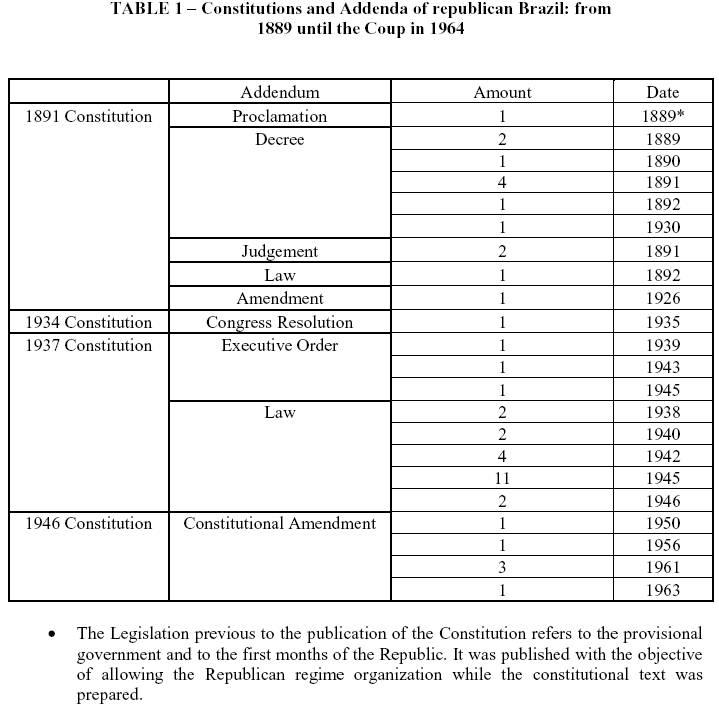
After the Proclamation of the Republic, Brazil had several Constitutions and, to each one of them, several addenda (see Table 1).
The amount of legislation published in Brazil until 1964 is considerable. With the coup it was not different, Neither with the opening. During the military governments it was produced 01 Constitution, 17 institutional Acts, 105 Supplementary Acts and 42 Constitutional Amendments, including the Amendment nº01/69 that was so long that it was known as Constitution of 1969".
Just by way of comparison, it is necessary to highlight that the last Brazilian Constitution, published in 1988, has already received 56 Amendments. Yet the North-American one, dated 1787, just 27.
The Brazilian Constitution changes so much because the texts are thorough and full of details (really prolix), with analyses and propositions that exceed, by far, the establishment of the general settings of the nation and the organization of the republican regime. As it states on almost everything (including on matters that could be complementary legislation), it changes a lot because of the multiplicity of the social relations in constant motion. While the Constitutions of Brazill have an average of 200 articles, the U.S. has 093.
Up to now we have exemplified the huge amount of laws in Brazil just regarding the Constitutional Law. The reader can imagine how that number would increase if we devoted ourselves to the set of rules published in the country to govern the lives of citizens. Since October 5, 1988 (the date of enactment of the present Federal Constitution) until October 5, 2008 (its 20th anniversary), were published in Brazil 3,776,364 rules (...). This represents, on average, 517 rules issued every day or 774 rules issued by working day (AMARAL, 2008:1).
That amount of laws successively published exemplifies, in our view, the culture of legality existing in our country. In Brazil, the culture of legality is expressed by the need of the political group in the government to allege to be always guided in a set of normalizations that govern the society. In many ways, we, Brazilians, are accustomed to the guardianship of the State, expressed into public laws concerning the social rights. Our cultural habit does not include, unfortunately, the practice of using justice to solve conflict among members of the society, since we are, in these cases, used to appealing to favors, in a political-personal practice that dates back to the tié of the political barons. Among us, the political culture of legality is restricted to political domination of the State. In this sense, it would not be possible to the civil-military group which took over the Brazilian State in 1964 to do it, disregarding the laws that rule the country and even so achieve any legitimacy.
The command of the civil-military movement in 1964 knew that the national tradition had already incorporated the element of legality. In Brazil, it was not possible just to despise the laws: it was necessary to build the simulacrum, disguise the free will and become believable that the actions form the military governments had legal bases4.
In Renato Lemos's opinion (2004:415), the worry about the legal formality meant more than "mere juridicist prejudice, expressing a difficulty in acting (the gorvernment established in 1964) alongside of certain paradigm of the political culture". In this sense, the author adverts the fact that in the after-war world, the "world market of ideas" established the democratic-representative legitimacy as prerequisite for an approval of the political domination, which imposed over the non-democratic regimes coming from a condition of "ideological schizofrenia"; to practice the authoritarism in the present promising the democracy in the future.
]]> Regarding concerns about the legality, Luiz Vianna Filho (1975:56) recalled the irritation of Costa e Silva because of the delay in setting the first Institutional Act. The general insisted: "that they gave him some paper," anything "(...) to allow him to begin the punishment5.Indeed, Irene Cardoso (1997:473) suggests the combination legality/legitimacy as a "mainstay" of the Brazilian authoritarian state:
(...) The emphasis on the legality and legitimacy (supporters of the dictatorial regime) had a precise meaning: that of creating an appearance of normality for social and political life that prevented the recognition of the regime from the perspective of exceptionality and free will.
Precisely because of what we call culture of legality, the efforts of the military governments were not few in enacting laws and disclose in a particular legal concept that would promote the maintenance of the authoritarian State. We insisted: the issue of national legislation was (and still is) grounded in certain principles which form the Constitutional Law. It was not enough for military rulers on behalf of legitimacy, just issue the laws, but they should do it in accordance with the theoretical justifications for the widespread knowledge of law, on pain of not being recognized as legitimate.
The Constitutional Law as a means of obtaining legitimacy of the military governments in Brazil
The Constitutional Law is, while sub-area of knowledge, showed as a branch of Public Law, obviously by those who admit the dichotomy between the Public and Private. However, it is important to emphasize the difficulty in demarcating a dividing line between public and private, between the interests of the person as an individual and as member of the community. The division between Public Law and Private has been questioned by the legal science, but is still in use by didactic motives. Therefore, the Constitutional Law remains understood as the main branch of Public law that deals with the organization and activity of the State, considered a more or less extensive, depending if Constitution is seen just legal or political as well.
Anyway, the edition of the supreme laws governing a given society, towards the structuring and fundamental norms of the State, refers to the Constitutional Law.
But who edits the laws? When is the law legitimate? The Replies to these questions must be sought in the theories on the constituent power.
]]> The origins of conceptions of constituent power dates back to the French Revolution. Sieyes published in 1789, the known text Qu'est-le le Tiers État? In it he argues that the Third State, considered an absolute numerical majority in France and had no corresponding representation, should achieve certain political rights through a bill coming from the constituent power. Sieyès parts from the hypothesis that men in the state of nature, were free and had equal rights. In original condition the political society would have been formed from a social pact on behalf of the institutionalization of a power that could guarantee the survival of social being and his natural rights6. Agreed that power, according to Sieyès, it would be organized and limited by a series of extraordinary rules established by representatives of the people - legitimate author of the Constitution (Sieyes, 1988).According to Manuel Ferreira Filho (2003:43), the appropriation of the concepts of legal writings by Sieyès later meant "a transmutation of an expertly exposed for immediate political objectives in an alleged scientific theory of constituent power."
When the writers wrote about the constituent power they warned the need for the group that prepares the Constitution to represent the general will of the nation, in fact they were defending the principle that this group should be identified as such.
In general, theorists of Constitutional Law would agree that the constituent power is divided between "original" and "instituted." The first is exercised by the people, it is not subjected to any previous normalization and it repesents the general will of the nation. But the constituent power is subordinate to the original set, usually exercised by a National Constituent Assembly and obedient to the rules established by the political community.
Although the Constitutional Law is an area of knowledge with broad visions shared by most researchers and lawyers, the history records the authors who disagreed most common interpretations or dedicated themselves in building specific theories about this or that matter.
When can the supreme law of a nation be changed? Is it possible to change the government of a country out of the procedures stipulated by the Constitution in force and still talk about legality? We find different answers to these questions, depending on the author to whom we appeal to justify them.
The Constitutional Law and its many interpretations offered a theoretical basis for the seizure of State power in 1964. As we hope to clarify in this article, the preambles of the Institutional Acts and the speeches of the general presidents allow the assertion that the military governments (and / or the authors of the legislation in the period) were aware of the different conceptions of Constitutional Law as to claim that "The Revolutionary government of 1964 was carrying the original constituent power", a statement from the preamble of the AI-1.
According to Ruoquié (1984), authoritarian governments, like the Brazilian one, develop two strategies for legitimacy. First, they make the speech, willingly or not, having a transitory character because they are necessary to contain a present evil (in this case communism) and then they seek to institutionalize themselves through future legislations which provide them a basis for various actions when taking maximum advantages from the existing administrative, political and bureaucratic structure. Therefore, they will be governments always perceived in their uniqueness, despite the call for legislation seen as urgent at the moment they emerge, on behalf of democratic redemption of the future.
In Brazil, each edition of an Institutional Act was accompanied by a preamble explaining the reason for that law and the reasons for the government to do it, citing specific legal principles and specially selected to serve the purposes of authoritarianism. From these preambles, they called our attention for the references to the thought of Carl Schmitt and Hans Kelsen, more from the former than from the latter.
Schmitt and Kelsen had different conceptions about the status, significance and purpose of the legislation of a given country. Both protagonists, including an interesting debate about political power and the Constitution in the first half of the twentieth century.
]]> In 1929, was published the famous essay by Carl Schmitt, Der Hüter der Verfassung (or the guardian of Constitution), in the journal Archiv des öffentlichen Rechts. In it, Schmitt defends the submission of the Law to the politics, including the latter not as the power relationship between different divergent social groups and interests, but as all the action of the sovereign State that evaluates everything and everyone as friends or enemies. For the author, the head of State is above the constitutional laws and should protect the nation, even if has to cancel the Constitution itself. Here it is important to differentiate between constitutional laws (set of norms validated in the Constitution) and Constitution (which validates in decision of the political unit). Carl Schmitt gives much importance to this distinction, always subordinating the Constitution to politics. For the same reason, the author criticizes Kelsen, arguing that he treats the Constitution and constitutional laws in a theoretical framework commonly referred to as pure theory of Law.In response to the text of Schmitt, Hans Kelsen wrote Wer soll der Huter der Verfassung sein? (Or Who should be the guardian of the Constitution?), an essay published in the journal Die Justiz. In this work, Kelsen criticizes what he thinks is the excessive influence of politics, political interests, the Executive power and the moral (and / or value judgments always relative and different for each historical epoch) in the constitutional process. For Kelsen, the body of laws should be examined by eliminating as much as possible external influences to the Constitutional Law.
In short, the debate between Schmitt (German jurist who had joined the Nazis) and Kelsen (Jewish jurist) about who should "keep" the Constitution can be expressed thus: the first, the holder of sovereignty is above the Constitution because of the maintenance of unit of a totalitarian State, however for the second, politics should not subjugate the Law, and the Judiciary is no less important than the Executive.
And taking into account the historical context in which the debate took place - the spread of fascism in Europe - we can say that Kelsen's propositions were quite closer to democracy than that of Schmitt.
Although different, both Schmitt and Kelsen advocated ideas that were raised in the context of military governments by the dominant group, for reasons and at different times.
The legal concepts of Carl Schmitt and the military governments in Brazil
Carl Schmitt (1888-1985) was German, a lawyer and a teacher. He kept relations with Nazism and ascended professionally under the auspices of totalitarianism. His thinking was used to justify various aspects of German ideology of the time of Hitler and various actions of the Nazi State.
Because of his involvement with Nazism, much of the production of Carl Schmitt is still seen with restraint7.
]]> In the year 1921, Schmitt published the essay entitled "Die Diktatur". In this and other publications, although they are facing the Weimar Republic, we find a logical and well worked out theory of justification of authoritarian governments.Two elements of Schmitt's theory were extremely conducive to the kind of State power defended by military governments in Brazil: the state of exception and the concept of sovereignty.
The state of exception, in the theoretical Schmittian's contribution (1931, 1968, 1992), is characterized by the fact that "the sovereign is, at the same time, inside and outside the legal system," which gives him the right, in exceptional times, change the law. In this sense, the German jurist developed arguments about the need for a sovereign dictatorship, and also described how it would characterize itself when it became necessary. According to Schmitt, in times of crisis, the State should be under the command of a group able to decide on political issues and resolve that adverse situation. Such a group would compose a government with absolute power to suspend the constitutional validity, change the Magna Carta and even propose another rule of law, due to its revolutionary condition.
In plain language: as "there is no norm that applies to chaos (...), firstly it must be established the order: only then it makes sense to the legal system (...)" (AGAMBEN, 2002:23,24) . So the Schmittian thinking was extremely timely for the authoritative speech of 1964, for it justified the political and legal intervention of return "to order and morality".
In the assessment of Giorgio Agamben (2003:54), the physical contribution of Schmittian theory is exactly to make possible the articulation between the state of exception and the legal system. It is a paradoxical relationship, for what must be included in the law is something essentially exterior to it, i.e. nothing less than the cancellation of the own legal order.
The proximity between the theory proposed by Schmitt and the official legal conception of the period of military governments in Brazil has already been suggested by Nilson Borges. When looking for similarities between the lawyer and military governments, Nilson Borges (2003:27) stated that for both, the government defines itself as the institution or the person who enacts a state of crisis by cancelling the rights and introducing restrictions on political action. The sovereign dictatorship is based on the ability to legitimize the revolution by itself and replace all the existing jurisdiction (italics from the author).
It was exactly the need for a state of exception the central argument of the military government to take power in 1964 and installing a revolutionary government. The historiography has already demonstrated, to the exhaustion, the difusion of imagination against communism and red danger, the depletion of populist politics and / or the fear of the labor movement, finally, the reality of popular political participation that demanded greater representation in the 1950s and 1960s. Before the emergence of the most popular sectors in national politics, more traditional groups resorted to authoritarianism to maintain ancient privileges of domination. The state of exception was then justified as being necessary in maintaining order and morality.
In the vision of Giorgio Agamben, the definition of state of exception by Carl Schmitt can justify the repression even those considered subversive. According to Agamben (3003:13), the exception is a constitutive element of modern authoritarianism, since it includes "the establishment of a civil war, permitting the physical elimination not only of political adversaries, but of entire categories of citizens who, for any reason, seem not be integrated into the political system".
If we consider the state of exception and Schmittian sovereignty, it is pertinent to state that there was nothing illegal in taking state power in 1964, since one could argue that the military assessed the danger to national security facing the country at that moment in history and have established sovereign dictatorship.
For Carl Schmitt (2007), the guardian of the Constitution, with power to change it or not, is always the head of state. But the author is referring to Nazi Germany and, therefore, he identifies the country's sovereignty and the duty to maintain internal order with the Führer. In Brazil, things were quite different.
]]> The government was in the hands of Joao Goulart, who had great internal opposition from both the right (who accused him of yielding to the wishes of the people), and the left (who did not see promised reforms realized).At the beginning of 1964, Janio was accused of allowing the growth of the communist threat, which was considered a threat to national security. Therefore, the head of state in Brazil was far from being understood as the bearer of national sovereignty. Moreover, the duty to maintain order and defend the sovereignty had already been assigned to the Armed Forces by the constitutions of Brazil. Since the first republican constitution, the military gained autonomy and saw its functions extended until the constitution of 1934 introduced the term "order" as a function of the military: "The Armed Forces are permanent national institutions, and within the law, essentially obedient to their superiors. Intended to defend our homeland and ensure the constitutional powers, law and order " (our italics).
The issue is that the word order suggests a function that overflows the law; it is an informed concept more by the interests of established powers than by legal concepts. To address this issue, Roberto de Aguiar (1986:21) wrote that order is above the law, and his name and even the maintenance of law, the legal structure is denied, leading the military to protect political orders or tear them down, with the justification of a maintenance order, which is made more than a rhetorical term that reflects the clash between the legal / political law and the new order emerging new arrangements and commitments between the hegemonic groups in a given society.
The writer complements that, giving the role of "guardians" of order to the Armed Forces, the legislature left "the legal door open for a growing military intervention in Brazilian political life" (AGUIAR, 1986:21). Thus, the duty of guarding the Constitution was transferred to the Armed Forces.
In possession of power arising from the belief in the need to protect the national sovereignty from socialist influence, it would be possible and even necessary to, according to Schmitt, fit the Constitution to the new time, outside the procedures stipulated by the prior Charta Magna.
In 1964 the Constiution of 1946 was in force which regulated the requirements for its own modification.
Art. 217 – The Constitution may be amended.
§ 1 The amendment will be deemed proposed if it is, at least, presented by the fourth part of the members of the House of Representatives or the Federal Senate, or by more than half of the Legislative Assemblies of the States in the course of two years, each one of them manifesting itself by the majority of its members.
§ 2 It will be accepted the amendment which be approved in its discussions by the absolute majority of the House of Representatives and the Federal Senate in two ordinary and consecutive legislative sessions.
§ 3 If the amendment receives, in two discussions, the vote of two thirds of its members in one of the Houses, it will soon be submitted another one; and being approved in that one by the same procedure and by an equal majority, it will be considered accepted.
]]> § 4 The amendment will be enacted by the Boards of the House of Representatives and the Federal Senate. Being published with the signatures of the members of the two Houses, it will be added, with its serial number, to the text of the Constitution.§ 5 The Constitution will not be overhauled under siege.
§ 6 Projects aimed at abolishing the Federation or the Republic will not be admitted as object of deliberation.
Since it was not obeyed to the Article 217, AI-1 (First Institutional Act dealing with the new government) was upheld by means of "procedures not foreseen by the Constitution" and, therefore, is considered by many as evidence of the Coup d'Etat imposed to most Brazilians. However, if weresort to the thought of Carl Schmitt, we can argue that amid the threat to national order, the supreme dictatorship was settled, authoritarian regime that may be necessary for the survival of a country.
The military governments spread, through the preambles of the Institutional Acts and in official speeches of representatives of the Executive, the defense theory that Schmitt did political regimes based on authoritarianism, started by coups.
Hans Kelsen's legal concepts and the military governments in Brazil
Leading exponent of what we know as Positivist School of Law, Hans Kelsen (1881-1973) became one of the most influential jurists of the twentieth century.
Of Jewish origin, Kelsen suffered Nazi persecution and fled to the U.S. where he became a known lecturer and writer. In the book titled Pure Theory of Law (German: Reine Rechtslehre), Kelsen exposed the core of his legal concepts. For him, the law as a science, must be built on a set of thoughts and reflections which excludes influences of factors from elements which are not the laws themselves.
]]> Explained: the writer believes that the moral issues and values are strange objects towards the law, arguing that sociological and axiological references are subjects of study of other sciences. Thus, justice, for example, is not an object of law anymore. Kelsen argues that the good, good, the evil and bad are historical values, concepts and content variable in space and time and that the law should become a field of knowledge universally valid and applicable.Still about Kelsen, it is important to emphasize that the writer is not only devoted to works on law, but he also published reflections on politics and democracy. Because of his vast work, the researcher is usually separated into two components: Kelsen as a lawyer and as a politician. Here we approach just the former, for we believe that, in the publications of AIs, the writers mentioned Kelsen's legal reflections and not their approaches on democracy.
Like Carl Schmitt, Hans Kelsen also believes that the supreme law of a nation can be changed by processes not foreseen in the Constitution, but not because he advocates the total supremacy of politics over law. For Kelsen, a generation always has the power to review its guidelines, considering the so-called "effectiveness of law" and the fact that it is changed "by legitimate representatives of the people."
The effectiveness of a given law or Constitution and the own constituent power is about the fact that the law is globally effective and the group prepares to be recognized as the legitimate representative of the nation. The question of effectiveness is above the existence of a Constituent Assembly, even though the idea of the Assembly is already part of the legal tradition prevailing in the political community (as is the case of Brazil in the 1960s). Thus the first condition of existence of the norm is its effectiveness, ie, "the fact that this standard be applied by legal authorities, especially by the bench (...)" as well as "the fact that this standard be respected by the individuals subjected to the legal order", otherwise it ceases to exist [the law] by remaining "permanently ineffective" (KELSEN, 1979:35).
The absence of a fixed and rigid rule for changes in the body of legislation of a certain country was exposed as a need by the Sieyès (1988:69), during the French Revolution, in a text always evoked as the beginning of democratic political society of law: "de quelque manière que la nation veuille, il suffit qu'elle veuille; toutes les formes sont bonnes et the volonté est toujours la loi suprême".
Despite the variety of ways that the constituent power can obtain, one element seems to be consensus: the holder of the constituent power is necessarily the people. Assign ownership of the constituent power to the people means that the laws need to be published on behalf of the majority of the nation and / or approved by them. At the Institutional Act No.1, the Armed Forces proclaimed themselves the legitimate representatives of the people (and / or holders of the constituent power), they issued AI-1 and undertook great effort to convince various social sectors that the same benefited them likewise. If the military governments got the approval from a considerable portion of society for the legislation that they started to publish, they would reach the constitutional effectiveness.
The group that becomes the holder of constituent power may come to be so in several ways. As stated by Hans Kelsen (1979:35), from a legal standpoint, it is immaterial that the change of the legal situation is produced by a use of force directed against the legitimate government or by the members of this government, through a popular mass movement or a small group of individuals.
For the writer, important thing is to stress that it is also legitimate "the fact that the current Constitution be modified or completely replaced by a new one through a process not required by the Constitution" (KELSEN, 1979:35), provided there is an effectiveness of the new norms. This design allows, at most, a recasting of the Constitution on the own articles about the norms for future amendments and alterations.
The military government, for the publication of AI-1, claimed this principle of constituent power theory, ie the maximum immunity from laws passed to future generations. The Discourse of presentation of the first Institutional Act confirms that the military more directly attuned to the prospect of effective domination of authoritarian rule were aware of the different conceptions of the constituent power and the existence of theories of the state to justify the seizure of power by processes not provided constitutionally. The proper terms used in the presentation of AI-1 shows that the text was written by someone familiar with the legal reading: (...) the victorious revolution, as constituent power is legitimized by itself. It deprived the previous government and has the ability to build the new government. In it there is the normative force inherent in the Constituent Power. It edits the legal rules that is not limited by the normativity prior to its victory.
In May 1964, during the revolutionary junta, laws were edited that allowed future norms coming from privileged sectors of government, in order to build a legal structure to sustain the state of exception. Future legislative adjustments proposed by the Executive were being successively provided inside the proper amended Constitution. Explained: the traditional paths for the issuing of new laws - approval and proposal by the politicians elected to legislative seats - were removed from the constitutional text that, little by little, the power to legislate was concentrated in the hands of the President and his advisors more directly.
]]> The AI-1, signed by the heads of the three Forces - General Arthur da Costa e Silva, Brigadier Francisco de Assis Corrêa de Melo and Vice-Admiral Augusto Hamann Grunewald - resized the powers of the President with the claim, published just in the beginning of Presentation of the Act, that it was necessary to enable him to fulfill the mission in Brazil to restore economic and financial order and take urgent measures to drain the communist gang whose purulence had already infiltrated not only inside the leadership of the government, but also its administrative facilities.After the AI-1 Act that installs the Revolutionary government, a rule was allowing the other and so on. A lot of norms issued in the early years of military government imposed the issue of another Constitution, issued in 1967. The preamble of the first AIs brought theoretical arguments of constitutional law laid down expertly to justify authoritarian rule. Over time, the outstanding amount of laws enacted made the process of constitutionality in Brazil be perceived as a kind of legal hysteria".
Then the preambles of legislation started to allege the legality of the act of promulgating them, always referring to an earlier law. It was as if the political reasons had been relegated to a second plan and most important was the act of legislating, pure and simple. On these occasions, the legislator, remembered Hans Kelsen, arguing that the standard is devoid of reasons external to law. After all, the authoritarian regime was not defending the national sovereignty, nor the existence of the political community, but the permanence of their own military governments.
Concluding Remarks
In 1964, a civil-military move seized State power and placed the Armed Forces as the group of higher visibility in the Brazilian political scene. Since then there has been constant search for legitimacy. Among the various resources for obtaining such legitimacy is the legality, ie the speech that the state's political actions were guided by obedience to law.
We firmly believe that success in maintaining its military general presidents, who have adopted economic policies and repression to those who identified themselves as enemies can also be explained by appeal to the legality of the regime.
Followers, even for just convenience, from the legal reasoning who defended the necessity of sovereign power to maintain order in a given country, the Armed Forces raised and spread the idea that the government, as appropriate, are outside the law and at the same time, within it, in the sense that they can decide to keep or not to juridical-legal in force. On behalf of the order, that extra-juridical and political by excellence, the suspension of law is allowed in the sphere of legality itself.
From the preambles of the Institutional Acts and the speeches of the general presidents, jumps out the recurrence of some reflections of Carl Schmitt and Hans Kelsen. The former made use of the justification of a strong, authoritarian government, defense of a sovereign dictatorship, the submissions made in the implementation of authoritarianism in 1964 and the years that immediately followed, the latter, they served mainly of the idea that laws should be completed and judged, isolating them as much as possible from the influences of moral and historical concepts of each period, useful argument after the bases of legislation of exception were already enacted, ie when the proper standards allowed the issue of others.
]]> The revolutionary government established in 1964 to enact the AI-1, was guided by two ideas: in selected elements of the theory of constituent power and theoretical argument of necessity of "sovereign dictatorship" in times of crisis, even if the word "dictatorship" has not been used. As remembered Giorgio Agamben, it is possible to consider, even if we move away from democracy, sovereignty as the supreme law of the legal system (as advocated by Kelsen) or as a power external to law (as advocated Schmitt). If we used the concepts of Kelsen and Schmitt, the exception can be justified and applied without losing the element of legality.The military governments used the law to their benefit and, contrary to what think those that characterize them as the exclusive domain of the will, the legality was essential to stay the same for many years. The law was not simply forgotten, but evoked through theories that quite served in order to sustain the state of exception. The military governments, even if they have not been successful in building the semblance of legality in all instances (such as the administration of justice), they made laws to protect privileged instrument of choice.
References
AGAMBEN, G. Estado De Exceção. São Paulo: Bointempo, 2003. [ Links ]
__________. Homo Sacer: o poder soberano e a vida nua. Belo Horizonte: UFMG, 2002. [ Links ]
AGUIAR, R. A. R. Os Militares e a Constituinte. Poder Civil e Poder Militar na Constituição. São Paulo: Alfa Omega, 1986 [ Links ]
ALMOND, G.; VERBA, S. The Civic Culture: political attitudes and democracy in five nations. Princeton: Princeton University Press, 1989. [ Links ]
AMARAL, G. L. et al. Quantidade de normas editadas no Brasil: 20 anos da Constituição Federal de 1988. Instituto Brasileiro de Planejamento Tributário. Disponível em <www.ibpt.com.br > [ Links ]
ARENDT, H. Origens do Totalitarismo. Anti-Semitismo, Imperialismo e Totalitarismo. São Paulo: Cia das Letras, 1989 [ Links ]
BOBBIO, N., MATTEUCCI, N., PASQUINO, G. Dicionário de política. Verbetes autoritarismo e legitimidade. V.1. 12 ed. Brasília: UnB, 1999, p.94-104, p.675-679. [ Links ]
BORGES, N. A Doutrina de Segurança Nacional e os governos militares. In: FERREIRA, J.; DELGADO, L. A. N. (orgs). O tempo da ditadura: regime militar e movimentos sociais em fins do século XX. Rio de Janeiro: Civilização Brasileira, 2003, p.13-42. (Col. O Brasil Republicano, v. 4). [ Links ]
CARDOSO, I. O arbítrio transformado em lei e a tortura política. In: FREIRE, A. et al. (orgs). Tiradentes, um presídio da ditadura. São Paulo: Scipione, 1997. [ Links ]
FERREIRA FILHO, Manoel Gonçalves. Aspectos do Direito Constitucional Contemporâneo. São Paulo: Saraiva, 2003 [ Links ]
HOBBES, T. Leviatã. São Paulo: Abril Cultural, 1974 (Coleção Os Pensadores). [ Links ]
HOBSBAWN, E. O novo século: entrevista a Antônio Polito. São Paulo: Cia das Letras, 2000
KELSEN, H. Quem deve ser o guardião da Constituição?. In: ____________ . Jurisdição Constitucional. Tradução de Alexandre Krug. São Paulo: Martins Fontes, 2003, p. 237-298. [ Links ]
__________. O que é justiça: a justiça, o direito e a política no espelho da ciência. Tradução: Luís Carlos Borges. São Paulo: Martins Fontes, 3. ed., 2001 [ Links ]
__________ . Teoria pura do direito. 4ed. Coimbra: Armênio Amado, 1979. [ Links ]
]]>LEMOS, R. Poder Judiciário e poder militar (1964-69). In: CASTRO, C.; IZECKSOHN, V.; KRAAY, H. Nova história militar brasileira. Rio de Janeiro: FGV, 2004. [ Links ]
LOCKE, J. Segundo tratado sobre os governos. São Paulo: Abril Cultural, 1973. (Coleção Os Pensadores) [ Links ]
LOEWENSTEIN, K. Teoria de la Constitución. Barcelona: Ariel, 1965. [ Links ]
O'DONNELL, G. Autoritarismo e democratização. São Paulo, Vértice, 1985. [ Links ]
REIS FILHO, D. A. A Ditadura Militar no Brasil: uma incômoda memória. Gramsci e o Brasil, 29 de março de 2001, p.1. [ Links ]
ROUQUIÉ, Alain, O Estado Militar na América Latina. São Paulo: Alfa-Ômega, 1984. [ Links ]
ROUSSEAU, J. J. A vontade geral é indiscutível. In: ____________ . O contrato social. Princípio de Direito Político. Livro 4º. Cap. 1. São Paulo: Editora Tecnoprint, s/d. [ Links ]
SCHMITT, C. O guardião da Constituição. Tradução de Geraldo Luiz de Carvalho Neto, Belo Horizonte: Ed. Del Rey, 2007. [ Links ]
___________ . O Conceito de Político. Petrópolis: Vozes, 1992. [ Links ]
___________ . La Dictadura. Madrid: Revista de Ocidente, 1968. [ Links ]
___________ . La Defesa de la Constitución – Estudio acerca de las diversas espécies y possibilidade de savaguardia de la constitución. Barcelona: Labor, 1931. [ Links ]
SILVA, M. P., COTRIM, C. C. O arbítrio e a violência: a prática da tortura no governo militar brasileiro. Unimontes Cientifica. Montes Claros. Unimontes, 2004, pp.83-91.
SIEYÈS, E. J. Qu'est-ce que le Tiers État? Paris: Éditions Flammarion, 1789/1988. [ Links ]
VIANNA FILHO, L. W. O governo Castelo Branco, v.1. Rio de Janeiro: Biblioteca do Exército: José Olimpio, 1975. [ Links ]
1 We use the denomination "militay governments" just to identify the period, but it is necessary to highlight that we are not unaware of the participation of civilians in the bureaucratic organization, the point of support reached by the State among the different Brazilian social sectors, neither the diversity of the groups which constituted a civil-military ally responsible for the taking of the State popwer in 1964.
2 The terms "force" and "violence" do not mean, necessarily, the same thing. We understand by "force" the use or threat of aggression to oblige people to do things that in other circumstances they would not do. The "force" is allowed to groups previously established from the political community for effect of organized domination and maintenance of the own society. To become into "force", the aggression must obey always to the general welfare of everybody, in the sense that nobody can do what exactly they want to, since there are common laws and procedures previously agreed by the political community. Differently from the "force", the "violence" goes beyond the use of aggressions and physical coercion over and above the reasons of defence and survival of the State. It means the use of aggressions and threats of any kind for purposes much more related to the objectives from those who make use of them. The use of the violence does not obey to any law and does not have as final objective the survival of the political community. Starting from the exposed concepts, "force" and "violence" comprise distinct actions, but the military governments in Brazil made use of both of them. For the former, the militaries increased, in the legal texts which they produced, the moments and reasons in which it was allowed the use of force. In the other hand, the violence was expressed, especially, in the torture, a trick systematically used to disrupt the opposing party and eliminate the governments's enenies. The torture is expressed by "violence" and not by "force", because the same is no good for protecting the survival of the political community or the nation, but to allow the endurance of the government. "Force" and "violence" were present side by side in the repression. The force established a routine for the obedience of the laws which would never be well-received in a democratic regime and the violence was largely carried out upon the occasion of the political enquiry which seeked to eliminate the inopportune agents from the social criticism (SILVA, COTRIM, 2004: 84).
]]> 3 The Constitutions, according to the classical approach of Karl Loewenstein (1964), can still be of three types: normative, nominal and semantic. The normative Constitutions are defined by legal effect, achieved by virtue of the text expressing political conceptions of the governing society. A supreme Law, in such cases, is about the future ambitions of rulers and the ruled, and in virtue of its articles being based on reality, both undergo to it. In the other extreme are the semantic Constitutions, a text that strives to formalize the existing political power, in name of the interests of the group that runs the State. Yet the nominal Constitution is between the normative and semantic. In it there is a clear gap between the norm and political reality, but the text keeps in itself the future hope of achievement. In this case, the supreme Law is not issued in order to change the present at any price, it is expected for the future, being it the country's major power, the rich country or the educated country. According to the described conception, in Brazil there has never been a normative Constitution, being the republican Constitutions of 1891, 1934, 1946 and 1988 able to intend the status of nominal, the others - 1937, 1967 and the Amendment No.1 of 1969 would be semantic.4 As warned Hannah Arendt (1989), not even in Nazi Germany it was possible to rule, promptly, the democratic tradition: the early years of power, the Nazis unleashed a barrage of laws and decrees, culminating in the promulgation of the Nuremberg Laws (which institutionalized the persecution of Jews). Later, it became evident that the legality would not have much importance in the construction of the totalitarian State.
5 Guilheme O'Donnell, when comparing Brazil to the authoritarian States of Latin America, he considered that Brazilian governments were maybe more bureaucratic and predictable just by editing a major concern in legislation that could give them support. About his experience in Argentina O'Connell wrote that the "regime in line with its profoundly terrorist refused to set any clear rules about what was or was not criminally liable, it was virtually impossible to feel secure. In our melancholic meetings with friends (from other countries in Latin America) we found out that we were envious of his less repressive regimes, but more bureaucratic and hence more predictable. "O'Donnel (1985:104).
6 Similar ideas can be found in the known theoristsof the "Social Contract". See: ROUSSEAU, no date; LOCKE, 1973; HOBBES, 1974.
7 In spite of anti-Semitism and to have justified assassinations committed in the name of the pure race, Schmitt had an extremely contradictory life, eventually being accused of opportunist by the Nazi police.
]]>