Where Alfredo Volpi starts to get complex: the painter's. Dialogue with both concretistas and neoconcretistas
A complexidade de Volpi: notas sobre o diálogo do artista com concretistas e neoconcretistas
Rodrigo Naves
Translated by David Allan Rodgers
Translation from Novos Estudos Cebrap, n.81, p.139-155, July 2008
In the opposite direction of the belief according to which Volpi would be an intuitive artist, this article states that the artist found the solutions of his work after a peculiar assimilation of the modern tradition. The article shows how Volpi's experience with discussions raised by concrete and neoconcrete artists helped shape his formal articulations, even though with solutions quite different from those of the artists of both groups.
Keywords: Volpi; modern art; concretism; neoconcretism
RESUMO
Em sentido oposto à crença segundo a qual Volpi seria um artista intuitivo, este artigo sustenta que o artista chegou às soluções de sua obra a partir de uma incorporação peculiar de toda a tradição moderna. O artigo mostra ainda como a experiência de Volpi com as discussões levantadas por concretos e neoconcretos contribuiu para suas novas articulações formais, ainda que com soluções bem distantes daquelas encontradas pelos artistas dos dois grupos.
Palavras-chave: Volpi; arte moderna; concretismo; neoconcretismo
To put it bluntly, Alfredo Volpi did not endorse manifestos or publish theoretical material. He barely uttered a word about other artists and was not strongly tied to any Brazilian art trend. Volpi was the son of Italian immigrant parents who owned a small business in a working-class neighborhood of São Paulo.1 The artist thrived on his simple, lifelong habits, and he was attached to his neighborhood in the Cambuci, which at the time was a lower-middle-class district where he spent his entire life. At the early age of twelve, Volpi went to work, first as a carver and bookbinder, and then as a residential painter of decorative arts. Volpi's humble origins likely contributed to his avoiding the social scene of the visual arts milieu, thus reinforcing his image as a simple-minded person. Volpi was reluctant to accept influences or artistic affiliations,2 and I do not believe it is by chance that he was primarily influenced by medieval painters such as Margaritone d'Arezzo or Giotto, the latter of whose works he studied assiduously on his only return trip to Europe, in 1950. It is said that Volpi visited the Arena (or Scovegni) Chapel (1303–5) in Padua eighteen times or so during that visit.
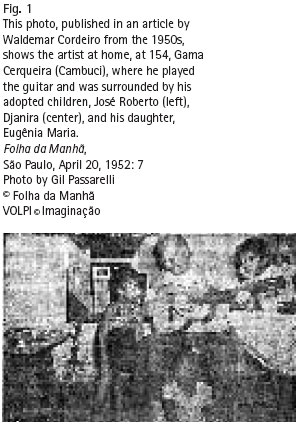
It was this aura of simplicity that art critics and writers employed to explain Volpi's personal and artistic purity as well as his intuitive approach. Even the Marxist critic Mário Pedrosa—one of the most important interpreters of Volpi's work and the chief curator of his first retrospective at the Museu de Arte Moderna do Rio de Janeiro (MAM-RJ, in 1957)—joined in bolstering Volpi's image of unaffectedness. That same year, in the exhibition catalogue for the MAM-RJ, Pedrosa wrote: "Volpi never consulted a foreign magazine to learn something about Picasso, Matisse, Renoir, Van Gogh, or Gauguin's production. He never needed to look at other people's solutions (Volpi is not a pretentious person); instead, he examined the people who surrounded him, the humble human beings who gathered around him, children… everyday things and daily chores." [Fig. 1] To the art critic, the painter was "incommunicado in the middle of the Cambuci area."3
]]>
Indeed, Volpi was not a theoretician, someone who clarified his conception of the visual arts through written formulations and debates. Nevertheless, there are few Brazilian artists who— apart from their artistic subjects— would have within their reach a richer cultural milieu. That is to say, a modern cultural scene in which dialogue and coexistence—and not merely etiquette and scholarly approach—prevailed, and thus taking into account the limitations intrinsic to one's cultural milieu. To ignore this would be to identify Volpi's painting with a simplicity that would undoubtedly diminish the quandaries and complexities of the work. If, on one hand, Volpi's painting seems to suggest an elementary approach lacking critical tension, on the other hand it would be deceptive to understand his painting merely as something accomplished with-out mediation or debate. As understood by the poet and art critic Murilo Mendes, Volpi "became impersonal, as anonymous as a painter from the Middle Ages,"4 because his painting concentrated on experience beyond subjective lyricism. However, as suggested by another artist and his friend, Willys de Castro, Volpi was able to "draw on a wealth of experience, which he shared—that is, translated and articulated—with thoseeager to embrace his work."5
Volpi maintained an intense level of productivity. During almost every phase of his career, he found ways to keep his own work in the forefront of discus-sions, participating in dialogues with other artists and intellectuals that promoted diverse trends. He fostered these connections with an outstanding and a real sense of purpose. I do not believe it was by mere chance that, in 1926, his curiosity led him to a lecture given by Filippo Tommasso Marinetti at Teatro Cassino Antárctica, in São Paulo. If Volpi's technical apprentice-ship began during his early years as a painter-decorator, it was only in the next decade of the 1930s that Volpi would come closer to joining an unoffi-cial association of artists—the Grupo Santa Helena—comprised of Francisco Rebolo, Mario Zanini, Manoel Martins, Humberto Rosa, Fulvio Pennacchi, Aldo Bonadei, and Clovis Graciano, among others. Most of these artists came from lower-class backgrounds and thus were not exposed to art. As a result, they were employed as vocational painters (as was the case with Volpi, Rebolo, and Zanini) or as butchers (as was the case with Pennacchi).
Despite their modest social and cultural backgrounds, the members of the Grupo Santa Helena participated in important discussions on the international art milieu. On one hand, in the case of Pennacchi, one could see the influence of the Italian Novecento in his paint-ings;6 moreover, Rebolo and Zanini analyzed the works of Carlo Carrà's fad, the "retour à l'ordre." On the other hand, the group was receptive to an Italian tendency that was overtly opposed: the Florentine painting promoted by Ardengo Soffici.7 In the second half of the 1930s, Volpi frequently attended art classes that the painter Paulo Rossi Ossir organized at his workshop; well-informed artists partici-pated in addition to those belonging to the Santa Helena group. [Fig. 2] Among them was Ernesto de Fiori, an Italo-German painter and sculptor who had arrived in Brazil in 1936 and maintained a high level of productivity as an artist and art critic; Lasar Segall, a Lithuanian painter of Jewish birth who was trained in the German Expressionist milieu and had already settled in São Paulo in 1923; Tarsila do Amaral, a member of the 1922 Semana de Arte Moderna generation, who also was closely affili-ated with the avant garde tradition in Paris; and, finally, the art critic Sérgio Milliet, as well as the sculptor Bruno Giorgi.
According to Giorgi's statement to the press at Folha de São Paulo (1979), the sculptor himself brought Mário de Andrade—a Modernist writer and well-respected intellectual at the time— and Milliet to Volpi's painting studio in 1937, and both scholars "were amazed."8 Later, in 1944, the year of Volpi's first solo exhibition, de Andrade bought Marinha [Seascape], now in the collection of the Institute of Brazilian Studies at the Universidade de São Paulo (IEB-USP). That same year de Andrade wrote an article for Folha da Manhã in which he described an "unrestrained temper" with regard to a painting that is "voluptuously lyrical."9 Even if we stop at this point in Volpi's career, it would be impossible not to refer to someone who was involved with the São Paulo artistic and cultural milieus.
From 1930 to 1947, the city of São Paulo was far from being a modern art center. Nonetheless, Volpi had the opportunity during this time to attend exhibitions on Cézanne, Matisse, Dufy, Picasso, de Chirico, Morandi, Carrà, Albers, Magnelli, Calder, Mario Sironi, and Giovanni Fattori, among many others.10 Volpi even studied the polemical 1917 exhibition of the Brazilian painter Anita Malfatti's work. In principle, attending art shows does not seem impressive by itself. Few Brazilian artists were able to incorporate productively into their own works all of the aesthetic influences within their reach. Consequently, Milliet's descrip-tion of Volpi, on one of his forays to the 1940 French Art Exhibition in São Paulo, perfectly illustrates the kind of rapport that the painter felt with the works displayed there. Accord-ing to Milliet, Volpi "used to go to the exhibition galleries for hours, every day, directly studying the originals that he had previously loved only from a distance.... Mainly, he was bewildered by Cézanne. ...The volumetric achieve-ment, the composition, the values, Volpi analyzed everything silently, interrupted from time to time only by the dull noise of his usual bad words."11 The reason that I have spent so much time elucidating Volpi's traits is that I want to destroy the artist's image— bolstered by the artist himself—as a talented noble savage.12
From the late 1940s to the 1950s, the period around which the core of my essay revolves, Volpi maintained an intense dialogue with artists and intel-lectuals who were deeply committed to overcoming Brazil's parochialism, in general, and São Paulo's art milieu, in particular. This exchange was carried out through the production of specific works. Very often, Volpi, the midcareer painter of the late 1940s Facades series, has been incorrectly ascribed positions on issues he did not actually endorse. Due to both his silence on and distance from the group's positions, Volpi came to be viewed in his old age as Cézanne was; that is, living in isolation in Aix-en-Provence, his public persona at the mercy of Émile Bernard, who offered him information and interpretations based on accounts by Maurice Denis, the artist's most frequent contact.13
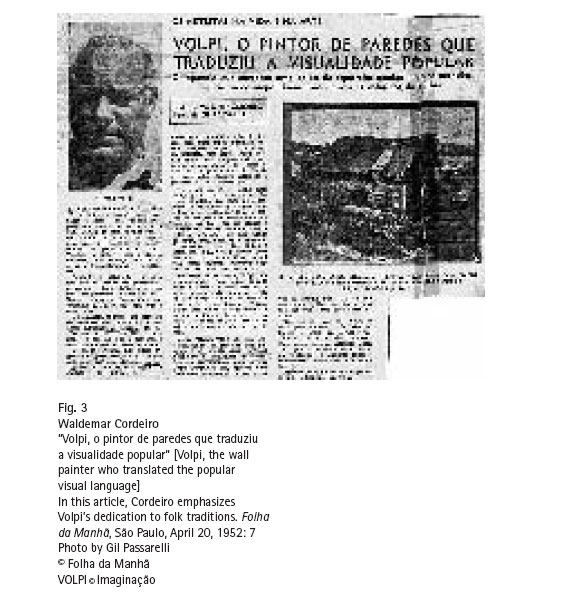
]]> It must be explained again that Volpi made an important six-month trip in 1950 to Italy and France, where he studied original works that until then he had known only through reproduc-tions. Concurrently, the painter maintained, from 1951 on, a close relationship with the psychoanalyst, art critic, and poet Theon Spanudis.14 And I also wish to underscore that Volpi was in contact with the São Paulo Concrete art group headed by Walde-mar Cordeiro, who wrote an article on him in 1952, the same year that the ruptura Manifesto was brought to light. [Fig. 3] From 1953 on, Volpi got along well with less orthodox Construc-tive painters, such as Willys de Castro and Hércules Barsotti. These acquain-tances were enriched in São Paulo by Décio Pignatari and the brothers Augusto and Haroldo de Campos, harbingers of Concrete poetry, and in Rio de Janeiro by Mário Pedrosa, among many others. In the late 1950s, Volpi's home in the Cambuci district became a meeting place for artists, and Volpi relished sharing his expertise with younger artists. During the 1960s, Volpi became acquainted with intellectual and artistic celebrities such as the Ital-ian poet Giuseppe Ungaretti [Fig. 4] and the Russian linguist Roman Jakobson, both of whom visited him at his work-shop. Their visits testified that Volpi was respected as an artist and not viewed simply as an exotic curiousity by Europeans passing through Brazil. Since the inauguration of the Museu de Arte de São Paulo [MASP], in 1947, and the decisive contribution of the First São Paulo Biennial, in 1951, an unusual number of high-quality art-works were presented in the country. To this day, the Second São Paulo Biennial (1953) is considered to be one of the most important modern art exhibitions of the twentieth century.15
By and large, Volpi's career is viewed as having developed organically. Nevertheless, as far as we know, his production during his so-called Concrete art phase—a period that lasted three years in the late 1950s, though this cannot be stated with certainty because he never dated his paintings— is represented by work reflecting the most radical shift of his career. Further-more, I am apt to believe that Volpi experimented with numerous options while creating his paintings during this period, demonstrating that, for at least a few years, the painter put aside previous methods of production.
Some of these changes are overwhelm-ingly obvious. The painter abandons paler and washed-out colors in favor of tempera's opacity, looking to create homogeneous, intensely chromatic surfaces. Volpi never adopted industrial painting as applied by Concrete art adherents. Two of his works exhibited at The First National Exhibition of Concrete Art (1956–57)—in which hetook part as a guest contributor—were built on a red tone that he had rarely used previously nor would he ever employ in future canvases. Also, the irregular characteristics of his Facades series, as well as the rough configura-tions that stressed handmade shapes, are substituted in this period by rigor-ous straight lines and strictly geometric forms. Many times—with regard to differences that will be tackled below— the outlined figures convey to each other a kind of dynamic link, seemingly in accordance with the ruptura Mani-festo. I mean, the artistic intuition "endowed with clear and intelligent principles" while "considering art as a means of knowledge deducible from concepts," and all sorts of experiences that tend "to [the] renewal of the fundamental values of visual art (space-time, movement, and matter)."16 Admittedly, the paintings during this period reveal a clearer nexus among forms and the evolutions therein. In one of the paintings shown at the Concrete art exhibition—Composição concreta branca e vermelha [White andRed Concrete Composition] (mid-1960s) —Volpi focused on a way to unify the elements of the work. [Fig. 5] Red is extended to the edges of the painting and is suddenly interrupted by the chesslike mesh that subtly organizes it, resulting from a progressive integration of the red surface into the regular grid in which red and white squares form a sequence. A pair of external diagonals (to the left and to the right) unleashes a movement that breaks the peaceful series of red and white squares, thus generating triangles that energize the composition so as to create new axes of perception. This occurs mainly if we consider that the position of these triangles is inverted in both directions, thus intensifying the dynamics of the whole. Stemming from the two diago-nals are two new ones (albeit interior) that, given the odd number of squares making up the work, have a parallel displacement instead of meeting each other. Such an uneven situation provokes, at the geometric center of the piece, the emergence of a parallelogram, a sort of taut combination of those triangles generated by cutting off the central squares. Due to its centrality and formal difference, this figure is highlighted, so that it operates as a sort of synthesis of movement that animates the static chessboard. It really appears as the only form that, while occupying two squares, could contain the key to elucidating the other procedures—the "construct" from which the work is figured: a diagonal cutting-off of a square.
In another work, identified as Concreto [Concrete Work] [see p. 319], the artist displays three vertical lines of triangles of the same size. The ones at right and center are yellow and share an identical position. The line at left is also begun by a yellow triangle (at the base); then, it rises in a sequence of green triangles that alternate in opposite directions. The canvas offers a much less strong and less clear dominance than the painting previously described, but it still follows Constructive procedures. The only triangle at left seems to suggest a mere continuity of the layout ruling the other pair of lines. By using irregular unfolding and different colors, Volpi tries to show evidence of how both the insertion and the alternate unfolding of similar shapes cause quite different perceptions and dynamics. If Josef Albers's influence could be evocative of such a dynamic percep-tion, this influence contributes to give every appearance of complexity indeed to the other two lines. They seem to avoid the symmetrical arrangement of the green triangles, which is more vivid, albeit more classical.
Compared with a painting by Waldemar Cordeiro shown at The First NationalExhibition of Concrete Art, Volpi's canvasis significantly different. In Cordeiro's Idéia visível [Visible Idea], the materialemployed is a sure indicator of the artist's intentions. Highlighted by the black protection in the background, the transparency of the support helps to make visible Cordeiro's idea. One way or another, Cordeiro avoids the mere concentric reiteration of the circles. Instead, the composition suggests some figures that—due to their eccentricity— give the impression that a lack of balance leads to circular dynamics, which in turn puts them into motion, precisely, for being unbalanced. Under the ascendancy of late Constructivism— Max Bill at the time was at the helm of the Hochschule für Gestaltung [School of Advanced Studies in Form] in Ulm— many of the pieces displayed in The First National Exhibition of Concrete Art gave greater importance to makingvisible the process that contributed to the final work itself. According to this thinking, the art that stemmed from industrial times would be unable to perform if old notions of intuition, inspiration, or genius were at work. Despite the fact that in 1956 it was easier to find a bigger rationality and formal unity among the Concrete group of artists in São Paulo, some artists from Rio—such as the painters Aluísio Carvão, the brothers César and Hélio Oiticica, Ivan Serpa, and the sculptor Franz Weissmann (mainly with regard to his Composição com semicírculos [Semicircular Composition] (1953)— often lapsed into employing similar methods.17
]]> The artistic breakdown between the São Paulo Concretos and the Rio de Janeiro Neoconcretos became official as soonas the latter's manifesto was published in the Jornal de Brasil Sunday Supple-ment on March 22, 1959, and at the Neo-Concrete Exhibition (held at theBelvedere facilities [Salvador, Bahia, on November 11 of the same year). Eventually, it became clear that ties between the groups had been acrimo-niously severed. I do not accept the premise that this split was the result of mere provincialism, because that obscures the complexity of the problem. Additionally, very few of the artists involved in the dispute were from either city, and the poet Spanudis, who signed the 1959 manifesto, and Barsotti and de Castro, both well-established artists in São Paulo, were all always closer to the Neo-Concrete movement. Nevertheless, because two versions of The First Na-tional Exhibition of Concrete Art were held (at MAM-SP in December 1956 and at the Ministry of Education and Health, Rio de Janeiro, in February 1957), some differences of opinion emerged. At the time that the Rio exhibition was carried out, both writers of the Neo-Concrete trend, Ferreira Gullar18 and Mário Pedrosa,19 made clear their points of disagreement with regard to São Paulo, and their refutations appeared in the press only two days apart. In spite of Gullar having set a much more polemical tone in his note, both his and Pedrosa's arguments were headed in the same direction. On one hand, the Paulistas were more theoreti-cally grounded, closer to embracing ideas and visual dynamics, either coping with simplified forms or avoiding any sort of subjective reference; on the other hand, the Cariocas were prone to the empirical, involving both sensuality and subjectivity. They understood painting as a result of color and matter, and not only as retinality produced by solid colors and intense shapes.A broad discussion on the polemical approaches of Concretos and Neocon-cretos is beyond the focus of this essay.20 What is important to stress, however, is that according to his output during the second half of the 1950s, Volpi seemed to straddle the influence of both groups, and always because of his unique artistic solutions. Indeed, one of the works that he created in 1958, Composição [Composition] [see p. 317], points away from the previous paintings scrutinized.
To begin, Volpi seems to plot a course according to the expectations set forth by Concrete art. His rendering is still homogeneous: the lines are quite straight, and—because the base of the left triangle and the brown irregular polygon (below) have (almost) the same dimension—the observer gets the impression that the left triangle could be generating a formal development in line with Concrete production. If an imaginary line is drawn linking the upper left angle of the brown polygon to its lower right angle, the result is in fact another triangle that shares similar dimensions with the one at left. That is to say, it hints at unleashing a formal dynamic, which is logical to a certain extent, but that is frustrated. Why? Be-cause of its irregularity, the brown strip inhibits the conclusion of the process.
In this way, the brown-colored area tends to show up more as a force field breaking the stability of the painting square than as a device merely implying the potential of motion. It is not by chance that the frame seems to move closer to the rectangle. Moreover, such a movement is reinforced by the fact that the strip becomes wider while ascending. If it were set in an inverted way—narrowing as it rises— it would be perceived inevitably as a mere perspective of a surface, and nothing more. Thus, the impression of one area operating on the other one would benegated because of the virtuality in which both would become entangled.
Because of the way it is extended, the brown strip is not exempt from ambi-guity: it can merely suggest a blade that is supported by the surface of the canvas. However, the illusion disappears because of its firm placement at the base of the painting. Instead of dynamics, the work as a whole has as its prevalent trait a lack of balance, which creates an unstable relationship between the brown strip and the field of the canvas. This intensifies much of its presence as a force operating on an unvarying field, albeit at the start of something more complex.
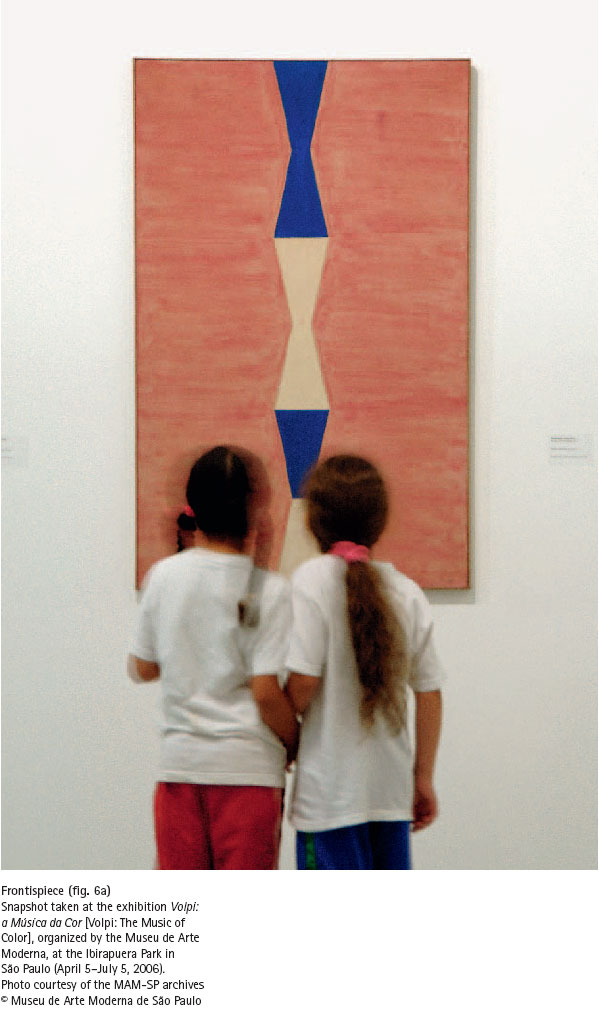
Perhaps most of Volpi's oeuvre within Constructive art's sphere of influence is closer to the aestheticism of Concrete art. [Fig. 6a, frontispiece, and Fig. 6b] Several other works, however, feature solutions closer to those described above, which imply a deeper involvement with Neo-Concrete art. Furthermore, the late 1950s painting Composição Concreta [Concrete Compo-sition] [Fig. 7] is also evolving in the same direction. From left to right, there is a triangle painted in a sort of faded red sepia, a trapezoid in a more intense red, and a white triangle.
In this canvas the chromatic relationship performs a much more important role than in the previous work analyzed. The intrusion of the left triangle into the trapezoidal area signals a triumph over the solid color that gives, in turn, more intense actuality to the form that unfolds next. But, ironically, the expansion of this form is restricted by the white triangle. Once again, Volpi operates on the assumption of a full-fledged formal dynamic, which is being thwarted. Indeed, the three more aggressive triangles directing the observer's gaze—the central triangle as well as the ones at the lower right of the painting—engage in an intense dialogue, a nexus of continuity in which the direction pointed out by the previous triangle is intensified by the next one. The result, however, is a sort of zero-sum, a realm of possibility (the lower right angle of the painting) in which the force field ceases to exist.
Everything leads us to believe that, during the same period, Volpi was painting canvases based on an array of styles, some closer to either Concrete or Neo-Concrete art, others refocusing his previous production. What is at stake, however, is understanding why in the late 1950s he nearly put aside his clear method of articulating formal elements in order to return to those that his early oeuvre usually highlighted: the repressed gesture, the emphasis on the handmade quality of painting, the timid and faded colors, the ongoing transfer of tones to different areas of the canvas. So, if we are to understand this resumption, we must take into account the extent to which the artist's experience with strong, clearly articu-lated shapes spurred change later on. This is at the crux of understanding one of Volpi's most prolific periods, the 1960s.
From Kasimir Malevich on, Construc-tivism—perhaps beginning with its earliest manifestation, Suprematism— aimed for art associated with techno-logical growth. Constructivism intended to create a form of expression that was equal to new challenges: "The past is unable to contain both the construction and the massive stream of our life. Just as in our technical life: we cannot take advantage of the same sailing ships used by Saracens; as in art, we must look for forms responding to new life."21 In our times, technique goes further; however, people strive to push art back more and more. A clear and evident nexus among the elements of either painting or sculpture would mirror—in a critical manner for sure— how these technical elements speak to each other and how their neat assimila-tion into nature occurs.22 In its last phase, primarily via Max Bill, such a Constructivist concern led to a vindica-tion of the formal clarity that reached the fringes of transforming the art-work's own structure into a reversible process, one in which the observer should remake all sorts of procedures carried out in either painting or sculp-ture. It is not by chance that the Möbius strip practically became the emblem of this way of thinking. All we have to do is to observe a sculpture such as Bill's Dreiteilige Einheit [Tripartite Unity](1948–49)—so influential in Brazilian art in the 1950s [see p. 52, frontispiece]— to get an idea of the widespread con-ception of form, as well as the problems that its reversibility, transparence, and linearity imply.
For Volpi (and in our effort to see his production as a whole), it would be practically impossible to thoroughly assimilate all of the possible premises, even if they are considered important to his pictorial education. In Volpi's painting a critical insight into both capitalist society and industry takes place, so that his work is completely devoted to a tighter notion of arts and craft than to a rigorous diagram of all technical, industrial, and mechanical processes.23 Volpi's way of sketching and moving closer to human beings depends on a protracted experience through which knowledge is constituted. I mean, a knowledge that grasps the formal aspect of matter and things without altering natural consistency or resisting technical procedures. Ideally, to Volpi, forms should accept the natural wear and tear of things, just as the rungs on an old ladder become rotten and concave with time. And this is precisely revealed by the hesitant development of Volpi's motives, which are rarely defined, except during the ascendancy of Concrete art in Brazil, in which Volpi became aligned with the principles of matter taking shape.
]]> Likewise, the relationship between forms is due to similar principles. In Volpi's best pictorial moments—at least from the late 1940s on—a very subtle tendency totones was made possible because of theinterplay among several elements in a work. In this respect, few artists were more important to Volpi than Giorgio Morandi.24 The proximity of tones unites some areas of Volpi's canvas, but with-out giving the impression of an outright subjection to a previous structure; even though such a structure exists, which is demonstrated by the complex profusion of bandeirinhas [flags] that dominate his production during the 1960s. What is at stake here is to find a common ground among the elements, rather than to ascribe false affinities to them. Volpi's approach to tempera helped to organize his painting. The artist's timid gestures are not related to a certain expressiveness that discloses a subjective drama; the gestures serve a decisive function: to contribute to the effective-ness of the tones. Insofar as colors are not really seen as a whole—just as the result of an application that yields a flat, homogeneous texture—they natu-rally tend to go beyond the fringes in search of their own identity. Coming closer to these border lines, any tonal transition is followed to the letter.This is where Volpi starts to get complex, I believe, and some of the difficulties in his work are found when the artist used more subdued colors, either in his Concrete art phase or in his previous as well as later production. He was unable to overcome the limits imposed by the traditional figure/background nexus. In my opinion, and according to the works already analyzed—in which the rela-tionship between his production and Concrete/Neo-Concrete discussions was underscored—Volpi has overcome such difficulties either by presenting more dynamic solutions or by constructing less readable paths, albeit encompass-ing brand-new and enticing ways out. By and large, however, the canvases are ruled by a certain stiffness, which, in my view, diminishes the strength of his works. Also, it seems clear to me that Volpi's own experience with regard to the discussions carried out by both Concrete and Neo-Concrete artists and poets is partly responsible for his inno-vative formal articulations, even though his solutions fell short of those achieved by his counterparts in both groups.
Volpi is invariably considered a great colorist, and I do not deny that color plays an important role in his painting. But it is paradoxical to characterize an artist as being prone to tones. In addition to Morandi, Henri Matisse was among Volpi's favorite modern painters because color in Matisse's paintings has an organizing function. Colors confirm and organize the surface of Matisse's works, even if their chromatic unity is challenged by the introduction of mani-fold arabesques and patterns. In Volpi's painting, however, such a movement is rarely consolidated. From time to time, some colors achieve a broader autonomy so that they hold on tightly to the surface of the canvas. Due to their timid application, however, the full intensity of those affirmative instants plays down the force of the tonal movement.
According to Constructivist aesthetics, the emphasis on impersonal, colored surfaces is justified by the search for an art departing from subjectivity and heading toward individuality. From the point of view of perception, what was at stake implied the need to find a sensible form to express the present, a present that is both anonymous and full of new possibilities; in other words, a time in which we would be freed from the shackles of tradition and receptive to new paths made possible because of technological innovation and the nurturing of human ability.
Volpi tries to be anonymous, but not in the present or within the sphere of industrial impersonality. The imperson-ality of his canvases stems from the very same lingering time through which his forms appear. Similar to his treatment of colors—and reminiscent of the frescos of which he was so fond—Volpi was committed to creating experiences evoking an age that had stratified in time.25 For this reason, his canvases needed to make evident their hand-crafted origin. It is through this kind of work, conveyed by one's experiences and put into practice—a tradition lost in time and therefore omitting every trace of individual approach—that Volpi wanted to build his hopes. The history that emerged from his works distrusted the availability of a present that required the past to be put in parentheses in order to accomplish its expectations.
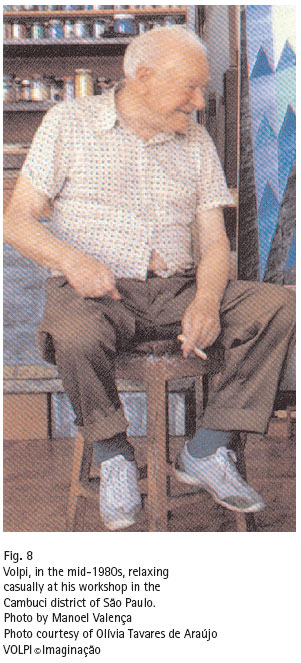
Moreover, there was a public image, an almost Franciscan look that Volpi crafted over the decades to reinforce the symbolic dimension embedded in his works. To wit, his inevitable hand-made cigarette, his clogs, his very simple dress, the personal framing of his pieces and the handmade paints, the countless children he adopted, the humble house he owned at 154, Gama Cerqueira in Cambuci, his readiness to help others in urgent need of humanitarian aid, and so on. These characteristics all spoke volumes about a lifestyle that veered as far as possible from trade, profit, and vested interests. [Fig. 8] As with the very subtle crafts-manship that his canvases suggest, Volpi himself would stand as a sort of last, great representative of a noble specimen in danger of extinction, as in the original; his works being both the exclamation point and thus the defining statement of that remote but worthwhile history. What is hidden by Volpi's persona—and for this reason I needed to begin by sketching it—is the fact that the artist reached these kinds of solutions because of his peculiar incorporation of modern tradition. And such solutions were not sponta-neous, shadowlike representations of the artist. So, we must understand why the Brazilian social experience followed a plot against an affirmative and differentiated art, as occurred both in the United States and in Europe under Constructivist concerns.
]]> I think, in his unique way, Volpi produced work that challenged the optimism that industrialization had introduced in Brazil, mainly from the 1950s on. And this challenge also echoed throughout the works of both the Concrete and the Neo-Concrete artists, in addition to other artistic and intellectual productions at the time in São Paulo or Rio. On the other hand, even if Volpi had absorbed the influence of Brazilian Constructivist movements, he later inverted the rule to have an impact on key artists belonging to those movements. To the best of my knowledge, it is almost impossible to consider Hélio Oiticica's pigmented Bólides series (1963–67) without acknowledging the influence of Volpi's canvases, in which the pigments are barely hidden.26 Moreover, Amilcar de Castro used to consider Volpi the top Brazilian artist, and I believe de Castro's displaced-cutout sculptures owe a debt to Volpi's tonal passages.27 The list becomes endless: the foldings of the Bichos [Critters] series (1960–63) by Lygia Clark; Aluísio Carvão's para-digmatic Grupo Frente piece Cubocôr [Color Cube] (1960); certain expansions unfolded in Franz Weissmann's sculptures; Lygia Pape's woodcuts of the Tecelares [Looms] series (1955–59), and this involves their simultaneous manual and geometric implications, and so on and so forth. All of these developments indicate that the issues embedded in Volpi's painting responded to questions that were not superficial with regard to Brazil at the polar extremes: the possibilities and the impossibilities.
According to Volpi, everything seems to indicate that the social order existing in Brazil was unfit to produce the proper answer to the challenges brought to the fore by industrial growth, urban planning, and competition. Beyond the complex issues set up by capitalist development in the country, Volpi responded with another sort ofcomplexity, the result of his sophisticatedexperiences as an individual and stem-ming from his quite different nature. Volpi refused to participate in either a differentiated game or an unavoidable conflict within such a new form of sociability. And it seems to me that his refusal really shows Brazilian culture, and so deeply that the discussion of his oeuvre—simplifications and reductions apart—contains at the very core a good amount of instruction.
NOTES
1 Volpi was born in Lucca, Italy, on April 14, 1896. He arrived in Brazil in October 1898.
2 See Olívio Tavares de Araújo, "Volpi 2006. Nenhum subterfúgio ou estratégia," in Volpi–a música da cor, exh. cat. (São Paulo: Museu de Arte Moderna de São Paulo, 2006), 21.
3 Mário Pedrosa, "Volpi, 1924–1957," in an exhibition catalogue of the artist's retrospective at the MAM-RJ, June 1957. Under the title "Introdução a Volpi," Pedrosa's essay was also published in Malasartes, no. 2, Rio de Janeiro (1976): 32–34. Repr., Otília Arantes, ed., Acadêmicos e modernos. Textos escolhidos III–Mário Pedrosa (São Paulo: edusp, 1998), 264, 268.
4 Murilo Mendes, untitled exhibition catalogue for the Galeria de Arte da Casa do Brasil, in Rome, 1963. Repr., Aracy A. Amaral, ed., Alfredo Volpi: pintura(1914–1972), exh. cat. (Rio de Janeiro: Museu de ArteModerna, October–November, 1972), 40.
5 Willys de Castro, Volpi pinta vôlpis, exh. cat. (São Paulo: Galeria São Luís, September 1960). Repr., AlfredoVolpi: pintura (1914–1972), 39. My emphasis.
6 See Tadeu Chiarelli, "Sobre a experiência brasileira de Fulvio Pennacchi," in Pennacchi–100 anos (São Paulo: Pinacoteca do Estado de São Paulo, 2006).
]]> 7 Lorenzo Mammì, Volpi (São Paulo: Cosac & Naify, 1999), 15–16.8 Quoted in the chronology established in Sônia Salzstein, Volpi (Rio de Janeiro: Sílvia Roesler/Campos Gerais, 2000).
9 Apud Mammì, Volpi, 25.
10 For a thorough consideration of these exhibitions, see the already cited works of Salzstein (chronology) and Mammì (foreword).
11 Milliet, "Alfredo Volpi," in Fora de forma (São Paulo: Anchieta, 1942), 135.
12 Eleonore Koch was the only painter that Volpi ac-cepted as his student (1952–53). They lived and worked side by side. She said he used to go to exhibitions on weekends, that he cherished the discussion of his works with other artists, and that he was extremely rigorous in his opinion of others' work. Statement to Fernanda Pitta, September 23, 2007.
13 See Richard Shiff, Cézanne et la fin de l'impression-isme, trans. Jean-François Allain (Paris: Flammarion,1995), mainly chapters 12–13. Original edition in Eng-lish, Cézanne and the End of Impressionism: A Study ofthe Theory, Technique, and Critical Evaluation of Modern Art (Chicago: The University of Chicago Press, 1984).
14 Theon Spanudis (1915–1986) was born in Smyrna, Turkey, to a Greek family. He graduated with a degree in psychiatry and psychoanalysis from the university in Vienna, arriving in 1950 in Brazil, where he practiced for a decade. Later, Spanudis studied Martin Heidegger's philosophy and became one of the first translators in Brazil of the Greek poet Kavafys. As of 1951, Spanudis became the main supporter of Volpi's work, either by buying his paintings or by writing about them. Spanudis influenced São Paulo collectors, and that aided the promotion of Volpi's work through different collections.
15 Among the foreigners, the presence of the following artists must be underscored: Paul Klee (65 works); Oskar Kokoschka (9 paintings); James Ensor (29 prints); Alexander Calder (45 pieces); Willem de Kooning (8 paintings); Robert Motherwell (5 works); Georges Braque (9 paintings); Robert Delaunay (5 works); Marcel Duchamp (The Chess Players only); Fernand Léger (7 paintings); Pablo Picasso (10 works, plus a 51-piece special hall that included his masterpiece Guernica); Constantin Brancusi (1 sculpture); Henry Moore (69 pieces); Piet Mondrian (20 works, including two Boogie-Woogie versions); Karel Appel (5 works); an exhibitionon Futurism that encompassed the works of Giaccomo Balla (5), Umberto Boccioni (10), Carlo Carrà (5), and Ardengo Soffici (3), among others; Giorgio Morandi (29 works); Edvard Munch (69 paintings); Joaquín Torres-García (4 works); and so forth. In addition to these, there was an outstanding show on modern architecture.
]]> 16 The ruptura Manifesto was read aloud and distributed as a flyer at the exhibition of the Concrete grupo ruptura at the Museu de Arte Moderna de São Paulo on December 22, 1952. The controversial manifesto was signed by Lothar Charroux, Waldemar Cordeiro, Geraldo de Barros, Kazmer Féjer, Leopold Haar, Luis Sacilotto, and Anatol Wladyslaw. Later, it was published in the daily press as "Ruptura," Correio Paulistano, São Paulo, January 11, 1953: 3. English translation in Héctor Olea and Mari Car-men Ramírez, eds., Inverted Utopias: Avant-Garde Art inLatin America (New Haven and Houston: Yale UniversityPress/The Museum of Fine Arts, Houston, 2004), 494; document 47.—Ed.17 For a comprehensive perspective on The FirstNational Exhibition of Concrete Art, see concreta'56, a raiz da forma, exh. cat. (São Paulo: Museu de Arte Mod-erna de São Paulo, 2006).
18 Oliveira Bastos and Ferreira Gullar, "I Exposição Na-cional de Arte Concreta, I, O Grupo de São Paulo," SDJB, February 17, 1957.
19 Pedrosa, "Paulistas e cariocas," Jornal do Brasil, February 19, 1957. Repr., Aracy A. Amaral, ed., ProjetoConstrutivo na Arte, exh. cat. (São Paulo: Pinacoteca doEstado de São Paulo, 1977). Also in Acadêmicos e mod-ernos, 253–56.
20 See Ronaldo Brito, Neoconcretismo. Vértice e rupturado projeto construtivo brasileiro (Rio de Janeiro:FUNARTE/Instituto Nacional de Artes Plásticas, 1985; 2nd ed. [São Paulo, Cosac & Naify], 1999).
21 Kasimir Malevitch, "Del cubismo y del futurismo al suprematismo. El nuevo realismo pictorico," in El nuevorealismo plástico, translated into Spanish by AntonioRodriguez (Madrid: Comunicación, 1975), 30. A thirty-one-page brochure titled "Ot kubizma i futurizma k suprematizmu. Novyi jivopisnyi realizm" was published in Moscow (1916), illustrating the text with a pair of Malevich's Suprematist paintings. French version in "Du cubisme et du futurisme au suprématisme: le nouveau réalisme pictural," in Malevitch. Écrits, presented by Andréi Nakov and translated by Andrée Robel (Paris: Éditions Ivrea, 1996), 182.—Ed.
22 Later, in 1920–21, Malevich will specify his criticism of a merely utilitarian technique. See Malevich, Dosnovos sistemas de arte, translated into Portuguese byCristina Dunaeva (São Paulo: Hedra, 2007), 26. A thirty-two-page lithographic brochure—three pages of which explain Malevich's nonlogical system—was originally published as "O novych sistemakh v iskusstve," Vitevsk Art School, 1920. French version in "Des nouveaux sys-tèmes dans l'art," in Malevitch. Écrits, 323–71.—Ed.
23 In this part of the argument, I repurpose some ideas, duly informed by debates and reflection, from my essay "Anonimato e singularidade em Volpi," in A forma difícil (São Paulo: Ática, 1996).
24 With regard to Morandi's problems facing industrial civilization, see Franco Solmi, Morandi: storia e leggenda (Bologna: Grafis, 1978).
]]> 25 I had the opportunity to talk about these issues with Domingos Giobbi, one of the main collectors of Volpi's oeuvre. With regard to my focus, Giobbi understands Volpi's work in a similar manner, because he began visiting Volpi's workshop in the late 1960s. Both Giobbi's shrewdness and sensibility speak volumes on the sophistication of some of the collectors of Volpi's work.26 As far as I know, Waldemar Cordeiro was the first to underscore an approach between Volpi's colors and "the clay [that he] used to color" walls in humble houses in the provinces. See "Volpi, o pintor de paredes que traduziu a visualidade popular," in Folha da Manhã, April 20, 1952: 7. According to Cordeiro, Volpi produced mas-terpieces by "heightening the visual acuity of Brazilian folks and raising it to a universal language." As a popular procedure in rural areas of Brazil, clay is diluted with water for whitewashing the exterior walls of houses. I also had a conversation with the artist Antonio Manuel, who was close to Hélio Oiticica in the 1960s and 1970s. Manuel thought the comparison of Volpi's work to Oiti-cica's pigmented Bólides series was too obvious.
27 I received a confirmatory response from Amilcar de Castro, to whom I was very close in the 1980s and 1990s. According to de Castro, the sculptures that he was creat-ing incorporated tonal hues influenced by Morandi's work; however, I believe that Volpi was instrumental in bringing de Castro's tonality to light.
]]>![[Fig. 2]](/img/revistas/s_nec/v4nse/scs_a04v4nsefig2.jpg)
![[Fig. 5]](/img/revistas/s_nec/v4nse/scs_a04v4nsefig5.jpg)
![and Fig. 6b]](/img/revistas/s_nec/v4nse/scs_a04v4nsefig6b.jpg)
![[Fig. 7]](/img/revistas/s_nec/v4nse/scs_a04v4nsefig7.jpg)