A política social no governo Lula
Maria Hermínia Tavares de Almeida
Translated by Enrique Julio Romera
Translation from Novos Estudos - CEBRAP, São Paulo, n.70, p.7-17, Nov. 2004.
The article focuses on the initiatives taken by the Lula administration regarding social policies. To begin with, we describe the social reform process implemented by the governments that followed the redemocratization of Brazil. Then, we examine some indices showing the evolution of social conditions due to social policies practiced during the democratic period. Finally, we analyze the views about the social question predominant in the PT government, as well as the most appropriate policies to tackle such a question. We also discuss the present government's proposals and initiatives regarding the social area.
Key words: social policies; Lula administration; Partido dos Trabalhadores - The Workers' Party.
RESUMO
O artigo enfoca as iniciativas do governo Lula na área social. Inicialmente descreve-se o processo de reforma social implementado ao longo dos governos que se sucederam à redemocratização do país. Em seguida são examinados alguns indicadores da evolução das condições sociais relacionados às políticas na área social no período democrático. Por fim, analisam-se as visões predominantes no governo petista sobre a questão social e as políticas mais apropriadas para enfrentá-la, discutindo as suas propostas e iniciativas na área social.
Palavras-chave: política social; governo Lula; Partido dos Trabalhadores.
On the 1st of January, 2003, Luiz Inácio Lula Da Silva took office as President of Brazil. This meant the first major change in governing elites in the country since the end of the military regime, in 1985. Until then the PT had been the only one out of the seven major Brazilian political parties that had always remained in opposition to the federal government. Despite the fact that the new government is supported by a coalition including parties that have been members of government over the last 19 years, the change in leading cadres has been quite profound. The PT is known to be an organization committed to social reform. Has their victory and the substitution of elites thereafter significantly altered the orientation of social policies? Although it is still early to answer such a question definitely, this article starts to pose an answer to it, on the basis of the initiatives taken by the new administration regarding the social issue.
We sustain hereby that regardless of the governmental rhetoric concerning the founding character of its social policies, the PT administration's proposals that managed to become anything other than printed matter, consist of a mix of continuity and change of emphasis and ways of management. Prioritizing income transference policies favoring the poor seems to be, up to now, the most distinctive feature of the PT administration's social policy, which differentiates it from what had been done in terms of welfare policies at a federal level. However, such policies imply a conception of social protection and a style of politics that are quite distant from the general expectations of reformist policy that the PT administration was supposed to implement.
]]> To understand up to what extent they have innovated or continued actions taken by previous governments, and moreover up to what degree they have set apart from traditional conceptions of left-wing social reformism, we need to examine the agenda of social reform implemented by the successive governments that took office since redemocratization. Thus, the first part of the article deals with the social reform program constructed by the political forces that opposed the military regime, and how it was partly implemented by civilian governments up to 2002. In the second part we show some indices of the evolution of social conditions due to welfare initiatives implemented during the democratic period. The third part deals with what seems to be the views on the social question predominant in the PT administration, as well as the most appropriate policies to tackle such a question, discussing the administration's proposals and initiatives.
The social reform agenda after redemocratization
The opposition to the authoritarian regime was exerted on behalf of the reestablishment of civilian freedoms and democratic institutions, the reorganization of federal relations by means of decentralization and the settlement of the so-called social debt, accumulated due to an economic model of growth that reproduced poverty and multiplied inequalities. At the social welfare level, the analysis of actions taken by the military government led us to identify some perverse features in the social protection system generated by the dictatorship: excessive centralization of resources and decision making on the part of the federal government, fragmentation and overlapping of policies and programs, inefficient social expenditure, cronysm, deterioration of the distribution of benefits and social services.
The system of social protection, which matured during the military regime was a mere variety of the conservative model, according to the definition by Esping-Andersen, or a meritocratic-particularistic model as Draibe and Aureliano2 prefer to call it. Through criticism against this conservative system, a social reform program took form, which would have to proceed in the direction of decentralization, the participation of beneficiaries in decision-making, the combat against cronysm in the use of social welfare resources, rationalization and more efficient spending and greater equity in the provision of benefits and social services for all. Also, a consensus arose about the need to promote emergency policies to assist the poverty-stricken population, while the eventual combined positive effects of sustained economic growth and a more efficient and equitable social welfare system would not yet come into being.
As in all social reform3 experiences, researchers from universities and state research bodies, - such as the Instituto de Pesquisa Econômica Aplicada (Ipea) Research Institute of Applied Economics - and from international organizations - such as the Pan American Health Organization (PAHO) and the Latin American and Caribbean Institute for Economic and Social Planning (Ilpes/ECLAC) - have been decisive in elaborating diagnoses and reform proposals. Changes in the welfare model started when the first civilian government took office, and were explicitly included in the 1988 Brazilian Constitution4, its objective being to provide health care, basic education and security for all. Regarding the distribution of responsibilities among government levels for the provision of welfare goods and services, a decentralized cooperative federal model was conceived, widening municipal attributions. Such changes in the design and scope of policies and federal responsibilities would be counterbalanced by a new structure for financing social expenses, characterized by a significant decentralization of taxing.
Throughout the 1990's the social reform guidelines defined in the new Constitution were gradually implemented by slowly decentralizing responsibilities and resources and expanding the provision of benefits and social services, particularly as regards health care, basic education and social assistance. Two factors were decisive in this process. The first one was the monetary stability achieved with the Real Plan, which made welfare resources more predictable. The second one regards a long-lasting institutional learning about the creation of incentives to decentralize responsibilities and enhance cooperation among the various government levels concerning the provision of welfare goods and services. Thus, during the second half of the decade the municipalization of social assistance and the basic health-care network5 was completed. In addition, significant progress was made in transferring the responsibility for the first four years of basic education to the cities. Furthermore, access to basic education and public health care became available to almost everyone; meanwhile social assistance was significantly widened through programs of guaranteed income for the elderly and the physically or mentally handicapped.
During Fernando Enrique Cardoso's first term of office the distortions in the welfare system, characterized by the deterioration of the distribution of benefits, began to be corrected. Through altering the Constitution, a moderate reform was carried out concerning the private sector retirement system. The minimum age and the number of years the beneficiaries must contribute before retirement were modified. (the required time of contribution) However, the public servants' retirement system, where the largest distortions were found, remained untouched6. Finally, regarding social policies geared to the poorest and most deprived, several significant innovations took place.
During Cardoso's both terms of office a set of programs were created, as components of a social protection network, which would also include the rural retirement system and the non contributive social assistance programs, such as: Bolsa-Escola - School Allowance, Erradicação do Trabalho Infantil - Eradication of Child Labor, Bolsa-Alimentação - Food Allowance, Auxilio-Gás - Gas Subsidy, Agente Jovem - Youth Program, Programa de Saúde da Família - Family Health Care Program, Programa de Apoio à Agricultura Familiar - Family Farming Support Program, plus the Alvorada Project, supporting the 2.361 Brazilian towns with the highest rates of inhabitants living below the poverty line. All these programs consist of direct transference of monetary income to the beneficiaries, centrally managed by the Federal Government7. Thus, the basic food basket distribution programs, which were often subject to cronysm, were eliminated.
The direct income transference programs demanded certain conditions to be complied with by the beneficiaries, such as school attendance and family visits to health care units, assuming that compliance with such requirements would later generate conditions for the self-sufficiency of the beneficiaries. However, monitoring the compliance with such conditions was difficult. On the other hand, the establishment of automatic mechanisms for the transference of resources supporting education, health care and social assistance narrowed the chances of political bargaining and cronyism, even though these were not eliminated. Finally, the Comunidade Solidária program, created and directed by first lady Ruth Cardoso, tried new forms of collaboration among ministries and civil society organizations, aiming at extending the borders of the public sphere beyond the state itself.
]]> Some areas were left out of the reforms process: a minimum consensus was never arrived at regarding housing and sanitation policies; no innovative initiatives were taken with regard to big cities. Despite the importance of social protection programs during Cardoso's second term of office, the emphasis was always put on policies for the general public - especially basic education and basic health care. In this respect, the agenda on the reform of the social protection system defined in the previous decade was maintained, aiming at greater equity and universal access to such programs8.
The slow (and limited) settlement of the so-called social debt.
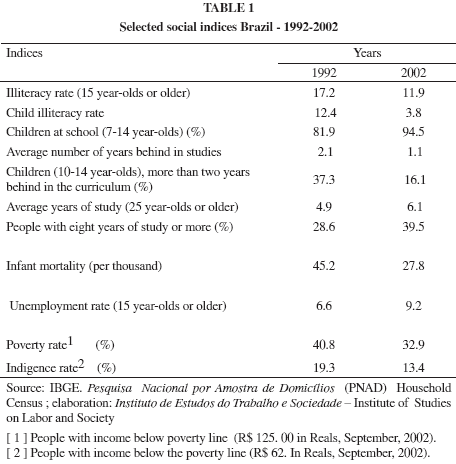
The changes in the social protection system, deriving from the efforts taken by the three levels of government, and the stabilization of the national currency undeniably produced positive results, however modest. Table 1 shows some indices in this respect, for the period 1992-2002: illiteracy rate was reduced, access to and levels of education were bettered, infant mortality lowered and the number of poor and needy decreased. These results acquire greater significance when considering that inflation was only controlled in the mid 1990's, economic growth was sluggish and unemployment grew.
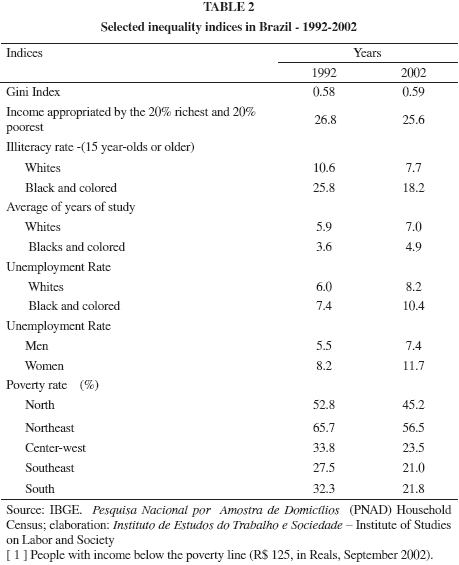
However, the improvement in education, health care, poverty and indigence indices contrasts with the persistence of inequalities - which are measured following different procedures. Acute inequalities were noted in the same period between rich and poor, whites and not-whites and different regions within the country, as indices show in Table 2.
]]>
In short, when the national elections delivered the federal government to the PT and its allies, previous governments had already implemented an important part of the reform of the social protection system inherited from the authoritarian regime. They had also achieved limited success against poverty, improved education and health care conditions and yet failed to reduce inequalities. However, this was not the PT's diagnosis of the facts.
Social policy in the elections and later
Lula and his allies had a strong and efficient electoral campaign discourse, that consisted of emphasizing the extent of poverty and the existing inequalities within the country, and in presenting their opposing coalition as being most capable of tackling such issues. Their rhetoric ignored the progress achieved in a decade and a half of democracy by the previous governments, technical elites and social movements - many of which, as happens, were connected to the PT. In contrast, their discourse emphasized the secular nature of Brazilian social problems, and only Lula's victory would produce the necessary changes. Due to the force of the image of the candidate and his party, rather than to the definition of proposals, the political change acquired a precise social content: the substantial reduction of poverty and inequality, plus the full social inclusion of the millions of poor people throughout Brazil. Regarding social policy, Lula's election would be a turning point.
The only concrete promise in the campaign was the creation of jobs, through the alteration of the economic policy in order to resume sustainable growth. Concerning social policies as such, little was said during the electoral dispute, as usually happens in such circumstances. Two documents on social policies were made public before and immediately after the elections: "Zero Hunger Project: A Proposal on Nutritional Safety for Brazil", dated 2001, and "Economic Policy and Structural Reforms", produced in the period between the election and the time when the new government took office. The first one, elaborated by 45 researchers from the PT think-tank Instituto Cidadania-Citizenship Institute, under the orientation of Jose Graziano Da Silva, consisted of a combination of social assistance policies with wider reaching family farming incentives9.
The second document, prepared by a Finance Ministry team, composed by economists of liberal orientation who were not PT members, was an ampler statement on the future direction of the Lula administration. Focused on economic policy, the document included a chapter on proposals for social policies, in which the reform of the retirement system was outlined in the chapter that dealt with the issue of long-term fiscal balance. The declared objectives were the following: restructuring the balance of the public welfare system, guaranteeing its solvency in the long term; reducing pressure on resources, expanding the capacity of public expenditure; increasing equity and reducing the distortions in income transference carried out by the State.
Regarding social policies, the objective was to reduce its regressive effects by improving the effectiveness of both welfare programs and expenditure, concentrating on the lowest income bracket10. Little was said on other overall policies besides the retirement system, and policies aimed at the very poor were given distinct priority, these being the very heart of welfare policy. The document from the Finance Ministry -inspired on a text prepared by a group of liberal economists from Princeton University, entitled "Lost Agenda"11 -reconsidered issues from the previous social reform program, as endorsed by the World Bank and the neoliberal ideologists. It reflected the opinions of the finance minister's team - to which one of the authors of the "Lost Agenda" pertained - rather than the views of most of the P.T. intellectual cadres.
]]> Thus, Lula started to rule bearing two proposals for the social issue, both placing the very poor in the center of the government's social policy. The first proposal coming from the party was excessively complex - it demanded the collaboration among several ministries and government levels - and it was based on a wrong diagnosis12. The second one, which had not been elaborated within the party, was severely criticized by party intellectuals. Actually, besides campaign messages, during its years in the opposition the PT had not formulated a thorough diagnosis of the challenges posed by the social issue, so as to define clear priority actions and get partisan consensus. Consequently, the first steps of the new government regarding the social issue were initiatives of strong symbolic impact both nationally and internationally.During the first days of the new administration the Zero Hunger program was launched and simultaneously a proposal on social welfare reform was announced. This was the first legislative initiative of the government, which was approved in late 2003 after months of discussion. The proposal started at the point where the Cardoso administration had left it: the reform of the public servants retirement scheme. It undermined the existing system of privileges by establishing the same retirement allowance ceiling for employees of the public and private sectors, as well as creating the complementary retirement system, to be defined in specific legislation.
The proposal of social welfare reform unmistakably aimed at correcting the distortions of an iniquitous and backward benefit system. Hence, it gave continuity to the reform agenda elaborated during redemocratization - particularly the previous government's program. However, it also was a proposal undeniably welcome by international agencies, foreign investors and the domestic conservative establishment, who expected the new government to deliver signs of political moderation and to remain within the parameters of fiscal austerity.
Likewise, the Zero Hunger program had aroused universal sympathy and widespread approval both from international agencies, foreign governments of various political leanings and by organizations and personalities committed to the struggle against globalization. Moreover, it provided the government with success d'estime in international forums. Domestically, it incited the mobilization of civil society and strengthened the image of a president identified with the socially excluded, due to his life history and political career.
However, in contrast to the proposal for welfare system reform, the Zero Hunger program lacked substance and clearly defined objectives, seemingly ignoring the series of social protection network programs established by the previous government. It consisted of a series of interventions, such as: transference of monetary income (Cartão-Alimentação - Food Card - Food-Card), distribution of basic food baskets, creation of food canteens for the poor and food banks, purchasing food from family farms, nutritional education programs, drilling artesian wells, building popular housing projects, milk distribution and basic education programs. It required that the actions taken by various ministries be coordinated by the Ministério Especial de Segurança Alimentar - Special Ministry for Nutritional Safety, a difficult task to carry out. This program was based on a questionable diagnosis related to social needs within the country, and it assumed that hunger was the central problem facing the poor in Brazil. Finally, it was precariously implemented in a centralized manner, as the federal government got directly involved in the cities, skipping state governments and participatory institutions created beforehand.
The weakness of the program was becoming clearer, and towards the end of 2003 the Special Ministry for Nutritional Safety was merged with the Ministry of Social Assistance, the minister became a special advisor to the Presidency and the Cartão-Alimentação - Food Card was incorporated to a new program of direct income transference, the Bolsa-Família - Family Allowance, thus unifying three of the programs created by the Cardoso administration: the Bolsa-Escola - School Allowance, Bolsa-Alimentação Food Allowance and Auxilio-Gás - Gas Subsidy. By means of agreements, the interventions of the federal, state and municipal governments were unified via a single program of direct income transference. The Bolsa-Família - Family Allowance, still in its implementation phase, is today announced as the leading force of the Lula administration's social policy13.
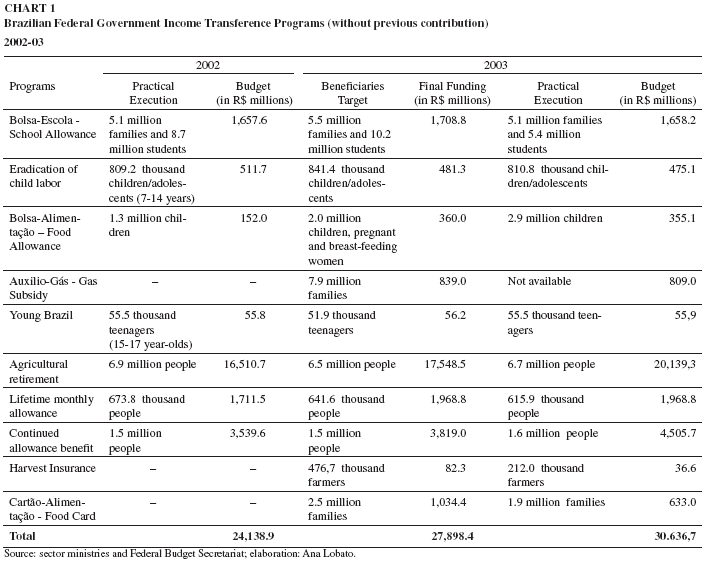
If we examine the budgets and practical execution of the income transference programs implemented in the last year of the Cardoso administration and in the first year of the Lula government, we see the limited reach of the Cartão-Alimentação - Food Card, in comparison to the already existing programs, as presented in Chart 1. It also indicates the continuity of efforts between the two governments with regard to income polices geared to the poorest.
Up to the present, the retirement system reform, the Zero Hunger program and the Bolsa-Família - Family Allowance (established at the beginning of 2004) have been the main initiatives of the Lula administration regarding the social issue. The First Job program, aimed at providing work for poor young people, and launched by the Ministry of Labor in 2003, did not get off the ground, while health policies were marked by a strong continuity in relation to the previous government. In the first year of office educational polices were characterized by the revision the orientation so far followed, without clearly establishing objectives and priorities. Minister Cristóvam Buarque's term in office was marked by the recurrent announcement of initiatives, which never actually materialized14. After his substitution, at the beginning of 2004, higher education seems to have become the government's priority15.
As for basic education, the main proposal presented is the transformation of Fundef (Fundo de Manutenção e Desenvolvimento do Ensino Fundamental e de Valorização do Magistério - Basic Education Maintenance and Development and Teachers' Fund) into Fundeb (Fundo de Manutenção e Desenvolvimento da Educação Básica Basica - Education Maintenance and Development Fund), which allows for the inclusion of secondary education within the system of incentives established by the previous government. Its implementation will mean a significant improvement in the policies to promote education, as long as additional resources are invested, so that funds destined towards basic education are maintained16.
]]> Conclusions
Despite the strong symbolic association between president Lula and his party, on one hand, and social reform on the other, the new government did not seem to have a clear and realistic standpoint on social protection schemes, capable of guiding its social policies. By examining the record so far, Lula's policies seem to follow those of previous administrations, in particular those of the Cardoso government. At the same time, the emphasis of governmental intervention seems to have moved away from policies geared to society as a whole - such as education and health - towards assistance programs aimed at the poor, such as Bolsa-Família - Family Allowance. Hence, the current social policy is partly different and moves away from the course followed since the mid 1980s, being now closer to narrower social protection conceptions.
Received for publication on the 8th of September, 2004.
Maria Hermínia Tavares de Almeida is a professor of the Department of Political Science at USP.
1 Article published simultaneously in the El Debate Politico magazine (Buenos Aires). The author thanks Andres Urani and the Institute of Labor and Society Studies for the information in the charts above.
2 Esping-Andersen, Gosta. The three worlds of the welfare capitalism. Princeton: Princeton University Press, 1990; [ Links ] Aureliano, Liana and Draibe, Sonia. "A especificidade do Welfare State brasileiro ". In: MPAS/Cepal. A politica social em tempo de crise: articulação institucional e decentralização, vol. 3. Brasilia, 1989. [ Links ] In opposition to these authors, Werneck Vianna includes the Brazilian system of social protection in the "residual" or "liberal" model, since it would especially aim at the poor, while the needs for protection of the middle social strata would be provided by the market (Werneck Vianna, Maria Lúcia. A americanização (perversa) da seguridade social no brasil. Rio de Janeiro: Revan, 1998). [ Links ] I think however that this thesis is difficult to sustain, when we take into account the characteristics of the retirement system - in particular the one which serves the public sector - and of the of basic education system, where the offer of public school places meets about 90% of the demand.
3 Cf. Heclo, Hugh. Modern social policy in Britain and Sweden: from relief to income maintenance. New Haven: Yale University Press, 1974; [ Links ] Rimlinger, Gaston. Welfare policy and industrialization in Europe, America, and Russia. New York: Wiley & Sons, 1982; [ Links ] Weir, Margaret, Orloff, Ann S. and Skocpol, Theda (orgs.). The politics of social policy in the United States. Princeton: Princeton University Press, 1988; [ Links ] Esping-Andersen, op. cit.
4 The debate and first initiatives regarding the health care system reform started during the Sarney government. The federal government still set up emergency programs aimed at the poor, milk distribution being among those which stood out. Also from this period are the first experiments in decentralization of education, carried out by state governments. The changes introduced in the Constitution are summarized by Sonia Draibe (Brasil, anos 90: as políticas sociais no marco das reformas estruturais. Campinas, 1999, mimeo. p. 10): "a) the broadening and expansion of social rights, [ Links ] b) social security as a more encompassing form of protection, c) a certain reduction of taxes as a structuring principle of the system, d) universal access and expansion of coverage, e) recovery and redefinition of the minimum values of social benefits, f) greater State commitment to the welfare system, bigger degree of public provision of social goods and services".
5 In 2001, 90% of the 5,531 Brazilian cities had already taken over the full running of the basic health care network. ]]>
6 For an analysis of the retirement reform, cf. Melo (2002).
7 The city halls registered the beneficiaries - via the Caixa Econômica Federal (federal government saving bank), but later they lost control of the distribution of benefits.
8 For an example of these standpoints, see the official Brazilian government document for the United Nations conference "Copenhagen + 5", Brasil, Ministério das Relações Exteriores (Foreign Office). Brasil - relatório nacional, Copenhague +5. Brasília, 2000. [ Links ]
9 The Zero Hunger program implies three great sets of initiatives. The first one includes structural policies: generation of jobs and income, social welfare for all, incentives to family agriculture, expansion of the agrarian reform, school-allowances and minimum income. The second implies specific policies: a food-coupon program (later substituted by a direct transfer of R$ 50 to each beneficiary by means of the Cartão-Alimentação - Food Card), donation of emergency basic food baskets, maintenance of safety supplies, higher quantity and quality of foods, expansion of the Programa de Alimentação do Trabalhador-Worker's Food Program, combat against infant mortality and malnutrition, a broader school meal program, consumption and nutritional education. Finally, there should be policies for rural areas, small and medium sized cities and metropolises, with a series of measures, which in the latter two cases include food banks, run on donations (cf. Instituto Cidadania. Projeto Fome Zero - uma proposta de política de segurança alimentar para o Brasil. São Paulo, 2001). [ Links ]
10 The document says: "The small capacity of social expenditure of the Union in reducing income inequality derives from the fact that a good part of the resources is destined to the non-poor, and from the inefficient management of resources destined to social programs. The lack of specific evaluation of the impacts of these resources on the benefited population, contributes in a decisive way to this problem […] Moreover, it is necessary to reformulate the State collection and transference schemes in order to reduce income inequality […] these policies could be sufficiently effective in redistributing income, as they have been in other countries" (Brasil, Ministério da Fazenda. Política econômica e reformas estruturais. Brasília, 2003, p. 15). [ Links ]
11 Coordinated by the economist Alexander Scheinkman, the text was presented as a contribution to the debate during the electoral campaign of 2002.
12 This proposal assumed that the main problem of the Brazilian poor is lack of food, when it is known that malnutrition and chronic hunger affect only a small part of the millions of Brazilian poor. These people need more than just food. They need public services - health, education, sanitation - with reasonable quality, decent housing and a supplementary income to cover other necessities. For a criticism of the Zero Hunger program diagnosis cf. Monteiro, Carlos Augusto. "A dimensão da pobreza, da desnutrição e da fome no Brasil: implicações para as políticas públicas". Estudos e Pesquisas. Brasília: Inae, nº 53, 2003. [ Links ]
13 The Bolsa-Família - Family Allowance foresees that a part of the transferred income will not require any conditions, establishing a minimum family income in the country, plus the possibility of a second part of income conditioned to children's school attendance. In practice, monitoring of this condition remains as difficult as in the Bolsa-Escola - School Allowance and Bolsa-Alimentação - Food Allowance cases.
14 At the beginning of Lula's term of office, combat against illiteracy, which is far from being the main Brazilian educational problem, seemed to be central to educational policy.
15 Remark the change in the evaluation system of higher education, with the substitution of the so-called "Provão" by the Enade (National Examination of Student Performance) and the controversial introduction of quotas for the poor, colored and indigenous peoples in public universities and private institutions, which in turn benefit from fiscal exemptions. A broad proposal on tertiary education was presented for debate by leading members of the Ministry of the Education (Haddad, Fernando e outros. "A reforma da educação superior". Teoria & Debate, vol. 17, nº 59, 2004, pp. 18-21), which is not discussed hereby, as it exceeds the scope of our treatment of social welfare policies. [ Links ]
16 In case there are no additional resources, it is possible that the pressure on cities to expand access to pre-school day care centers, and on state governments to broaden secondary education, might deviate funds now destined to basic education, where the problem is no longer general access to primary schools, but the improvement of school standards. If so, the Fundeb scheme would tend to be a setback.