Ana Maria Mustapic
Universidad Torcuato Di Tella/CONICET
Translated by Judith Evans.
Translation from Revista Desarrollo Económico, São Paulo, v.45, n.178, July/Sept. 2005.
SUMMARY
]]> Since the 1980s, there have been numerous presidential resignations in different countries in Latin America. With respect to this phenomenon, this article puts forward two questions: What circumstances are most favorable for provoking presidents to resign and what is the impact on the presidential system. To address these questions, a case study is used, that of the presidency of de la Rúa in Argentina (1999-2001) with the aim of constructing a hypothesis that should be tested by additional research. This analysis contends that Argentine presidential resignations took two forms in accordance with the distribution of party power in Congress: a) a parliamentary response to the crisis and b) a presidential response to the crisis. The first occurred in a multiparty context that facilitated the formation of alternative parliamentary majorities. Within this framework, Congress deprived the president of support, precipitating his departure. The second seems to be characteristic of contexts that are bipartisan or in which there is a predominant party. In this case, it is the departing president who, within a crisis situation, manages to oversee an orderly succession. As for the impact of presidential resignations on the functioning of presidential regimes, the article puts forward the importance of redefining the place of the fixed term as a characteristic of presidentialism. In light of the numerous presidential resignations, the fixed presidential mandate does not seem to be a necessary component of the definition of presidentialism as it is, in contrast, for legislators. From this another question arises: when analyzing the political dynamic of presidentialism, it is necessary to incorporate presidential resignation as a possible factor.
1. Introduction
Conventional knowledge asserts that the resignation of a prime minister has a central role in the architecture of parliamentary regimes as it establishes the political dynamic in a decisive manner. However, the resignation of a president is not within the procedures of presidential regimes; resignations are exceptional and, in fact, it is their absence that structures the relations between the Executive and the Legislative branches of government. In light of what has occurred in Latin America since the 1980s it is obvious that this understanding requires modification. Presidents, in effect, have resigned more than anticipated. We have, for example, the cases of Collor de Melo in Brazil, Siles Suazo, Sánchez de Lozada y Mesa in Bolivia, Raúl Cubas in Paraguay and, in special manner, the Argentine experience. Since Argentina's transition to democracy in 1983, resignations, more or less precipitous, were tendered by presidents Raúl Alfonsín in 1989, Fernando de la Rúa in December 2001, Adolfo Rodríguez Saá a week later and Eduardo Duhalde in May 2003. In just over two decades, only Carlos Menem managed to complete his two presidential terms.
The greater occurrence of presidential resignations, without a parallel rupture of democracy, has not gone unnoticed by political analysts. Some authors emphasize their novel aspects. John Carey (2002), for example, points out that Latin American constitutions continue to be formally presidential. However, they are acquiring a profile more akin to parliamentary systems through the informal practices which have led to the replacement of presidents. On the other hand, Fabian Bosoer (2003) identifies these phenomena as "crises with safety nets", which is to say, crises that avoid a democratic rupture by finding solutions within the framework of the capacities and resources of the existing institutions. Proposing that such exit formulas be called "neo-parliamentarism", Aníbal Pérez-Liñán (2003) makes reference to the strengthening of Congress, given the greater capacity that legislators have shown for prosecuting, removing and replacing presidents. As a result, the risks to Latin American presidential systems today are linked more, in his opinion, to the instability of elected governments than to the instability of democracy as such. Finally, María Matilde Ollier (2004), based on an analysis of the Argentine case, calls attention to the effects of the fragmentation of political parties on the government's stability.
Other authors, particularly Arturo Valenzuela (2004), focus, above all, on the negative effects of presidential resignations. According to Valenzuela, the fact that fourteen Latin American presidents have had to pass through what he calls "undignified situation" of being deposed before the end of their term, whether because of a political prosecution or of finding themselves forced to resign, reveals the persistent instability which afflicts presidential systems. Faithful to his original position, Valenzuela encounters in these "interrupted presidencies" yet another reason to continue arguing in favor of parliamentary systems or, at least, qualified presidential regimes. In spite of these differing points of view, all of the authors develop their arguments based on the same assumption: the military alternative, that is to say, the probability of a democratic rupture in Latin America by means of a coup by the Armed Forces, is notably less in the present than it was in the past. Under these circumstances, presidential crises – as in the analytical category proposed by Pérez-Liñán – are being resolved by another means, namely the substantive intervention of Congress.
In the following investigation, the new phenomena of presidential resignations will be analysed under the assumption that the authoritarian alternative is not viable. On assuming that this way out of crisis is not available, it is understood that the relevant actors arrive at solutions within the margins, not always precise of course, of the existing rules of the game. Within this framework, the questions posed are: a) under what circumstances is a presidential resignation likely to be provoked, and b) what is the impact of a resignation on the presidential system.
In order to address these questions a case study will be used for the purpose of constructing a hypothesis which should, of course, be tested by additional research. The case of President de la Rúa (1999-2001) will serve as the focus of analysis, to which will be added discussion of other Argentine presidential resignations. This analysis contends that the Argentine presidential resignations took two forms: a) a parliamentary response to a crisis and b) a presidential response to the crisis. The first occurred in a multiparty context that facilitated the formation of alternative parliamentary coalitions. Within this framework, Congress deprived the president of support, precipitating his departure. This created a situation analogous to a vote of censure. The second seems to be characteristic of contexts that are bipartisan or in which there is a predominant party. In this case, it is the departing president who, within a crisis situation, manages to oversee an orderly succession.
As for the impact of these processes on the functioning of presidential systems, it is important of emphasize all the elements that attest to the supposed rigidity of presidentialism. The obligatory reference on this subject is the rich and productive debate initiated by Juan Linz, also joined later by Arturo Valenzuela (1994). Linz maintained that a fixed term introduced rigidities in the political process of presidential regimes by making it more costly to replace a president who loses the confidence of his party or of those parties that brought him to power. The voluntary resignation of a head of state is, according to the author, an improbable result and, in any case, exceptional. Moreover, he considers Congress is, likewise, unable to negotiate the underlying conflict in such a crisis. A framework is created that favors a stalemate between the Executive and Legislative powers, endangering the very survival of democracy.
]]> The numerous resignations that have occurred in Latin America seem to contradict some of the arguments made by Linz, particularly with regard to the lack of flexibility of presidential regimes. However, simultaneously, the departures confirmed the relevance of the problem he emphasized, the rigidity of presidential terms. In effect, it could be argued that a presidential resignation is a solution to this problem in that it is a means of making a term more flexible. If that is the case, it requires taking another look at the fixed term as part of the definition of presidentialism. At the same time, the possibility of a presidential resignation should be a potential outcome to be introduced in the analysis of the political dynamic of presidentialism.This reading of presidential resignations is inserted in a context of more diverse empirical evidence than was previously available. In the past, the reflections on presidentialism were based on two sources: the stability of the presidential system in the United States and the instability of those in Latin America. Today, the growth in the time horizon for Latin America's democracies provides more information each time that the actors, given the absence of a coup threat, have resource to new, unexplored strategies for confronting the problems of governing. Presidential resignation can be understood as one of these strategies.
This investigation will be organized in the following sections: The first part will analyse the distribution of institutional power under the presidency of de la Rúa and the strategies employed to overcome the problems of a divided government. The second treats the consequences of the strategy used on the parliamentary majority. In the third section the focus is on the succession law and its role in the final outcome. The fourth part incorporates an analysis of the other cases of presidential resignations in Argentina in accordance with the hypothesis formulated on the basis of the de la Rúa case. In the conclusions the implications of presidential resignations are evaluated with regard to both the conventional definition of presidentialism as well as its political dynamic.
2. Divided government and presidential strategy
The divided government, which is to say, that situation in which the president does not have his own majority in Congress, whether in one or both chambers, is identified in the specialized literature as one of the causes of stalemate between the Executive and Legislative branches. In the case of Argentine presidentialism, a divided government is a familiar configuration. Since the beginning of the democratization process in 1983, two of the three popularly elected presidents, the Radicals Raúl Alfonsín and Fernando de la Rúa, faced not only a Senate whose majority was in the hands of the Justicialist Party (PJ) but, on occasions, with a Chamber of Deputies in which they did not have an absolute majority. Not even President Menem had an absolute majority in both chambers, except for a short period between 1995 and 1997. In his case, the difficulty presented itself in the Chamber of Deputies, in which the Peronist legislators, while still numerous, did not in any case obtain the half plus one required for a majority. As well demonstrated in the work of Ernesto Calvo et al. (2001), divided government in Argentina isn't just one of the foreseeable results of the presidentialist design, but one that has roots in other institutional causes. These are the disproportionality and majoritarian and party bias in the national and provincial electoral systems. These biases end up favoring one party in particular, the PJ, and contribute to assuring its dominant position in the Senate. One of the consequences of the interaction between the national and provincial electoral systems and voter preferences is that any party other than the PJ that wins presidential elections confronts, at this point in history, a divided government. In the period studied in this paper, this other party was the UCR; its two presidents, Raúl Alfonsín and Fernando de la Rúa, governed with a Senate controlled by the PJ.
The de la Rúa presidency, moreover, added other aspects that made it unique. To begin, the 48.4 percent of the votes that gave it victory were not sufficient to avoid his presidency developing under the uncomfortable combination of being both a coalition government and a divided government. In effect, de la Rúa became president through an electoral coalition, the Alliance, created in 1997 between the Unión Cívica Radical (UCR) and the Frepaso. Second, he not only headed a coalition government but also a minority government, as the Senate was controlled by the Peronists. He was, therefore, exposed to a double risk: the veto power of the Senate opposition and the discordances common among coalition partners.
The picture just described would not be complete if two other factors were not mentioned. In the first place, in contrast to his predecessors, de la Rúa was never the head of his party but rather only an associate of a UCR faction based in the Federal Capital. In the second place, he was neither a leader nor promoter of the Alliance, the coalition that brought him to office. Clearly, in terms of political support, de la Rúa began his presidency in a weak position. It is taken for granted that a president without a parliamentary majority faces difficulties in his relations with Congress. In a similar scenario, the unavoidable question deals with the strategies that the Executive adopts to confront the legislative power. To take these into account, it is useful to recall the typology elaborated by G. Cox and S. Morgenstern (2002). The authors, interested in the distinct forms of the relation "President-Congress" in the process of taking decisions, identified, as ideal types, four pairs of strategies: 1) imperial president-recalcitrant legislature, 2) nationally oriented president-parochial legislature, 3) coalition president-workable legislature, and 4) dominant president-subservient legislature. Each will be succinctly examined.
When the president considers the legislature as "recalcitrant", that is, it does not approve his proposals nor demonstrate any proclivity to agree, it is most probable that he will use an imperial strategy to carry out his policies, depending on his capacity to take unilateral decisions. The second and third strategies apply when legislatures are disposed to negotiate and differ in what is offered or obtained as the product of the negotiation. The parochial legislature receives in return for its approval small and not so small favors on the part of the Executive; the coalition legislature, basically interested in taking part in decision-making, negotiates policies and seeks to obtain concessions in that area. Last, when the legislature is in debt to the president and shows that it is disposed to accept practically all the proposals he formulates, then there is a dominate president and a submissive legislature.
The president has in his reach, then, a range of strategies: confront the Congress, impose his preferences, buy the legislators, seek cooperation. Naturally, this does not mean that all of these options are available at all times. A first dimension to take into account is presidential legislative attributes; a second is presidential agenda power. According to these, the range of options expands or narrows, particularly the greater or lesser ability to act unilaterally. In the specific case of Argentina, the institutional architecture clearly evolved in the direction of strengthening the presidential functions, as was made manifest in the 1994 constitutional reform. In that instance, the decrees of necessity and urgency acquired constitutional status as did the power of the partial veto with partial implementation. To that, the new Constitution also added the authorization to delegate legislative powers to the Executive under exceptional circumstances, although for an expressly fixed period. With the incorporation of these mechanisms, the legislative powers of the president and the power of his agenda were enhanced. As a result, in comparative terms, the Argentine presidency is among those that has at its disposal the greatest legislative powers. (Shugart and Haggard, 2001).
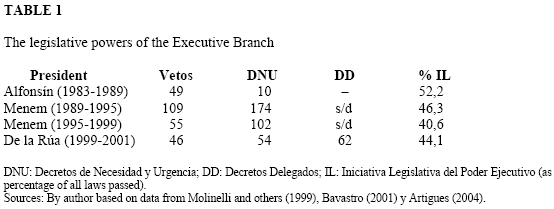
]]> The degree to which Argentine presidents made use of these powers has differed. Box 1 reviews the information on the distinct ways in which each president has resorted to the use of legislative powers.A reading of Table 1 reveals the following presidential profiles: President Alfonsín was the most cautious in the use of legislative powers, although it is necessary to point out that his term in office took place before the 1994 constitutional reform. President Menem, in contrast, had no hesitancy in seizing upon the decrees of necessity and urgency (DNU) even before their constitutional authorization. Moreover, Congress delegated powers to him in a number of instances. As for the two years of divided government and de la Rúa's minority, not only are they distinguished by the quantity of emergency decrees, but also for the number of delegated decrees. On this point one significant indication was that, at the beginning of 2001, de la Rúa obtained legislative powers from Congress through the approval of Law 25.414. Under this law, he handed down sixty-two decrees using those delegated powers.
The table presented above serves as a first approximation for identifying the kind of strategy used by each president in his relations with Congress. In comparative terms, it can be argued that Alfonsín placed more emphasis on a negotiating strategy (Mustapic-Goretti, 1992), while Menem and de la Rúa relied on their "imperial" prerogatives. The characterization of presidents Alfonsín and Menem are in line, certainly, with the conventional views of their administrations. They also conform to the results of research into the issue (Mustapic-Goretti, 1992; Ferreira Rubio-Goretti, 1998; Llanos, 2002). By contrast, the description of President de la Rúa's strategy as imperial may come as a surprise. His style of government was hardly associated with the image of a decisive and determined president, more typical of those that can count on unilateral powers to govern. However, it shouldn't be overlooked that the use of powers is consistent with weak presidents in that they cannot depend on parliamentary political support, either because they have no majority in Congress or lack cohesion within their own followers.
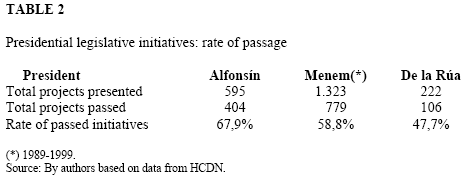
Another indicator that reinforces the different presidential profiles is the rate of approval for laws presented by each one of them.
The numbers shown in Table 2 are congruent with the comments made above. With a Senate controlled by the opposition, President Alfonsín presented projects compatible with the preferences of the legislators; this is one of the possible reasons for the higher rate of approval for his initiatives (Mustapic-Goretti, 1992). Menem and de la Rúa were under less pressure to take such precautions. The first had no hesitation about crossing constitutional barriers in order to evade congressional participation, particularly, by means of emergency decrees. De la Rúa, on the other hand, relied on a generous range of legislative powers turned over to the Executive in the 1994 constitutional reform.
]]>
Returning to de la Rúa's presidency, there is an important point within the typology of Cox and Morgenstern as it can't be applied to de la Rúa's case. According to these two authors, the legislative counterpart, as previously described, of an "imperial" president is, in principle, a "recalcitrant" Congress. In their analysis it is understood that the president opts to act unilaterally because he expects the legislature to reject his proposals or he refuses to agree to any kind of compromise. This, however, was not what happened under President de la Rúa. Without doubt, Executive-Legislative relations went through tense moments. Even so, observers underscore that de la Rúa got a good portion of what he asked for from Congress. In addition, it is difficult to use the adjective "recalcitrant" to describe a Congress which in order to approve the delegation of legislative powers secured the cooperation of the opposition PJ.
Why did President de la Rúa end up choosing a unilateral strategy when he was in principle not facing a recalcitrant legislature and had, at the least, two other possible strategies, the parochial and the negotiating? A tentative reply is that the last two strategies were not available. It is notable, in the first place, that the government employed the parochial strategy. In this way, it sought to neutralize the Senate's veto power over the first important project of its administration: the labour reform. Certainly, beyond an evaluation of the situation as it stood, what was present in the minds of those that decided how to proceed was the ghost of the total failure experienced by Alfonsín in the Senate in 1984 when the Mucci labour union law was rejected by a single vote. The method elected by the government of de la Rúa and its final result could not have been more disgraceful: bribery and scandal. This took place at the beginning of his term.
There was no reason that the brakes placed on this strategy need to have closed the door to the negotiating option. The difficulty in embracing it was perhaps the absence of a leadership with the authority to negotiate. In this regard, it should be recalled that de la Rúa was neither a leader of his party nor of the coalition that had voted him into office.
He lacked, in principle, the authority – and possibly the ability and the interest – to undertake this role. In any case, de la Rúa relied to a great degree on his unilateral presidential powers, the option that was probably most in tune with his own vision of the exercise of power.
3. The risks of the unilateral strategy
The first danger to which a president who employs a unilateral strategy is exposed is isolation. The earliest victims of such a strategy tend to be his own bases for parliamentary approval. This may well be a price that such a president is willing to pay. However, a second danger, with greater consequences, goes hand in hand with the first: the readjustment of coalitions within Congress. This was not a likely under the Alfonsín or Menem presidencies; but, in contrast, it was probable under de la Rúa. A key aspect for explaining these differences has to do with the changes that took place in the parliamentary system. This merits attention.
]]> The inaugural elections of 1983 had once again placed the traditional two party Argentine system, based on the two strong party families, Radicals and Peronists, at the center of the political scene. During Alfonsín's government, the two party logic favored disciplined behaviour on the part of the legislators. In critical moments, the Radical legislators ended up rallying behind the presidential leadership as occurred, for example, with the polemical approvals of the laws dealing with trials of the military, the Law of Due Obedience and the Full Stop Law (Ley de Punto Final). At the same time, this logic meant that the Peronists, though internally divided, at decisive moments, voted as a bloc (Mustapic, 2000).Menem governed under a much more favorable scenario in terms of the distribution of institutional power. His party, it should be recalled, had an absolute majority in the Senate and was very close to this number in the Chamber of Deputies. Even so, he profusely relied on unilateral mechanisms to carry forward his policies. One of the reasons was the resistance mounted by members of his own party as a consequence of the drastic turn taken by the government's policies (Gerchunoff and Torre, 1996). In effect, the pro-market orientation of his proposals went counter to the more interventionist and nationalist tradition of Peronism. Part of the internal opposition translated into desertions in the Chamber of Deputies at the beginning of the 1990s. But, in the first stage, this did not enlarge the ranks of the opposition, mainly because the two party system still retained such strength. So the majority coalition in Congress continued in the hands of Peronism.
Under the government of de la Rúa, the political map was substantially different: the two party system had been replaced by a multi-party system in which the PJ preserved its dominant position. The votes registered for the UCR and the Frepaso yielded the greater number of legislators in the Chamber of Deputies but was still insufficient to initiate a session. For that reason, the cooperation of other parties was necessary. On the other hand, the domination of the Senate by the Peronists pointed toward the possibility of forming alternative coalitions, as was to be expected under a multi-party system. This possibility had not existed during other presidencies. Under Alfonsín the only alternative that the UCR government had was a coalition with the PJ. True, in critical moments there was no lack of calls for a government of national unity but this scenario was not seriously on the agenda of any of the actors. During Menem's terms, the dominant position of the PJ precluded any space for other options.
The favorable terrain for the rise of alternative coalitions began to build with desertions in the Alliance's own ranks. The first, most notorious and dramatic, was, without doubt, the resignation of the vice president of the Republic and leader of the Frepaso, Carlos Alvarez. The other, strictly in the parliamentary arena, occurred when members of the Alliance lead by Deputy Elisa Carrió, formed a new group, Argentina for a Republic of Equals (ARI). At the same time, changes were taking place within the de la Rúa government as Domingo Cavallo, leader of another minority party, Action for the Republic (APR), was brought into the Cabinet in the same position he had held under Menem's presidency, Minister of Economy. It should be clarified that these rearrangements, the government coalition still remained just as much a minority given the control of the PJ in the Senate.
The power configuration just described was again modified following the 2001 elections. The PJ made advances in the Senate while the Alliance lost its relative majority in the Chamber of Deputies, which passed into the hands of the PJ. As a result, the PJ became the political force in the best position to form an alternative parliamentary coalition. A combination of factors contributed to transform this coalition into a government coalition. One of them was the law to be applied when there was no head of state (Ley de Acefalía).
4. Ley de Acefalía
In December 2001 the Ley de Acefalía (Number 20.972), the law governing presidential succession that was sanctioned in 1975 in the last years of the government of María Estela Martínez de Perón was applied for the first time. This put the novel mechanism, which conferred a key role on Congress, to the test. Under the old Ley de Acefalía Congress had no particular active role. While it is true that it participated in the order of succession by means of, first, the provisional president of the Senate and later the president of the Chamber of Deputies, this was no more than a transitional government. In effect, the law established that the authority that took charge of the Executive power should call for new presidential elections in thirty days. This was, for example, the course followed in 1973 following the resignations of the president and vice president of the nation, Héctor J. Cámpora and Vicente Solano Lima, in order to make way for the election of Perón.
In contrast, the law in effect in 2001 conferred on Congress the power to elect a new president to complete the term of the resigning president. This paved the way, when faced with the simultaneous absence of a president and vice president, for the formation of a new government to become the responsibility of Congress as in parliamentary systems. One of the consequences of the rulings of the new law is that it opened the system to the formation of government parliamentary coalitions. Be aware that the accent here is placed on the term government. This is to say, that what is being dealt with is not only the presence of alternative parliamentary coalitions to approve laws but coalitions disposed to support a government as well.
This point can be illustrated with the succession process precipitated by the resignation of de la Rúa. During the course of the crisis two government parliamentary coalitions were formed, both headed by the PJ. The first designated as president the Peronist leader of San Luis province, Adolfo Rodríguez Saá; following his resignation, the second coalition designated Eduardo Duhalde. The results of the voting in Congress can be found in Table 3.
]]>
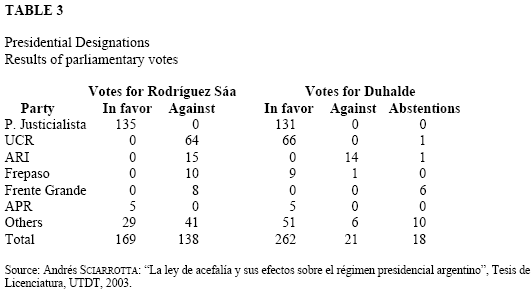
The process merits the following comments. In both vote counts, the vote by the Peronist legislators was disciplined. However, the bloc confronted cohesion problems. At least three examples can be mentioned. In the first place, the reluctant support for Rodríguez Saá was reflected in a peculiar restriction introduced at the moment of his appointment: leaving aside the dictates of the law which mandated that the designated president should complete the term of the departing president, Congress imposed on Rodríguez Sáa the obligation to call presidential elections within three months. In the second place, it insisted that these elections should take place under the system of double simultaneous voting. This proposal which implied, at the very least, a modification of the Electoral Code, was clearly a reflection of the PJ's internal divisions. Finally, the low level of cohesion in the Peronist universe was attested to by President Rodríguez Saá's own confession. In his letter of resignation he emphasizes the lack of support he received from Peronist governors: "Some governors who didn't understand the seriousness of the moment with held support from me."
Barely a week had passed when the Ley de Acefalía had to be applied for the second time, this time to designate as president Eduardo Duhalde, senator and Peronist leader in the powerful province of Buenos Aires. On this occasion, the parliamentary majority was broader as it also included a good part of the forces that up to a few days before had been the government, the UCR and the Frepaso, and had opposed the appointment of Rodríguez Saá.
5. Presidential resignations in Argentina
As has been shown, President de la Rúa, in the framework of a minority coalition government, preferred unilateral Executive action, resorting to his ample constitutional powers. With the background of a profound economic, social and political crisis – the latter clearly exposed in the October 2001 legislative elections – the elected strategy isolated him from Congress and even resulted in the loss of support from his own ranks. The absence of a vice president activated the formation of an alternative parliamentary coalitions in Congress when it was faced with a possible application of the Ley de Acefalía. One indication that the Peronist opposition in Congress was heading in the direction of a change in government is offered by a revealing fact. At the end of November 2001, at the moment of designating its new authorities, the Senate broke with an informal rule: it did not name as provisional president of the Chamber – and, given the lack of a vice president, the first in the line of succession – a member of the government party. Up to then, this had been the usual practice. On this occasion Ramón Puerta, a representative of the PJ, the opposition party with a majority in the Senate, was selected.
The president's isolation plus the scenario of social tumult and mobilizations precipitated his stepping down. It is interesting to note that the context in which de la Rúa submitted his resignation was similar to that produced in a parliamentary system: before abandoning his office and without success, the went to Congress in search of a "vote of confidence". The text of his resignation revealed: "My message today in order to assure governability and construct a government of unity was rejected by parliamentary leaders." At the same time, the loss of the confidence of Congress was made clear in the gesture – at this stage, December 20, 2001, symbolic for sure – of defeating the law, that in March of that year, had delegated legislative powers to the Executive.
]]> With respect to the question raised regarding those circumstances which precipitate presidential resignations, the de la Rúa experience shows that the presence of alternative parliamentary majorities tends to favor presidents stepping down. The change in government, driven by the presidential resignation, is viable when parliamentary backing exists to support a new administration. What is interesting to underscore is the existence of a replacement formula. This exit plan softens the traumatic impact that forced removals of a president tend to generate. The other three cases of presidential resignations reinforce this hypothesis.In an earlier section, the withdrawal of Rodríguez Saá, a similar episode, was examined. The resignations of Alfonsín and Duhalde, in contrast, had distinct characteristics. In the first place, they were not driven by the loss of parliamentary support but rather by critical junctures. In the second place, the "parliamentary solution" was not available for the simple reason that there were no alternative parliamentary majorities. Neither was the other typical parliamentary solution, the impeachment, viable. Therefore, a "presidential solution" was appealed to. This implied depending on another range of resources available to the Executive, centrally, advancing the electoral calendar and resigning once the elections produced a new president. In that manner, Alfonsín and Duhalde left their positions once they had assured an orderly transition.
Having arrived at this point, it is pertinent to introduce a comment related to the role of the vice presidency. In none of the crisis situations through which Argentina lived was the succession of the vice president an available option. Víctor Martínez resigned together with Alfonsín; Carlos Alvarez, the vice president under de la Rúa, left shortly after taking over his office. Rodríguez Saá and Duhalde didn't have vice presidents, as the law for replacing the president did not foresee their designation. This fact suggests – except in the case of Alfonsín where the vice president's resignation was part of a deliberate combined strategy – that the absence of a vice president, together with the possibility of forming alternative coalitions in Congress, opens the doors to government instability. A case in which this condition was not present, that of Menem, helps to reinforce the argument. Menem governed a good part of his term without a vice president, as Duhalde had stepped down in order to become governor of the province of Buenos Aires. At no time did this absence create a scenario of government instability. The two party format up to 1995 or bipolar – PJ vs. the Alliance – between 1997 and 1999, limited the possibility of forming alternative parliamentary coalitions. Beginning in 2001, with the progressive disintegration of the Alliance and the installation of a multiparty system, this scenario was modified, facilitating the formation of alternative parliamentary coalitions.
6. Conclusions
The analysis of the Argentine case opens a range of questions to take into account. To begin with, it makes manifest that one of the factors precipitating a presidential resignation in crisis situations is the "difficult" combination of presidentialism and multiparty systems, opportunely discussed by Mainwaring (1997). But, paradoxically, it also indicates that this same combination facilitates a way out of the crisis by creating a scenario favorable to the formation of alternative parliamentary coalitions able to support a new government. The result is a procedural innovation: the presence of a manner of making the presidential term more "flexible" beyond the complicated procedure of a political trial. It is convenient to emphasize that this flexibility does not respond to a specific rule, as is the case in parliamentary regimes. However, there may be a combination of informal rules – those related to the presidential succession – that facilitate the introduction of mechanisms that, through reiteration, can be converted into formal rules.
On the issue of presidential terms becoming more flexible, the case study suggests that becoming flexible varies in accordance with the rules of succession adopted by each country. A comparison between Argentina and the United States is pertinent to the analysis. The vice president tends to be the successor to a president who has resigned. When this option is not available, Congress may be called upon to designate a new president, as occurred in Argentina. But there may also be rules that establish a fixed and explicit order of officials to occupy the presidential position should there be no vice president, as in the United States. This is, in any case, a procedure whose application is decidedly exceptional as, above all, the legislation in the United States impedes a vice presidential vacancy. In effect, the constitutional amendment of 1967 established that should the vice presidency not be occupied, the president must appoint one, subject to confirmation by a majority in both Houses of Congress. Under this legislation, first Gerald Ford in 1973 on the resignation of Richard Nixon's vice president Spiro Agnew and, second, Nelson Rockefeller in 1974 when Ford took over the presidency upon Nixon's resignation, were confirmed. Note that, as a consequence of this crisis, neither the president nor the vice president who held office between 1974 and 1976, Gerald Ford and Nelson Rockefeller, were elected by a popular vote for these positions but were, rather, appointed by the president with the approval of Congress. Leaving aside such particular cases, on comparing one and another mechanism of succession, it seems obvious that the principle of rigidity in presidential terms, understood as a less likely possibility of Congressional intervention, is stronger in the United States than in Argentina. Even so, in neither of the two cases is Congress alien from the crisis of presidential succession.
A digression will conclude the discussion of this issue. The emergence from the crisis by means of a de facto flexibilizing of the presidential term, illustrated by the Argentine case, is similar to the proposal for constitutional reform elaborated by J. Linz and other political scientists and constitutional experts at the beginning of the 1990s for Bolivia. Precisely, to dissipate the negative effects of Bolivian minority presidents and term rigidity, they proposed the incorporation of a vote of constructive censure. This convergence between the observed behavior and the reform proposals reinforces the diagnosis formulated by Linz with regard to the problems of presidentialism. The difference is that Linz perceived certain consequences, particularly the rupture of the democratic system, given that he considered a military alternative as being available. Absent this option, its place is occupied by the alternatives that the actors extract or imagine within the institutional framework and the power relations within which they operate. One of the consequences of this new structure is what today attracts the attention of analysts: the strengthening of Congress (Carey, 2002; Perez-Linan, 2003) as an institution capable of dealing with crisis situations.
Another aspect that the Argentine case highlights is the presence of two kinds of possible solutions to a presidential crisis: the parliamentary outcome and the presidential outcome. In the first case, Congress is the key actor it generates or forces the resignation of the president, building support for a new successor to the office. In the second, Congress behaves in a more passive role, one limited to accompanying the presidential decision to step down. This variant appears to be more suited to two party systems or one in which there is a dominate party. The recent crisis of Bolivia's President Mesa illustrates the point.
Mesa became president of Bolivia following the resignation of Sánchez de Lozada, under whom he served as vice president, within the framework of what this article has called the "parliamentary outcome" of the crisis. Later, cornered by party fragmentation in Congress and the mobilization and social protests in the streets and looking to strengthen his position, he submitted his resignation to Congress. Congress, in what was evaluated as a successful "vote of confidence", rejected it. A few days later, he proposed moving up the date for presidential elections, relying on the "presidential outcome" to the crisis that had been successful for Alfonsín and Duhalde. The rejection by the Bolivian Congress of this way out supports the hypothesis that this mechanism is more viable under two party or dominant party systems. In the end, Mesa resigned and the Law of Presidential Succession was applied but not before congressional pressures were brought to bear: the Senate president, lacking parliamentary support, did not assume the office but, rather, the second in the line of succession, the president of the Supreme Court, replaced Mesa.
]]> In terms of the impact of a presidential resignation on the presidential regime itself, there are three comments. In the first place, a more general point. In the light of analysis, it should be understood that it is necessary to redefine the place of fixed terms in the characterization of presidentialism. A fixed presidential term is not an essential component in the definition of presidentialism as it is for legislators. It should be kept in mind that the idea of a fixed term rests on the fact that, compared with parliamentary regimes, the destitution of a president by means of a political trial is a more costly procedure than a vote of censure. In other words, it isn't that presidents can't be forced to step down, but the institutional measures for doing so require more than the opposition of a majority. Today, the high number of presidential resignations in Latin America shows that the lack of congressional support can affect the fate of a president in a way similar to that of a vote of censure. In contrast, there do not exist mechanisms to dissolve Congress.A second question that follows from these observations is that, in analysing the political dynamic of presidentialism, a fact that should be included in the equation is the possibility of a presidential resignation. To have at hand as an alternative the possibility of forcing a president to resign could contribute to promote cooperation between the Executive and the Legislative branches. The first interested in promoting such behavior should be the president. From this perspective, and taking issue with Valenzuela's argument that sees presidential resignations only as a sign of instability belonging to presidential systems, they have the potential to strengthen stability. A presidential resignation should not be seen, therefore, as an "undignified" situation but rather, as in parliamentary regimes, as evidence of a loss of parliamentary support.
Finally, a third question that illuminates this analysis is the role played by the vice president. With the current rules of succession, the analysis of presidential resignations in Argentina reveals that the possibility of creating a situation in which the lack of parliamentary approval provokes government instability is also tied to the permanence and loyalty of the vice president. When there is no vice president or, one can add, when the vice president has his own ambitions, the president is more exposed and has fewer resources to deal with the moods of Congress. Therefore the position that has up to now been considered secondary can play a crucial role in government stability in presidential systems. The case study used in this article demonstrates that presence or absence of a vice president weighs on the dynamic of the political regime in moments of crisis.
To conclude, placing this case study within a more general argument on the functioning of institutions, it can be assumed that today the authoritarian alternative is increasingly unavailable on the immediate horizon for Latin American countries. This situation, by limiting certain strategic options, mainly the resort to military coups, creates opportunities unknown in the treatment of presidential crises. It does so by directing the search for solutions to the utilization of the toolkit offered by existing institutional rules. In other words, when the only possible game is democracy, unforeseen alternatives within that game appear on the table. One of them is presidential resignation.
Certainly, a significant number of presidential resignations have been accompanied by protests and social agitation, with diverse degrees of repression and violence. This is not to disregard that this new political dynamic creates a framework propitious for a learning process. Over the course of this apprenticeship two things can happen; either government instability is accentuated or the government begins to diminish the risks of conflict. In the first case, the learning process translates into a strengthening of congressional factions; in the second, mechanisms of greater cooperation between the Executive and Congress are encouraged, particularly, the growth of coalition governments.
Bibliography
Alvarez, Carlos, y Morales Solá, Joaquín (2002): Sin excusas, Sudamericana-La Nación, Buenos Aires. [ Links ]
Artigues, Javier (2004): "Iniciativa Legislativa del Poder Ejecutivo (1932-2003)", in: Revista de Derecho Parlamentario, Nº 11, Secretaría Parlamentaria, Dirección de Información Parlamentaria, Cámara de Diputados de la Nación. La versión on-line can be found at: http://www1.hcdn.gov.ar/dependencias/dip/publicacion/revderpar-11.pdf. [ Links ]
Bavastro, Roberto (2001): "The Dynamics of Latin American Presidentialism. Government and Opposition in Argentina: 1983-1995". M. Phil Thesis, University of Oxford. [ Links ]
Bosoer, Fabián (2003): "1999-2003: el auto-rescate de las democracias sudamericanas. Una hipótesis sobre la eficacia del «componente parlamentario»". Debates Latinoamericanos, año 1, Nº1, octubre, Buenos Aires. [ Links ]
Calvo, Ernesto, Szwarcberg, Mariela, Micozzi , Juan Pablo, y Labanca, Juan Facundo (2001): "Las fuentes institucionales del gobierno dividido en la Argentina: sesgo mayoritario, sesgo partidario y competencia electoral en las legislaturas provinciales argentinas". In Ernesto Calvo y Juan Manuel Abal Medina (h.): El federalismo electoral argentino, Inap-Eudeba, Buenos Aires. [ Links ]
Carey, John (2002): "Legislatures and Political Accountability", Harvard Review of Latin America, Fall 2002: 32-34. [ Links ]
Carrizo, Carla (2002): "Presidentes, partidos y dirigencia política en Argentina: del gobierno de partido al gobierno competitivo (1983-2000)". In Wilhelm Hofmeister (comp.): Liderazgo político en América Latina, Konrad Adenauer Stiftung, Brasil. [ Links ]
Cox, Gary, y Morgenstern, Scott (2002): "Epilogue: Latin America's reactive Assemblies and Proactive Presidents". In Scott Morgenstern y Benito Na-cif: Legislative Politics in Latin America, Cambridge University Press. [ Links ] A Spanish language version can be found in Gary Cox y Scott Morgenstern: "Legislaturas reactivas y presidentes proactivos en América Latina", Desarrollo Económico, Nº 163, vol. 41, octubre-diciembre 2001. [ Links ]
De Luca, Miguel, Jones, Mark P., y Tula, María Inés (2002): "Back Rooms or Ballot Boxes? Candidate Nomination in Argentina". Comparative Political Studies 35: 413-436. [ Links ]
Dinatale, Martín (2001): Anuario 2001. Congreso de la Nación. CIPPEC, Buenos Aires. [ Links ]
Escolar, Marcelo, Calvo, Ernesto, Calcagno, Natalia, y Minvielle, Sandra (2002): "Últimas imágenes antes del naufragio: las elecciones del 2001 en la Argentina". Desarrollo Económico, vol. 42, Nº 165, pp. 25-43. [ Links ]
Ferreira Rubio, Delia, y Goretti, Matteo (1998): "When the President Governs Alone: The Decretazo in Argentina, 1989-93". In: John Carey y Mathew Shugart: Executive Decree Authority. Cambridge University Press. [ Links ]
Fiorina, Morris (1996): Divided Government, 2nd Edition, Boston. [ Links ]
Gelli, María Angélica (2003): Constitución de la Nación Argentina. Comentada y concordada. La Ley, Buenos Aires. [ Links ]
Gerchunoff, Pablo, y Torre, Juan Carlos (1996): "La política de liberalización económica en la administración de Menem", Desarrollo Económico, vol. 36, Nº 143, octubre-diciembre. [ Links ]
Jones, Mark P. (2002): "Explaining the High Level of Party Discipline in the Argentine Congress". In Scott Morgenstern y Benito Nacif: Legislative Politics in Latin America, Cambridge Univ. Press. [ Links ]
Jones, Mark P., Saiegh, Sebastián, Spiller, Pablo, and Tommasi, Mariano (2002): "Amateur Legislators-Professional Politicians: The Consequences of Party Centered Electoral Rules in a Federal System". American Journal of Political Science, vol. 46, Nº 3, julio. [ Links ]
Linz, Juan J. (1994): "Presidential or Parliamentary Democracy: Does It Make a Difference?". In Juan J. Linz y Arturo Valenzuela (ed.): The Failure of Presidential Democracy. The Case of Latin America, vol. 2, The Johns Hopkins University Press. [ Links ]
Llanos, Mariana (1998): "El presidente, el Congreso y las políticas de privatización en la Argentina (1989-1997)". Desarrollo Económico, Nº 151, vol. 38, octubre-diciembre. [ Links ]
Llanos, Mariana, y Margheritis, Ana (1999): "Liderazgo presidencial y dinámica institucional durante el primer período presidencial de Menem. El caso de las privatizaciones". Política y Gobierno, vol. VI, Nº 2. [ Links ]
Llanos, Mariana (2002): Privatization and Democracy in Argentina, Palgrave, England. [ Links ]
Mainwaring, Scott (1997): "Multipartidism, Robust Federalism and Presidentialism. The case of Brazil". In Scott Mainwaring y Matthew Shugart (eds.): Presidentialism and Democracy in Latin America, Cambridge University Press. [ Links ]
Mayorga, René Antonio (2001): "Presidencialismo parlamentarizado y gobiernos de coalición en Bolivia". En Jorge Lanzaro (comp.): Tipos de presidencialismo y coaliciones políticas en América Latina, Clacso, Buenos Aires. [ Links ]
Morales Solá, Joaquín (2001): El sueño eterno. Ascenso y caída de la Alianza. Planeta -La Nación, Buenos Aires. [ Links ]
Morgenstern, Scott, y Domingo, Pilar (1997): "The Success of Presidentialism? Breaking Gridlock in Presidential Regimes", Documento de Trabajo, CIDE, México. [ Links ]
Morgenstern, Scott (2002): "Explaining Legislative Politics". In Scott Morgenstern y Benito Nacif: Legislative Politics in Latin America, Cambridge University Press. [ Links ]
Mustapic, Ana María, y Goretti, Matteo (1992): "Gobierno y oposición en el Congreso: la práctica de la cohabitación durante la presidencia de Alfonsín". Desarrollo Económico, Nº 126, vol. 32, julio-setiembre. [ Links ]
Mustapic, Ana María (2002): "Oscillating Relations: President and Congress in Argentina". In Scott Morgenstern y Benito Nacif: Legislative Politics in Latin America, Cambridge University Press. [ Links ]
Molinelli, Guillermo, Palanza, Valeria, y Sin, Gisella (1999): Congreso, presidencia y justicia en Argentina, Temas-CEDI. [ Links ]
Munck, Gerardo (2004): "Contribuciones y desafíos de la literatura institucional en América Latina". In Política y Gobierno, vol. XI, Nº 3. [ Links ]
Murillo, Victoria (2002): "Crónica de una muerte anunciada". Foreign Affairs, verano 2002. [ Links ]
Novaro, Marcos, comp. (2002): El derrumbe político en el ocaso de la convertibilidad. Ed. Norma, Buenos Aires. [ Links ]
Ollier, María Matilde (2004): "Hacia un patrón argentino de inestabilidad presidencial". Estudios Sociales, Nº 27. [ Links ]
Pérez- Liñán, Aníbal S. (2003): "Pugna de poderes y crisis de gobernabilidad. ¿Hacia un nuevo presidencialismo?". In Latin American Research Review, vol. 38, Nº 3, octubre 2003. [ Links ]
Schamis, Héctor E. (2002): "Argentina: Crisis and Democratic Consolidation". In Journal of Democracy, vol. 13, Nº 2, abril 2002. [ Links ]
Sciarrotta, Andrés (2003): "La ley de acefalía y sus efectos sobre el régimen presidencial argentino", Tesis de Licenciatura, UTDT. [ Links ]
Shugart, Matthew Soberg, y Haggard, Stephan (2001): "Institutions and Public Policy in Presidential Systems". In Stephan Haggard y Mathew D. Mccubins: Presidents, Parliaments, and Policy. Cambridge University Press. [ Links ]
Valenzuela, Arturo (2004): "Latin American Presidencies Interrupted", Journal of Democracy, Vol. 15, octubre. [ Links ]
My gratitude is extended to Alejandro Bonvecchi, Carla Carrizo, Sebastián Mazzuca, Vicente Palermo, Aníbal Pérez-Liñán and Javier Zelaznik for their valuable comments and suggestions.
1 An absolute majority is relevant because it is the quorum required for opening the sessions. During Alfonsín's presidency, the UCR lost its absolute majority in the House of Deputies after the 1987 legislative elections. When de la Rúa took office, the deputies from the Alliance did not have an absolute majority. ]]>
2 Shugart and Haggard (2001: 80) elaborated a kind of index based on the function of the legislative powers of presidents in which Argentina headed the list of a total of twenty-three presidential countries.
3 It is worth noting that in 1990, in the decision "Peralta, Luis c/Estado Nacional, Ministerio de Economía-Banco Central", CSJN, 27/12/1990, the resort to the Emergency Decree received the endorsement of the Supreme Court.
4 No register is available of the decisions adopted in function of this delegation. For this reason it was not possible to include this information in the Table.
5 On the style of de la Rúa administration, see Joaquín Morales Solá (2001).
6 The numbers are based on all of the projects presented by the Executive Brance. It should be clarified that some of these projects were approved after the presidents concluded their terms.
7 It is important to point out that this resource first gained the backing of the Supreme Court and, later, in 1994 was incorporated into the Constitution. The decision "Peralta, Luis c/Estado Nacional, Ministerio de Economía-Banco Central", CSJN, 27/12/1990, legitimated the use of Emergency Decrees.
8 Interviews with Darío Alessandro, national deputy and head of the Alliance bloc, and Jesús Rodríguez, national deputy and vice president of the UCR bloc.
9 It made it possible for the Senate quorum to meet for the approval but voted against it.
10 We disagree on this point with the analysis offered by H. Schamis (2002), who attributed the 1994 constitutional reform to a quasi-parliamentary innovation in terms of the presidential succession. The Constitution Convention simply did not deal with the issue.
11 Some of the distinctive features of the 2001 legislative elections were the high percentage of blank and voided ballots, a notable decline in voter participation and the strong loss of votes, principally for those parties associated with the government. ]]>
12 A report on the events can be found in Clarín, May 19 and 20, 2002.
13 I owe this distinction to Carla Carrizo.
14 On the issues of the presidential succession law and the greater flexibility of the presidential term, see Sciarrotta (2003).
15 Juan Linz (1994) introduced the concept of "parliamentarized presidentialism" in order to refer to the proposed reform of the Bolivian presidential regime in whose elaboration he participated. René Mayorga returned to the concept but in order to refer to the logic of the functioning of the Bolivian political regime based on inter party coalitions and the election of the president by Congress. See Mayorga (2001).
16 This mechanism was considered for situations in which no president achieved a majority of the votes and it fell to Congress to make the designation, as has occurred in Bolivia.
17 This issue was put forward, for example, during the 1993 Guatemalan crisis, as a result of Congress' lack of prestige.
18 Linz (1994) pointed out that the vice presidency is not an essential characteristic of presidential regimes although most of them have a vice president. This is certain. However, what we emphasize it that the presence of a vice president is relevant for government stability.