<?xml version="1.0" encoding="ISO-8859-1"?><article xmlns:mml="http://www.w3.org/1998/Math/MathML" xmlns:xlink="http://www.w3.org/1999/xlink" xmlns:xsi="http://www.w3.org/2001/XMLSchema-instance">
<front>
<journal-meta>
<journal-id>0046-001X</journal-id>
<journal-title><![CDATA[Desarrollo Económico (Buenos Aires)]]></journal-title>
<abbrev-journal-title><![CDATA[Desarro. econ. (B. Aires)]]></abbrev-journal-title>
<issn>0046-001X</issn>
<publisher>
<publisher-name><![CDATA[Instituto de Desarrollo Económico y Social]]></publisher-name>
</publisher>
</journal-meta>
<article-meta>
<article-id>S0046-001X2006000100002</article-id>
<title-group>
<article-title xml:lang="en"><![CDATA[Popular protest and clientelar nets in Argentina: federal distribution of "plan trabajar" [emergency employment program] (1996-2001)]]></article-title>
<article-title xml:lang="es"><![CDATA[Protesta popular y redes clientelares en la Argentina: el reparto federal del plan trabajar (1996-2001)]]></article-title>
</title-group>
<contrib-group>
<contrib contrib-type="author">
<name>
<surname><![CDATA[Lodola]]></surname>
<given-names><![CDATA[German]]></given-names>
</name>
<xref ref-type="aff" rid="A01"/>
</contrib>
<contrib contrib-type="author">
<name>
<surname><![CDATA[Merajver]]></surname>
<given-names><![CDATA[Marta Ines]]></given-names>
</name>
</contrib>
</contrib-group>
<aff id="A01">
<institution><![CDATA[,University of Pittsburgh Department of Political Science ]]></institution>
<addr-line><![CDATA[ ]]></addr-line>
</aff>
<pub-date pub-type="pub">
<day>00</day>
<month>00</month>
<year>2006</year>
</pub-date>
<pub-date pub-type="epub">
<day>00</day>
<month>00</month>
<year>2006</year>
</pub-date>
<volume>1</volume>
<numero>se</numero>
<fpage>0</fpage>
<lpage>0</lpage>
<copyright-statement/>
<copyright-year/>
<self-uri xlink:href="http://socialsciences.scielo.org/scielo.php?script=sci_arttext&amp;pid=S0046-001X2006000100002&amp;lng=en&amp;nrm=iso"></self-uri><self-uri xlink:href="http://socialsciences.scielo.org/scielo.php?script=sci_abstract&amp;pid=S0046-001X2006000100002&amp;lng=en&amp;nrm=iso"></self-uri><self-uri xlink:href="http://socialsciences.scielo.org/scielo.php?script=sci_pdf&amp;pid=S0046-001X2006000100002&amp;lng=en&amp;nrm=iso"></self-uri><abstract abstract-type="short" xml:lang="en"><p><![CDATA[This paper presents a statistical analysis of the determinants that ruled the federal allocation of the Argentinean Plan Trabajar for the period 1996-2001. The overall results indicate that this emergency employment program was created as a mechanism to deal with increasing unemployment. However, the federal distribution of resources was later associated to the frequency of popular protest and the parallel evolution of the so-called "picket movement". The political variables included in the model suggest that the Peronist Party succeeded in making a better political use of federal allocation of funds than did the Unión Cívica Radical/Alianza.]]></p></abstract>
<abstract abstract-type="short" xml:lang="es"><p><![CDATA[Este trabajo presenta un análisis estadístico de los determinantes distributivos del Plan Trabajar a las provincias argentinas en el período 1996-2001. En general, los resultados indican que la creación de este plan de emergencia ocupacional obedeció a la decisión de luchar contra el creciente desempleo. La distribución federal de recursos, no obstante, pasó luego a estar también asociada con la frecuencia de la protesta popular y el desarrollo paralelo experimentado por el denominado movimiento piquetero. Por su parte, las variables políticas incluidas en el modelo sugieren que el Partido Justicialista ejerció mayor influencia sobre la asignación federal de fondos que la Unión Cívica Radical/Alianza.]]></p></abstract>
<kwd-group>
<kwd lng="en"><![CDATA[Political Science]]></kwd>
<kwd lng="en"><![CDATA[Social Policies]]></kwd>
<kwd lng="en"><![CDATA[Social Movements]]></kwd>
<kwd lng="en"><![CDATA[Popular Protest]]></kwd>
<kwd lng="en"><![CDATA[Clientelar Net]]></kwd>
<kwd lng="en"><![CDATA[Plan Trabajar]]></kwd>
<kwd lng="en"><![CDATA[Argentina]]></kwd>
<kwd lng="es"><![CDATA[Ciencia política]]></kwd>
<kwd lng="es"><![CDATA[Políticas sociales]]></kwd>
<kwd lng="es"><![CDATA[Movimientos sociales]]></kwd>
<kwd lng="es"><![CDATA[Protesta popular]]></kwd>
<kwd lng="es"><![CDATA[Red clientelar]]></kwd>
<kwd lng="es"><![CDATA[Plan Trabajar]]></kwd>
<kwd lng="es"><![CDATA[Argentina]]></kwd>
</kwd-group>
</article-meta>
</front><body><![CDATA[ <p><font face="Verdana, Arial, Helvetica, sans-serif" size="4"><b><a name="topo"></a>Popular    protest and clientelar nets in Argentina: federal distribution of “plan trabajar”    &#91;emergency employment program&#93; (1996-2001)<a href="#not">*</a></b></font></p>     <p><font face="Verdana, Arial, Helvetica, sans-serif" size="2"><b>&nbsp;</b></font></p>     <p><font size="3" face="Verdana, Arial, Helvetica, sans-serif"><b>Protesta popular    y redes clientelares en la Argentina: el reparto federal del plan trabajar (1996-2001)*</b></font></p>     <p>&nbsp;</p>     <p>&nbsp;</p>     <p><font face="Verdana, Arial, Helvetica, sans-serif" size="2"><b>German  Lodola</b></font></p>     <p ><font face="Verdana, Arial, Helvetica, sans-serif" size="2">Department of    Political Science,  University of Pittsburgh. &#91;4L01 Wesley W. Posvar Hall /    Pittsburgh, PA 15260 / USA / E-mail: &lt;<a href="mailto:gjl16@pitt.edu">gjl16@pitt.edu</a>&gt;&#93;</font></p>     <p ><font face="Verdana, Arial, Helvetica, sans-serif" size="2">Translated by    Marta Ines Merajver    <br>   </font><font face="Verdana, Arial, Helvetica, sans-serif" size="2">Translation    from <b>Revista Desarrollo Económico</b>, Buenos Aires, v.44, n.17, p.515-536,    Jan./Mar. 2005.</font></p>     <p >&nbsp;</p>     ]]></body>
<body><![CDATA[<p>&nbsp;</p> <hr noshade size="1">     <p><font face="Verdana, Arial, Helvetica, sans-serif" size="2"><b>SUMMARY</b></font></p>     <p><font face="Verdana, Arial, Helvetica, sans-serif" size="2">This paper presents    a statistical analysis of the determinants that ruled the federal allocation    of the Argentinean Plan Trabajar for the period 1996-2001. The overall results    indicate that this emergency employment program was created as a mechanism to    deal with increasing unemployment. However, the federal distribution of resources    was later associated to the frequency of popular protest and the parallel evolution    of the so-called “picket movement”. The political variables included in the    model suggest that the Peronist Party succeeded in making a better political    use of federal allocation of funds than did the Unión Cívica Radical/Alianza.</font></p>     <p><font face="Verdana, Arial, Helvetica, sans-serif" size="2"><b>Descriptors:</b>    Political Science, Social Policies, Social Movements, Popular Protest, Clientelar    Net, Plan Trabajar, Argentina.</font></p> <hr noshade size="1">     <p><font face="Verdana, Arial, Helvetica, sans-serif" size="2"><b>RESUMEN</b></font></p>     <p><font face="Verdana, Arial, Helvetica, sans-serif" size="2">Este trabajo presenta    un an&aacute;lisis estad&iacute;stico de los determinantes distributivos del    Plan Trabajar a las provincias argentinas en el per&iacute;odo 1996-2001. En    general, los resultados indican que la creaci&oacute;n de este plan de emergencia    ocupacional obedeci&oacute; a la decisi&oacute;n de luchar contra el creciente    desempleo. La distribuci&oacute;n federal de recursos, no obstante, pas&oacute;    luego a estar tambi&eacute;n asociada con la frecuencia de la protesta popular    y el desarrollo paralelo experimentado por el denominado movimiento piquetero.    Por su parte, las variables pol&iacute;ticas incluidas en el modelo sugieren    que el Partido Justicialista ejerci&oacute; mayor influencia sobre la asignaci&oacute;n    federal de fondos que la Uni&oacute;n C&iacute;vica Radical/Alianza.</font></p>     <p><font face="Verdana, Arial, Helvetica, sans-serif" size="2"><b>Descriptores:</b>    Ciencia pol&iacute;tica, Pol&iacute;ticas sociales, Movimientos sociales, Protesta    popular, Red clientelar, Plan Trabajar, Argentina.</font></p> <hr noshade size="1">     <p><font face="Verdana, Arial, Helvetica, sans-serif" size="2"> </font><font face="Verdana, Arial, Helvetica, sans-serif">    </font> </p>     <p>&nbsp;</p>     <p><font face="Verdana, Arial, Helvetica, sans-serif" size="3"><b>Introduction</b></font></p>     ]]></body>
<body><![CDATA[<p><font face="Verdana, Arial, Helvetica, sans-serif" size="2">Over the past decade,    the literature on market reforms in Latin America explored the conditions that    facilitated the adoption of drastic economic adjustment policies without significant    social opposition (Acuña and Smith, 1994; Haggard and Kaufman, 1992; Nelson,    1990; Przerworski, 1991; Stokes, 2001; Torre, 1998; Weyland, 1998). A group    of scholars argue that a large number of these reformistic experiences stood    for a “liberal” or neopopulist variant of Latin American traditional populism<a name="1b"></a><a href="#1"><sup>1</sup></a>.    According to this interpretation, compensatory distribution of material benefits    to the losers of economic adjustment paved the way for neoliberalism in the    region. It is specifically stated that the launching of focalized social policies    served a twofold purpose: it galvanized electoral support from the popular sectors,    and silenced their opposition by bringing about fragmentation among the poor,    encouraging political clientelism and preventing marginalized sectors from establishing    social ties.  </font></p>     <p><font face="Verdana, Arial, Helvetica, sans-serif" size="2">The case of Argentina    in the  90s, however, illustrates a completely different pattern from that proposed    by the neopopulist theory of compensations. Even when well-oiled clientelar    practices characterized the political nets of the ruling party (Auyero, 2001;    Levitsky, 2003), Carlos Menem’s Peronist administration failed to strengthen    the political feasibility of the neoliberal project through focalized compensation<a name="2b"></a><a href="#2"><sup>2</sup></a>.    Indeed, it was only after the structural transformation process was well under    way that the government launched an ambitious, nationwide employment program    called the <i>Plan Trabajar</i>. This emergency employment program was aimed    at allaying the costs of sweeping unemployment and controlling increasing social    mobilization. Moreover, the implementation of this program was accompanied by    an escalation (rather than by a decrease) of protests led by unemployed and    informal workers gathered in the so-called <i>Movimiento Piquetero</i> (Picketer    Movement). Thus, Argentina  witnessed a delayed compensatory intervention that    neither quieted social unrest nor conditioned the organization of popular sectors.</font></p>     <p><font face="Verdana, Arial, Helvetica, sans-serif" size="2">This study presents    a statistical analysis of the role played by popular protest and party politics    in the distribution of resources from the Plan Trabajar among Argentine provinces    during the period 1996-2001. The overarching results indicate that the plan    was designed as a way to fight unemployment. The federal allocation of funds    is also related to the frequency of popular protests and the concomitant development    of picketer organizations. In addition, the political variables included in    the model suggest that the Partido Justicialista &#91;Justicialist Party&#93; (PJ) exercised    a greater influence on the federal allocation of resources than did the Unión    Cívica Radical / Alianza. </font></p>     <p><font face="Verdana, Arial, Helvetica, sans-serif" size="2">Unfortunately,    theorits of social movements in Latin America have tended to focus on the rise    and evolution of movements throughout time while paying little attention to    their impact on the policy-making process<a name="3b"></a><a href="#3"><sup>3</sup></a>.    This paper aims to identify the causal effect of popular protest in the region.    Likewise, by analyzing the role played by executives, governors, and political    parties in the federal distribution of public resources, this study attempts    to contribute to the growing debate about the functioning of clientilistic politics    in the context of Argentinean federalism<a name="4b"></a><a href="#4"><sup>4</sup></a>.    </font></p>     <p><font face="Verdana, Arial, Helvetica, sans-serif" size="2">This paper has    been organized as follows. The first section presents descriptive evidence of    the evolution of social expenditure and employment policies in the 90s to show    that the Menem administration lacked compensatory policies. The second section    develops the hypotheses of analysis to test the main determinants of the distribution    of the Plan Trabajar. The third section, explains the statistical models and    discusses the results. The last section concludes.  </font></p>     <p>&nbsp;</p>     <p><font face="Verdana, Arial, Helvetica, sans-serif" size="3"> <b>1.Focalized    social expenditure and employment policies in the 90s</b></font></p>     <p><font face="Verdana, Arial, Helvetica, sans-serif" size="2">The profound process    of productive restructuring and redefinition of the labor system that accompanied    programs of economic liberalization entailed high costs for the working classes<a name="5b"></a><a href="#5"><sup>5</sup></a>.    The reform of rigid labor institutions in force since postwar times involved    the flexibilization of labor relations while drastic changes in the development    model particularly affected new workers, informal workers and the unemployed.    The case of Argentina was not an exception. The labor movement joined the governing    coalition at an early stage, a fact which allowed trade union leaders to delay    and/or to curb the scope of the labor reform when it compromised the interests    of trade unions as organizations, therefore affecting the interests of unionized    workers as well (Etchemendy, 2001; Murillo, 1997).</font></p>     <p><font face="Verdana, Arial, Helvetica, sans-serif" size="2">Latin American    governments, however, did not respond in the same way to the social impact brought    about by economic adjustment. Some understood that structural reform was bound    to exclude a significant sector of the society, and so devised safety nets in    the form of focalized social assistance<a name="6b"></a><a href="#6"><sup>6</sup></a>.    Others sought to counteract the distributive costs of economic transition by    actively generating employment policies<a name="7b"></a><a href="#7"><sup>7</sup></a>.    Overestimating the market’s capacity to adapt to the new scenario, the Menem    administration did not contrive actions to temper the negative effects of changes    or redirect the labor market in accordance with the process of economic reconversion.    In effect, as we will see below, the Menem administration did not strengthen    social expenditures specifically targeted the poor, nor did it allocate large    resources to protect or to generate employment. Rather, the government encouraged    workers to join plans of voluntary retirement. While it can be argued that this    kind of “market compensations” had been resorted to by most European countries    when they adjusted their economies in the 80s (Kohli et al., 1991), the Argentinean    government implemented such measures without providing incentives for the retiree    to find a new job or promoting access of younger, more qualified workers to    replace old ones.  </font></p>     <p><font face="Verdana, Arial, Helvetica, sans-serif" size="2"><b><i>Social expenditure    and focalized policies</i></b></font></p>     ]]></body>
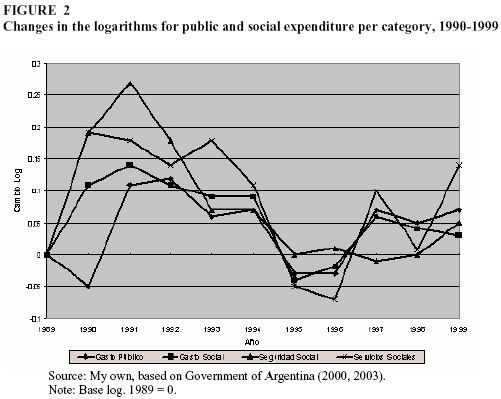
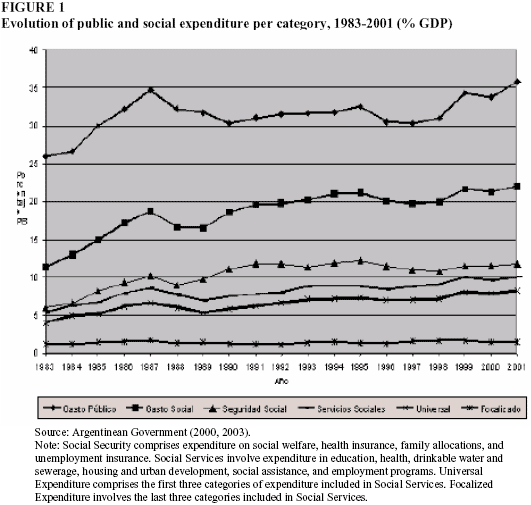
<body><![CDATA[<p><font face="Verdana, Arial, Helvetica, sans-serif" size="2"><a href="#fig1">Figure    1</a> shows the evolution of public and social expenditures divided by categories    as a percentage of GDP between 1983 and 2001. During the Alfonsín administration    (UCR, 1983-1989), social expenditure averaged 16.2 %, in the Menem period it    totaled 20.2%, and it reached 21.6% under Fernando de la Rúa (Alianza, 1999-2001)<a name="8b"></a><a href="#8"><sup>8</sup></a>.    These figures amounted to about 52%, 64%, and 62% of public expenditure respectively.    The increase observed during Menem’s tenure seems to confirm the neopopulist    theory of compensations. However, disaggregated evidence indicates that the    share of social expenditure targeted at the poor sectors was negligible and    did not show significant changes.</font></p>     <p><a name="fig1"></a></p>     <p>&nbsp;</p>     <p align="center"><img src="/img/revistas/s_rde/v1nse/a02fig1.gif"></p>     <p>&nbsp;</p>     <p><font face="Verdana, Arial, Helvetica, sans-serif" size="2">It is worth noting    that Argentina’s social expenditure included in the “social service” category    is more addressed to the poor than that included in the “social security” category,    which requires recipients to be employed or to have been employed in the formal    economy<a name="9b"></a><a href="#9"><sup>9</sup></a>. On average, the social    services expenditure, which amounted 7.4% of the GDP in 1984-1989, increased    to 8.6% in 1990-1999, while expenditure on social security grew from 8.8% to    11.6%<a name="10b"></a><a href="#10"><sup>10</sup></a>. However, the increment    in social services was not applied to build focalized programs, whose growth    barely averaged 0,2%. In addition, about 85% of resources of social services    were allocated to education and public health, universal categories that do    not benefit the poor exclusively, but generate positive externalities for middle    sectors as well. Finally, three quarters of the increase observed in social    security programs were transferred to the retirement and spouse pension systems<a name="11b"></a><a href="#11"><sup>11</sup></a>.    </font></p>     <p><font face="Verdana, Arial, Helvetica, sans-serif" size="2">A second indicator    of the government’s weak commitment towards social focalization resides in the    elasticity of social expenditures<a name="12b"></a><a href="#12"><sup>12</sup></a>.    <a href="#fig2">Figure 2</a> (see following page) plots annual changes in the    logarithms of public and social expenditures by category for the 1990-1999 period.    It can be appreciated that social expenditure invariably decreases when there    is a drop in public expenditure, and that it falls to lower, even negative levels,    when public expenditure increases. Likewise, social services expenditure was    reduced regardless of whether the country experienced periods of fiscal contraction    (1995, 1996, and 1998) or expansion (1991, 1992, and 1994). It was only in 1990    and 1993 that expenditure on social programs directly related to the poor behaved    in an inelastic fashion, as predicted by the neopopulist theory of compensations<a name="13b"></a><a href="#13"><sup>13</sup></a>.    </font></p>     <p><a name="fig2"></a></p>     <p>&nbsp;</p>     <p align="center"><img src="/img/revistas/s_rde/v1nse/a02fig2.gif"></p>     ]]></body>
<body><![CDATA[<p align="center">&nbsp;</p>     <p><font face="Verdana, Arial, Helvetica, sans-serif" size="2">In short, the information    presented indicates that focalized compensation occupied a residual place in    president Menem’s agenda (see also Cortes and Marshall, 1999; Repetto, 2000).    In sharp cpntrast to neopopulist theorists, therefore, social focalization was    not a necessary condition for the advancement of neoliberalism in Argentina<a name="14b"></a><a href="#14"><sup>14</sup></a>.    We will now see that the employment system also lacked compensatory features    quite until the Plan Trabajar was launched.   </font></p>     <p><font face="Verdana, Arial, Helvetica, sans-serif" size="2"><b><i>Employment    Policies</i></b></font></p>     <p><font face="Verdana, Arial, Helvetica, sans-serif" size="2">With the exception    of the Plan Trabajar, employment policies were limited in time, depended on    scanty resources and suffered endless modifications in their design and implementation.    In 1991, Congress passed the National Law of Employment, which created an unemployment    insurance funded by labor taxes<a name="15b"></a><a href="#15"><sup>15</sup></a>.    However, strict legal provisions conditioned the scope of this policy and favored    its redirection to formally employed middle-class workers. Firstly, only salary-earning    workers registered in the social security system with a minimum of twelve contributions    a year over the three years prior to redundancy were entitled to unemployment    insurance. Secondly, temporary and informal workers, rural workers, hired domestic    help, building industry workers, and public workers subjected to the state’s    rationalization process were excluded from the benefit.</font></p>     <p><font face="Verdana, Arial, Helvetica, sans-serif" size="2">Indeed, no Latin    American country has developed a universal unemployment insurance system. Nonetheless,    it should be noted that the Menem administration allocated fewer resources to    this policy than did the governments of Brazil, Chile, and Uruguay (Marquez,    2000). Resources devoted to this area barely reached 0.14% of the GDP, to cover    only between 7% and 8% of the workforce (Government of Argentina, 2000)<a name="16b"></a><a href="#16"><sup>16</sup></a>.    The rate of unemployment insurance lay well below the ones in other reformist    countries, and did not go up as unemployment mounted. Etchemendy (2004), for    example, reports that 37.8% and  51.6% of the unemployee were benefited by the    insurance system in Chile and Spain respectively. In Argentina, the number of    unemployed workers tripled between 1990 and 1996, but unemployment insurance    rose only by 22%. </font></p>     <p><font face="Verdana, Arial, Helvetica, sans-serif" size="2">The national government    also allocated modest resources to the active generation of employment policies.    Although between 1993 and 1996 the Ministry of Labor (MTSS) launched a set of    programs to promote temporary public employment, labor training, and subsidies    for the private sector, this battery of policies proved shallow and lacked compensatory    direction. The most important measure in the period was the Programa Intensivo    de Trabajo &#91;Intensive Labor Program&#93; (PIT), which employed low-income workers    to develop communal projects. Yet in the year when unemployment reached its    peak, PIT provided cover for only 2.2% of the unemployed (Marshall, 1997). On    the other hand, labor training programs engaged a monthly average of only 2,000    to 12,000 workers, while subsidy programs for the private sector averaged just    25,000 beneficiaries per month (MTSS 1997, 1998). Taken together, these programs    were not really significant, since they amounted 0.1% of the GDP to cover 9%    of the urban unemployed (Government of Argentina, 2000). Proportionally, and    in comparison with other countries in the region, the Argentinean government    allocated fewer resources to the creation of genuine employment that did its    counterparts in Mexico, Brazil, Uruguay, Peru, and Costa Rica (Marquez, 2000).    </font></p>     <p><font face="Verdana, Arial, Helvetica, sans-serif" size="2">In 1996, immediately    after violent riots unleashed in some cities of the interior, the government    launched the Plan Trabajar<a name="17b"></a><a href="#17"><sup>17</sup></a>.    Devised by the MTSS together with World Bank (WB) economists (an agency that    co-funded the program since 1997), the Plan was in operation until 2001, spending    an average of 130 million pesos a year to cover about 20% of the unemployed.    The Plan Trabajar engaged unemployed workers who had no social security coverage    and paid a monthly salary of 200 pesos over a six-month period (with limited    possibilities of renewing their contract) in exchange for communal tasks. The    national government took upon itself the hiring costs of unskilled workers,    while the municipalities or NGOs in charge of executing infrastructure projects    supplied the materials and hired skilled workers. </font></p>     <p><font face="Verdana, Arial, Helvetica, sans-serif" size="2">The distribution    process consisted of three stages. First, the Executive transferred the resources    to the provinces. Then, Governors decided on the municipalities to which the    funds would be allocated. Finally, Mayors were responsible for the selection    of beneficiaries and decided on the execution guidelines. Within this institutional    framework, unemployed organizations (particularly those with a long tradition)    established direct relations with the Town Halls, made their own lists of beneficiaries    through a previous registration of unemployed workers, and adopted roadblocks    as a strategy to claim for their inclusion in the Plan Trabajar. This resulted    in an increase of the volume of organizational resources and fostered new memberships,    including those social actors that had links with the PJ <i>punteros</i>’<a href="#_ftn1" name="_ftnref1" title=""><sup>**</sup></a> net<a name="18b"></a><a href="#18"><sup>18</sup></a>.</font></p>     <p><font face="Verdana, Arial, Helvetica, sans-serif" size="2">When Fernando de    la Rúa took office, the Alianza administration changed rules of distribution.    Paradoxically, these changes strengthened the larger picketer organizations    and contributed to the growth of smaller groups. With the purpose of constraining    the clientelar control of funds made by the PJ, it was decided that the plans    were to be managed by authorized NGOs through projects submitted to and approved    by the MTSS. The picketers reacted by establishing their own NGOs, thus formalizing    their access to the distribution chain. Towards the end of 2000, the government    created a system of local institutions caleed <i>Consejos de Emergencia</i>    &#91;Emergency Councils&#93;, with the purpose of monitoring the distribution and preventing    further social protest<a name="19b"></a><a href="#19"><sup>19</sup></a>. Far    from fulfilling their objectives, the Councils returned power to Peronist municipalities    so that these local authorities could handle the allocation of employment plans,    and institutionalized the presence of picketers in the arenas of negotiations.    </font></p>     <p><font face="Verdana, Arial, Helvetica, sans-serif" size="2">Numerous assessments    on the performance of Plan Trabajar acknowledge the importance of clientelar    practices in the distribution (World Bank, 2000; Jalan and Ravallion, 1998;    Ravallion, 2002; Ronconi, 2002; SIEMPRO, 1997, 1998). Likewise, essays on the    picketer movement point out that the plan was a condition of possibility for    its development<a name="20b"></a><a href="#20"><sup>20</sup></a>. However, none    of these studies has undertaken a systematic analysis of the causal effect of    party politics and popular protest on the program’s distributive patterns. The    following section, then, presents a series of hypotheses to empirically test    the distributive determinants of Plan Trabajar.</font></p>     ]]></body>
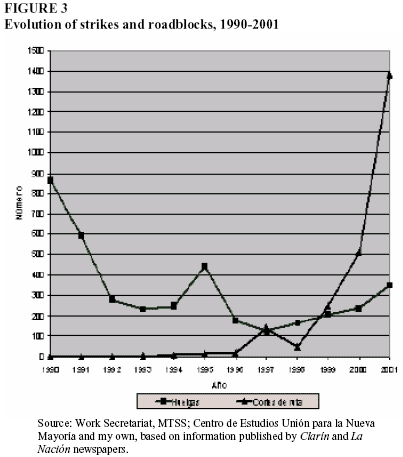
<body><![CDATA[<p>&nbsp;</p>     <p><font face="Verdana, Arial, Helvetica, sans-serif" size="3"><b>2. Hypotheses    of analysis</b></font></p>     <p><font face="Verdana, Arial, Helvetica, sans-serif" size="2">Which were the    determinats of the intergovernmental allocation of resources from the Plan Trabajar?    I present a set of hypotheses that explore the role played by three factors:    material needs, social conflict, and party politics. </font></p>     <p><font face="Verdana, Arial, Helvetica, sans-serif" size="2">A first argument    suggests that the programs’s transfer system followed a public policy logic    compensating provinces according to some social equity criteria. This notion    found wide support among World Bank (WB) officials and it is implicit in the    neopopulist theory of compensations. For WB officials , the central government    is a kind of social planner in charge of redistributing public resources to    favor regions with the lowest  social and demographic indicators. For the neopopulist    view, distribution does not depend on normative principles but rather it is    guided by political needs, namely, the need to earn acquiescence from excluded    sectors. Along these lines of thought, we may expect the following:    </font></p>     <p><font face="Verdana, Arial, Helvetica, sans-serif" size="2"><i>Hypothesis 1:    The greater the “material need” in province <b>i</b>, the greater the probability    that this province may receive a proportionally higher number of resources from    the Plan Trabajar.</i></font></p>     <p><font face="Verdana, Arial, Helvetica, sans-serif" size="2">A second argument    stems from the classic works by Piven and Cloward (1977, 1992, 1993) about the    effects of popular protests on the expansion of the welfare state in the US    between 1930 and 1970. On the basis of a series of case studies, these authors    put forward a compelling thesis: disruption rather than organization is the    most powerful resourse for poor organizations to achieve their goals. Ever since    then, specialists in urban riots and social movements in developed countries    have analyzed whether disruption or moderation is functional to the success    of social protest. Empirical evidence is not conclusive: while some scholars    contend the efficacy of disruption and violence (Jennings, 1979; McAdam, 1999;    Gamson, 1990; Tarrow, 1994), others argue that disruption is effective only    under particular circumstances (Schumaker, 1978; Koopmans, 1993). </font></p>     <p><font face="Verdana, Arial, Helvetica, sans-serif" size="2">It is important    to note that, unlike countries such as Bolivia and Venezuela, where neoliberal    policies gave rise to generalized popular protests, Argentina implemented its    market-oriented  reforms in an atmosphere of relative social peace. Indeed,    on the one hand, acceptance by the union movement drastically reduced labor    conflicts and confine trade-union activism to public sector workers affected    by the rationalization and decentralization of state services. On the other    hand, social protest was initially sporadic and restricted to a few peripheral    cities especially affected by economic reconversion processes. As increasing    unemployment began to erode the relationship between the unemployed and trade    unions, social conflict grew steadily and roadblocks (the modality of accion    used by picketer organizations) replaced strikes as the crucial manifestation    of social discontent. <a href="#fig3">Figure 3</a> (see following page) shows    this change.</font></p>     <p><a name="fig3"></a></p>     <p>&nbsp;</p>     <p align="center"><img src="/img/revistas/s_rde/v1nse/a02fig3.gif"></p>     ]]></body>
<body><![CDATA[<p>&nbsp;</p>     <p><font face="Verdana, Arial, Helvetica, sans-serif" size="2">If pr</font><font face="Verdana, Arial, Helvetica, sans-serif" size="2">otests    led by the picketer movement affected the federal distribution of the Plan Trabajar,    then those provinces that had been more exposed to social conflicts should have    received a proportionally higher share of funds than those suffering less. Consequently,    the second hypothesis states:</font></p>     <p><font face="Verdana, Arial, Helvetica, sans-serif" size="2"><i>Hypothesis 2:    The higher the frequency (or number) of protests in province <b>i</b>, the higher    the probability that this province will receive a proportionally higher number    of resources from the Plan Trabajar.  </i></font></p>     <p><font face="Verdana, Arial, Helvetica, sans-serif" size="2">Finally, a third    argument focuses on the role played by party politics. Here the assumption holds    that the government will favor provinces where the president’s party is dominant,    measured in terms of political control of the municipalities and governor’s    partisanship. Conversely, it will penalize provinces that do not comply with    these requirements. Thus, the third and fourth hypotheses state:   </font></p>     <p><font face="Verdana, Arial, Helvetica, sans-serif" size="2"><i>Hypothesis 3:    The larger the percentage of municipalities controlled by the President’s party    (PJ or UCR/Alianza) in province <b>i</b>, the higher the probability that this    province will receive a proportionally higher number of resources from the Plan    Trabajar. Conversely, the larger the percentage of municipalities controlled    by the opposition (PJ or UCR/Alianza), the smaller that probability</i>. </font></p>     <p><font face="Verdana, Arial, Helvetica, sans-serif" size="2"><i>Hypothesis 4:    Provinces governed by the President’s party (PJ or UCR/Alianza) receive a proportionally    higher number of resources from the  Plan Trabajar. Conversely, provinces ruled    by the opposition (PJ or UCR/Alianza) receive a proportionally smaller number    of resources.</i></font></p>     <p><font face="Verdana, Arial, Helvetica, sans-serif" size="2">Ever since the    return to democracy in 1983, the PJ enjoyed a considerable electoral advantage    over other political parties. Indeed, the PJ controlled the Senate (even when    it lost the presidential election) and the two legislative chambers when it    came into office (1989-1999). The UCR, in contrast, never succeeded in controlling    the Senate and only held the majority in the Lower Chamber between 1983-1987    and 1999-2001. During the period under study, the PJ governed  14 (1995-1999)    and 15 (1999-2001) provinces and about 40% and 50% of the municipalities. Peronist    electoral supremacy, added to the PJ’s decentralized organization, results in    forceful structures of provincial power whose cooperation is vital to govern    effectively (Levitsky, 2003). We can then expect that provinces in which the    PJ is the dominant political force would receive a preferential treatment by    the national government, even when the Presidency is not in Peronist hands.    In other words, the federal distribution of employment plans depends on who    are in power and in the opposition at the national level. Such reasoning leads    us to the fifth hypothesis: </font></p>     <p><font face="Verdana, Arial, Helvetica, sans-serif" size="2"><i>Hypothesis 5:    Provinces politically dominated by the PJ receive a proportionally higher number    of resources from the Plan Trabajar even when the President is not a member    of the PJ.   </i></font></p>     <p><font face="Verdana, Arial, Helvetica, sans-serif" size="2">Finally, the last    hypothesis refers to the provinces’ and governors’ ability to influence the    federal distribution of resources through their national legislators. First,    the President may grant material benefits to certain provinces in the hope that    their representatives will support his/her proposals in Congress. Thus, when    analyzing the role of Congress in the national budget, Jones (2001) demonstrates    that the higher the proportional contribution made by a given province to the    President’s legislative block, the larger the funds the province is likely to    receive. Second, legislators may direct part of their legislative work to divert    resources toward their provinces if their political careers depend on governors’    political strength.Argentine legislators are indeed vulnerable to the interests    of provincial political leaders, since they control party nominations to national    candidatures and the position of candidates on the party lists (Jones, Saiegh,    Spiller and Tommasi, 2002; De Luca, Jones, and Tula, 2002).. Therefore, the    sixth hypothesis tests the argument about the exchange of votes for favors in    the legislative arena, and examines the “indirect” influence of governors on    the intergovernmental allocation of employment plans.</font></p>     <p><font face="Verdana, Arial, Helvetica, sans-serif" size="2"><i>Hypothesis 6:    The greater the proportional contribution of province <b>i</b> to the President’s    coalition in Congress, the greater the probability that this province will receive    a proportionally higher number of resources from the Plan Trabajar.</i></font></p>     ]]></body>
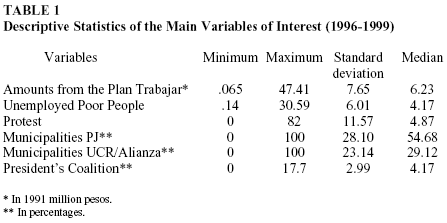
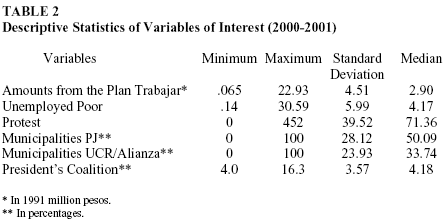
<body><![CDATA[<p><font face="Verdana, Arial, Helvetica, sans-serif" size="2">To resume, unlike    extant quantitative studies that analyze the efficacy of the Plan Trabajar in    reaching the needy (see Jalan and Ravallion, 2003; Ravallion, 2002), the hypotheses    posited in this section also allow us to measure the relative pressure of a    number of political factors and practices on the distributive patterns. Bearing    these expectations in mind, the following section operationalizes the variables    of interest, describes the statistical techniques and analyzes the empirical    results. </font></p>     <p>&nbsp;</p>     <p><b><font face="Verdana, Arial, Helvetica, sans-serif" size="3">3. Specifications    of the model and analysis of results</font></b></p>     <p><font face="Verdana, Arial, Helvetica, sans-serif" size="2">In order to test    the hypotheses presented in the previous section, I estimated two separate panel    regression models for the Menem and de la Rúa administrations respectively.    The choice for running separate models is based on solid theoretical reasons    given that I postulate that the federal distribution of resources differs depending    on who govers at the national level: the PJ or the UCR/Alianza<a name="21b"></a><a href="#21"><sup>21</sup></a>.    All estimates are OLS with robust standard errors to correct for potential heteroskedasticity.    The unit of analysis is the 24 Argentine provinces <a name="22b"></a><a href="#22"><sup>22</sup></a>.    The dependent variable is the yearly amount (in 1991 million pesos) from the    Plan Trabajar allocated to each province<a name="23b"></a><a href="#23"><sup>23</sup></a>.    These data were supplied by the Secretariat of Labor Relations,MTSS.</font></p>     <p><font face="Verdana, Arial, Helvetica, sans-serif" size="2">The first independent    variable is the percentage of unemployed poor people per province (estimates    issued by the World Bank). The models were also estimated using the index of    Basic Unsatisfied Needs (NBI) from the 1991 and 2003 censuses, and the provincial    unemployment rate recorded by INDEC. The second independent variable –popular    protests –is operationalized as the frequency (number) of roadblocks in province    <b><i>i</i></b> over a particular year. This information was provided by the    Centro de Estudios Unión para la Nueva Mayoría, which generate data from Gendarmería    Nacional &#91;National Gendarmerie&#93; and nationwide newspapers<a name="24b"></a><a href="#24"><sup>24</sup></a>.    The third independent variable measures the power of the President’s party and    opposition forces in province <b><i>i</i></b> as the percentage of municipalities    governed by the PJ and the UCR/Alianza respectively.<a name="25b"></a><a href="#25"><sup>25</sup></a>    These data are taken from  Cao (1999). Following Jones (2000), the fourth independent    variable is the sum of the percentage of legislators that province <b><i>i</i></b>    contributes to the President’s coalition in both the Senate and the Lower Chamber    divided by two. The information used to build this variable was supplied by    the Programa de Estudios Ejecutivos y Legislativos &#91;Program of Executive    and Legislative Studies&#93; (PEEL-UTDT). The models also include a dummy variable    coded 1 for Peronist governors in 1996-1999 and 1 for UCR/Alianza governors    in 2000-20001. Moreover, models control for population through its logarithms    and assume a contemporary effect of the independent variables<a name="26b"></a><a href="#26"><sup>26</sup></a>.    <a href="#tab1">Tables 1</a> and <a href="#tab2">2</a> report descriptive data    of the main variables of interest.</font></p>     <p><a name="tab1"></a></p>     <p align="center"><img src="/img/revistas/s_rde/v1nse/a02tab1.gif"></p>     <p align="center">&nbsp;</p>     <p><a name="tab2"></a></p>     <p>&nbsp;</p>     ]]></body>
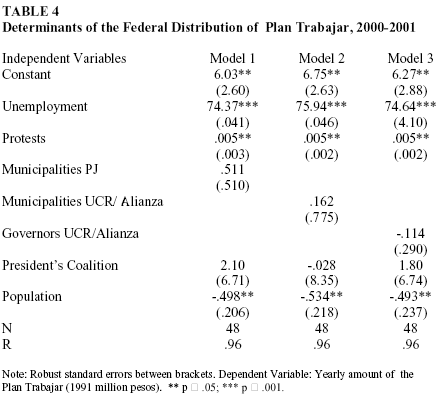
<body><![CDATA[<p align="center"><img src="/img/revistas/s_rde/v1nse/a02tab2.gif"></p>     <p align="center">&nbsp;</p>     <p><font face="Verdana, Arial, Helvetica, sans-serif" size="2"><a href="#tab3">Tables    3</a> and <a href="#tab4">4</a> show regression results of models for Menem    and de la Rúa administrations. Overall, results confirm most hypotheses, although    some unexpected outcomes are observed. Concretely, distributive patterns are    different under the two administrations. This bears out the notion that federal    distribution of employment plans depends on who holds the Presidency. In addition,    results indicate that the effect of unemployment keeps constant throughout the    period, yet the causal impact of protests only occurs during the Alianza government    and  party politics becomes ore apparent during the Menem administration. </font></p>     <p><a name="tab3"></a></p>     <p>&nbsp;</p>     <p align="center"><img src="/img/revistas/s_rde/v1nse/a02tab3.gif"></p>     <p>&nbsp;</p>     <p><a name="tab4"></a></p>     <p>&nbsp;</p>     <p align="center"><img src="/img/revistas/s_rde/v1nse/a02tab4.gif"></p>     ]]></body>
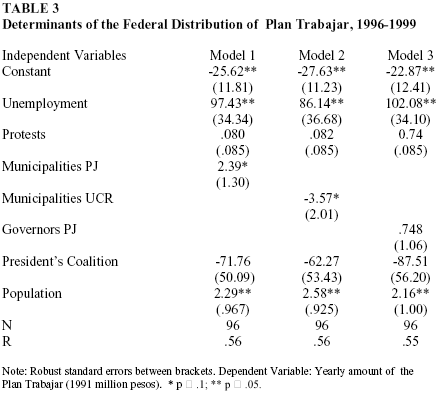
<body><![CDATA[<p>&nbsp;</p>     <p ><font face="Verdana, Arial, Helvetica, sans-serif" size="2">Let us proceed    to analyze these results. First, and in consonance with Hypothesis 1, the unemployment    variable is positive and statistically significant under both administrations.    This suggests that, other factors being equal, the distribution of the Plan    Trabajar compensate provinces with larger percentages of unemployed poor people.    For example, the 97.43 coefficient under the Menem administration (see <a href="#tab3">Table    3</a>, model 1) indicates that a 1% increase in the percentage of the unemployed    poor in province <b><i>i </i></b> is - <i>ceteris paribus</i> – related to 974,300    more pesos. Coefficients for this variable are slightly lower under the de la    Rúa administration, where  a 1% increase in the percentage of poor unemployed    people is related to 743,700 more pesos (see <a href="#tab4">Table 4</a>, model    1).  </font></p>     <p><font face="Verdana, Arial, Helvetica, sans-serif" size="2">What proves most    interesting is the effect of popular protest and party politics on the distribution    of funds among provinces. In the first place, although the protest variable    has the hypothesized sign, social conflict did not make a significant impact    during the Menem administration. But it does prove positive and significant    when the Alianza ruled the country<a name="27b"></a><a href="#27"><sup>27</sup></a>.    Coefficients for the period 2000-20001 suggest that each protest amounted to    5,000 more pesos for the province where it took place. Although the value of    these coefficients is relatively low, it is substantive considering that each    employment plan amounted 200 pesos. The province of Buenos Aires, for instance,     witnessed 452 roadblocks in 2001 and should have received about 2,25 million    more pesos. Similarly, a province that shows the median for roadblocks would    receive about 400,000 more pesos. </font></p>     <p><font face="Verdana, Arial, Helvetica, sans-serif" size="2">While it cannot    be denied that the <i>“puebladas”</i>&#91;social uprisings&#93; in 1996-1997 influenced    the government’s decision to launch the Plan Trabajar (notwithstanding the fact    that roadblocks were always related to claims for employment programs), the    causal effect of picketer protests seems to have passed unnoticed until the    de la Rúa administration. Yet this finding should not come as a surprise since    it is consistent with the cycle of popular mobilization and the concomitant    development of the picketer movement. Between 1996 and 1999, protests constituted    an incidental phenomenon, were restricted to some social uprisings in the interior    and a few collective claims for food headed by territorial organizations in    La Matanza (the biggest electoral district of the country, located in the west    of the Buenos Aires province). Encouraged by these foundational events, a new    repertory of collective action (the roadblocks) became consolidated as a modality    of action and a mechanism to claim for employment. Roadblocks gradually spread    out, involving both the picketer organizations led by Luis D’Elía <i>(the Federación    de Tierra, Vivienday Hábitat</i>) and Juan Carlos Alderete (the <i>Corriente    Clasista y Combativa</i>) and a number of radical and autonomous groups, and    picketer organizations more associated to leftist parties<a name="28b"></a><a href="#28"><sup>28</sup></a>.    But it was not until  2000 that the multiple branches of the movement escalated    to national politics thanks to generalized and successful roadblocks led by    groups from La Matansa and the south of the province. The upward cycle reached    its peak in the demonstrations held by the Asamblea Nacional Piquetera &#91;National    Picketer Assembly&#93; in July and September 2001. These events demonstrate that    although the movement did not respond to a unified political leadership, it    was able to engineered coordinated actions called ”national days of roadblocks    <a name="29b"></a><a href="#29"><sup>29</sup></a></font></p>     <p><font face="Verdana, Arial, Helvetica, sans-serif" size="2">Regarding the role    played by party politics, there is partial evidence that provinces with a larger    number of municipalities ruled by the President’s party were awarded. On the    one hand, as it is stated in Hypothesis 3, the variable “municipalities PJ”    is positive and significant during the Menem administration<a name="30b"></a><a href="#30"><sup>30</sup></a>.    In accordance with previous findings, this suggests that initially the local    nature of protests led to a distribution of funds that rewarded Peronist mayors    in a way they could reinforce their political structures, mobilize activists    and thus prevent new social turmoils. On the other hand, the coefficients for    “municipalities UCR/Alianza” are positive during de la Rúa administration, but    lack statistical significance. The Alianza administration, then, did not reward    provinces with a larger proportion of municipalities ruled by its politicans.    One possible explanation for this result may lie in the fact that with the Peronism    in the opposition, the national government’s prioritized stopping the picketer    escalate rather than using resources with a partisan goal, in the hope that    governance might remain unaffected by the social conflict.</font></p>     <p><font face="Verdana, Arial, Helvetica, sans-serif" size="2">Hypothesis 3 also    holds that the Executive will penalize provinces whose municipalities are ruled    by mayors from the main opposition party. Results reported in <a href="#tab3">Table    3</a> confirm this idea. As it can be seen from the negative and statistically    significant coefficient of  the <i>municipalities UCR</i> variable, the Menem    administration showed a clear tendency toward penalize provinces that elected    a proportionally higher number of UCR/ Alianza municipal governments. Concretely,    the coefficient –3.57 indicates that a province where municipalities governed    by UCR/Alianza mayors exceeded by 10% those ruled by Peronist, received 357,000    fewer pesos<a name="31b"></a><a href="#31"><sup>31</sup></a>. Estimates in <a href="#tab4">Table    4</a>, however, also seem to indicate that the Alianza benefited Peronist municipalities.    But although the variable <i>municipalities PJ</i> has a positive sign, coefficients    are not statistically significant. In sum, while the Peronist government penalized    the UCR , the Alianza resorted to a more appeasing strategy in an attempt to    preserve its future years in office. </font></p>     <p><font face="Verdana, Arial, Helvetica, sans-serif" size="2">What was the impact    of provincial governors? In order to test Hypothesis 4, I estimated models including    a dummy variable coded 1 for PJ governors and 0 otherwise between 1996 and 1999,    and 1 for UCR/Alianza governors and 0 otherwise for the period 2000-2001<a name="32b"></a><a href="#32"><sup>32</sup></a>.    If intuitions stated in the fourth hypothesis are confirmed, then coefficients    for both variables should be positive and greater than zero. Evidence found    in models 3 is discouraging. First, as we expected, the sign of the variable    <i>governors PJ</i> points to the predicted direction, but coefficients lack    statistical significance. Second, against our expectations , the sign of the    variable <i>governors UCR/Alianza</i> is negative but not statistically significant.    Whereas the first result indicates that the Menem administration did not differentially    reward Peronist governors, the second suggests that the Alianza distributed    fewer resources among the provinces ruled by its own coalition. This does not    mean, however, that PJ governors were rewarded with larger funds when the Peronist    party was in the opposition. Contrary to Hypothesis 5, models for 2000-2001    including the variable <i>governors PJ</i> clearly show that the national government    did not allocate more funds to Peronist governors. Therefore, even though the    Alianza needed the PJ’s support to implement pending structural reforms and    a package of fiscal adjustment measures in the provinces –the so-called “Deficit    Cero” policy – demanded by international credit agencies<a name="33b"></a><a href="#33"><sup>33</sup></a>,    the Plan Trabajar does not seem to have played a role in trading legislative    votes for favors.</font></p>     <p><font face="Verdana, Arial, Helvetica, sans-serif" size="2">Finally, how influential    were national legislators? Recall that Hypothesis 6 tests both the political    power of province <b><i>i </i></b>on the president’s legislative coalition,    and the “indirect” effect of governors over national legislators. None of the    results indicates that the national governments allocated resources of the Plan    Trabajar through Congress: note that the variable <i>president’s coalition</i>    lacks statistical significance in all models and it oddly has a negative sign    for the Menem administration<a name="34b"></a><a href="#34"><sup>34</sup></a>.    A possible interpretation, is that the PJ built distributive channels resorting    to its party mayors. The Alianza, on the other hand, may not have used Congress    partly due to the PJ’s cooperation in issuing crucial laws for the government    and due to the absence of conflicts between the government and the UCR/Alianza    governors. These local politicians supported (and depended on) the continuity    of the coalition for their own political survival. Regardless of these nuances,    the overall analysis indicates that politics played a major role in defining    who got what in the intergovernmental distributive game.</font></p>     <p>&nbsp;</p>     <p><font face="Verdana, Arial, Helvetica, sans-serif" size="3"><b>Final considerations    </b></font></p>     ]]></body>
<body><![CDATA[<p><font face="Verdana, Arial, Helvetica, sans-serif" size="2">This paper aims    to make a contribution to the systematization of the role played by popular    protest and party politics in the federal distribution of employment plans in    Argentina. On the one hand, statistical results show that unemployment affected    throughout the period under study the distribution of resources from the Plan    Trabajar. On the other hand, the impact of the picketer protest only became    evident during the Alianza administration. This finding is consistent with the    upward mobilization cycle observed over the past decade and the concomitant    development of the picketer movement, which became a nationwide political actor    only in 2000. The analysis of the political variables included in the models    also suggests that the PJ’s use of these funds was more party-oriented than    that of the UCR/Alianza. In fact, the Menem administration “localized” the distribution    of the Plan Trabajar, thus benefiting Peronist mayors and penalizing those from    the opposition. Instead, the de la Rúa administration did not reward the coalition’s    mayors and governors, and neither did it penalize Peronist municipalities and    governors by allocatind less funds.  </font></p>     <p><font face="Verdana, Arial, Helvetica, sans-serif" size="2">At a time where    there is a large number of studies on the picketer movement, it is alarming    that none of them attempt a systematic analysis of the impact of unemployed    organizations on public policies. While it is undeniable that existing studies    contribute to our understanding of the phenomenon, results presented here indicate    the need to abandon discussions on the origin and development of the movement    to begin exploring the political scope of its actions. Moreover, evidence on    the effects of party politics suggests the insufficiency of undertaking a shallow    study of the efficacy of social expenditure to allay or neutralize the distributive    costs of economic changes. Obviously, this was not the sole concern underlying    the implementation of  the Plan Trabajar. Nor was it the single factor that    defined who obtained what. There were many other motives: to contain social    conflict, to build up clientelar nets at the subnational level, and to promote    political interchange between officialism and opposition. In short, the officials    responsible for the plan’s distribution did not merely act as technicians or    social planners but actively engaged in politics.</font></p>     <p><font face="Verdana, Arial, Helvetica, sans-serif" size="2">This study also    presents some other issues that deserve closer attention. The first and most    obvious is that existing data impede a reliable conclusion about the ultimate    destination of resources. This could be solved with information at the municipal    and/or  individual levels. The causal connection between protests and resource    distribution entails a more substantive issue. This analysis has demonstrated    the impact of protests on the federal allocation of funds, but further studies    investigate analyze whether there is also an inverse relation. Programs like    the Plan Trabajar might encourage conflict rather than prevent it, or at least    stimulate contested actions by the most underprivileged sectors when it comes    to the distribution of resources. Finally –and this is a more general concern    –observers should analyze the impact of different institutional settings, party-policy    alignments, and the economic independence of governors and mayors in the face    of clientelar nets such as the ones built up in federal systems like Argentina’s.</font></p>     <p>&nbsp;</p>     <p><font face="Verdana, Arial, Helvetica, sans-serif" size="3"><b>Bibliography</b></font></p>     <!-- ref --><p><font face="Verdana, Arial, Helvetica, sans-serif" size="2">Acuña, Carlos,    and Smith, William (1994): “The Political Economy of Structural Adjustment:    The Logic of Support and Opposition to Neoliberal Reforms”, in W. Smith, C.    Acuña and E. Gamarra (comps): <i>Latin America Political Economy in the Age    of Neoliberal Reform</i>, New Brunswick, Transaction Books, pp. 17-66.</font><!-- ref --><p><font face="Verdana, Arial, Helvetica, sans-serif" size="2">Auyero, Javier    (2001): <i>La política de los pobres. Las prácticas clientelistas del peronismo</i>,    Buenos Aires, Manantial.</font><!-- ref --><p><font face="Verdana, Arial, Helvetica, sans-serif" size="2">Auyero, Javier    (2002): <i>La protesta: Retratos de la beligerancia popular en la Argentina    democrática</i>, Buenos Aires, Libros del Rojas. </font><!-- ref --><p><font face="Verdana, Arial, Helvetica, sans-serif" size="2">Banco Mundial (2000):    “Implementation Completion Report. Republic of Argentina. Second Social Protection    Project”, Washington D.C. </font><!-- ref --><p><font face="Verdana, Arial, Helvetica, sans-serif" size="2">Blake, Charles    (1994): “Social Packs and Inflation Control in New Democracies”, <i>Comparative    Political Studies</i> 27 (3), pp. 381-401. </font><!-- ref --><p><font face="Verdana, Arial, Helvetica, sans-serif" size="2">Cao, Horacio (1999):    <i>Elecciones y reelecciones en el nivel municipal argentino: 1983-1999</i>,    Buenos Aires, Grupo Provincias/Jefatura de Gabinete de Ministros.</font><!-- ref --><p><font face="Verdana, Arial, Helvetica, sans-serif" size="2">Calvo, Ernesto,    and Murillo, María V. (2004): “Who Delivers? Partisan Clients in the Argentine    Electoral Market”, <i>American Journal of Political Science</i>  48 (4): 742-57.</font><!-- ref --><p><font face="Verdana, Arial, Helvetica, sans-serif" size="2">Conniff, Michael    (1999): “Introduction”, in M. Conniff (comp.): <i>Populism in Latin America</i>,    Tuscaloosa, University of Alabama Press, pp. 1-21.</font><!-- ref --><p><font face="Verdana, Arial, Helvetica, sans-serif" size="2">Cortés, Rosalía,    and Marshall, Adriana (1999): “Estrategia económica, instituciones y negociación    política en la reforma social de los noventa”, <i>Desarrollo Económico </i>39    (154), pp. 195-212. </font><!-- ref --><p><font face="Verdana, Arial, Helvetica, sans-serif" size="2">Delamata, Gabriela    (2002): “De los estallidos provinciales a la generación de las protestas en    Argentina”, <i>Revista de Ciencias Sociales,</i>  Universidad de Quilmes, 14.</font><!-- ref --><p><font face="Verdana, Arial, Helvetica, sans-serif" size="2">De Luca, Miguel,    Jones, Mark, and Tula, María Inés (2002): “Back Rooms to Ballot Boxes?: Candidate    Nomination in Argentina”, <i>Comparative Political Studies </i> 35 (4), pp.    413-36. </font><!-- ref --><p><font face="Verdana, Arial, Helvetica, sans-serif" size="2">Díaz-Cayeros, Alberto,    Magoli, Beatriz, and Weingast, Barry (2002): “Democratization and the Economy    in Mexico: Equilibrium (PRI) Hegemony and its Demise”, mimeo. </font><!-- ref --><p ><font face="Verdana, Arial, Helvetica, sans-serif" size="2">Etchemendy, Sebastián    (2001): “Construir coaliciones reformistas: la política de las compensaciones    en el camino argentino hacia la liberalización”, <i>Desarrollo Económico</i>     40 (160), pp. 675-706.</font><!-- ref --><p><font face="Verdana, Arial, Helvetica, sans-serif" size="2">Gamson, William    (1990): <i>The Strategy of Social Conflict</i>, Belmont, Wadsworth.</font><!-- ref --><p><font face="Verdana, Arial, Helvetica, sans-serif" size="2">Gasparini, Leonardo    (1999): “Incidencia Distributiva del Gasto Público”, mimeo, FIEL.</font><!-- ref --><p><font face="Verdana, Arial, Helvetica, sans-serif" size="2">Giarraca, Norma    (2001): <i>La protesta social en Argentina: Transformaciones económicas y crisis    social en el interior del país</i>, Buenos Aires, Alianza.</font><!-- ref --><p><font face="Verdana, Arial, Helvetica, sans-serif" size="2">Gibson, Edward    (1997): “The Populist Road to Market Reforms: Policy and Electoral Coalitions    in Mexico and Argentina”, <i>World Politics</i> 49 (3), pp. 339-70.</font><!-- ref --><p><font face="Verdana, Arial, Helvetica, sans-serif" size="2">Gibson, Edward,    and Calvo, Ernesto (2000): “Federalism and Low-Maintenance Constituencies: Territorial    Dimensions of Economic Reforms in Argentina”, <i>Studies in Comparative International    Development</i> 35 (3), pp. 32-55. </font><!-- ref --><p><font face="Verdana, Arial, Helvetica, sans-serif" size="2">Gibson, Edward,    Calvo, Ernesto, and Falleti, Tulia (2004): “Reallocative Federalism: Legislative    Overrepresentation and Public Spending in the Western Hemisphere”, in E. Gibson    (comp.): <i>Federalism and Democracy in Latin America</i>, The Johns Hopkins    University Press, Baltimore and London, pp. 173-96.</font><!-- ref --><p><font face="Verdana, Arial, Helvetica, sans-serif" size="2">Giugni, Marco (1998):    What is Worth the Effort? The Outcomes and Consequences of Social Movements”,    <i>Annual Review of Sociology</i> 24, pp. 371-93. </font><!-- ref --><p><font face="Verdana, Arial, Helvetica, sans-serif" size="2">Giugni, Marco (1999):    “How Social Movements Matter: Past Research, Present Problems, Future Developments”,    in M. Giugni, D. McAdam y C. Tilly (comps): <i>How Social Movements Matter</i>,    University of Minnesota Press, Minneapolis, pp. xiii-xxxiii.</font><!-- ref --><p><font face="Verdana, Arial, Helvetica, sans-serif" size="2">Gobierno de Argentina    (1999, 2000, 2003): <i>Caracterización y Evolución del Gasto Público Social</i>,    Buenos Aires, Secretaría de Programación Económica y Regional. </font><!-- ref --><p><font face="Verdana, Arial, Helvetica, sans-serif" size="2">Graham, Carol (1994):    <i>Safety Nets, Politics, and the Poor. Transitions to Market Economies</i>,    Washington D.C., The Brookings Institution.</font><!-- ref --><p><font face="Verdana, Arial, Helvetica, sans-serif" size="2">Haggard, Stephen    y Kaufman, Robert (1992): <i>The Politics of Economic Adjustment</i>, New York,    Oxford University Press.</font><!-- ref --><p><font face="Verdana, Arial, Helvetica, sans-serif" size="2">Haggard, Stephen    and Webb, Steven (1994): “Introduction”, in S. Haggard y S. Webb (comps.): <i>Voting    for Reform</i>, New York, Oxford University Press, pp. 1-36.</font><!-- ref --><p><font face="Verdana, Arial, Helvetica, sans-serif" size="2">Kohli, Martin,    Rein, Martin, Guillemard, Anne-Marie, and van Gunsteren, Herman (1991): <i>Time    for Retirement</i>. Cambridge, UK: Cambridge University Press.</font><!-- ref --><p><font face="Verdana, Arial, Helvetica, sans-serif" size="2">Koopmans, Ruud    (1993): “The Dynamics of Protest Waves: West Germany, 1965 to 1989”, <i>American    Sociological Review</i>  58, pp. 637-58.</font><!-- ref --><p><font face="Verdana, Arial, Helvetica, sans-serif" size="2">Jalan, Jyotsna,    and Ravallion, Martin (1998): “Income Gains to the Poor from Workfare. Estimates    for Argentina’s Trabajar Program”, Washington D.C., Banco Mundial.</font><!-- ref --><p><font face="Verdana, Arial, Helvetica, sans-serif" size="2">Jennings, Edward    (1979): “Civil Turmoil and the Growth of Welfare Rolls: A Comparative State    Policy Analysis”, <i>Policy Studies Journal</i> 7, pp. 739-45.</font><!-- ref --><p><font face="Verdana, Arial, Helvetica, sans-serif" size="2">Jones, Mark (2001):    “Political Institutions and Public Policy in Argentina. An Overview of the Formation    and Execution of the National Budget”, in S. Haggard and M. McCubbins (comps),    <i>Presidents, Parliaments, and Policy, </i>Cambridge, Cambridge University    Press.</font><!-- ref --><p ><font face="Verdana, Arial, Helvetica, sans-serif" size="2">Jones, Mark, Saiegh,    Sebastián, Spiller, Pablo, and Tommasi, Mariano (2002): “Amateur Legislators-Professional    Politicians: The Consequences of Party-Centered Electoral Rules in a Federal    System”, <i>American Journal of Political Science</i> 46 (3), pp. 656-69.</font><!-- ref --><p><font face="Verdana, Arial, Helvetica, sans-serif" size="2">Knight, Alan (1998):    “Populism and Neo-populism in Latin America, especially Mexico”, <i>Journal    of Latin American Studies</i> 30 (2), pp. 223-48.</font><!-- ref --><p><font face="Verdana, Arial, Helvetica, sans-serif" size="2">Leaman, David (1999):    “Populist Liberalism as Dominant Ideology”, <i>Studies in Comparative International    Development</i> 34 (3), pp. 98-118.</font><!-- ref --><p><font face="Verdana, Arial, Helvetica, sans-serif" size="2">Levitsky, Steve    (2003): <i>Transforming Labor-Based Parties in Latin America. Argentine Peronism    in Comparative Perspective</i>, Cambridge, Cambridge University Press.</font><!-- ref --><p><font face="Verdana, Arial, Helvetica, sans-serif" size="2">Lodola, Germán    (2002): “Social Protests under Industrial Restructuring: Argentina in the 1990s”,    Paper submitted to the V CALACS Conference, Montreal, October.</font><!-- ref --><p><font face="Verdana, Arial, Helvetica, sans-serif" size="2">Lodola, Germán    (2004): “Neopopulismo y compensaciones a los perdedores del cambio económico    en América Latina”, <i>Diálogo Político</i> 2, pp. 11-37.</font><!-- ref --><p><font face="Verdana, Arial, Helvetica, sans-serif" size="2">Marquez, Gustavo    (2000): “Labor Markets and Income Support: What Did We Learn from the Crisis?”,    Working Paper 425, Washington D.C., BID.</font><!-- ref --><p><font face="Verdana, Arial, Helvetica, sans-serif" size="2">Marshall, Adriana    (1997): “State Labor Market Intervention in Argentina, Chile and Uruguay: Common    Model, Different Versions”, Employment and Training Papers 10, ILO.</font><!-- ref --><p><font face="Verdana, Arial, Helvetica, sans-serif" size="2">McAdam, Doug (1999):    <i>Political Process and the Development of Black Insurgency, 1930-1970</i>,    Chicago, Chicago University Press.</font><!-- ref --><p><font face="Verdana, Arial, Helvetica, sans-serif" size="2">MTSS (1997): <i>Informe    de Coyuntura Laboral</i>, Buenos Aires.</font><!-- ref --><p><font face="Verdana, Arial, Helvetica, sans-serif" size="2">MTSS (1998): <i>Programa    de la Seguridad Social. Segundo Semestre</i>, Buenos Aires.</font><!-- ref --><p><font face="Verdana, Arial, Helvetica, sans-serif" size="2">MTSS (2003): <i>Boletín    de Estadísticas Laborales</i>, Buenos Aires. </font><!-- ref --><p><font face="Verdana, Arial, Helvetica, sans-serif" size="2">Murillo, María    Victoria (1997): “La adaptación del sindicalismo argentino a las reformas de    mercado en la primera presidencia de Menem”, <i>Desarrollo Económico</i> 147    (37), pp. 419-46. </font><!-- ref --><p><font face="Verdana, Arial, Helvetica, sans-serif" size="2">Nelson, Joan (1990):    <i>Economic Crisis and Policy Choice: The Politics of Adjustment in the Third    World</i>, Princeton, Princeton University Press.</font><!-- ref --><p><font face="Verdana, Arial, Helvetica, sans-serif" size="2">Oviedo, Luis (2001):    <i>Una historia del movimiento piquetero. De las primeras coordinadoras a las    asambleas nacionales</i>, Buenos Aires, Ediciones Rumbos.</font><!-- ref --><p><font face="Verdana, Arial, Helvetica, sans-serif" size="2">Oxhorn, Philip    (1998): “The Social Foundations of Latin America’s Recurrent Populism”, <i>Journal    of Historical Sociology</i> 11 (2), pp. 212-46.</font><!-- ref --><p><font face="Verdana, Arial, Helvetica, sans-serif" size="2">Piven, Frances,    and Cloward, Richard (1977): <i>Poor People’s Movements: Why They Succeed, How    They Fail</i>, New York, Vintage.</font><!-- ref --><p><font face="Verdana, Arial, Helvetica, sans-serif" size="2">Piven, Frances,    and Cloward, Richard (1992): “Normalizing Collective Protest”, in A. Morris    and C. Mueller (comps.):<i> Frontiers in Social Movement Theory</i>, New Haven,    Yale University Press, pp. 301-25.  </font><!-- ref --><p><font face="Verdana, Arial, Helvetica, sans-serif" size="2">Piven, Frances,    y Cloward, Richard (1993): <i>Regulating the Poor: The Functions of Public Welfare</i>,    New York, Vintage.</font><!-- ref --><p><font face="Verdana, Arial, Helvetica, sans-serif" size="2">Przerworski, Adam    (1991): <i>Democracy and the Market: Political and Economy Reforms in Eastern    Europe and Latin America</i>, Cambridge, Cambridge University Press.</font><!-- ref --><p><font face="Verdana, Arial, Helvetica, sans-serif" size="2">Ravallion, Martin    (2002): “Are the Poor Protected from Budget Cuts? Evidence from Argentina”,    <i>Journal of Applied Economics</i> 5 (1), pp. 95-121.</font><!-- ref --><p><font face="Verdana, Arial, Helvetica, sans-serif" size="2">Remmer, Karen,    and Gélineau, Francois (2003): “Subnational Electoral Choice. Economic and Referendum    Voting in Argentina”, <i>Comparative Political Studies</i> 36 (7), pp. 801-21.</font><!-- ref --><p><font face="Verdana, Arial, Helvetica, sans-serif" size="2">Remmer, Karen and    Wibbels, Erik (2000): “The Subnational Politics of Economic Adjustment”, <i>Comparative    Political Studies</i>, 33 (4), pp. 419-51. </font><!-- ref --><p><font face="Verdana, Arial, Helvetica, sans-serif" size="2">Repetto, Fabián    (2000): “Gestión pública, actores e institucionalidad: las políticas frente    a la pobreza en los ‘90”,<i> Desarrollo Económico </i>39 (156), pp. 597-617.    </font><!-- ref --><p><font face="Verdana, Arial, Helvetica, sans-serif" size="2">Roberts, Kenneth    (1995): “Neoliberalism and the Transformation of Populism in Latin America:    The Peruvian Case”, <i>World Politics</i> 48 (1), pp. 82-116.</font><!-- ref --><p><font face="Verdana, Arial, Helvetica, sans-serif" size="2">Roberts, Kenneth,    and Arce, Moisés (1998): “Neoliberalism and Lower-Class Voting Behavior in Peru”,    <i>Comparative Political Studies</i> 31 (2), pp. 217-246.</font><!-- ref --><p><font face="Verdana, Arial, Helvetica, sans-serif" size="2">Ronconi, Lucas    (2002): “El Programa Trabajar”, Centro de Estudios para el Desarrollo Institucional-Fundación    Gobierno y Sociedad, Documento 63.</font><!-- ref --><p><font face="Verdana, Arial, Helvetica, sans-serif" size="2">Schumaker, Paul    (1978): “The Scope of Political Conflict and the Effectiveness of Constraints    in Urban Politics”, <i>Sociological Quarterly </i>19, pp. 168-84.</font><!-- ref --><p><font face="Verdana, Arial, Helvetica, sans-serif" size="2">SIEMPRO (1997):    <i>Evaluación de Programa Trabajar I</i>, Buenos Aires.</font><!-- ref --><p><font face="Verdana, Arial, Helvetica, sans-serif" size="2">SIEMPRO (1998):    <i>Evaluación de Programa Trabajar II</i>, Buenos Aires.</font><!-- ref --><p><font face="Verdana, Arial, Helvetica, sans-serif" size="2">Smulovitz, Catalina    (2003): “The (Unforeseen) Effects of the Trabajar Program on Empowerment in    Argentina”, mimeo, UTDT.</font><!-- ref --><p><font face="Verdana, Arial, Helvetica, sans-serif" size="2">Stokes, Susan (comp.)    (2001): <i>Public Support for Market Reforms in New Democracies</i>, Cambridge,    Cambridge University Press. </font><!-- ref --><p><font face="Verdana, Arial, Helvetica, sans-serif" size="2">Svampa, Maristela,    and Pereyra, Sebastián (2003): <i>Entre el barrio y la ruta. La experiencia    de las organizaciones piqueteras, </i>Buenos Aires, Ediciones Biblos.</font><!-- ref --><p><font face="Verdana, Arial, Helvetica, sans-serif" size="2">Tarrow, Sidney    (1994):<i> Power in Movement: Social Movements, Collective Action, and Politics</i>,    Cambridge, Cambridge University Press.</font><!-- ref --><p><font face="Verdana, Arial, Helvetica, sans-serif" size="2">Torre, Juan Carlos    (1998): <i>El proceso político de las reformas económicas en América Latina</i>,    Buenos Aires, Paidós.</font><!-- ref --><p><font face="Verdana, Arial, Helvetica, sans-serif" size="2">Weyland, Kurt (1996):    “Neo-populism and Neoliberalism in Latin America: Unexpected Affinities”, <i>Studies    in Comparative International Development</i> 31 (3), pp. 3-31.</font><!-- ref --><p><font face="Verdana, Arial, Helvetica, sans-serif" size="2">Weyland, Kurt (1998):    “Swallowing the Bitter Pill. Sources of Popular Support for Neoliberal Reform    in Latin America”, <i>Comparative Political Studies</i>, 31 (5), pp. 539-68.</font><!-- ref --><p><font face="Verdana, Arial, Helvetica, sans-serif" size="2">Weyland, Kurt (1999):    “Neoliberal Populism in Latin America and Eastern Europe”, <i>Comparative Politics</i>    31 (4), pp.379-401. </font><!-- ref --><p><font face="Verdana, Arial, Helvetica, sans-serif" size="2">Weyland, Kurt (2002):    <i>The Politics of Market Reforms in Fragile Democracies. Argentina, Brazil,    Peru, and Venezuela</i>, Princeton, Princeton University Press. </font><!-- ref --><p><font face="Verdana, Arial, Helvetica, sans-serif" size="2">Weitz, Rebecca    (2003): “The Politics of Workfare Distribution in Argentina”, mimeo, Columbia    University. </font><p>&nbsp;</p>     <p><font face="Verdana, Arial, Helvetica, sans-serif" size="3"><b>Footnotes</b></font></p>     <p><font face="Verdana, Arial, Helvetica, sans-serif" size="2"><a name="not"></a><a href="#topo">*</a>    I am grateful to the comments and suggestions made by Barry Ames, John Markoff,    Aníbal Pérez-Liñán, Juan Carlos Torre, and two anonymous commentators. Preliminary    versions of this study were submitted at the XXIV LASA Conference, Dallas, Texas,    March 2003, and at the V LACEA-PEG Conference, Cartagena de Indias, Colombia,    September 2003.    <br>   </font><font face="Verdana, Arial, Helvetica, sans-serif" size="2"><a href="#_ftnref1" name="_ftn1" title=""><sup>**</sup></a> Name    given in Argentina to political activists with an influence on inhabitants of    poor neighborhoods &#91;T.N&#93;</font><font face="Verdana, Arial, Helvetica, sans-serif" size="2">    <br>   <a name="1"></a><a href="#1b">1</a> The affinity between neoliberalism and neopopulism    was first posted by Roberts (1995) and Weyland (1996). A few important works    on this subject are Conniff (1999), Gibson (1997), Knight (1998), Leaman (1999),    Oxhorn (1998), Roberts and Arce (1998), and Weyland (1999, 2002). From different    theoretical stances, similar versions of this thesis can also be found in Blake    (1994), Graham (1994), and Haggard and Webb (1994).    ]]></body>
<body><![CDATA[<br>   </font><font face="Verdana, Arial, Helvetica, sans-serif" size="2"><a name="2"></a><a href="#2b">2</a>    This does not imply ignoring that the government offered material compensations    to potential losers in the formal sector, such as trade unions and local entrepreneurs    (see Etchemendy, 2001). My argument rounds this off by pointing out that similar    compensatory mechanisms were not created for the popular sectors excluded by    adjustment policies. In other words, the Menem administration promoted compensation    of “powerful” actors while abandoning the idea of dealing with “weak” actors    on equal terms.    <br>   </font><font face="Verdana, Arial, Helvetica, sans-serif" size="2"><a name="3"></a><a href="#3b">3</A>    There is a vast corpus of literature about the political impact of social movements    in developed countries. For excellent reviews, see Giugni (1998, 1999).      <br>   </font><font face="Verdana, Arial, Helvetica, sans-serif" size="2"><a name="4"></a><a href="#4b">4</a>    See, for example, Calvo and Murillo (2004), Gibson and Calvo (2000), Gibson,    Calvo and Falleti (2004), Remmer and Wibbels (2000) and Remmer and Gélineau    (2003). </font>    <br>   <font face="Verdana, Arial, Helvetica, sans-serif" size="2"><a name="5"></a><a href="#5b">5</a>    In Argentina, real salaries dropped by 20% between 1990 and 1995. The unemployment    rate during the same period grew from 8.6% to 18.4%, and fell to 16.4% in 2001.    Underemployment showed a steady increase, moving up from 9.3% in 1990 to 14.9%    in 2001. This led to an increase of poverty levels. While in 1990 the poor and    the destitute constituted about 22% and 3% of the population respectively, the    percentages for 2001 raised to 28% and 8% (INDEC and MTSS 2003).     <br>   </font><font face="Verdana, Arial, Helvetica, sans-serif" size="2"><a name="6"></a><a href="#6b">6</a>    Emblematic cases are the Fondo Nacional de Compensación y Desarrollo &#91;National    Compensation and Development Fund&#93; (FOCONDES) established by Peruvian President    Alberto Fujimori (1990-2000); the Programa Nacional de Solidaridad &#91;National    Solidarity Program&#93; (PRONASOL), and the Programa de Educación, Salud y Alimentación    &#91;Education, Health, and Nourishment Program&#93; (PROGRESA) implemented in Mexico    during the administrations headed by Carlos Salinas de Gortari (1988-1994) and    Ernesto Zedillo (1994-2000) respectively; the Fondo Social de Emergencia &#91;Social    Emergency Fund&#93; (FSE) launched by President Víctor Paz Estenssoro (1985-1989)    in Bolivia; and the so-called Mega Proyecto Social &#91;Social Megaproject&#93; designed    in Venezuela by Carlos Andrés Pérez’s administration (1989-1993).    <br>   </font><font face="Verdana, Arial, Helvetica, sans-serif" size="2"><a name="7"></a><a href="#7b">7</a>    For example, Augusto Pinochet’s regime (1973-1990) created the Programa de Empleo    Mínimo &#91;Minimal Employment Program&#93; and the Programa Ocupacional para Hogares    &#91;Household Occupational Program&#93; when the economic crisis that unleashed in    the early 80s triggered a wave of protest led by the “pobladores” (the urban    poor) in Santiago de Chile. Likewise, Peruvian President Alan García from the    APRA (1985-1990), implemented the Programa de Apoyo al Ingreso Temporario &#91;Program    in Support of Temporary Income&#93; and the Programa de Asistencia Directa &#91;Direct    Relief Program&#93; both of which especially targeted the urban poor and provided    a basis for the design of the Plan Trabajar.      <br>   </font><font face="Verdana, Arial, Helvetica, sans-serif" size="2"><a name="8"></a><a href="#8b">8</a>    In this study, the years in which the control of the Executive Power was divided    (i.e. 1983, 1989, and 1999) are considered years ruled by the outgoing president,    since transfer of power took place in December.      <br>   </font><font face="Verdana, Arial, Helvetica, sans-serif" size="2"><a name="9"></a><a href="#9b">9</a>    Gasparini (1999) reports that in 1996, about 30% of the expenditure on social    services and less than 10% of the expenditure on social security reached the    poorest quintile of households.      <br>   </font><font face="Verdana, Arial, Helvetica, sans-serif" size="2"><a name="10"></a><a href="#10b">10</a>    Yet average social expenditure allocated to social services was somewhat lower    during the Menem administration than it was during Alfonsin’s government (42.8%    and 45.6% respectively).     <br>   </font><font face="Verdana, Arial, Helvetica, sans-serif" size="2"><a name="11"></a><a href="#11b">11</a>    There could not be a clearer difference between this experience and other experiences    that go by the name of neopopulism. In effect, PRONASOL and PROGRESA yielded    higher figures than the aggregated amount of all existing social assistance    programs in the region. In real terms, Perú’s focalized expenditure grew by    60% between 1993 and 1994, and reached something like 90% in 1995. This was    accompanied by a staggering increase in social expenditure, which increased    from 3% of the GDP in 1993 to 7.8% in 1995. In Venezuela, social expenditure    amounted to 32.1% of total public expenditure in 1989, and mounted to 37.1%    in 1991, while the Mega Proyecto Social covered 9.7% of the national budget.    Finally, resources allocated to the FSE involved more than 10% of the GDP.     ]]></body>
<body><![CDATA[<br>   </font><font face="Verdana, Arial, Helvetica, sans-serif" size="2"><a name="12"></a><a href="#12b">12</a>    Using a temporal series for the period 1980-1997, Ravallion (2002) shows an    elastic response of social expenditure to the cutbacks in public expenditure,    whereas its response to fiscal expansion is statistically insignificant. Along    the same lines, the author reports that social expenditure was not adequately    protected over the years of fiscal contraction.    <br>   </font><font face="Verdana, Arial, Helvetica, sans-serif" size="2"><a name="13"></a><a href="#13b">13</a>    Roberts (1995) coined the notion of “micro-level populism” to characterize reformist    governments that implemented social policies in harsh fiscal adjustment settings.    <br>   </font><font face="Verdana, Arial, Helvetica, sans-serif" size="2"><a name="14"></a><a href="#14b">14</a>    The Venezuelan case under Carlos Andrés Pérez also shows that this was not a    sufficient condition. Therefore, focalization of social policies should not    be considered as a defining feature of neopopulism. On this issue, see Lodola    (2004).    <br>   </font><font face="Verdana, Arial, Helvetica, sans-serif" size="2"><a name="15"></a><a href="#15b">15</a>    In 1984, the Alfonsin administration implemented an unemployment insurance system    that guaranteed 70% of the minimal wages or a salary support for a period of    four months to a very small number of unemployed workers.    <br>   </font><font face="Verdana, Arial, Helvetica, sans-serif" size="2"><a name="16"></a><a href="#16b">16</a>    The cover period (between four and twelve months) and the replacement rate (60%    of the last six salaries) remained close to the average observed for the region.    <br>   </font><font face="Verdana, Arial, Helvetica, sans-serif" size="2"><a name="17"></a><a href="#17b">17</a>    For the origin of protests that in 1996-1998 erupted in oil  (Cutral-Có and    Plaza Huincul in the province of Neuquén; Tartagal and General Mosconi in Salta)    and sugar cane enclaves (Libertador General San Martín in Jujuy) depply harmed    by the privatization of YPF, the State oil company, as well as by ruthless industrial    reconversion processes, see Auyero (2002), Delamata (2002), Giarraca (2001),    and Lodola (2002).    <br>   </font><font face="Verdana, Arial, Helvetica, sans-serif" size="2"><a name="18"></a><a href="#18b">18</a>    I mean the so-called “manzaneras”, women in charge of collecting information    to aid food distribution provided by the Plan Vida in the province of Buenos    Aires.    <br>   </font><font face="Verdana, Arial, Helvetica, sans-serif" size="2"><a name="19"></a><a href="#19b">19</a>    Governors, mayors, “<i>punteros</i>”, and delegates of the more temperate picket    organizations, as well as NGOs members, used to participate in these Councils.    For an analisis of their functioning, see Smulovitz (2003).    <br>   </font><font face="Verdana, Arial, Helvetica, sans-serif" size="2"><a name="20"></a><a href="#20b">20</a>    They mostly made use of the Plan Trabajar as an organizational resource that    might help them deepen their intervention in neighborhoods, attract new members    by selectively offering employment plans, and strengthen ties among militants.</font>    <br>   <font face="Verdana, Arial, Helvetica, sans-serif" size="2"><a name="21"></a><a href="#21b">21</a>    The models were also estimated with a dummy variable coded 1 for the years when    the Alianza was in power (2000-2001) and 0 otherwise, and interacting this term    with all the independent variables. The results yielded by the interactive models    (which are more complicated to interpret because we need to estimate conditional    coefficients and conditional standard errors for each interaction) are similar    to those obtained in the additive models reported below.    ]]></body>
<body><![CDATA[<br>   </font><font face="Verdana, Arial, Helvetica, sans-serif" size="2"><a name="22"></a><a href="#22b">22</a>    Although Capital Federal and Tierra del Fuego have different norms for the distribution    of federal resources, these norms did not apply to the Plan Trabajar. Therefore,    there are no reasons to exclude these provinces from the analysis.    <br>   </font><font face="Verdana, Arial, Helvetica, sans-serif" size="2"><a name="23"></a><a href="#23b">23</a>    As the Plan Trabajar was specifically targeted to low-income unemployed workers    rather than to the general population, the dependent variable is measured in    total amounts rather than in per capita amounts, controlling for population.        <br>   </font><font face="Verdana, Arial, Helvetica, sans-serif" size="2"><a name="24"></a><a href="#24b">24</a>    The data available starts in 1997. Data for 1996 are my own, based on information    published by <i>La Nación </i> and <i> Clarín</i> newspapers. Existing data    does not provide details about the number of participants, detainees, and casualties,    all of which prevents us from building an index to capture the intensity of    protests. However, studies on the role of social protests in developed countries    tend to find a positive correlation between their frequency and intensity.    <br>   </font><font face="Verdana, Arial, Helvetica, sans-serif" size="2"><a name="25"></a><a href="#25b">25</a>    Since variables measuring municipal power show a 99% negative correlation (Pierson    Watson = -0.61 for both periods), I decided to estimate separate models for    the percentage of municipalities governed by the PJ and the UCR/Alianza respectively.    Thus, although ideally the models should include both variables, I decided to    avoid multicollinerarity problems that seriously affect results. See Díaz-Cayeros,    Magoli and Weingast (2002), who use this procedure to analyze the federal distribution    of the PRONASOL in Mexico.    <br>   </font><font face="Verdana, Arial, Helvetica, sans-serif" size="2"><a name="26"></a><a href="#26b">26</a>    There are good reasons to assume a contemporary effect of the independent variables    on the federal distribution of the Plan Trabajar. As it has already been stated,    the Executive concentrated the distribution of funds and allocated them to the    provinces on a monthly base. This enabled the President to engineer distribution    in accordance with the political priorities of the moment. In other words, the    assumption (confirmed by several interviews) is that the government took advantage    of their margin for discretionality to enact a political reaction in accordance    with the course of events. As we will see, this does not mean that the distribution    of employment plans was completely independent of guidelines and/or control    mechanisms. As Weitz points out (2003, see also Ravallion, 2002) in a critique    to a preliminary version of this study, the intervention of the World Bank seems    to have induced a distribution of the plan that took into account its anti-poverty    component.    <br>   </font><font face="Verdana, Arial, Helvetica, sans-serif" size="2"><a name="27"></a><a href="#27b">27</a>    There are no significant changes in the results when the models are estimated    using NBI (poverty compensation) and the unemployment index (DES) rather than    using the percentage of poor unemployed per province. The coefficients for the    variable “protest” remain significant in 2000-2001, while those for NBI and    DES are slightly lower and statistically significant.</font>    <br>   <font face="Verdana, Arial, Helvetica, sans-serif" size="2"><a name="28"></a><a href="#28b">28</a>    For a  historiography of the picket movement, see Oviedo (2001) and Svampa and    Pereyra (2003).     <br>   </font><font face="Verdana, Arial, Helvetica, sans-serif" size="2"><a name="29"></a><a href="#29b">29</a>    The I Asamblea Nacional Piquetera &#91;First National Picket Assembly&#93; decided to    launch a struggle plan that combined gradual and full roadblocks of 48 and 72    hours on the main 50 country roads. The II Asamblea Nacional Piquetera &#91;Second    National Picket Assembly&#93; extended this strategy by blocking access to factories    and calling a national strike with mobilization by state workers’ unions.    <br>   </font><font face="Verdana, Arial, Helvetica, sans-serif" size="2"><a name="30"></a><a href="#30b">30</a>    These results proved robust in estimates made with NBI and DES.    <br>   </font><font face="Verdana, Arial, Helvetica, sans-serif" size="2"><a name="31"></a><a href="#31b">31</a>    Results remain virtually the same in estimates made with NBI and DES.    ]]></body>
<body><![CDATA[<br>   </font><font face="Verdana, Arial, Helvetica, sans-serif" size="2"><a name="32"></a><a href="#32b">32</a>    Results remain unchanged when these variables are coded 0 for non-Peronist governors    (whether or not they are from the UCR) and 0 for non-Alianza governors (whether    or not they are from the PJ) respectively.    <br>   </font><font face="Verdana, Arial, Helvetica, sans-serif" size="2"><a name="33"></a><a href="#33b">33</a>    It should be noted that governors had frequently declared that a shrinking of    federal fiscal resources would result in violent social turmoil in their territories.    <br>   </font><font face="Verdana, Arial, Helvetica, sans-serif" size="2"><a name="34"></a><a href="#34b">34</a>    In Gibson and Calvo’s interesting study (2000), the authors demonstrate that    the success of economic reforms under the Menem administration lay mostly on    the legislative support provided by peripheral provinces which, owing to the    characteristics of Argentinean federalism, are overrepresented in Congress.     Along the same lines, Gibson, Calvo and Falleti (2004) show that overrepresentation    in the Lower House promotes reallocation of federal funds and discretional expenses    that favors small provinces. In order to test for the effect of federalism (overrepresentation)    on the distribution of the Plan Trabajar, I estimated models with a dummy variable    coded 0) for metropolitan provinces (City of Buenos Aires, Buenos Aires, Córdoba,    Santa Fe and, alternatively, Mendoza) and 1 for peripheral provinces. In none    of the cases do the results support the hypothesis that overrepresented provinces    received more resources.</font></p>      ]]></body><back>
<ref-list>
<ref id="B1">
<nlm-citation citation-type="book">
<person-group person-group-type="author">
<name>
<surname><![CDATA[Acuña]]></surname>
<given-names><![CDATA[Carlos]]></given-names>
</name>
<name>
<surname><![CDATA[Smith]]></surname>
<given-names><![CDATA[William]]></given-names>
</name>
</person-group>
<article-title xml:lang="en"><![CDATA[The Political Economy of Structural Adjustment: The Logic of Support and Opposition to Neoliberal Reforms]]></article-title>
<person-group person-group-type="editor">
<name>
<surname><![CDATA[Smith]]></surname>
<given-names><![CDATA[W.]]></given-names>
</name>
<name>
<surname><![CDATA[Acuña]]></surname>
<given-names><![CDATA[C.]]></given-names>
</name>
<name>
<surname><![CDATA[Gamarra]]></surname>
<given-names><![CDATA[E.]]></given-names>
</name>
</person-group>
<source><![CDATA[Latin America Political Economy in the Age of Neoliberal Reform]]></source>
<year>1994</year>
<page-range>17-66</page-range><publisher-loc><![CDATA[New Brunswick ]]></publisher-loc>
<publisher-name><![CDATA[Transaction Books]]></publisher-name>
</nlm-citation>
</ref>
<ref id="B2">
<nlm-citation citation-type="book">
<person-group person-group-type="author">
<name>
<surname><![CDATA[Auyero]]></surname>
<given-names><![CDATA[Javier]]></given-names>
</name>
</person-group>
<source><![CDATA[La política de los pobres: Las prácticas clientelistas del peronismo]]></source>
<year>2001</year>
<publisher-loc><![CDATA[Buenos Aires ]]></publisher-loc>
<publisher-name><![CDATA[Manantial]]></publisher-name>
</nlm-citation>
</ref>
<ref id="B3">
<nlm-citation citation-type="book">
<person-group person-group-type="author">
<name>
<surname><![CDATA[Auyero]]></surname>
<given-names><![CDATA[Javier]]></given-names>
</name>
</person-group>
<source><![CDATA[La protesta: Retratos de la beligerancia popular en la Argentina democrática]]></source>
<year>2002</year>
<publisher-loc><![CDATA[Buenos Aires ]]></publisher-loc>
<publisher-name><![CDATA[Libros del Rojas]]></publisher-name>
</nlm-citation>
</ref>
<ref id="B4">
<nlm-citation citation-type="">
<collab>Banco Mundial</collab>
<source><![CDATA[Implementation Completion Report: Republic of Argentina. Second Social Protection Project]]></source>
<year>2000</year>
<publisher-loc><![CDATA[Washington^eD.C D.C]]></publisher-loc>
</nlm-citation>
</ref>
<ref id="B5">
<nlm-citation citation-type="journal">
<person-group person-group-type="author">
<name>
<surname><![CDATA[Blake]]></surname>
<given-names><![CDATA[Charles]]></given-names>
</name>
</person-group>
<article-title xml:lang="en"><![CDATA[Social Packs and Inflation Control in New Democracies]]></article-title>
<source><![CDATA[Comparative Political Studies]]></source>
<year>1994</year>
<volume>27</volume>
<numero>3</numero>
<issue>3</issue>
<page-range>381-401</page-range></nlm-citation>
</ref>
<ref id="B6">
<nlm-citation citation-type="book">
<person-group person-group-type="author">
<name>
<surname><![CDATA[Cao]]></surname>
<given-names><![CDATA[Horacio]]></given-names>
</name>
</person-group>
<source><![CDATA[Elecciones y reelecciones en el nivel municipal argentino: 1983-1999]]></source>
<year>1999</year>
<publisher-loc><![CDATA[Buenos Aires ]]></publisher-loc>
<publisher-name><![CDATA[Grupo Provincias/Jefatura de Gabinete de Ministros]]></publisher-name>
</nlm-citation>
</ref>
<ref id="B7">
<nlm-citation citation-type="journal">
<person-group person-group-type="author">
<name>
<surname><![CDATA[Calvo]]></surname>
<given-names><![CDATA[Ernesto]]></given-names>
</name>
<name>
<surname><![CDATA[Murillo]]></surname>
<given-names><![CDATA[María V.]]></given-names>
</name>
</person-group>
<article-title xml:lang="en"><![CDATA[Who Delivers?: Partisan Clients in the Argentine Electoral Market]]></article-title>
<source><![CDATA[American Journal of Political Science]]></source>
<year>2004</year>
<volume>48</volume>
<numero>4</numero>
<issue>4</issue>
<page-range>742-57</page-range></nlm-citation>
</ref>
<ref id="B8">
<nlm-citation citation-type="book">
<person-group person-group-type="author">
<name>
<surname><![CDATA[Conniff]]></surname>
<given-names><![CDATA[Michael]]></given-names>
</name>
</person-group>
<article-title xml:lang="en"><![CDATA[Introduction]]></article-title>
<person-group person-group-type="editor">
<name>
<surname><![CDATA[Conniff]]></surname>
<given-names><![CDATA[M.]]></given-names>
</name>
</person-group>
<source><![CDATA[Populism in Latin America]]></source>
<year>1999</year>
<page-range>1-21</page-range><publisher-loc><![CDATA[Tuscaloosa ]]></publisher-loc>
<publisher-name><![CDATA[University of Alabama Press]]></publisher-name>
</nlm-citation>
</ref>
<ref id="B9">
<nlm-citation citation-type="journal">
<person-group person-group-type="author">
<name>
<surname><![CDATA[Cortés]]></surname>
<given-names><![CDATA[Rosalía]]></given-names>
</name>
<name>
<surname><![CDATA[Marshall]]></surname>
<given-names><![CDATA[Adriana]]></given-names>
</name>
</person-group>
<article-title xml:lang="es"><![CDATA[Estrategia económica, instituciones y negociación política en la reforma social de los noventa]]></article-title>
<source><![CDATA[Desarrollo Económico]]></source>
<year>1999</year>
<volume>39</volume>
<numero>154</numero>
<issue>154</issue>
<page-range>195-212</page-range></nlm-citation>
</ref>
<ref id="B10">
<nlm-citation citation-type="journal">
<person-group person-group-type="author">
<name>
<surname><![CDATA[Delamata]]></surname>
<given-names><![CDATA[Gabriela]]></given-names>
</name>
</person-group>
<article-title xml:lang="es"><![CDATA[De los estallidos provinciales a la generación de las protestas en Argentina]]></article-title>
<source><![CDATA[Revista de Ciencias Sociales]]></source>
<year>2002</year>
<volume>14</volume>
<publisher-name><![CDATA[Universidad de Quilmes]]></publisher-name>
</nlm-citation>
</ref>
<ref id="B11">
<nlm-citation citation-type="journal">
<person-group person-group-type="author">
<name>
<surname><![CDATA[De Luca]]></surname>
<given-names><![CDATA[Miguel]]></given-names>
</name>
<name>
<surname><![CDATA[Jones]]></surname>
<given-names><![CDATA[Mark]]></given-names>
</name>
<name>
<surname><![CDATA[Tula]]></surname>
<given-names><![CDATA[María Inés]]></given-names>
</name>
</person-group>
<article-title xml:lang="en"><![CDATA[Back Rooms to Ballot Boxes?: Candidate Nomination in Argentina]]></article-title>
<source><![CDATA[Comparative Political Studies]]></source>
<year>2002</year>
<volume>35</volume>
<numero>4</numero>
<issue>4</issue>
<page-range>413-36</page-range></nlm-citation>
</ref>
<ref id="B12">
<nlm-citation citation-type="">
<person-group person-group-type="author">
<name>
<surname><![CDATA[Díaz-Cayeros]]></surname>
<given-names><![CDATA[Alberto]]></given-names>
</name>
<name>
<surname><![CDATA[Magoli]]></surname>
<given-names><![CDATA[Beatriz]]></given-names>
</name>
<name>
<surname><![CDATA[Weingast]]></surname>
<given-names><![CDATA[Barry]]></given-names>
</name>
</person-group>
<source><![CDATA[Democratization and the Economy in Mexico: Equilibrium (PRI) Hegemony and its Demise]]></source>
<year>2002</year>
</nlm-citation>
</ref>
<ref id="B13">
<nlm-citation citation-type="journal">
<person-group person-group-type="author">
<name>
<surname><![CDATA[Etchemendy]]></surname>
<given-names><![CDATA[Sebastián]]></given-names>
</name>
</person-group>
<article-title xml:lang="es"><![CDATA[Construir coaliciones reformistas: la política de las compensaciones en el camino argentino hacia la liberalización]]></article-title>
<source><![CDATA[Desarrollo Económico]]></source>
<year>2001</year>
<volume>40</volume>
<numero>160</numero>
<issue>160</issue>
<page-range>675-706</page-range></nlm-citation>
</ref>
<ref id="B14">
<nlm-citation citation-type="book">
<person-group person-group-type="author">
<name>
<surname><![CDATA[Gamson]]></surname>
<given-names><![CDATA[William]]></given-names>
</name>
</person-group>
<source><![CDATA[The Strategy of Social Conflict]]></source>
<year>1990</year>
<publisher-loc><![CDATA[Belmont ]]></publisher-loc>
<publisher-name><![CDATA[Wadsworth]]></publisher-name>
</nlm-citation>
</ref>
<ref id="B15">
<nlm-citation citation-type="book">
<person-group person-group-type="author">
<name>
<surname><![CDATA[Gasparini]]></surname>
<given-names><![CDATA[Leonardo]]></given-names>
</name>
</person-group>
<source><![CDATA[Incidencia Distributiva del Gasto Público]]></source>
<year>1999</year>
<publisher-name><![CDATA[FIEL]]></publisher-name>
</nlm-citation>
</ref>
<ref id="B16">
<nlm-citation citation-type="book">
<person-group person-group-type="author">
<name>
<surname><![CDATA[Giarraca]]></surname>
<given-names><![CDATA[Norma]]></given-names>
</name>
</person-group>
<source><![CDATA[La protesta social en Argentina: Transformaciones económicas y crisis social en el interior del país]]></source>
<year>2001</year>
<publisher-loc><![CDATA[Buenos Aires ]]></publisher-loc>
<publisher-name><![CDATA[Alianza]]></publisher-name>
</nlm-citation>
</ref>
<ref id="B17">
<nlm-citation citation-type="journal">
<person-group person-group-type="author">
<name>
<surname><![CDATA[Gibson]]></surname>
<given-names><![CDATA[Edward]]></given-names>
</name>
</person-group>
<article-title xml:lang="en"><![CDATA[The Populist Road to Market Reforms: Policy and Electoral Coalitions in Mexico and Argentina]]></article-title>
<source><![CDATA[World Politics]]></source>
<year>1997</year>
<volume>49</volume>
<numero>3</numero>
<issue>3</issue>
<page-range>339-70</page-range></nlm-citation>
</ref>
<ref id="B18">
<nlm-citation citation-type="journal">
<person-group person-group-type="author">
<name>
<surname><![CDATA[Gibson]]></surname>
<given-names><![CDATA[Edward]]></given-names>
</name>
<name>
<surname><![CDATA[Calvo]]></surname>
<given-names><![CDATA[Ernesto]]></given-names>
</name>
</person-group>
<article-title xml:lang="en"><![CDATA[Federalism and Low-Maintenance Constituencies: Territorial Dimensions of Economic Reforms in Argentina]]></article-title>
<source><![CDATA[Studies in Comparative International Development]]></source>
<year>2000</year>
<volume>35</volume>
<numero>3</numero>
<issue>3</issue>
<page-range>32-55</page-range></nlm-citation>
</ref>
<ref id="B19">
<nlm-citation citation-type="book">
<person-group person-group-type="author">
<name>
<surname><![CDATA[Gibson]]></surname>
<given-names><![CDATA[Edward]]></given-names>
</name>
<name>
<surname><![CDATA[Calvo]]></surname>
<given-names><![CDATA[Ernesto]]></given-names>
</name>
<name>
<surname><![CDATA[Falleti]]></surname>
<given-names><![CDATA[Tulia]]></given-names>
</name>
</person-group>
<article-title xml:lang="en"><![CDATA[Reallocative Federalism: Legislative Overrepresentation and Public Spending in the Western Hemisphere]]></article-title>
<person-group person-group-type="editor">
<name>
<surname><![CDATA[Gibson]]></surname>
<given-names><![CDATA[E.]]></given-names>
</name>
</person-group>
<source><![CDATA[Federalism and Democracy in Latin America]]></source>
<year>2004</year>
<page-range>173-96</page-range><publisher-loc><![CDATA[BaltimoreLondon ]]></publisher-loc>
<publisher-name><![CDATA[The Johns Hopkins University Press]]></publisher-name>
</nlm-citation>
</ref>
<ref id="B20">
<nlm-citation citation-type="journal">
<person-group person-group-type="author">
<name>
<surname><![CDATA[Giugni]]></surname>
<given-names><![CDATA[Marco]]></given-names>
</name>
</person-group>
<article-title xml:lang="en"><![CDATA[What is Worth the Effort?: The Outcomes and Consequences of Social Movements]]></article-title>
<source><![CDATA[Annual Review of Sociology]]></source>
<year>1998</year>
<volume>24</volume>
<page-range>371-93</page-range></nlm-citation>
</ref>
<ref id="B21">
<nlm-citation citation-type="book">
<person-group person-group-type="author">
<name>
<surname><![CDATA[Giugni]]></surname>
<given-names><![CDATA[Marco]]></given-names>
</name>
</person-group>
<article-title xml:lang="en"><![CDATA[How Social Movements Matter: Past Research, Present Problems, Future Developments]]></article-title>
<person-group person-group-type="editor">
<name>
<surname><![CDATA[Giugni]]></surname>
<given-names><![CDATA[M.]]></given-names>
</name>
<name>
<surname><![CDATA[McAdam]]></surname>
<given-names><![CDATA[D.]]></given-names>
</name>
<name>
<surname><![CDATA[Tilly]]></surname>
<given-names><![CDATA[C.]]></given-names>
</name>
</person-group>
<source><![CDATA[How Social Movements Matter]]></source>
<year>1999</year>
<page-range>xiii-xxxiii</page-range><publisher-loc><![CDATA[Minneapolis ]]></publisher-loc>
<publisher-name><![CDATA[University of Minnesota Press]]></publisher-name>
</nlm-citation>
</ref>
<ref id="B22">
<nlm-citation citation-type="book">
<collab>Gobierno de Argentina</collab>
<source><![CDATA[Caracterización y Evolución del Gasto Público Social]]></source>
<year>2003</year>
<publisher-loc><![CDATA[Buenos Aires ]]></publisher-loc>
<publisher-name><![CDATA[Secretaría de Programación Económica y Regional]]></publisher-name>
</nlm-citation>
</ref>
<ref id="B23">
<nlm-citation citation-type="book">
<person-group person-group-type="author">
<name>
<surname><![CDATA[Graham]]></surname>
<given-names><![CDATA[Carol]]></given-names>
</name>
</person-group>
<source><![CDATA[Safety Nets, Politics, and the Poor]]></source>
<year>1994</year>
<publisher-loc><![CDATA[Washington^eD.C. D.C.]]></publisher-loc>
<publisher-name><![CDATA[The Brookings Institution]]></publisher-name>
</nlm-citation>
</ref>
<ref id="B24">
<nlm-citation citation-type="book">
<person-group person-group-type="author">
<name>
<surname><![CDATA[Haggard]]></surname>
<given-names><![CDATA[Stephen]]></given-names>
</name>
<name>
<surname><![CDATA[Kaufman]]></surname>
<given-names><![CDATA[Robert]]></given-names>
</name>
</person-group>
<source><![CDATA[The Politics of Economic Adjustment]]></source>
<year>1992</year>
<publisher-loc><![CDATA[New York ]]></publisher-loc>
<publisher-name><![CDATA[Oxford University Press]]></publisher-name>
</nlm-citation>
</ref>
<ref id="B25">
<nlm-citation citation-type="book">
<person-group person-group-type="author">
<name>
<surname><![CDATA[Haggard]]></surname>
<given-names><![CDATA[Stephen]]></given-names>
</name>
<name>
<surname><![CDATA[Webb]]></surname>
<given-names><![CDATA[Steven]]></given-names>
</name>
</person-group>
<article-title xml:lang="en"><![CDATA[Introduction]]></article-title>
<person-group person-group-type="editor">
<name>
<surname><![CDATA[Haggard]]></surname>
<given-names><![CDATA[S.]]></given-names>
</name>
<name>
<surname><![CDATA[Webb]]></surname>
<given-names><![CDATA[S.]]></given-names>
</name>
</person-group>
<source><![CDATA[Voting for Reform]]></source>
<year>1994</year>
<page-range>1-36</page-range><publisher-loc><![CDATA[New York ]]></publisher-loc>
<publisher-name><![CDATA[Oxford University Press]]></publisher-name>
</nlm-citation>
</ref>
<ref id="B26">
<nlm-citation citation-type="book">
<person-group person-group-type="author">
<name>
<surname><![CDATA[Kohli]]></surname>
<given-names><![CDATA[Martin]]></given-names>
</name>
<name>
<surname><![CDATA[Rein]]></surname>
<given-names><![CDATA[Martin]]></given-names>
</name>
<name>
<surname><![CDATA[Guillemard]]></surname>
<given-names><![CDATA[Anne-Marie]]></given-names>
</name>
<name>
<surname><![CDATA[van Gunsteren]]></surname>
<given-names><![CDATA[Herman]]></given-names>
</name>
</person-group>
<source><![CDATA[Time for Retirement]]></source>
<year>1991</year>
<publisher-loc><![CDATA[Cambridge^eUK UK]]></publisher-loc>
<publisher-name><![CDATA[Cambridge University Press]]></publisher-name>
</nlm-citation>
</ref>
<ref id="B27">
<nlm-citation citation-type="journal">
<person-group person-group-type="author">
<name>
<surname><![CDATA[Koopmans]]></surname>
<given-names><![CDATA[Ruud]]></given-names>
</name>
</person-group>
<article-title xml:lang="en"><![CDATA[The Dynamics of Protest Waves: West Germany, 1965 to 1989]]></article-title>
<source><![CDATA[American Sociological Review]]></source>
<year>1993</year>
<volume>58</volume>
<page-range>637-58</page-range></nlm-citation>
</ref>
<ref id="B28">
<nlm-citation citation-type="book">
<person-group person-group-type="author">
<name>
<surname><![CDATA[Jalan]]></surname>
<given-names><![CDATA[Jyotsna]]></given-names>
</name>
<name>
<surname><![CDATA[Ravallion]]></surname>
<given-names><![CDATA[Martin]]></given-names>
</name>
</person-group>
<source><![CDATA[Income Gains to the Poor from Workfare: Estimates for Argentina’s Trabajar Program]]></source>
<year>1998</year>
<publisher-loc><![CDATA[Washington^eD.C. D.C.]]></publisher-loc>
<publisher-name><![CDATA[Banco Mundial]]></publisher-name>
</nlm-citation>
</ref>
<ref id="B29">
<nlm-citation citation-type="journal">
<person-group person-group-type="author">
<name>
<surname><![CDATA[Jennings]]></surname>
<given-names><![CDATA[Edward]]></given-names>
</name>
</person-group>
<article-title xml:lang="en"><![CDATA[Civil Turmoil and the Growth of Welfare Rolls: A Comparative State Policy Analysis]]></article-title>
<source><![CDATA[Policy Studies Journal]]></source>
<year>1979</year>
<volume>7</volume>
<page-range>739-45</page-range></nlm-citation>
</ref>
<ref id="B30">
<nlm-citation citation-type="book">
<person-group person-group-type="author">
<name>
<surname><![CDATA[Jones]]></surname>
<given-names><![CDATA[Mark]]></given-names>
</name>
</person-group>
<article-title xml:lang="en"><![CDATA[Political Institutions and Public Policy in Argentina: An Overview of the Formation and Execution of the National Budget]]></article-title>
<person-group person-group-type="editor">
<name>
<surname><![CDATA[Haggard]]></surname>
<given-names><![CDATA[S.]]></given-names>
</name>
<name>
<surname><![CDATA[McCubbins]]></surname>
<given-names><![CDATA[M.]]></given-names>
</name>
</person-group>
<source><![CDATA[Presidents, Parliaments, and Policy]]></source>
<year>2001</year>
<publisher-loc><![CDATA[Cambridge ]]></publisher-loc>
<publisher-name><![CDATA[Cambridge University Press]]></publisher-name>
</nlm-citation>
</ref>
<ref id="B31">
<nlm-citation citation-type="journal">
<person-group person-group-type="author">
<name>
<surname><![CDATA[Jones]]></surname>
<given-names><![CDATA[Mark]]></given-names>
</name>
<name>
<surname><![CDATA[Saiegh]]></surname>
<given-names><![CDATA[Sebastián]]></given-names>
</name>
<name>
<surname><![CDATA[Spiller]]></surname>
<given-names><![CDATA[Pablo]]></given-names>
</name>
<name>
<surname><![CDATA[Tommasi]]></surname>
<given-names><![CDATA[Mariano]]></given-names>
</name>
</person-group>
<article-title xml:lang="en"><![CDATA[Amateur Legislators-Professional Politicians: The Consequences of Party-Centered Electoral Rules in a Federal System]]></article-title>
<source><![CDATA[American Journal of Political Science]]></source>
<year>2002</year>
<volume>46</volume>
<numero>3</numero>
<issue>3</issue>
<page-range>656-69</page-range></nlm-citation>
</ref>
<ref id="B32">
<nlm-citation citation-type="journal">
<person-group person-group-type="author">
<name>
<surname><![CDATA[Knight]]></surname>
<given-names><![CDATA[Alan]]></given-names>
</name>
</person-group>
<article-title xml:lang="en"><![CDATA[Populism and Neo-populism in Latin America, especially Mexico]]></article-title>
<source><![CDATA[Journal of Latin American Studies]]></source>
<year>1998</year>
<volume>30</volume>
<numero>2</numero>
<issue>2</issue>
<page-range>223-48</page-range></nlm-citation>
</ref>
<ref id="B33">
<nlm-citation citation-type="journal">
<person-group person-group-type="author">
<name>
<surname><![CDATA[Leaman]]></surname>
<given-names><![CDATA[David]]></given-names>
</name>
</person-group>
<article-title xml:lang="en"><![CDATA[Populist Liberalism as Dominant Ideology]]></article-title>
<source><![CDATA[Studies in Comparative International Development]]></source>
<year>1999</year>
<volume>34</volume>
<numero>3</numero>
<issue>3</issue>
<page-range>98-118</page-range></nlm-citation>
</ref>
<ref id="B34">
<nlm-citation citation-type="book">
<person-group person-group-type="author">
<name>
<surname><![CDATA[Levitsky]]></surname>
<given-names><![CDATA[Steve]]></given-names>
</name>
</person-group>
<source><![CDATA[Transforming Labor-Based Parties in Latin America: Argentine Peronism in Comparative Perspective]]></source>
<year>2003</year>
<publisher-loc><![CDATA[Cambridge ]]></publisher-loc>
<publisher-name><![CDATA[Cambridge University Press]]></publisher-name>
</nlm-citation>
</ref>
<ref id="B35">
<nlm-citation citation-type="confpro">
<person-group person-group-type="author">
<name>
<surname><![CDATA[Lodola]]></surname>
<given-names><![CDATA[Germán]]></given-names>
</name>
</person-group>
<source><![CDATA[Social Protests under Industrial Restructuring: Argentina in the 1990s]]></source>
<year>2002</year>
<conf-name><![CDATA[V CALACS Conference]]></conf-name>
<conf-date>October</conf-date>
<conf-loc>Montreal </conf-loc>
</nlm-citation>
</ref>
<ref id="B36">
<nlm-citation citation-type="journal">
<person-group person-group-type="author">
<name>
<surname><![CDATA[Lodola]]></surname>
<given-names><![CDATA[Germán]]></given-names>
</name>
</person-group>
<article-title xml:lang="es"><![CDATA[Neopopulismo y compensaciones a los perdedores del cambio económico en América Latina]]></article-title>
<source><![CDATA[Diálogo Político]]></source>
<year>2004</year>
<volume>2</volume>
<page-range>11-37</page-range></nlm-citation>
</ref>
<ref id="B37">
<nlm-citation citation-type="book">
<person-group person-group-type="author">
<name>
<surname><![CDATA[Marquez]]></surname>
<given-names><![CDATA[Gustavo]]></given-names>
</name>
</person-group>
<source><![CDATA[Labor Markets and Income Support: What Did We Learn from the Crisis?]]></source>
<year>2000</year>
<publisher-loc><![CDATA[Washington^eD.C. D.C.]]></publisher-loc>
<publisher-name><![CDATA[BID]]></publisher-name>
</nlm-citation>
</ref>
<ref id="B38">
<nlm-citation citation-type="book">
<person-group person-group-type="author">
<name>
<surname><![CDATA[Marshall]]></surname>
<given-names><![CDATA[Adriana]]></given-names>
</name>
</person-group>
<source><![CDATA[State Labor Market Intervention in Argentina, Chile and Uruguay: Common Model, Different Versions]]></source>
<year>1997</year>
<volume>10</volume>
<publisher-name><![CDATA[ILO]]></publisher-name>
</nlm-citation>
</ref>
<ref id="B39">
<nlm-citation citation-type="book">
<person-group person-group-type="author">
<name>
<surname><![CDATA[McAdam]]></surname>
<given-names><![CDATA[Doug]]></given-names>
</name>
</person-group>
<source><![CDATA[Political Process and the Development of Black Insurgency, 1930-1970]]></source>
<year>1999</year>
<publisher-loc><![CDATA[Chicago ]]></publisher-loc>
<publisher-name><![CDATA[Chicago University Press]]></publisher-name>
</nlm-citation>
</ref>
<ref id="B40">
<nlm-citation citation-type="">
<collab>MTSS</collab>
<source><![CDATA[Informe de Coyuntura Laboral]]></source>
<year>1997</year>
<publisher-loc><![CDATA[Buenos Aires ]]></publisher-loc>
</nlm-citation>
</ref>
<ref id="B41">
<nlm-citation citation-type="">
<collab>MTSS</collab>
<source><![CDATA[Programa de la Seguridad Social]]></source>
<year>1998</year>
</nlm-citation>
</ref>
<ref id="B42">
<nlm-citation citation-type="">
<collab>MTSS</collab>
<source><![CDATA[Boletín de Estadísticas Laborales]]></source>
<year>2003</year>
<publisher-loc><![CDATA[Buenos Aires ]]></publisher-loc>
</nlm-citation>
</ref>
<ref id="B43">
<nlm-citation citation-type="journal">
<person-group person-group-type="author">
<name>
<surname><![CDATA[Murillo]]></surname>
<given-names><![CDATA[María Victoria]]></given-names>
</name>
</person-group>
<article-title xml:lang="es"><![CDATA[La adaptación del sindicalismo argentino a las reformas de mercado en la primera presidencia de Menem]]></article-title>
<source><![CDATA[Desarrollo Económico]]></source>
<year>1997</year>
<volume>147</volume>
<numero>37</numero>
<issue>37</issue>
<page-range>419-46</page-range></nlm-citation>
</ref>
<ref id="B44">
<nlm-citation citation-type="book">
<person-group person-group-type="author">
<name>
<surname><![CDATA[Nelson]]></surname>
<given-names><![CDATA[Joan]]></given-names>
</name>
</person-group>
<source><![CDATA[Economic Crisis and Policy Choice: The Politics of Adjustment in the Third World]]></source>
<year>1990</year>
<publisher-loc><![CDATA[Princeton ]]></publisher-loc>
<publisher-name><![CDATA[Princeton University Press]]></publisher-name>
</nlm-citation>
</ref>
<ref id="B45">
<nlm-citation citation-type="book">
<person-group person-group-type="author">
<name>
<surname><![CDATA[Oviedo]]></surname>
<given-names><![CDATA[Luis]]></given-names>
</name>
</person-group>
<source><![CDATA[Una historia del movimiento piquetero: De las primeras coordinadoras a las asambleas nacionales]]></source>
<year>2001</year>
<publisher-loc><![CDATA[Buenos Aires ]]></publisher-loc>
<publisher-name><![CDATA[Ediciones Rumbos]]></publisher-name>
</nlm-citation>
</ref>
<ref id="B46">
<nlm-citation citation-type="journal">
<person-group person-group-type="author">
<name>
<surname><![CDATA[Oxhorn]]></surname>
<given-names><![CDATA[Philip]]></given-names>
</name>
</person-group>
<article-title xml:lang="en"><![CDATA[The Social Foundations of Latin America’s Recurrent Populism]]></article-title>
<source><![CDATA[Journal of Historical Sociology]]></source>
<year>1998</year>
<volume>11</volume>
<numero>2</numero>
<issue>2</issue>
<page-range>212-46</page-range></nlm-citation>
</ref>
<ref id="B47">
<nlm-citation citation-type="book">
<person-group person-group-type="author">
<name>
<surname><![CDATA[Piven]]></surname>
<given-names><![CDATA[Frances]]></given-names>
</name>
<name>
<surname><![CDATA[Cloward]]></surname>
<given-names><![CDATA[Richard]]></given-names>
</name>
</person-group>
<source><![CDATA[Poor People’s Movements: Why They Succeed, How They Fail]]></source>
<year>1977</year>
<publisher-loc><![CDATA[New York ]]></publisher-loc>
<publisher-name><![CDATA[Vintage]]></publisher-name>
</nlm-citation>
</ref>
<ref id="B48">
<nlm-citation citation-type="book">
<person-group person-group-type="author">
<name>
<surname><![CDATA[Piven]]></surname>
<given-names><![CDATA[Frances]]></given-names>
</name>
<name>
<surname><![CDATA[Cloward]]></surname>
<given-names><![CDATA[Richard]]></given-names>
</name>
</person-group>
<article-title xml:lang="en"><![CDATA[Normalizing Collective Protest]]></article-title>
<person-group person-group-type="editor">
<name>
<surname><![CDATA[Morris]]></surname>
<given-names><![CDATA[A.]]></given-names>
</name>
<name>
<surname><![CDATA[Mueller]]></surname>
<given-names><![CDATA[C.]]></given-names>
</name>
</person-group>
<source><![CDATA[Frontiers in Social Movement Theory]]></source>
<year>1992</year>
<page-range>301-25</page-range><publisher-loc><![CDATA[New Haven ]]></publisher-loc>
<publisher-name><![CDATA[Yale University Press]]></publisher-name>
</nlm-citation>
</ref>
<ref id="B49">
<nlm-citation citation-type="">
<person-group person-group-type="author">
<name>
<surname><![CDATA[Piven]]></surname>
<given-names><![CDATA[Frances]]></given-names>
</name>
<name>
<surname><![CDATA[Cloward]]></surname>
<given-names><![CDATA[Richard]]></given-names>
</name>
</person-group>
<source><![CDATA[Regulating the Poor: The Functions of Public Welfare]]></source>
<year>1993</year>
<publisher-loc><![CDATA[New York ]]></publisher-loc>
</nlm-citation>
</ref>
<ref id="B50">
<nlm-citation citation-type="book">
<person-group person-group-type="author">
<name>
<surname><![CDATA[Przerworski]]></surname>
<given-names><![CDATA[Adam]]></given-names>
</name>
</person-group>
<source><![CDATA[Democracy and the Market: Political and Economy Reforms in Eastern Europe and Latin America]]></source>
<year>1991</year>
<publisher-loc><![CDATA[Cambridge ]]></publisher-loc>
<publisher-name><![CDATA[Cambridge University Press]]></publisher-name>
</nlm-citation>
</ref>
<ref id="B51">
<nlm-citation citation-type="journal">
<person-group person-group-type="author">
<name>
<surname><![CDATA[Ravallion]]></surname>
<given-names><![CDATA[Martin]]></given-names>
</name>
</person-group>
<article-title xml:lang="en"><![CDATA[Are the Poor Protected from Budget Cuts?: Evidence from Argentina]]></article-title>
<source><![CDATA[Journal of Applied Economics]]></source>
<year>2002</year>
<volume>5</volume>
<numero>1</numero>
<issue>1</issue>
<page-range>95-121</page-range></nlm-citation>
</ref>
<ref id="B52">
<nlm-citation citation-type="journal">
<person-group person-group-type="author">
<name>
<surname><![CDATA[Remmer]]></surname>
<given-names><![CDATA[Karen]]></given-names>
</name>
<name>
<surname><![CDATA[Gélineau]]></surname>
<given-names><![CDATA[Francois]]></given-names>
</name>
</person-group>
<article-title xml:lang="en"><![CDATA[Subnational Electoral Choice: Economic and Referendum Voting in Argentina]]></article-title>
<source><![CDATA[Comparative Political Studies]]></source>
<year>200</year>
<volume>36</volume>
<numero>7</numero>
<issue>7</issue>
<page-range>801-21</page-range></nlm-citation>
</ref>
<ref id="B53">
<nlm-citation citation-type="journal">
<person-group person-group-type="author">
<name>
<surname><![CDATA[Remmer]]></surname>
<given-names><![CDATA[Karen]]></given-names>
</name>
<name>
<surname><![CDATA[Wibbels]]></surname>
<given-names><![CDATA[Erik]]></given-names>
</name>
</person-group>
<article-title xml:lang="en"><![CDATA[The Subnational Politics of Economic Adjustment]]></article-title>
<source><![CDATA[Comparative Political Studies]]></source>
<year>2000</year>
<volume>33</volume>
<numero>4</numero>
<issue>4</issue>
<page-range>419-51</page-range></nlm-citation>
</ref>
<ref id="B54">
<nlm-citation citation-type="journal">
<person-group person-group-type="author">
<name>
<surname><![CDATA[Repetto]]></surname>
<given-names><![CDATA[Fabián]]></given-names>
</name>
</person-group>
<article-title xml:lang="es"><![CDATA[Gestión pública, actores e institucionalidad: las políticas frente a la pobreza en los ‘90]]></article-title>
<source><![CDATA[Desarrollo Económico]]></source>
<year>2000</year>
<volume>39</volume>
<numero>156</numero>
<issue>156</issue>
<page-range>597-617</page-range></nlm-citation>
</ref>
<ref id="B55">
<nlm-citation citation-type="journal">
<person-group person-group-type="author">
<name>
<surname><![CDATA[Roberts]]></surname>
<given-names><![CDATA[Kenneth]]></given-names>
</name>
</person-group>
<article-title xml:lang="en"><![CDATA[Neoliberalism and the Transformation of Populism in Latin America: The Peruvian Case]]></article-title>
<source><![CDATA[World Politics]]></source>
<year>1995</year>
<volume>48</volume>
<numero>1</numero>
<issue>1</issue>
<page-range>82-116</page-range></nlm-citation>
</ref>
<ref id="B56">
<nlm-citation citation-type="journal">
<person-group person-group-type="author">
<name>
<surname><![CDATA[Roberts]]></surname>
<given-names><![CDATA[Kenneth]]></given-names>
</name>
<name>
<surname><![CDATA[Arce]]></surname>
<given-names><![CDATA[Moisés]]></given-names>
</name>
</person-group>
<article-title xml:lang="en"><![CDATA[Neoliberalism and Lower-Class Voting Behavior in Peru]]></article-title>
<source><![CDATA[Comparative Political Studies]]></source>
<year>1998</year>
<volume>31</volume>
<numero>2</numero>
<issue>2</issue>
<page-range>217-246</page-range></nlm-citation>
</ref>
<ref id="B57">
<nlm-citation citation-type="book">
<person-group person-group-type="author">
<name>
<surname><![CDATA[Ronconi]]></surname>
<given-names><![CDATA[Lucas]]></given-names>
</name>
</person-group>
<source><![CDATA[El Programa Trabajar]]></source>
<year>2002</year>
<publisher-name><![CDATA[Centro de Estudios para el Desarrollo Institucional-Fundación Gobierno y Sociedad]]></publisher-name>
</nlm-citation>
</ref>
<ref id="B58">
<nlm-citation citation-type="journal">
<person-group person-group-type="author">
<name>
<surname><![CDATA[Schumaker]]></surname>
<given-names><![CDATA[Paul]]></given-names>
</name>
</person-group>
<article-title xml:lang="en"><![CDATA[The Scope of Political Conflict and the Effectiveness of Constraints in Urban Politics]]></article-title>
<source><![CDATA[Sociological Quarterly]]></source>
<year>1978</year>
<volume>19</volume>
<page-range>168-84</page-range></nlm-citation>
</ref>
<ref id="B59">
<nlm-citation citation-type="">
<collab>SIEMPRO</collab>
<source><![CDATA[Evaluación de Programa Trabajar I]]></source>
<year>1997</year>
<publisher-loc><![CDATA[Buenos Aires ]]></publisher-loc>
</nlm-citation>
</ref>
<ref id="B60">
<nlm-citation citation-type="">
<collab>SIEMPRO</collab>
<source><![CDATA[Evaluación de Programa Trabajar II]]></source>
<year>1998</year>
<publisher-loc><![CDATA[Buenos Aires ]]></publisher-loc>
</nlm-citation>
</ref>
<ref id="B61">
<nlm-citation citation-type="book">
<person-group person-group-type="author">
<name>
<surname><![CDATA[Smulovitz]]></surname>
<given-names><![CDATA[Catalina]]></given-names>
</name>
</person-group>
<source><![CDATA[The (Unforeseen) Effects of the Trabajar Program on Empowerment in Argentina]]></source>
<year>2003</year>
<publisher-name><![CDATA[UTDT]]></publisher-name>
</nlm-citation>
</ref>
<ref id="B62">
<nlm-citation citation-type="book">
<person-group person-group-type="author">
<name>
<surname><![CDATA[Stokes]]></surname>
<given-names><![CDATA[Susan]]></given-names>
</name>
</person-group>
<source><![CDATA[Public Support for Market Reforms in New Democracies]]></source>
<year>2001</year>
<publisher-loc><![CDATA[Cambridge ]]></publisher-loc>
<publisher-name><![CDATA[Cambridge University Press]]></publisher-name>
</nlm-citation>
</ref>
<ref id="B63">
<nlm-citation citation-type="book">
<person-group person-group-type="author">
<name>
<surname><![CDATA[Svampa]]></surname>
<given-names><![CDATA[Maristela]]></given-names>
</name>
<name>
<surname><![CDATA[Pereyra]]></surname>
<given-names><![CDATA[Sebastián]]></given-names>
</name>
</person-group>
<source><![CDATA[Entre el barrio y la ruta: La experiencia de las organizaciones piqueteras]]></source>
<year>2003</year>
<publisher-loc><![CDATA[Buenos Aires ]]></publisher-loc>
<publisher-name><![CDATA[Ediciones Biblos]]></publisher-name>
</nlm-citation>
</ref>
<ref id="B64">
<nlm-citation citation-type="book">
<person-group person-group-type="author">
<name>
<surname><![CDATA[Tarrow]]></surname>
<given-names><![CDATA[Sidney]]></given-names>
</name>
</person-group>
<source><![CDATA[Power in Movement: Social Movements, Collective Action, and Politics]]></source>
<year>1994</year>
<publisher-loc><![CDATA[Cambridge ]]></publisher-loc>
<publisher-name><![CDATA[Cambridge University Press]]></publisher-name>
</nlm-citation>
</ref>
<ref id="B65">
<nlm-citation citation-type="book">
<person-group person-group-type="author">
<name>
<surname><![CDATA[Torre]]></surname>
<given-names><![CDATA[Juan Carlos]]></given-names>
</name>
</person-group>
<source><![CDATA[El proceso político de las reformas económicas en América Latina]]></source>
<year>1998</year>
<publisher-loc><![CDATA[Buenos Aires ]]></publisher-loc>
<publisher-name><![CDATA[Paidós]]></publisher-name>
</nlm-citation>
</ref>
<ref id="B66">
<nlm-citation citation-type="journal">
<person-group person-group-type="author">
<name>
<surname><![CDATA[Weyland]]></surname>
<given-names><![CDATA[Kurt]]></given-names>
</name>
</person-group>
<article-title xml:lang="en"><![CDATA[Neo-populism and Neoliberalism in Latin America: Unexpected Affinities]]></article-title>
<source><![CDATA[Studies in Comparative International Development]]></source>
<year>1996</year>
<volume>31</volume>
<numero>3</numero>
<issue>3</issue>
<page-range>3-31</page-range></nlm-citation>
</ref>
<ref id="B67">
<nlm-citation citation-type="journal">
<person-group person-group-type="author">
<name>
<surname><![CDATA[Weyland]]></surname>
<given-names><![CDATA[Kurt]]></given-names>
</name>
</person-group>
<article-title xml:lang="en"><![CDATA[Swallowing the Bitter Pill: Sources of Popular Support for Neoliberal Reform in Latin America]]></article-title>
<source><![CDATA[Comparative Political Studies]]></source>
<year>1998</year>
<volume>31</volume>
<numero>5</numero>
<issue>5</issue>
<page-range>539-68</page-range></nlm-citation>
</ref>
<ref id="B68">
<nlm-citation citation-type="journal">
<person-group person-group-type="author">
<name>
<surname><![CDATA[Weyland]]></surname>
<given-names><![CDATA[Kurt]]></given-names>
</name>
</person-group>
<article-title xml:lang="en"><![CDATA[Neoliberal Populism in Latin America and Eastern Europe]]></article-title>
<source><![CDATA[Comparative Politics]]></source>
<year>1999</year>
<volume>31</volume>
<numero>4</numero>
<issue>4</issue>
<page-range>379-401</page-range></nlm-citation>
</ref>
<ref id="B69">
<nlm-citation citation-type="book">
<person-group person-group-type="author">
<name>
<surname><![CDATA[Weyland]]></surname>
<given-names><![CDATA[Kurt]]></given-names>
</name>
</person-group>
<source><![CDATA[The Politics of Market Reforms in Fragile Democracies: Argentina, Brazil, Peru, and Venezuela]]></source>
<year>2002</year>
<publisher-loc><![CDATA[Princeton ]]></publisher-loc>
<publisher-name><![CDATA[Princeton University Press]]></publisher-name>
</nlm-citation>
</ref>
<ref id="B70">
<nlm-citation citation-type="book">
<person-group person-group-type="author">
<name>
<surname><![CDATA[Weitz]]></surname>
<given-names><![CDATA[Rebecca]]></given-names>
</name>
</person-group>
<source><![CDATA[The Politics of Workfare Distribution in Argentina]]></source>
<year>2003</year>
<publisher-name><![CDATA[Columbia University]]></publisher-name>
</nlm-citation>
</ref>
</ref-list>
</back>
</article>