La deuda argentina: historia, default y reestructuración
Mario Damill; Roberto Frenkel; Martín Rapetti
Translation from Revista Desarrollo Económico, Buenos Aires, v.45, n.178, p.187-233, July/Sept. 2005.
ABSTRACT
]]> The processes that led to the default and restructuring constitute the main focus of the paper. Chapter 2 examines the evolution of the foreign debt in the long run. Chapter 3 focuses on the analysis of the macroeconomic performance before and after the crisis. Chapter 4 presents the public sector's financial obligations after the default and describes the restructuring proposal. Chapter 5 discusses the relationship between Argentina and the IMF and its repercussions on the international financial architecture.RESUMEN
El foco principal de este trabajo son los procesos que condujeron al default y a la reestructuración de la deuda. El capítulo 2 examina la evolución de la deuda en el largo plazo. El capítulo 3 se enfoca en el comportamiento macroeconómico antes y después de la crisis. El capítulo 4 presenta la evolución de las obligaciones financieras del sector público después del default y describe la propuesta de reestructuración. El capítulo 5 discute la relación entre la Argentina y el FMI y sus repercusiones sobre la arquitectura financiera internacional.
1. Introduction and overview
To us, who have written this work, the study of the Argentinean foreign debt does not need justification. For almost three decades, the foreign debt was continuously one of the main concerns of economic policy. On the other hand, both the record amount of the defaulted debt and the novel characteristics of its restructuring may be sufficient reasons to include an analysis of Argentina in a selection of studies about sovereign debt. Therefore, the processes that led to the default of the debt and its subsequent restructuring constitute one of the focuses of this work. However, the case also presents other singular aspects that call for attention. Our analysis is also focused on some of them.
References to the country are frequently found in the recent literature. It is often used as an example of general arguments that take Argentina as a notable particular case. The rhetoric power of the example precisely comes from its supposedly well-known characteristics, that sometimes seem to exempt the quote of solid proofs. Many are second hand references and in some cases not even that but the mere mentioning of a 'consensual image'. This is a motivation to take a close look at what happened in Argentina.
This work is in part guided by the polemic with some of those references that we consider fallacious. Each reference involves certain facts that we examine and try to explain. Our criticism also reaches the general plausibility of the argument that falsely takes the Argentinean case as an example. We think that the plausibility of an argument is strongly questioned when the argument is proved false in the case serving as its notable example.
1.1 Debt intolerance
]]> In the first place we consider the reference that takes the Argentinean experience as an example of debt intolerance. The confrontation with this approach leads us to the analysis of the long-term evolution of the foreign debt.Some economists include Argentina into the group of countries that carry the original sin of being serial defaulters and consequently suffer from debt intolerance (Reinhart, Rogoff and Savastano, 2003; and Reinhart and Rogoff, 2004). From this perspective, the general explanation of the recent crisis and default would be found in the combination of two factors. One is the country's own debt intolerance, an inherent characteristic attained by the country along its two centuries of existence. In the short run this characteristic is as fixed as the country's ethnic population composition. The other factor is the government irresponsible behavior, pushing the foreign debt above the country's low limit of intolerance. The diagnostic requires an international financial market willing to lend over that limit. The propensity to do it is considered an intrinsic feature of the financial markets, associated to its procyclical character. In those circumstances, the high risk premium charged by the market and the propensity to sudden stops make their contributions to determine a high probability of default. Argentina's latest default adds to the series, confirming that the original sinners sin repeatedly.
Criticizing this vision helps us to set some issues related to the problem of the Argentinean foreign debt in a long-term perspective. The first one is the irrelevance of the remote past. The insertion of the developing economies into the present phase of financial globalization dates from the beginning of the seventies, when the international banks plenty of liquidity were anxious to lend and Latin American countries became the first recipients of these credits. Which could be in this context the relevance of the memories of the thirties' international crisis? After forty years of practical inexistence of an international capital market, the countries' foreign debts were small and concentrated in governments and multilateral institutions.
In any case, had the remote past been relevant it would have been so to improve the risk valuation of Argentina, since in the thirties the country completely fulfilled its financial obligations whereas other nine Latin-American economies fell in default and other four only paid part of the interests (US Department of Commerce, 1933). Argentina was precisely the exceptional case among Latin-American debtors; it was the country that didn't fall in default in the thirties!
All the Latin-American economies that got indebted with the international banks in the seventies, including Argentina, fell in default in the 1981-82 crises (although Colombia restructured its foreign debts without defaulting).
If the remote past is irrelevant and all the indebted Latin-American economies fell in default in the early eighties, only the post crises countries' trajectories could explain the differences in risk valuations made by the international financial markets. In fact, coming from a common experience of crisis and default, the countries' evolutions have taken different directions. Which are the most important elements differentiating the countries in the eyes of the international market: reputation or the debt-sustainability indicators?
Let us exemplify our view by considering the four biggest Latin-American debtors that fell in default in the beginning of the eighties: Argentina, Brazil, Chile and Mexico. All of them are classified as serial defaulters in the 'debt intolerance' approach. Among these countries, only Argentina fell again in default later on. Certainly, Brazil and Mexico did suffer from 'debt problems' after the crises of the early eighties (and also Argentina in 1995, when the country experienced the 'Tequila effect' crisis), but they fulfill their external obligations.
The four mentioned Latin-American economies got different –and changing- country risk valuations from the market in the nineties. The countries followed different trade and financial integration paths that led to configurations with different degrees of vulnerability vis-à-vis the market's volatility and contagion that emerged in the nineties. We have argued in other works that those different paths –reflected in dissimilar evolutions of the debt ratios and other indicators of foreign debt sustainability- are to a great extent associated to the different policies followed by the countries from the second half of the eighties (Frenkel, 2003a and 2003b; Damill et.al., 1993). Certainly, fiscal and public debt policies played a significant role, but the exchange rate policy and the financial opening management -intended to facilitate the preservation of competitive exchange rates- were also singularly relevant.
The extraordinary emphasis that the debt intolerance approach puts on both the remote past and rigid institutional features takes the focus out of what could be the most fruitful perspective in an international comparative analysis of the external debt problem: the different policies followed by the countries in their processes of financial integration into the global system. The four above-mentioned Latin-American economies well illustrate this point. They have a common remote past –with the caveat that Argentina did not fall in default in the thirties-, a similar first phase of indebtedness in the seventies and the default in the beginning of the eighties. Nevertheless the debt ratios, the foreign debt sustainability indicators and the market's risk evaluations showed different evolutions in the nineties. The analysis of the differences in the recent past is clearly more interesting than the remote past common features.
In this work, our long-term analysis pays special attention to the economic policies that framed Argentina's external debt growth. The conclusion is that there is no supporting evidence for the 'debt intolerance approach'. We show that from the end of the seventies the country has got an intolerable debt burden. In the origin of the external debt problem there is not a remote original sin but a more recent original policy mistake –essentially, the combination of capital account opening, fixed nominal exchange rate and appreciated real exchange rate. That original policy mistake was repeated again in the nineties.
]]> 1.2. Fiscal profligacyThe second reference we criticize is the one that takes the Argentinean case as an example of an uncontrolled public spending as the main cause of crises and defaults. This is probably the most common false image of the Argentinean case (Mussa, 2002). We have analyzed this issue in previous works (Damill and Frenkel, 2003; and also Damill, Frenkel and Juvenal, 2003). The polemic leads us to a detailed examination of the fiscal accounts. We show that the cumulative effects of the interest rates' rise, pushed by the increase in the country-risk premium after the Asian and Russian crises, were the main cause of the public debt dynamics in the last quarter of the nineties. The interests' item was the main factor explaining the increase in the fiscal deficit in the 1998-2001 period. The deficit of the pension system also contributed to that increase. The fall in the public pension system receipts mainly resulted from the recession and the employment contraction that started in mid-1998; thus, it was also an indirect effect of the new financial conditions. The fiscal deficit increased despite a significant rise in the primary balance surplus. The climbing trend in the country-risk premium and the interest rate can be associated with the situation of the fragile external accounts or, alternatively, with the evolution of public finances, or with both, as the investment funds analysts and the risk rating agencies actually did in their reports. However, even if the uncertainties regarding public debt sustainability weighted significantly in the investors' assessments, this should not hide the original source of the rise in public deficits and debt in the late nineties. The main source was not an exogenous mistaken fiscal policy, but the compounded effects of inherent fragility and contagion.
1.3. The opportunity and costs of the default decision
In this work we also question a reference that identifies the default as the main responsible factor for the Argentinean deep crisis and its high social cost. Our analysis shows that the abrupt contraction in the activity and employment levels came up to a great extent before the default, while the government submitted the country to big efforts to keep the debt services on track. The collapse of activity and employment was a consequence of the generalized run towards external assets and the liquidity crunch. In the first quarter of 2002, the real devaluation added another contractionary effect. Actually, the default turned out to be one of the conditions that allowed the recovery that took place soon after. This was not only due to the positive fiscal effect of the payments suspension, but also a consequence of having freed the economic policy from the need to continuously issue signals aimed at facilitating the roll over of the debt obligations. It allowed the implementation of a pragmatic macroeconomic policy, focused on the stabilization of the exchange market and the quick recovery of fiscal revenues, which became feasible when no further new private or multilateral external fresh funds were needed. The success of this policy provided the frame for the recovery. Our conclusion is that when a country faces a crisis motivated by firm expectations of default, what is really costly is the postponement of the default and not the default itself.
1.4. Argentina, the IMF and the international financial architecture
The role played by the Argentinean case in the evolution of the international financial architecture is also a matter of interest. At first sight it is striking that the crisis and the massive default took place in a country that for a long time was considered an example of the Washington Consensus success. Almost until the end of the nineties, the IMF and most of the financial market's analysts considered the experience as one of the successful cases of macroeconomic policy and structural reforms in the financial globalization context. In the middle of the crisis, the IMF's commitment to the convertibility regime –particularly, the rescue package granted to the country in the end of 2000 and extended in 2001- generated criticisms and conflicts in the institution. These issues motivated a special investigation by the Independent Evaluation Office (which mandate only covered the convertibility regime period).
The relationship between Argentina and the IMF is also peculiar in the period following the default and this singularity extends to nowadays. The debt restructuring took place in the context of a conflictive relationship between the IMF and the country. It was also a period in which the role played by the IMF in the financial international system was changing. The most unusual feature in this process is that the IMF did not participate in the design and management of the debt restructuring. Neither did the organism audit the government's financial projections that justify the sustainability of the proposal. These circumstances have no precedent in the international financial system that has been developing from the seventies. The importance of this novelty is highlighted both by the record dimension of the restructured debt and by the unprecedented haircut, the highest in the debt restructuring history of the recent globalization period. Is this the antecedent of a new relationship between the IMF, the emergent-market countries and the markets?
The mentioned topics are treated below in four chapters. The following one examines the evolution of Argentinean foreign debt in the long run and the macroeconomic policies that contribute to explain it. What happened in the nineties deserves special attention. Then, chapter 3 is dedicated to the analysis of the macroeconomic performance before and after the recent crisis. Chapter 4 presents the evolution of the public sector's financial obligations after the default and describes the restructuring proposal. Finally, chapter 5 examines the relationships between Argentina and the IMF and its repercussions on the international financial architecture.
2. Financial opening and indebtedness in the recent phase of financial globalization
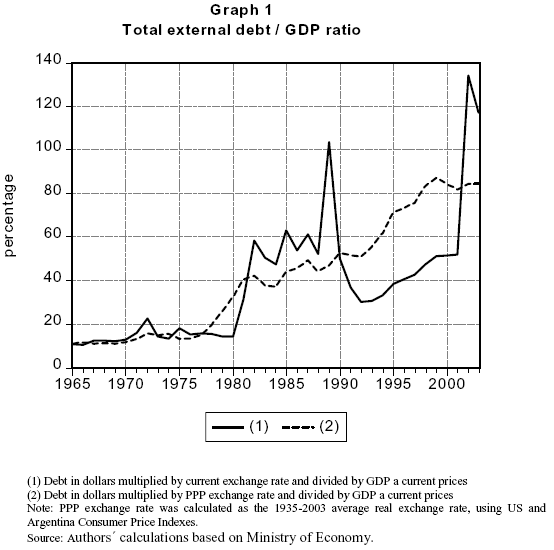
]]> 2.1. The Argentinean debt in the long termBefore the recent financial globalization process – which initial steps can be dated in the early seventies - Argentina showed low and stable debt indicators. The foreign debt, public and private, was mostly owed to multilateral organizations and governments. It fluctuated in a range of 10% to 15% of GDP from the beginning of the sixties to the mid seventies, as it can be seen in graph 1.
As from the mid seventies, the confluence of new international and local factors gave birth to a new stage markedly different from the previous one. In first place, after the oil shock in 1973 the strong expansion of the euro market opened for the country the easy access to international credit. Meanwhile, a deep liberalizing financial reform was implemented in 1977 and was followed by the progressive dismantling of foreign exchange controls to capital account private flows in 1978-80. These changes would jointly operate to completely change the country links with the international financial markets.
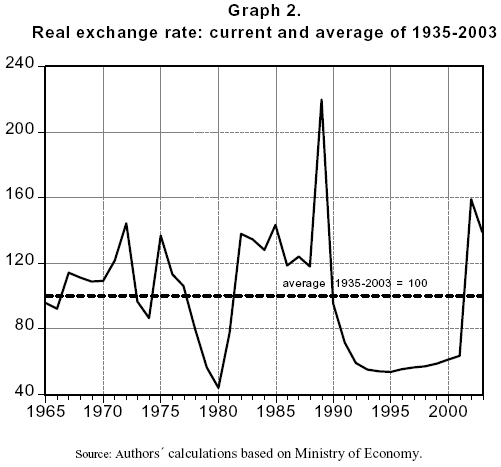
As can be seen in the graph, the foreign debt/output ratio showed a rising trend between 1976 and 2000. The ratio measured with the PPP exchange rate grew approximately 3 percentage points of GDP per year in this period. The curve is more volatile when the ratio is measured at current exchange rates, with sharp rises in the beginning and end of the eighties as well as in 2002, and a strong fall in 1990-93. These jumps are due to the real exchange rate instability experienced in the period, as can be seen in graph 2.1
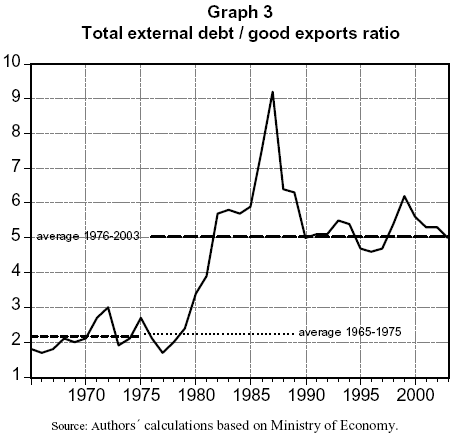
The total foreign debt/exports ratio, another standard debt indicator shown in graph 3, complements the mentioned evidence. It rose abruptly since 1977, especially between 1977 and 1982, and never returned to the previous level. The 1976-2003 average much more than duplicates the level registered in the period ending in the mid seventies.
]]>
2.2. Three stages
Between the mid seventies and present times, three main stages can be distinguished in the evolution of the debt.
In the first stage, between 1977 and 1982, Argentina went trough a phase of financial opening and accelerated indebtedness that ended up in massive capital flight, exchange rate crisis, devaluation and default. The second stage is a long period of international credit rationing, between 1982 -the Latin American's debt crisis year- and 1990. The third stage comprises the 1991-2001 period. As the first stage, it was also characterized by financial opening and accelerated indebtedness and exhibited again many of its features. This is the convertibility period, which would also end up in capital flight, exchange and financial crises, devaluation and default.
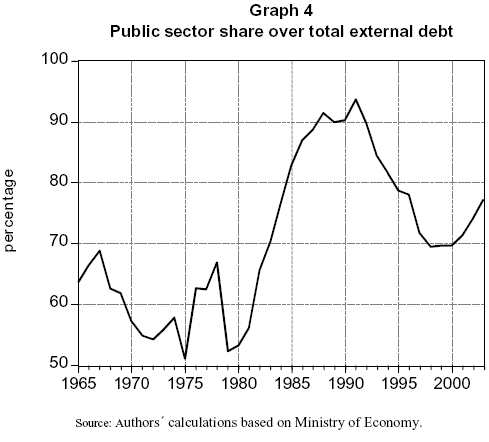
]]> In what follows, we present the main stylized facts of the mentioned stages.A first fact that deserves to be highlighted is the role played by the private sector in the generation of external financial obligations. In both stages of accelerated indebtedness this sector was initially the most dynamic one. As can be seen in graph 4, the government's proportion in total obligations declines between 1978 and 1980. Something similar can be appreciated in the period starting in 1991, although in this case the process would be longer. Despite the strong public external debt rise in the nineties, its participation in total debt declined in more than 20 percentage points during that period.
The second important fact is that fiscal policies have not been the main factor of the debt growth and the fiscal desequilibrium has not been the main cause of the crises and defaults that followed both phases of accelerated indebtedness. We will consider this issue in detail below in this chapter, when we focus the analysis on the nineties' evolution.
A third fact relevant for the understanding of the indebtness process is that Argentina entered both phases of accelerated indebtness in the context of stabilization programs based on the fixation of the nominal exchange rate. High inflation was experienced in the mid seventies and the same happened in the beginning of the nineties. The opening of the capital account was in both phases adopted together with the launching of antiinflationary programs (jointly with other liberalizing-reform measures in goods, and financial markets). In both cases, the key instrument of the stabilization policy was the fixation of the nominal exchange rate instrumented as an anchor for the stabilization of the prices.2
The stabilization programs based on the exchange rate anchoring and financial opening put in motion a cyclical macroeconomic process (Frenkel, 1983; Taylor, 1998; and Frenkel, 2003a). The exchange rate fixation encourages private capital inflows, induced by the difference between international and domestic interest rates. The aggregated demand expands while inflation declines, although the residual inflation causes the real exchange rate to appreciate. The current account worsens as a consequence of increasing net imports caused by both the exchange rate appreciation and the demand expansion. The external financial needs rise and debt accumulates. This implies that the vulnerability of the economy to negative external financial shocks progressively increases. The domestic financial fragility increases as well. Exogenous shocks may trigger the reversion of the expansionary trend. The change in the trend can also be caused endogenously by a domestic financial crisis. This happened, for instance, in Argentina at the beginning of the eighties. The failed stabilization attempt of the late seventies led to an internal financial crisis that started in early 1980 and developed along that year. Finally, the program collapsed in early 1981 leaving a heavy burden of external financial obligations.
The mentioned stylized facts help to understand the features of the debt evolution presented in what follows. Table 1 presents the changes in the debt/GDP ratio, and the factors explaining them: the changes in the amount of the debt in dollars and the variations in the real exchange rate and in the GDP. It can be seen that between 1975 and 1980 the debt ratio rose by more than 19 points of GDP, measured with the PPP exchange rate (it passed from 13,2% to 32,4%). The figures in the same table show that this result was hidden by the strong exchange rate appreciation, since the debt ratio calculated with the current exchange rate not only did not rise but fell in almost 4 points of GDP in that same period.
]]>
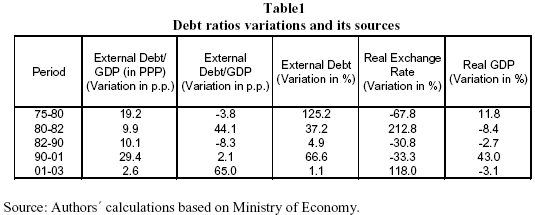
In 1981, the exchange rate anchor stabilization policy was abandoned, putting end to the first phase of accelerated indebtedness in an appreciated exchange rate context. A new phase followed, characterized by massive devaluations of the peso. These devaluations caused the foreign debt ratio measured in current dollars to reach a peak level close to 60% of GDP in 1982. The figures in table 1 show that the jump in the debt ratio at current prices between 1980 and 1982 (more than 44 GDP points) was to a great extent due to an increase of more than 200% in the real value of the dollar.
Nonetheless, the debt in dollars rose 37% between 1980 and 1982. An important factor behind this increment was the rise in the international interest rates that resulted from the policy carried on by the Federal Reserve since 1979.
An important jump in the public sector proportion in the country's foreign debt can also be observed in those years (graph 4). In 1981-82 the public sector ended up absorbing a considerable proportion of the private foreign debt, with the approval of the international banks. This to a great extent explains the jump in the participation of the public sector in total debt. It should also be stressed that no haircut provided relieve to the public debt in the early eighties default situation (it would only come late and in homeopathic doses with the Brady agreement in 1992-93).
In the following period of international private credit rationing the debt measured with the PPP exchange rate kept on increasing, though at a slow pace. It increased the equivalent of 10 GDP points between 1982 and 1990 (table 1). The external obligations in dollars continued rising despite the lack of access to the international market (although at a much lower speed than in previous stages). The stagnant output trend also contributes to explain the mentioned rise.3
Later on, in the nineties, the debt's rate of growth accelerated again, especially from 1992. The Brady agreement did not provide significant relieve to the debt inherited from the mistaken polices of the late seventies. The achieved haircut was practically insignificant. The main favorable impact of the Brady agreement was on the banks' portfolios, since they could transform into bonds the defaulted credits, including the past due interests.4
During the 1990-2001 period, the foreign debt/GDP ratio, measured with the PPP exchange rate, rose almost 30 GDP points (table 1). This jump was completely due to the increase in the debt in dollars, which surpassed the accumulated GDP growth. However, it can be seen that the debt ratio measured with the current exchange rate barely rose, as a consequence of the important real appreciation that took place in the period.
]]> 2.3. The public debt in the ninetiesWe have seen that the total foreign debt, measured with the PPP exchange rate, increased in almost 30 points of GDP between 1990 and 2001. About 60% of that rise was generated by the private sector. The participation of the private sector was even more accentuated in the early nineties: it originated approximately 70% of the increase in the external financial obligations between 1990 and 1995.
The public sector debt issuing was more significant in the second half of the decade, when the international financial conditions worsened. Besides, the placement of public debt in the domestic market started to play a more significant role in those years.
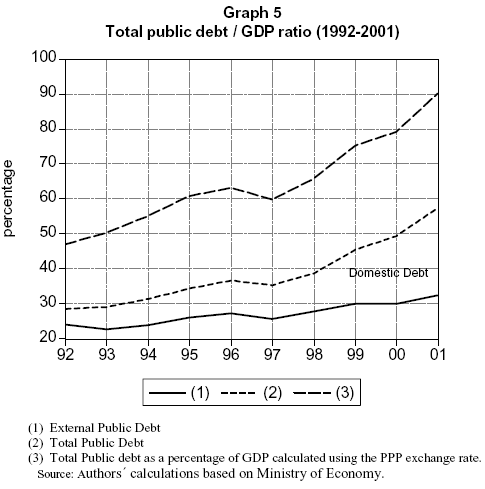
The following graph illustrates the public debt evolution in the period.
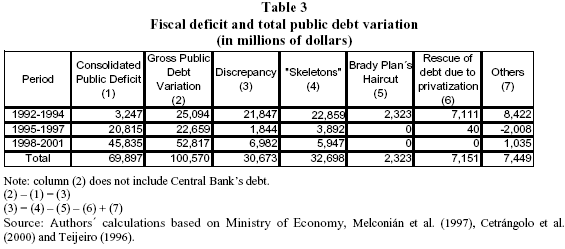
The series in the graph and the figures in tables 2 and 3 allow us to describe the main stylized facts of the Argentinean public sector indebtedness in the convertibility decade.
]]>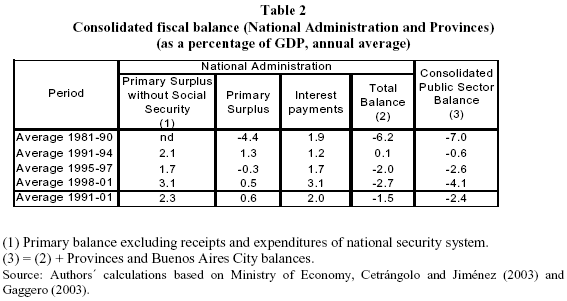
The analysis of the fiscal accounts allows us to distinguish three periods in the nineties. In the first period, a sharp adjustment in the public accounts is observed. The average deficit, which in the eighties was about 7% of GDP, decreased to less than 1% of GDP in the 1991-94 period. As figures in table 2 show, this was mainly due to an improvement of 6 points of GDP in the national public sector balance result, from which 90% is explained by the primary balance result.
The year 1994 was a breakpoint in last decade for three main reasons. In the first place, the social security reform that created the Private Pension Funds was then instrumented. One of the consequences of the reform was a considerable loss in the contributions to the public subsystem. In the second place, the expansion initiated in 1990 was then coming to an end: Argentina would go through the recession associated to the Tequila effect in 1995. In the third place, the government took several measures aimed at compensating for some of the negative effects of the combination of commercial opening and exchange rate appreciation. It did that by lowering the tax burden on the tradable goods production sectors. All of the mentioned factors negatively affected the public finances. Even though, in spite of these negative effects, between 1995 and 1997 the average fiscal deficit was only 2 points of GDP higher than the early nineties deficit. This figure is almost equivalent to the increase in the public social security subsystem desequilibrium caused by the reform.
However, after 1997 the fiscal panorama would change significantly. The impact of the Russian and Brazilian crisis in 1998 resulted in a new jump in the country-risk premiums, which had already started rising since mid 1997, after the South East Asian crisis. This, on the one hand, negatively affected the internal demand and triggered a new recession trend. On the other hand, it increased the financial vulnerability of debtors, including the public sector as well as many private agents that were in a net debtor position.
]]> Before analyzing this stage in more detail, let us take a look at the association between the fiscal results and the public debt evolution using the figures in table 3.A first important observation refers to the discrepancy between the variation of public sector's financial obligations and the accumulated fiscal deficit, which represents more than 30 billion dollars in the nineties. The figures show the main reason of this inconsistency: the verification of debts incurred in previous periods but not registered in the fiscal results balance, especially debt with the public sector purveyors and with the social security system's beneficiaries (skeletons). There had been erroneous liquidations and payment delays, mainly during the 1989-90 period, when the economy experienced two short hyperinflationary episodes.
The documentation of past debts was mostly concentrated in the initial stage, between 1991 and 1994. Even though, it should be noticed that the public debt ratio measured as percentage of GDP, was relatively stable up to 1994, in around 30% in the case of total debt and 25% in the case of foreign debt (graph 5).
In comparison to the eighties, the 1991-94 phase was in synthesis characterized by a significant improvement in the public accounts and by the relatively ordered absorption of a considerable volume of debt mostly generated in previous periods, i.e. by the regularization of liabilities, many of which were litigious. It is clear from these figures that the standard financial vulnerability indicators did not show evidence of fiscal sustainability problems towards 1994, when the economy was reached by the shock resulting from the Mexican crisis contagion.
However, it is undeniable that the high debt burden inherited from the previous phase - a sort of an original fiscal sin of the nineties- is partially hidden by the real appreciation veil. Graph 5 shows the public debt/GDP ratio calculated with the PPP exchange rate. As it can be seen, the curve intersects the 50% line in 1993. The dollarization of the public debt establishes a direct link between the external fragility and the fiscal financial fragility, since taxes are paid in domestic currency. The relevance of this link is stressed by the exchange rate appreciation.
Between 1995 and 1997 the public debt/GDP ratio increases, in part as a result of the 1995 recession, and also because of the significant financial aid package led by the IMF, amounting approximately 11 billion dollars. This support enabled the country to quickly recover from the crisis that followed the tequila effect. As can be seen in graph 5, in the expansionary phase that followed the crisis, the debt ratio tended to stabilize again between 35 and 40% of GDP, a relatively low level in comparison to international standards. Again, in spite of the rise in the current deficit and the desequilibrium in the social security system, the standard debt indicators did not suggest fiscal sustainability risk towards 1997, before the beginning of the depression. However, the debt ratio measured with the PPP exchange rate had already reached 60% of GDP.
]]> As pointed out above, the Argentina's macroeconomic panorama would drastically change soon after, since the August 1998 Russian crisis.Table 4 helps us to understand some key features of the fiscal evolution in this stage. Public sector's deficit took a significant rising path that would lead it to reach about 6 points of GDP in 2001, despite the many rounds of contractive fiscal policies instrumented to stop the trend.
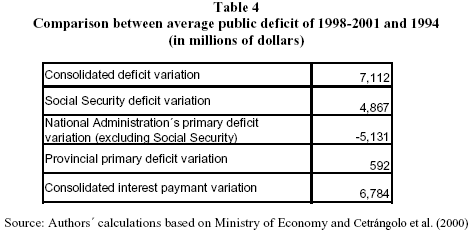
In the table 4 we compare the average desequilibrium of the depression period to the deficit registered in 1994.
In 1998-2001 the average accrued annual deficit (amounting 11.5 billion dollars) was 7.1 billion dollars higher than the deficit registered in 1994. Which were the sources of this increase? As it can be seen, it was chiefly due to the rise in the interest payments (+6.8 billions) and, in the second place, to the amplification of the social security system gap (+4.9 billions). Contrary to the standard interpretation, a relatively minor figure (+582 millions) is explained by the desequilibrium in the result of the provincial administrations, though it is true that it was on an increasing path.
The table also suggests that the procyclical fiscal policies implemented were not ineffective: they produced a substantial increase in the primary surplus of more than a 5 billion dollar annual average (without including the public social security results), though that was not sufficient to compensate for the rises in the interests item and in the social security system desequilibrium.
The explosive trend in the public debt interests account is also observed in the following table.
]]>
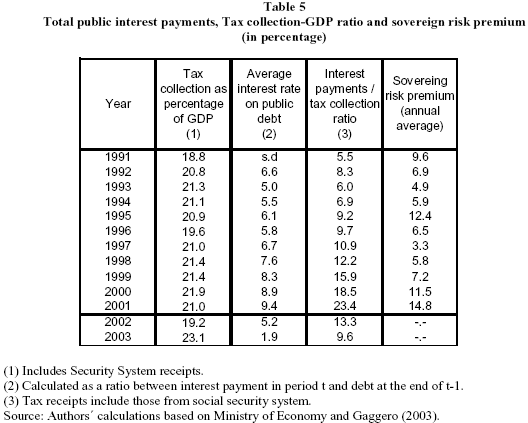
The weight of interests on tax resources, which had slightly increased after 1994, takes a fast upward trend after 1996. In 2000, that ratio was nearly 19%, duplicating the ratio registered in the middle of the decade. This was in part due to the decrease in tax revenues caused by the recession, but it was fundamentally originated in the rise in the average interest rate paid by the public debt. The average interest rate of the total public debt went from 5,8% in 1996 to 9,4% in 2001. Considering that this is an average rate, it is easy to see that the marginal rate rise was extremely higher.
The rising path of the interest rate is associated with the increasing trend in the country-risk premium (the two variables are narrowly correlated in the 1997-2001 period). These rising trends are the main factors behind both the consolidate deficit trajectory and the explosive path taken by the public debt. This is illustrated in graph 5. Between 1997 and 2001, in only four years, the public debt/GDP ratio increased by more than 20 percentage points.
3. The macroeconomic performance before and after the default
3.1. The nineties: from euphoria to depression
The basic plot of the macroeconomic story of the late nineties was quite simple. To start with, the negative financial turnaround in the foreign environment experienced in 1997-1998, after de South East Asian and Russian crises, found the Argentine economy with a significant and growing current account deficit, a considerably appreciated currency and a visible lack of policy instruments to deal with this problem, given the rigidities of the adopted macroeconomic rule. No surprise, in these conditions the country-risk premium jumped upwards and the access to foreign funds became more and more problematic. As explained in the previous chapter, the subsequently increased interest burden had a negative impact on all borrowers, including the public sector.
]]> Given that the government lacked of other policy instruments, restrictive fiscal policies had to bear with the main burden of the adjustment to the new situation. The official story used to say that fiscal discipline would entail stronger confidence, and consequently the risk premium would fall bringing interest rates down. Therefore, domestic expenditure would recover pushing the economic out of the recession. Lower interest rates and an increased GDP would, in turn, reestablish a balanced budget, thus closing a virtuous circle. De la Rua's administration borrowed the entire argument from Menem's administration and the IMF gave its seal of approval. All of them failed.Hence, the macroeconomic story of the late nineties is about this failure. Despite the strong adjustment in the primary result of the public sector we have already mentioned in the above chapter, the virtuous circle was never attained. Worse enough, the increases in taxes and the cuts in public expenditures reinforced the recessionary trend, thus feeding the negative expectations that prevented the so much expected fall in the country-risk premium. Fiscal policy alone was impotent to compensate for the strong macroeconomic unbalances, which laid mainly in the external sector of the economy. Under this self-destructive fiscal policy orientation, the economy got trapped into a vicious circle for several years, and suffered from the longer recession since the First World War.
3.2. The balance of payments and the public debt under the currency board
In the following graph we present the results of the principal accounts of the balance of payment in the nineties. They make possible to complement our previous discussion by illustrating some important aspects of the performance of the economy under the currency board regime.5
Let us start by making a short reference to the early nineties. The macroeconomic performance of the 1991-95 period clearly fit the stylized cycle described in the previous chapter. The capital inflows-led growth lasted until 1994. In early 1994 the Federal Reserve started to increase the discount rates affecting the capital inflows negatively and causing the foreign reserves stop growing, due to the continuously increasing deficit in the current account.
Then, the contagion of the Mexican crisis of December 1994 triggered a massive capital outflow at the beginning of 1995, with a sharp increase in interest rates. Foreign reserves fell, as can be seen in Graph 6, and a contraction ensued. However, the recession of mid nineties was short-lived. As it was already mentioned, a strong financial-support package structured with the coordination of the IMF helped to change the negative expectations.
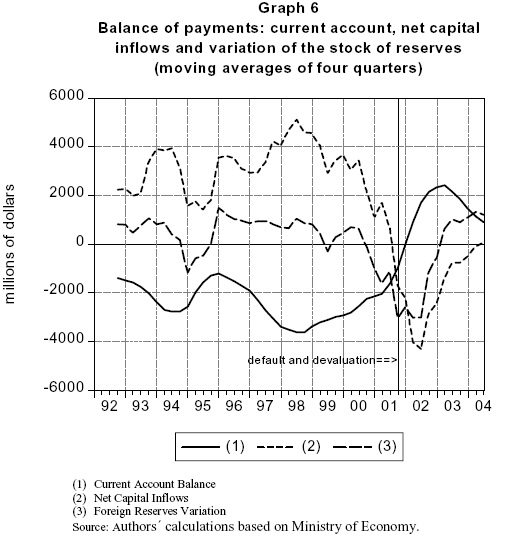
]]> Due to the favorable effects of the external financial support, it was possible to preserve the monetary regime and in late 1995 a new expansion was already starting. The elements of the cyclical dynamics were once again in motion. The expansion phase that followed showed the same stylized facts of the first, although this time it was shorter. The country-risk premium jumped in mid-1997, after the devaluation in Thailand. Then, after the Russian crisis of 1998, a new contraction started.
3.3. Foreign debt, public and private
Beyond the mentioned similarities, the second cycle of the nineties differed from the first one in many respects. We want to highlight here one of them: the dissimilar roles played by the public and private sectors in the generation of the capital inflows that fed the accumulation of reserves (a crucial variable under the currency board regime).
During the first economic expansion, in the early nineties, private inflows were predominant in spite of the fact that the privatization of the most important state-owned companies took place in that period. Capital inflows to the public sector became significant during the recession of 1995, thanks to the foreign financial-support package we have already mentioned. Since then, capital inflows to the public sector were kept at a high level until the end of the period. Thus, the second expansion in the nineties was bolstered mainly by capital inflows directed to the national government.6 Meanwhile, net capital inflows directed to the private sector recovered only slowly and, from mid-1998 on, they stopped flowing in important amounts. Actually, an abrupt outflow started in late 2000.
As Table 6 shows, the increase in the foreign public debt surpassed 35 billion dollars in the period. This amount is quite close to the increase in the foreign financial obligations of the non-financial private sector, which was above 32 billion dollars. If we add the increase in the external liabilities of the domestic financial sector, the amount jumps to more than 44 billion dollars, but with a significant fall in the critical period 2000:4-2001:4. Thus, the rise in the amount of the public foreign financial obligations (including the Central Bank) explains about 44% of the change in the total external debt during the period, or about 38% if the year 2001 is excluded from the calculation. The public sector played, as we have just stated, a crucial role in the financing of the accumulation of foreign reserves in the nineties. Certainly, the increase in the foreign debt of the private sector was not less important, but a significant part of it had a counterpart in private outflows of funds. In effect, whether the private debt experienced a considerable increase, also did the external assets of this sector. The Table 6 shows that foreign assets grew more than foreign liabilities in the case of the non-financial private sector. As we have analyzed in other works, this sector's net demand of foreign currency was positive in the aggregate (Damill, 2000; and Damill and Frenkel, 2005).
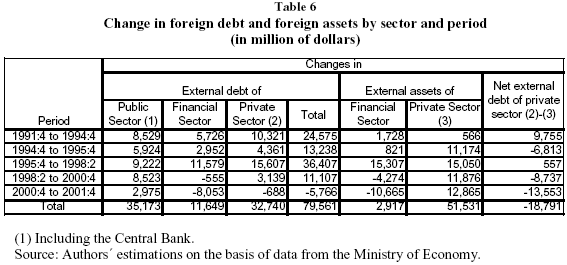
The accumulation of foreign assets by the private sector was small in 1991-94. It rose during the second half of the decade, after the Tequila shock. As it can be seen in the table, in the expansionary phase extended from late 1995 to mid 1998, the private debt increased rapidly. It grew by more than 15 billion dollars (for the non-financial sector). But private foreign assets went up in a roughly similar amount.7 Furthermore, from then on the net private foreign debt declined substantially. In the whole period, it fell by about 19 billion dollars, according to the figures of the table. Synthetically, in the late nineties the level of reserves and the internal liquidity became more and more dependent on the access of the public sector to foreign funds.8
]]> 3.4. The efforts to prevent the default and the end of the currency board regimeAs it usually happens during a crisis, its development involved a complex succession of events, including many contradictory policy decisions (especially throughout 2001) and steps back and forward. We will only mention here some crucial aspects of these processes.
In December 1999 a newly elected government took office. As we have already mentioned, the new administration adhered to the belief that the main cause of the economic depression was not the exchange rate appreciation and the financial vulnerability to external shocks, but the fiscal mismanagement. This vision led the government to adopt a tight fiscal policy as a way to, quite paradoxically, take the economy out of the recession. We have presented these arguments and the expected results above.
However, the failure of this policy orientation should not hide the fact that huge efforts were made to balance the public accounts and to prevent the default of the government's financial obligations.
Indeed, aiming at reestablishing the bridges to the international financial markets, successive packages of tight fiscal measures were applied during 2000 and 2001, grounded on the fiscalist view of the crisis. We do not intend to describe them in detail here, but some episodes deserve to be mentioned as examples of the actions oriented to fulfill the commitments with creditors, both foreign and domestic.
The efforts to prevent the default included, among other measures, a Fiscal Responsibility Law approved in late 1999 that set a mandatory declining trend for the public deficit that should bring it to zero in a few years. Tax increases and expenditure cuts were adopted with that purpose. Later on, when the credit constraint had become very hard, a “zero deficit” policy was approved, by mid 2001, determining that the public accounts had to be immediately balanced (so that total expenditures had to be adjusted to total cash receipts). The norm intended to guarantee some basic payments of the state, including interests on the public debt, and making endogenous the rest of the expenditures subjected to the evolution of public receipts. The other “protected” items were legally established transfers of tax receipts to provinces, and wages and pensions amounting less than 500 pesos per month (or dollars at the ruling parity). The package included an unprecedented 13% across the board cut in public wages and pension benefits, which hardly contributed to either the social approval of the government policy or the social peace. It should be kept in mind that these measures were taken when the economy was already in the end its third recession year. These decisions exemplify the huge efforts made to prevent the default of the public debt.
In any case, the expected "confidence shock" did never materialize. With the economy suffering from a deep recession and caught into a debt trap, these rounds of contractionary fiscal policies only reinforced the deflationary scenario and the pessimistic expectations, as we have already explained.
During 2000 and 2001 the government attempted to complement the fiscal measures with some initiatives on the financial front. It obtained foreign support and implemented important debt swaps aiming to convince the public that there was no risk of default. Thus, at the end of 2000 an important package of local and external support, for about 40 billion dollars, was announced: (the “blindaje”, financial shield). The IMF led the operation with a 13.7 billion dollar extension of the stand-by credit in force since March 2000. Local agents (a group of banks and the private pension funds) also had a significant participation. The beneficial effect of this action was very short lived. Two months after its announcement, and following the outburst of a new crisis in Turkey, the country-risk premium started to climb again.
Later on, an important voluntary debt swap (the "megacanje") was implemented in mid-2001 to seduce private creditors (local and foreign). The transaction amounted about 30 billion dollars in public bonds (24% of the total debt of the National Public Sector at the moment) and had the IMF's support. The operation made possible some extension in the duration, but involved an increase in the nominal debt (of about 2 billion dollars) as well as a heavy interest burden, because the newly issued bonds committed dollar interest rates of about 15%. Instead of alleviating the financial constraint, these high interest rates contributed to consolidate the perception that the debt path had become unsustainable.
Finally, there was another voluntary swap of public debt in November (although it would be better to call it 'induced', semi-voluntary). This was directed to domestic bondholders (mainly banks and the private pension funds), who agreed to swap more than 42 billion dollars in public bonds for the same amount in loans of lower yield but insured by tax revenues. The operation could not stop, however, the on-going divergent processes.
]]> The withdrawal of bank deposits and the contraction of international reserves had started in October 2000, with the resignation of Vice-President Alvarez. In March 2001, after the ephemeral recuperation that followed the announcement of the 'blindaje', this process became more intense and lasted until mid-June, when the government again issued a new signal aiming at changing the expectations: the 'mega-canje' (mega swap). As we have mentioned, the stabilizing effects of this operation were very weak. In the beginning of July, the deposits withdrawal and the run against the reserves started again. The intensification of these processes could neither be stopped with the announcement in August of a new extension of 8 billion dollars of the current IMF stand-by credit, nor with the debt swap in November.From the beginning of December on the government established hard restrictions on capital movements and on cash retirements from banks (the so called 'corralito'). One of the purposes of the measures was to avoid either the generalized bankruptcy of the banks or the violation of the currency board monetary rule. No bank, domestic or foreign owned, complained for that. But the main objective of the measures was to hold back the demand for foreign currency, preserve the stock of reserves and avoid the devaluation (i.e. the formal abandonment of the convertibility regime). It was also the last drastic move attempting to prevent the default. Yet, the measures actually did represent the end of the regime.
The December financial restrictive measures contributed to deepen the already strong social and political tensions. After a few days of social unrest and political commotion the country experienced the resign of the government followed by a series of ephemeral presidents. One of them announced to the Congress the decision of defaulting the public debt, and resigned a few days later. In the first days of 2002, with a new president, the economic policy officially abandoned the currency board regime and the one-to-one parity of the peso to the US dollar.
3.5. The macroeconomic performance after devaluation and default
After three years of recession, the economic activity suffered from an additional abrupt fall since mid-2001. The massive flight to external assets that took place in the second semester precipitated the collapse of the convertibility regime and ended up in the devaluation of the peso and the default. Graph 6 shows the strong fall in reserves experienced along that year that rapidly shrank the liquidity. The payments chain collapsed after the 'corralito' was established. The output and employment followed the abrupt contractive trajectory showed by the reserves and liquidity. Social indicators such us the unemployment rates and the poverty and indigence indexes, which had considerably worsened along the nineties, suffered from an additional deterioration, adding to the social tensions and the politic crisis that brought the government of the Alianza to an end (Damill, Frenkel y Maurizio, 2003).
3.5.1. The economic recovery
The abyssal fall in output and employment continued after the end of the convertibility regime, but for a very short period. Certainly, in opposition to most of opinions and beliefs -including those of the IMF's officials- the traumatic episodes that brought the convertibility regime to an end were not followed by a deeper depression. Moreover, an extraordinary quick recovery started only one quarter after the devaluation and default, as can be seen in graph 7.
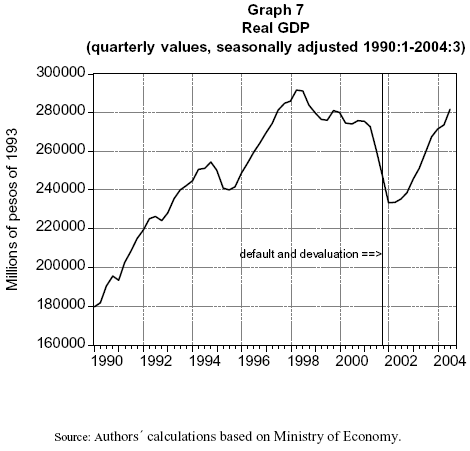
In the graph, the 'V-shaped' trajectory can be seen, consisting of the economic collapse phase of the last quarters of the convertibility regime and the following quick recovery. As we have just indicated, the GDP recovery started soon after the exchange rate depreciation (around three months later, as can be seen in the available monthly activity indicators. The recovery was precisely triggered by the sudden change in the relative prices in favor of the tradable goods sectors. In the beginning of this phase the recovery was led by the local production of previously imported goods.
It is remarkable that the beginning of the new phase started to be perceptible while the country was still immersed in a context of accentuated economic instability and political uncertainty, and when the services payments of part of the public debt were interrupted.9 In other terms, the 'rebound' took place in spite of this extremely complicated setting and also despite the short-term recessionary effects of the depreciation.
3.5.2. Despite the IMF
Apart from the shift in the relative prices, the quick economic recovery that followed the crisis is also a consequence of a set of policies that, still with flaws and ambiguities, aimed at recovering the basic macroeconomic equilibria.
We discuss the Argentinean relations with the IMF in greater detail below in chapter 5. However, for the purpose of this section it should be stressed that many of the policies that played important roles in this stage had to face the IMF's opposition. Firstly, the imposition of exchange controls. This measure compelled the exporters to liquidate in the local market a considerable part of the international currency generated by the exports and also restricted the capital outflows. Secondly, the establishment of taxes on exports (retentions), which absorbed part of the devaluation's favorable effect on the exporters' incomes (thus significantly contributing to the recovery of the fiscal equilibrium), and attenuated the impact of the devaluation on domestic prices and, consequently, on real wages. Thirdly, a flexible monetary policy that initially enabled the assistance to banks in the crisis phase and afterwards contributed to the recovery of the money demand, thus helping the recovery. Fourthly, when the exchange market started to show an excess supply of international currency, an exchange rate policy attempted to avoid the peso appreciation throughout the interventions of the Central Bank (and of the Treasure later on).
The IMF put particular insistence in the free flotation of the peso. For a short period the government adopted this regime. Once the exchange rate was free to float the parity rose abruptly, reaching levels close to 4 pesos per dollar. The following reintroduction of exchange controls was crucial to contain the exchange rate bubble. The government managed to stabilize the nominal exchange rate by mid-2002 by compelling the exporters to liquidate the international currency in the local exchange market and by limiting the currency outflows.
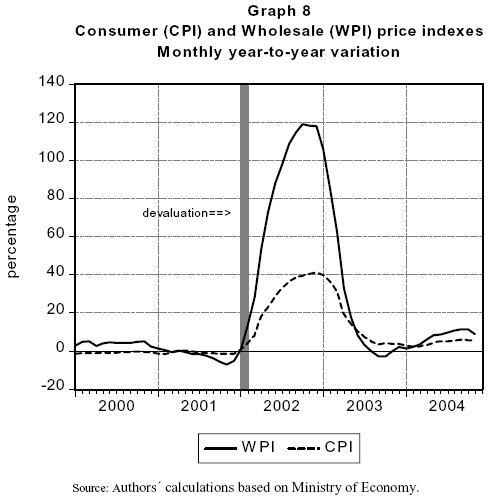
Soon after, when the exchange rate was stabilized the demand for pesos started to recover and the exchange market begun to show an excess of supply of dollars. The stop of the exchange rate bubble decisively contributed to stop the rise in the domestic prices. The freezing of the public utilities rates10 as well as the high unemployment rates -that kept constant the nominal wages - also contributed to stop the rise in prices. The quick decline of inflation in the second half of 2002 can be seen in the graph 8.
Another important point involving the tense relations of the country with the IMF refers to the net flows of funds between Argentina and the multilateral organizations. In this regard, a substantial change can be seen after the end of the convertibility regime. Actually, in the post default phase the net funding of the IMF and the multilateral organizations became negative. According to the Argentinean Minister of the Economy the IMF passed from playing the role of 'last-resort lender' to play the role of 'privileged debt payments collector'. This point is illustrated in the following graph.
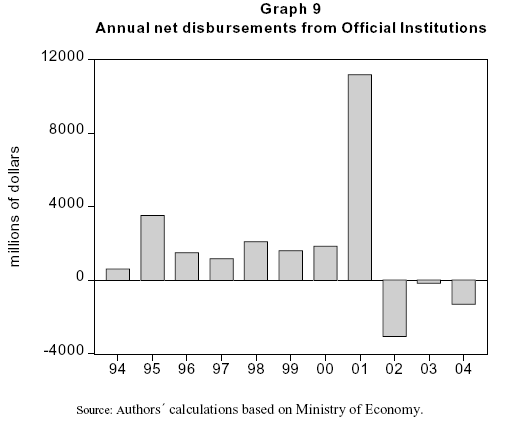
Whereas in the 1994-2001 period Argentina received from the multilateral organizations a net funding of more than 23 billion dollars (40% of which were concentrated in 2001), in the 2002-2004 phase the country made net payments amounting more than 4,6 billions dollars.
3.5.3. The main characteristics of the recovery phase
The GDP recovery that started in the first half of 2002 had a short first phase in which the aggregate demand barely rose and in which every internal component of domestic expenditure (private consumption, public consumption, investment) kept on shrinking, as it happened, though at a low pace, along the previous depression. Therefore, it was not the aggregate demand what stopped the declination in the activity level. The expansive factors were mainly the international trade variables, exports and imports, and especially the latter. The local production started to provide an increasing proportion of the aggregate demand. This imports substitution particularly favored the manufacturing sector. After that short initial stage, the activity level recovery was led by the increase in the domestic demand components, especially by the investment -that grew at an annualized rate close to 40% between 2002 and 2004- and by the private consumption.
It is frequently mentioned that the favorable external context is an important element behind the economic recovery. In some analyses the main part of the rebound is usually attributed to a set of positive 'exogenous' factors. In those interpretations, this recovery would be taking place in spite of what is interpreted from this perspective as an economic policy full of mistakes and omissions. Although the contribution of external facts to recovery has been undeniable (in particular some commodities' high prices) the fact that the substantial part of the expansion's dynamism derives from internal demand sources weakens that interpretation.
]]> It should also be stressed that the consumption and investment recovery took place in a context of accentuated credit rationing, both external and internal. The investment was apparently financed by higher profits retained by firms, although the 'wealth effect' resulting from the significant external assets holdings of the private resident sector, surely contributed as well. These assets -that nowadays largely surpass 100 billion dollars- increased their value in pesos with the exchange depreciation, and also rose in relation to the prices of domestic assets such as real estate and land. This was also a factor that fed the recovery of the private consumption expenditure.3.5.4. Fiscal and external adjustment
The adjustment experienced by the Argentinean external sector in recent years took place to a great extent before the devaluation, as it can be seen in graph 6 where the improvement in the current account since 1998 can be seen.
Actually, the abrupt contraction that characterized the end of the convertibility generated an important trade surplus. The trade balance exhibited a deficit higher than 3 billion dollars in 1998. It rapidly decreased from then on and turned into surplus, due to the reduction in the volume of imports. In 2002 the balance was higher than 17 billion dollars, and remained over 16 billion in 2003 (and over 12 billion in 2004). The trade surplus caused the change of sign in the current account balance. In recent years it has shown positive results even taking into account the interests accrued by the debt in default (as it is shown in the figures in graph 6). In fact, the macroeconomic policy has recently been facing the problem of sustaining the real exchange parity in order to preserve the incentives to investment in the tradable goods sector in a context of international currency excess supply.
As can be seen in table 7, a strong adjustment in the public accounts has been also taking place together with the external adjustment process we have just mentioned.
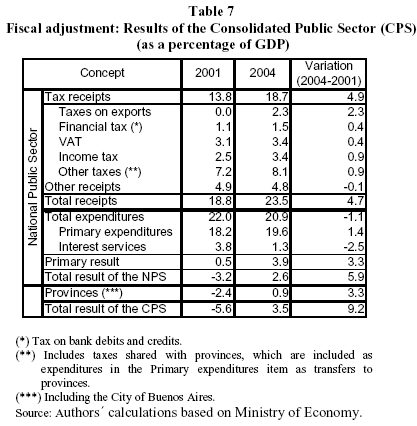
The improvement in the Consolidated Public Sector global result that took place between 2001 and 2004 was equivalent to 9.2 points of GDP. This result passed from a global deficit of 5.6% of GDP in 2001 to a 3.5% surplus in 2004.
]]> Which are the factors explaining the adjustment in the fiscal cash flow results? More than a third of it derives from an improvement in the provinces' balances. This improvement comes from the increase in tax collection facilitated by the recovery and the rise in nominal prices, together with the restraint in expenditure. Meanwhile, around 60% of the almost six-points-adjustment in the national public sector's budget is explained by the improvement in the primary result (+3.3% of GDP). The contraction of interest payments, basically resulting from the default of the sovereign debt, accounts for the rest (-2.5% of GDP).The rise in the national primary surplus is mainly explained by an improvement in tax revenues (+4.9% of GDP). It is interesting to observe that although the receipts from traditional taxes such as the VAT and the Incomes tax rose significantly, they did not increase substantially when measured as a proportion of GDP. Between 2001 and 2004 they increased in 1.3% of GDP as a whole. The tax on exports is the item that mostly explains the rise in tax revenues (+2.3% of GDP). The soy and derivatives industry generated almost one half of the taxes on exports.
Hence, the public sector absorbed part of the effect of the devaluation on the profitability of the tradable goods sector, and was also benefited by the high prices reached by some of the exportable goods, such as soy and oil. The tax on financial operations established in 2001 also contributed to the increase of tax collection (+0.4% of GDP).
The interest payments on the public debt deserve a separate paragraph. As it can be seen in table 7, this flow passed from representing almost 4% of GDP in 2001 to only 1.3% in 2004 (without taking into account the accrued interests on the debt in default. Table 7 shows cash flows figures, not accrued flows).
However, the fiscal effects of the suspension of part of the debt services payments are significantly higher than what is shown in the mentioned account. It cannot be calculated with precision because a significant amount of new debt was issued after the suspension of debt payments, as it is described in the following chapter. However it can be estimated that the amount of interests on the public debt –valued at the 2004 exchange rate- would have represented in that year between 9 and 11 points of GDP. This is approximately equivalent to one half of the total tax collection of the year. These payments would have been certainly incompatible with the economic recovery. As it was pointed out above, a crucial aspect of the fiscal financial vulnerability derived from the extremely high proportion of debt in foreign currency, with the consequent exposure to the impacts of the exchange rate variations. The 2002 substantial exchange rate depreciation would have had a harsh impact on the public sector's financial equilibrium. Taking this aspect into account, it can be said that the payments suspension and the following debt restructuring enabled a considerable amount of fiscal savings -either measured in domestic currency or as a proportion of GDP.
However, the most important effect of the default and the end of the convertibility regime was the recuperation of the instruments of macroeconomic policy which had crucial importance to take the economy out of the abyssal situation generated by the agony and the final collapse of the convertibility regime.
4. The evolution of the debt after the default and the restructuring proposals
The suspension of the services payments of a part of the public debt was declared on December 24th of 2001 (by then the debt reached 144.5 billion dollars). The measure initially affected 61.8 billion dollars in public bonds and other 8 billion dollars in diverse liabilities. The rest –mainly debt with multilateral organizations (32.4 billion dollars) and the recently issued guaranteed loans (42.3 billion dollars)- remained as performing debt.11
The devaluation of the peso that followed had a strong impact on the economy's contractual structure, given the important dollarization of contracts inherited from the convertibility period. A few days after the devaluation, in order to attenuate some of the consequences of the shock, the authorities resorted to the issuing of new debt. In this chapter we examine both the generation of these new liabilities ('non voluntary' and 'inertial', as called in the official documents) and the restructuring process of the defaulted liabilities.
]]> 4.1. The evolution of public debt after the defaultAs it was pointed out above, there were government interventions aimed both at reducing the wealth transfer from debtors to creditors and at avoiding the collapse that would have resulted from the fulfilling of contracts set in foreign currency. The official intervention was intended at managing the 'distribution of losses'. In many cases the intervention meant that part of the losses were absorbed by the State via new debt issuing. The evolution of public debt in the period following the default is summarized in table 8 presented in the annex.
The main source of the new indebtness came from the intervention in the financial system, which involved a 14.4 billion dollar public debt rise. In February 2002 the government decided to compulsively convert the foreign-currency bank deposits into pesos at a rate of 1.4 pesos per dollar.12 The withdrawal of the demand and saving deposits was restrained to 1,500 pesos per week. The rest of the deposits constituted until the end of 2001 was transformed in longer term deposits. This measure included both the deposits recently converted from dollars to pesos and the originally denominated in pesos.
Bank credits in foreign currency were converted into pesos at a rate of one peso per dollar. This measure was aimed at avoiding generalized bankruptcies in the private sector. The 'asymmetric pesoification' of credits and deposits caused a significant loss in banks' net worth that was compensated by the government. The issuing of new debt with this purpose amounted 5.9 billion dollars.13
Many banks' financial positions in domestic and international currency were not hedged at the time of the devaluation. Therefore, the peso devaluation caused an additional loss in the banks' net worth. The government compensated this effect by issuing 2.4 billion dollar bonds ('bonos cobertura') denominated in foreign currency in exchange for banks' liabilities with the State.14
The pesoification of the private deposits at 1.4 pesos per dollar and the forced reprogramming of their maturities triggered strong claims. The savers claimed for the value of their deposits in their original currency denomination and for their free availability. In many cases there were judicial decisions favorable to these claims causing a considerable 'filtration' of funds out of the banks. To face this situation, the government of President Duhalde launched three different offers for the voluntary swap of reprogrammed deposits for new public bonds.15 The first two offers involved the swapping of the banks' debts with the savers for public debt. The third one was intended to free all the reprogrammed funds. In this case the government issued debt papers for the difference between the deposits' value in its original currency (dollar) and the amount effectively disbursed by the bank (1.4 pesos per dollar plus the inflation adjustment, following the CER index).16 The three offers as a whole reached a broad acceptation from the savers. This helped to alleviate the financial system's liquidity problem, though at the expense of augmenting the public debt in 6.1 billion dollars in exchange for banks debt with the State.17
Another source of the public debt increase came from the transfer of liabilities from the provincial governments to the central government. The latter absorbed 9.7 billion dollars of the provincial governments' debts with the banks. It also undertook the loss derived from the rescue of provincial governments' bonds that had performed as currency ('cuasi monedas') between 2001 and 2003.18 In this case, the national government assumed a liability of 2.4 billion dollars with the Central Bank, the institution that was in charge of the rescue of the provincial governments' bonds by issuing notes in exchange for the provincial bonds. Both transactions were granted by a proportion of the future flow of national tax resources distributed among the provincial governments.
During 2002 and 2003 the public debt also rose due to the accounting of obligations with employees, pensioners and purveyors for 2 billion dollars. A ruling of the Supreme Court –stating that the 13% cut applied on public wages and pensions since July 2001 was unconstitutional- forced the government to issue debt papers for 873 million dollars. On the other hand, the liabilities with purveyors and other debts committed before the default amounted 1.2 billion dollars. All together, the measures aimed at managing directly or indirectly some of the consequences of the convertibility collapse entailed a gross debt emission of 28.5 billion dollars.
In February 2002 the government determined the conversion into pesos of all the debt issued in foreign currency under the Argentinean legislation. The measure would affect 57.5 billion dollar debt, most of it constituted by 'guaranteed loans' issued after the November 2001 debt swap.19 It was also decided to apply fixed interest rates to the 'new' pesoified debt that varied from 2% to 5.5%. The 'guaranteed loans' had been issued with a clause that allowed the holder to turn the asset into the original bond in case the original emission conditions were changed. In 2003 most of the private pension funds (AFJP) and the local insurance firms decided to re-convert their holdings of 17.8 billion dollars of 'guaranteed loans' into the original foreign-currency- denominated bonds. In spite of that, the pesoification of the 'guaranteed loans' reduced the value in dollars of the debt issued under local legislation in about 22.1 billion dollars.
However, the pesoified debt indexed with the CER experienced a rise due to the inflation. The same happened with the new bonds in pesos issued to manage the losses caused by the exit from the convertibility regime. Until the end of 2003 the value of all these obligations rose due to the indexation effects in about 7.3 billion dollars. In a similar way, capitalized past due interests of the defaulted debt accumulated 13.9 billion dollars.
]]> In summary, considering the different measures and effects derived from the management of the convertibility collapse and the declaration of default, between December 2001 and December 2003 the gross public debt stock increased in about 28.2 billion dollars.204.2. The proposals for the public debt swap
In the second half of 2003 the first official steps for the restructuring of the defaulted debt were taken. In September, after reaching an agreement with the IMF, the government took advantage of the annual meeting of the IMF and the World Bank in Dubai to make public the main guidelines and the agenda of a restructuring proposal.
The 'Dubai proposal' established that the offer would be directed to every bondholder of bonds issued until December 2001 with a uniform treatment, while keeping performing the rest of the debt.21 22
The government recognized a defaulted debt stock of about 87 billion dollars. This amount left aside an important volume of past due interests. A 75% haircut was imposed to this amount. According to those guidelines the issuing of new bonds would reach a maximum amount of about 21.8 billion dollars. The issuing of three bonds called Par, cuasi-Par and Discount was announced. Although the specific characteristics of the instruments were not divulged, it was mentioned that the Par would preserve the nominal value of the original debt but would have longer maturity and lower interest rate than the other two. The other two bonds would imply nominal haircuts. The haircut corresponding to the Discount bond would be higher than the haircut of the cuasi-Par. The new bonds would also incorporate mechanisms –which would be specified later on- to reward the bondholders with a coupon tied to the economy rate of growth. The sustainability of the proposal was consistent with the primary surplus that had been recently agreed with the IMF (2.4% of GDP for the central government and 3% for the consolidated public sector). The government announced that it expected to maintain that target in the long run.
The voices of the financial market expressed strong disapproval. It was affirmed that Argentina was in a position to make a much better offer by compromising a higher fiscal effort. The IMF exerted pressures on the government in many ways and repeatedly claimed for signs of 'good-faith'. In June 2004, a few months after the G-7 finance ministers manifested that Argentina should accelerate the restructuring process and issue 'good faith' signals, the government made public a new proposal in Buenos Aires.
Although efforts were made to present it as a refined version of the Dubai proposal, the 'Buenos Aires proposal' was certainly a second offer that aimed to get closer to the creditors' positions. The eligible debt was the same than the one defined in Dubai. The debt to be restructured amounted 81.8 billion dollars.23 In exchange for that defaulted debt stock new bonds would be issued for a total of 38.5 billion dollars, in case the level of acceptance of the swap was lower than 70%, and for 41.8 billion dollars in case the level of acceptance was higher than the 70% benchmark. This offer involved a substantial improvement if compared to the 21.8 billion dollars to be issued according to the Dubai proposal. In spite of it, the government manifested that the 75% haircut on the debt's nominal value presented in Dubai would be maintained, although the past due interests would now be recognized.24 The announcement created confusion, since it was interpreted that the swap would consist in a new issuing (of 38.5 or 42.3 billion dollars, according to the degree of acceptance) in exchange for an eligible debt that in the Buenos Aires proposal included the accrued interests, amounting to 99.9 billion dollars (or 103.2 billion dollars, according to the degree of acceptance). As time passed, it was made clear that the swap would comprise only the capital of the defaulted bonds while the past due interests would not be recognized; i.e. liabilities amounting 81.8 billion dollars would be exchanged for new bonds amounting 38.5 or 41.8 billion dollars, depending on the level of acceptance.
The three instruments announced in Dubai were maintained in the Buenos Aires proposal: the Par, the cuasi-Par and the Discount.25 It was established that the issuing date would be December 31, 2003 and that the bonds would accrue interests since then. 26 The offer to include a coupon tied to the GDP growth was also maintained. It was announced that the Par and Discount bonds could be issued in CER-adjusted pesos, US dollars, euros and yens. The cuasi-Par bond was exclusively issued in CER-adjusted pesos.
The offer specified a Par bond issuing of 10 billion dollars in case the acceptance was not higher then 70% and of 15 billion dollars in the opposite case. This instrument would recognize the original nominal value of the defaulted bond, would have a 35-year maturity and would have fixed rates (in dollars) rising from 1,33% during the first 5 years to 5,25% in the last 10 years.
For the Discount bond, it was announced an issuing of approximately 20.17 billion dollars in the lowest acceptance scenario and of about 19.87 billion dollars in the most optimistic one. The new bond would imply a 66.3% haircut on the original nominal debt value, would have a 30-year maturity and would yield an increasing fixed interest, part of which would be capitalized throughout the first 10 years.
]]> The cuasi-Par bond was designed taking into account the local institutional holders' needs –mainly the private pension funds- and involved a 30.1% haircut. The announced issuing amount was about 24.3 billion pesos (about 8.33 billion dollars) independently of the degree acceptance. The instrument would have a 42-year maturity, yielding a fixed 3.31% interest rate in pesos, with capitalization of interests during the first 15 years.The announcement made in June also specified the characteristics of the coupons tied to the GDP growth.27 There would be issued a quantity of unities equal to the amount of the capital effectively swapped. These unities could be separated from the bond and quoted independently since 6 months after the swap. The possession of each unity would entitle the collection of the correspondent proportion of 5% of the observed GDP surplus over the 'base GDP', provided that the former had grown more than 3% in the previous year. The 'base GDP' was defined as a GDP trajectory with a 3% average annual growth rate, using the GDP of 2004 as a starting point. 28
In comparison to the Dubai proposal, the improvement involved a future higher fiscal effort. The government announced that in order to guarantee the offer's financial consistency it would commit to maintain a 2.7 points of GDP primary surplus target during the first 5 years –when the service of the post default issued debt is concentrated- and stabilize the primary surplus around 2.3% of GDP from 2014 on. With this program and a 3.3% annual average growth assumption, the projections indicated that the fiscal effort would finance the interest payments, though it left aside a relevant proportion of the capital maturities, for which funding sources had to be obtained. Even if the multilateral organizations agreed the refinancing of their debt amortizations, the government would have to obtain annual funding for about 2% of GDP, to face capital payments maturing along the first 10 years after the swap.29
The evidence that Argentina would keep on supporting a heavy debt burden after the swap did not ease the creditors' demands. Immediately after the announcement in June, the bondholder's organizations rejected the proposal, claiming that the country should pay more than what was offered. The financial analyses showed that the new offered debt value, including the coupons tied to the GDP-growth, was between 20 and 27-dollar cents. This signified a present value haircut of about 73% to 80%, which was considered unacceptable by the market's participants. The discount rate used in these calculations was crucial. Most of the analysts considered reasonable to use the yield of assets of similar-risk emerging market countries, which at that moment was around 12-14%.30
By late 2004 the international capital markets evolution unexpectedly started to play in favor of the Argentinean offer. The world liquidity stimulated the appetite for risk, which turned out into an increasing demand form emerging markets debt and into a reduction of the developing countries' risk premium.31 In this new context, the swap looked more attractive. The present value of the offered bonds calculated with the discount rate settled by the new financial conditions (for instance 10%, the Brazilian debt yield) was between 30 and 35-dollar cents. This present value represented a 65-70% haircut and was similar to the market price of the defaulted bonds.32
The improvement in the financial environment did not stop the pressures for a better offer; but it did pave the way for the government to finally launch the swap practically without introducing any change in the proposal announced in June 2004. To put pressure on the bondholders, the government mentioned that it would be satisfied with a 50% level of acceptance and warned the bondholders that they would not be another offer.33
The swap started on January 14, 2005. As minister Lavagna said, 'it has come the moment for the markets to talk'. Six weeks later the restructuring operation was closed. On May 3, 2005, the government announced that the acceptance had reached 76.15% of the debt in default. This meant that 62.3 billion dollars of the old bonds would be exchanged for about 35.3 billion dollars of new instruments plus the corresponding GDP growth-linked coupons. The maximum amount of the issuing would be 15 billion dollars in the case of the Par bonds, 8.33 billion dollars in the case of the cuasi-Par bonds and about 11.9 billion dollars in the case of the Discount bonds.
The government expressed satisfaction for the swap outcome. The operation signified the reduction in the public debt stock by about 67.3 billion dollars34 and attenuated the public finances' exposure to the exchange risk, since around 44% of the new bonds are denominated in local currency.
5. Argentina, the IMF and the international financial system
]]> 5.1. Argentina and the IMF between the crisis and the swapIt is at first sight striking that the crisis and the massive default took place in a country that for a long time was considered an example of the Washington Consensus success. Almost until the end of the nineties, the IMF and most of the financial market's analysts considered the experience as one of the successful cases of macroeconomic policy and structural reforms in the financial globalization context.
The default in Argentina took place one year after the IMF gave a considerable support to sustain the convertibility program in crisis. In August 2001, four months before the default, the IMF expanded in 8 billion dollars the current stand by program and made a disbursement. At that moment the crisis was in its peak. The devaluation and default were openly discussed (particularly in financial and academic settings in the United States) and there was a widespread opinion that the debt and the convertibility regime were not sustainable.
The assistance to Argentina was the last rescue package approved by the IMF in the period of the democrat administration in the United States. All of the circumstances converged to make it an exemplary case for the critics of the IMF administration.
The program openly showed weak flanks opened to criticism from its very conception. It did not involve any substantial change in the current macroeconomic policy. Particularly, the exchange rate regime was preserved. Besides the undeniable complexity and the difficulties that a regime change would have implicated, there was a complete lack of willingness to modify it among the authorities. Furthermore, from the IMF's side, the preservation of the regime was consistent with the systematic support that the organization had provided throughout the nineties. The Argentinean currency board regime was usually mentioned as an example of a feasible corner solution for the exchange rate policy in an emerging market country (Fischer, 2001).
The program aimed at recovering the confidence through commitments of fiscal austerity measures. The accomplishment of these measures was unlikely and its effects were doubtful. In the middle of the crisis the recession and the liquidity crunch made to a great extent endogenous the fiscal account deterioration. It was implausible that the issuing of fiscal signals would be sufficient to stop the critical trends. In brief, in the moment when the program was approved and even more in August 2001 -when the program was extended- there were good reasons to think that the multilateral resources would end up funding payments to the private creditors and capital flights, without being able to stop the crisis and prevent the default, as it actually happened. Certainly, some of the characteristics of the rescue packages that were in the center of its criticisms were clearly observable in the support given to Argentina.
After the changes in the head of the organization that followed the republican take over of the US administration, the relationship of the IMF with Argentina was a significant example in the criticisms to the previous management. The issue was important enough to carry out a special investigation by the Independent Evaluation Office (IEO, 2004).
The relationship between the IMF and Argentina after the devaluation and the default is marked by that previous story in a curious way. Actually, the IMF's support was absent precisely when it would have been more necessary: in the period after the devaluation, when efforts to stabilize the economy were in the center of the economic policy.
Although the new management's criticisms to the support given by the IMF to the convertibility regime were justified, this did not provide any reason for not supporting the post-devaluation stabilization efforts. On the contrary, the self-criticism of the IMF certainly implies the acknowledgement of its part of the responsibility for the crisis. Therefore, the organization should have been even more committed with the stabilization attempts.
With new authorities in both the institution and the country, at least a cooperative attitude of the organization would be expected. The institution's orientation was precisely the opposite. The mentioning of 'the mistakes that we made with Argentina in the past' helped to justify an extremely reticent attitude. The negotiations were centered in only one substantial matter: the Argentinean payments to the IMF.
]]> The role played by the IMF in the stabilization and the recovery of the economy in crisis was actually very negative. We have already mentioned, for example, its positions regarding the exchange rate policy. In February 2002, in a context of high political fragility, the staff exerted pressures for the modification of the exchange rate policy adopted by the country after the exit of the convertibility regime (it was a fixed exchange rate system with controls on the purchases of international currency). This system was explicitly set up as a transitory one, intended to stabilize the nominal exchange rate while the domestic prices absorbed the impact of the devaluation. A flexible exchange rate should later on be established. The IMF demanded the immediate pure flotation of the exchange rate, threatening with not reestablishing negotiations with Argentina while the exchange controls were in place. As described in the previous chapter, the measure demanded by the IMF was instrumented. It was followed by an abrupt rise in the price of the dollar, as it was clearly expectable, and a fast acceleration of inflation. The country got nothing in exchange of that 'prior action'.Soon after, the recently designated Minister Lavagna implemented a new stabilization program that preserved the flotation but instrumented interventions in the exchange market, and reinforced some exchange controls aiming at stabilizing the exchange rate. This policy also faced the opposition of the IMF, though in this opportunity the demands of the institution were not satisfied. The interventions and the control measures that were instrumented in spite of the opposition of the Fund's staff turned out to be crucial for the exchange rate and the inflation stabilization.
Another example of the negative role of the IMF is the orientation that it tried to impose to the bank crisis management. Since the Minister Lavagna took over his function, the government looked for a gradual exit from the crisis, favoring the generation of voluntary options for the savers and avoiding new shocks to the system. Confronting this orientation, the staff promoted heroic 'solutions' with uncertain outcomes (banks liquidations, the restructuring of the public banks, etc.). This issue derived into an open conflict between the government and the Fund's staff that resulted in the creation of an arbitrating commission mainly compounded by European central bank's former presidents.
The government did not satisfy the main demands of the IMF regarding the management of the bank crisis. It persisted in its orientation, which ended up showing success when the exchange market stabilized and an incipient recovery of the economic activity helped to stabilize the savers' behavior. The crisis could be managed without ulterior disruptions in a context of gradual growth in bank deposits.
The two mentioned examples indicate that the Fund's staff operated in that phase with the diagnosis that the exchange market could not be stabilized, that a hyperinflationary process was unavoidable and that it would be impossible to reestablish some degree of financial intermediation in domestic currency in the near future (in fact, the staff publicly acknowledged the diagnosis mistake later on). It is clear that had the economic policy followed the orientation that the IMF wanted, the evolution of the economy would have been more similar to what the IMF expected. The implementation of the measures promoted by the IMF would have transformed its implicit diagnosis in a self-fulfilling prophecy.
The IMF sustained a negative attitude for a long time. In the second semester of 2002 the exchange market and the prices stabilized, and the data of the activity level and the external sector performance started to show positive outcomes. The staff did not waste any occasion to make public its disbelief regarding the sustainability of the stabilization and the recovery of the activity and employment levels. In that matter, it is memorable the public comment by the Deputy Manager Director Krueger, indicating that the recovery showed by the data was 'the bounce of a dead cat'. It was only in May 2003 that the Deputy Manager Director publicly confessed to have failed in her diagnosis and manifested having been surprised by the quick economic recovery and by the fact that there was no hyperinflation.
The 2002 and 2003 agreements were signed in that high conflictive context in the relationship between the Argentinean government and the staff. Given the attitude of the latter, the political influences were crucial, specially the favorable position of the United States. In September 2003 a three-year agreement was subscribed intended to refinance the amortizations of the debt with the institution. The refunding mechanism consists in crediting new funds for the equivalent amount of the capital amortizations. This 'fresh funding' is subjected to the usual terms of conditionality.
The terms of conditionality were established for the first year. The terms corresponding to the following two years were left to be defined in future negotiations. The most important of the committed targets was the magnitude of the consolidated fiscal primary surplus. 3% of GDP was determined only for the first year of the agreement because the government resisted the pressure to commit increasing targets for the following years. Other important targets included in the agreement are the redefinition of the concessionaire contracts of public services and the establishment of new regulations on the public utilities privatized in the nineties, the establishment of new measures tending to reinforce the financial system and the approval of a law about fiscal revenues distribution between the Nation and the provincial governments. The conditionality also included a clause under which the country commits good faith in the treatment of the external creditors. The ambiguity of the term left to the IMF a great margin of discretion in the evaluation of the accomplishment of this clause.
One year later Argentina had comfortably fulfilled the quantitative fiscal and monetary targets, but not the qualitative conditions. Probably, the most significant one of those not fulfilled targets is the finalization of the renegotiation of the contracts and the establishment of a new regulatory frame for the privatized public utilities.
In the moment that the IMF had to evaluate the fulfillment of the conditionality clauses the country was presenting the debt restructuring proposal and organizing the swap. The relationship between Argentina and the Fund reached then an impasse, which foundations we comment next.
]]> The IMF could have terminated the agreement justifying the decision by the no fulfillment of the qualitative targets or by resolving that Argentina did not negotiate in good faith with the creditors. That would have signified a serious negative shock for the country that was in the middle of the debt restructuring process. Nevertheless, in those circumstances, the IMF would have also placed itself in a difficult position. Argentina is one of the big debtors of the institution and there was a chance that the country stopped giving seniority to the multilateral debt and suspended payments. This would have generated a complex international problem. Furthermore, the interpretation that the IMF was interfering in the country's negotiation with the bondholders could have not been avoided, in contradiction with the doctrine saying that these matters should be solved by the parties involved without the IMF's intervention –particularly emphasized by the United States.The impasse was overcome through the suspension of the program. Following a request from Argentina, the program was suspended until the beginning of 2005. Since the suspension Argentina has paid to the Fund all the interests and the amortizations that could not technically be postponed and has asked and obtained the postponement of the payments that did have this possibility. Moreover, some minor capital payments were done which postponement could have been required. The Argentinean government did so to avoid the board's discussion of the Argentinean case before the swap was finished. In the period 2002-2004 the country made net capital payments to the IMF for more than 2.1 billion dollars, together with another 1.9 billion dollars in interests.
5.2. The United States position
The debt restructuring took place in the context of a conflictive relationship between the IMF and the country, which is also a changing situation in the role played by the IMF in the international financial system. The most unusual feature is that the design and management of the debt restructuring were developed without the intervention of the IMF. This has no precedent in the international financial system constituted since the seventies. The importance of this novelty is highlighted both by the record dimension of the restructured debt and the unprecedented haircut, the highest in the history of debt restructuring in the recent globalization period.
The position adopted by the United States government has been a crucial element in the process. Throughout its public manifestations and mainly throughout its influence in the IMF, it opened space to the development of the Argentinean strategy. This political attitude has its foundation in the orientation of the American government with respect the international financial system.
The American administration expresses the vision that the crises and defaults result from excessive debts attributed to the irresponsible behavior of both the countries and the lenders. This irresponsible behavior was encouraged in the past by the implicit guaranty given by the IMF's rescue packages. We have already mentioned that the relationship between Argentina and the IMF before the default was a prominent example of those criticisms.
The United States demands less intervention of the IMF in the relations between the countries and their private lenders, both under normal conditions and in a default situation. The rejection by the United States of the Sovereign Debt Restructuring Mechanism initiative constituted a well-defined expression of that orientation.
The Argentinean government coordinated its discourse with this vision. It also mentioned the co responsibility of the lenders and requested the no intervention of the IMF, basing this demand in the fact that the restructuring proposal did not involve additional multilateral funding. The long term financial program on which the proposal is based does not assume additional multilateral funding in the future. The magnitude of the haircut in part derives from this characteristic, as we explain below.
The high haircut does not put the United States government in an uncomfortable position if it is presented as a particular feature of an exceptional case. The haircut can be presented as proportional to the irresponsibility shown by the market. In this special case the penalty would not be excessive. It seems to be consistent that the penalty should be exemplary tough in a case that has been placed as an example of irresponsible behavior by the country, its lenders and the IMF.
For the mentioned reasons, the Argentinean strategy did not conflict with the rhetoric of the United States government. On the contrary, throughout its different stages from 2001 on, the country has been playing an exemplary role for the United States orientation towards the international financial system, since it illustrates both the system flaws and the viability of alternative ways to solve its problems. The United States opened space for the implementation of the Argentinean restructuring strategy because the case could provide support to the idea that the countries and the markets can get around on their own, without the coordination and funds of the multilateral organizations. The high level of acceptance of the swap reinforces that idea.
]]> 5.3. Argentina and the IMF after the successful swapIn the moment we are writing these lines Argentina restarts the negotiations with the IMF with the asset of a high proportion of acceptance of the swap. The figure is not only relevant because it legitimizes the operation. New actors and elements emerged after the episode such as the new bonds' quotations and the voices of the financial markets. After the swap Argentina brings to its side an important number of bondholders interested in a cooperative attitude of the IMF contributing to improve the new bonds' market valuation. If, as it has been happening, the new bonds' prices and the voices of the market indicate the success of the restructuring, it becomes more difficult for the IMF to reject an agreement and to force Argentina to choose between the continuation of the capital payments until the debt extinguishes or the default of debt with the institution. Both alternatives go against the interests of the new bondholders. In addition, an extremely rigid position of the IMF would result politically uncomfortable for some G-7 governments, since it would be seen in contradiction with the acceptance of the haircut by the private creditors, who are the parties directly involved.
With the high acceptance of the swap, the IMF faces a fait accompli. The outcomes of the swap indicate that the market has taken as a fact that the multilateral debt would be refinanced. It seems to be reasonable presumption: How could the Argentine multilateral partners reject the demand of the country if a private large majority accepted a record haircut? This is the logic of the market but the institutional logic of the IMF is different and has its own weight.
The IMF faces the Argentinean requirement from the point of view of its institutional logic. To comment this point is worth highlighting an important aspect of the restructuring strategy. The long term fiscal financial program on which the restructuring proposal was based assumes that the Argentinean public sector will not get any funding in the international markets in the future. This assumption, together with the fiscal and output-growth projections, is one of the parameters from which derive both the magnitude of the haircut and the need to extend the terms of the multilateral debt payments.
In the moment the restructuring proposal was designed any assumption involving the renewed access of the Argentinean public sector to the international market did not seem realistic. But beyond the viability considerations the assumption resulted from a strategic policy decision of the government. The restructuring proposal has one of its foundations in that strategic decision: the country will not issue new public debt in the international market. Consistently with this assumption/strategic decision, the financial program supporting the restructuring proposal requires the longer term refinancing of the multilateral debt. This is one of the restructuring program components that the IMF would have certainly questioned had it had the possibility to do it (it would have also questioned the haircut and the magnitude of the projected primary fiscal surplus).
This aspect of the restructuring program is particularly uncomfortable for the IMF. While the multilateral debt is in fact involved in the sustainability of the program, the IMF did not participate in the design of the proposal and the financial program supporting it.
The mentioned circumstances clash with the institutional logic. In this logic, the refinancing of the country's debt involves the approval of new loans. Actually, the purpose of these loans would be to provide support to a fiscal financial program based on an autonomous strategic decision of the Argentinean government in which the IMF did not have any participation. Consequently, the acceptance of the Argentinean demands would mean that the IMF was forced to accept an important innovation.
The conflicts involved in the treatment of the Argentinean case are exacerbated by the special circumstances that the institution is going through.
The role that the IMF has been playing in the Argentinean sovereign debt restructuring is in the antipodes of the crucial role delineated in the initiative proposed by Anne Krueger at the beginning of her mandate.
From the beginning of the eighties the IMF actively participated in the restructurings of sovereign debts with the private sector. Regarding this tradition, the SDRM initiative seems to have been an attempt to precise, formalize and strengthen the mentioned function of the IMF. As we have already pointed out, after Wall Street and the United States government rejected the SDRM initiative, the role of the institution in cases of sovereign debt default remained undefined. The US government rejection not only frustrated the IMF initiative but also ended up questioning the very participation of the IMF and the commitment of multilateral funds in the restructuring of debts with the private sector.
]]> Nowadays, the functions of the IMF in the international financial system are probably more undefined than ever before and the institution lacks of precise orientation. No new function replaced the role of 'financial globalization central bank' to which its performance got close in the nineties. On the other hand, as we have already mentioned, the burial of the SDRM initiative was a hard negative shock to the aspiration of a new role for the institution, and nothing came in replacement.The agreement with the IMF would complete and consolidate the Argentinean debt restructuring. From the point of view of its objectives as a multilateral financial institution, there is no doubt that the IMF should give positive answers to the country's demands and contribute to its normalization. However, from the point of view of the institution as a bureaucratic organization with its own interests, the agreement with Argentina implies the formal acknowledgement of a much less important role than the one played in the past.
It frequently happened that the developed countries governments –with the particular influence of the United States- redefined the functions of the IMF while trying to deal with immediate and specific problems. That happened, for example, in 1982, when a new function for the IMF in the negotiations of defaulted external debts was defined, after the Mexican case. Something similar happened in 1995, also after a Mexican crisis, when the rescue packages policy for dealing with capital account crises was instituted.
Under the light of this tradition, the Argentinean case may be indicating a lasting redefinition of the functions of the IMF in the international financial system.
References
Cetrángolo, O., M. Damill, R. Frenkel and J.P. Jiménez. (2000): "La sostenibilidad de la política fiscal en América Latina. El caso argentino", in: Talvi, E. and C. Végh (Eds.), ¿Cómo armar el rompecabezas fiscal? Nuevos indicadores de sostenibilidad. IDB, Washington D.C. [ Links ]
Cetrángolo, O. and J.P. Jiménez. (2003): "Política fiscal en Argentina durante el régimen de convertibilidad ", Serie Gestión Pública Nº 108, CEPAL, Santiago de Chile. [ Links ]
]]>Damill, M. (2000): “El balance de pagos y la deuda externa pública bajo la convertibilidad”, Boletín InformativoTechint Nº 303, Buenos Aires. [ Links ]
Damill, M.; J.M. Fanelli, R. Frenkel and G. Rozenwurcel (1993): "Crecimiento económico en América Latina: Experiencia reciente y perspectivas", Desarrollo Económico Nº. 130, julio-setiembre, Buenos Aires. [ Links ]
Damill, M. and R. Frenkel (1987): “De la apertura a la crisis financiera. Un análisis de la experiencia argentina de 1977 a 1982”, Ensayos Económicos, Nº 37, BCRA, Buenos Aires. [ Links ]
Damill, M. and R Frenkel (2005): “Argentina: Macroeconomic Performance and Crisis”, in: Ffrench-Davis, R., D. Nayyar y J.E. Stiglitz (comps.), Stabilization Policies for Growth and Development, Nueva York, Initiative for Policy Dialogue, Macroeconomics Task Force, forthcoming. [ Links ]
Damill, M., R. Frenkel and R. Maurizio (2003): “Políticas macroeconómicas y vulnerabilidad social. La Argentina en los años noventa”, Serie Financiamiento del Desarrollo Nº 135, CEPAL, Santiago de Chile. [ Links ]
]]>Damill, M., R. Frenkel and R. Maurizio (2002): “Argentina: A decade of currency board. An analysis of growth, employment and income distribution”, Employment Paper 2002/42, International Labour Office, Geneva. [ Links ]
Damill, M., R. Frenkel and L. Juvenal (2003): “Las cuentas públicas y la crisis de la Convertibilidad en Argentina”. Desarrollo Económico-Revista de Ciencias Sociales, Nº 170, Buenos Aires. [ Links ]
Fischer, S. (2001): “Exchange rates regimes: is the bipolar view correct?”, Distinguished Lecture on Economics in Government, American Economic Association, New Orleans, January 6, 2001. [ Links ]
Frenkel, R. (1983a): “Mercado financiero, Expectativas Cambiarias y Movimientos de Capital”, El Trimestre Económico, vol. L (4), Nº 200, México. [ Links ]
Frenkel, R. (2003a): “Globalization and Financial Crises in Latin America”, ECLAC Review. No 80. [ Links ]
]]>Frenkel, R. (2003b): “From the boom in capital inflows to financial traps”, Initiative for Policy Dialogue (IPD) Capital Market Liberalization Task Force, Barcelona, Spain, June 2-3 , 2003. [ Links ]
Gaggero, J. (2003): “La cuestión fiscal bajo la convertibilidad” Buenos Aires, mimeo. [ Links ]
IEO (2004): “Report on the evaluation of the role of the IMF in Argentina, 1991-2001”, Independent Evaluation Office, IMF, Washington DC. [ Links ]
Melconián, C., R. Santángelo, D. Barceló and C. Mauro (1997). “La deuda pública argentina entre 1988 y 1996”. Programa de Consolidación y de Reforma Administrativa y Financiera del Sector Público Nacional, Buenos Aires. [ Links ]
Mussa, M (2002): “Argentina and The Fund: From Triumph to Tragedy”, Working Papers, Institute for International Economics, Washington D.C. [ Links ]
]]>Reinhart C., K. S. Rogoff and M. A. Savastano (2003) “Debt Intolerance”, NBER Working Paper Series, 9908. [ Links ]
Reinhart C.and K. S. Rogoff (2004) “Serial Default and the “Paradox” of Rich to Poor Capital Flows”, NBER Working Paper Series, 10296. [ Links ]
Taylor, L. (1998): “Lax Public Sector and Destabilizing Private Sector: Origins of Capital Market Crises”, in United Nations Conference on Trade and Development, International Monetary and Financial Issues for 1990s, vol. 10, New York. [ Links ]
Teijeiro, M. (1996): La política fiscal durante la convertibilidad. Centro de Estudios Públicos, Buenos Aires. [ Links ]
U. S. Deparment of Commerce (1933) Shepherd Report. Default and Adjustment of Argentine Foreign Debts. Washington DC. [ Links ]
]]>
1 Note that the debt ratio is defined as: (d.P*E/y.P), where d is the debt measured in real dollars, P* is the international price level, E the nominal exchange rate, y the real GDP, and P the domestic price level. Therefore, this ratio is affected by variations of the real exchange rate (EP*/P). Ceteris paribus, the real depreciation increases the debt ratio and the real appreciation reduces it.
2 We are refering to “la tablita” , a program of prefixed devaluations implemented from the end of 1978, and the convertibility regime that established the free convertibility of the peso to the dollar at a 1 to 1 parity.
3 Although the access to voluntary international funding was closed, part of the interest flows accrued in the eighties were accumulated as new debt, i.e. as bank credit involuntary funding, and would end up being recognized and instrumented in bonds with the Brady agreement.
4 In 1992, before the agreement, the bonds in circulation were only 17% of total public debt, whereas in 1993 they had reached almost 65% of it. On the other hand, foreign currency denominated bonds represented less than 13% of the public debt in 1992, but approximately 57% in 1993.
5 A formal model of the dynamics of the Argentine economy under the currency board regime as well as its econometric estimation can be found in Damill, Frenkel and Maurizio (2002).
6 Notice that the main channel was not the foreign financing of public expenditures, but a monetary mechanism: the issuing of new foreign debt by the government surpassed its payments in foreign currency. By selling this surplus to the Central Bank, the Treasury covered the net foreign currency needs of the private sector and fed the accumulation of reserves, essential for the expansion of both the money and credit supplies at the domestic level. The mechanism is discussed in Damill (2000).
7 Capital flights and the dollarization of private portfolios had also been a central feature of the crisis of the financial opening experience of the late seventies. Thus both policy experiments ended, among other aspects, in a strong de-nationalization of private wealth.
8 Note, in table 6, the important declination of the financial sector external assets in the crisis phase (that adds up more than 10 billion dollars in 2001 only). However, this is basically a reflection of the capital flight of the rest of the private sector. In effect, banks then held the main part of their reserves ('liquidity requirements') in liquid deposits abroad. Facing the withdrawal of deposits, the banks were forced to use those funds, hence their external assets declined while the external assets of the rest of the private sector increased. ]]>
Annex
]]>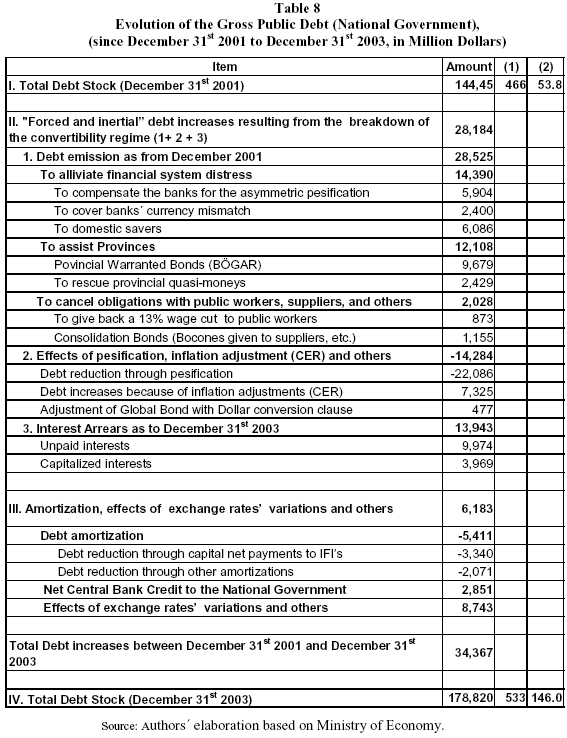
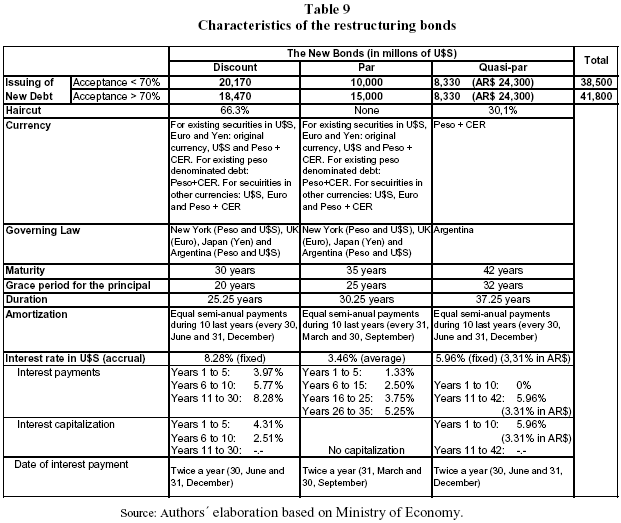
]]>
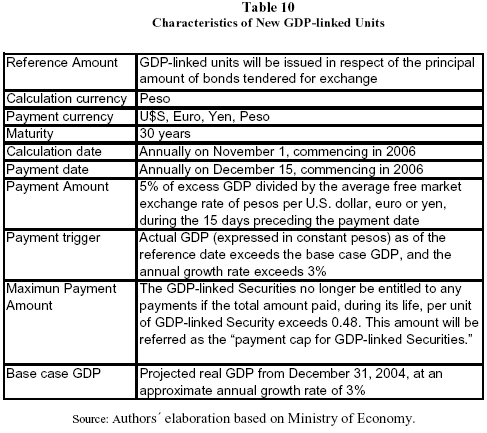 ]]>
]]>