O judiciário e as políticas públicas no Brasil
Le pouvoir judiciaire et les politiques publiques au Brésil
Matthew M. Taylor
Translated by Matthew M. Taylor
Translation from DADOS – Revista de Ciências Sociais, v. 50, n. 2, pp. 229-257, 2007.
ABSTRACT
This article discusses the role of the Judiciary in public policymaking. The first part of the text summarizes the importance of integrating the courts better into our analyses of public policymaking and policy implementation in the Brazilian political system. The second part discusses the main factors influencing the degree and depth of the Judiciary's impact on public policies.
Key words: Judiciary; public policies
RÉSUMÉ
Dans cet article, on discute le rôle du pouvoir judiciaire dans la formulation de politiques publiques. Dans sa première partie, on montre l'importance de mettre en place une meilleure intégration des tribunaux à nos analyses du processus de formulation et d'implantation de politiques publiques dans le système politique brésilien. Dans la seconde, on juge les principaux facteurs qui influent sur le degré et la profondeur de l'impact du pouvoir judiciaire dans les politiques publiques.
Mots-clé: pouvoir judiciaire; politiques publiques
]]> Courts have a significant effect on public policymaking: courts influence what Schattschneider (1960) called the "definition of alternatives" by the political system. Nonetheless, this simple statement is more complicated than it might seem at first glance, especially in the Latin American context, where specialists have taken many years after the transitions from military rule to turn their attention to the role of courts in public policymaking and in governability. The classic view of courts as strictly legal institutions has been increasingly challenged by the growing evidence of its political role and its daily effects on public policy. But despite these developments, the role of the Judiciary in the public policy arena remains nebulous in Brazil as well as in the rest of Latin America.2
The purpose of this article is to systematically evaluate the role of the Judiciary in the Brazilian political system and particularly, in the formulation of public policy. I do not mean to suggest that the works that precede it are not enormously useful. There has been a growing wave of important studies on the Judiciary and the judicialization of politics in Brazil, analyzing how and under what conditions the courts influence decisions taken by the Executive and Legislative branches. But despite these studies on the political role of the courts, political scientists have been slow to incorporate the Judiciary into their analysis of governmental decision-making within the overall political system. With few exceptions, very few members of the mainstream of Brazilian political science incorporate the Judiciary into their analyses with the same depth that they consider the party system, the Executive or Legislative branches, or even, social movements, public bureaucracies, or economic institutions.
The courts act in three dimensions relevant to political science, which can be described as Hobbesian, Smithian and Madisonian. These dimensions of court behavior have important effects, respectively, on the monopoly of violence by the State, on the rules governing economic behavior, and on the relations between the three branches of government.3 In this article, I focus primarily on the last, Madisonian, dimension of interbranch relations. In particular, I focus on the impact of the courts on the formulation, deliberation and implementation of public policies by the Executive and Legislative branches of the federal government. This is not an empirical research project but instead, an attempt to describe the state of the existing literature and to propose new directions for future research, in light of existing work.
The Judiciary in the Policymaking Process
Brazil has not seen the "persistent neglect of the courts," that is the subject of criticism in the rest of the world (Epstein, Knight and Shvetsova, 2001). A vast range of books, articles and theses published recently on the political role of the Judiciary emphasizes the courts' influence in the political process and its impact on resulting political realities. 4 Nonetheless, despite the large number of works that specifically address the role of the courts, much of the broader literature on the Brazilian political system still neglects the political role of the courts when it comes time to describe decision-making processes in the political system as a whole. As a result, in the sophisticated debate over Brazilian political institutions – and, in particular, in the debate over presidencialismo de coalizão, or coalitional presidentialism – the courts barely figure and are rarely included in explanations of political outcomes. The consequences of this failure to incorporate the Judiciary into our understanding of policymaking processes can be serious, as shown below.
It is commonplace to argue that a Judiciary that functions well serves as a check and balance on government, providing guarantees of the separation of powers and providing for the protection of minorities (Madison, Hamilton and Jay, 1961; Montesquieu, 1990). However, the Judiciary is inherently passive and must be activated by external actors if it is to have any effect whatsoever. For this reason, the degree to which the Judiciary is called upon to serve as an arbiter of conflicts between political forces or political institutions depends not solely on the strength of the courts themselves, but also, more broadly, on patterns of political conflict.
Analyses of Brazilian politics tend to fluctuate between two extremes.5 On the one hand, some authors see the political system as excessively consensual and replete with veto players, which significantly compromises effective decision-making. From this perspective, only proposals with supermajoritarian support can be approved. In the atomized political system, various factors complicate decision-making: 1) a weak Congress, in which the disproportionality of the electoral system strengthens small states, while weak mechanisms of electoral accountability – resulting from open list proportional representation – favor organized interest groups and facilitate party-switching; 2) the weak party system, which allows for the existence of a large number of fragmented, unstable and regionally-based political parties; 3) the unwieldy presidential cabinet, in which cabinet positions are used as an instrument to build legislative coalitions; 4) the nature of the State and, in particular, of the civil service, which presses forcefully for the preservation of its privileges within the state bureaucracy; 5) a Senate with unparalleled power to interfere in many political issues; and 6) federalism and in particular, powerful governors with the ability to interfere regularly in fiscal affairs.6 Institutional roadblocks are abundant: as Kinzo (2001:11) noted, political representation in Brazil "reproduces to the nth power the system of checks and balances present in the Madisonian model."
On the other side of the debate, another group of political scientists suggest that the political system may be more majoritarian than initially believed (in the sense of "majoritarian" suggested by Lijphart, 1999) and that the decision-making process and policy reform are not as difficult and costly as others maintain. Among the factors cited by these authors are: 1) the strong control exercised by presidents over the political agenda, facilitated by the concentration of budgetary powers in the Executive branch and the strong legislative powers of the presidency; 2) robust mechanisms of party control in the legislative (but not electoral) arena; 3) the power of the Colégio de Líderes (council of party leaders) in the Chamber of Deputies, which permits rigid control over the legislative agenda, generally by close allies of the Executive branch.7 As Figueiredo and Limongi (1999:24) note, only 0.026% of the Executive branch's proposals were rejected by Congress between the approval of the 1988 Constitution and 1999. In sum, there is an abundance of internal rules that facilitate the control of Congress by government and that increase the incentives for members of Congress to cooperate with the Executive branch.
As in any academic debate, these two viewpoints are less divergent and mutually exclusive than the rigid and unidimensional perspectives offered by the most vehement proponents on either side. And in truth, there is a considerable middle ground, if for no other reason than because the post-authoritarian political experience has been marked by a continued evolution of both the institutional rules and the actors involved, suggesting that both sides of the debate may have been correct at different points in time. Pereira and Mueller (2003:737-738) argue, for example, that although the decision-making process is decentralized by electoral rules (particularly open-list proportional representation), by the multiparty system and by federalism, on the other hand it is centralized by decision-making rules within Congress and the strong legislative and budgetary powers of the Executive branch. The result is a delicate balance between centralization and decentralization of decision-making. Policymaking success depends on the ability of the President and the Colégio de Líderes to provide the electoral and budgetary benefits that will attract potential allies. Under able leadership, it may be possible to create what Amorim Neto, Cox and McCubbins (2003) denominate a "parliamentary agenda cartel," in which the legislative agenda and legislative proposals can be hammered out between the Executive and allied party leaders before any proposal is taken to a vote. This arrangement allows potential veto players to be excluded from political deliberations, and thus avoids the loss of agenda control. The "cartel" thus limits participation to party leaders interested in achieving specific goals within the majority coalition, without costly bargaining with the opposition.8
]]> In the period since the 1988 Constitution went into effect, phases of significant reform have alternated with phases of chaotic and undisciplined rent-seeking, suggesting the presence of a delicate equilibrium between centralized and decentralized decision-making in the Brazilian political system. This equilibrium depends on the issue under consideration, the popularity of the Executive, the proximity of elections, and numerous other political factors.But where does the Judiciary fit into these distinct perspectives of the Brazilian political system?
With the exception of Stepan (2000), who incorporates the Judiciary into his analysis as a "demos-constraining", anti-majoritarian force, few political scientists consider the role of the Judiciary, when analyzing decision making in the Brazilian political system. Some comment en passant on the possible importance of courts. Ames, for example, remarks in a footnote that, "although this discussion of veto players has centered on presidents and parties, the concept clearly has implications for other institutional actors. In systems of many veto players, courts and bureaucracies typically take larger legislative roles..." (2001:17).
Even when the courts are included in broader studies of the Brazilian political system, the analysis frequently focuses on their effects in the Hobbesian field of public security (e.g., Pereira, 2000) or their Smithian dimension, providing contractual credibility that is of enormous importance to modern markets (e.g., Castelar Pinheiro, 2000). Little attention is given to their Madisonian role in arbitrating relations between the elected branches, especially as it affects public policymaking. In part, this is due to the difficulty of translating the courts' effects in clear and objective terms. Electoral rules, congressional maneuvering and the structure of the Executive branch are of common interest to political scientists. The Judiciary remains – alongside central banking and regulatory frameworks – a marginal object of analysis, considered accessible only to a narrow group of specialists. It is a subject of inquiry whose importance is usually recognized only when it behaves unexpectedly.
This approach is unfortunate, as it significantly affects political scientists' understanding of the real workings of the political system. Considering only public policies adopted by the federal government, Brazil's position on the majoritarian–consensual dimension of democracy appears to vary according to the stage of the policymaking process. The system is highly majoritarian when it comes to deliberating on public policy alternatives, but it becomes much more consensual during implementation. The Judiciary – together with governors, mayors and state bureaucrats – can have a significant effect on policy implementation. The courts broaden the range of actors who can influence policy implementation, even after these policies have been approved by ample legislative majorities.
In addition to its effects in broadening the number of possible actors with an influence over policy, there is another reason why it is essential to incorporate the Judiciary more objectively into our analyses: the growing recognition by political scientists that interest groups seek the institutional venue that is most favorable to influencing policy, whether this venue is the Judiciary, regulatory agencies or specific bureaucracies. The concept of "venue-seeking" suggests that political actors seek the institutional venues that best suit them. For a series of reasons related to the Judiciary's ability to impose its decisions (discussed below), it is not all that surprising that it has become an increasingly important venue for contesting public policy.
Part of the debate over the Judiciary's performance, especially among those analyzing constitutional review, focuses on the courts' effects on policy. On the one hand, Arantes (2005:232; my translation) argues that the Judiciary has had a significant effect on decision-making, "further accentuating the consensual model of Brazilian democracy". On the other, Koerner affirms that the Supreme Federal Tribunal (Supremo Tribunal Federal, STF) has acted cautiously. According to Koerner, since the new constitution went into effect in 1988, the STF has "not functioned as a counter-majoritarian institution, which permitted political reforms to be vetoed, nor has it caused uncertainty or ungovernability" (2005:24; translated by me).
I will argue below that the federal courts – at all levels, and not restricting myself solely to the STF9 -- have had, and probably will continue to have, an important effect on the public policies adopted by the federal government. This has allowed minority voices to be incorporated into policy decisions, even if sometimes only minimally or marginally. But even if the courts had not had any concrete effect in the first two decades of the New Republic, the analysis presented here would not be in vain, for the same reason that analyzing a Congress subservient to the Executive branch would not be a merely academic exercise. Such exercises may help us to understand the practical consequences and the possible repercussions of potential institutional changes.
With regard to the impact of the courts on federal policies, the Judiciary has been repeatedly asked to resolve contentious policy questions, using both the Constitution and infra-constitutional laws as justification. I agree with Koerner (2005) when he argues that the STF, in particular, has acted cautiously and even conservatively to avoid deepening conflicts with the Executive branch. Such arguments are common in the global literature on courts, since courts cannot act without running the risk of losing power to executives jealous of their own prerogatives.10
Using a game-theoretic model of legislative-judicial relations, Vanberg (2001) demonstrates that – under transparent conditions – public support for the courts will make them less deferential to the legislative branch. But if the legislation being questioned is highly salient to the legislature, courts are likely to take a less adverse stance against it. Two important questions arise from these findings: why would Brazilian courts not act equally timidly in light of weak public support?; and why does the Brazilian Judiciary appear not to worry about vetoing proposals of enormous salience to the legislative branch?
]]> I will not provide a definitive answer to these question here, but point them out to suggest that greater cross-fertilization between scholars of judicial politics and mainstream political scientists in Brazil is a two-way street, and that judicial scholars, too, have much to learn from scholars of Executive-Legislative relations.The Vanberg model seems doomed to failure in the Brazilian case. The combination of a weak legislative branch (in terms of its capacity for collective action independent of the Executive branch) and the difficulty citizens face in moving the Congress to action (a result of the electoral system) means that there is a high probability that the Judiciary will avoid legislative punishment or retribution when it takes decisions that run contrary to the legislative majority's preferences. It is harder for the courts to avoid punishments forthcoming from the Executive branch, and perhaps for this reason the courts tend to behave conservatively when possible. But as we'll see below, the courts are not always submissive, even when they could act more timidly. Because the game is iterative, furthermore, and the actors learn from previous turns, it would be expected that at some point the Executive branch would react to these provocations or the courts would capitulate. We may be closer to this second possibility. But the fact is that despite its conservatism, the STF has not been overly cautious. Together, the assertiveness of the Judiciary and the acceptance of such assertiveness by the Executive branch and its allies in Congress pose an important puzzle.
In comparative terms, the role of the Brazilian judiciary has been significant. In the 15 years between 1988 and 2002, the STF – using just one instrument of constitutional review, the Direct Action of Unconstitutionality (or ADIN) – invalidated more than 200 federal laws either by granting injunctions or through decisions on the merit of the cases at hand. By way of comparison, between 1994 and 2002, the Mexican Supreme Court ruled on the constitutionality of roughly 600 laws using two instruments similar to the ADIN, but it overturned only 21 federal laws. Comparison with the U.S. is even starker: in all of its history, the U.S. Supreme Court has only overturned 135 federal laws (Taylor, 2008). Even during the administration of President Fernando Henrique Cardoso – a president backed, at least initially, by an ample reformist coalition – the federal courts were called upon by external actors to judge all of the most important policy changes adopted by the Executive branch and its allies in Congress. The Cardoso government bargained actively to produce the legislative majorities that would allow it to overcome the tough rules for approval of constitutional amendments and complementary laws in the Senate and Chamber of Deputies. But at the end of that enormous political effort, the judicial contestation of policy was a chronic event, recurrently used by the groups who were left out of negotiations within the "parliamentary agenda cartel." The most significant and real threats to reform arose in the courts and not in Congress: of the 10 most important political initiatives of the Cardoso administration, all were contested in some way in the courts, and seven of the 10 were either altered or significantly delayed by the STF.11 In other words, not all government proposals were contested in the courts, but the most important and contentious proposals were, and with some success.
Over the course of the past decade, the Federal Judiciary has revealed itself to be an important political actor: federal courts repeatedly interrupted large privatization auctions, a delicate pension reform was overturned, and the courts annulled or significantly altered legislation governing everything from agrarian reform to tax reform. The Judiciary continues to play an important role today. During the government of Luiz Inácio "Lula" da Silva, courts have continued to participate in government policymaking in a number of ways. Among the most recent illustrations: in 2005, the federal courts approved a large corporate acquisition by Nestlé, overturning a decision by the CADE economic regulatory agency, which had rejected the purchase; the STF interrupted corruption investigations in Congress in 2006; federal judges have forced state governments to honor debt bonds (precatórios) valued at as much as US$20 billion a year; the STF retroactively rejected an increase in the PIS/Cofins tax, with a cost that might in principle have reached as much as 11% of total federal tax revenues; and so forth.
In light of its recurrent and manifest role, it is evident that the Judiciary needs to be better incorporated into our analyses of the political system. If it is not, the decision-making process will be incorrectly understood and the relevant actors in public policy debates may be miss-specified. In particular, the losers in executive-legislative negotiations – exactly those groups most likely to utilize the Judiciary – will be neglected or left out of our understanding of the bargaining process, with obvious repercussion in terms of our beliefs about the possibilities for policy change.
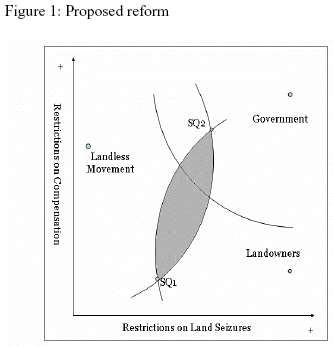
To illustrate the consequences of leaving the courts out of our analyses of decision-making by the political system, I offer here a simplified, heuristic account of the 1999-2000 agrarian reform. In this case, the Cardoso administration attempted, with some success, to find some middle ground between landowners and the landless movement (Movimento dos Sem-Terra, MST). The legislation proposed by the federal government set limits on compensation for land expropriations, but it also set important limits on land "invasions" by the landless movement. To simplify this to two Euclidean dimensions, I represent this as: 1) landowners preferred stronger limits on land invasions and weaker limits on compensations; 2) the landless movement preferred the opposite; and 3) the government preferred to restrict both invasions and compensation that would be paid out of the public trough (Figure 1). In other words, it should have been possible to move the existing policy from the existing status quo (SQ1) to any position within the dark space SQ1:SQ2. In particular, it should have been possible to move from SQ1 to a position closer to SQ2.
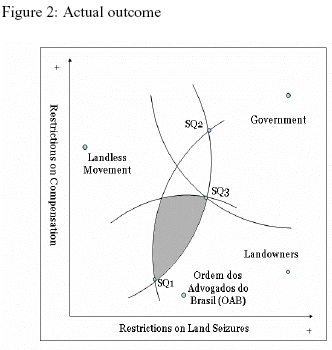
]]> This prediction, however, failed to incorporate the interests of a powerful potential veto player, the national bar association (Ordem dos Advogados do Brasil, OAB). The OAB had no direct representation in Congress – and even if it had, it would not have been able to do much anyway, since the proposed reform was implemented by executive decree. But the OAB had access to the important potential veto point offered by the fact that it is one of a restricted group of actors with standing to contest constitutionality via the Adin mechanism. This allowed the OAB to insert itself into the debate on agrarian reform via the venue of the STF. As soon as the executive decree was issued, the OAB immediately questioned the constitutionality of the proposal on a number of fronts. And it was successful on one particular point of interest to its members: the STF granted an injunction that halted the government's proposal to limit lawyers' fees in expropriation cases.12
As a result, the OAB managed to move the policy from SQ2 to SQ3 (shown in Figure 2), shifting the result away from a position close to the government's central preferences to one closer to its own preferences, in which the new limits on lawyers' fees proposed by the government were eliminated. If it had not had access to the venue of the STF and to the Adin mechanism, or if it had not had access to a judiciary capable of taking policy decisions that were respected and complied with by the Executive branch, this result would have been impossible. From an analytical point of view, the veto point offered by the Judiciary to a professional association opposed to restrictions on its own earnings had a significant effect on the ability of the government to achieve its first order preferences. Similar outcomes resulted on other occasions, in which government proposals were implemented either by executive decree or after long deliberations between the executive branch and Congress.
With this potential effect of the Judiciary in mind, in the next section, I shall attempt to systematically explore the role of courts in public policy. My goal is to facilitate the incorporation of the Judiciary by the mainstream of Brazilian political science and, perhaps even more importantly, to help future researchers to explain the practical results of that role in terms of the public policies that can be effectively implemented by the Brazilian political system.
Considering the role of the Judiciary in public policymaking
It is of course impossible to create a predictive model that incorporates all of the factors that could influence the role of the courts in public policy, in the same way that there is no predictive model of legislative influence. Nonetheless, four dimensions are central to thinking about the effect of the Judiciary on public policy and about how to incorporate the courts into our broader studies of policymaking:
]]>1. At what moment and in what manner can the courts influence public policy?
2. What are the motivations of the Judiciary when it intervenes in conflicts around public policy?
3. How can actors external to the Judiciary use it to achieve their political objectives?
4. What are the consequences of judicial intervention in public policy?
1. With regard to the first dimension – the timing of judicial intervention in public policymaking – it is common to assume that the courts will only act on policy after policy has been approved by the Legislative branch (see, for example, Epstein, Knight and Shvetsova 2001: 123-124). But both lower court judges and STF ministers can have a significant and much earlier effect on policymaking. Although they do not have standing to initiate judicial contestation of legislative and executive actions, members of the Brazilian judiciary have the ability to influence public policy debates before these policies are approved, by signaling their preferences and the breadth of acceptable policy change.
Judges signal their preferences long before policy reforms' final approval by the other branches of government, be it publicly (e.g., Minister Carlos Velloso's comments on the second wave of social security reform under President Cardoso) or in closed-door meetings between representatives of the branches (e.g., measures to address the electricity shortage crisis, which were negotiated ahead of time between a representative of the executive branch, Pedro Parente, and members of the STF). These calculated signals have effects that precede the final approval of reforms, inserting judges into the policymaking game and altering the resulting policies, oftentimes without any formal use of judicial power. As Lax and McCubbins (2006) note in the U.S. case, recognition of the courts' ex-ante effects on policy reform helps to counter Rosenberg's (1991) argument that the courts are ineffective policy players. In other words, even when they do not use their formal powers – such as the power of constitutional review – courts can have an effect on deliberative processes, eliminating some alternatives and constraining other political actors.
Further, the Judiciary has formal instruments it can use to influence policies that are still being debated in the executive and legislative branches. The STF does not have the same power of a priori constitutional review (prior to a law's implementation) that the Chilean Supreme Court or the upper-level German and Italian courts have, which allows them to suspend a law before it goes into effect. Nonetheless, the STF has shown a growing (and controversial) willingness to interfere in legislative debates using formal legal instruments. One example is the injunction decision granted by STF Minister Marco Aurélio de Mello that effectively froze a vote on the first wave of pension reform under Cardoso. The congressional vote only occurred after the injunction had been overturned in a 10-1 decision by the full STF.
The possibility of the Judiciary acting after policy implementation to alter the rules or results of a public policy is much better recognized. Various factors influence judges' decisions to intervene in policy implementation. The first is the role of institutional rules, which influence the ability of opposition groups to access the courts effectively: the type of constitutional review (abstract, concrete or, as in the Brazilian case, hybrid review); the legal standing of potential plaintiffs (who has standing, and in what cases?); judges' independence from other branches, as well as from each other; the efficiency of the legal system; and so forth (Ríos-Figueroa and Taylor, 2006). Given that these factors are relatively well-established in the Brazilian case, however, it is perhaps best to focus on two characteristics that provide judges with some room for maneuver: instruments of judicial review and the timing with which these instruments are used.
With regard to the instruments of judicial review, some are naturally more robust than others, in terms of their impacts on policy. An ADIN or other instrument of review such as the Arguição de Descumprimento de Preceito Fundamental (ADPF) [Argument regarding Failure to meet a Fundamental Precept], for example, has a much greater impact and is typically longer-lived than a decision by a federal trial court judge that can be appealed. But even in the case of the ADIN constitutional review mechanism, there is considerable margin for justices of the STF to alter the timing of the judicial effects on implementation, whether it is by issuing a rapidly enforceable injunction or by requesting additional time to study the case. There are also numerous possibilities to archive the case for procedural reasons so as to avoid a decision on the merit (Koerner, 2005; Pacheco, 2006). In sum, STF ministers have considerable opportunity to shape the timing and consequences of their decisions, either by upholding policies they support or slowing the defeat of policies that they prefer, but that might be subject to adverse review. Lower court judges have less decisive control over policy, given that their decisions can always be overturned. But well-argued decisions by trial court judges, especially when they reflect a consensus among lower-court judges, can be especially influential, and thus may block certain policies from being implemented or remove certain alternatives from consideration by policymakers.
]]> In sum, the Judiciary can influence policymaking both during policy deliberations and after policy implementation, through a range of possible strategies: signaling the permissible boundaries of policy change, sustaining or legitimating policy choices in the face of opposition, delaying decisions about specific policies (and thus controlling the deliberative agenda), or at the extreme, altering or rejecting policies after these have been approved and are in the process of implementation.2. The second dimension refers to judicial motivations. There is a good literature on the legal culture of judges, both in Brazil (Bonelli, 2002; Castelar Pinheiro, 2003; Nalini, 2000; Rosenn, 1984; Werneck Vianna et al., 1997), as well as internationally (e.g., Pérez-Perdomo and Friedman, 2003). Internal judicial culture is often blamed for the formalism of Brazilian judges who tend to place higher priority on abstract legal principles over concrete policy consequences, falling back on the civil and criminal codes as their justification. This leads to considerable emphasis on individual rights, regardless of the broader implications for society at large. In the legal literature and even in daily press accounts, the defense of judges' "neutrality" is frequent, and a common theme among jurists is the view that the "correct" judge does not deviate from the law, whatever his or her personal preferences may be.13 This is an idyllic and yet to some extent correct view of reality, to the extent that judges cannot really deviate greatly from the prevailing law. But that does not mean that it is one hundred percent accurate when it comes to public policy, especially if we take into account the large degree of flexibility mentioned earlier, which allows judges to interfere in policy making in a variety of ways and at a variety of different moments.
In this sense, I agree with Gibson's (1983) conclusion that judges' decisions are the result of what they prefer to do, moderated by what they think they should do, but constrained by what they perceive is viable for them to do. As noted earlier, at times judges can have an effect on deliberations without ever issuing a formal decision. As a result, adherence to the strict letter of the law is not always the main determining factor in judges' behavior. After all, judges – like other political actors – can act strategically, bluffing and creating legal obstacles that correspond to their own personal preferences (for example, the large number of recent judicial decisions that rejected the strict anti-nepotism rules imposed on judges by the National Council of Justice, CNJ).
In light of this more skeptical view of judges' motivations, the broader international political science literature on judges and the constraints on their judicial decisions has developed along three main axes: institutional (see Clayton and Gillman, 1999; Smith, 19888); strategic (e.g., Baum, 1997, Vanberg, 2001); and attitudinal (e.g., Segal and Spaeth, 1993). In Brazil, only the first of these three approaches appears to have flourished. The attitudinal approach is very hard to apply, given the complexity of studying judges or justices' attitudes in a multiparty system in which the dimensions of the political debate are hard to reduce to a binary two-party spectrum. The strategic approach refers to the efforts of courts to obtain or maintain power in the face of the elected branches. This approach has been broadly applied in the Mexican case (e.g., Finkel, 2007) and the Argentine case (e.g., Helmke, 2002), for example, raising questions about why the same approach has not been popular among scholars of Brazilian courts. In part, the answer may be due to the fact that Brazilian history seems to have followed a path very different from the rest of the world: rather than needing to obtain more power, the courts were granted an abundance of power in the 1988 Constitution and only later found themselves forced to figure out how to use these powers without provoking a strong reaction from the elected branches. I do not mean to suggest that strategic or attitudinal motivations are inexistent in the Brazilian case, nor that such approaches might not bear fruit. Rather, I only mean to say that the institutionalistic approach seems to have been the most useful and productive in the earliest studies of the post-1988 Judiciary for a number of methodological reasons, as well as in light of concrete historical circumstances.
To these three common approaches to judicial studies, I would add two additional factors related to the study of public policy. The first says more about the public policies being contested than about the Judiciary per se: the salience of these policies in the broader body politic. The notion that the salience of a given legal suit may motivate the courts to intervene (or not) -- and therefore, that the salience of a specific legal suit may influence the calculations of policy players about whether or not to activate the courts – can be easily proven empirically and is part of the general consensus in the overall literature on courts (see Epstein, Knight and Shvetsova, 2001). To this argument, I would add a second one: that the characteristics of public policies themselves help to determine whether they will be judicialized, with or without the active participation of judges. The classical argument of Lowi (1964; 1972) and Wilson (1995) – that "policy determines politics" – allows us to affirm that, in the same way that the distribution of a policy's costs and benefits determines its politics in the executive and legislative branches of government, these characteristics also determine the probability that the courts will be drawn into the policy debate (Taylor 2008, Ch. 3). Borrowing from Clausewitz's famous phrase about war, judicialization can be seen as the extension of politics by other means, and may become more likely when the costs of a policy are highly concentrated among a small group of "losers".
3. As a result, judges are seldom the only actors relevant in policy deliberations in the Judiciary. Especially after policy has been implemented, it can be contested in the courts by a variety of actors from both the traditional political sphere and civil society more broadly. The Judiciary must necessarily address these cases – even against its own will and delaying to the maximum – meaning that it is forced to hear opinions that often run contrary to the predominant interests of the Executive-Legislative majority. Earlier in this article, I mentioned the concept of "venue-seeking" and the fact that the courts are one of the most powerful "venues" available for opposition to policies that have already been implemented. Institutional rules, as we saw earlier, may offer a say to minority groups that cannot participate in Executive-Legislative deliberations, inserting them into the debate after the fact and allowing them to use the courts as a veto point in the political game.
The existing literature has reached a general consensus about which actors are best able to use specific legal instruments: in Class Actions, the two most successful plaintiffs are members of Congress and lawyers; in Public Civil Actions [Ações Civis Públicas], the Public Attorney [Ministério Público] is one of the most important litigants; in the case of ADINs, the most important are the Public Attorney and the OAB [Brazilian Bar Association] (Arantes, 1997; Taylor 2006b); and so forth. The effect of this use of the courts in the political system, however, depends on the rules governing standing in the courts, the strength of the legal arguments each side is able to present, and the existing rules on the breadth of judicial decisions. Simplifying a bit, the broader and the more binding the juridical instrument used, the more likely it will become a veto point in the judicial system. The best example of such a broad and binding instrument is the ADIN constitutional review mechanism at the STF. But the frequent absence of broad and binding effects of judicial decisions in the Brazilian court system – what Arantes (1997:33) called the "atomization of diffuse judicial review" – creates a second tactical mechanism for political actors: generating uncertainty about policy by delaying a definitive decision through repeated appeals throughout the judicial system (Figure 1).
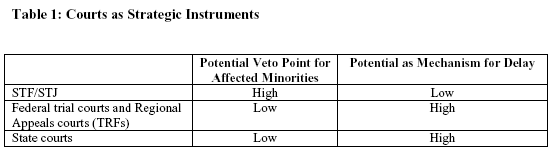
]]> This second tactic does not require that the legal arguments necessarily be in favor of the opposition plaintiffs: in the fight against privatization in the 1990s, for example, the opposition often sought out judges who sympathized enough with opposition arguments to issue an injunction against the privatization auctions, even though they recognized that existing jurisprudence suggested that they would be overturned immediately. In other words, the opposition has used the courts even when they knew that the legal arguments were against them: the Judiciary has been an important arena for the opposition to demonstrate its opposition to reform, to delay the implementation of policy changes considered harmful to its constituents, or to draw public attention to its efforts in opposition. In this spirit, Werneck Vianna et al. discuss the frequent decision by political parties to appeal decisions in the courts thus: "they seek only to set down their position against the majority and demonstrate to their supporters and the public at large their disposition to exhaust all the possibilities for intervention in the institutional terrain" (1999: 127; translated by me).
4. Finally, it is worth considering the consequences of the growing role of courts in public policy. Even if we argue that courts have had little concrete effect on public policies, acting timidly and conservatively, in a reactive fashion, it is nonetheless important to recognize that the Judiciary may nonetheless have had a significant effect through its legitimation of the majority's proposals. This effect has been important in the recent history of the courts and indeed, may have had a very strong effect, for example in the legitimation of certain questionable procedures such as the exaggerated use of provisional measures (a type of executive decree) or of certain questionable public policies, such as President Collor's economic stabilization plan, the Plano Collor (Koerner, 2005; Vilhena Vieira, 2002).
If we instead assume that the Judiciary has indeed had a very important, and proactive, role in policymaking, the question that arises is why? Why did a powerful executive branch, allied with a parliamentary agenda cartel that represented a majority, comply with the decisions of a judicial branch that proactively opposed it? The question of why executives follow the determinations of judges whose individual power is extremely restricted is itself little studied (but it is worth reading Epstein, Knight and Shvetsova, 2001: 126 and Staton, 2002; 2004) and in the Brazilian case, it is a bit mysterious. Could it be that despite its strength, the Brazilian Executive prefers to adopt attitudes that strengthen democracy, such as faithfully following judicial decisions? Given the professional skepticism of political scientists, such an explanation – no matter how accurate – would probably be quickly ridiculed. So how to explain the Executive's resolve to comply with counter-majoritarian judicial decisions, even when these are extremely costly in terms of lost resources, wasted bargaining, and denied preferences?
One explanation is the alternation of power, whereby today's Executive obeys the courts today so as to preserve judicial control for such a time when it is out of power (see Ginsburg, 2003; Ramseyer, 1994). Another is Whittington's (2005) suggestion that even incumbents benefit from an independent Judiciary: 1) the Judiciary can alter legislation approved by previous governments and thus, even while acting independently, improve the conditions for the current incumbent's policy preferences to be implemented. Perhaps more importantly, Whittington suggests that 2) a Judiciary that acts against the government's wishes in some cases serves to legitimate its decisions in all the other cases where it does not decide against the government. According to Weingast (1997), such considerations by the executive branch can contribute to a self-enforcing system, where under favorable conditions, there are incentives for the executive branch (and by extension, the legislative branch) to obey the courts, even though they do not have to. Could it be that this logic explains the relations between courts and the executive branch in Brazil? A deeper analysis of the cause of this phenomenon is lacking, as is a greater study of the strategic relation between the three branches and its concrete effects in terms of the negotiation and implementation of public policies.
Conclusion
It is widely recognized that while the Judiciary holds "neither the purse nor the sword"14 – that is, neither the budgetary powers of the legislative branch nor the coercive powers of the executive – it has considerable political power as the guardian of public trust in the rules of the game. The Judiciary plays a central role in the application of both constitutional and ideal principles such as the Rechtstaat or état de droit. It decides which rules are legitimate and in accordance with local laws and the Constitution, as well as what actions (or omissions) are aberrations or infractions. As a result, courts influence the course of public policy: courts and judges influence the type of policy that is implemented and judge the legality of these policies from the perspective of existing laws, norms and traditions.
Political scientists have recognized for at least half a century that the Judiciary fulfills a vital political role as an institution "for arriving at decisions on controversial questions of national policy" (Dahl, 1957:279). We know that plaintiffs often use the courts as one more political opportunity or venue, and not solely as the source of legal and constitutional truths. And we recognize that when they judge important cases, judges frequently operate on the basis of criteria that go beyond the solely legal. Even when they temper their decisions using totally legal arguments, by the very nature of judicial review, judges make decisions that influence or even create public policies (e.g., Ferejohn, 2002).
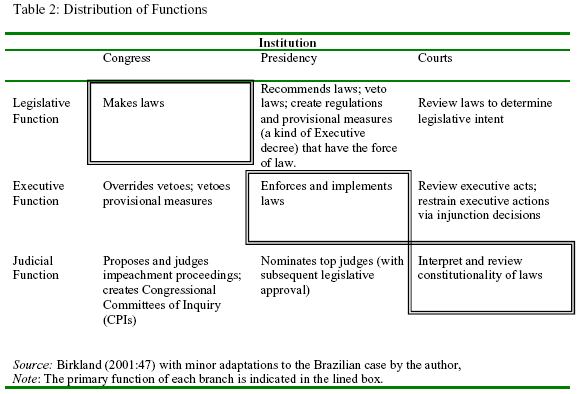
That said, public perceptions frequently suggest there is something "wrong" with this political behavior by the courts in the policymaking process. The Judiciary may seek to hide such behavior behind a legalistic façade so as to preserve its legitimacy as the only branch of government not selected by directly democratic procedures. Certainly the wave of judicialization and the resulting importance of the courts around the world have brought with them a chance in the discourse of judicial influence in politics and in particular, a very strong critique by elected politicians of "unelected legislators". But it is worth recognizing the importance of that judicial political function and its inevitability. While the concept of the separation of powers leads us to think of three clearly distinct institutions, the fact of the matter is that seldom are the judicial, legislative and executive functions of these institutions clearly separated into neat institutional boxes. These functions are shared among the three institutions, as Table 2 illustrates. As a result, it should not be surprising that the Judiciary has some effect on policymaking. After all, as Ehrmann noted, "The authority of a court to declare laws and official acts unconstitutional is ... a judicial act which gives to judges so obvious a share in policy-making that, where it prevails, there is little room left for the pretense that judges only apply the law" (1976: 138).
]]>
Analytically, therefore, it is easy to conclude that the Judiciary could be better incorporated into our analyses of the Brazilian political system. Normatively, things are a bit more unresolved, given the ambiguity that will always surround the Judiciary's political role, both in terms of democratic theory and in terms of the effective and efficacious formulation of public policies. It is important to recognize, as Werneck Vianna and Burgos (2005:781-782) did, the democratizing role of the courts, acting both as a "wailing wall" and as an "effective arena for the exercise of democracy", in a democracy where the relation between the executive and legislative branches is far from ideal. There is a similar normative tension when we think about the judiciary from the perspective of policymaking. There is recognition that a Judiciary that can rule against the government may be better both in economic terms (see Castelar Pinheiro, 2003: 185), as well as in terms of the durability of policy. The Judiciary is fundamental to achieving balance between two aspects of policy: decisiveness, or the efficiency of decision-making by the political system; and resoluteness, or the capacity of a nation to follow a stable course that is not erratic in the adoption and implementation of public policies.15 In a country in which the courts do not check the Executive, decision-making by the political system may be very efficient, but suffer from great oscillations between governments (for example, Argentina over the past decade).
This article has enumerated some of the factors that may influence the role of the Judiciary in the Brazilian policymaking process, as well as the ways by which the Judiciary can be incorporated into an analytical model of the Brazilian political system that is not predictive, but at least has causal pretensions. I may have succeeded better at my goal of illustrating the error of excluding the Judiciary from our analyses than in describing the goals for the courts' future inclusion in the broader political science literature on decision-making. This imbalance is due not to any lack of interest in this subject in the literature, which includes a wealth of studies on the role of the Judiciary. But the dialogue between studies of Executive-Legislative relations, the study of the Judiciary, and public policymaking in Brazil is still incipient. This article has hopefully taken a step toward greater integration of these fields of research.
References
ABRUCIO, Fernando L. (1998), Os Barões da Federação: Os Governadores e a Redemocratização Brasileira. São Paulo, Hucitec. [ Links ]
AMES, Barry. (2001), The Deadlock of Democracy in Brazil. Ann Arbor, University of Michigan Press. [ Links ]
AMORIM NETO, Octavio, COX, Gary W. e MCCUBBINS, Mathew D. (2003), "Agenda Power in Brazil's Câmara Dos Deputados, 1989-98". World Politics, vol. 55, pp. 550-578. [ Links ]
ARANTES, Rogério B. (1997), Judiciário e Política no Brasil. São Paulo, Idesp. [ Links ]
________. (2005), "Constitutionalism, the Expansion of Justice and the Judicialization of Politics in Brazil", in R. Sieder, L. Schjolden e A. Angell (orgs.), The Judicialization of Politics in Latin America. New York, Palgrave. [ Links ]
BAUM, Lawrence. (1997), The Puzzle of Judicial Behavior. Ann Arbor, The University of Michigan Press. [ Links ]
BIRKLAND, Thomas A. (2001), An Introduction to the Policy Process: Theories, Concepts, and Models of Public Policy Making. New York, M.E. Sharpe. [ Links ]
BONELLI, Maria da Glória. (2002), Profissionalismo e Política no Mundo do Direito. São Carlos, Sumaré/Edufscar/Fapesp. [ Links ]
CARVALHO NETO, Ernani R. de. (2005), Revisão Abstrata da Legislação e a Judicialização da Política no Brasil. Tese de doutorado, USP, São Paulo. [ Links ]
CASTELAR PINHEIRO, Armando (org.). (2000), Judiciário e Economia no Brasil. São Paulo, Sumaré [ Links ].
________. (2003), "Judiciário, Reforma e Economia: A Visão dos Magistrados", in A. Castelar Pinheiro (org.), Reforma do Judiciário: Planos, Propostas e Perspectivas. Rio de Janeiro, Booklink Publicações. [ Links ]
CHAVEZ, Rebecca B. (2001), The Construction of the Rule of Law in Nascent Democracies: Judicial Autonomy in Latin America. Tese de doutorado, Stanford University, Stanford. [ Links ]
________. (2004), Rule of Law in Nascent Democracies: Judicial Politics in Argentina. Stanford, Stanford University Press. [ Links ]
CLAYTON, Cornell W. e GILLMAN, Howard (orgs.). (1999), Supreme Court Decision-Making: New Institutional Approaches. Chicago, University of Chicago Press. [ Links ]
CUNHA, Luciana Gross. (2001), "Juizado Especial: Ampliação do Acesso à Justiça?", in M. T. Sadek (org.), Acesso à Justiça. São Paulo, Fundação Konrad Adenauer. [ Links ]
DAHL, Robert A. (1957), "Decision-Making in a Democracy: The Supreme Court as a National Policy-Maker". Journal of Public Law, vol. 6, pp. 279-295. [ Links ]
EHRMANN, H. W. (1976), Comparative Legal Cultures. New Jersey, Prentice-Hall. [ Links ]
EPSTEIN, Lee, KNIGHT, Jack e SHVETSOVA, Olga. (2001), "The Role of Constitutional Courts in the Establishment and Maintenance of Democratic Systems of Government". Law and Society Review, vol. 35, nº 1, pp.117-164. [ Links ]
FARO DE CASTRO, Marcus. (1997a), "The Courts, Law, and Democracy in Brazil". International Social Science Journal, vol. 49, nº 152, pp. 241-252. [ Links ]
________. (1997b), "O Supremo Tribunal Federal e a Judicialização da Política". Revista Brasileira de Ciências Sociais, vol. 12, nº 34, pp. 147-156. [ Links ]
FAVETTI, Rafael T. (2003), Controle de Constitucionalidade e Política Fiscal. Porto Alegre, Sergio Antonio Fabris Editor. [ Links ]
FEREJOHN, John A. (2002), "Judicializing Politics, Politicizing Law". Law and Contemporary Problems, vol. 65, nº 3, pp. 41-69. [ Links ]
FIGUEIREDO, Argelina C. (2001), "Instituições e Política no Controle do Executivo". Dados, vol. 44, nº 4, pp. 689-727. [ Links ]
________e LIMONGI, Fernando. (1999), Executivo e Legislativo na Nova Ordem Constitucional. Rio de Janeiro, Editora FGV. [ Links ]
________. (2002), "Incentivos Eleitorais, Partidos e Política Orçamentária". Dados, vol. 45, nº 2, pp. 303-344. [ Links ]
FINKEL, Jodi. (2007), Judicial Reform as Political Insurance: Latin America in the 1990s. Notre Dame, University of Notre Dame Press. [ Links ]
FRIEDMAN, Barry. (2005), "The Politics of Judicial Review". Texas Law Review, vol. 84, nº 2, pp. 257-337. [ Links ]
GIBSON, James L. (1983), "From Simplicity to Complexity: The Development of Theory in the Study of Judicial Behavior". Political Behavior, vol. 5, nº 1, pp. 7-49. [ Links ]
GINSBURG, Tom. (2003), Judicial Review in New Democracies: Constitutional Courts in Asian Cases. New York, Cambridge University Press. [ Links ]
HAGGARD, Stephan e MCCUBBINS, Mathew D. (orgs.). (2001), Presidents, Parliaments, and Policy. Cambridge, Cambridge University Press. [ Links ]
HAMILTON, Alexander. (1961), "Federalist Papers nº 78", in J. Madison, A. Hamilton e J. Jay, The Federalist Papers. New York, New American Library (editado por Clinton Rossiter). [ Links ]
HELMKE, Gretchen. (2002), "The Logic of Strategic Defection: Court-Executive Relations in Argentina under Dictatorship and Democracy". American Political Science Review vol. 96, nº 2, pp. 291-303. [ Links ]
KINZO, Maria D. G. (1997), "Governabilidade, Estrutura Institucional e Processo Decisório no Brasil". Parcerias Estratégicas, vol. 1, nº 3, pp. 19-53. [ Links ]
________. (1999), "Partidos Políticos y Proceso Decisorio Democrático: El Caso Brasileño", in M. Cavarozzi (org.), Hacia una Matriz de Gobierno en América Latina: Instituciones del Estado, la Sociedad Civil y el Mercado. Buenos Aires, Universidad Nacional de San Martín. [ Links ]
________. (2001), "A Democratização Brasileira". São Paulo em Perspectiva, vol. 15, nº 4, pp. 3-12. [ Links ]
KOERNER, Andrei. (2005), Direito e Modernização Periférica: Por uma Análise Sócio-Política do Pensamento Jurídico Constitucional Brasileiro Pós-1988. Trabalho apresentado no XXIX Encontro Anual da Anpocs, Caxambu, 25-29 de outubro. [ Links ]
________. (2006), "Decisão Judicial, Instituições e Estrutura Socioeconômica: Por uma Análise Política do Pensamento Jurídico Brasileiro", in A. Koerner (org.), História da Justiça Penal no Brasil: Pesquisas e Análises. São Paulo, IBCCRIM, pp. 259-281. [ Links ]
LAX, Jeffrey R. e MCCUBBINS, Mathew D. (2006), "Courts, Congress, and Public Policy, Part I: The FDA, the Courts, and the Regulation of Tobacco". San Diego Legal Studies Paper, nº 07-42. [ Links ]
LIJPHART, Arend. (1999), Patterns of Democracy: Government Forms and Performance in Thirty-Six Countries. New Haven, Yale University Press. [ Links ]
LOWI, Theodore J. (1964), "American Business, Public Policy, Case-Studies, and Political Science". World Politics, vol. 16, pp. 677-715. [ Links ]
________. (1972), "Four Systems of Policy, Politics, and Choice". Public Administration Review, vol. 33, pp. 298-310. [ Links ]
MADISON, James, HAMILTON, Alexander e JAY, John. (1961), The Federalist Papers. New York, New American Library (editado por Clinton Rossiter). [ Links ]
MAGALONI, Beatriz. (2003), "Authoritarianism, Democracy and the Supreme Court: Horizontal Exchange and the Rule of Law in Mexico", in S. Mainwaring e C. Welna (orgs.), Democratic Accountability in Latin America. Oxford, Oxford University Press. [ Links ]
MAINWARING, Scott. (1995), "Brazil: Weak Parties, Feckless Democracy", in S. Mainwaring e T.R. Scully (orgs.), Building Democratic Institutions: Party Systems in Latin America. Stanford, Stanford University Press. [ Links ]
MONTESQUIEU, Charles-Louis. (1990), The Spirit of Laws. Chicago, Encyclopaedia Britannica. [ Links ]
NALINI, José R. (2000), "O Juiz e a Privatização", in A. C. Pinheiro e F. Giambiagi (orgs.), A Privatização no Brasil: O Caso dos Serviços de Utilidade Pública. Rio de Janeiro, BNDES. [ Links ]
OLIVEIRA, Fabiana L. (2006), Justiça, Profissionalismo e Política: O Supremo Tribunal Federal e o Controle da Constitucionalidade das Leis no Brasil (1998-2003). Tese de doutorado, UFSCar, São Carlos. [ Links ]
OLIVEIRA, Vanessa E. (2005), "Judiciário e Privatizações no Brasil: Existe uma Judicialização da Política?". Dados, vol. 48, nº 3, pp. 559-587. [ Links ]
PACHECO, Cristina C. (2006), O Supremo Tribunal Federal e a Reforma do Estado: Uma Análise das Ações Diretas de Inconstitucionalidade Julgadas no Primeiro Governo de Fernando Henrique Cardoso (1995-1998). Tese de doutorado, Unicamp, Campinas. [ Links ]
PALERMO, Vicente. (2000), "Como se Governa o Brasil? O Debate sobre Instituições Políticas e Gestão de Governo". Dados, vol. 43, nº 3, pp. 521-557. [ Links ]
PEREIRA, Anthony W. (2000), "An Ugly Democracy: State Violence and the Rule of Law in Postauthoritarian Brazil", in P. Kingstone e T. Power (orgs.), Democratic Brazil: Actors, Institutions and Processes. Pittsburgh, University of Pittsburgh Press. [ Links ]
PEREIRA, Carlos e MUELLER, Bernardo. (2003), "Partidos Fracos na Arena Eleitoral e Partidos Fortes na Arena Legislativa: A Conexão Eleitoral no Brasil". Dados, vol. 46, nº 4, pp. 735-771. [ Links ]
PÉREZ-PERDOMO, Rogelio e FRIEDMAN, Lawrence. (2003), "Latin Legal Cultures in the Age of Globalization", in L. Friedman e R. Pérez-Perdomo (orgs.), Legal Culture in the Age of Globalization: Latin America and Latin Europe. Stanford, Stanford University Press. [ Links ]
RAMSEYER, J. M. (1994), "The Puzzling (In)Dependence of Courts: A Comparative Approach". Journal of Legal Studies, vol. 23, pp. 721-747. [ Links ]
RÍOS-FIGUEROA, Julio e TAYLOR, Matthew M. (2006), "Institutional Determinants of the Judicialization of Policy in Brazil and Mexico". Journal of Latin American Studies, vol. 38, nº 4, pp. 739-766. [ Links ]
ROSENBERG, Gerald N. (1991), The Hollow Hope: Can Courts Bring About Social Change? Chicago, University of Chicago Press. [ Links ]
ROSENN, Keith S. (1984), "Brazil's Legal Culture: The Jeito Revisited". Florida International Law Journal, vol. I, nº 1, pp. 1-43. [ Links ]
SADEK, Maria T. (1995), "A Crise do Judiciário Vista pelos Juízes: Resultados da Pesquisa Quantitativa", in M. T. Sadek (org.), Uma Introdução ao Estudo da Justiça. São Paulo, Sumaré [ Links ].
________. (1999), "O Sistema de Justiça", in M. T. Sadek (org.), O Sistema de Justiça. São Paulo, Sumaré [ Links ].
________. (2000), Justiça e Cidadania no Brasil. São Paulo, Sumaré [ Links ].
SCHATTSCHNEIDER, Elmer E. (1960), The Semisovereign People: A Realist's View of Democracy in America. New York, Holt, Rinehart and Winston. [ Links ]
SCRIBNER, Druscilla. (2003), Limiting Presidential Power: Supreme Court – Executive Relations in Argentina and Chile. Tese de doutorado, University of California, San Diego. [ Links ]
SEGAL, Jeffrey A. e SPAETH, Harold J. (1993), The Supreme Court and the Attitudinal Model. New York, Cambridge University Press. [ Links ]
SHAPIRO, Martin. (2004), "Judicial Review in Developed Democracies", in S. Gloppen, R. Gargarella e E. Skaar (orgs.), Democratization and the Judiciary: The Accountability Function of Courts in New Democracies. London, Frank Cass Publishers. [ Links ]
SMITH, Rogers M. (1988), "Political Jurisprudence, the 'New Institutionalism', and the Future of Public Law". American Political Science Review, vol. 82, nº 1, pp.89-108. [ Links ]
STATON, Jeffrey K. (2002), Judicial Activism and Public Authority Compliance: The Role of Public Support in the Mexican Separation-of-Powers System. Tese de doutorado, Washington University, St. Louis. [ Links ]
________. (2004), "Judicial Policy Implementation in Mexico City and Mérida". Comparative Politics, vol. 37, pp. 41-60. [ Links ]
STEPAN, Alfred. (2000), "Brazil's Decentralized Federalism: Bringing Government Closer to the Citizens?". Daedalus, vol. 129, nº 2, pp. 145-169. [ Links ]
TAYLOR, Matthew M. (2006a), "Courts, Policy Contestation and the Legitimation of Economic Reform under Cardoso", in L. Sola e L. Whitehead (orgs.), Statecrafting Monetary Authority: Democracy and Financial Order in Brazil. Oxford, Centre for Brazilian Studies. [ Links ]
________. (2006b), "Veto and Voice in the Courts: Policy Implications of Institutional Design in the Brazilian Judiciary". Comparative Politics, vol. 38, nº 3, pp. 337-355. [ Links ]
________. (no prelo), Judging Policy: Courts and Policy Reform in Democratic Brazil. [ Links ]
UPRIMNY, Rodrigo. (2004), "The Constitutional Court and Control of Presidential Extraordinary Powers in Colombia", in S. Gloppen, R. Gargarella e E. Skaar (orgs.), Democratization and the Judiciary: The Accountability Function of Courts in New Democracies. London, Frank Cass Publishers. [ Links ]
VANBERG, Georg. (2001), "Legislative-Judicial Relations: A Game-Theoretic Approach to Constitutional Review". American Journal of Political Science, vol. 45, nº 2, pp. 346-361. [ Links ]
VILHENA VIEIRA, Oscar. (2002), Supremo Tribunal Federal: Jurisprudência Política (2ª ed.). São Paulo, Malheiros Editores. [ Links ]
WEINGAST, Barry. (1997), "The Political Foundations of Democracy and the Rule of Law". American Political Science Review, vol. 91, nº 2, pp. 245-263. [ Links ]
WERNECK VIANNA, Luiz (org.). (2002), A Democracia e os Três Poderes no Brasil. Belo Horizonte, Editora UFMG. [ Links ]
________e BURGOS, Marcelo B. (2002), "Revolução Processual do Direito e Democracia Progressiva", in L. Werneck Vianna (org.), A Democracia e os Três Poderes no Brasil. Belo Horizonte, Editora UFMG. [ Links ]
________. (2005), "Entre Princípios e Regras: Cinco Estudos de Caso de Ação Civil Pública". DADOS, vol. 48, nº 4, pp. 777-843. [ Links ]
WERNECK VIANNA, Luiz, CARVALHO, Maria Alice R. de, MELO, Manuel P. C. e BURGOS, Marcelo B. (1997), Corpo e Alma da Magistratura Brasileira (2ª ed.). Rio de Janeiro, Revan. [ Links ]
________. (1999), A Judicialização da Política e das Relações Sociais no Brasil. Rio de Janeiro, Revan. [ Links ]
WHITTINGTON, Keith E. (2005), "'Interpose Your Friendly Hand': Political Supports for the Exercise of Judicial Review by the United States Supreme Court". American Political Science Review, vol. 99, nº 4, pp. 583-596. [ Links ]
WILSON, James Q. (1995), Political Organizations. Princeton, Princeton University Press. [ Links ]
Received for publication in November 2006
Definitive version in May 2007
1 I would like to thank two anonymous reviewers at DADOS; Luciana Gross Cunha, Vitor Marchetti Ferraz and Andrei Koerner; and participants in the group that Professor Koerner organized to discuss justice-related themes at the Third Congress of the Latin American Association of Political Science (ALACIP), held at the University of Campinas in September 2006. The article was also greatly improved with the editorial advice of Simone Costa, Josué Nóbrega, Elisabeth Lissovsky and Mônica Farias. I further thank Charles Pessanha for the chance to publish this version of the article in English, and for his support throughout. All remaining errors are mine alone.
2 This article fits within a broader positivist literature on the political role of courts, quite distinct from the normative literature produced by jurists and professors of law. The normative approach seeks to define how judges should decide, or how they should interact with other political institutions in light of existing legal rules. In the positivist approach, the goal is not solely to understand how judges should act, but why they act the way they do and what forces motivate these decisions. One of the best discussions of the distinctions between the two literatures, both for political scientists and legal scholars, is Friedman (2005).
3 For a broader discussion of the Hobbesian and Madisonian dimensions, see Magaloni (2003). I add the Smithian dimension here because of its importance to our understanding of courts' effects on governability.
4 Among many works in the field, several works stand out: books such as Arantes (1997); Favetti (2003); Sadek (1995; 1999; 2000); Werneck Vianna et al. (1999); Werneck Vianna (2002); articles and chapters such as Cunha (2001); Faro de Castro (1997a; 1997b); Koerner (2005; 2006); Oliveira (2005); Werneck Vianna and Burgos (2005); and recent doctoral dissertations such as Carvalho Neto (2005); Oliveira (2006); and Pacheco (2006). ]]>
5 The dichotomous nature of the debate about Brazilian political institutions is laid out in Palermo (2000) and Pereira and Mueller (2003).
6 For example, Abrucio (1998); Ames (2001); Kinzo (1997; 1999); Mainwaring (1995); Stepan (2000).
7 For example, Figueiredo (2001); Figueiredo and Limongi (1999; 2002).
8 Nonetheless, trading votes for posts or pork continues. But it is better administered, by a smaller group and with fewer representatives acting individually as free agents outside of political parties.
9 According to Article 106 of the Constitution, the STF and the Superior Justice Tribunal (STJ) are not technically a part of the Federal court system, which is formally composed only of Regional Federal Courts (TRFs) and federal trial courts. But because the STF and STJ have national jurisdiction (Article 92), they can review all legislation, including federal legislation, as well as lower court decisions. When I use the phrase "federal courts" or "Judiciary" here, then, I am referring to the STF, STJ, TRFs, and federal trial courts.
10 On the experiences of other countries in this regard see, for example, Chavez (2001; 2004); Scribner (2003); Shapiro (2004); Uprimny (2004).
11 The ten policies are the Social Emergency Fund (FSE), the Real Stabilization Plan, the "economic" order reforms, the national privatization program, the Fiscal Stabilization Plan (FEF), the CPMF tax, civil service reform, social security reform, the civil service pension contribution and electricity rationing (Taylor, 2006a).
12 As in many other cases, in this ADIN, the injunction was granted. But to date, the STF has not yet made a decision about the merit of the case. The injunction decision essentially created a new status quo that obviates the need for a decision on the merit.
13 One statement of this view was offered by STF minister Moreira Alves in ADIN No. 896: "It is well-known that not only is the Court restricted to examining only those segments or portions of the law that are alleged to be unconstitutional, but also that the Court cannot declare unconstitutionality in a partial fashion that changes the meaning or reach of the Law being questioned...otherwise, the Court would become a ‘positive legislator', since the suppression [deletion] of the questioned segment would modify the meaning and reach of the impugned Law. The constitutional review of norms by the Judiciary only permits [the courts] to act as a ‘negative legislator'"(translated by me).
14 "The judiciary...has no influence over either the sword or the purse; no direction either of the strength or the wealth of the society, and can take no active resolution whatever." (Hamilton, 1961) ]]>
15 The concepts of "decisiveness" and "resoluteness" with regard to policymaking are drawn from Haggard and McCubbins (2001). However, the authors do not address the potential role of the courts in policymaking.