Classe, raça e mobilidade social no Brasil
Classe, race et mobilité sociale au Brésil
Carlos Antonio Costa Ribeiro
Translated by André Villalobos
Translation from Dados - Revista de Ciências Sociais, v.49, n.4, p. 833-873, 2006.
ABSTRACT
This article analyzes the differences in inter-generational social mobility and schooling between white, brown, and black men in Brazil. The main objective is to analyze inequality of opportunities for mobility and educational transitions. The results indicate that for individuals from lower social origins, inequality of opportunities is significantly marked by racial differences, and that for persons originating in the upper classes, racial inequality influences the odds of social mobility. The results suggest that theories of stratification by race and class in Brazil should be rethought, taking into account the observed interactions between race and class.
Key words: class; social mobility; race; Brazil
RÉSUMÉ
Dans cet article, on étudie les différentiels de mobilité sociale intergénérationnelle et de scolarité entre Blancs, Mulâtres et Noirs. On cherche à examiner les inégalités de chances en ce qui concerne la mobilité sociale et les transitions dans l'éducation. Selon les résultats obtenus, chez les personnes d'origine sociale plus défavorisée l'inégalité de chances est marquée significativement par les différences raciales, tandis que chez les classes plus favorisées les différences raciales jouent moins sur leurs chances de mobilité sociale. On suggère que les théories de stratification par race et par classe sociale au Brésil méritent d'être repensées en tenant compte des interactions ici observées entre race et classe.
Mots-clé: classe; mobilité sociale; race; Brésil
]]>
INTRODUCTION
Public debate over racial and class inequalities has been recurrent in recent times. Although there are no doubts about the high levels of inequality (Oliveira, Porcaro & Costa, 1983; Hasenbalg, 1979; Hasenbalg & Silva, 1988; 1992; Hasenbalg, Lima & Silva, 1999; Henriques, 2001), the main issue in such debate remains that of defining whether the inequalities of opportunity are determined either by class or by race prejudice. Some commentators maintain that race prejudice is less important than class origin, while others argue that the former is important and has to be taken into account as a factor that transcends the stigma of coming from a low class.
In analyzing these questions, most of the studies make use of statistical information on inequalities of individuals' and families' life conditions (income, education, and so on) in a given moment, typically in some year or month, and frequently compare these life conditions along several years. Although this kind of approach allows for observing several forms of race and class inequalities, it cannot be used to decide what is more relevant, race or class, in determining chances of social ascension. In other words, information on inequality of outcomes is not a substitute for inequality of opportunities. This distinction is of paramount importance because the main focus of interest in the debate is the inequality of opportunities between blacks, pardos#, and whites, and between poor and rich, but the data used by those studies are often about inequality of outcomes in a determined moment in time.
In this sense, it becomes essential to study the association of class origin and skin color with the chances of ascensional social mobility, since this type of analysis is one of the only forms of approach to the main theme in debate: the inequality of opportunities between class and color groups. The relevant questions we have to answer are the following: is it true that people with distinct class origins and belonging to different groups of color or race have unequal opportunities of ascensional mobility? How color of skin and class of origin are related to opportunities of ascensional mobility?
These are precisely the questions I propose to answer in this article, in base of empirical analyses on inequalities of opportunity for social mobility. In order to carry out these analyses, it is necessary to make use of data bases with information on: class origin (measured through the father's occupation at the time when the interviewee was 14 years old); class destination (measured by the individual's occupation); color or race, and level of education. The last three variables are present in several researches usually carried out in Brazil, but the first is not normally obtained by the collected data. The latest nationally representative data base with information on the respondents' fathers is the Pesquisa Nacional por Amostragem Domiciliar [Brazil's National Household Sample Survey] – the 1996 PNAD. I use such data base in all the analyses developed in this article.
I make three types of analyses. First, I describe the intergenerational mobility between the parents' class or class of origin and the class of destination of whites, pardos and blacks. The intent here is to verify what influences more the inequality of opportunities for ascensional mobility: the class of origin and/or the color of the skin. After that, I make a decomposition of such mobility, taking as an intermediary point the educational level achieved. As it is well known, education is one of the most important factors of social ascension. Without educational qualifications, one cannot, for instance, occupy self-employed positions, among others, providing relatively more comfortable life conditions. Thus, I analyze the inequality of educational opportunities, that is, I seek to verify the weight of class origin and skin color upon the chances of completing different educational levels. Finally, I analyze the chances of mobility towards the more privileged classes according to the educational level achieved by the individuals, their class origin and skin color. This three-stages analysis not only permits disclosing which are the main barriers to ascensional social mobility, as reveals in which points race and class of origin combine as inhibiting factors for such mobility.
Before presenting my empirical analyses, I discuss, in next section, former studies on social mobility of whites, blacks, and pardos in Brazil, not only with the purpose of describing results previously found, but also with the aim of defining hypotheses susceptible of being tested and discussed in base of empirical analyses. In the subsequent section, I present the methodology I use in the analyses as well as the goodness-of-fit statistics of the models to the data. Finally, I discuss the outcomes of the analyses and propose answers to this article's initial questions.
FORMER STUDIES
]]> Although in the literature on racial relations the topic of social mobility is considered essential for determining whether there is racial prejudice or discrimination, studies using quantitative methodology are not so numerous in Brazil. Until the 1970's, most of the works have been based on qualitative researches or historical interpretations. Only at the end of that decade studies using aggregate data bases and descriptive statistics started to appear. Most of these studies, however, analyze the inequalities of conditions, and only a few deal with the inequality of educational opportunities and social mobility.Some studies of the 1940's, 1950's, and 1960's argued the existence of class but not racial prejudice. Donald Pierson, for example, maintained that "castes based on race do not exist [in Brazil]; what exist are just classes. This does not mean that something we can properly call 'prejudice' does not exist, but that the existing prejudice is a class and not a race prejudice" (1945:402). This Pierson's statement confirmed Freyre's interpretation (1973) on the relatively harmonic sociability among racial groups in Brazil. Other studies carried out in Salvador, Bahia (Azevedo, 1952) and in rural communities (Wagley, 1952, for instance), also followed and confirmed Freyrian interpretation by means of case-studies and qualitative researches. However, not all the studies in the period arrived to the conclusion that the prejudice was of class rather than race.
In his book O Negro no Rio de Janeiro: Relações de Raça numa Sociedade em Mudança [Blacks in Rio: Race Relations in a Changing Society], Costa Pinto (1952) proposes a distinct interpretation. Although suggesting that Brazilian society's modernization process made social class stratification more relevant than stratification by race or caste, he argued that, with the increase in social mobility resulting from changes in the class structure, there would be a threat to the establishment and, in consequence, a return of stratification by caste and the stirring up of racial discrimination. To arrive to these conclusions, he used the Population Census to show that blacks were concentrated in manual labor occupations and that they have had small chances of mobility between 1872 and 1940. Other studies also indicated the existence of racial discrimination and of disadvantages in social mobility of blacks and pardos compared to whites in the midlands of Sao Paulo state (Nogueira, 1998) and in the South of the country (Cardoso & Ianni, 1960).
Cardoso's and Ianni's study (idem) on Florianopolis arrived to a different interpretation from Costa Pinto's views, coming close to Florestan Fernandes' perspective (1965). According to this author, Brazil was rapidly becoming a class society, and the stratification by race, a remaining heritage from the colonial past, would gradually be replaced by class discriminations. Racial disadvantages existed as a legacy of a past of slavery.
Three hypotheses on the relationship between class, race, and social mobility can be observed in this literature. The first derives from Pierson's work (1945), and suggests that "there would not be strong racial barriers to ascensional mobility, but in fact class barriers". The second is Costa Pinto's (1952) hypothesis, and can be formulated as follows: the expansion of the class society will lead to an increase in social mobility, and as non-whites start to come into the more privileged classes, there will be a return and a stirring up of racial discrimination. The third is the hypothesis of Florestan Fernandes (1965), which suggests that racial discrimination in the process of social mobility will be gradually replaced by class discrimination, that is, racial prejudice is a legacy of the colonial past.
In 1979, Carlos Hasenbalg published his book Discriminação e Desigualdades Raciais no Brasil [Discrimination and Racial Inequalities in Brazil]. This work reviews the literature on racial relations in the country and suggests an alternative to Florestan Fernandes' hypothesis (1965). Such alternative can be summed up as follows: racial discrimination would remain an important factor of social stratification in Brazilian society even with the expansion of the class society resulting from industrialization. This fourth hypothesis therefore foresees that there would be inequalities in chances of mobility between whites and non-whites (blacks and pardos) regardless their classes of origin.
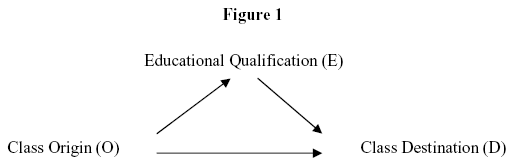
Directly or indirectly, these four hypotheses have been the focus of discussion in the studies on racial relations carried out since the end of the 1970's, and mainly from 1976 onwards, when national households sample surveys accomplished by the IBGE [Brazilian Institute of Geography and Statistics] started collecting information on the interviewees' race or color (especially: white, black, and pardo). The main empirical works have been those developed by Carlos Hasenbalg & Nelson do Valle Silva (1988; 1992; Hasenbalg, Lima & Silva, 1999). Although most of the articles were about inequality of conditions between whites and non-whites1, these two authors wrote about inequality of educational opportunities and social mobility as well. Studies on inequality of opportunities generally seek to analyze the relationship between class origin (O), Education (E), and class destination (D). The following figure presents the basic triangle of the analyses on inequality of opportunities:
]]> The studies on inequality of educational opportunities deal with the analysis of the relationship between O and E. They seek, therefore, to determine whether there is a statistical association between class origin and race, on one hand, and educational transitions for different cohorts of age, on the other. This type of analysis uses models of logistic regression, or logits, that is, it estimates the logarithm of relative chances of accomplishing or not a determined educational transition. Usually, these relative chances are estimated for each of the age cohorts, using one model for each transition 2 – for instance, one model for each cohort's relative chances of concluding the fundamental education, another for the relative chances of concluding the secondary education by those having concluded the fundamental education, and so on. Besides independent variables as class of origin and race, some other variables are used in the analyses. Initially proposed by Mare (1980; 1981), this methodology has been largely used in comparative researches (Shavit & Blossfeld, 1993).
The first study about Brazil using such methodology was an article by Silva & Souza (1986). In that study, the authors are enough cautious in stressing that some important variables (especially cognitive capacity and educational aspiration) were not available in the 1976 PNAD's data base they used. In fact, these extremely important variables still do not exist even in more contemporary data bases3. The authors, anyway, arrive to the important conclusion that, for males aged between 20 and 64 years in 1976, as much their father's occupation and education as the individuals' colors are strongly associated to the educational transitions. This association, as one would expect, decreases for transitions on the higher levels of the educational system. Subsequently, Hasenbalg & Silva (1992) used the 1982 PNAD's data in order to show that there was racial inequality in the educational transitions for people aged between 6 and 24. Blacks and pardos had disadvantages comparing to whites. Silva & Souza used controls for the individual's ages, but did not analyze the effects of class origins. Afterwards, Hasenbalg & Silva (1999a) enlarged the study to include other independent variables besides the color of the individuals. By including into the model variables concerning the family structure, they showed a substantial decrease in the magnitude of the individual's color effect, which nevertheless remained significant, pointing to the existence of a racial bias. They concluded that effectively there ought to be racial discrimination involved at the moment of children's registration into the educational system. Finally, also using PNAD's data, Silva (2003) analyzes in three different moments (1981, 1990, and 1999) the educational transitions of individuals aged between 6 and 19 years, arriving to the interesting conclusion that the effects of color upon educational transitions "increase as one progresses within the educational system" (idem: 132). In addition, the effect of family income (a socioeconomic variable) also increases along the transitions.
Another important study about inequality of educational opportunities is a monograph by Fernandes (2005). The author analyzes educational transitions for different age cohorts, using data of the 1988 PNAD. The main conclusion is that the effect of race increases in higher transitions (finishing secondary education). Although the other socioeconomic variables' effect decreases along the educational transitions, it is not possible to compare the magnitude of the effects of socioeconomic variables and race upon educational transitions because the monograph does not present standardized coefficients. The author, nonetheless, reveals that the effect of race decreases along the transitions, but augments significantly precisely at the moment of secondary school conclusion.
As for the effects of race and class of origin (socioeconomic characteristics), the studies on inequality of educational opportunities point to the permanence of both effects upon educational transitions. White people originating from more privileged classes tend to have better chances of succeeding in educational transitions. Whites get even more advantages for completing secondary school. These conclusions corroborate the fourth hypothesis formerly presented (Hasenbalg's, 1979). In other words, inequalities of educational opportunities are marked by racial stratification, which seems to be even more accentuated on the higher levels of the educational system.
Besides studying educational transitions, researches on inequality of opportunities use to analyze intergenerational mobility in order to verify whether there are class and race advantages or disadvantages in what comes to chances of social ascension. The study of mobility refers to the association between class of origin (O) and class destination (D). In Brazil, most of the studies on social mobility of different racial groups have been based mainly on the analysis of absolute mobility rates, i.e., on the analysis of percents calculated from the mobility table by crossing the father's class with the son's class. Farther on, I will show why this methodology confounds race and class of origin effects upon chances of mobility.
The first studies on mobility and race employing quantitative methodology have been carried out by Hasenbalg (1979; 1988; Hasenbalg & Silva, 1988), respectively using data from the 1976 and 1982 PNADs for six states of Center-South Brazil. In all these studies, the author shows that the whites have more upward mobility than non-whites, and interpret the results as indications that racial discrimination or racial barriers ought to exist within the process of intergenerational mobility. Hasenbalg's conclusions have been later confirmed by Caillaux (1994), who compared data of the 1976 and 1988 PNADs. A new PNAD containing data on social mobility was collected in 1996. Using these data, Hasenbalg & Silva (1999a) and Telles (2003) once more confirmed what they had observed in their previous studies with the former data, i.e., they concluded that racial barriers to intergenerational mobility continued to exist in 1996.
In spite of having been fundamental for the advancement of knowledge about social mobility, the fact that all these studies were based in simple percentage analysis causes doubts on which are the effects of race and which are those of class origin upon the chances of mobility, considering that these two variables are correlated. That is, blacks and pardos constitute a greater percent of people raised in lower classes, and a lesser percent of those raised in higher classes. Thus, in analyzing chances of upward mobility, one must be aware of such initial disproportion. If one finds more upward mobility of whites, as observed in the above mentioned studies, this may be due to the fact that the percentage of such group in the more privileged classes is greater than that of the other groups. To solve this problem, one has to use log-linear models able to control the marginal distribution of the mobility tables, i.e., able to control the disproportion of whites and non-whites in the classes of origin.
Aware of this limitation, Silva (2000) and Hasenbalg & Silva (1999b) use log-linear models in order to analyze the intergenerational social mobility of whites, blacks and pardos. The statistical tests using log-linear models signalize that occupational destination and color are associated regardless of the individuals' class of origin, i.e., the models indicate that there is inequality of social mobility opportunities between whites and non-whites. One of the limitations of the models employed is the fact that they only permit global conclusions as those just indicated, but do not allow for a more detailed analysis about the interaction between color and class origin. In the analyses developed in this article, I use more advanced log-linear models permitting to verify not only whether there is interaction among class of origin and race upon the chances of social mobility, but also to determine the pattern of such interaction.
Finally, there are some articles seeking to jointly analyze the relationship between class origin (O), educational qualification (E), and class destination (D), as well as their differentials by racial groups. The works of Silva (1988), Carvalho & Neri (2000), and Osório (2003) analyze different aspects of the relationship between origin, education, and class destination.
In order to understand the process of socioeconomic attainment (status attainment), Silva (1988) proposes linear regression models aimed at explaining the occupational position and the income obtained by the individuals. Such models include as explicative variable the characteristics of the socioeconomic origin (as the father's occupation and level of education), the residential situation (as the region of residence and of birth), and the education achieved (schooling years). The models are estimated for whites and non-whites. Silva (idem: 158) arrives to the following conclusion: "besides the inheritance of a socioeconomic situation by the individuals, there is still a legacy of race, which causes the colored individuals to find themselves in competitive disadvantage respecting the whites in the struggle for positions within the social structure".
]]> Another article dealing with occupational mobility is that of Carvalho & Neri (2000), based on the analysis of data from the Pesquisa Mensal de Emprego – PME [Monthly Employment Research] of 1996. Besides making the usual percentage analyses of mobility tables (intra-generational mobility, in this case), the authors estimate logistic regression models. By crossing initial occupation and final occupation in the tables, they conclude, on one hand, that there is a differential in mobility between whites and non-whites, and, on the other hand, that the variable race is not statistically significant when analyzed in the regression along with other variables of socioeconomic origin. They come to the conclusion that socioeconomic variables are more important than race in what regards to intra-generational mobility chances.Finally, Osório (2003) estimates log-linear models including class origin (O), class destination (D), education (E), sex (S), age (I), and color (C). Even though log linear models estimated in such a way are subject to a complex interpretation, Osório does a good work and comes to interesting conclusions about the process of intergenerational mobility. He says, for example, that "[…] not completing secondary studies represents in the high class a concrete risk of falling into middle and low classes, but the fact of being white specifically reduces the risk of the movement being directed downwards – blacks will have more chances of a fall as destiny –, besides enhancing the chances of remaining in the class" (Osório, 2003:144).
The results provided by these three articles are important. On one hand, Silva's (1988) and Osório's (2003) analyses show that there is difference in the relative chances of mobility distinguishing whites and non-whites. Osório (idem) shows that such a difference is more prominent in the higher classes – an outcome which is similar to those I find in this article. On the other hand, Carvalho & Néri (2000) indicate that, in the process of intra-generational mobility, the chances of mobility are better explained by the socioeconomic variables.
Even though they do not discuss directly their theoretical implications, the studies of Osório (2003) and Carvalho & Néri (2000) challenge Hasenbalg's hypothesis (1979), according to which racial inequality factors are independent from factors of stratification by class. What is suggested by these works is that some form of interaction between class and race ought to exist in the building-up of inequalities. In a certain way, Hasenbalg's theory (idem) foresees it, although the more simplifying interpretation of his argument does not emphasize the interaction between race and class. One of the implications of this article's outcomes is precisely the need to think more coherently about the interactions between race and class in the production of social inequalities.
DATA, MODELS AND MODEL'S ADJUSTMENTS
In this section, I present the models I use in order to analyze the inequality of opportunities of social mobility between white, black, and pardo males aged from 25 to 64 years. The data here used are those of the 1996 PNAD, and they are representative for the entire country. In presenting the characteristics of the models and their adjustments to the data, I describe as well the variables used in each one of them. Before that, however, I discuss briefly the four strata used for classifying classes of origin (measured from the fathers' occupations when the respondents were 14 years old) and of destination (based on the respondents' occupations in September 1996).
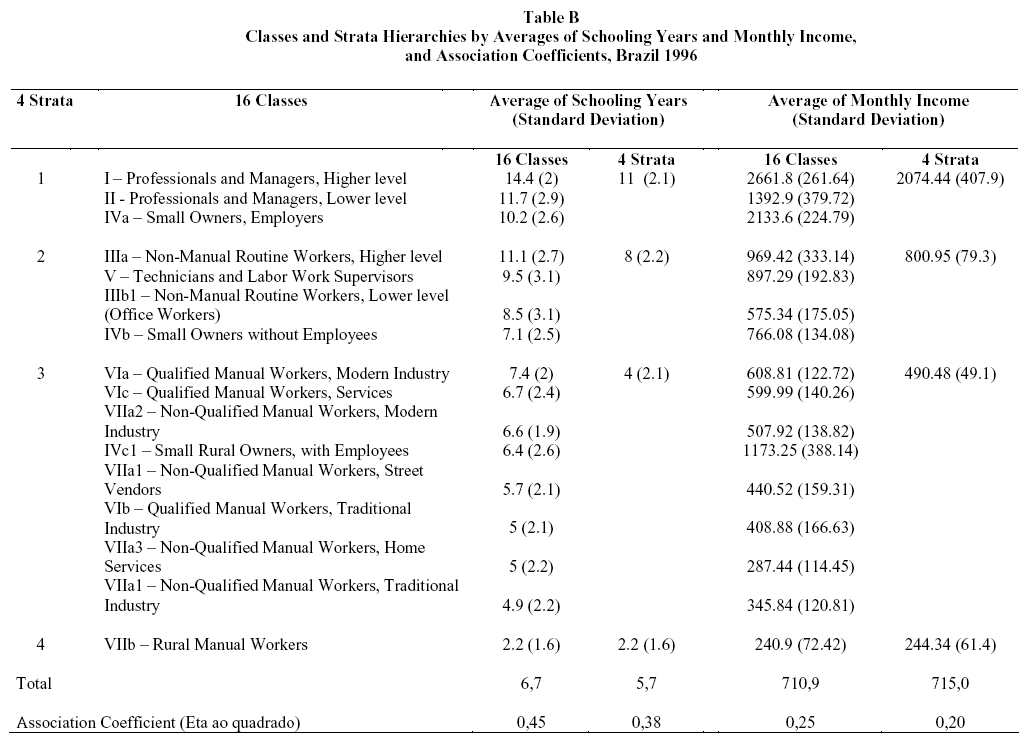
Classes of origin and destination have been classified as follows: (1) professionals, managers, and employers (average income and schooling years for the class of destination are: R$ 2,074.00 and 11 years, respectively); (2) non-manual routine workers, technicians, and owners without employees (average income and schooling years for the class of destination: R$ 801.00 and 8 years); (3) manual workers and small rural employers (average income and schooling years for the class of destination: R$ 490.00 and 5 years); and (4) rural workers (average income and schooling years for the class of destination: R$ 244.00 and 2 years). This scheme of four groups of classes is an aggregation of the 16 groups described by Ribeiro (2007: chap. 2). These 16 classes are obtained in base of the occupational variables (which include the position in the occupation as well) present in the PNAD, with the purpose of constructing a Brazilian version of the international scheme described in the second chapter of Erickson & Goldthorpe (1993) and obtained in base of the methodology proposed by Ganzeboom & Treiman (1996). In the case of the Brazilian data, the classes of qualified (VI) and non-qualified (VIIa) manual workers can be divided into seven categories according to the type of industry in which the work is concentrated. In order to analyze the intergenerational mobility of the groups of color (whites, blacks, and pardos), I have been obliged to diminish the number of class categories because the group of blacks is very small, what leads to the methodological impossibility of analyzing the mobility table for this group. In face of this limitation, I have aggregated the class groups, from 16 to 4 categories, taking into account the work characteristics of each group and the socioeconomic conditions expressed in the respective averages of education and of income provided by the main work activity. The averages of income and schooling years for the schemes with 16 and with 4 categories are presented in the annex Table B.
All the analyses in this article are based on statistical models for categorical data. More specifically, the models here used are: log-linear, logit (logistic regression), and conditional multinomial logit. All these three types are mathematically equivalent, that is, they are distinct specifications of a same type of model. My analyses are disposed according to the following order: initially, I describe the intergenerational mobility and estimate models in order to verify whether the force and pattern of association between class of origin (O) and of destination (D) vary between the three color groups (C). Then, I analyze the association between class origin (O) and educational transitions (E), on one hand, and the impacts of acquired educational qualifications (E) and of class origin (O) upon the chances of mobility for the classes of destination (D), on the other. For each of these steps, I use distinct models.
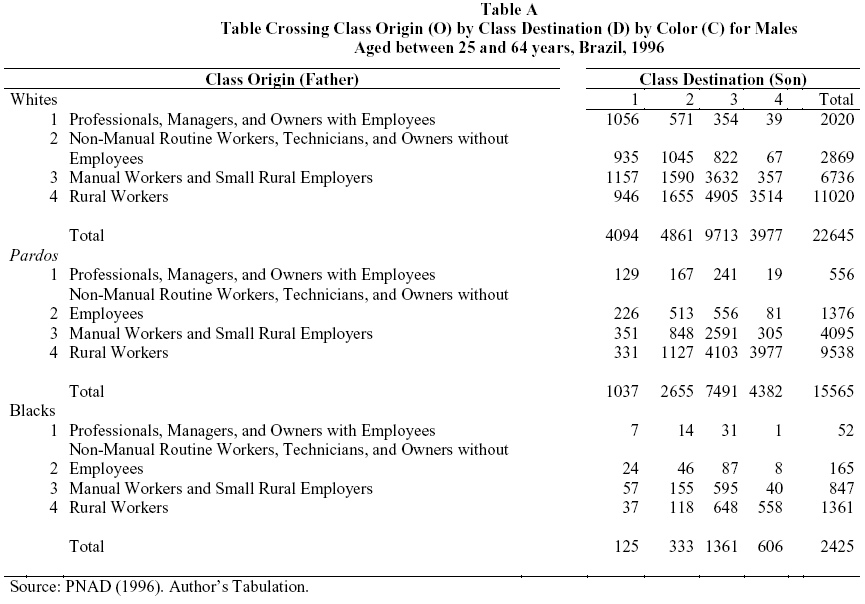
In order to analyze the intergenerational mobility, I adjusted three log-linear models to the table by crossing four classes of origin (O) with four classes of destination (D) and three groups of color (C)4. The three models adjusted to this table are presented as follows.
]]> The model of constant association:
Where log Fijk is the logarithm of the odds ratio that measures the association between origin i and destination j conditional in color k; the term µ is the general average; the terms liº, ljD e lkC control the marginal distributions of origin, destination, and color; the term likOC controls the association between origin and color; and the term ljkDC controls the association between destination and color. As this model includes a term for the association between origin and destination (lijOD), and does not include a term for the interaction between origin, destination, and color (lijkODC), if it is adjusted to the data, one should conclude that the association between origin and destination is the same for the three color groups.
The second model that I adjust to the data is the log-multiplicative proposed by Xie (1992), whose general formula is:

The only difference of this model (M2) relatively to the former (M1) is that the term lijOD of M1 is replaced by exp(yijfk). yij describes a single pattern of association between origin and destination, and is multiplied by fk, that defines the variation, by color group, of the force of association between O and D. If this model provides a better adjustment to the data than that of M1, we can conclude that the force of the association is different for each color group, according to the numerical value of fk.
Finally, I make use of a last model that permits not only that the force of the association between origin and destination vary according to the color groups, but also that the pattern of this association be different. This model, proposed by Goodman & Hout (1998), is the following:

This formula (M3) simply adds the term lijOD to the previous model (M2). This inclusion allows for analyzing the difference in the pattern of association between the three racial groups, besides analyzing the difference in the force (exp[yijfk]). This third model may be rewritten in order to render its formula similar to that of a linear regression, including an intersection (that measures the pattern of association – µij) and an inclination (measuring the force of the association - µ'ij). This alternative manner of conceiving the same model permits a clearer interpretation, helps to improve the adjustment of the model, starting from restrictions to its estimators, and is responsible for the model's denomination: "regression-type layer effect model" (idem). The alternative formula is:

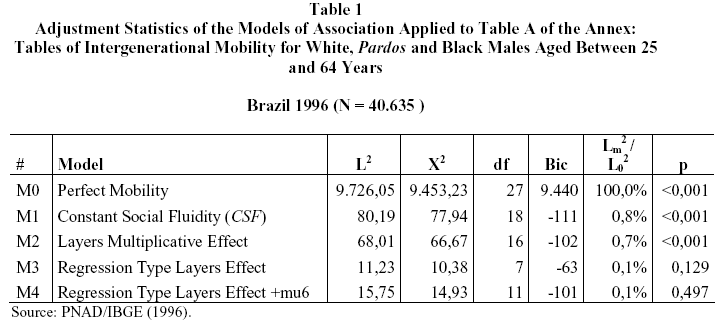
In order to evaluate the adjustment of the models, one uses the qui-square test (c2) and the bic test, giving preference to the first. The perfect mobility model (MO) does not adjust itself to the data; the model of constant association (M1) adjusts itself according to the bic (the more negative the bic, the better the adjustment of the model); the log-multiplicative model (M2) is adjusted as well, but dos not represent a significant improvement in relation to M1. Finally, the regression-type model (M3) is adjusted according to the bic and the qui-square. This model should be chosen as the better adjustment, but it is yet rather complex, for it uses 9 degrees of freedom more than the M2 (df = 16-7 = 9), what is the reason why the bic statistics, which penalizes models rather complex, is less negative than in the former models. Because of this type of complexity, Goodman & Hout (idem) suggest specific restrictions to the estimated parameters of the intersection and/or the inclination. These parameters for the M3 model are presented in Table 2.
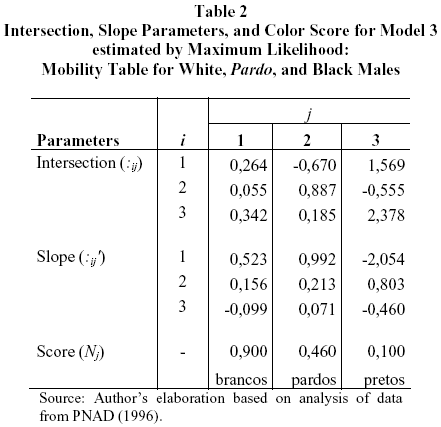
Considering that the slopes between -0.3 and + 0.3 are practically equal to zero, we can define the slopes in the coordinates i and j (2,1), (2,2), (3,1) and (3,2) as being equal to zero. Once this restriction applied, we have the M4 model of the table above. This model (M4) uses less degrees of freedom than the M3 (is less complex), is better adjusted to the data than the other formerly proposed models (for M4, the c2 = 14.93 with the value of p = 0.497), and, therefore, will be used in the next section for interpreting the variation between the three racial groups in the association between class origin and destination.
]]> Besides analyzing intergenerational mobility, I investigate the correlation between class of origin and educational transitions. In order to analyze these transitions, I use logistic regression models whose equation can be found in several methodology books (for example, Powers & Xie, 2000:49). Such modes are used in order to estimate six important educational transitions:1) Be admitted to school (comparing those having completed the 1st grade of primary school with all those having not);
2) Successfully conclude the 4th grade of primary school (for those having completed the 1st grade of primary school);
3) Successfully conclude the 8th grade of primary school [Lower Middle School] (for those having completed the 4th grade, but having not concluded the 8th grade);
4) Successfully conclude Secondary School [Upper Middle School] (for those having completed fundamental education);
5) Be admitted to College or University (comparing those who completed one year of Superior Education with all those having completed the Upper Middle School); and
6) Successfully conclude Superior Education (comparing those who attained the conclusion of the course of study at a College or University with all those having completed only one year of the course).
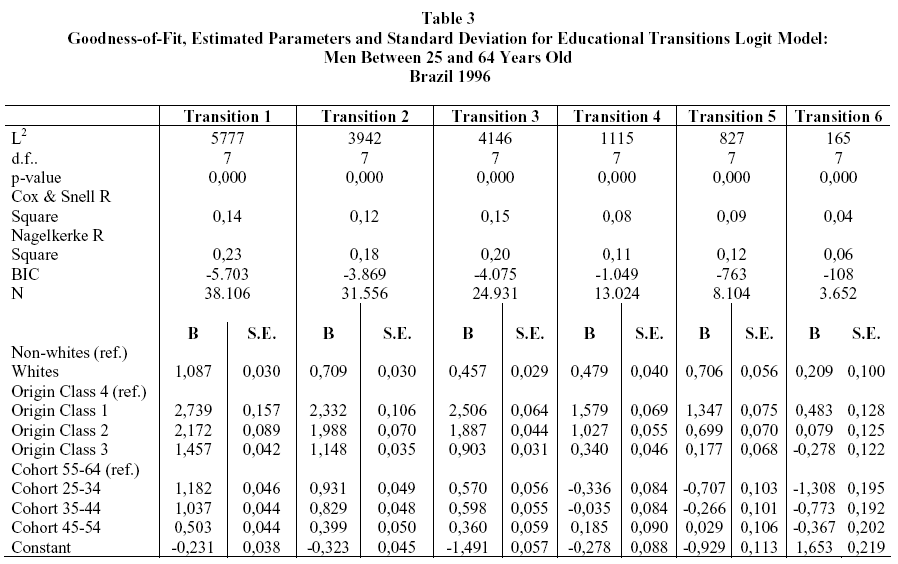
Each of these transitions, from the second onwards, is conditional in relation to the former. In other words, in order to have the chance of making a certain educational transition, one has to have been successful in the former. The models estimated for the six transitions are presented in Table 3.
Each model analyzes the probabilities of making or not an educational transition according to color or race, class origin, and age cohort. All the models are well adjusted to the data (the bic statistics are negative), and will be interpreted farther on.
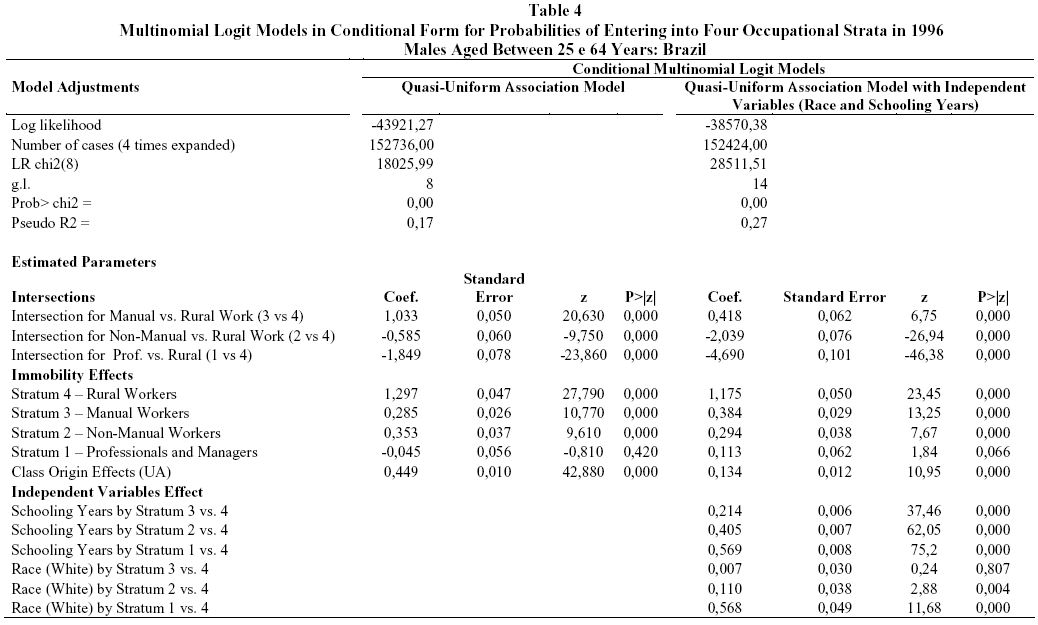
Finally, I used a conditional model for multinomial logits in order to explain the association between race, class of origin, and level of education, on one hand, and the relative chances of entering into one of the four classes of destination, on the other hand. This type of model is entirely equivalent to a log-linear one, but it allows for the inclusion of three more variables, without rendering the interpretation excessively complex (as it occurs with Osório's work of 2003). In spite of having been considered by Logan (1983), Breen (1994), and DiPrete (1990), as important for the analysis of social mobility, such a model only began to be used in sociological literature after the syntax for processing it using the statistical package STATA has been made available by Hendrickx (2000). The formula for the version I use in this article is:
]]>
Where Lij is the logit for the individual i in class of destination j; gj (j = 2, 3, and 4) are variables indicating class of destination; (a1ri.1 + ajrij) are the parameters of class heritage (probabilities of immobility); d is the effect of origin upon destination according with the pattern of uniform association (linear association with identical scale of origin and destination) for the individual i in class of destination j; bj1 is the effect of being white in class j for the individual i; and bj2 is the effect of each schooling year attained by the individual i.5 I have adjusted two versions of the former model: (1) one of them excluding the independent variables for race and education (bj1ci + bj2ei); which is equivalent to the log-linear model of uniform association with restrictions for the diagonal, and (2) another including all the independent variables. This second version greatly improves the model's adjustment, as it becomes clear by the value of the pseudo R2 in Table 4. The effects of immobility and of uniform association (UA) decrease when we include race and schooling years. The whites' advantage is more accentuated for entering into class 1 than in classes 2 and 3; and each schooling year has a positive effect, enhancing the chances of upward mobility. The detailed interpretation of the model will be presented farther on.
RACE OR CLASS: THE DETERMINANTS OF SOCIAL MOBILITY
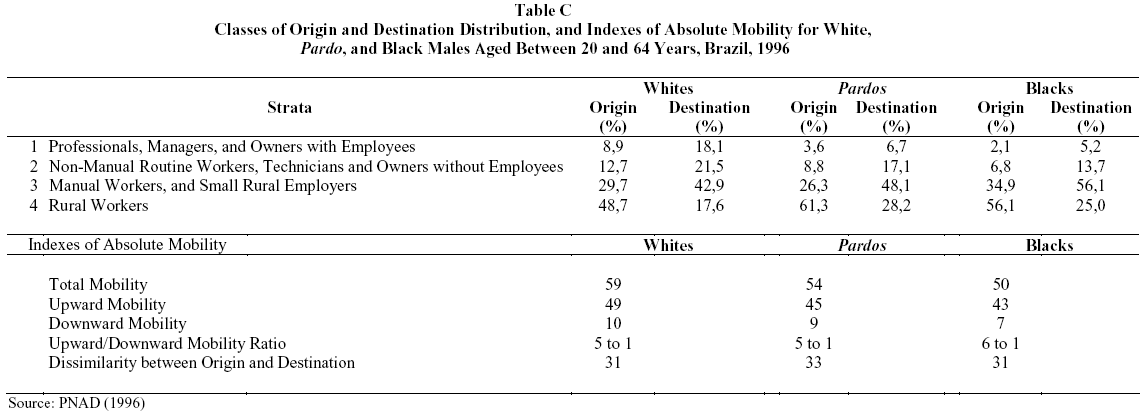
The main methodological problem faced by a study about the chances of upward social mobility of individuals in different color groups and with distinct class origin is that, in general, these two variables are interrelated. That is, blacks and pardos constitute a higher percentage of individuals grown up in lower classes, and a lower percentage of those reared in the higher classes. Thus, in analyzing the chances of upward mobility, we have to pay attention to this initial disproportion. We can observe this fact through the 1996 data (see Table C). While 61% of the pardos and 56% of the blacks were sons of rural workers, only 49% of the whites had this family origin. Historically, rural workers' families are the poorest in Brazil. So, we can easily conclude that blacks and pardos have been grown up in larger proportion in poor families. The opposite occurs with the richer families. Among all the whites, 9% are sons of professionals and small entrepreneurs, and only 4% of the pardos and 2% of the blacks have a similar origin. Thus, whites come in a larger proportion from more well-to-do families than do the blacks and pardos.
This larger proportion of blacks and pardos with origin in low classes, and whites with high class origins, is reflected in the class destination, the occupations in which the individuals find themselves nowadays. In 1996, 56% of the blacks, 48% of the pardos, and 43% of the whites were urban manual workers (a class also very poor). At the top, there are more whites and less blacks and pardos. In 1996, 18% of the whites were professionals and small entrepreneurs, and only 7% of the pardos and 5% of the blacks had that class position.
Hence, the difference in class position in 1996 is partly determined by the difference in the class position of origin. We cannot simply say, for instance, that the disproportion of blacks and pardos in the class of professionals and small entrepreneurs in 1996 results from racial prejudice, because, as we have seen, blacks and pardos, more than whites, are concentrated in low classes of origin, what reduces their chances of upward social mobility.
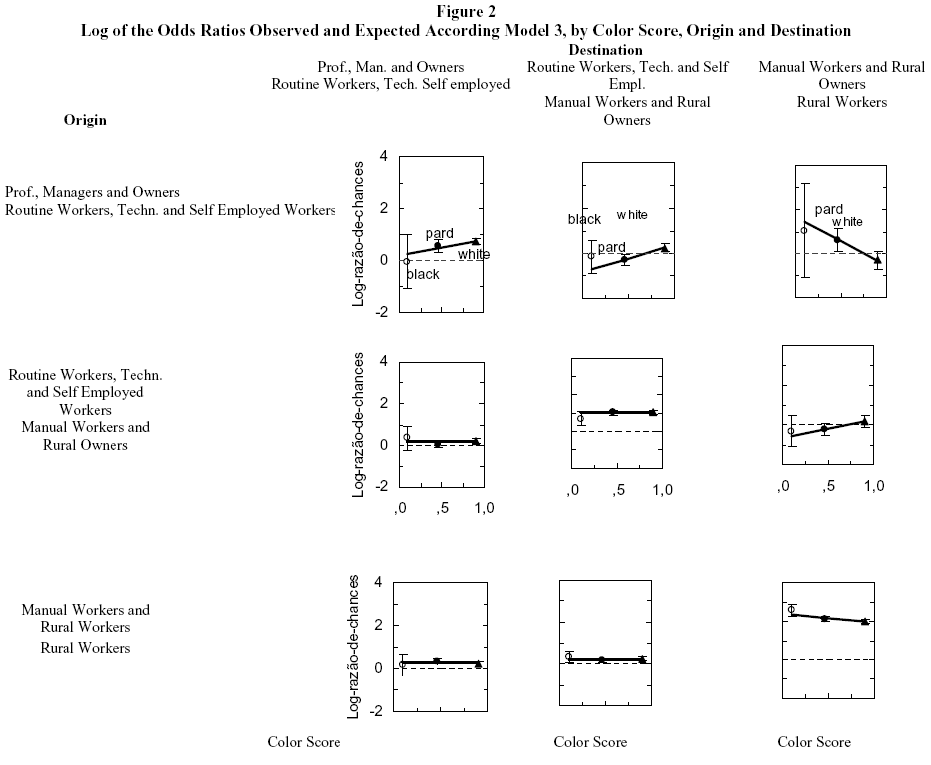
In order to define the role of race and class of origin regarding upward social mobility, we have to use models able to control statistically the disproportions in the classes of origin. After implementing the different statistical analyses presented in the previous section, I arrived to a model (M4 model in Table 1) that, although mathematically complex, clearly expresses the interaction between race and class of origin upon the chances of upward mobility. The chief manner of expressing the outcomes of this model is to start from a numerical value known as "odds ratio", which defines the relative chances of people with similar class origins, in distinct color groups, to attain the same classes of destination. These odds ratios or, rather, their logarithm, permits designing the figure that follows, which shows the differential in relative chances of upward social mobility between whites, pardos and blacks, controlled by the disproportions in their classes of origin, discussed above. If the straight line connecting blacks, pardos and whites is completely horizontal to the color scores axis in each graph of the figure, then the "odds ratios", or relative chances of mobility, are identical for blacks, whites and pardos. Otherwise, there is inequality between the color groups in their relative chances of upward mobility.
Although Figure 2 is rather complex, what it reveals is quite simple and very important for us in order to evaluate in what the class of origin is more important than race in determining the chances of social mobility, and vice-versa.
The first two graphs, in lines two and three, indicate that there is no difference in relative chances of upward mobility between blacks, pardos and whites whose parents were in the lowest classes. Those graphs compare relative chances of sons of rural workers and manual urban workers achieving upward mobility towards the classes of professionals and non-manual urban workers. In none of these comparisons there is any difference between relative chances of mobility for black, pardo, and white male. For example, regardless of their color or race, sons of urban manual workers have 1.3 times more chances of reaching the professional class than have the sons of rural workers. In short, the chances of upward mobility of people with origins in the lowest classes are entirely determined by their class origin, and the color of their skin is not relevant. There is no racial inequality in chances of upward mobility for people originated from the low classes.
]]> If we observe, however, the relative chances of professionals' and non-manual routine workers' sons (represented on the first three graphs of the first line of Figure 2), we find out that the relative chances of immobility on the top and of downward mobility are different for blacks, pardos, and whites. For instance, white sons of professionals have 2 times more chances of remaining in this class than to descend to the class of routine non-manual workers, while black sons of professionals have only 1.2 times more chances. In short, the chances of downward mobility and of immobility of persons originating from higher classes are significantly influenced by the color of their skin. There is racial inequality in chances of downward mobility and immobility for people with origin in the higher classes.What is suggested by these analyses is that, in Brazil, racial prejudice becomes more relevant as we go upwards in the class hierarchy. People with origin in lower classes find difficulties in upward mobility because they belong to lower classes, and not because of their color or race. There are, however, important evidences suggesting that black persons originating from the higher classes have fewer chances than whites, with origins in those same classes, of remaining on the top, and more chances of downward mobility. The analyses reveal that the inequality of opportunities of social mobility is racial only in the high classes, and not in the low ones. This is a very important conclusion, for it indicates that racial prejudice should be more strongly present on the top and not on the basis of the class hierarchy.
INEQUALITY OF EDUCATIONAL OPPORTUNITIES
In contemporary society, one of the most important roads for social mobility is formal education. In order to occupy certain prestigious positions, educational qualification is essential; to be a son of someone qualified is not enough. For becoming a doctor or a judge, one needs to have a superior education. Being the son of a doctor or a judge does not qualify anybody as doctor or judge. What qualifies are the schools of medicine and Law. It is, however, a widely discussed fact that sons of qualified professionals have more chances of attaining higher educational levels than sons of non-qualified workers. Besides, much is said in Brazil about unequal educational chances between whites and non-whites. Such presuppositions must be empirically investigated.
Modern sociological methodology for the study of educational stratification points out to the need of studying several significant educational transitions. That is, we shall find out which are the main characteristics influencing the chances of children and youngsters to have success in making educational transitions. In this article, I analyze six educational transitions: (1) admission to school; (2) conclusion of the 4th grade of elementary education; (3) conclusion of the 8th grade of elementary education (Lower Middle School); (4) conclusion of secondary education (Higher Middle School); (5) admission to College or University; and (6) conclusion of university education.
One of the expected consequences along these educational transitions is that the inherited characteristics (as class of origin, race or gender) tend to have more weight in the first than in the last transitions, since each transition produces a selection in terms of educational qualification. For instance, people with different class origins, when admitted to university, share an important similarity: they all have concluded their secondary education.
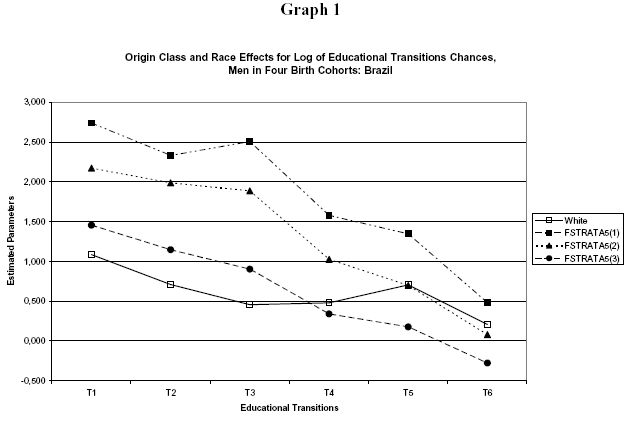
Although different characteristics influence the chances of success in each of the educational transitions (I have included class of origin, age, and color into the models of logistic regression I used), I present in Graph 1 only the weight of people's class origin and color in each transition. The purpose, in this case, is that of verifying, in each transition, which is the magnitude of the inequality of educational opportunities in terms of race and class origin.
Graph 1 effectively reveals that the influence of people's class origin and color decreases progressively along the educational transitions. Moreover, class origin seems to have greater effect than color upon people's chances of accomplishing transitions. That is, people whose parents were in the higher classes (professionals, for example) have more chances of success in educational transitions than those whose parents were in lower classes. Whites have also more chances of success than non-whites, but the weight of class origin is bigger than that of race. In other words, we can say that there is more inequality of educational opportunities in terms of class than in terms of race. In the last transitions, however, the effect of race becomes similar to the effect of class, that is, chances of entering and completing university are unequal in racial and class terms. Let us see an example: the sons of professionals have 15 times more chances of entering primary school than those of rural workers, and whites have 3 times more chances of entering primary school than non-whites. There is inequality of educational opportunities as well in terms of class origin as in terms of race, although the first factor is stronger than the second. In order to enter university, sons of professionals have 4 times more chances than sons of rural workers; and whites have 2 times more chances than non-whites. In short, at the early stages of the educational career, class inequality is much stronger than race inequality, while at the higher educational levels both types of inequality decrease in relation to what occurs in the first transitions, and become more similar. That is, in educational transitions of higher levels, inequalities of race and class have similar magnitudes.
These conclusions on educational transitions reinforce the conclusions on upward mobility presented in the previous section of this article. In terms of opportunities, class inequality is much stronger than race inequality in the first transitions. In contrast, compared to class inequality, racial inequality starts to become more relevant in the higher transitions of the educational system. As we go upwards in society's socioeconomic hierarchy, racial inequality seems to become more important than, or at least as important as, class inequality.
]]>CLASS DESTINATION: THE EFFECTS OF RACE, CLASS ORIGIN, AND EDUCATIONAL QUALIFICATION
Having analyzed, in the two precedent sections, the intergenerational social mobility and the educational stratification, it is now the case of integrating these two analyses. In other words, what is left to be known are the effects of class origin, color, and level attained in education, upon the chances of social mobility for the classes of destination in 1996, year in which the IBGE data that I am using in this article have been collected.
It is also convenient here the use of statistical models susceptible of being controlled by the different proportion of whites, pardos, and blacks with origins in high and low classes. In addition, I have introduced the variable "completed schooling years" as one of the main factors determining social mobility. The model I employed is known as "conditional multinomial logit model" (see section on methodology).
The outcomes of the model (according to Table 4) strengthen yet more the conclusions to which I have previously arrived. Racial inequality seems to be effectively stronger for entering the higher than the lower classes. That is, the entrance in the lower classes is unequal rather in terms of class origin than of race, while, for entering the higher classes, there is inequality of opportunities between whites and non-whites (pardos + blacks), indicating that racial discrimination becomes stronger as one goes upwards in class hierarchy.
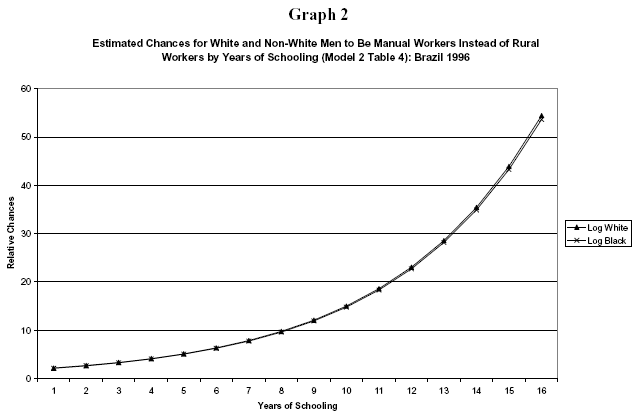
Graph 2 presents the relative chances of white and non-white males entering the class of urban manual workers, instead of entering that of rural workers, according to the schooling years they have completed. The calculation of these chances also takes into account the class of origin. In statistical language, we say that we are controlling by the class of origin, i.e., we are observing the conditional chances (in terms of education and class of origin) of whites and non-whites entering the manual workers class.
What the graph shows is that there is no difference between the chances of whites and non-whites, and that the more the schooling years, the more the chances of entering the class of urban workers (hierarchically higher than that of rural workers).
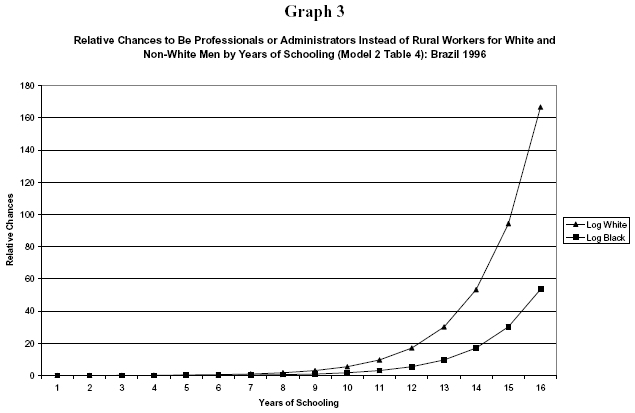
An entirely different outcome is found when we analyze the chances of entering the professional class instead of that of the rural workers (the two extremes of the class hierarchy). Graph 3 shows precisely this comparison according to the same model used for designing the graph 2, referred above.
Graph 3 reveals that there is a significant difference in whites' and non-whites' chances of entering the professional class. With the same schooling years than the whites, the non-whites have rather smaller chances of becoming professionals (remember that these data control by the class origin). For instance, between those males having completed 15 schooling years (having completed university education), whites have 3 times more chances than non-whites of becoming professionals. It is interesting to observe that, in spite of the non existence of racial inequality in the chances of completing university education, there are strong evidences that non-white graduates find more difficulty in entering professional positions than the whites with the same educational level.
These analyses, once more, confirm what I have observed before. In the process of upward mobility, racial inequality is present mainly on the higher levels of the class hierarchy, while the chances of ascension of those originated from lower classes are determined by class position, and not by race or color of skin.
]]>CONCLUSIONS
This article's main conclusion is that racial inequality in chances of mobility is only present for individuals with origin in the higher classes. White, pardo, and black males with origin in lower classes have similar chances of social mobility. I have arrived to this outcome from a detailed analysis of three aspects of social mobility: (1) inequalities of intergenerational mobility opportunities between classes of origin and destination; (2) inequalities in chances of accomplishing educational transitions; and (3) effects of the education achieved and of the class origin upon the chances of social mobility. In all these analyses, I emphasized the comparisons between the effects of the skin color and the class of origin.
The main problem in the analysis of intergenerational mobility of whites, pardos, and blacks is that the first group tends to be represented in greater proportion in the higher classes of origin, and the last two in the lower classes of origin. This fact makes that the whites' mobility opportunities are greater than those of blacks and pardos. Hence, in analyzing the chances of mobility using only the gross rates (percents), we do not have how to separate the effect of the class of origin from that of the color of the skin. For this reason, I used statistical models that control this disproportion in the class of origin, and allow for analyzing the variation, between the color groups, of the pattern and force of association between classes of origin and of destination. In other words, they make possible to verify not only which are the effects of class origin and skin color upon the chances of mobility, but also whether, and how, these effects combine (interact) or not.
The outcomes of such analysis lead to the conclusion that, for males with origin in lower classes (rural workers, urban manual workers, and small rural employers), there is no racial inequality in chances of upward mobility; that is, in the lower strata, whites, pardos, and blacks face similar difficulties concerning upward mobility. In contrast, white, pardo, and black males with origin in higher classes (professionals, managers and small employers; and routine workers, technicians, and independent workers) have distinct chances of immobility and downward mobility. Whites have more chances of immobility on the top of the class hierarchy than pardos and blacks, while the later have more chances of downward mobility. That is, there is racial inequality in the opportunities of intergenerational mobility for males with origin in the higher classes. These outcomes reveal that: the inequality of opportunities is present at the top of the class hierarchy, but not at its bottom. This conclusion leads us to suggest that racial discrimination occurs mainly when valued social positions are at stake. 6
Another fundamental aspect of the social mobility process is the acquirement of formal education. Schooling is one of the main factors conducing to social mobility. The analysis of inequalities of educational opportunities is, therefore, fundamental for understanding the mobility process. In this sense, I have analyzed the effects of race and class of origin upon the chances of accomplishing six educational transitions: (1) completing the 1st grade of primary school; (2) completing the 4th grade of primary school, having accomplished the transition 1; (3) completing fundamental education, having accomplished transitions 1 and 2; (4) completing secondary education, having accomplished the previous transitions; (5) completing one year of university studies, having accomplished the previous transitions; and (6) completing university studies, having accomplished all previous transitions. According to current interpretation (Shavit & Blossfeld, 1993), the effect of the variables concerning class origin tends to decrease along the educational transitions. This tendency is confirmed by my analyses. My major interest, however, has been that of verifying the weight of skin color and class of origin upon the chances of accomplishing educational transitions.
The analyses show the inequality of chances in accomplishing transitions both in terms of color and class origin, but they also reveal that the second type of inequality is stronger than the first. In addition, while class inequality decreases along transitions, racial inequality increases in transition five - completing or not the first year of university studies. Until the fourth transition (completing secondary education), the class of origin effects are at least six times bigger than the effect of race. That is, until the fourth transition, the inequality of class is bigger than the inequality of race. In fifth and sixth transitions (completing the first year of university studies, and finishing university graduation), racial inequality becomes more similar to class inequality, the weight of the class of origin being only 2.5 times bigger than weight of the skin color. Being originated in higher classes increases the chances of success in accomplishing educational transitions, the same happening by the fact of being white instead of non-white (black or pardo). In short, in those educational transitions until admission to secondary school, class inequality is much bigger than race inequality, while for completing one year of university studies and finishing university graduation, racial inequality is almost as big as class inequality.
Finally, I analyzed the effects of the attained level of formal education, of race, and of class of origin upon the chances of upward mobility. In these analyses, which combine the former two, it has become clear that the effect of race upon the chances of mobility, taking into account level of formal education and class of origin, is observed only for people with more than 10 or 12 schooling years entering the class of professionals, managers and employers. With more than 12 schooling years, whites have in average three times more chances than non-whites of experiencing upward mobility towards the more privileged classes. Although education is important for any type of upward mobility, racial inequality is present only on the chances of mobility towards the top of the class hierarchy. Once more, the outcomes confirm that there is racial inequality only upon the chances of upward mobility towards the hierarchically higher classes.
The outcomes of this research are extremely relevant for discussing the four theories on racial and class stratification I have briefly presented in section 2 of this article. The first, derived from Pierson's work (1945), suggests that the strong barriers to upward mobility would not be racial, but class barriers. The second, presented by Costa Pinto (1952), suggests that the class society's enlargement will lead to an increase in social mobility and, as non-whites start entering in the more privileged classes, there will be a recurrence and a stirring up of racial discrimination. The third, adopted by Fernandes (1965), says that racial discrimination in social mobility process will be gradually replaced by class discrimination, that is, racial prejudice is an inheritance of colonial past. Finally, Hasenbalg's work (1979) suggests that racial discrimination would continue to be an important factor of social stratification in Brazilian society, even with the industrialization and the ensuing expansion of the class society.
This is an obviously reductionist presentation of the four perspectives. Even Pierce (1945:221-239) suggests that some form of stratification by race could result from an increase in competition between whites and non-whites for socially privileged positions.7 Here, Pierson's perspective seems to come close to Costa Pinto's (1952) conception, although the later argues the existence of racial discrimination. Although my analyses are not suitable for evaluating temporal changes in chances of mobility - as I analyze mobility only on a determined moment in time -, they suggest that the competition for hierarchically higher social positions is marked by racial inequalities, while the chances of ascension of those with origin in the lower classes are entirely determined by their class position. This outcome indicates that racial inequality is present at the top of the class hierarchy, but not at its bottom.
]]> These conclusions also challenge Fernandes' (1965) and Hasenbalg's (1979) theories. Fernandes' idea that racial inequality is an inheritance of the past would be well represented if the analyses had not taken into account the disproportion between non-whites and whites in the class of origin. This disproportion, that influences the gross rates of mobility, is a consequence of the inequality in the past that determines the chances of mobility in the present. However, by controlling these initial differences, the methodology I used permits to say that the forms of racial inequalities in the chances of mobility that have been found are not merely a consequence of the inequality in the past. They are neither generalized as suggests Hasenbalg's theory, i.e., the idea that there would not be inequalities in chances of mobility between non-whites and whites regardless their class origin is not confirmed in my analyses. On the contrary, I have shown that racial inequalities in chances of mobility are marked by significant differences in class origins.8The outcomes of the analyses presented in this article point to the need of new theoretical syntheses on the relation between class, race, and social mobility. The answer cannot simply be that there is or there is not racial discrimination and racial inequality in chances of mobility. This sort of Manichean vision, which seems to be present in most of the current debate, does not help the development of new theories and analyses about racial relations in Brazil. This study intends to be a small contribution to the academic debate. Analyses about this theme including changes in chances of mobility along time would be interesting possibilities for extending this work.
BIBLIOGRAPHIC REFERENCES
AZEVEDO, T. (1996), As Elites de Cor numa Cidade Brasileira: Um Estudo de Ascensão Social, Classes Sociais e Grupos de Prestígio. Salvador, Edufba. [ Links ]
BREEN, R. (1994), "Individual Level Models for Mobility Tables and Other Cross-Classifications". Sociological Methods & Research, vol. 23, nº 2, pp. 147-173. [ Links ]
CAILLAUX, E. L. (1994), "Cor e Mobilidade Social no Brasil". Estudos Afro-Asiáticos, nº 26. [ Links ]
]]>CAMERON, S. e HECKMAN, J. (1998), "Life Cycle Schooling and Dynamic Selection Bias: Models and Evidence for Five Cohorts of American Males". Journal of Political Economy, vol. 106, pp. 262-333. [ Links ]
CARDOSO, F. H. e IANNI, O. (1960), Cor e Mobilidade Social em Florianópolis: Aspectos das Relações entre Negros e Brancos numa Comunidade do Brasil Meridional. São Paulo, Companhia Editora Nacional (Coleção Brasiliana, vol. 307). [ Links ]
CARVALHO, A. P. e NERI, M. C. (2000), "Mobilidade Ocupacional e Raça: Origens, Destinos e Riscos dos Afro-Brasileiros". Ensaios Econômicos, nº 392, EPGE/Fundação Getulio Vargas Editora. [ Links ]
COSTA PINTO, L. (1952), O Negro no Rio de Janeiro: Relações de Raça numa Sociedade em Mudança. São Paulo, Companhia Editora Nacional. [ Links ]
COSTA RIBEIRO, Carlos Antonio. (no prelo), Estrutura de Classe e Mobilidade Social no Brasil. Bauru, Edusc. [ Links ]
]]>DiPRETE, T. e GRUSKY, D. (1990), "Structure and Trend in the Process of Stratification for American Men and Women". American Journal of Sociology, vol. 96, pp. 107-143. [ Links ]
ERICKSON, R. e GOLDTHORPE, J. (1993), The Constant Flux: A Study of Class Mobility in Industrial Nations. Oxford, Clarendon Press. [ Links ]
FERNANDES, D. (2005), "Estratificação Educacional, Origem Socioeconômica e Raça no Brasil: As Barreiras de Cor". Prêmio IPEA 40 Anos-IPEA-CAIXA 2004 (Monografias Premiadas), Brasília, IPEA. [ Links ]
FERNANDES, Florestan. (1965), A Integração do Negro na Sociedade de Classes. São Paulo, Companhia Editora Nacional. [ Links ]
FREYRE, Gilberto. (1973) [1933], Casa-Grande & Senzala. Rio de Janeiro, José Olympio. [ Links ]
]]>GANZEBOOM, Harry e TREIMAN, Donald. (1996), "Internationally Comparable Measures of Occupational Status for the 1988 International Standard Classification of Occupations". Social Science Research, vol. 25, pp. 201-239. [ Links ]
GOODMAN, Leo e HOUT, M. (1998), "Statistical Methods and Graphical Displays for Analyzing How the Association Between Two Qualitative Variables Differs Among Countries, Among Groups or Over Time: A Modified Regression-Type Approach". Sociological Methodology, vol. 28, pp. 175-230. [ Links ]
HASENBALG, Carlos. (1979), Discriminação e Desigualdades Raciais no Brasil. Rio de Janeiro, Graal. [ Links ]
____. (1988), "Raça e Mobilidade Social", in C. Hasenbalg e N. V. Silva (eds.), Estrutura Social, Mobilidade e Raça. Rio de Janeiro, Iuperj/Vértice. [ Links ]
HASENBALG, Carlos e SILVA, Nelson do Valle (eds.). (1988), Estrutura Social, Mobilidade e Raça. Rio de Janeiro, Iuperj/Vértice. [ Links ]
]]>HASENBALG, Carlos e SILVA, Nelson do Valle. (1992), Relações Raciais no Brasil Contemporâneo. Rio de Janeiro, Rio Fundo Editora. [ Links ]
____. (1999a), "Educação e Diferenças Raciais na Mobilidade Ocupacional no Brasil", in C. Hasenbalg, N. V. Silva e M. Lima (eds.), Cor e Estratificação Social. Rio de Janeiro, Contracapa. [ Links ]
____. (1999b), "Race, Schooling and Social Mobility in Brazil". Ciência e Cultura, vol. 51, pp. 457-463. [ Links ]
HASENBALG, Carlos, LIMA, Márcia e SILVA, Nelson do Valle. (1999), Cor e Estratificação Social. Rio de Janeiro, Contracapa. [ Links ]
HENDRICKX, J. (2000), "Special Restriction in Multinomial Logistic Regression". Stata Technical Bulletin, nº56, pp. 18-26. [ Links ]
]]>HENRIQUES, Ricardo. (2001), "Desigualdade Racial no Brasil: Evolução das Condições de Vida na Década de 90". Texto para Discussão, nº 807, Ipea. [ Links ]
LOGAN, J. A. (1983), "A Multivariate Model for Mobility Tables". American Journal of Sociology, vol. 89, nº 2, pp. 324-349. [ Links ]
MARE, R. (1980), "Social Background and School Continuation Decisions". Journal of the American Statistical Association, vol. 75, pp. 295-305. [ Links ]
____. (1981), "Change and Stability in Educational Stratification". American Sociological Review, vol. 46, pp. 72-87. [ Links ]
NOGUEIRA, O. (1998), Preconceito de Marca: As Relações Raciais em Itapetininga. São Paulo, Edusp. [ Links ]
]]>OLIVEIRA, L. E. G., PORCARO, R. M. e COSTA, T.C.N.A. (1983), O Lugar do Negro na Força de Trabalho. Rio de Janeiro, IBGE. [ Links ]
OSÓRIO, Rafael G. (2003), Mobilidade Social sob a Perspectiva da Distribuição de Renda. Dissertação de Mestrado, Departamento de Sociologia, UnB. [ Links ]
PAGER, Devah. (2003), "The Mark of Criminal Record". American Journal of Sociology, vol. 108, nº 5, pp. 937-975. [ Links ]
PIERSON, D. (1945), Brancos e Pretos na Bahia: Estudo de Contato Racial. São Paulo, Companhia Editora Nacional (Coleção Brasiliana, vol. 241). [ Links ]
POWERS, Daniel e XIE, Yu. (2000), Statistical Methods for Categorical Data Analysis. New York, Academic Press. [ Links ]
]]>SHAVIT, Y. e BLOSSFELD, H. P. (1993), Persistent Inequality.Changing Educational Attainment in Thirteen Countries. Boulder, CO, Westview. [ Links ]
SILVA, Nelson do V. (1988), "Cor e Processo de Realização Socioeconômica", in C. Hasenbalg e N. V. Silva (eds.), Estrutura Social, Mobilidade e Raça. Rio de Janeiro, Vértice. [ Links ]
____. (2000), "Cor e Mobilidade Ocupacional", in N. V. Silva e J. Pastore (eds.), Mobilidade Social no Brasil. São Paulo, Makron. [ Links ]
____. (2003), "Expansão Escolar e Estratificação Educacional no Brasil", in C. Hasenbalg e N. V. Silva (eds.), Origens e Destinos: Desigualdades Sociais ao Longo da Vida. Rio de Janeiro, Topbooks. [ Links ]
____e SOUZA, A. M. (1986), "Um Modelo para Análise da Estratificação Educacional no Brasil". Cadernos de Pesquisa, nº 58, Fundação Carlos Chagas, pp. 40-57. [ Links ]
]]>TELLES, E. (2003), Racismo à Brasileira: Uma Nova Perspectiva Sociológica. Rio de Janeiro, Relume-Dumará. [ Links ]
WAGLEY, C. (1952), Race and Class in Rural Brazil. Paris, UNESCO. [ Links ]
XIE, Yu. (1992), "The Long-Multiplicative Layer Effect Model for Comparing Mobility Tables". American Sociological Review, vol. 16, pp. 159-183. [ Links ]
(Received for publication in August 2006)
(Final version in October 2006)
* Several colleagues and students, with different views about the theme of racial quotas and affirmative action in Brazil, have read this article before its publication. As it would take long to enumerate, I just let here the expression of my gratitude to them all. The criticisms of the two anonymous advisers of Dados have been especially important for the final version of this article. All those readings and comments have helped me in improving the article's argument. As usual, I am entirely responsible for the final outcome.
# Individuals whose ancestry is a mixture of White and Black, generally with a light-brown skin color. (T.N.)
1 I use the category non-white in order to emphasize that the sum of blacks and pardos is rather a methodological necessity than a political choice or a choice based in some theoretical grounds.
2 There are cases of joint analyses of all the transitions in a single model, but this has not yet been done for the Brazilian data.
3 On this subject, see the criticisms of Cameron & Heckman (1998) to Mare's methodology (1980; 1981).
4 See annex Table A.
5 Considering that the difference between blacks and pardos is not statistically significant, it has not been included into this model, i.e., I worked with the difference between whites and non-whites (blacks + pardos). The variable 'completed schooling years" varies between 0 and 15 years.
6 Conclusions about discrimination based on statistical studies as I present in this article are not unequivocal. It is possible the existence of a series of other factors leading to the pattern of racial inequality exposed here. An interesting alternative for directly studying discrimination would be quasi-experimental studies. For a methodological discussion based on the American case, see Pager (2003). ]]>
7 I thank the anonymous adviser of Dados for calling my attention to these points.
8 Once more, I thank the anonymous adviser of Dados for calling my attention to this point.