Exécutif, législatif et syndicats dans la réforme du système de retraite Argentin
Executivo, legislativo e sindicatos na reforma previdenciária Argentina
Sidney Jard da Silva
Professor adjunto do Centro de Engenharia, Modelagem e Ciências Sociais Aplicadas da Universidade Federal do ABC – UFABC. E-mail: sidney.jard@ufabc.edu.br
Translated by André Villalobos ]]> Translation from Dados - Revista de Ciências Sociais, v.49, n.2, p. 345-377, 2006.
ABSTRACT
This article analyzes the interaction between organized labor and government during reform of the pension system in Argentina. The purpose is to investigate the political and institutional conditions favorable to the inclusion of trade unions in a negotiated pension reform process. The Argentine pattern of union-government interaction was shown to be shaped more by the peculiarities of the decision-making process than by the demands and power of union organizations.
Key words: unionism, pension reform, Executive-Legislative relations
RÉSUMÉ
Dans cet article, on analyse le processus d'interaction syndicates-gouvernement dans la réforme du système de retraite argentin. On cherche à savoir dans quelles conditions politico-institutionnelles les syndicats ont plus de chances d'être inclus dans un processus négocié de réforme du système de retraite. On voit que le modèle d'interaction syndicates-gouvernement dans cette réforme a plutôt suivi les caractères intrinsèques du processus décisionnel du pays que les revendications et sources de pouvoir des organisations syndicales.
Mots-clé: syndicalisme; réforme du système de retraite; relations pouvoir exécutif-pouvoir législatif
]]>
INTRODUCTION
The academic production on labor union power is tributary of two major traditions: 1) pluralism, and 2) corporatism. Pluralist tradition considers power as an intrinsic attribute of social actors (collective or individual). In the case of labor union organizations, it emphasizes resources as capacity of mobilization, number of affiliates, spatial concentration, financial assets, etc. In corporatist tradition, on the contrary, power is not seen as an outcome of the organizations' own attributes, but as depending upon the specific characteristics of the interests intermediation system (Almeida, 1998). In this case, researchers dedicate their attention to variables as the degree of centralization, monopoly of representation, recruitment modalities, etc.1 The tradition of studies on trade-unionism in Latin America has been strongly influenced by this second orientation. The extent of the politico-institutional arrangements that can be classified as corporatists, however, confronted the scholars studying unionism in Latin America with the need of defining with greater precision the specificities assumed by these systems in different countries of the region or even in distinct historical contexts of a same country.
Ruth Collier & David Collier (1979), for instance, argue that corporatism is not to be treated as a dichotomous variable (present or absent), but as a continuous variable in which it is possible to observe different degrees. According to the analytical model proposed by these authors, it is fundamentally important to distinguish whether the State restricts itself to control and subdue labor unions or whether it also promotes a policy of encouragement and strengthening of labor-union organizations (inducements versus constraints).2 Equally concerned with the variety of arrangements that can be classified under the generic label of corporatism, Alfred Stepan (1980) distinguishes between inclusive and exclusive corporatism. In the first case, through the promotion of redistributive and welfare policies, the State incorporates interest groups into the political and economic system. In the second, on the contrary, by means of coercive measures, it acts in the sense of excluding interest groups. As well as the distinction proposed by Collier & Collier (1979) about the inducing and constraining mechanisms present in the corporatist arrangements, Stepan's formulation (1980:102) is not dichotomous. According to this author, inclusive and exclusive policies should be understood as two "poles" around which gravitates the relation State-society.
In recent years, the emergence of new forms of relationship between State and interest groups stirred up the concern of Latin American researchers about corporatist political arrangements.3 It is the case of noticing, however, that recent studies have emphasized much more the interaction between trade-unionism and government than the relationship between labor-union and State. This shifting in focus is important because it draws attention to a negotiated pattern of changes implementation, rather than to the mere subordination or co-optation of interest groups by the State apparatus.4
In effect, a varied range of studies has already showed that, without significant changes in the intermediation system, governs have been more susceptible of including trade-unionism into the decision-making process in some areas of reform than in others (Almeida, 1998; Cheibub & Locke, 1999; Etchemendy & Palermo, 1998). I thus consider that, in order to answer the question of why governments decide to negotiate with union organizations, besides analyzing the system of interests' intermediation, one must investigate the profile of the politico-institutional arrangements delimitating labor union participation in the reforms' decision-making process.5
In a well known comparative study about the reform of social health-insurance in France, Sweden, and Switzerland, Ellen Immergut (1996) showed that changing a determined policy requires a succession of affirmative votes in different decision points. Governments engaged in promoting reforms ought, therefore, to accumulate favorable votes and reaffirm their position in different decisional instances of the process of reform.6 In this perspective, the analysis of the formal proceedings defining the rules of the game, as well as of the party composition in each of the decisional instances, is of fundamental significance for the understanding of the possibilities opened for interest groups intervention in the processes intended at changing public policies.
In the same line of argumentation, but shifting the focus of analysis from the veto instances to the actors with veto capacity, Tsebelis (1997) made an important contribution to the institutional analysis, showing that stability or change in policies varies according to the number of veto players, the degree of congruence amongst them (the difference between their political positions), and their cohesion (the similarity of political positions of their constitutive unities). According to this analytical model, changes will have less chances of success within institutional arrangements where there is a large number of actors with veto capacity, a high degree of cohesion, and a low level of congruence. Inversely, changes will have greater chances of being implemented where there is a small number of veto players, with low cohesion and high congruence.7 At this point, it is convenient to point out that Immergut (1996), as much as Tsebelis (1997), concentrates the analysis on the logic of the decisional process. Interest groups are taken as agents external to the decisional instances. Those authors do not discuss the possibility that interest groups could count with representatives within the decisional arenas.8
In this article, however, I will use of the notions of veto instance and actor with veto capacity in order to study the implementation of changes in politico-institutional contexts where interest groups have representatives within the very decisional process of reform or, more precisely, within the legislative arena. As we will see, it makes a difference whether labor union entities have representatives situated within decisional instances of the reform process, or simply exert pressure over the actors with institutional power of veto. These are not excluding situations; yet, for the union organizations, the first alternative increases the possibilities of being included in a negotiated process of social security reform.
]]> THE EXECUTIVE'S FIRST PROJECT – JUNE 1992
On June 5, 1992, Menen's Administration sent to the Honorable Cámara de Diputados de la Nación (the Nation's Chamber of Representatives) its first proposal for a structural reform of the Argentinean social security system. Following the example of the Chilean experience, the initial proposal was to transfer from the State to private initiative the role of main agent in the provision of social security benefits (Alonso, 1998; 2000; Ghilarducci & Liébana, 2000). The justification for the reform was the profound crisis characterizing the public pay-as-you-go regime, which was made manifest by its incapacity of self financing, the low benefits accorded to pensioners, the persistent deficit manifested by the pension fund, the iniquity of the benefits, and the State inefficiency in the management of the resources collected (HCDN, 1993a).
The project's main appeal was the possibility of recomposing the benefits in accordance with legally established levels. According to Menen, the reform would allow for the immediate increase of pensions: "As soon as the Congress approves the projects of social security reform and the privatization of the YPF (Yacimientos Petrolíferos Fiscales), all the pensioners will start to receive 82% of the salary of those in active service. Any improvised change in these projects, however, will be object of presidential veto, and we will remain without a law, without a reform, and without a solution for the pensioners" (Ámbito Financiero, June 6, 1992:3, author's translation).
The Menen Administration was trying to impose to the social security reform the "decisionist" style that had been one of the main features of the first years of his term in the Presidency (Matsushita, 1999; Palermo, 1998; Torre & Gerchunoff, 1999). However, on the contrary of the preceding reforms, the social security reform would imply a broad process of negotiation involving the Executive, the Legislative, and several interest groups. The presage that the reform of the social security system would undergo a strong opposition in the Argentinean Congress was synthesized by the angry reaction of Raúl Baglini, a representative from the Unión Cívica Radical – UCR: "under no hypothesis will we accept the blackmail of the President, who decided to take the pensioners as hostages in order to force the privatization of the social security system and the auction of the YPF". After weeks affirming that it is not possible to grant the pensioners an increase in the benefits, the President lies again when he says that voting the referred projects is necessary for increasing pension benefits, and establishes a false confrontation between Congress and pensioners (Ámbito Financiero, June 6, 1992, author's translation).
For the Justicialist parliamentary ranks, the Executive's initiative has also been completely unexpected. The technical complexity and the high political visibility of the reform placed the Peronist representatives in a somewhat uncomfortable situation for approving it without a preliminary debate over its economical, political and social consequences (Nino, 2003). Thus, notwithstanding the pressures for a fast approval, the appreciation of the social security reform project went through a dilatory and uncompromising debate in the committees of Previsión y Seguridad Social – PySS [Social Welfare and Social Security] and of Presupuesto y Hacienda – PyH [Budget and Finances]. During the course of almost two years of legislative procedures, the parliamentary discussion counted with the participation of workers' and entrepreneurs' representative entities, as well as of pensioners' associations and different experts of the social security area (Isuani & San Martino, 1993). The resistance to the introduction of the capitalization system stemmed above all from the Radical representatives and from the union representatives in the Peronist ranks. The project's opponents interposed four central criticisms to the Executive's proposal.
The first referred the disentailment of the pensions system from the concept of social security. The supporters of this criticism argued that the regime of capitalization was well fitted for a system of savings accounts, but not for a social security system, which should also have the purpose of offering protection to those who had not been able to make savings during their time of active service (Armendáriz, 1996). The second was related to the lack of a preliminary study about the administrative costs of the new system. The Executive's proposal did not establish a ceiling for the rates of administrative fees to be charged by the pension funds administrators. In this case, the legislators called attention to the risk of "cartelization" in the social security market. The third criticism concerned the lack of mechanisms allowing for the acknowledgement of the contributions made under the former regime. According to the bill proposed by the Executive, all those aged less than 45 years would be compulsorily transferred to the capitalization regime, but the process of transition from one regime to the other did not foresee the recognition of the past contributions. If adopted, such a measure would represent a significant loss for the workers next to the age dividing line (45 years). Finally, with respect to the State regulatory capacity, the opponents of the reform claimed that there were no reasons to believe that the State – considered inefficient for the management of the public system – would be efficient in the supervision of the private system. To this criticism, they added the incompatibility of private management vis-à-vis the constitutional disposition establishing the organization of national and provincial social security entities "managed by the insured and with the participation of the State" (HCDN, 2004, author's translation). In addition to criticisms, the social security reform supported by the Executive gave rise to the proposal of alternative projects in the PySS and the PyH Committees. The proposals which received greater attention in the political and academic debate were those presented by Unión Cívica Radical – UCR and by the Consejo Federal de Previsión Social – Cofepres.
ALTERNATIVE PROJECTS
The alternative project presented by UCR proposed a parametric reform of the Argentinean social security system. Among other things, it foresaw the creation of an institutional body allowing for the participation of the affiliates in the management of the system, an Asamblea (Assembly) which would have the responsibility for analyzing the economic and financial situation of the system and the management of the new pay-as-you-go regime.9 The affiliates to the system would also elect a body of representatives for the Comisión Asesora de la Secretaría de Seguridad Social (Advisory Commission for the Social Security Secretariat), charged of formulating proposals in the area of social security and of passing them on to the competent authorities. The members of the Assembly would be elected by the Centros de Jubilados y Pensionados (Retirees' and Pensioners' Centers) and would meet annually, summoned by the Social Security Secretariat.
The social security model proposed by the UCR would unify the regimes concerning non-salaried and salaried workers (the adhesion of the provinces would be optional). The system would be financed by the contribution of 10% of the salaried workers' salaries, 16% of the employers' incomes, and 26% of the non-salaried workers' earnings. Retirement by age would be possible at the age of 65 years for males and 60 years for women, having contributed along at least 20 years. Disability pensions would be accorded only to workers total and permanently unable for the exercise of their professional activities. Benefits paid by the system would range from 40% to 82% of the worker's salary in the active service, depending on the years of contribution. For the ordinary pension, the project also determined a ceiling of 10 times the minimum benefit. Finally, it established a universal minimum benefit by age for all the Argentineans with more than 70 years of age and for disabled persons aged over 15 years.
]]> The alternative project proposed by the Cofepres, an entity integrated by provincial social security organisms, also supported the maintenance of the public pay-as-you-go regime, which would be supplemented by a voluntary capitalization regime. The project foresaw the immediate augmentation of the minimal age for retirement: 65 years for male, and 60 years for female beneficiaries. It increased as well the time of contribution. The social security benefit would be determined in 2% for each year of contribution, updated according to the last 10 years of active service, with a ceiling of 3 thousand pesos. The benefits would be mobile and subjected to adjustments in 30 days after the increase in the salaries of the workers in active service. It would not be up to the State to assure a minimum benefit. Pensions for old age would not be granted anymore, and pensions for invalidity would only be granted in case of absolute and permanent working incapacity. As for the values of pensions for dependents, they would be defined according to their numbers: 50% of the benefit in case of a single dependent; 67%; 75%; and 80% in cases of two, three, and four dependents, respectively.In this first moment, without a project of its own, the position of the Confederación General del Trabajo – CGT-RA [Argentine's General Confederation of Labor] was very close to that supported by the to Justicialist government's opposition, that is, a parametric reform of the social security system, whose main measures would be the rise of the age for retirement and the increase in time of contribution (MTSS, 1992). At the beginning of the legislative procedures of the reform, the ranks of trade-unionist representatives aligned with the oppositionists in order to obstruct the Government's attempt of obtaining a visto bueno [good approval] for the project it had sent to the Argentinean parliament. This dissidence of the Peronist trade-unionist bloc became known as the Alianza Sindical-Radical. The possibility of making ad hoc alliances with opposition sectors in the Congress enlarged the bargaining power of the CGT-RA in the game of the reform. On the one hand, the trade-unionist representatives allied themselves to the opposition in order to obstruct the legislative procedures of the reform; on the other, the union mobilization for changes in Menen administration's economic policy was intensified.
THE JULY 1992 THREAT OF STRIKE
On July 1st,1992, one month after the Social Security Reform project had been sent to the Congress, the CGT-RA's Central Committee announced the preliminary call for a paro general [general strike], the first during Menen's term as President. The threat of strike marked the beginning of a period of growing difficulties for the government in order to maintain the trade-unions support to the policy of structural reforms carried out in the country. The announcement of the preliminary call, on July 28, coincided with the term stated by the Executive for the approval of the reform. It was not by chance that the rejection to the reform became one of the main mottos of the strike. At that same period, the CGT-RA oriented the trade-unionist bloc at the House of Representatives to postpone the treatment of the social security reform until an alternative project could be offered by the trade-unions (Ámbito Financiero, 7/2/1992:17). The social security reform became as well one of the central elements in the negotiations aimed at the suspension of the call for a general strike. On mid July, the newspaper Ámbito Financiero published that the Menen administration rejected the CGT-RA's proposal of suspending the strike in exchange for the giving up of the project of reforming the Argentinean social security system.
In face of the rumors that the government would be negotiating a new "black pact" with the trade-unions, Menen came to declare that the decree on productivity, the deregulation of the sistema de obras sociales, and the privatization of the social security system would not be negotiated. 10 In addition, he oriented his cabinet in the sense of making clear for the entire society that "the CGT-RA's claim is for the trade-union's ruling staff, not for the workers" (Clarín, 7/17/1992:3, author's translation). Even though Menen radicalized in the media his speech with regard to his old allies from the trade-unions movement, representatives of his administration and of the CGT-RA worked behind the scene in order to find a solution for the crisis.
Menen designated his leading ministers to negotiate with the ruling staff of the CGT-RA: Domingo Cavallo (Finance), Rodolfo Diaz (Labor Relations), and Julio Cesar Aráos (Health and Social Welfare), among others. The concessions to be offered included the creation of a commission intended to study changes in the sistema de obras sociales, the emission of a state bonus in view of liquidating the debts of that system, and the summoning of the Consejo del Salario, la Productividad y el Empleo [Council for Salary, Productivity, and Employment]. In return, the government demanded that the CGT-RA signed a clause of social peace, by which it would be committed to support the social security reform project and abstain itself from medidas de fuerza [forceful actions] for a period of three years.
The proposal was considered unacceptable by the Central's directive board. According to the leaders of the CGT-RA, the social peace clause would be a carta blanca [unconditional authority] accorded to the government. On July 16, 1992, the Central communicated to Rodolfo Díaz, then minister of Labor Relations, that the schedule for the general strike would be defined in the next days (Clarín, 7/17/1992:3). The CGT-RA's threat produced the intended outcome. Considering the negative impact that the strike would have upon the economic stabilization program that was beginning to show its first positive signs, the government opened a new round of negotiations with the Central. The Finance Minister himself, Domingo Cavallo, the main artificer of the Plan de Convertibilidad [Convertibility Plan], was designated to offer a new package of concessions to the trade-union leaders.
The agreement represented an important setback with regard to the intransigent attitude assumed by the government at the beginning of the conflict. Points until then considered out of the negotiations agenda were included into the protocol signed by the leaders of the CGT-RA and the Finance Minister. The main concessions included the reexamination of the decree attaching salary increases to increases in productivity, the direct transfer to the trade-unions of the resources assigned for the obras sociales, the issue of public securities for the payment of the obras sociales system's debt, the ending of the compulsory transference of those aged less than 45 years to the capitalization regime, and an emergency increase in benefits for pensioners.
The main points of the agreement's minute signed by CGT-RA representatives and government officials are the following:
]]> 1. Collective Negotiation – compromise of seeking the approval of the collective negotiation bill, taking into account the social actors' interests and principles. Once sanctioned, the law shall allow for collective negotiation between the parts involved and enlarge the criteria for salary negotiation within a framework of stability, equity, and social justice. Similarly, mechanisms for participation and consultation of the CGT-RA in the regulation of the law shall be considered;2. The System of Collection – the collection will be accomplished through a system of bank payment vouchers, in a single payment operation. The receipt referring to the Administración Nacional de la Seguridad Social [National Social Security Administration] – ANSES shall be separated from those concerning each obra social, and shall come with an information stub. The receipts referring the obras sociales shall be fashioned so as to allow for magnetic data processing. Deposits shall be made directly into the obras sociales accounts, without an intermediary account. The obras sociales shall be in charge of the supervision and execution of the allotment of resources and contributions;
3. Obras Sociales - compromise of establishing mechanisms of participation and consultation in order to reform the system of obras sociales. The reform shall include the restructuring of the system, guarantee of the benefits installments, financial equilibrium, managerial efficiency, and the principle of solidarity;
4. Obras Sociales' Liabilities and Housing Programs – according to Law n. 24,070, a compromise is settled for regulating the Obras Sociales' and Housing Programs' liabilities within a term of 30 days, being in charge of such regulation the Ministries of Health and Social Welfare, Labor and Social Security, and Finance, with the intervention of the Court of Public Accounts.
5. Social Security System – acknowledgement of the need for reformulating the prevailing legislation in order to assure the rights of the workers in active service, retired beneficiaries, and pensioners. With the purpose of improving the Executive's project, compromise of seeking to assure the basic rights of workers of all ages, avoiding discriminatory divisions by age cohorts. Emergency benefits readjustment for retirees and pensioners, along with the implementation of mechanisms allowing for the enlargement of the system's collecting capacity.
6. Consejo Nacional del Empleo, la Productividad y el Salario Mínimo y Móvil [National Council for Employment, Productivity, and Minimun and Mobile Salary] - shall immediately start its activities, according to the social actors' proposals, ratified by the President's Decree n. 1,148/92. Such act attests the commitment for dialogue and participation in order to improve the economic and social situation, implementing mechanisms allowing for finding solutions and assuring social peace (Página 12, 7/18/1992; Ámbito Financiero, 7/20/1992:12).
In what comes to the Social Security Reform, the agreement opened the way for dismembering the original project into two distinct parts: the first, dealing with bringing the benefits back to the levels determined by law; the second, dealing with the reform properly. It is worth noticing that this was the proposal supported by the trade-unionist representatives in the Legislative. On August, 1992, Menen sent to Congress a new project of social security reform. Among the main changes there were the end of the age limit for adhering to the new system and the acknowledgement of the contributions made to the old pay-as-you-go system. However, even considering that the project sent by the Executive represented a progress compared to the former, the congressional labor caucus decided not to support the government's proposal. At that same time, Menen decided to open an exclusive channel for the dialogue with representatives of entrepreneurs and workers. On September 15, 1992, by means of presidential decree n. 1,717/92, the government created the Consejo Nacional Económico para la Producción, la Inversión y el Crecimiento [National Economic Council for Production, Investment and Growth] – CNEPIyC. This council would be converted into the chief instrument used by the government in order to gain the support of the CGT-RA's directive board to the social security reform (interview granted to the author by Juan Manuel Moure, vice-president of the Comisión de Previsión y Seguridad Social, 8/13/2003).
SOCIAL SECURITY REFORM AND SOCIAL CONCERTATION
The creation of a special consultation and advice body – bringing together representatives of entrepreneurs, government, and workers within the orbit of the Ministerio de Economia y Obras y Servicios Sociales – MEOSS – was announced as a new period in the process of implementation of structural reforms in Argentina. In an internal publication justifying the creation of the CNEPIyC, the technical team of the Ministry of Economy classified the Argentinean experience of social participation in the formulation of public policies into three differentiated types of consultation organs: 1) Technocratic - confined to the limits of elaborating plans and programs which remain theoretical or just partially adopted by the politicians in power; 2) Participative – characterized by the social actors' previous commitment to a determined government or economic plan, to which they contribute with ideas or corrections, but without substantial demands; 3) "concertationist" – those where social actors (trade-unions and entrepreneurial groups) proceed to participate in the political decision, and become virtual partners of the State (MEOSSP, 1992).
]]> According to this classification, Menen's administration was passing through a transition from a situation where councils of technocratic and participative type were predominant, to a period when the predominance would be that of "concertationist" councils, characterized by a larger space for interest groups to exert influence on political decisions. An aspect of fundamental significance in the creation of the CNEPyC was the opening of a negotiation channel within the very Ministry of the Economy, an old demand of the Argentinean trade-unionism, since that Ministry centralized the main decisions of the government.11 Thirty-two representative entities of workers and entrepreneurs were invited to integrate the CNEPyC. In the case of the CGT-AR, five representatives have been nominated: Aníbal Martinez (civil construction workers), José Pedraza (railway employees), José Rodríguez (mechanical industry workers), Oscar Baldassini (post office employees), and Oscar Lescano (electricity workers).The CNEPIyC's formal inauguration took place on October 15, 1992, at the premises of the Ministry of the Economy. In that occasion, the agenda has been restricted to the Council's structure, internal rules, and working procedures. Among the invited entities, only the Federación Agraria Argentina [Argentinean Agrarian Federation] - FAA did not send its representative. The CGT-RA was represented by three of its five secretary-generals: José Pedraza, Oscar Baldassini, and Oscar Lescano. In the first ordinary meeting, occurred on October 22, 1992, the members of the CNEPIyC came to an agreement on the basic requirements for the guidelines by which the regulatory pattern of the Promoción Industrial [industrial furtherance] should be established. In the following meeting, which took place on October 29, 1992, the agenda included the reorganization of the external trade, the fiscal agreement with the provinces, and the deregulation of professional services (Acta del CNEPIyC, 10/29/1992). In those first two meetings, the CNEPIyC had succeeded in the formulation of policies that represented a consensus among its members. A new stalemate in the interaction between trade-unionism and the government would, however, overshadow the search for accorded solutions within the Council. On November, 1992, the CGT-RA would carry out the first general strike against the economic policy of Menen's administration, demanding, among other things, the fulfillment of the agreement signed with the Central on July of that same year.
THE NOVEMBER 1992 GENERAL STRIKE
The general strike carried out on November 9, 1992, must be analyzed within the context of the Argentinean trade-unionism's internal divisions. Since the Peronist victory in the 1989 elections, the union movement had been divided between "loyal" trade-unionists and trade-unionists that assumed a critical posture with regard to the new socioeconomic model (McGuire, 1997; Murillo, 1997; 2001). On the Menen side were the Quince and the Veinticinco groups, controlled by Guerino Andreoni (commercial workers), Raúl Amin (mechanical industry workers), and Luis Barrionuevo (food industry workers); on the other side were the trade-unionists aligned with Lorenzo Miguel (metalworkers), Saúl Ubaldini (workers in brewery), and Juan Palácios (workers in transports). From this division, two centrals have emerged: the CGT-San Martín, under the leadership of Guerino Andreoni; and the CGT-Azopardo, directed by Saúl Ubaldini. Menen counted with the support of the CGT - San Martín for the implementation of a significant part of his political agenda: privatizations, regulation of the right to strike, dismissal of civil servants, discontinuance of collective conventions in the public sector, etc. On the other hand, the main mobilizations against Menen's economic policy have been organized by the trade-unions affiliated to the CGT-Azopardo.
After more than two years of rupture, trade-unionists of both CGTs decided to start a reunification process of the Central. The chief justification for the unification was the need to face in a unified way the challenges placed by the labor relations, social security, and obras sociales reforms. In the reunification process, the CGT-RA's directive posts were subdivided in order to include the different political orientations: five secretary-generals, five assistant secretaries, five finance secretaries, etc. At each year, the main directive post of the Central would be occupied by one of its five secretary-generals (interview accorded to the author by Mario Gasparri, CGT's union advisor, 09/11/2003). Such function, in the first year, was given to the "independent" Oscar Lescano (Luz y Fuerza [electricity workers]). In the composition of the Central's first board of collective direction, there has been a clear predominance of moderate trade-unionists: Oscar Lescano, José Rodríguez (mechanical industry workers), Alberto Martinez (metalworkers). The block supporting Menen was represented by José Pedraza (railway employees), and that with a more combative attitude by Juan Manuel Palácios (workers in transports).
The divergences concerning the economic policy that was being implemented in the country and the systematic non-compliance with the agreements signed between the moderate leadership of the CGT-RA and the Menen administration strengthened the more combative sectors of the Central, who threatened with a new rupture if the moderates did not adopt a medida de fuerza [forceful action]. In such a context of growing dissension among the component groups of the CGT-RA's leadership, the November 1992 call for a general strike has been a clear concession of the moderates to the combative group, in order to prevent a new rupture of the Central. The movement was successful in the industrial sector, the traditional ground of CGT's trade-unionism. The Dirección Nacional de Relaciones Laborales [National Board of Labor Relations], subordinated to the Ministry of Labor, recorded that 100% of the Autolatina workers complied with the call for strike, the same occurring with 90% of those in the automobile concessionaires, as well as in the textile, naval, and glass industries; 70% of the workers of Mercedes Bens, 60 % of those in civil construction, 43% of those in the plastics industry, and 30% of those in clothing and Fashion industries. The Unión Industrial Argentina [Argentinean Industrial Union] estimated in 70% the participation of the industrial workers in the strike (Notícias Gremiales, 11/18/1992:2).
In the other sectors, the assessment of the movement's success varied a lot. While the evaluation of the CGT-RA's board suggested that an average of 90% of the workers had complied with the call for a paro general, the government and the media considered that at the most 40% of them participated in the strike.12 Over and above the quantitative debate about the percentage of workers having participated in the strike, it is the case of noticing that it did not result in any concession from Menen's administration for the CGT-RA. It is not by chance that the novelty of the post-strike scenario has been a new dissension within the Argentinean trade-unionism, which gave origin to the Central de los Trabajadores Argentinos – CTA [Argentinean Workers' Central].13
THE ALTERNATIVE PROPOSAL OF THE CGT-RA
]]> A few days after the new scission of the CGT-RA, its directive board presented to the government a proposal on the social security reform, which represented an important change in its position regarding the reform of the system. The main novelty was the claim that non-profit entities (cooperatives, mutual funds, trade-union entities) could organize their own pension funds.The proposal's principal points were the following:
1. Maintenance of the public regime's structure, restricting the capitalization regime to a system of supplementary and voluntary nature, thus eliminating its obligatory character;
2. Enlargement of the kinds of entities entitled to manage social security funds. In addition to banks, the trade-unions, mutual funds, cooperatives, and joint-stock companies should function as Administradoras de Fondos de Jubilación y Pensión –AFJP [Retirement and Pension Funds Administrators];
3. Differentiation between allocations of funds addressed to the public regime, which should be deposited in name of the Sistema Único de la Seguridad Social – SUSS [Social Security's Single System], and those destined to the capitalization regime, which should be voluntary and deposited directly into the individual account of each employee;
4. The worker who decides to contribute to the regime of individual capitalization should have the right to choose the modality of capitalization, and the determination of a single modality should not be admitted;
5. The only modality for getting the benefit should be the guaranteed income for life, the programmed income being expressly forbidden;
6. In order to improve the value of the social security benefit, an article should be incorporated to the law with the purpose of providing incentives to employers who develop contributive programs in favor of their workers. These incentives should be entirely deductible from income taxes;
7. All the agents integrating the capitalization system that are not defined as AFJP shall be controlled by the legal agencies already in charge of such function (Clarín, 11/12/1992:23; Notícias Gremiales, 11/18/1992:10).
The proposal presented by the CGT-RA anticipated two of the main changes to be included into the original project of the government: the possibility for other institutions, including the trade-unions, to become AFJPs; and the optional character of the capitalization regime, i.e., the possibility of choice, for the worker, between remaining in the public pay-as-you-go system and migrating to the capitalization regime. One week after the presentation of the CGT's proposal, government and trade-unionists announced the signature of a new agreement on the reform of the social security system, which included into the original project of the Executive some of the demands posed by the CGT-RA. Among them, the possibility for trade-unions to organize their own pension funds.
]]> The proceedings of the negotiation carried out within the CNPIyC registered the following 11 points:1. Authorize that, in addition to the joint stock companies, other institutions of different juridical nature, such as non-profit entities (trade-unions, mutual funds, civil associations, etc.), could create Administradoras de Fondos de Jubilación y Pensión – AFJP. Regardless their juridical status, all the AFJP will be subject to the totality of the norms established by the Sistema Integrado de Jubilaciones y Pensiones – SIJP and its single controlling agency (Superintendencia de AFJP);
2. With the purpose of assuring the free choice of the AFJP by the contributors, establish that it is absolutely forbidden to subordinate the concession of benefits, no matter their nature, to the affiliation and transfer of the worker to a determined AFJP;
3. Assure the participation of employees, employers, and of the social security system beneficiaries by means of an agency guaranteeing the fulfillment of the supervision and regulation aims of the SIPJ;
4. Assure that the Administradoras' responsibilities on incomes for life be adjusted, in terms of life expectancy, to the rules jointly established by the Superintendencia de Seguro de la Nación [National Superintendence for Insurance] and the Superintendencia de las Administradoras de Fondos de Jubilación y Pensión;
5. Deepen the definitions concerning the coverage of invalidity retirement benefits;
6. Make explicit in the legal text the needed requirements and proceedings for the opening or the closing of Administradoras;
7. Once the respective deposits received, the contributions concerning the AFJPs will be automatically credited by the banking entity;
8. Define with precision the concept of remuneration, so that the so-called social benefits are excluded from such concept;
9. Prevent the double incidence of taxes caused by the joint fiscal treatment of the AFJPs commissions and the first payment provided by the insurance companies (death or invalidity). Assure, in addition, homogeneous fiscal treatment for all the AFJPs;
]]> 10. Specify in the legal text the sanctions to which will be subject the different actors – employees, employers, public and private sector agents (administradoras and insurance companies) – in case of non-compliance with the new legal norms;11. Give notice to the Honorable Congreso de la Nación and to the distinct parliamentary blocs of the consensually agreed aspects registered in these proceedings (Ámbito Financiero, 11/27/1992:27; Clarín, 11/27/1992:18).
The agreement's proceedings contained two points of fundamental significance for the support of the CGT-RA to the social security reform: 1) the permission for non-profit entities to organize undertakings dedicated to the management of pension funds; and 2) the creation of an agency charged of the supervision of the social security system, integrated by representatives of employers, government, and workers. Notwithstanding, the formal support of the CGT-RA to the governmental project of social security reform did not represent yet an endorsement authorizing the congressional labor caucus to vote favorably to the project of the Executive in the Congress committees of PySS and PyH. The Central would condition the trade-unionist representatives' favorable vote to the approval of a new Ley de Convenios Coletivos [Law of Collective Agreements] :
"The Consejo de la Producción, la Inversión y el Crecimiento, integrated by representatives of the government, the CGT and the employers, finally achieved a consensus on the social security reform project, whose parliamentary sanction is to occur before the end of the year, provided the Ley de Convenios Colectivos is previously and rapidly approved. Anyway, trade-unionist representatives in the Consejo anticipated that the trade-unionist deputies shall not vote in favor of the social security reform until a new norm on the paritarias [paritarian agreements] takes effect as an act of law" (Notícias Gremiales, 12/03/1992:10, author's translation).
The conditionality in the GT-RA's support to the project of social security reform indicated that, from then on, the central actor in the debate over the reform passed to be the bloc of trade-unionist representatives in the Cámara de Diputados. Thus, far from representing the end of a long debate, the Central's support to the social security reform was just a new phase in the negotiation process between trade-unionism and government.
THE CONGRESSIONAL LABOR CAUCUS
An important step in the analysis of social security reforms is to identify which are the actors with effective institutional veto power. The trade-unionist movement, as other social movements, can exert pressure over those who decide the reforms' fate, but does not have enough institutional power to veto them (Immergut, 1996; Tsebelis, 1997; 1998). Legislators linked to the trade-unionist movement can however stand up for the interests of those they represent in the Parliament and, in this case, the ranks of trade-unionist representatives may constitute themselves as a political actor capable of blocking (total or partially) projects in course in the Legislative.
The social security reform was sent to the Honorable Cámara de Diputados de la Nación as a bill proposed by the Executive. In conformity with the internal rules of the House, the proposal was forwarded to the PySS and PyH committees. According to the same internal rules, the project could not be appreciated by the plenary assembly without a previous favorable advice by majority of members of those two committees in a joint session. 14 At the end of their works, the legislative committees charged of analyzing the project should present a favorable advice (dictamen de mayoría) signed by all the representatives having manifested themselves in favor of the substitutive project issued from the committees' discussions, to be forwarded to the plenary assembly of the Cámara.
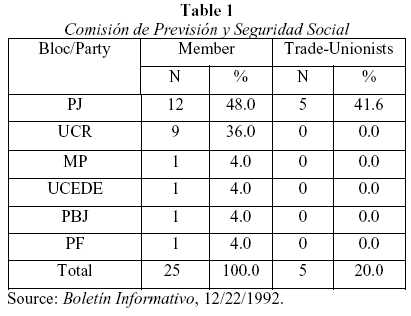
The Justicialist representatives held 12 of the 25 posts (48%) in the PySS committee, where they needed one more vote to attain absolute majority. The same situation was observed in the PyH committee, where the Justicialist Party – PJ counted with 17 among the 34 members (50%). The second major party, UCR, counted with nine votes (36%) in the PySS committee and 13 votes (38%) in the PyH committee. The remaining parties counted with four members (16%) in the PySS committee and four members (11.7%) in the PyH committee. In other words, in a joint session of the two committees, the Peronists held 29 seats (49.1%) and the non-Peronists, 30 seats (50.8%).
]]>
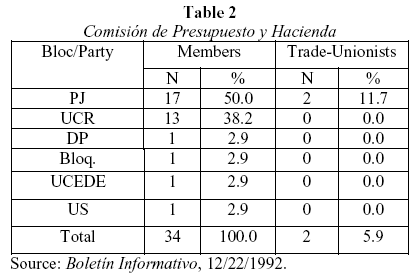
Notwithstanding its reduced weight in the Congress, and in the committees where the project ought to receive a favorable opinion before being forwarded to the plenary, the trade-unionist parliamentary ranks enjoyed a privileged position to obstruct the legislative course of the social security reform. In the PySS committee, the trade-unionist bloc amounted to 20% of its members, and to 41.6% of the Peronist ranks. In the PyH committee, the trade-unionist representatives amounted to 5.9% of the members, and to 11.7 of the PJ representatives. As the Executive needed the united vote of its benches (plus one vote) in order to reach a favorable opinion in those committees' joint meeting, the trade-unionist parliamentary ranks were in a position of "turning the balance". 15 Taking advantage of their strategic situation, the trade-unionist representatives blocked several of the Executive's intents aimed at the approval of the social security reform project in the PySS and PyH committees. As we shall see, besides the concessions concerning the social security reform itself, the trade-unionist parliamentary ranks also used their veto power in order to compel Menen's administration to open negotiations on other areas of interest for the Argentinean trade-unionism.
"ACUERDO GLOBAL"
1993 has been a particularly significant year in the relationship between trade-unionist representatives and the Executive. After almost four years of a tense relationship between the congressional labor caucus and the Peronist government, the renovation of part of the Legislature and the project of constitutional reform (including the reelection of the President of the Republic) represented an incentive for government and trade-unionists to start-up a new period of closer relationship. Between 1991 and 1993, there were 18 trade-unionist representatives at the House of Representatives, 13 of them concluding their terms on December 1993. Thus, the proximity of the elections represented a strong incentive for the CGT-RA to seek a closer relationship with the government and enlarge its participation in the Peronist ticket.16 On the other hand, on that same year political articulations have been started for the constitutional reform, in which one of the main points would be the possibility of reelection for the Presidency of the Republic. Hence, it was equally important for Menen's government to assure the cohesion of its parliamentary basis in favor of the constitutional reform.
]]> On January 7, 1993 Menen announced the launching of the Plan Social [Social Plan]. The measures announced in the plan comprehended, among other things, the implementation of employment programs for the young, subsidies for the retirees, restructuring of the public hospitals system, incentives to micro-enterprises, and partial deregulation of the obras sociales system. The opposition denounced the launching of the plan as another electoral maneuver of the government. But the Plan Social was also an answer to the appeals of sectors of the government's supporters, among them especially the trade-unionist leaders, who demanded compensatory policies for the strata negatively affected by the economic stabilization plan and the policies of structural reforms. Initially, the CGT leaders have had an ambiguous reaction to the Plan Social. A group of trade-unionists led by leaders of government employees, Andrés Rodríguez (Unión del Personal Civil de la Nación – UPCN) and José Luis Lingeri (Federación Nacional de Trabajadores de Obras Sanitarias – FENTOS), in a meeting with the Presidency's Social Cabinet, declared their support to the program. Such support, however, has been rejected in a meeting of the Consejo Directivo [board of directors] of the CGT-RA, and those trade-unionists having supported the plan without previous consultation with the Central were invited to revise their positions (Notícias Gremiales, 01/13/1993:3).The deregulation of the Obras Sociales system was at the center of the controversy. The Argentinean trade-unionism was opposed to the total deregulation of that system. The government, however, proposed a partial deregulation – the possibility of competition among trade-unions – that opposed the interests of the larger and the smaller trade-unions. In face of the division of the trade-unions with regard to the partial deregulation, the CGT-RA's Consejo Directivo decided to support the social measures announced by the government and reject the deregulation of the Obras Sociales system. In this respect, Oscar Lescano, co-secretary-general of the Central declared that: "The CGT accepts the complementarity among obras sociales through the implementation of a system of reciprocal rendering of services, but not the competition between them", and added that "in no way we will accept that this decree is put into effect" (Notícias Gremiales, 01/13/1993:3, author's translation).
The punctual opposition of the CGT-RA to the Plan Social was a sign that a new space for negotiation between trade-unions and government was being opened. The building-up of an acuerdo global [a global agreement] was started, involving, among other themes, partial deregulation of the obras sociales system, flexibility on the productivity criteria, reform of the social security system, and political reform. After several meetings with government representatives, at the end of January 1993, the adhesion of the CGT-RA to the Plan Social was announced. At the same occasion, Gerardo Martínez, leader of the Unión Obrera de la Construcción de la República Argentina – UOCRA, was appointed supervisor of the program for the elimination of the escuelas rancho [precarious school buildings], and José Luis Lingeri (FENTOS) was nominated for integrating the commission charged of the plan de saneamiento de aguas [plan for water & sanitation] (Notícias Gremiales, 01/27/1993:3).
The new agreement was commemorated by the main leaders of the CGT-RA. In a meeting with members of the Social Cabinet of the Presidency, José Pedraza, co-secretary-general of the CGT-RA, emphasized that the trade-union participation in the Plan Social would go "far beyond the formalities", adding that "it is up to the people, not to some leaders, to decide whether a president should proceed in his office" (Notícias Gremiales, 01/27/1993:3, author's translation). The final stage of the agreement would take place around the negotiation of a new decree partially disentailing salary readjustment from the productivity indexes. In a meeting with the then Labor Minister, Henrique Rodríguez, the leaders of the Central assumed the compromise of orienting the congressional labor caucus' favorable vote for the social security reform, considered the engagement of the government in editing a new decree in substitution for the Decree n. 1,334/91 (related to productivity).
In its edition of February 19, 1993, the newspaper Ámbito Financiero announced the accomplishment of another pacto negro between Menen's administration and the CGT-RA: "The case now is of a new policy of salary negotiation. Domingo Cavallo's principle of productivity as a limit for salary increases is seriously at risk. In return, the government obtains in the Congress the support of the trade-unionists to get approved the social security reform" (Ámbito Financiero, 02/19/1993:1, author's translation). On February 24, 1993, in a tumultuous joint session of the PySS and PyH committees, the Menen administration finally got the dictamen de mayoría needed in order to send the project to the plenary of the House of Representatives. The Justicialist benches presented a favorable opinion with exactly 29 signatures. Among such signatures endorsing the opinion, six were from the trade-unionist bloc. Among the trade-unionists, only Luis Guerrero, from the Unión Obrera Metalúrgica – UOM did not sign the dictamen de mayoría presented by the Justicialists.
One month after the approval of the favorable opinion in the PySS and PyH committees, the Boletín Oficial [the Argentinean Official Gazette] published two decrees of interest for the trade-unionism: Decree no 447/93, of March 17, 1993, and Decree no 470/93, of March 18, 1993. The first regulated the Law no 24185 (convenios colectivos para trabajadores del Estado). This law, sanctioned on December 16, 1992, had been proposed by trade-unionist representative German Abdala (PJ), and defined criteria for collective negotiation in the public sector (Orlansky, 2000). The second decree opened space for disentailing salary readjustments from the productivity criteria. The new regime of collective negotiation would be mixed: the entailment to the gains in productivity would remain applicable to the agreements by branch of activity, but in the sphere of the enterprises, the "free-negotiation" between trade-unions and entrepreneurs would prevail.
Once more, CGT-RA's reaction to the decree issued by the government was ambiguous. On one hand, the group of trade-unionists supporting Menen, led by Andrés Rodríguez (UPCN), manifested its support to the decree: "We agree with everything; there are no criticisms to be made" (Página 12, 04/02/1993, author's translation). On the other hand, the group of moderate and combative trade-unionists rejected the resolution concerning the decentralization of collective negotiations. Oscar Lescano, one of the chief organizers of the agreement, declared that he had been deceived by Labor Minister Enrique Rodríguez. According to him, the first version of the Decree no 470/93 did not foresee the decentralization of collective negotiations: "I am really disappointed. This man (Enrique Rodríguez) has deceived us. Three lines have been added that did not count with the trade-unions' support. This is not the text agreed upon" (Página 12, 04/02/1993, author's translation). The fact is that, despite the disagreements over the decree's contents, the agreement between the CGT-RA and Menen's administration unlocked the course of the social security reform in the legislative committees and, at the same time, established a new pattern for the Argentinean regime of salaries, both in what concerns the decentralization of collective negotiations and the revocation of productivity as the single criterion of increases in salary.
NEGOTIATIONS IN MULTIPLE ARENAS
The transit of the Executive's project to the plenary of the House of Representatives coincided with an important change in CGT-RA's leadership. At the beginning of April, 1993, metalworker Naldo Brunelli, leader of the UOM, assumed the General Secretariat of the Central. It is worth noticing that the change in the CGT-RA's leadership occurred precisely when the government had complied with the main demands of the "moderate" trade-unionists: the opening of the pension funds to union organizations, the inclusion of the trade-unionism into the Plan Social, the partial deregulation of the obras sociales system, the regulation of collective agreements in the public sector, and the disentailment of the salary negotiations from the productivity indexes. From that moment on, the leadership of the CGT-RA was given to the trade-unionist group opposed to the compulsory character of the private pension system, one of the principal still pending points of the social security reform. Naldo Brunelli belonged to the direction of one of the more critical industrial trade-unions in relation to Menen's economic policy. Negatively affected by the processes of privatization and productive restructuration, the UOM went more times on strike in the course of Menen's government than along Alfonsín's administration.
]]> Within the Legislative, the UOM's representatives were those who resisted more to the Executive's proposal of social security reform. UOM's leaders also supported the petition nationally organized by the Mesa Cordinadora de los Jubilados – MCJ [Board of Coordination for Pensioners] and the CTA, which assembled a million of signatures demanding a national plebiscite on the reform. On the occasion of the presentation of the petition, to which the trade-unionists Lorenzo Miguel and Saúl Ubaldini have also been present, metalworker Naldo Brunelli declared that: "One cannot either talk of CGT's support to the project of social security reform, or to the action of the trade-unionist representatives, because there has been no voting and nothing has been decided by the Consejo Directivo" (El Cronista, 03/11/1993:4, author's translation).On April 14, 1993, after four failed attempts, the government arrived to assemble the quorum (130 representatives) needed to start the appreciation of the social security reform in the plenary. The trade-unionist bloc split, but the majority of the leaders followed the orientation of the moderate group. Among those who persisted in the strategy of boycotting the quorum for the appreciation of the matter, three belonged to the UOM: Luis Guerrero, Horacio Salusso, and Roberto Monteverde. 17 The quorum authorizing the discussion in plenary marked a crucial moment for the reform. From one stage to the other, from the committees to the discussion in plenary, the trade-unionist bloc has had its veto power diminished. At this moment, the intensification of negotiations between the CGT-RA and government representatives had become a central element in the support to the performance of the trade-unionist benches in the Congress.
On the last week of May, 1993, government and trade-unionists met again – on the agenda, a new agreement on the decentralization of collective negotiations and a proposal for the postponement of the partial deregulation of the obras sociales system. At the meeting, the Labor minister presented as well a new draft of a project for a reform of labor relations, to be discussed with employers' and workers' representatives. 18 On the sphere of the social security reform, the new board of the CGT-RA obtained a concession of fundamental importance: the workers would be able to choose between either remain in the pay-as-you-go regime or migrate to the capitalization regime. With these proposals, Menen succeeded in getting the support of the CGT-RA to the social security reform project. On April 29, 1993, after almost a year of negotiations, the congressional labor caucus joined the Peronist bloc prepared to vote favorably to the reform. According to Ámbito Financiero (04/30/1993:2, author's translation): "Never before the bloc of the Justicialist Party had gathered together 112 representatives of their own ranks".
After the approval of the reform in the House of Representatives, the Consejo Directivo of the Central recommended its approval, without changes, in the Senate. The following lines show an extract of the document in which the CGT-RA gives an account of the social security reform's long negotiation process:
"a) We have succeeded in converting the system into one of triple optional nature: workers will either be allowed to remain in the State [system], or contribute to the Banco de la Nación (with guarantee), or even to choose a private operator.
"b) We have reduced the cost for the private system; the State will assume part of the coverage in death or invalidity cases of workers who were already participants of the system. Thus, the risks to be assumed by the private sector will be those compatible with its responsibilities.
"c) In order to care for social needs not adequately satisfied, we have succeeded in directing the investments of the private system's funds towards the construction of houses, roads, and other public works, since, other the social benefit they imply, they generate economic reactivation and the increase in employment.
"d) Through the investments authorized to the AFJPs, we have assured support to the regional economies.
"e) We have got that non-profit organizations are allowed to establish fund managing entities and that they are permitted to freely enter or exit the capitalization system.
"f) According to the constitutional provisions applicable to the case, the National State will guarantee to the existing retirees the rights they have acquired by the legislation in force before the promulgation of the new legislation."
]]> In the end of the same document, the Central recommended to the Honorable Cámara of Senators:"For all that, and in face of the transcendental significance acquired for all the workers by the so conformed social security reform, we respectfully demand from the Cámara de Senadores the due handling and approval of the project approved by the Cámara de Diputados, including the initiatives proposed by the CGT-RA; and to the PEN, we demand its consequent promulgation. And all that without introducing changes that would modify or impair the spirit of the law and the workers' rights it acknowledges" (Notícias Gremiales, 05/13/1993:11; author's translation).
In September 1993, following the orientation emanated from the Executive, the Argentinean Senate sanctioned without modifications the social security's reform project. The SIJP would be effective at the second semester of 1994, two years after the remittance of the project to the Congress.
FINAL CONSIDERATIONS
The CGT-RA used traditional resources of trade-unionism to introduce its demands into the process of the social security reform: strikes, public demonstrations, lobbies, threefold negotiations, etc. However, the chief instrument utilized by the Central in order to force Menen's administration to comply with its claims has been the strategic situation of the congressional labor caucus within the reform's decision-making process. The main concessions obtained by the Argentinean trade-unionism have been achieved during the period in which the social security reform project was under the appreciation of the PySS and PyH committees, instances with veto power, where Menen's government depended on the support of the trade-unionist representatives in order to proceed in the legislative course of the reform. The social security reform assumed a central role in a complex negotiation process involving so distinct themes as partial deregulation of the obras sociales system, compensation for the social costs of the reforms implemented in the country (Plan Social), disentailment of salary increases from the productivity indexes, and the definition of a new regulatory framework for collective negotiation in the public and private sectors.
In general lines, the concessions obtained by the Argentinean trade-unionism along the process of the social security reform may be divided into two major groups: 1) endogenous concessions (intra social security system); and 2) exogenous concessions (extra social security system). The former were those properly related to the content of the reform: end of age limit (45 years), acknowledgement of the contributions to the previous system, threefold supervision, right of option between the pay-as-you-go system and the capitalization regime, participation of trade-unions in the pension funds, etc. The latter have been those concerning other areas of trade-unionism interest, as the regulation of collective negotiation in the public sector, the modification of the decree that made salary increases dependent on productivity indexes, and the partial deregulation of the obras sociales system. In both cases, the strategic location of the congressional labor caucus within the legislative course of the social security reform has been of fundamental importance for enhancing the CGT-RA's bargaining power and forcing Menen's government to negotiate with the trade-unionism.
NOTES
1 The classic distinction between pluralism and corporatism, made by Philippe Schmitter (1974), has influenced a whole generation of researches on Latin-American trade-unionism. According to that author, the main characteristics of pluralism are: an unlimited number of auto determined competitive organizations, not hierarchically arranged, which are not specifically authorized, acknowledged, subsidized, controlled or created by the State, and do not perform a monopolistic representation of their categories. In contrast, corporatism is distinguished by a limited number of non-competitive compulsory organizations, hierarchically arranged, functionally differentiated, which are authorized, acknowledged, subsidized, controlled or created by the State, performing a monopolistic representation of their categories. ]]>
2 It is worth noticing that the distinction between mechanisms of subordination and cooptation, concerning corporatist arrangements, has assumed particular importance in the studies about the development of Latin-American social security systems. Outstanding, in this case, are the different works seeking to elucidate the role of the State and the interest groups in the definition of the stratified character of social security in Latin-America (Mesa-Lago, 1977; Cohn, 1980; Malloy, 1986).
3 Brazilian academic production is full of examples in this sense. See, among others, the works of Almeida (1995; 1996), Arbix (1996), Martins Rodrigues (1990), and Noronha (1999).
4 See, for instance, the works of Acuña & Smith (1996), Almeida & Moya (1997), Etchemendy & Palermo (1998), and Murillo (2001).
5 In the Brazilian case, the importance of politico-institutional arrangements in the change of public policies has been emphasized by Almeida (1998), Arretche (1996), Coelho (1998), Figueiredo & Limongi (1998), and Melo (1997), among others.
6 According to Immergut (1996:146), "veto positions are not physical entities, but points of strategic uncertainty resulting from the very logic of the decisional process. Even a small change in constitutional rules or in the electoral outcomes can provoke changes in the localization of the veto positions and in their strategic significance. Thus, constitutional rules and electoral outcomes detetermine the context in which takes place the formulation of policies. Is there where the space is open for the interest groups influence".
7 In Tsebelis' (1997:107) own words: "In very general lines, and following my argument, systems having multiple incongruent and cohesive veto players shall reveal more elevated stability levels in the policies' formulation process than systems counting with a single veto player or with a small number of non-cohesive and congruent veto players".
8 To be more precise, Tsebelis (1997:99) only considers this possibility in the arrangements of neo-corporatist type: "For instance, in corporatist countries, decisions about salaries (which cause more general economic consequences) are taken by the government, but with the approval of two additional veto players: the representatives of workers and enterprises".
9 Among the main measures proposed, the project foresaw the creation of the Administración Nacional de la Seguridad Soci al [National Administration of Social Security], which would be responsible for the administration of the Régimen Nacional de Jubilaciones y Pensiones [National Regime for Retirements and Pensions], the Régimen Nacional del Voluntariado de la Seguridad Social [National Regime for Social Security's Volunteers], the Régimen Nacional de Subsidios Familiares [National Regime for Family Subsidies], and the Régimen Nacional de Subsidios por Desempleo [National Regime for Unemployment Subsidies], which would be independently financed and managed (Armendáriz, 1996).
10 Three systems integrate the Argentinean health service: 1) the public system; 2) the system of pre-payment; and 3) the obras sociales. This latter is organized by trade-unionist entities with personeria gremial, and maintained by compulsory contributions of workers and employers. Along with the monthly trade-union fees (between 1% and 3% of the salary), the contributions to the obras sociales (8% from the employers and 6% from the employees) represent one of the main financial sustaining pillars of the Argentinean trade-unions. There is a relative consensus among specialists that the dispute over the control of the obras sociales constitutes one of the main sources of conflict between Menen and the CGT-RA in the process of structural reforms (Cortés & Marshall, 1999; Etchemendy & Palermo, 1998; Lodola, 1995).
11 It is to be noticed that the Secretary for Seguridad Social, formally subordinated to the Minister of Labor, had been nominated by the Minister of the Economy (interview accorded to the author by Walter Schulthess, then Secretary of Social Security of Menen's administration, 09/04/2003). On the importance of state actors (president, governmental coalition, ministerial bureaucracy) in the definition of the scope of social security reforms, see Coelho (2003). ]]>
12 In an interview accorded to the author on 07/28/2003, Rodolfo Daer, CGT-RA's secretary-general, attributed the difficulties in expanding the strike to the support of the Argentinean society to the privatization process promoted by Menen's government.
13 Due to restrictions concerning the trade-unionist legislation, the CTA was first organized as a "union alternative", on November 14, 1992, only later being acknowledged as a "union confederation", officially registered by the Ministry of Labor on May 27, 1997. According to Castro (2001:69), "This central was officially acknowledged by the Ministry of Labor as a 'simply registered trade-union' in 1997. This fact without precedents in the history of trade-unionism in Argentina took place thanks to pressures from international trade-unionism and the ILO, since Argentina is signatory of the 87th Convention on freedom of organization and autonomy of trade-unions. The delay in the acknowledgement was of political order, and was due to pressures exerted by the CGT-RA, having the government used as justification for successive denials the argument that the CTA's statute that was not in accordance with the law of professional associations".
14 In order to be appreciated by the plenary of the House of Representatives without passing by the permanent committee, a proposal need to be backed by 2/3 of the parliamentarians in a "report" session with the presence of representatives of the Executive Power (HCDN, 1993).
15 The strategic location within legislative committees offered the trade-unionist representatives a greater power than that normally conferred by their effective representation in the House of Representatives and in the ranks of the Justicialist Party (Etchmendy & Palermo, 1998; Torre, 1999; Torre & Gerchunoff, 1999). Between 1983 and 1993, the congressional labor caucus had showed a decreasing tendency within the Argentinean legislative. In 1983, the trade-unionist representatives were 13.8% of the House and 31.5% of the Peronist benches; in 1993, they were 3.9% of the House and 7.8% of the Justicialist bloc.
16 The Argentinean electoral system is a system of proportional representation with closed list, i.e., the elector votes for the party. For a discussion in depth of the Argentinean political and party systems, see Mustapic (2000). For a general introduction on electoral systems, see Nicolau (2002).
17 The other two were Dante Camaño (food industry workers) and José Rodríguez (mechanical industry workers).
18 The CGT-RA initially rejected the new draft for the labor reform presented by Menen's administration. The outcome of the new negotiation process would become effective only on the 25th of July, 1994, with the subscription – by representatives of employers, government, and workers – of the Acuerdo Marco para el Empleo, la Productividad y Equidad Social (MTSS, 1994).
BIBLIOGRAPHY
ACUÑA, Carlos H. and SMITH, William C. (1996), "La Economía Política del Ajuste Estructural: La Lógica de Apoyo y Oposición a las Reformas Neoliberales". Desarrollo Económico, vol. 36, nº 141, pp. 355-389. [ Links ]
ALMEIDA, Maria H. T. de. (1995), "Além do Corporativismo: Interesses Organizados e Democratização", in L. Sola and L. M. Paulani (orgs.), Lições da Década de 80. São Paulo, Edusp/Unrisd. [ Links ]
___. (1996), Crise Econômica e Interesses Organizados. São Paulo, Edusp. [ Links ]
___. (1998), "Sindicatos em Tempos de Reforma". São Paulo em Perspectiva, vol. 12, nº 1, pp. 3-9. [ Links ]
___ and MOYA, Maurício. (1997), "A Reforma Negociada: O Congresso e a Política de Privatização". Revista Brasileira de Ciências Sociais, vol. 12, nº 34, pp. 119-132. [ Links ]
ALONSO, Guillermo V. (1998), "Democracia y Reformas: Las Tensiones entre Decretismo y Deliberación. El Caso de la Reforma Previsional Argentina". Desarrollo Económico, vol. 38, nº 150, pp. 595-626. [ Links ]
___. (2000), Política y Seguridad Social en la Argentina de los 90. Buenos Aires, FLACSO. [ Links ]
ARBIX, Glauco A. (1996), Uma Aposta no Futuro: Os Primeiros Anos da Câmara Setorial da Indústria Automobilística. São Paulo, Scritta. [ Links ]
ARRETCHE, Marta T. S. (1996), "Mitos da Descentralização: Mais Democracia e Eficiência nas Políticas Públicas?". Revista Brasileira de Ciências Sociais, vol. 31, nº 11, pp. 44-66. [ Links ]
ARMENDÁRIZ, Alejandro. (1996), Labor Parlamentaria. Buenos Aires, HCD, Tomo II. [ Links ]
CASTRO, Maria S. P. de. (2001), As Mudanças nas Leis Trabalhistas e no Perfil Sindical no Brasil e na Argentina na Década de 90. Master's Thesis, Programa de Pós-Graduação em Integração da América Latina – Prolam. [ Links ]
CHEIBUB, Z. B. e LOCKE, R. M. (1999), "Reforma Administrativa e Relações Trabalhistas no Setor Público". Cadernos ENAP, nº 18, pp. 7-70. [ Links ]
COELHO, Vera S. P. (1998), "Interesses e Instituições na Política de Saúde". Revista Brasileira de Ciências Sociais, vol. 13, nº 37, pp. 115-128. [ Links ]
___. (2003), "Poder Executivo e Reforma da Previdência na América Latina", in V. S. P. Coelho (org.), A Reforma da Previdência Social na América Latina. São Paulo, Fundação Getúlio Vargas Editora. [ Links ]
COHN, Amélia. (1980), Previdência Social e Processo Político no Brasil. São Paulo, Editora Moderna. [ Links ]
COLLIER, Ruth B. and COLLIER David. (1979), "Inducements versus Constraints: Disaggregating 'Corporatism'". The American Political Science Review, vol. 73, nº 4, pp. 967-986. [ Links ]
CORTÉS, Rosalía and MARSHALL, Adriana. (1999), "Estrategia Económica, Instituciones y Negociación Política en la Reforma Social de los 90". Desarrollo Económico, vol. 39, nº 154, pp. 195-212. [ Links ]
ETCHEMENDY, Sebastián and PALERMO, Vicente. (1998), "Conflicto y Concertación: Gobierno, Congreso y Organizaciones de Interés en la Reforma Laboral de Primer Gobierno de Menem (1989-1995)". Desarrollo Económico, vol. 37, nº 148, pp. 559-590. [ Links ]
FIGUEIREDO, Argelina C. and LIMONGI, Fernando. (1998), "Reforma da Previdência e Instituições Políticas". Novos Estudos CEBRAP, vol. 51, pp. 63-90. [ Links ]
GHILARDUCCI, Teresa and LIÉBANA, Patricia L. (2000), "Union's Role in Argentine and Chilean Pension Reform". World Development, vol. 28, nº 4, pp. 743-764. [ Links ]
HONORABLE CÁMARA DE DIPUTADOS DE LA NACIÓN – HCDN. (1992), Breve Comentario del Reglamento de la Cámara de Diputados de la Nación. Buenos Aires, HCDN. [ Links ]
___. (1993a), "Mensaje del Poder Ejecutivo". Buenos Aires, HCDN, pp. 6.870-6.876. [ Links ]
___. (2004), Constitución de la Nación. Buenos Aires, HCDN (http://www.diputados. gov.ar/). [ Links ]
IMMERGUT, Ellen M. (1996), "As Regras do Jogo: A Lógica da Política de Saúde na França, na Suíça e na Suécia". Revista Brasileira de Ciências Sociais, vol. 30, nº 11, pp. 139-165. [ Links ]
ISUANI, Ernesto A. and SAN MARTINO, Jorge A. (1993), La Reforma Previsional Argentina: Opciones y Riesgos. Buenos Aires, Miño y Dávila Editores S.R.L. [ Links ]
LODOLA, Germán J. (1995), "La Modalidad de la Relación Estado-Sindicatos en la Recta Final del Menemismo: Juegos en dos Arenas", in R. Sidicaro and J. Mayer (orgs.), Política y Sociedad en los Años del Menemismo. Buenos Aires, Universidad de Buenos Aires. [ Links ]
MALLOY, James M. (1986), A Política da Previdência Social no Brasil. Rio de Janeiro, Graal (translated by Maria José Lindgren Alves). [ Links ]
MARTINS RODRIGUES, Lêoncio. (1990), Partidos e Sindicatos: Escritos de Sociologia Política. São Paulo, Ática. [ Links ]
MATSUSHITA, Hiroshi. (1999), "Un Análisis de las Reformas Obreras en la Primera Presidencia de Menem: La Perspectiva de Opción Estratégica", in S. S. Gonzáles and F. Bosoer (orgs.), El Sindicalismo en Tiempos de Menem. Buenos Aires, Ediciones Corregidor. [ Links ]
MCGUIRE, James. (1997), Peronism without Perón: Unions, Parties, and Democracy in Argentina. Stanford, Stanford University Press. [ Links ]
MELO, Marcus André B. C. de. (1997), "As Reformas Constitucionais e a Previdência Social", in E. Diniz and S. Azevedo (orgs.), Reforma do Estado e Democracia no Brasil: Dilemas e Perspectivas. Brasília, UnB/ENAP. [ Links ]
MESA-LAGO, Carmelo. (1977), Modelos de Seguridad Social en América Latina: Estudio Comparativo. Buenos Aires, Ediciones Siap-Planteos (translated by Mario R. dos Santos). [ Links ]
MINISTERIO DE ECONOMÍA Y OBRAS SOCIALES Y SERVICIOS PÚBLICOS – MEOSSP. (1992), Consejo Nacional Económico para la Producción, la Inversión y el Crecimiento: Antecedentes y Bibliografía. Buenos Aires, MEOSSP. [ Links ]
MINISTERIO DE TRABAJO Y SEGURIDAD SOCIAL – MTSS. (1992), Análisis de las Opiniones y Posicionamentos de Diferentes Actores Sociales acerca de la Reforma del Sistema Previsional Argentino. Buenos Aires, MTSS. [ Links ]
___. (1994), Acuerdo Marco para el Empleo la Productividad y la Equidad Social. Buenos Aires, MTSS. [ Links ]
MURILLO, Maria V. (1997), "La Adaptación del Sindicalismo Argentino a las Reformas de Mercado en la Primera Presidencia de Menem". Desarrollo Económico, vol. 37, nº 147, pp. 419-446. [ Links ]
___. (2001), Labor Unions, Partisan Coalitions, and Market Reforms in Latin America. Cambridge, Cambridge University Press. [ Links ]
MUSTAPIC, Ana M. (2000), "Oficialistas y Diputados: Las Relaciones Ejecutivo-Legislativo en la Argentina". Desarrollo Económico, vol. 39, nº 156, pp. 571-595. [ Links ]
NICOLAU, Jairo M. (2002), Sistemas Eleitorais. Rio de Janeiro, Fundação Getulio Vargas Editora. [ Links ]
NINO, Mariano. (2003), "Reforma Previsional: La Subordinación del Interés Público en el Proceso Democrático de Decisión y Negociación en la Argentina. Revista Realidad Económica, nº 195 (http://www.iade.org.ar). [ Links ]
NORONHA, Eduardo G. (1999), Entre a Lei e a Arbitrariedade: Mercados e Relações de Trabalho no Brasil. São Paulo, LTr. [ Links ]
ORLANSKY, Dora. (2000), Reforma del Estado y Empleo Público: Innovaciones en las Condiciones Laborales (Argentina 1989-1999). Paper presented at III Congreso Latinoamericano de Sociología del Trabajo. Buenos Aires, Argentina, 17-20 de maio. [ Links ]
PALERMO, Vicente. (1998), "Os Caminhos da Reforma na Argentina e no Brasil". Lua Nova, nº 45, pp. 131-162. [ Links ]
SCHMITTER, Philippe C. (1974), "Still the Century of Corporatism?". The Review of Politics, vol. 36, nº 1, pp. 85-131. [ Links ]
STEPAN, Alfred. (1980), Estado, Corporativismo e Autoritarismo. Rio de Janeiro, Paz e Terra (translated by Marina Leão Teixeira Viriato de Medeiros). [ Links ]
TORRE, Juan C. (1999), "El Sindicalismo a la Defensiva". Todo es Historia, nº 389, pp. 54-62. [ Links ]
___ and GERCHUNOFF, Pablo. (1999), "La Economía Política de las Reformas Institucionales en Argentina: Los Casos de la Política de Privatización de Entel, la Reforma de la Seguridad Social y la Reforma Laboral". Working Paper R-349, New York, Banco Interamericano de Desarrollo. [ Links ]
TSEBELIS, George. (1997), "Processo Decisório em Sistemas Políticos: Veto Players no Presidencialismo, Parlamentarismo, Multicameralismo e Pluralismo". Revista Brasileira de Ciências Sociais, vol. 12, nº 34, pp. 89-117. [ Links ]
___. (1998) [1990], Jogos Ocultos: Escolha Racional no Campo da Política Comparada. São Paulo, Edusp. [ Links ]
(Received for publication in June 2005) ]]> (Final version in April 2006)
This article is a modified version of the third chapter of my PhD thesis entitled Interação Sindicalismo-Governo nas Reformas Previdenciárias Argentina e Brasileira [Union-Government Interaction in Argentinean and Brazilian Social Security Reforms]. I am grateful to Marta Arretche, Heloísa Martins, Vera Schattan, and Eduardo Noronha, for their criticisms and suggestions on the first version of this article. I am also grateful to Richard M. Locke (Massachusetts Institute of Technology – MIT) and Juan C. Torre (Universidad Torcuato di Tella – UTDT). My PhD advisor, Maria Hermínia Tavares de Almeida, and my colleague Simone Diniz deserve a special mention for their important contribution to this text. Finally, I want to thank the anonymous advisors from Dados for their valuable comments. To the Fundação de Amparo à Pesquisa do Estado de São Paulo – FAPESP and to the Conselho Nacional de Desenvolvimento Científico e Tecnológico – CNPq, I owe the technical and financial support which has made possible the accomplishment of my PhD research.
]]>