Le système électoral de liste ouverte au Brésil
O sistema eleitoral de lista aberta no Brasil
Jairo Nicolau
Professor of Instituto Universitário de Pesquisas do Rio de Janeiro - IUPERJ. E-mail: jnicolau@iuperj.br
Translated by Plínio Dentzien ]]> Translation from Dados - Revista de Ciências Sociais, v.49, n.4, p. 689-720, 2006.
ABSTRACT
This article analyzes the open list electoral system in Brazil in the elections for the Chamber of Deputies (Lower House) and compares it to other countries that employ this mechanism. The author describes the history and functioning of the prevailing electoral system; evaluates the list's impact on parties, voters, and the relationship between Deputies and their constituencies; and discusses the mechanisms offered by the electoral system for voters to either punish or reward their representatives. Linking the Brazilian case to current analyses of electoral systems, the article draws on evidence from three studies conducted with members of the Brazilian Congress and voters.
Key words: electoral system; open-lists; Chamber of Deputies
RÉSUMÉ
Dans cet article, on examine le système brésilien de liste ouverte pour la Chambre des Députés, en le comparant à d'autres pays qui se servent de ce même mécanisme. On décrit l'histoire et le fonctionnement du système électoral actuel; on évalue l'impact de cette liste sur les partis, les électeurs et la relation des députés avec leurs bases électorales; on discute les moyens que le système électoral offre aux électeurs pour punir ou récompenser leurs représentants. En cherchant à comparer le cas brésilien aux réflexions courantes sur les systèmes électoraux, on se sert d'évidences présentées dans trois recherches effectuées auprès de parlementaires et électeurs.
Mots-clé: système électoral; liste ouverte; Chambre des Députés
]]>
In a review of the state of the art of studies regarding electoral systems, Matthew Shugart (2005) emphasized the advances in recent years in the knowledge about the impact of the electoral system on the party system. Research on how electoral systems affect the parties' organization and the relations of representatives with their constituencies, on the other hand, still requires more systematic studies. According to Shugart, "the study of the intraparty dimension has been hampered by sometimes nebulous characterizations of variables, a lack of data and even worse, a lack of clear understanding of what the rules being investigated across countries are" (idem:36). One of the evidences of such fragility is the limited number of comparative studies analyzing the effects of the electoral system on voters' behavior (Norris, 2004)
Today, our knowledge about the influence of electoral systems on the behavior of both voters and the parliamentary elite derives above all from generalizations originated in case studies (Bogdanor, 1985; Gallaguer, 2005) and typologies of a deductive kind (Carey and Shugart, 1995). Comparative research allowed for an increase in the knowledge of the effects of the Single Non-Transferable Vote (SNTV), adopted in Japan until 1993 and in other Asian countries (Groffman et al, 1999), and of the Single Transferable Vote (STV), adopted in Ireland and Malta (Bowler and Grofman, 2000). But the comparative efforts on the effects of the different models of proportional representation with lists are practically concentrated in the elaboration of typologies (Katz, 1997, 2005; Shugart, 2005). We know very little, for instance, about how the closed list or the various models of preferential vote affect the constituency service, legislative behavior and the electors' vote (Karvonen, 2004). However, in this particular respect, comparative research depends on a more systematic probing of the rules and singularities produced by case studies.
The utilization of the open list system in Brazil is remarkable for a series of reasons. The first one is its longevity. No other country in the world has utilized the open list for so many years. The second one derives from the size of the Brazilian electorate, 115 million in 2002, in contrast to the other countries that adopt the same model: Poland, 29.4 million (2001); Peru, 14.9 million (2001); Chile, 8.1 million (2001); Finland, 4.1 million (1999)1; as we will see, the number of voters is particularly important to define some patterns of relation between representatives and their constituencies. The third reason is associated with the combination of the open list with other attributes of the electoral system: large electoral districts, possibility of achieving electoral coalitions, simultaneous elections for other offices (president, state governors and senators) and a marked distortion in states' representation in the Chamber of Deputies (mallaportionment).
In spite of its importance, the Brazilian open list system has not received enough attention on the part of experts. In the last years, few studies (Mainwaring, 1991; Ames, 1995; Samuels, 1999) dealt specifically with the issue. The impact of these three studies on the community of researchers of electoral systems notwithstanding, they concentrated on very specific aspects of the functioning of the Brazilian electoral system. Mainwaring (1991) describes its rules and compares it to other experiences in countries adopting the preferential vote (Italy, Chile, Finland), and presents limited empirical evidence. Ames' article (1995) only indirectly discusses the question of the electoral system; his study has two different concerns: to find out whether the representatives elected in 1986 submitted budgetary amendments in favor of the municipalities where they got their vote and to evaluate the electoral success of the representatives who ran in 19902. Samuels (1999) is specifically interested in showing how a party, the Workers' Party, PT (Partido dos Trabalhadores) achieved its partisan reputation in a system centered on the candidates.
This article intends performing a systematic analysis of the way the open list system functions in Brazil, especially in the elections for the Chamber of Deputies. Inspired in the model proposed by Gallaguer and Mitchell (2005), I begin by describing the history and functioning of the open list system adopted in the country. Then, I evaluate the system's possible effects along three dimensions: parties, voters and the relation of representatives to their constituencies. The text ends up discussing a theme that is central to democratic theory (at least to one of its versions): the possibility of punishing or rewarding legislators which the system offers voters through the vote. Besides relating the Brazilian case to the modern reflection on electoral systems, I collect evidence from three different studies of representatives and voters, bringing to the fore more consistent data on various aspects of the Brazilian representative system3.
ORIGIN AND FUNCTIONING OF THE OPEN LIST IN BRAZIL
The first version of proportional representation adopted in Brazil in 1932 established the preferential vote. The ballot could include a great number of candidates (as many as the State's seats in the Chamber, plus one), and the voter could choose candidates from different parties and even candidates not affiliated to any party – a model similar to that used in Switzerland today. But the counting procedure favored the name at the top of the list of candidates, since the calculation of the distribution of seats considered only that vote; the other names on the list could only compete for the seats not allocated in the first distribution. This system was utilized in the 1933 and 1934 elections, but criticism regarding counting complexity (which took weeks in some States) stimulated the adoption, in 1935, of a simpler version, whereby the voter was to choose only one name. Due to the suppression of elections during Getulio Vargas's (1937-1945) authoritarian government, the new rule came into effect only in the 1945 elections (Porto, 1989; Nicolau, 2002). It is worth noting that Brazil adopted the open list system before two other countries – Finland (1955) and Chile (1958) – that would come to be known for utilizing that system of proportional representation (Raunio, 2005; Siaveles, 2005).
The system in effect in Brazil offers voters two options: either to vote for a name or for a party. Seats won by parties (or inter-party coalitions) are held by the candidates who obtained the most votes from each list. It is important to emphasize that inter-party coalitions function as a single list, i.e., the most voted-for from within the coalition, regardless of their own party, are elected. Unlike other countries (Chile, Finland, Poland), where voters have to choose a name from the list in order for their vote to count for the party, in Brazil, voters have the option of either voting for a candidate or for a name (legenda). The vote for the party is considered only in the distribution of seats among the parties, but has no effect on the distribution of seats among candidates4.
]]> In the history of the open list in Brazil, two aspects deserve emphasis. The first one is the manner whereby candidates' names were presented to voters. Unlike other countries adopting the preferential vote (The Netherlands, Belgium, Denmark, Austria and Finland, for example), the Brazilian ballot never presented a complete list with all candidates. In the three different voting procedures adopted since 1945 (ballot printed by the parties, official ballot, and electronic voting machines) to vote for the Chamber of Deputies always consisted in writing (or typing, after the adoption of the electronic ballot box) either the name or the number of a candidate with no mention of the other candidates in the list. This fact, along with the choice of other offices through a majority system in the same election, ended up by concurring to reinforce among voters the widespread misperception that elections to the chamber are held according to a majority rule where all candidates compete against each other.A second relevant aspect has to do with the process of institutionalization of the party vote (legenda). In the elections for the Chamber of Deputies held from 1945 to 1958, there was no official ballot. Ballots were mostly printed by the parties and distributed on election day by mobilized party members (cabos eleitorais) as well as placed by the precinct presidents inside the electoral cabins. At that time, voting meant going to the electoral precinct to place the ballot made up by the parties inside an envelope and placing the envelope in the ballot box. Party votes were counted only when there was imprecision in the vote but the party of voter's choice could still be identified.5 The official ballot (printed by Electoral Courts) started being used from 1962 on. Such a change made the voting procedure more difficult, for the voter had to write the name (or number) of the candidate, and/or the candidate's party or coalition name. In fact, by presenting the voter with a specific box for him to select a party, the official ballot introduced, in a more formal manner, the party vote (legenda). These rules were not altered in the elections held during the Military Regime – with the sole exception of 1982, when the ballot did not have a specific box for the party vote. In the first election after the Military Regime (1986), the ballot kept the old option of voting in the name/number of the candidate, but it presented the novelty of offering a list of all parties in order for the voter to mark his (her) preference. With this, the option for an exclusive vote for a party became clearer. In 1994 and 1998, the parties list was excluded from the ballot and, in order to vote for a party, the voter had to write his (her) chosen party's name (or number). Since 1998, voters have used been using electronic voting machines.6
Candidate Selection
In the competition for the Chamber of Deputies, each party may present a candidate's list equal to one and a half times the number of seats of the electoral district; in the case of a party coalition, such number may be twice that of the electoral district. In the constituencies that elect up to 20 representatives, a party may present a number of candidates up to twice that total; in case of a coalition, such total increases to two and a half times. Since 1998, there is a candidates' gender quota that each party must obey, with the objective of increasing the number of women in the legislative. The lists must reserve a minimum of 30% and a maximum of 70% for each gender. In spite of this determination, the total number of women inscribed as candidates by the parties has been below the one established in law: only 10.3% in 1998 and 11.3% in 2002. In 1998, the quota requirement was met only by the PCB, which presented two women among its five candidates. No party met the determination in 2002.7
A candidate cannot compete in other States and neither can he run simultaneously for other seats in the same election. In order to be a candidate for any seat, a citizen must be affiliated to some party for at least a year. There is also a requirement of territorial bond (electoral dwelling) to a determinate municipality (and consequently to a determinate State) also for at least one year; for instance, in order to be a federal representative for the State of Rio de Janeiro, a citizen must be affiliated to a party in the State for at least a year. There are also requirements regarding literacy (illiterates may vote, but they cannot be candidates) and minimum age (21 years old to be a candidate for the House). Up to 1998, laws assured Representatives (as well as those that had occupied the seat during the legislature) the candidacy's inscription through the party of their affiliation (innate candidacy); in other words, those in charge choosing the party's candidates were not empowered to exclude incumbent politicians from the list. In 2002, the Supreme Court defined such a privilege as non-constitutional, and thus it was no longer in force in that year's election.8
Laws ruling on parties establish that the rule for candidates' choice be defined by each party's internal bylaws. The only requirement is that they hold a statewide meeting in order to formalize the candidates' choice; the meetings must be held between June 10th and 30th of the electoral year, and the list must be presented to the Electoral Court up to July 5. Parties may form coalitions to dispute seats in each electoral district.9 From 1986 to 1998, the parties' State directions were autonomous to decide on coalitions, and there were very few cases of the parties' national organs intervening in such these decisions. The laws only forbade parties to form different coalitions for majority and proportional seats. For example, parties A, B and C could coalesce for the State government and compete with different combinations for the Chamber of Deputies (ABC; AB C; BCA; ACB); what was forbidden was a coalition with party D for any of the seats in dispute. In 2002, the Higher Electoral Court (TSE, from the Portuguese Tribunal Superior Eleitoral) forbade parties coalescing in the presidential election to form different coalitions within the State. Thus, the ABC coalition may take on different configurations in each State, but it cannot include a party of the DEF presidential coalition; strangely enough, a party that has not presented a presidential candidate may coalesce with any party in the States.
We still know very little about the process through which parties choose their candidates, particularly for the Chamber of Deputies elections.10 We do not know, for instance, whether the parties organize specific committees to choose candidates, or whether the main State leaders are directly involved in this task. Two aspects, however, must be stressed. The first one is that no party utilizes internal primary elections among their affiliates for the choice of names that will form the list; the second one is that official conventions have a merely ratifying character, since candidates were defined beforehand.
The number and profiles of candidates that each party presents for the Chamber of Deputies in each electoral district depend on a series of factors such as party size, possibility of forming coalitions and the number of affiliates intending to run. My hypothesis is that both territorial size and social diversity of candidates are fundamental factors for the list organizers. Those responsible for the list organization take into account geographical criteria, preferring names from different regions of the State and avoiding many candidates from the same area; they also tend to prefer names with prestige among specific segments of the electorate: union leaders, leaders of professional and business associations; social movements activists (women, blacks, neighbors, environmentalists); or personalities of prominence in some specific activity (broadcasters, artists, sportsmen, intellectuals). Only detailed studies of the candidates' profiles could confirm the relevance of these two factors.
An interesting aspect has to do with the number of candidates the parties present in each State. As the total number of seats that the party will win is the aggregate result of the votes each candidate individually gets, it is reasonable to assume that the party is interested in maximizing the number of candidates in the list. Smaller parties are an exception, as they adopt another strategy when coalescing with larger parties: presenting a small number of candidates and concentrating resources in their campaigns. In spite of this general incentive to present many names, no party managed to use by itself all positions available in the last three elections for the Chamber of Deputies (1994, 1998 and 2002).11 What needs to be investigated in some detail is to what extent this stems from a deliberate choice or from the fact that a reduced number of citizens want to be Federal Representatives.
Electoral Campaign Strategies12
]]> A candidate for the Chamber of Deputies has a large degree of autonomy in the organization of his (her) campaign. Generally he (she) is the one that decides on the agenda and on the making and distribution of electoral propaganda. The law acknowledges a fundamental aspect of such autonomy: finance. Candidates may collect and spend resources, and account for these directly to the Electoral courts, without passing through party echelons.13The kind of campaign of a candidate depends, to a large extent, on his (her) political profile and on the resources on which he (she) can count. Practically all candidates organize activities that allow for a direct contact with voters in public places (rallies, hand to hand leaflet distribution, visits to areas of concentrated population or in private events (visits and meetings with small groups). In these events, the candidate generally distributes printed material with biographical data, offering tokens (t-shirts, caps, calendars) to voters.14 Some cases in which candidates offer voters resources or some kind of personal advantage in exchange for their vote are aired in the campaigns' press coverage. Due to the number of candidates and to their different strategies, it is difficult to evaluate the degree of permanence of clientelistic practices in the elections for the House. In 1999, Act 9.840 was passed forbidding candidates to donate, offer, promise or give voters advantages in exchange for their vote.15 Besides paying a fine, transgressors may lose their candidacy or mandate (if they are incumbents). In addition to a direct contact, candidates also try to divulge their names (and numbers) on house fronts publicity.16
For most candidates, it is vital to enroll voters to directly support their campaigns. Those with more resources organize a support network in the smaller municipalities or in neighborhoods within the larger cities. Generally the chosen regions are those where the candidate already has some kind of political activity – in the case of incumbent candidates, they are their primary areas of parliamentary activity. Such networks can count on support from local councilmen, mayors, local leaders and candidates to other seats in the same election (mainly State Representatives). Support of local leaders either involves a commitment to support in future local elections, or is a reward for past support. The candidate may still hire professionals for specific tasks, such as distributing leaflets, standing with banners or making up the material to be distributed. Some candidates get the support of voluntary followers, a practice that is more usual in parties on the left.
Candidates are entitled to appear on the Free Campaign Airtime, broadcast in radio and TV. The law assigns three weekdays during 45 days for the exhibition of propaganda by candidates to the House. Propaganda goes on the air twice a day, in 50-minute programs. As the Free Airtime lasts for approximately six weeks, the total time for candidates' appearances amounts to some 900 minutes. This time is distributed pro rata the parties' representation in the House, and this means that larger parties will have more time to expose their candidates. But, as large parties tend to present more candidates, the time for each candidate is very limited, regardless of party size. To give an example: in the 2002 elections, there were in São Paulo 724 candidates for the Chamber of Deputies – and this meant an average of a little more than one minute per candidate. Parties have designed different strategies to deal with the limited Free Airtime. Some parties give more time to some candidates, the vote champions who presumably attract more votes for the others; other parties show only the photos and the candidates' brief C.V. While most of the candidates believe in the efficacy of the Free Airtime as a means of communication, we still know very little to which degree it is a determinant factor in electoral success. A pioneer study on the candidates' campaigns in the Free Airtime in 1994 (Schmitt, Carneiro and Kuschnir, 1999) found some correlation (Pearson's R = .5) between candidates' vote and the duration of their appearance during the TV campaign.17
EFFECTS
Effects on Parties
Carey and Shugart (1995) wrote the most influential article about the possible effects of electoral systems on candidates' electoral strategies. Their central concern is to know if the electoral systems offer incentives in order for the candidates to cultivate either their personalized reputation or that of their parties. Their definition of personalized reputation is this: "if a politician's electoral prospects improve as a result of being personally well known and liked by voters, then personal reputation matters. The more this matters, the more valuable a personal reputation is." (p. 419) The definition of party reputation is shorter: "party reputation, then, refers to the information that party label conveys to voters in a given electoral district." (p. 419). The authors present a classification that took into account three attributes: party control in the selection of candidates; the fact of candidates being individually elected, regardless of party colleagues; and if the vote is either a sole one, or intra-party, or multiple or a party vote. The distinction between uninominal (choosing one representative per district) and multi-nominal systems (electing more than one representative per district) was also taken into account. From the scores attributed to each of these aspects, the authors arrived at 13 combinations. The procedure is basically deductive, mobilizing different examples from countries, places, and even from the New York City School Boards to illustrate each combination (idem, p. 425). The classification offered proved to be particularly limited for the analysis of variants of proportional representation with preferential vote. For instance, the systems of open list in Chile, Poland, Finland, and Brazil, in spite of their similar characteristics, are placed in very far apart in the scale. The classification also neglected the different rules used in the flexible list system.18
Regardless of the limitations of Carey and Shugart's typology, students of electoral systems generally agree that the open list stimulates campaigns centered in the candidate. As they have to get individual votes, it is only natural that they stress their own attributes (personal reputation) to distinguish themselves from their fellow party members or the attributes common to all members of the party (party reputation). Studies on the two countries that have been using open list for a long time (Finland and Chile) show a predominance of campaigns centered in the candidates. In Finland, individual candidates are responsible for collecting funds and distributing campaign materials. While there is party propaganda, candidates invest significant individual propaganda resources in the press and electronic media, emphasizing their personal qualities (Raunio, 2005). In Chile, from 1958 to 1973, although parties had a centralized procedure for the choice of candidates, the latter cultivated the individual vote offering particularistic benefits to voters (Siaveles, 2005).
There are few empirical investigations about the effects of the open list on parties in Brazil (Samuels, 1999; Carvalho, 2000).19 The best existing evidence reinforces the idea of campaigns centered on the candidate. Carvalho made a detailed opinion survey with Federal Representatives in 1999. Answering the many questions, they recognized their campaigns' great autonomy and the reduced capacity parties had in order to intervene in the electoral process. One of the questions asked Representatives to locate (in a 0-100 scale) the weight of their personal efforts, and, in another, that of the party. Final average of the weight of the personal efforts was 75. The per party average is the following: PTB (94); PFL (83); PPB (80); PSDB (79); PMDB (74); PDT (70); PT (52); PCdoB (40).20 Acknowledging that campaigns are centralized in the candidates does not amount to saying that they are exclusively centered in them. Parties often use campaign resources (mainly the Free Airtime) to disseminate their party propaganda; it is usual, for instance, to see party leaders and majority election candidates arguing in favor of a party vote in the dispute for proportional seats (Samuels, 1999). But, as data make clear, except for PT and PCdoB representatives, this is considered to be a marginal influence.
]]> To what extent does the electoral system have an impact on a party's organizational configuration? To what extent is the greater or lesser institutionalization of the parties associated to some electoral systems? Besides the electoral system, other dimensions of the political system affect parties; for instance: the governmental system (presidential, parliamentary, semi-presidential); the vertical power structure (federalist, Unitarian); the decision process within the legislative; party legislation; the different issues dividing the political elite; each party's specific organizational initiatives. In fact, comparative studies contributed very little to the understanding of the factors affecting the nature of party organization in each country, and especially to the evaluation of the specific impact of the electoral systems (Gallaguer, 2005). The diversity of kinds of parties within the same country shows that the effects of electoral system must be softened (Gunther and Diamond, 2003). In Brazil, for instance, even with a system clearly centered in the candidate, a party (PT) was able to develop mechanisms that reinforce party reputation (Samuels, 1999; Leal, 2005). The simple choice of certain internal rules, such as the stimulation of party activities between elections, the transformation of a great number of cadres in professional politicians, the punishing of representatives who do not vote along with party decisions and the obligation of a monthly money contribution, all these factors helped the party to create an organizational structure different from that of other Brazilian parties.Besides the stimulus for campaigns to center on candidates, the open list affects parties by also stimulating competition among their members. As the position in the list follows the majority system, candidates have as their main competitors their colleagues in the list and not those from other parties. These effects are often contrasted to those produced by the closed list, where competition would be concentrated in the dispute between parties (Mainwaring, 1991; Nicolau, 1996, 2004). In Brazil, competition among the candidates in the same list tends to be generally aggravated by the high degree of uncertainty characterizing the elections to the House, with a number of candidates in each list generally much higher than the party's electoral potential, and by the reduced information candidates have about that potential and that of their colleagues in the list.21
Even if, in logical terms, it is reasonable to expect a larger incentive for the dispute among candidates in the open list system than in the closed list system, it is not easy to evaluate empirically the competition among candidates. A possible way out of this is to observe how the system affects representatives up for reelection. In this case, it is interesting to know if a non reelected candidate was defeated either because of his (her) performance or by that of his (her) party. Katz (1986) examined the effects of intra-party disputes in 13 countries. Data show a large variation: in some countries, the proportion of candidates defeated because of their parties' performance is higher (Belgium, Denmark, Ireland, The Netherlands, Norway, Switzerland and the United States), while in others the defeat by other names in the list is higher (Finland, Greece, Italy, Japan, Luxemburg and Malta). But, on the whole, the number of candidates defeated by colleagues in the list is relatively low, varying from 7.8% in Italy to 17% in Greece.
According to Katz, candidates for reelection may lose their seats for two reasons: party failure or candidate failure. A candidate's defeat is attributed to the party either when there is no new name in the final list of the party's elected candidates (in other words, representatives from the last legislature were reelected), or when the party for which he ran did not elect anyone. It is a candidate's failure when the party elects some new name and the candidate is not elected. The same criterion was used to analyze the performance of the representatives who aimed at reelection in three elections for the Chamber of Deputies (1994, 1998 and 2002) in Brazil.22 The results are presented in Table 1. The total number of representatives elected in one election and presenting their candidacy in the following election is 1,094. Of these, 743 (68%) were reelected, 241 (22%) were defeated by candidate failure and 110 (10%) by party failure.23 That is, the number of candidates that were not reelected by being for defeated by other list members is more than twice as large as that of the candidates defeated by party failure. This large number of defeated candidates in the list (larger than that of any other country with preferential vote) may be interpreted as a strong index of the intense dispute among candidates from the same party.
Effects on Voters
Studies on electoral behavior have investigated the motivations that lead the voter to choose a given candidate. One of the fundamental themes is the influence of the candidate's attributes (personalized vote) on the voter's decision. In the classical definition presented by Cain, Farejohn and Fiorina (1987:9):
"The Personal vote refers to that portion of a candidate's electoral support which originates in his or her personal qualities, qualifications, activities, and record. The part of the vote that is not personal includes support for the candidate based on his or her partisan affiliation, fixed voter characteristics such as class, religion, and ethnicity, reactions to national conditions such as the state of the economy, an performance evaluations centered on the head of the governing party".
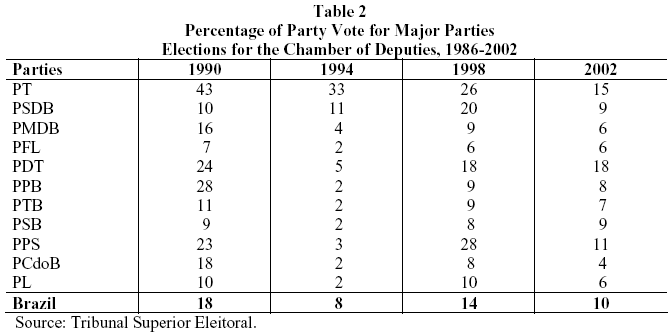
Even if it does not exhaust all possibilities of choice by voters, the distinction between party vote and personalized vote became dominant in the studies on the effects of electoral systems on voters (Dalton and Wattemberg, 2000; Norris, 2004). In Brazil, the possibility voters have to choose to vote either for a party or for a candidate suggests that the voter's decision may be analyzed respectively as an expression of a party vote or of a personalized vote (Samuels, 1999). Table 2 presents the percentage of party vote for the major parties in the last four elections for the House. Figures show an intense variation across parties and years. Particularly interesting is PT's performance, a party that always benefited from large numbers of party vote: the percentage of party vote has been steadily declining: from 43% in 1990 to 15% in 2002.
Many reasons may be mobilized to try to explain the variation presented in Table 2. First, it is worth pointing out the change in the ballot form, that posed different degrees of difficulty in order for the voter to express his preference for a party: in 1986 and 1990, ballot included a roll with all party labels;24 in 1994 and 1998 (for voters not using the electronic ballot box), the party vote became more difficult, for the ballot no longer showed all labels, and the voter had to write down the party label or number; with the electronic ballot box (1998 and 2002), the voter then had to type the party number. Second, the variation in the party vote also reflects different strategies used in the campaign; for example, during the Free Airtime, leaders and candidates to majority seats explicitly ask for party votes. Finally, the party vote also expresses the long-term ties of voters with regard to parties (party identification), that also vary over time, according to parties and country regions.
]]> Aggregate data are, however, a limited source to make reliable inferences about the voter's motives. We cannot interpret the vote in candidates as a pure and simple expression of the personalized vote because many voters with more permanent ties to the parties often prefer to vote for a specific candidate. On the other hand, we cannot say either that a party vote is an exclusive expression of a long term party identification (party vote), for it often reflects short-term choices motivated by the electoral campaign. For these reasons, the safest way to evaluate the parties' impact on voters' decision is to use data from public opinion polls.The 2002 Iuperj Survey asked voters what was more important in the choice of a federal representative, the candidate or the party he belonged to (the possibility of choosing both alternatives was registered, but was not voluntarily offered by the interviewers). The result reveals that a significant number of voters (92%) answered that the candidate was more important; only 4% considered the party as more important, and other 4% answered "both" (see Table 3). Another question asked voters to point out the party in which they voted for federal representative. Only four parties (PT, PSDB, PMDB and PFL) got more than 2% of the mentions. Using the same criterion, we may say that the group of voters 'centered in the candidates' varied between 83% (PT) and 96% (PFL). Another aspect that reinforces the idea of the reduced weight of the party reputation is the fact that two months after the election, 46% of the voters did not remember or otherwise were not able to say the name of the party for which they voted.25
Data in Table 3 are strong evidence of the reduced importance of parties in the voters' decision in the elections for the Chamber of Deputies. The result confirms the experts' predictions: institutional rules stimulating campaigns centered in candidates (and not in parties) show as a response the heavy weight of personal reputation (and the light weight of party reputation) in voters' choice.
Effects on Representatives' Relationships to their Constituencies
Many factors determine the kind of relationship representatives develop vis-à-vis their constituencies during their term in office, especially if they are somewhat inclined to give some kind of particular response to voters: power distribution within the legislative; the nature of parties; the possibility of budgetary resources transference to representatives' constituency; the candidate selection procedure; the attributions of sub-national units. But many studies have emphasized the particular importance of stimuli produced by the different electoral systems (Bogdanor, 1985; Cain, Farejohn and Fiorina, 1987; Cox and McCubbins, 2001; Gallaguer, 2005; Shugart, 2005). In Gallagher's synthesis (2005), a premise of a good part of the studies is that, in proportional systems centered in the candidate (STV and open list), the representative has incentives to develop activities differentiating him(her)self from his (her) colleagues, especially through response to specific demands (p. 562). But such studies go a step further and believe that the relationship will be established on the basis of meeting particularistic interests, mobilizing in general clientelistic projects or acting in defense of the electoral constituency's interests (Cox and McCubbins, 2001; Shugart, 2005). There is no necessary relationship between the open list and the development of a parliamentary activity exclusively turned to satisfying voters' demands. A representative may, for example, invest efforts in legislative life (committee work, parliamentary leadership, bill presentation) and in the reinforcement of party reputation (leadership on the floor, party direction activities). In this case, it is fundamental that he (she) has some channel to expose his (her) activity to voters, be it through coverage by national (or regional) media, or through his (her) own channels (meetings with voters, distribution of printed materials and, more recently, the internet). Only empirical studies can show the true mechanisms that representatives develop in order to take care of their reputation before the voters in each country.
In Brazil, federal representatives develop different patterns of accounting, associated to a series of factors, such as their electoral constituencies, the kind of career ambitions, parliamentary specialization and the bonds to certain interest groups. A representative with a career oriented towards the defense of certain policies (a specialist in specific issues or a representative of certain interest groups) or one who belongs to the parliamentary elite may obtain space in national media to cover his (her) activity and may do without particularistic actions in favor of his (her) electoral constituency. On the other hand, representatives who are not part of the parliamentary elite and/or were elected with highly concentrated votes tend to privilege actions directly benefiting their constituencies (allocation of budget amendments to the region, intermediation between mayors and the federal government for investments in the region). We still know very little about how the representatives' different patterns of career and political resources condition the after-election pattern of accounting (Carvalho, 2003).
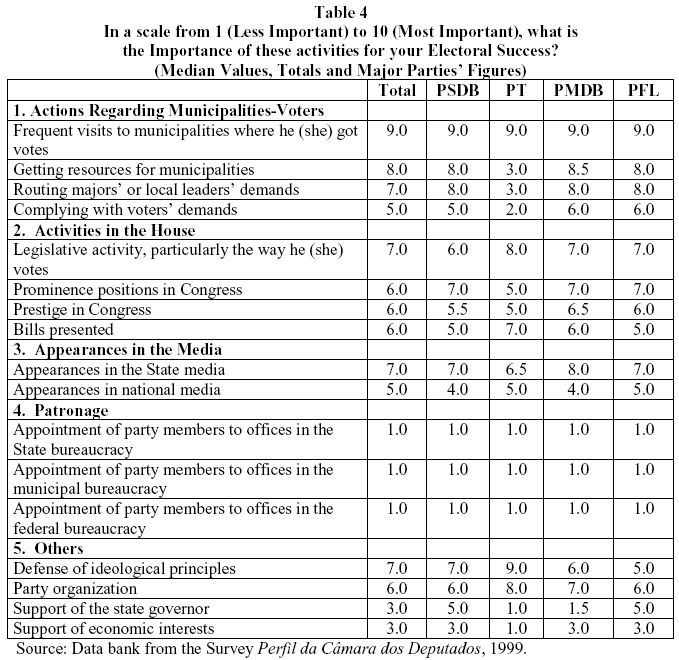
In the survey he conducted among federal representatives, Carvalho (2000) asked them to classify 17 items according to their importance for electoral success, along a 10 point scale. Although the questions' aim was not exclusively that of drawing a picture of the kind of accounting representatives developed in their terms in office, the answers present some interesting results. In order to better present the data, results were aggregated in five groups: 1) interaction with municipalities-voters; 2) activities in the House; 3) appearance in the media; 4) patronage; 5) others. Median values for the set of included representatives (for members of the four major parties) are presented in Table 4.
The first datum that strikes the eye is the centrality of the connection to municipal life. The frequent visit to municipalities where the representative received a good number of votes is at the top of the list as the most important activity for representatives as a whole, and for every party. It is followed by the presentation of budgetary bills and the mediation of mayors' and local leaders' demands. It is worth noting that the latter activities were not considered important by PT representatives. We do not know whether these answers derive from the policy oriented nature of the party or from the fact that, at that time (1999), it was in the opposition and had therefore limited access to resources that would enhance the mediation for municipal governments. Items associated to legislative activities got intermediate values. It is worth stressing the reduced weight of leadership and patronage in the Chamber of Deputies for electoral success. Data still help undoing two myths about parliamentary action in Brazil. The negligible values for patronage (appointment of party members for office in the three power levels) mean that that resource may be utilized marginally as a political strategy in Brazil. Finally, it also comes as a surprise the low value attributed to the ties to the governor for electoral success, perhaps an indicator of his declining influence on the state benches.
What are the reasons for the predominance of a kind of accounting eminently geographic? During the electoral campaign, candidates choose different strategies for concentrating and/or dispersing their resources across the territory. The decision on where to concentrate the campaign (whether in one, a few or many municipalities) is in general associated with the political profile and availability of resources. A leader with strong ties to a given municipality (former councilman or mayor of a city), for instance, will probably concentrate his (her) campaign in a reduced area of the state. On the other hand, a leader with a more far-reaching political career (former state secretaries, representatives with exposure in the state media, leaders of geographically non-concentrated groups) may disperse his (her) campaign resources across different areas of the state.
There is a long tradition of studies investigating the geographical pattern of the vote for federal representatives in Brazil (Carvalho, 2003). Their purpose is, in general, to distinguish representatives who had concentrated votes from those with dispersed votes, taking municipalities as the units of analysis. These studies, however, generally show two problems. The first one is the concentration of the analysis exclusively on the elected candidates, which restricts the possibility of generalization. A full mapping of the dispute patterns should also include the defeated candidates. The second is a direct association between competition effects (concentration and dispersion of the vote) and candidates' intention, forgetting that the electoral results are the aggregated effects, often unanticipated, of the strategies of the different candidates. If, for instance, many candidates decide to concentrate their campaigns in a given region, the end result may, on the contrary, be a great dispersion of the vote in that region. For a representative, knowledge of the areas where he got his (her) vote (electoral constituencies) is fundamental, for these areas will probably be priorities for his (her) parliamentary activity.26 Even though parliamentary activity may also take into account a prospective dimension (the representative could also give priority to state areas without representatives in the Chamber of Deputies and areas that could provide him (her) with future electoral support), chances are that the retrospective dimension will prevail; the representative tends to privilege acting in the areas where he (she) received a significant vote.27
]]> Data from Carvalho's research (2000) provide very interesting indications for future research on how representatives relate themselves to voters and what are the important activities of parliamentary actions in Brazil. But results are conclusive with regards to the importance of the connections to municipal political life. Municipalities must be often visited; representatives should strive to obtain budgetary resources for given areas and route the mayors' and other local leaders' demands.Punishing and Rewarding Representatives in Brazil28
The process whereby voters control their representatives through the vote is a central theme for democratic theory (Schumpeter, 1984; Dahl, 1989; Katz, 1997; Powel Jr., 2000; Moreno, Crisp and Shugart, 2003). In its traditional version – that which Powell Jr. calls accountability model – elections are a privileged moment for punishing and rewarding representatives: good rulers would be brought back to power while bad performers would be excluded. In the same vein, other authors suggested that the relation between representatives and constituents should be thought of as that of principal agent model (Strom, 2000). According to Moreno, Crisp and Shugart,
"From this perspective, decision-making in large entities, such as democratic states, implies delegation of authority. In agency relations, the right to make a decision is assigned by a 'principal' to an 'agent', but this assignment, i.e., delegation, is conditional. That is, it continues only at the pleasure of the principal. That it may be withdrawn is the very essence of accountability. Only when the right to make a decision is subject to withdrawal can we understand a relationship founded on accountability to be in place." (2003:83).
Therefore, the accountability model is based on a retrospective element, evaluating those that already are in power. The voter, after evaluating the performance of a candidate (or party) that already occupies a seat, may choose either to reward or to punish him (her, it) in the next election. Reward occurs when the voter positively evaluates the representative and votes again for him (her) (or for his (her) party). Punishment occurs when the voter chooses another candidate (or party) or chooses not to express any preference for any candidate (he [she] either does not participate in election day or annuls his [her] vote.).
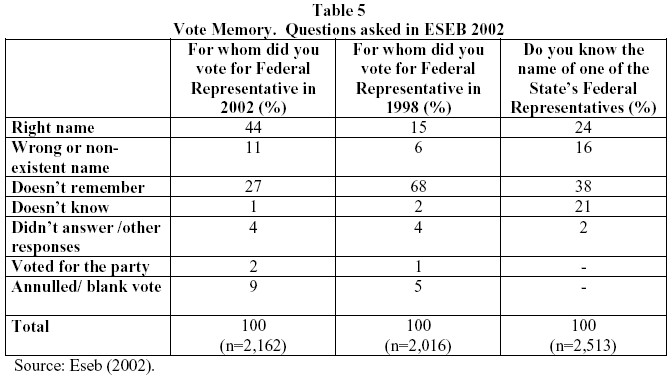
It is worth exploring to what extent the Brazilian representative system offers the voters clear mechanisms to control their representatives through elections. A first version of the retrospective vote presupposes three steps: 1) that the voter remember for whom he voted; 2) that the candidate is elected; 3) that the voter follow his (her) representative's activity. The lack of research on voters following up the activities of their federal representatives in Brazil prevents any evaluation of the third step. But we do have some evidence to evaluate the two other aspects. The Estudo Eleitoral Brasileiro (Eseb) [Brazilian Electoral Study], conducted in 2002, asked a series of questions regarding voters' memories.29 Asked if they remembered for whom they had voted for federal representative in the last election (1998), 67% answered they didn't remember, and only 15% mentioned the name of a candidate that in fact ran that year (see Table 5). If we exclude from the list of remembered candidates those that were elected, the number would be still smaller. We may thus say that the use of the retrospective vote in the elections for the Chamber of Deputies (2002) was entirely marginal.
Alternatively, it is possible to envisage a mode of retrospective vote that did not take into account the memory of the vote in the previous election. In that case, the voter could simply decide to vote for a representative that called his (her) attention positively during the legislature or simply eliminate from his possible choices the names that could be negatively tinted.30 In that option, the voter did not have to remember for whom he (she) voted, but just know an acting representative. Here too results from Eseb can help. Voters were asked if they knew any state representative in the House. Even though the survey was conducted immediately after the campaign (with high exposure of the representatives), 59% did not remember or could not answer; 16% presented wrong or non-existent names; only 24% presented the correct name of some of the state's representatives. Even with the (non plausible) option that all voters who know a representative's name may have voted retrospectively, the group would still be very small.
Eseb's data suggest that a small number of voters is able to make a retrospective evaluation of a representative's action. My suggestion is that a great part of the choices is a result of stimuli generated during the electoral campaign itself. As we saw, campaign strategies derive, to a large extent, from political resources and the candidate's career pattern. Therefore, the vote as a response to electoral mobilization would consider a varying number of strategies. Candidates could either emphasize their personal virtues, or stress some kind of identity with the voter (territorial, professional, religious, of gender), or present a policy-oriented campaign (in defense of specific themes or social groups). Campaigns could even mobilize party reputation, for instance, when the party asks voters to vote specifically for the party label. But Eseb shows the weight of short-term mobilization strategies in the final decision. Few weeks after the election, only 46% (44% in a name, 2% in a label) remembered for whom they had voted.
The crossing of choice pattern (personalized or partisan) with kind of electoral control (retrospective, non-retrospective) generates four ideal types of choice in the election for the Chamber of Deputies (see Chart 1). The first group, personalized and retrospective vote, has objective limits to reach a large number of voters (lack of electoral memory and of knowledge about incumbent representatives). The second group, partisan and retrospective vote, is formed by the small number of voters that consider the party more important than the candidate and always vote for the same party; that group is composed mainly of PT voters. A third group, partisan and non-retrospective vote, is formed by voters voting for a party, complying with request of a state leader or of a candidate for a majority seat. The last group, personalized and non-retrospective vote, is composed of voters that are mobilized above all by campaign appeals, excluding the appeals of incumbent candidates. My suggestion is that most of the voters choose according to electoral appeals that are not associated to an evaluation of the incumbent candidate's performance.
]]>CONCLUSION
This article's aim was to present a general picture of the open list electoral system functioning in the elections for the Chamber of Deputies in Brazil. To this end, a series of empirical evidences was gathered (electoral results and public opinion polls. In spite of being a case study on the many dimensions of an electoral system (open list) in a given country (Brazil), the text attempted to dialogue with studies of a more comparative kind. In many aspects there is a confluence with the practices of other democracies using the same electoral system: campaigns centered in the candidates; personalized vote; stimulation of an electoral connection outside the party structure. But in other points the article revealed some specificities of the Brazilian experience: the possibility of a strictly party vote; the significant number of candidates defeated by other candidates from the same party (a possible evidence of competitiveness); the importance of the connection with municipal networks for parliamentary activities; the low capacity of electoral control of representatives.
At various moments, we stressed the need for more empirical research. Some themes, in particular, deserve a careful treatment: voters' motivations when they choose their representatives; the role of the support networks in the municipalities both during the campaign and during the term; candidates' selection procedures by the parties; profile of the citizen candidates; the weight of the different campaign resources (Free Airtime on radio and TV; expenditure; spatial distribution) on the candidates' success. In sum, a long agenda for the future.
NOTES
* This article was written thanks to the support from Conselho Nacional de Desenvolvimento Científico e Tecnológico – CNPq and of the Centre for Brazilian Studies – Oxford University.
1 The Brazilian electorate may be seen in http://www.jaironicolau.iuperj.br; that of the other countries in http://www.idea.int.
2 A problem with Barry Ames' article is that the data presentation prevents the reader from evaluating the weight and significance of the variables he selected.
3 The studies are Estudo Eleitoral Brasileiro – Eseb [Brazilian Electoral Study; Pesquisa Pós Eleitoral Iuperj 2002 [Post-Electoral Research]; and Perfil dos Deputados Federais Brasileiros, 1999 [Profiles of Brazilian Federal Representatives], study coordinated by Nelson Carvalho. ]]>
4 In his typology on preferential systems, Shugart calls the model adopted in Chile, Finland and Poland a quasi-list, while he considers those of Brazil and Italy (before 1993) as open-list (Shugart, 2005: 42).
5 The law established many possibilities for counting votes in case the voter voted only in a name (vote counted for both the candidate and the party), or only for the party (vote counted for the party). In case voter voted for a candidate and a different party, the vote was counted for the party. As the ballots were distributed by the parties, these errors were not frequent. See article 55 of the Código Eleitoral Brasileiro de 1950 [Electoral Brasilian Code].
6 The electronic ballot box was introduced gradually. In 1996, it was used by 32% of the electoral body living in 57 municipalities (state capitals and cities with more than 200 thousand voters). In 1998, it was used by 58% of the electoral body living in 537 municipalities (all municipalities in the states of Rio de Janeiro, Alagoas, Roraima and Amapá; in the Federal District; and in the municipalities with more than 40,500 voters in all other states). In the 2000 (municipal) and 2002 (general) elections, all voters used the electronic ballot box.
7 For the complete picture of number of candidates by gender, see Álvares (2004: 236).
8 To my knowledge, no party failed to grant a place in the list for any incumbent politician running for reelection in 2002.
9 On electoral coalitions in Brazil, see Krause and Schmitt (2005).
10 The only systematic study on the process of candidate selection in Brazil is by Álvares (2004). It is a case study, emphasizing the choice of women in the State of Pará.
11 Data from the Tribunal Superior Eleitoral – TSE [Higher Electoral Court].
12 There are no systematic studies on how candidates organize their campaigns in Brazil. Observations in this section, to a large extent, derive from my experience in some electoral campaigns.
13 In spite of the requirement of accounting for campaign funds, the use of illegal resources in campaigns is a common practice in Brazil. Such a practice was acknowledged by many politicians (even by president Luiz Inácio Lula da Silva) during the Comissão Parlamentar de Inquérito dos Correios – CPI [House Committee on Post Office] that investigated the so-called Mensalão (Monthly Contribution) Scandal (2005-2006). What we know about campaign funds are the figures officially declared by candidates. While the reliability of such data may be questionable, they have been used. See, for example, Samuels (2002). ]]>
14 Act number 11,300, May 2006, prohibited gift distribution during elections.
15 Some studies on elections before 1945 (Leal, 1986; Graham, 1997; Faoro, 2004) emphasized the generalized practice of clientelistic politics in Brazilian electoral processes. But there are no systematic studies on the matter during the 1946 Republic and in today's democratic period.
16 Up to 2002, the use of outdoors was generalized, but it was banned by Act 11,300 referred to above, under note 14.
17 The authors did no test for a plausible hypothesis: the association between the exposure in Free Airtime and votes received in the previous election. Candidates may have received more exposure during the Free Airtime in a given election precisely because of their good performance in the previous election. Only through multivariate analyses, can we reach more precise conclusions about the actual effect of exposure in the Free Airtime on the candidates' electoral success.
18 In a latter work, Shugart (2005) gave special attention to list systems with preferential vote.
19 Figueiredo and Limongi criticize the idea according to which campaigns for federal representative are concentrated on the candidate. According to them "[...] In an 'open list' system, intra-party competition does not offset inter-party competition. As the votes in the list are transferred, any vote for one of the candidates from the party increases the chances of any other being elected" (2002: 309).
20 Calculations are based on data from survey Profile of Brazilian Representatives – 1999. I thank Nelson Carvalho for sharing the data bank.
21 My hypothesis, which needs further investigation, is that the high unpredictability of the dispute is one of the causes of the high cost of electoral campaigns in Brazil. It is worth noting that even representatives with many years of incumbency spend a lot of money in elections.
22 For Brazil, Figueiredo and Limongi (1996) used a different criterion, deeming defeats in the list those where the number of candidates elected by the party is larger than the number of candidates seeking reelection.
23 Here I considered only the parties' candidates, and not the list of candidates from each coalition. ]]>
24 An example of the ballot used in 1990 may be found in Nicolau (2004).
25 The same question posed about the state level representative gives a similar result: 93% answered the candidate, 2% the party and 4% both.
26 A different view is that of Santos (1999), who states that Brazilian representatives have no mechanisms to identify their electoral constituencies.
27 Students of the vote's geographic pattern in Brazil developed different forms to identify the representatives' electoral constituencies, all of them, however, based on electoral results (Ames, 1995; Pereira and Rennó, 2001; Carvalho, 2003).
28 This section develops some points made in Nicolau (2002a).
29 The research was conducted from December 2002 to February 2003.
30 Some authors that studied reelection in the elections to the Chamber of Deputies began from that assumption. Ames (1995) says that the ability for resource transference (through passing amendments) to specific places is very beneficial for candidates. Pereira and Rennó (2001) go a step further in analyzing the approval of budgetary amendments. They say that the chances of reelection in 1998, for representatives elected in 1994, are associated to their ability in transferring, during their term, budgetary resources to their electoral constituencies.
REFERENCES
ÁLVARES, Maria Luzia. (2004). Mulheres na Competição Eleitoral: Seleção de Candidaturas e Padrão de Carreira Política no Brasil. Doctoral Dissertation Iuperj. [ Links ]
AMES, Barry. (1995). Electoral Strategy under Open-List Proportional Representation. American Journal of Political Science, vol. 39, nº 2, pp. 406-433. [ Links ]
BOGDANOR, Vernon. (1985), Representatives of People? Parliamentarians and Constituents in Western Democracies. Aldershot, Gower. [ Links ]
BOWLER, Shaum, and GROFMAN, Bernard (eds.). (2000), Elections in Australia, Ireland and Malta under the Single Transferable Vote: Reflections on an Embedded Institution. Ann Arbor, The University of Michigan Press. [ Links ]
CAIN, Bruce, FAREJOHN, John A., and FIORINA, Morris. (1987), The Personal Vote: Constituency Service and Electoral Independence. Cambridge, Harvard University Press. [ Links ]
CAREY, John M., and SHUGART, Matthew Soberg. (1995), Incentives to Cultivate a Personal Vote: A Rank Ordering of Electoral Formulas. Electoral Studies, vol. 14, nº 4, pp. 417-439. [ Links ]
CARVALHO, Nelson Rojas de. (2000), Peço a Palavra: Primeiro Nós. Insight-Inteligência, vol. 9, pp. 89-96. [ Links ]
____. (2003), E no Início Eram as Bases: Geografia Política do Voto e Comportamento Legislativo no Brasil. Rio de Janeiro, Editora Revan. [ Links ]
COX, Gary W., and McCUBBINS, Mathew D. (2001), The Institutional Determinants of Economic Policy, in S. Haggard, and M. D. McCubbins (eds.), Presidents, Parliaments and Policy. Cambridge, Cambridge University Press. [ Links ]
DAHL, Robert. (1989), Um Prefácio à Teoria Democrática. Rio de Janeiro, Jorge Zahar Editor. [ Links ]
DALTON, Russel J., and WATTEMBERG, Martin P. (eds.). (2000), Parties Without Partisans: Political Change in Advanced Industrial Democracies. Oxford, Oxford University Press. [ Links ]
FAORO, Raymundo. (2004), Os Donos do Poder: Formação do Patronato Brasileiro. Porto Alegre, Globo. [ Links ]
FIGUEIREDO, Argelina Cheibub, and LIMONGI, Fernando. (1996), Congresso Nacional: Organização, Processo Legislativo e Produção Legal. Cadernos de Pesquisa, nº 5, Cebrap. [ Links ]
___. (2002), Incentivos Eleitorais, Partidos e Política Orçamentária. Dados, vol. 45, nº 2, pp. 303-344. [ Links ]
GALLAGUER, Michael. (2005), Conclusion, in M. Gallaguer and P. Mitchell (eds.), The Politics of Electoral Systems. Oxford, Oxford University Press. [ Links ]
___, and MITCHELL, Paul. (2005), Introduction, in M. Gallaguer and P. Mitchell (eds.), The Politics of Electoral Systems. Oxford, Oxford University Press. [ Links ]
GRAHAM, Richard. (1997), Clientelismo e Política no Brasil do Século XIX. Rio de Janeiro, Editora UFRJ. [ Links ]
GROFMAN, Bernard, LEE, Sung-Chull, WINKLER, Edwin A., and WOODALL, Brian (eds.). (1999), Elections in Japan, Korea and Taiwan under the Single Non-Transferable Vote. Ann Arbor, The University of Michigan Press. [ Links ]
GUNTHER, Richard, and DIAMOND, Larry. (2003), Species of Political Parties: A New Tipology. Party Politics, vol. 9, nº 2, pp. 167-199. [ Links ]
KARVONEN, Lauri. (2004), Preferential Voting: Incidence and Effects. International Political Science Review, vol. 25, nº 2, pp. 203-226. [ Links ]
KATZ, Richard S. (1986), Intraparty Preference Voting, in B. Grofman and A. Lijphart (eds.), Electoral Laws and Their Political Consequences. New York, Agathon Press. [ Links ]
___. (1997), Democracy and Elections. Oxford, Oxford University Press. [ Links ]
___. (2005), Why Are There so Many (or so Few) Electoral Reforms?, in M. Gallaguer and P. Mitchell (eds.), The Politics of Electoral Systems. Oxford, Oxford University Press. [ Links ]
KRAUSE, Silvana, and SCHMITT, Rogério. (2005), Partidos e Coligações no Brasil. São Paulo, Editora Unesp/Konrad Adenauer. [ Links ]
LEAL, Paulo Roberto Figueira. (2005), O PT e o Dilema da Representação Política. Rio de Janeiro, Fundação Getulio Vargas Editora. [ Links ]
LEAL, Victor Nunes. (1986), Coronelismo, Enxada e Voto. São Paulo, Editora Alfa-Ômega. [ Links ]
MAINWARING, Scott. (1991), Politicians, Parties, and Electoral Systems: Brazil in Comparative Perspective. Comparative Politics, vol. 24, nº 1, pp. 21-43. [ Links ]
MORENO, Erika, CRISP, Brian F., and SHUGART, Matthew Soberg. (2003), Accountability Deficit in Latin America, in S. Mainwaring and C. Welna (eds.), Democratic Accountability in Latin America. Oxford, Oxford University Press. [ Links ]
NICOLAU, Jairo. (1996), Multipartidarismo e Democracia: Um Estudo sobre o Sistema Partidário Brasileiro (1985-94). Rio de Janeiro, Fundação Getulio Vargas Editora. [ Links ]
___. (2002), História do Voto no Brasil. Rio de Janeiro, Jorge Zahar. [ Links ]
___. (2002a), Como Controlar o Representante? Considerações sobre as Eleições para a Câmara dos Deputados no Brasil. Dados, vol. 45, nº 2, pp. 219-236. [ Links ]
___. (2004), Sistemas Eleitorais. Rio de Janeiro, Fundação Getulio Vargas Editora. [ Links ]
NORRIS, Pippa. (2004), Electoral Engineering: Voting Rules and Political Behavior. Cambridge, Cambridge University Press. [ Links ]
PEREIRA, Carlos, and RENNÓ, Lúcio. (2001), O que É que o Reeleito Tem? Dinâmicas Político-Institucionais Locais e Nacionais nas Eleições de 1998 para a Câmara dos Deputados. Dados, vol. 44, nº 2, pp. 323-362. [ Links ]
PORTO, Walter Costa. (1989), O Voto no Brasil: Da Colônia à Quinta República. Brasília, Senado Federal. [ Links ]
POWELL JR., Bingham G. (2000), Elections as Instruments of Democracy: Majoritarian and Proportional Visions. New Haven, Yale University Press. [ Links ]
RAUNIO, Tapio. (2005), Finland: One Hundred Years of Quietude, in M. Gallaguer e P. Mitchell (eds.), The Politics of Electoral Systems. Oxford, Oxford University Press. [ Links ]
SAMUELS, David. (1999), Incentives to Cultivate a Party Vote in a Candidate-Centric Electoral System. Comparative Political Studies, vol. 32, nº 4. [ Links ]
___. (2002), Pork-Barrel Politics is Not Credit-Claiming or Advertising: Campaign Finance and the Sources of the Personal Vote in Brazil. Journal of Politics, vol. 64, nº 3, pp. 845-863. [ Links ]
SANTOS, Fabiano. (1999), Instituições Eleitorais e Desempenho do Presidencialismo no Brasil. Dados, vol. 42, nº 1, pp. 111-138. [ Links ]
SCHMITT, Rogério, CARNEIRO, Leandro P., and KUSCHNIR, Karina. (1999), Estratégias de Campanha no Horário Gratuito de Propaganda Eleitoral em Eleições Proporcionais. Dados, vol. 42, nº 2, pp. 277-301. [ Links ]
SCHUMPETER, Joseph. (1984), Capitalismo, Socialismo, Democracia. Rio de Janeiro, Jorge Zahar Editor. [ Links ]
SHUGART, Matthew Soberg. (2005), Comparative Electoral Systems Research: The Maturation of a Field and a New Challenge Ahead, in M. Gallaguer e P. Mitchell (eds.), The Politics of Electoral Systems. Oxford, Oxford University Press. [ Links ]
SIAVELES, Peter M. (2005), Chile: The Unexpected (and Expected) Consequences of Electoral Engineering, in M. Gallaguer e P. Mitchell (eds.), The Politics of Electoral Systems. Oxford, Oxford University Press. [ Links ]
STROM, Kaare. (2000), Delegation and Accountability in Parliamentary Democracies. European Journal of Political Research, vol. 37, nº 3, pp. 261-289. [ Links ]
]]> PARTY LABELS AND NAMES
PC do B Partido Comunista do Brasil
PDT Partido Democrático Trabalhista
PFL Partido da Frente Liberal
PL Partido Liberal
PMDB Partido do Movimento Democrático Brasileiro
PP Partido Progressista
PPB Partido Progressista Brasileiro
PPS Partido Popular Socialista
PSB Partido Socialista Brasileiro
]]> PSDB Partido da Social Democracia BrasileiraPT Partido dos Trabalhadores
PTB Partido Trabalhista Brasileiro
]]>