Activité et vulnérabilité: quels modèles familiaux courent des risques?
Atividade e vulnerabilidade: quais os arranjos familiares em risco?
Lena Lavinas; Marcelo Nicoll
Translated by Peter Lenny
Translation from Dados - Revista de Ciências Sociais, v.49, n.1, p. 67-97, 2006.
ABSTRACT
The purpose of this article is to compare different family models according to the typology proposed by the IBGE (Brazilian Institute of Geography and Statistics, or National Census Bureau), to verify whether families headed by women really represent the most vulnerable or "at-risk" family arrangement. The latter is the commonsense notion that legitimizes the framework of feminization of poverty, in vogue in the last two decades and with considerable impact on the design of anti-poverty social policies. The current empirical study disaggregates the employment data (employment rate, mean wages, workweek) not only by gender (identifying differences between men and women), but also breaking down the data for women, comparing the situation of women heads-of-families versus wives. In terms of women's full participation in the work market, the effect of conjugality is even more harmful than motherhood (presence of children).
Key words: gender and work market; feminization of poverty; gender inequalities
RÉSUMÉ
Dans cet article, on cherche à comparer des modèles différents de familles, selon la typologie proposée par l'IBGE, afin de vérifier si les familles dont le chef est une femme constituent en effet l'organisation familiale la plus vulnérable et en péril. C'est une idée courante qui justifie le tableau de féminisation de la pauvreté, si connu dans les vingt dernières années avec des impacts considérables sur les politiques sociales de lutte contre la pauvreté. Dans cette étude, on dégage des données sur les activités – taux d'occupation, salaire moyen, nombre d'heures de travail – non seulement par sexe, identifiant les différences homme-femme, mais on discrimine aussi les femmes entre elles, faisant un parallèle entre celles qui sont chef de famille et celles qui vivent avec leur conjoint. On observe que la vie en couple est plus nuisible à la pleine insertion de la femme sur le marché de travail que les effets même de la maternité (présence des enfants).
Mots-clé: genre et marché de travail; féminisation de la pauvreté; inégalités de genre
]]> Much is spoken of the enormous vulnerability of families with children, notably those headed by lone mothers (i.e. with no spouse). Incontestably, Brazil lacks permanent, universal family-support policies and, therefore, much of what could be de-commodified through public policies to compensate families properly for their (i.e. the women's) contribution is not. As a result, families themselves bear all such costs privately. However, given this enormous vacuum in terms of family-friendly policies, the question is: is the greatest onus borne by families headed by lone women? Which family arrangements are rendered most precarious by the absence of a social protection system to provide security, reduce vulnerability and promote equity?
The labour market and the nature and scope of the social protection system are two factors that explain the greater or lesser degree of social vulnerability, and are thus intricately related to the levels of poverty and inequality observed in a society. Below, it will be seen how they operate on gender inequalities.
It is well known that, in Brazil, not only has the schooling gap between the sexes been reversed in favour of women at all levels of schooling since the mid-80s (Guedes, 2004; Beltrão and Alves, 2004,), but that earnings differentials between men and women have also narrowed constantly (Lavinas, 2001) over the last few decades1.
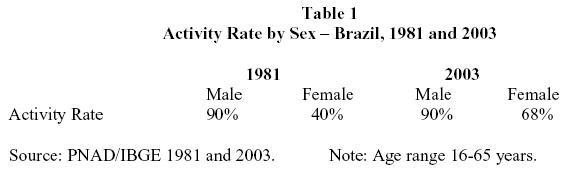
Until 1970, the female activity rate was less than 20% (Silva and Schwarzer, 2002), but it then began to grow at a more sustained pace, explaining the constant and linear feminization of employment (Lavinas, 2001). In the past 20 years, the activity rate among females 16-65 years old rose from 40% in 1981 to 68% in 2003, as shown in Table 1. Based on the 2003 Brazilian Household Survey (Pesquisa Nacional por Amostra de Domicílios – PNAD), women represent 45% of Brazil's active population, 44% of the occupied and 65% of the unemployed (Table 2). The table also shows that the relative proportionality that existed in the early 80s between the occupied or unoccupied groups (women were 1/3 of the active population, 1/3 of the occupied and 1/3 of the unemployed), twenty years later has disappeared: in 2003, women were over-represented among the unemployed.
In observing the recent dynamics of wage earnings in Brazil, by sex, we find that the convergent trend mentioned above persists: on average, women received 84% of men's earnings in 2003, against 68% 20 years earlier (Table 3). There remains no doubt that the wage gap is very slow to narrow (0.32% p.a.), and that, at such a rate, it would take about 80 years to close completely.
Table 4 shows that the activity rate for women with children is practically identical to the mean, i.e., in the region of 67%. Thus, the differential in the activity rates between women with children (71%) and without is small, indicating that, unlike other Latin American countries (e.g. Chile), in Brazil motherhood (or maternal status) does not constitute a watershed to the point of establishing significantly distinct patterns of activity among women. The convergence here is great.
]]>
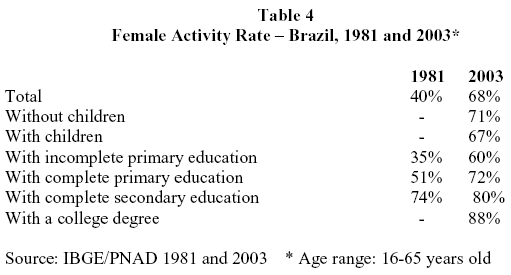
The opposite occurs when one considers female activity rates by level of schooling: the likelihood of activity increases with years of schooling. As Table 4 shows, although Brazilian women who hold a university degree display the highest activity rate (88%, a percentage similar to that among men with higher education), in the period analyzed (1981-2003), the activity rate increased most rapidly among less educated women (i.e., those who have not even completed their eight-year compulsory primary education). It therefore goes without saying that, in the last twenty years, female activity rates have progressed positively across all levels of schooling, reducing the conspicuous disparity (35% to 74%) of 20 years earlier.
In the period 1980-2000 the total fertility rate in Brazil continued its downward trend, falling from 4.3 to 2.4 children per woman. The 2003 Brazilian Household Survey indicated a total fertility rate of 2.3 children per woman, and the estimate is that this rate would reach the replacement level – the point at which a generation of children replaces their parents' generation – of approximately 2.1 children per woman of reproductive age during this first decade of the 21st century. In 2003, Brazil's census bureau (IBGE) estimated the average number of children per family in Brazil at 1.4, against 1.8 ten years earlier.
Families have also changed (Sorj, 2004; Goldani and Verdugo Lazo, 2004), and types of family arrangement have multiplied. Goldani and Verdugo Lazo (2004) report that Brazilian families have almost tripled in number over in the last 30 years, their average size has declined from 4.9 to 3.5 members and their conditions of life have improved. However, "[the family's] most notable characteristic is the diversity of models", state these two demographers. Moreover, they note a significant decrease in the number of two-parent-with-children families and an increase in single-parent-with-children families (family head with no spouse). Furthermore, they observe a marked increase in the number of single households.
1. Family Arrangements and Gender Income Gaps by Income Bracket
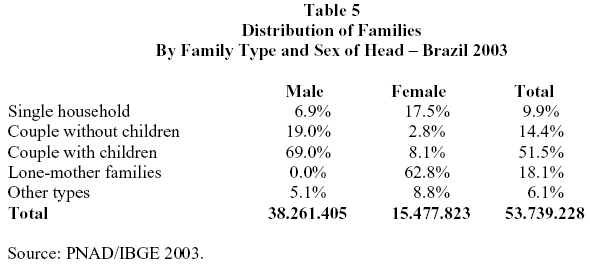
In 2003, according to IBGE (Table 5), 10% of Brazilian households were constituted of persons living alone (single households), almost 15% comprised childless couples – i.e., ¼ of the total was families without children, 51% were traditional, two-parent families with children, 18% were headed2 by lone mothers, and the remaining 6% covers other arrangements. In 2003, 28.8% of families were headed by a female, against 16% in 1981. Of this total of 15.3 million families headed by women, almost two thirds were single-parent families with children. Single-parent families with a male head were so few in Brazil (i.e. fewer than 1%) that they had no statistical significance.
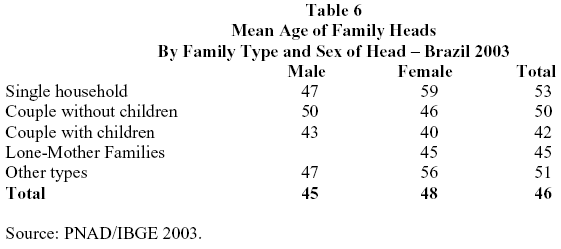
]]> The mean ages of men and women heads of families classified above are assumed to vary significantly. As shown in Table 6, single heads or childless couples were, on average, older (over 50) than heads of families with children (42-45). The mean age of women who declared themselves to be family heads was 48, while for men it was 45. This 3-year differential is hardly significant, but in the case of single households the differential is much greater (12 years). In the tables below, displaying income disaggregated by deciles, the average age of family heads can be seen to increase with family income. Consequently, adults at their peak productive capacity (30-45 years old), responsible for raising and educating their underage dependents, figure as more vulnerable, situated as they are at the lower tail end of the distribution.
Another valuable aspect to be contemplated when profiling by sex – whether for labour market role, degree of social security protection or other factors – is the situation of each sex across the income distribution curve. In this connection, the category "women" is becoming more heterogeneous every day as a result of growing levels of female activity and occupation (which probably accentuate the pattern of inequality among women prevalent in society). We should therefore detail the category's characteristics by income bracket in order to reveal specificities dictated by greater or lesser degrees of destitution and social inclusion, which, in aggregate form, the mean conceals. For this purpose, we decided to disaggregate the data that had been compiled by family type into per capita family income deciles3.
Table 7 thus shows the distribution of the families by the categories stipulated by the IBGE for 2003, but disaggregated consecutively by income decile. In the first six deciles, the vast majority (over 75%) are families with children, but that percentage decreases rapidly from the seventh decile onwards. This shows how fundamentally important policies targeting families with children could become if properly calibrated to promote income redistribution between rich and poor in Brazil. They would make it possible to offset the direct and indirect costs of educating children and reduce the opportunity costs of child labour, which remain high at the poorer levels of Brazilian society. Nevertheless, Brazil has never formulated universal policies to protect families, and the benefits granted by the labour legislation focus as priority on women's reproductive rights4 (Sorj, 2004) or meet the needs of the limited group of the formally employed who fulfil the entitlement criteria for the family-wage benefit.
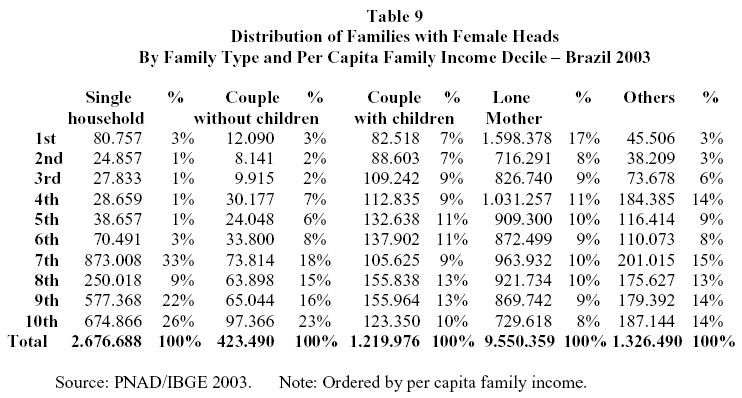
Disaggregating this same data by sex of the family head (Tables 8 and 9) reveals no family gender pattern across the distribution, except for the single parent families, whose heads are exclusively female5 (we can thus consider this a gender category). In other words, as displayed in Tables 8 and 9, both single households and childless couples are concentrated in the wealthiest 40%, whether headed by men (81% and 62%, respectively) or by women (90% and 72%). Note that this concentration in the upper deciles is even more marked for women. In the case of two-parent families with children, and regardless of the sex of the family head, the distribution is relatively isomerous across the deciles. However, lone mother families reveal a different distribution pattern, as 17% lie in the first decile, even though the remaining 83% actually are distributed in more or less equal proportions along the curve.
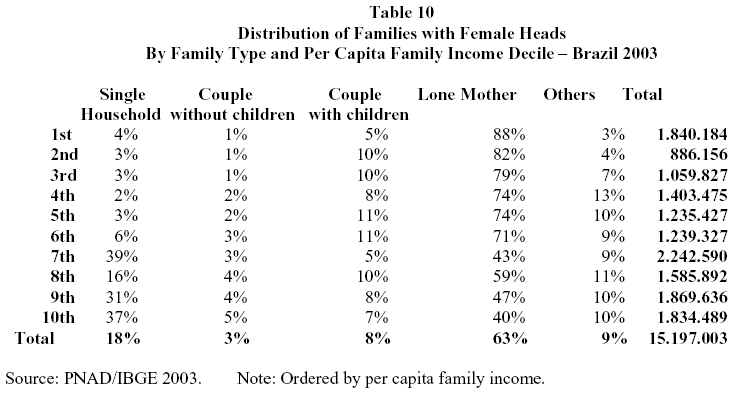
Some conclusions can be drawn from these tables. Firstly, lone-mother families with children can not be interpreted exclusively as a manifestation of poverty. The phenomenon is of much greater proportions, because it is represented in all income brackets and because this family setup entails an additional onus for all women. Secondly, a female head is not always synonymous with high vulnerability, because they are much more frequent in childless family arrangements in the upper deciles of the distribution. Finally, among the poorest 10%, the numbers of families headed by men and by women are more or less equivalent, though expressing completely distinct situations, since women have to face professional and family challenges alone.
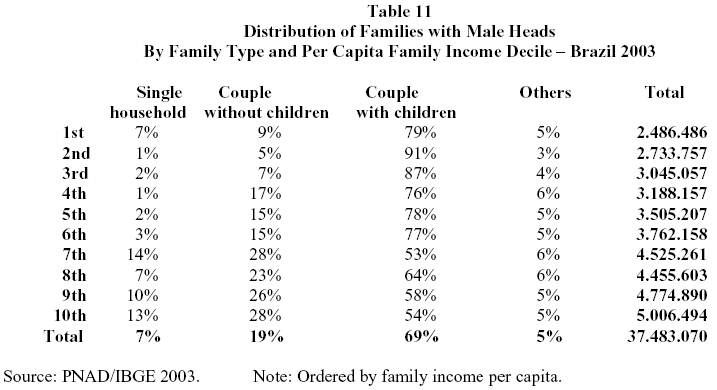
In Table 10, in the first six deciles of the distribution, at least 70% of the families with a female head are lone parents with children. This percentage is higher than the 63% average for this category in the overall population. On the other hand, sole female arrangements are a prominent presence at the higher income levels, more precisely among the richest 40%. For the women who declared themselves the head of household there is almost always no male figure (81% are lone mothers with children or constitute single households). Thus, being female head means being on your own. Meanwhile, as indicated in Table 11, male heads of families are concentrated (88%) in family structures with female spouses in a relationship based on patriarchal subordination. While, in absolute terms, families headed by women are distributed homogeneously among deciles, families headed by men increase in number as one proceeds up the income distribution.
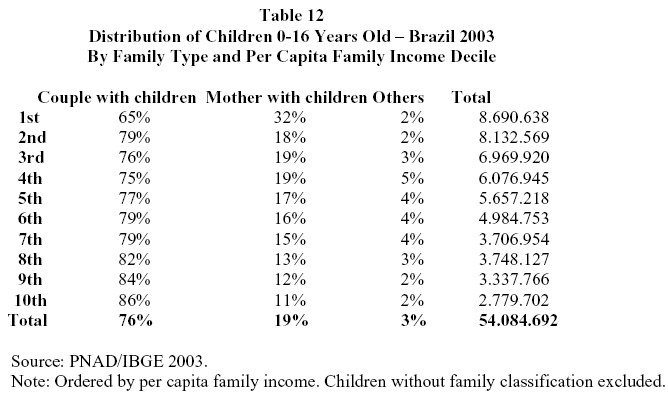
]]> Turning to families with children in the 0-16 age range, Table 12 shows that 2/3 are in the lower half of the distribution, and that the proportion varies inversely with income (Lavinas, 2004) in the three categories of family considered. Lone mother families account for only 19% of children in this age group, while three quarters live in nuclear families.It is commonly believed that the female activity rate can be affected in magnitude and dynamics by the presence of children, even though it is also known that, on aggregate, marriage or maternity, and caring for children and the elderly, no longer raise the inactivity rate among the younger cohorts, unlike what happened to women for decades. Its strongest impact is to reduce the spectrum of employment opportunities and galvanize access to precarious, less skilled occupations, which offer shorter working days and the possibility of reconciling work and family responsibilities. Recent research by Sorj (2004) revealed that poor working women whose children aged 0-6 years old attended daycare centres earned more than other, equally poor and occupied women, whose children of the same age had no external childcare options available. Sorj goes further to state that comparing groups of households by per capita income reveals that, for the poorest 25%, having children 4-6 years old attending pre-school institutions boosts the mother's salary by 35%, while for the richest 25% the corresponding increase was only 14%.
Table 13 below reiterates points emphasized by Sorj. It shows that only 37% of Brazilian children 0-6 years old frequent a day-care or pre-school facility. Lone-mother families seem to have more effective access to this type of service than the two-parent (nuclear) families, in all income brackets, by force of circumstances. Having to assume single-handed the financial responsibility of caring for a family, women heads are left no alternative but to find some means of minding their children. Access to day-care increases with income, more than doubling from the first to the last decile of the distribution, which confirms that provision of this service is not a de-commodified entitlement, but a private service. It must be remembered that, as most children are in the lower deciles of the distribution (Table 12), job opportunities are even scarcer for the poorest women. The ratio (the number of day-care vacancies required per adult working woman) thus remains high.
The PNAD figures (2003) indicate that only 2% of workers6 of both sexes reported receiving any financial assistance (family allowances) to offset day-care or educational expenses. However, 37% of female workers and 35% of male workers do get a public transport allowance. This demonstrates the scant attention, in terms of labour assistance, given to issues of what convention calls motherhood, to make it easier to reconcile time at work with caring for a family. In the absence of consistent public policies, the great majority of women with young children have to seek individual, private child-care solutions. Even for the classes with greater purchasing power, there are no income tax deductions to offset high expenditure on day-care and pre-school services.
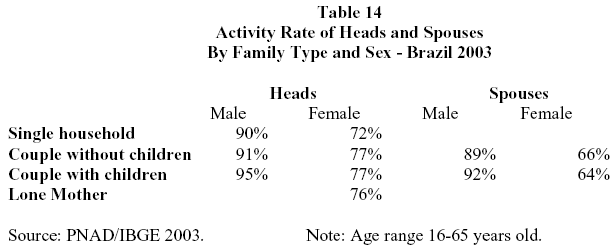
Analysed by age range, the female activity curve progressively resembles that for male activity, despite the fact the levels are still quite disparate. What Table 14 shows us is precisely that women in the position of family head displayed higher activity rates (around 70%) than those in the position of spouse (approximately 60%), a differential that is non-existent for men. Apparently, the status of subordinate spouse correlates more with lower activity rates than with number of offspring in itself.
In the same way, analysis of Table 15 shows that the paid working week of female spouses is shorter than that reported by female heads of household, which once again does not occur with men, where the uniform pattern seems to be independent of any such subordinate position in the family.
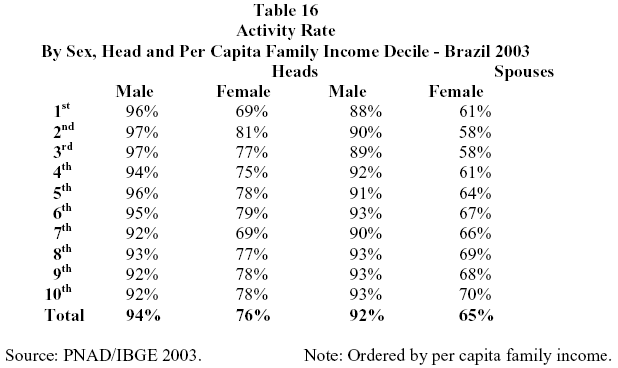
If this information is disaggregated by distribution deciles (Table 16), we see that, in the case of women heads, activity rates range from 75% to 81%, depending on income bracket. The exception that confirms the rule is the 10% poorest, which deviate from that interval to a lower level (69%). Spouses behave differently: the female activity rate tends to increase as one proceeds up through the distribution deciles, and oscillating more along the curve, but remaining lower than the activity recorded for female heads in all the income brackets. On average, only 65% of spouses are active, against 76% of heads of family. Contrasting men and women spouses in general reveals activity differentials more disadvantageous to women than the differentials encountered when comparing the sexes in the position of head of family.
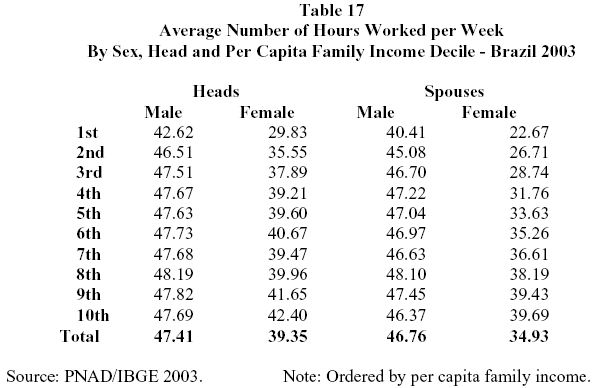
As expected, women's average number of working hours per week is systematically less among spouses than among those who declared themselves heads of family (34 hours and 39 hours, respectively). Just as with activity rates, the women's working week tends to increase consistently across the income distribution, as shown Table 17, consequently helping decrease the hour differential between the sexes in the upper income brackets.
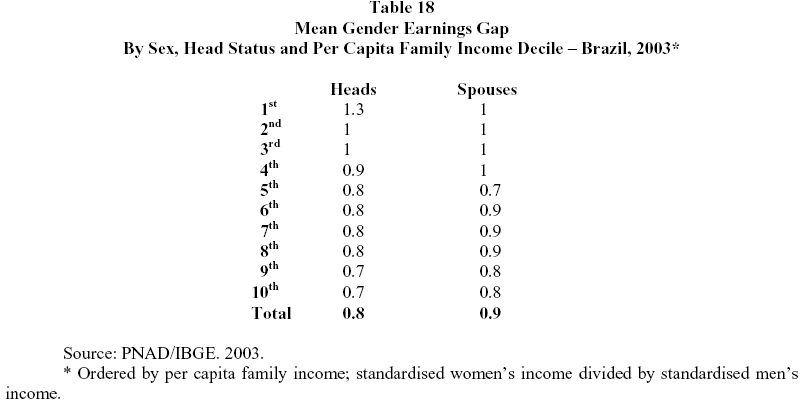
Finally, it is worth estimating the gender wage gap, according to the family typology adopted here, the position in the distribution deciles and status in the family, as set out in Table 18. In this connection, there are more than a few surprises. There is no wage gap between the sexes in the first four deciles of the distribution, regardless of the woman's status in the family, whether head or spouse. More striking still is that the reversed gender wage gap in the poorest income bracket favours the women heads of family by 30%. The unfavourable gap for women heads is accentuated from the fourth decile onwards. The widening earnings gap between the sexes, whether as heads or spouses, is seen in the upper half of the distribution curve, and is more marked in the final deciles, i.e. in positions where the women have more schooling, which may mean their career mobility is blocked as a result of sex discrimination on the labour market (it is difficult for women to access the apex of the occupation pyramid, regardless of how well endowed as human capital). Among the poorest, the gender wage gap is disappearing, which calls for supplementary research to explain the causes of such an abrupt turnaround.
Thus, it is not true that, in all circumstances, poor women are worse off than the men who share with them the same income bracket and position in the family. The earnings gap between the sexes varies noticeably with position in the family and income bracket, revealing that social inequalities do not necessarily reproduce the same gender hierarchies.
]]> Note that, as one follows the income distribution curve upwards, schooling does not seem to be the variable that would explain men earning more than women. If the data on years of study is disaggregated by income distribution decile, women's mean level of schooling is higher than men's in all income classes, except in the upper decile, as in Table 19.
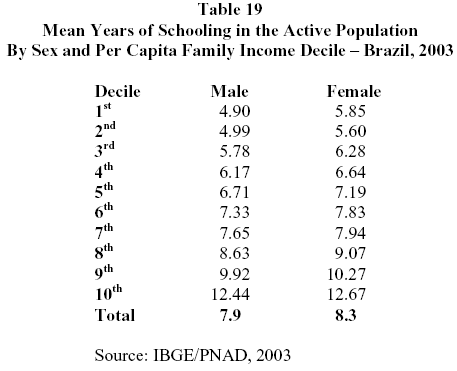
Table 18 suggests, intuitively, that the definition of family head in the nuclear arrangements, arises from a market convention, the reference datum being the highest salary and no longer non-monetary criteria (authority, seniority).
It can thus be seen that women have changed, and families too, but what seems unchanged is women's commitment and responsibility towards children and elderly dependents – i.e. the family sphere in general – regardless of type of family. The overload is evident, because women, as heads of families, assume a large part of the onus on their own or, as spouses, prejudice their career chances. The PNAD 2003 indicates that, while women devote an average of 28 hours per week to domestic tasks (36 hours, if inactive and 23 hours, if occupied), when men do so7, they spend less time, 11 hours (14, if inactive, and 10, if occupied). Not to mention that the sexual division of labour is reproduced in domestic work: men and women perform quite different activities, particularly in terms of value and interest, as demonstrated in innumerable studies of budgeting, time allocation and relations among employment, family and gender (Scalon and Araújo, 2004).
Europeans already know this and emphasize that EU member countries should adopt "gender-friendly policies" (Esping-Andersen, 2002) to enhance the social protection system in such a way as to reduce the "trade-offs" between family life and career, and raise the degree of social inclusion, reducing levels of vulnerability that are incompatible with high standards of social equity and well-being. These gender-friendly policies, which have been highly successful in Denmark, would consist in ensuring institutional support for reconciling work and family life, by reducing costs and increasing benefits. Esping-Andersen regards such policies as inevitably family-friendly too, and yield returns not just for women, but for society as whole.
Summarising, we can conclude that:
]]> 1) the absence or presence of children is decisive in determining position on the income distribution curve: their numbers increase in the lower tail end of the curve and decrease in the upper deciles. Thus, every policy intended to have redistributive impact in Brazil must privilege the children, because they are concentrated in the lower deciles and their presence is a factor in increasing family vulnerability;2) in all income brackets, female spouses access the labour market at greater disadvantage than female heads of family. The hypothesis may thus be formulated that the social cost of conjugality (relations of subordination and dependence), although difficult to estimate, are borne much more by women than men, and directly affect their occupational growth. This cost appears greater even than the costs of motherhood and caring for children and/or other relatives. However, women heads of families find themselves on their own and thus they take on the dual burden of career challenges and family responsibilities. In both situations what can help make women more autonomous and favour their occupational development is to reduce the time and costs of household chores relating to their children's education and care for the elderly. For this to occur, it is necessary to assure universal access to day-care and pre-school facilities and to promote full-time schooling, without imposing conditionalities (i.e. without discriminating against the inactive), likewise with regard to homes for the elderly. Also needed is a universal policy of income transfers to families with children up to 16 years old, i.e. the most vulnerable and unprotected families, where active adults – mostly working people – predominate;
3) policies to support families – both with income and with access to services and facilities – must be universal and dissociated from women's occupation status;
4) there is strong heterogeneity among women, which must be considered by public and social policy making designed to reduce gender disparities;
5) fiscal and tax measures must be taken to favour family arrangements with children – regardless of what those arrangements may be – to guarantee compensations for single-parent families with children, even offering compensation for expenses of day-care, pre-school and other care facilities. Such a measure would be extremely favourable to women in general, and particularly women heads of families, and would reduce gender differentials.
6) social investments – quality full-time schooling, nursery and day-care facilities, quality public transport, etc. – help raise working women's incomes, because they tend to expand their capacity to work, freeing up working time and strengthening their autonomy in gender relations, with direct, positive effects on poverty reduction.
2. Factors that contribute to family vulnerability
It is commonly accepted that the family arrangements at risk and most vulnerable are those headed by lone mothers. In other words, the failure of the patriarchal model of family, which has a male in the role of provider, is regarded as leading to increasing impoverishment of the new generations, in that many children are being brought up, cared for and educated in single-parent families headed exclusively by women whose position in the labour market is unquestionably less favourable than men's (lower mean wages, shorter working week and higher unemployment rate, etc).
The tables and figures presented in the first part of this paper suggest, however, that even in the lowest – and thus most vulnerable – income brackets (vulnerability expressed here exclusively on the basis of a certain income level), family arrangements involving lone mothers with children are not necessarily in the most critical condition, the notion induced by the "feminisation of poverty" framework which, in ranking the poorest of the poor, identifies lone mother heads of families as the neediest, at the bottom of the heap in terms of destitution.
]]> There can be no disputing the evidence that the great majority of Brazilian children live in families in the first five income distribution deciles8. It should be remembered that, of Brazil's poorest 10%, half are children; the other half are adults of working age. Table 20, which takes per capita family income of half a Minimum Wage as the poverty line, shows that the situation was different in 1981, when adults of working age constituted around 45% of the poor, against an estimated 53% in 2003. In 1981, the activity rate for women was much lower, thus family income was proportionally more dependent on men's work. Besides this, the dependence ratio was higher, because the fertility rate was also higher and families, larger. There was a significant fall in the percentage of children among the poor from 1981 to 2003, the same occurring with the elderly9. Brazilian children are thus poor because their parents, mainly working people, are poor and not because the dependence ratio is high.The doubt that persists is which factor contributes most to a family's vulnerability, whether children or being headed by women, who are nearly always alone and, by their less favourable access to the labour market and more restricted employment opportunities, end up achieving less than their full productive potential, with adverse effects on how they cope with their family obligations. Evidently, the combination of these two factors can only aggravate the situation of vulnerabilities, as common sense would suggest.
To answer this question, it was decided to estimate what influence each variable used to characterise the family arrangements (in the first part of this paper) had on calculation of the probability of a family's being, or not being, vulnerable (Table 21). For that purpose, we employed a logistic regression model and we define vulnerability, taking a certain per capita family income as the parameter and extrapolating the concept of relative poverty. In other words, this model was estimated on the basis of a relative poverty line equivalent to 40% of the median per capita family income for Brazil in 2003. This value was increased by 20%, given that there is a high degree of mobility above and below this line, due to intense socio-economic insecurity, which places those immediately above the poverty line at risk, wherever it is set. The intention, therefore, was to include this potentially vulnerable contingent in with the one identified as in fact vulnerable. Accordingly the vulnerability line was estimated at R$ 91.2010 (current Reais at September 2003). In other words, for the purposes of this study, vulnerable families are those with income of less than 40%*(1.2) = 48% of the median per capital family income.
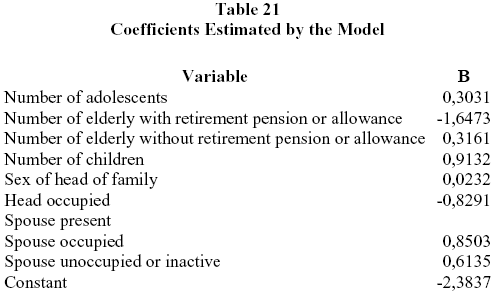
Table 21, showing the results of the coefficients estimated by the regression model, prompts some surprising conclusions. The first – and not the least significant – observation is that the sex of the family head is not a strong variable in determining vulnerability (0.232). Although the model does not reject sex of the family head, its contribution to vulnerability is minute. Thus, a family headed by a woman (often on her own) or by a man (the overwhelming majority with a spouse) are practically equally likely to be vulnerable, all other things being equal. This means that families headed by women, with or without spouse, are not more exposed to the risk of poverty than traditional nuclear families. The degree of a family's vulnerability is independent of whether the head is a man or a woman.
A second and very interesting result is that, although the presence of two parents reduces the likelihood that a family will be vulnerable, the impact is far smaller than produced by an elderly person with a retirement pension or allowance. In other words, having an elderly person in the family is strategically more effective in reducing vulnerability than having a spouse (i.e. in the traditional nuclear model of family, where this latter role falls to the woman), regardless of whether he (or nearly always she) is working (spouse 2-2) or not (spouse 2-1). The figures show that an occupied family head, whether male or female, has strong impact on reducing the likelihood that the family will be vulnerable, but that this impact is only half that estimated when an elderly person with a retirement pension is present. Instead of reducing the risk of vulnerability, the presence of a family head – regardless of sex – has a high, significant impact on increasing the chances that a family will be vulnerable. If the spouse is occupied, the coefficient is about 30% lower than estimated for a spouse without occupation, but nonetheless still contributes to increasing the likelihood that the family will be vulnerable (twice as much as the presence of adolescents, for example).
Unquestionably, the presence of elderly persons with retirement pensions of allowances reduces significantly the likelihood that a family will be vulnerable. This is explained by the fact that even the poorest strata of the population have access to a guaranteed minimum wage, thanks to the wide-ranging, effective coverage of the permanent benefit allowance (Benefício de Prestação Continuada) of one minimum wage, granted under the organic social assistance law (Lei Orgânica da Assistência Social, LOAS). The third salient finding is thus that the factor that contributes most to reducing the risk of vulnerability in poor, needy families is the presence of an elderly person receiving a retirement pension or allowance. In other words, having a social policy that guarantees income to Brazil's elderly, at the substantial level of one minimum wage, is what contributes most to reducing vulnerability among the country's poor, as revealed by the estimates of the model applied here.
]]> Another piece of evidence corroborates what is widely known: where there are children, there is an extremely high likelihood – the strongest estimated by the model – that the family will be vulnerable. Note that the presence of children (up to 16 years old) results in a coefficient three times as high as for presence of adolescents (17 to 24 years old) or for elderly persons with no social benefit allowance. That is to say that a single child causes three times more adverse impact on the likelihood family vulnerability than the presence of other kinds of dependents, whether adolescents or elderly persons with no social security coverage.Finally, a third observation contests the conventional reading as already mentioned in this paper. In the same way that the sex of a family head makes almost no difference to the likelihood that a family will be more or less vulnerable, neither does family type – whether two parent (headed generally by a man with a spouse) or single-parent (lone-mother) – carry much weight in explaining vulnerability. This finding contradicts the common understanding that single-parent families with children are much more exposed to the risk of vulnerability than nuclear families with children, which constitute the prevailing model in our society. The presence of a couple at the head of a family reduces the likelihood of vulnerability very little more than a lone mother (single-parent family).
In addition to the coefficients shown in Table 21, we extended our analysis to an extra exercise (Table 22), based on constructing hypothetical two-parent and single-parent families with children. The probability percentages estimated by the model11 for the two family types with and without children, adolescents and elderly persons are given in Table 22.
Briefly, it can be seen that:
1) the probability that a family without children will be vulnerable ranges from 1.4% to 8.8%, depending on whether or not there is an elderly person with a social security benefit or an occupied spouse;
2) for single-parent families in the same situation – i.e. without children – the likelihood of vulnerability is very similar to that for two-parent families with a male head. The difference is less than 0.5% when retirees/pensioners are present and about 2% when they are not;
3) with children12 – where all family types are much more likely to be vulnerable – single-parent families are more likely to be vulnerable than two-parent families where the male spouse has no occupation. What is still more interesting though – and deserves highlighting – is that the margin of disadvantage is small, much less than might be imagined, of the order of only 15% when no retirees/pensioners are present and falling to 2.2% when they are. It is therefore noteworthy that vulnerability is, at worst, only slightly more likely in a single-parent family than in a two-parent family headed by a man.
On the same line of reasoning, the presence of a male spouse with occupation (which occurs only in two-parent families) reduces significantly the likelihood that a family will be vulnerable. The empirical data showed in the first part of this paper that most female spouses are out of the labour market. That means that if two-parent families could free up and valorise female work, and thus expand the spouses' (mostly women's) employment opportunities, the chances of such families escaping poverty would increase. Now, what restricts that potential – over and beyond the constraints intrinsic to the labour market which reproduces gender inequalities (poor occupational mix, wage differentials) – is the conjugality effect. In all the family set-ups examined, women spouses in families with and without children, perform less effectively than women heads of family13 (activity rates, earnings, hours worked etc.). Therefore, what prevents women from gaining better access to the labour market – all other things being equal – is less the presence of children (motherhood) than the conjugal contract, which places women in a relationship of subordination and dependence in the family and in the sexual division of work, thus reducing their autonomy. Burdened not just by domestic chores (affecting all women), but also with their development limited by a contradictory, asymmetrical relationship structured on a patriarchal model where the male figure is the tradition breadwinner, women in the role of spouses have their employment opportunities restricted, notably in the poorest strata, in the struggle to reconcile families responsibilities and work.
Therefore, whenever it is possible to reduce the trade-offs between work and family, by bringing out the gender conflicts deriving from the dispute over allocation of domestic work time and reducing the latter for all members (although this time burden is still consistently shouldered by women) by providing public services, this will boost the productive potential of women in general, and particularly those in the position of spouse, i.e. in a subordinate position. For this purpose, more than cash income transfers to needy families, what is indispensable is to resume public investment in full-time schooling with quality teaching, to expand local government provision of day-care for pre-school children, so as to galvanise women's autonomy. Only by universalising access to, and the quality standards of, de-commodified services can gender and social class differentials be narrowed quickly and thoroughly in Brazil. Well designed income policies, as in the guaranteed minimum wage for the needy over-65s, are indispensable to reducing the likelihood that a family will be vulnerable, but insufficient to redress the inadequate contribution that women's earnings make to reducing poverty and inequity. What Brazil needs is to design a universal income policy targeting families with children to act effectively to reduce vulnerabilities and social inequalities. These affect all families in a situation of socio-economic insecurity, regardless of type (single- or two-parent) and the head of family's sex.
]]>REFERENCES
BELTRAO, K. I. and ALVES, J. E. D. (2004), "A Reversão do Hiato de Gênero na Educação Brasileira no Século XX". Anais do XIV Encontro Nacional de Estudos Populacionais. Campinas, SP, ABEP, vol. 1. [ Links ]
ESPING-ANDERSEN, C. (2002), Why We Need a New Welfare State? Oxford, Oxford University Press. [ Links ]
GOLDANI, A. M. and VERDUGO LAZO, A. (2004), Brasil: Desafios de Políticas para Famílias. Paper presented at the seminar "Cambio de las Familias en el Marco de las Transformaciones Globales: Necesidad de Políticas Públicas Eficaces", Santiago, ECLAC, 28-29 October. [ Links ]
GUEDES, M. C. (2004), As Mulheres de Formação Universitária: a Reversão da Desigualdade de Gênero e seus Reflexos no Mercado de Trabalho. Brasil: 1970-2000. Masters Thesis, Programa de Estudos Populacionais e Pesquisas Sociais, ENCE. [ Links ]
]]>IBGE. (1982), Pesquisa Nacional por Amostra de Domicílios 1981. [ Links ]
______. (2004a), Pesquisa Nacional por Amostra de Domicílios 2003. [ Links ]
______. (2004b), Síntese de Indicadores Sociais. [ Links ]
LAVINAS, L. (2001), "Empregabilidade no Brasil: Inflexões de Gênero e Diferenciais Femininos". Textos para Discussão, No. 826, Ipea, p. 44. [ Links ]
______. (2004), "Universalizando Direitos", in Social Watch Brasil. Observatório da Cidadania – Relatório 2004, Medos e Privações, pp. 67-74. [ Links ]
]]>______. (2005), "Salário Mínimo, Linha de Pobreza e Benefícios Assistenciais: Desvincular é Preciso?", in P. Baltar et alii, Salário Mínimo e Desenvolvimento, Unicamp, Instituto de Economia, pp. 121-136. [ Links ]
______ and DAIN, S. (2005), "Proteção Social e Justiça Redistributiva: Como Promover a Igualdade de Gênero". Convênio Fase-Novib, Relatório Final. Mimeo, 75 p. Accessible at: www.ie.ufrj.br/aparte. [ Links ]
LAVINAS, L. and GARSON, S. (2004), "O Gasto Social no Brasil: Transparências, sim; Partis-pris, não". Econômico, vol. 5, no. 1, pp. 145-162. [ Links ]
SCALON, C. and ARAÚJO, C. (2004), Gênero, Família e Trabalho. Study conducted as part of the ISSP, Iuperj/UERJ. [ Links ]
SILVA, E. and SCHWARZER, H. (2002), "Proteção Social, Aposentadorias, Pensões e Gênero". Textos para Discussão, Ipea, Brasília, n. 934, p. 55. [ Links ]
]]>SORJ, B. (2004), "Reconciling Work and Family: Issues and Policies in Brazil". Conditions of Work and Employment Series, no. 8, International Labour Office, Geneva, pp. 1-69. [ Links ]
* Part of this article was developed in the report Proteção Social e Justiça Redistributiva: como promover a igualdade de gênero [Social Protection and Redistributive Justice: how to promote gender equality] (Lavinas and Dain, 2005). We thank Prof. Getúlio Borges of the Institute of Economics. Rio de Janeiro Federal University (IE-UFRJ) for his critical comments on the modelling described in Section 2 of this paper, "Factors that contribute to family vulnerability", and Prof. José Eustáquio Alves, of the National School of Geography and Statistics (ENCE), for his contribution in a preliminary reading of this text.
1 In Lavinas L. (2001:12, Graph 8), wage earnings by women can be seen to evolve positively against men's in the period 1982–1998 (on a moving average basis). This narrowing of the wage gap was further accentuated in the 90s when women's wages recovered at a far higher rate than men's.
2 Note that, since 2001, the Brazilian Civil Code has dropped any reference to the male head in conjugal partnering, but for the purposes of this study we have used the terms "family head" or simply "head".
3 This explains why the number of families varies so much among deciles of the distribution.
4 Essentially, for pregnant regular employees, maternity leave (4 months) and job security (for 12 months after maternity leave ends).
5 The data for single-parent families with male heads are included in Others, as they are absolutely insignificant. In Brazil, in practice, this category thus has no equivalent for men. ]]>
6 Here, employed males and female domestic servants are computed.
7 As pointed out by Goldani and Verdugo Lazo (2004), on the basis of the 1998 IBGE Standard of Living Survey, less than 30% of men declared themselves involved with some type of household function, against 79% of women.
8 In this respect, see Lavinas L. and Garson S. (2004).
9 Detailed analysis of this trend and its causes were amply discussed by Lavinas and Dain (2005) and Lavinas (2005). We have therefore not pursued such an analysis in this paper.
10 Average US$ exchange rate in September 2003: USD 1 = R$ 2.92
11 See detailed methodology of this exercise in Statistical Annex.
12 The exercise conducted here considered a standard-type family with two children.
13 It should be remembered that most women heads of families are mothers with children.
]]> STATISTICAL ANNEX
The logistic regression model adopted in this study was useful for estimating the likelihood of an event's occurring when the dependent variable is binary. This type of modelling is advantageous in this specific context, compared with the linear regression model, particularly for the discretionary and qualitative response of the phenomenon, expressed by the well-defined characteristic: the dichotomous nature of whether or not families are vulnerable.
The response variable of the model is Family Vulnerability, the value of which is 1 when the family is vulnerable, and 0 when not. Family Vulnerability was defined on the basis of a relative poverty line of 40% of the median per capita family income in Brazil in September 2003. Considering that families are vulnerable in a broader zone, above and below the poverty line, we added 20% to the value of the median per capita family income, thus including as vulnerable all the families with a PCFI below R$ 91.20. To summarise, the vulnerability line thus contemplates families with a PCFI equal to or less than 48% of the median per capita family income in Brazil. Explanatory variables tested included two binary variables, four numerical variables and one categorical variable, viz.: sex of the head of family (male = 0 and female = 1); head of family occupation, (occupied = 1 and no occupation/inactive = 0); number of elderly without retirement pension or allowance in the family; number of elderly with retirement pension or allowance in the family; number of children in the family; number of adolescents in the family; spouse's situation in the family (family without spouse = 0, family with spouse with no occupation or inactive =1 and family with spouse with occupation = 2).
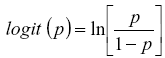
Each individual response of the Family Vulnerability variable is assumed to be independent, following a Bernoulli distribution, and the proportion between the cumulative number of successes in the response variable and the total of observations in the particular groups of explanatory binary variables follow a binomial distribution. Having defined the probability distribution of the response variable, suffice it to choose the link function, which relates the expectation of the response variable with the linear predictor. In this exercise logit(p) will be used as the link function, which associates the logarithm of the odds in favour of the event with the linear predictor, thus:
Two tests were produced using the SPSS statistics software to evaluate the model and its parameters:
• Test of hypotheses about the coefficients: for large samples, Wald statistics may be used to test whether the coefficients equal zero. This statistic has chi-square distribution with a degree of freedom (n – p), where n is the number of observations and p the number of parameters estimated. The null hypothesis is that the coefficient of the parameter = 0.
• Test of variable inclusion hypotheses: in order to compare the models contemplating each of the explanatory variables, the likelihood ratio test was used, i.e. the ratio between the likelihood the model evaluated and of the reduced model.
The likelihood ratio test analyses the changes in log likelihood when each variable is added to the model estimated. The test is performed by dividing the likelihood of the reduced model, containing only the intercept, and the maximal model, i.e., the one to be tested. For large samples, the deviance – twice the log of the likelihood ratio – has a chi-squared distribution with degree of freedom (n – p), where n is the number of observations and p the number of parameters estimated. The null hypothesis is that the reduced model is as good as the model tested.
]]>
Another exercise performed using the model described above was to calculate the likelihoods for four specific family formations, according to values determined for each of the explanatory variables, so as to compare families headed by men accompanied by an occupied male or female spouse with those headed by women without spouse. The families examined, in addition to varying by the sex of the head and the presence of an occupied male or female spouse, were configured as follows: family 1 (Fam1), no elderly, no adolescent, two children and occupied head; family 2 (Fam2), one elderly with retirement pension or allowance, no adolescent, two children and occupied male or female head; family 3 (Fam3), no elderly, no adolescent, no children, with adult offspring and occupied male or female head; family 4 (Fam4), one elderly with retirement pension or allowance, no adolescent, no children, with adult offspring and occupied male or female head.
]]>