Théorie informationnelle et sélection du rapporteurs dans le Chambre des Députés
Teoria informacional e a seleção de relatores na Câmara dos Deputados
Fabiano Santos; Acir Almeida
Translated by Plinio Dentzien
Translation from Dados - Revista de Ciências Sociais, Rio de Janeiro, v.48, n.4, p. 693-735, Oct./Dec. 2005.
ABSTRACT
This article analyzes which factors determine rapporteurship allocation for reviewing bills of law submitted by the Brazilian Executive Branch to the Chamber of Deputies. We argue that the rapporteurs' influence lies in their position as informational agents in the preliminary review committees. Based on this theoretical proposition, we identify the reasons why the first term of the Cardoso Administration witnessed a non-negligible number of rapporteurs from the minority opposition who were designated to report on bills submitted by the Executive. The hypotheses are tested through a statistical model that estimates the number of reports on Executive bills each Deputy obtained during the 1995-98 Legislature by using original data on the characteristics of the Deputies, their parties, and the committees to which they belonged.
Key words: rapporteurs; Chamber of Deputies; informational theory
RÉSUMÉ
Dans cet article, on analyse ce qui détermine la sélection des rapporteurs qui devront examiner des projets issus du pouvoir exécutif à la Chambre des Députés. On soutient que l'influence du rapporteur réside dans sa condition d'agent informationnel des commissions jugeant le mérite. À partir de cette proposition théorique, on repère la raison pour laquelle, pendant le premier gouvernement de Fernando Henrique Cardoso, on a nommé un nombre non négligeable de députés de l'opposition minoritaire pour rapporter des projets du pouvoir exécutif. Le test des hypothèses est fait à l'aide du modèle statistique qui estime le nombre de rapports de projets du pouvoir exécutif obtenus par chaque député pendant la législature 1995-1998, à partir de données d'origine concernant les caractéristiques des députés, leurs partis et les commissions auxquelles ils ont participé.
Mots-clé: rapporteurs; Chambre des Députés; théorie informationnelle
]]>
1. INTRODUCTION
The earlier months of 1997 were marked by strong tension among the parties of the coalition supporting President Fernando Henrique Cardoso. Throughout the first two years of the President's term, many constitutional reforms were passed, and one of them attracted the attention of both pro-government and opposition representatives: the amendment that abolished the state's monopoly in telecommunications. The new regulation for the sector depended upon the course and approval of at least two or three major legislative proposals, the most important being the General Telecommunications Law, sent to Congress by the end of 1996. Right away, the Brazilian Democratic Movement Party – PMDB and the Liberal Front Party – PFL, the two with the largest number of seats in the Chamber, started a dispute to indicate the rapporteur for the bill. PMDB presented Representative Alberto Goldman, of the Brazilian Social Democracy Party, from São Paulo, and PFL indicated its own Representative Paulo Bornhausen, from Santa Catarina. A way imagined to attenuate the conflict was to split the bill in three parts, but this displeased Minister Sergio Motta, leading proponent of the new policy. Finally, the law's complexity allowed the Chamber of Deputies President, Representative Luis Eduardo Magalhães, of Bahia's PFL, to install a special committee to appreciate the bill, what gave the government and its allies the required margin to solve the dispute – the rapporteurship went to Representative Goldman, while Representative Bornhausen was to preside over the Special Committee.1
This short account shows the importance the rapporteurship of a delicate matter has for government, parties and all congressmen. However, and despite the recent evolution of studies on the functioning of the Brazilian Congress, we do not find in the literature any work discussing the rapporteurship's importance in the legislative decision-making process or analyzing the rapporteur's selection process for permanent committees, either in the Chamber of Deputies or in the Federal Senate. Our aim in this article is to begin filling this void, specifying the mechanism through which the rapporteur influences the committee's decision and identifying (in the light of such mechanism) the determinants of his selection. We hope to thus contribute for the understanding of the decision-making process within the Brazilian Legislative.
The first step in our research was a close reading of the Chamber's internal rules, particularly of the articles defining the powers of the committees' rapporteurs. At the end of our reading, and to our surprise, we faced a kind of puzzle: while usually seen as a key actor in the decision-making process within the Brazilian Legislative, the rapporteur has not enough formal powers to influence the committee's final decision. This is so because, at the final decision, the committee's majority can pass any proposal alternative to the rapporteur's. How to account, then, for the perception that the rapporteur is a "key-actor" in the decision-making process? Would that be a wrong perception? We argue that the rapporteur is an influential actor in the committee's decision-making process, and that the foundation of his influence is not his formal authority (for instance, in the selection of amendments). His potential importance derives, in our opinion, from his function as the committee's informational agent, i. e., from his delegation to collect and share with his peers information on the consequences of a particular public policy. As we will explain later on, the strategic use of these attributions (especially the latter) is the mechanism through which the rapporteur influences the committee's final decision.
Our thesis on the rapporteur as the committee's informational agent2 is anchored, from a theoretical perspective, in the literature that analyzes decision making under uncertainty, particularly in works that analyze the choice of information sources by rationally ignorant decision makers. Our main result, based in that literature, is that a rapporteur moderately opposed to the original bill is more informative than a rapporteur either extremely opposed, or favorable, or neutral. Applying this approach to the selection of rapporteurs in the Chamber, along the 1995-98 legislature, we managed to explain a phenomenon to this time insufficiently understood: the designation of a substantial number of legislators from the minority opposition parties to report on Executive bills. From original data relative to the representatives' characteristics, their parties and the committees to which they belonged, we present strong evidence for the empirical validity of our explanation and, more remotely, for our thesis on the rapporteur's function.
The article is organized in the following manner. In the next section, we review the literature on the problem of information within the Legislative and how it appears in Brazil's Chamber of Deputies. In the third section, we analyze the rules for the selection of the rapporteurs and their power, and we propose our informational interpretation of their power to influence the committees' final decision. In the fourth, we discuss how the informational question is an embarrassment for the application of the legislative cartel theory to the Brazilian case (Amorim Neto et al, 2003) and how the latter's explanatory power may be improved adopting our perspective. Still in the fourth section, we derive some working hypotheses on the determinants of the selection of rapporteurs for Executive bills. In the fifth, we test our hypotheses through an econometric analysis applied to an original dataset including the representatives appointed to report, in the committees, Executive bills during President Fernando Henrique Cardoso's first term. In the sixth and last section, we close with a discussion of our main findings and with an indication of the potential unfolding of this research agenda.
2. LEGISLATIVE PROCESS AND BEHAVIOR FROM AN INFORMATIONAL PERSPECTIVE
It is in the collective interest that Legislative decisions be well informed in what respects the relationship of the adopted policy to its results. However, the individual legislator scarcely knows about the consequences of most of the policies on which he should decide. How is it then possible that the Legislative arrives to a well-informed decision on any policy when most of its members have not enough information on that policy's effects?
]]> This question generated a good many studies on the American Congress, published in the second half of the eighties and that proved seminal (Austen-Smith and Riker, 1987; and, especially, Gilligan and Krehbiel, 1987, 1989). With the publication, in 1991, of Keith Krehbiel's Information and Legislative Organization, the so-called "informational perspective" of legislative studies became widely known. In direct opposition to the distributive approach,3 the new perspective emphasizes two postulates that had been forsaken by the main proponents of the former approach: the majoritarian and that of uncertainty. The majority postulate establishes that decisions taken in the Legislative, in the committees or on the assembly's floor are founded on the will of the majority. The uncertainty postulate states that legislators vote without knowing for sure the results of the public policies they pass. The Legislative's organizational problem would then be that of assuring that decisions are taken, first, by taking into account the majority's preference, and second, on the basis of the largest possible amount of information, in order to reduce uncertainty about the results of public policies. Uncertainty reduction is, from the informational perspective, one of the fundamental collective goods to be achieved through the Congress' institutional structure, what means that legislative institutions will be more efficient in so far as they lead congressmen to acquire and share specialized knowledge. Guaranteeing that policies approved by the Legislative have as a foundation de maximum possible of available information and that this information reaches the average legislator are the measure of success of a well-organized Congress.In which way does Krehbiel and Gilligan's contribution helps our understanding of the internal decision-making process in the Brazilian Legislative? Would the informational perspective have any relevance for this case? Generally, analyses of the Brazilian Congress either emphasize the distributive element in the legislators' behavior, deriving from electoral incentives of a personalized nature, or privilege the party leaders' agenda power and the influence of the Executive Branch in leading the work of the Legislative Houses.4 Our purpose in this work is not to enter this debate, but we hope our findings may contribute to shed some light on some of its most salient aspects. What is worth stressing from the literature is that there is a consensus on the absence of institutional incentives for the acquisition and distribution of information within the Brazilian Legislative. In other words, there wouldn't be an informational component in the way in which Congress is institutionally structured.
In the literature, the structure of individual incentives the legislators face is the main explanatory variable for the absence of this informational element. In what respects individual incentives, the core of the argument has to do with the absence of endogenous mechanisms for the formation of public policy specialists. At least four points are relevant in this respect:
1. Party leaders have strong prerogatives on the organization of legislative activities. They speak for their party peers in the encaminhamentoi of votes, they appoint and dismiss committee members, they set the voting agenda in the Colégio de Líderes,ii they speed up the legislative process through urgency requests and a series of other prerogatives that end up depleting the power of committees, loci, in the last instance, where representatives may exert some influence on public policies.5
2. In the Chamber of Deputies, there is no seniority system through which the appointment for ruling positions, notably in committees, is defined by the years of service in the Legislative or in a permanent committee. Since Polsby's seminal study (1968), the literature on the American Congress abounds in examples that show the relevance of seniority for the consolidation of Legislative careers in general and in specialized committees in particular.6
3. On legislative careers there is also plenty of material about the scarcity of incentives for the continuity of legislative terms. Executive positions, at the federal, state and local levels, would have a higher value, and this would lead to relatively low rates of renewal of legislative terms.7
4. The over-valuation of Executive positions derives in its turn from the Executive's prerogatives in the decision-making process. The Executive's power over the budget, particularly the ability to postpone or otherwise restrict expenditures, the areas of exclusive initiative, the ability to define the course of fundamental matters and the powers of appointing and discharging public agencies' directors, all this adds up to a huge list of political powers that strengthen the members of the Executive in the process of defining public policy.8
For the reasons pointed to above, we may say that Brazilian representatives face an "informational problem," i.e., the Legislative's institutional structure does not generate incentives for the endogenous and systematic production of specialized information. In the absence of institutional incentives, we must not expect representatives to look for individual solutions for the problem for information about the relationship of public policies to their results is a collective good. This being so, one of the theoretical and empirical motivations for our analysis respects with what we identify as a gap in the literature on the Brazilian Legislative, for the already mentioned diagnostic should be followed with the natural question: how do Brazilian representatives deal with the informational problem? In what way is the uncertainty about the vote of crucial matters reduced?
An answer that is consistent with the Brazilian experience would be that the problem is solved through making the government more partisan – i.e., through the appointment of agents of the parties that support the government in Congress for ministerial positions. Each of these agents, through the formal control of information (in the case, bureaucratic expertise) and the de facto initiative in some areas of public policy, has an incentive to become better informed about the relationship of specific policies to their results. However, Brazilian ministers are far from being the representatives' perfect agents,9 and this leads us to believe that, in the case of conflict of interests between the government and its parliamentary basis on any public policy, the minister has a strong incentive to make strategic use of his informational advantage in his own benefit to the disadvantage of the representatives' interests. For that reason, there is a wide space for the representatives to collect advantages if not from the production, at least from the collection of information alternative to that presented by the government.
The public hearing is the formal mechanism most directly turned to the collection of information (alternative to that presented by the government) on the consequences of public policies. We understand, however, that there are two important limitations to the effective use of such a mechanism by individual representatives. First, attendance to public hearings represents a high cost to representatives, whose agendas use to be full of more pressing engagements, as, for instance, contacts with their constituencies. Second, there is the cost (or effort) to learn the information available through public audiences. As a function of these costs, the public audience mechanism is not enough in itself to solve the problem of collective action faced by Brazilian representatives in information production.10
]]> We identify in the formal position of the committee's rapporteur a possible solution for this problem. Our argument is that the rapporteur is a committee's informational agent, whose functions are to collect and share information on the consequences of a specific public policy. In the next section, we develop this argument and specify the mechanisms through which the rapporteur fulfills this function.
3. RAPPORTEUR: SELECTION, POWERS AND INFLUENCE
The internal rules of the Chamber of Deputies establish that every proposal examined in the permanent committees must be initially analyzed by a rapporteur (Câmara dos Deputados, 2004, art. 56).11 In general terms, the rapporteur pronounces a written opinion on the matter, suggesting either its rejection or approval, the latter referring to the original text or a substitute that, in his opinion, may or may not include eventual amendments presented by other committee members.
The choice of rapporteurs (and of their substitutes) is an exclusive attribution of the committee's chairman, and there is no restriction as to either whom amongst the committee's members or how many times they may be appointed to report on bills (idem, art. 41). The chairman, in its turn, while formally appointed by the committee's majority, in practice owes his position to the party leaders. This is so because the same proportional criterion applied to the composition of the Chamber's directing body and the committees themselves is also applied to the choice of their chairmen.12 The fact that the chosen chairman does not necessarily reflect the median preference (i. e., the possibility that the distance between their respective ideal points is significant) is important for it increases the chances of selection of a rapporteur whose preference is also distinct from the committee's median legislator.
The rapporteur is given half of the time given the committee as a whole to present his point of view; this time varies according to the matter's nature: five sessions if the bill follows an urgency regime; 10 if it follows a priority regime and 40 when used the ordinary regime (idem, art. 52). The deadline may be extended (for half of the initially intended sessions), however, if requested by the rapporteur, with the chairman's agreement, except in the case of the urgency regime. The deadline reached, the majority of the committee members may demand that the bill be sent to the committee's floor pending the rapporteur's report. If the rapporteur does not offer his report, the committee chairman should appoint another representative to do so.
In the formulation of his report, the rapporteur is completely free to amend or even to alter the original bill, and he may not take into account his peers' preferences. If his report is approved in all its terms, it is considered as the committee's report, and is sent to the Chamber's directing body, to be entered into the Chamber's agenda. If there are proposals to alter the rapporteur's report and if he agrees to them, a new deadline is given for the incorporation of the change and presentation of a new text. If the rapporteur's report is not accepted by the majority of the committee, a substitute rapporteur should write a new text in the terms approved by the committee's majority – if the latter is also defeated, the chairman appoints another representative to write the committee's position (idem, art. 57).
What can we conclude from the rules for the course of the matters in committees? Basically, that the rapporteur does not have agenda powers, i. e, the capacity to define what proposals are voted in the committee, and when. Let us look, first, the question about the proposals' content. An agenda setter may select amendments that will figure in the bill's final version, trying to approximate it as much as possible to his preferred alternative (or ideal point), respecting the limits defined by the indifference curve of the committee's median legislator. The committee members, however, at the very moment of voting the rapporteur's report may alter his text. As a consequence, the median legislator will be able to approve a final version of the bill corresponding to his ideal point. Second, let us look at the deadline question. If the preferences of agenda setter and median legislator relative to a proposal are such that what the latter approves is not in the interest of the former, then the agenda setter may act strategically not putting the bill to a vote. But we saw that the rapporteur does not have such prerogative – it is perfectly possible for the majority of the committee to force the appreciation of any matter before the committee in case the rapporteur does not obey the established deadline.
At first sight, the inexistence of formal powers that allow the rapporteur to influence the committee's decision seems to contradict the impressionistic evaluation according to which the rapporteur is a key-actor in the decision-making process. However, in our view, the rapporteur is, in fact, a strategic actor in the decision-making process within the committee, but not because of his eventual formal powers, as, for instance, agenda setting, for he does not have them. Alternatively, we propose that the rapporteur's power derives from his informational role or, specifically, from the delegation he receives from the committee to collect and share information on the impact of the bill on which he reports.
]]> 3.1. An Informational Rationale for the Rapporteur's Influence
Assuming that legislators are not sure about the consequences of the public policies on which they have to decide, we may interpret, from an informational perspective, the rapporteur as his committee's agent whose function is to collect and share information on the impact of a specific policy. In order to theoretically found such interpretation, we recur to the literature on decision making under conditions of uncertainty, specifically to works referring to the production, transmission and use of information, and applicable to the substantive question under analysis (Calvert, 1985; Crawford and Sobel, 1982; Dur and Swank, 2005; Krishna and Morgan, 2001; Milgrom and Roberts, 1986).
From the informational perspective, the interaction of the committee's rapporteur and the committee's median legislator may be described by the following general terms:
1. A committee's median legislator receives a public policy proposal for approval but he does not know for sure its consequences.
2. The committee's chairman selects one of its members to report on the bill, i. e., to collect information on the consequences of the policy proposed and recommend a decision to the committee. The quality of the information collected by the rapporteur is a direct function of his effort, which cannot be observed by the median legislator. With the collected information at hand, the rapporteur makes a recommendation whose quality depends on the use of such information, and this also cannot be observed by the median legislator.
3. After knowing the rapporteur's recommendation, the median legislator updates his belief on the policy's impact and decides on the bill.13
Even acknowledging that the median legislator's degree of uncertainty varies directly with the proposal's complexity, by virtue of the Brazilian representative's informational problem (defined above, in section 2), we assume that the median legislator is very uncertain about most of the bills on which he is to decide.14 Uncertainty is not a problem for the median legislator only in very special conditions: when his ideal point coincides with that of the proposal's author and the latter is fully informed about the policy (Crawford and Sobel, 1982). This is so because the author, in order to avoid that the median legislator makes a "wrong" decision due to uncertainty, has an incentive to reveal his own private information (and this incentive is greater the lesser the distance between his ideal point and that of the median legislator) – and the greater the incentive, the greater the credibility of the information revealed by the author. Only in the extraordinary situation in which the ideal points are equal and the proposal's author is fully informed, the median legislator decides under optimal informational conditions. Ordinarily, however, either the ideal points are not perfectly coincident; leading the author to suppress any information that leads the median legislator, in its turn, to make a decision less favorable to the proposal, or the author is not fully informed, so that, even when the ideal points coincide, the median legislator does not get all the relevant information. For this reason, the median legislator may generally increase his decision's informational basis through the rapporteur.
The delegation to the rapporteur, on the other hand, is not free from agency problems: the rapporteur may not exert himself enough in the search for information and he may make strategic use of the information produced to the disadvantage of the committee's median legislator (Dur and Swank, 2005). The former risk respects the quality of information; the latter, the quality of the recommendation. With regard to the quality of the information produced, as it depends on the rapporteur's effort, it is not assured that he will produce the best possible information (assuming effort aversion). Although neither the rapporteur's effort nor the quality of the information he produces may be directly observed by the committee members, the latter may infer them on the basis of the rapporteur's observed characteristics. One of these characteristics is the rapporteur's preference. From a model of "information collection agents", Dur and Swank (idem) show that individuals very biased for or against a proposal (taking as reference the decision maker's ideal point) have a lesser incentive to spend effort in information collection. This is so for, as a function of their strong belief relative to the proposals' consequences, the likelihood of their changing the recommendation as a result of relevant information is low. Thus, the more biased the chosen rapporteur, the lower the expectation of the median legislator relative to the quality of the information used by the rapporteur to make his recommendation. In addition, we emphasize other two characteristics: expertise and educational level. A legislator with specialized knowledge on the matter will have to collect less information and, besides, will have to spend less effort to learn new information.15 A highly educated legislator, even lacking specialized knowledge on the matter, will find it easier (than a less educated one) to learn new information. In what respects the ability of the rapporteur to produce high quality information, then, the preference of the committee members goes, first, to representatives who are specialists in the matter and, second, to highly educated representatives.
Let us now turn to the quality of the recommendation. Given the amount of information produced, unless the ideal points of rapporteur and median legislator coincide, the former has an incentive to act strategically in his recommendation, neglecting relevant information in order to lead the median legislator to decide for a proposal as close as possible to his own ideal point, and not that of the median legislator.16 To what extent the rapporteur's recommendation, even if biased, may be informative to the committee's median legislator? Considering that the rapporteur's recommendation is a reaction to the original proposal, it is then possible that it will be informative for the median legislator in so far as it serves, if not as a counterpoint, at least as a complement to the information in the original proposal (Krishna and Morgan, 2001; Milgrom and Roberts, 1986). So, a rapporteur biased against the original proposal is more informative than another biased pro or neutral, for he has more incentives to collect and reveal information that contradicts the information originally included by the proposal's author. However, as we argued above, rapporteurs extremely biased against the proposal are less informative than those moderately biased, for it is not credible that the formers' recommendations are based on high quality information. Then, the committee's median legislator expects the recommendations from a rapporteur moderately against the original proposal to be "better" (in the sense of being more informative) than that from a rapporteur who is extremely either pro or con it, or even neutral.
Finally, if the median legislator does not expect the recommendation of the chosen rapporteur to be based on high quality information, he will not use it to change his beliefs on the consequences of the policy under examination, deciding only on the basis of his original beliefs, and this may be disadvantageous for the committee's chairman. This is the reason why, in choosing a rapporteur, the chairman has an incentive to take into account the median legislator's preference and uncertainty.17 And this in turn implies that, in equilibrium, the chairman chooses a rapporteur whose proposal (recommendation) is part of a set of alternatives that may be approved by the median legislator and, at the same time, is the closest possible to the chairman's own ideal point.
]]> Summing up, the mechanism through which the rapporteur can influence the committee's decision is the strategic use of information that is expensive to the legislators. This is, in our view, the main attractive of the rapporteurship to those willing to exert it. From the point of view of the other committee members, this is an acceptable price, taking into account the informational gain and the alternative of spending time and valuable resources in search of information. This does not necessarily imply, however, that this delegation to the rapporteur is an efficient mechanism (in a Paretian sense) for collecting information – an evaluation that is beyond this work's scope. We hope to have shown that such delegation is at least a possible equilibrium solution.
4. CARTEL'S THEORY AND RAPPORTEUR SELECTION: AN INFORMATIONAL VIEW
In this section, we use our interpretation to identify the determinants of rapporteur's selection for bills in the Executive's interest during the first Fernando Henrique Cardoso's government (1995-98). The choice of this period derived from an apparent anomaly: while its support basis in the Chamber functioned as a legislative cartel (Amorim Neto et al, 2003), for many projects in the Executive's interest the rapporteurs came from opposition parties. As we will show below, through an informational perspective, the appointment of opposition rapporteurs, although a complicating factor for the cartel's functioning, is not inconsistent with its existence.
We must establish, first, in a precise way, the notion of legislative or parliamentary cartel (idem). A legislative cartel exists when the President, through agreements giving ministerial positions to members of parties represented in Congress, obtains the support of a majority formed by these parties for the approval of its legislative agenda. In this case, each party is a pivotal actor, in the sense that its leaving the coalition means that the cartel loses its majority in Congress. Besides, and flowing from the assumptions about pivotal actors, the agreement implies the concession of some veto power to the parties that compose the cartel relative to the substance and timing of the matters sent to vote on the Chamber's floor. Lastly, the definition of legislative cartel assumes that the members of the majority monopolize the relevant positions of the decision-making process in the Assembly, and this guarantees the making and application of formal and informal procedures through which the member parties' veto power is enforced. The last step is important, for a cartel functions in two stages. First, in what may be called the negative stage, the cartel's members negotiate the decision agenda among themselves, each of them making clear the limits of what can and what cannot be accommodated. Second, in the positive stage, the cartel "imposes" de resulting agenda to the Assembly, either through legal instruments that give it procedural advantages, or through the enforcement of party discipline. We are interested only in the second stage, the cartel's ability to enforce its agenda.18
In the application of the cartel theory to the Brazilian case, Amorim Neto et al do not include two elements that, in our view, may seriously hinder the cartel's functioning in the enforcement of its legislative agenda. The first is institutional: the authors do not take into account that key-positions in the Chamber's decision-making process, as the chairs of the permanent committees, are systematically controlled by the opposition, by virtue of the proportional criterion for these positions. The second is behavioral: the authors do not specify how the cartel deals with the problem of party indiscipline among its members, what is required particularly because it included parties with low discipline (PMDB, PTB and, from April 1996 on, PPB).19 As we will argue below, the control of the permanent committees' chairs by the opposition and the low level of party discipline within the cartel created difficulties for its leadership to enforce its agenda in the Legislative – and the mechanism through which these two factors produced effects were the committees' rapporteurships.
What are the implications of the cartel theory for the selection of rapporteurs for Executive bills? According to that theory, we are to expect that practically all Executive bills' rapporteurs are members of the cartel. This is simple to understand: they are the bills that really interest the cartel's leadership that, for this reason, has an incentive to mobilize its members in order to control the key-positions in the decision-making process, as that of the rapporteur. This is not, however, what may be observed in the period 1995-98: in fact, opposition representatives were selected in 23% of the appointments for permanent committees. That unexpectedly high percentage of opposition rapporteurs may have derived simply from the control of the committee chair by the opposition in some committees. In the committees chaired by cartel members, only 13.5% of the choices were of opposition representatives, against 64.3% in those chaired by opposition parties. It is worth noting, however, that the cartel, as it is a majority, may always, when interested, recur to legislative urgency in order to vote immediately any bill on the Chamber's floor (Câmara dos Deputados, 2004, art. 155), thus frustrating an eventual attempt by the committee's chairman to approximate, through the rapporteur, the Executive's proposal to his own ideal point. How to explain, then, in face of this resource, the high percentage of opposition rapporteurs in committees controlled by the opposition? The evidence does not show a significant difference in the frequency in which the cartel demanded urgency for its projects after the appointment of opposition rapporteurs, and this eliminates the possibility of non strategic behavior on the part of the committees' chairmen (i. e., of their having made their choices without considering the cartel's reaction).20 Therefore, the high proportion of rapporteurships obtained by opposition parties (64.3%), in the committees chaired by them, seems to us inconsistent with what is to be expected applying the cartel theory.21
The cartel theory, as applied to the Brazilian case, does not satisfactorily account for the high frequency of opposition representatives appointed to report on Executive bills during Fernando Henrique's first term in office. Our proposal is that, from an informational perspective, and considering the institutional and behavioral element mentioned above, the high frequency of opposition rapporteurs may be explained through the majoritarian logic of the cartel theory. Let us see how.
Let us assume that the median legislator's ideal point of a committee is far enough from that of the cartel's leadership (i. e., that of the Executive). Then, when the Executive sends to the Chamber a bill (Projeto de Lei, PL) under that committee's jurisdiction, it will have the incentive to be strategic in justifying its proposal, i. e., to omit any information that, while relevant to the committee's median legislator, may lead him to make a decision less favorable to it. In these conditions, the median legislator may benefit from the selection of a rapporteur biased against the proposal, i. e., whose ideal point is opposed to that of the Executive, from the point of view of the median legislator's, precisely because such rapporteur has an incentive to invest in collecting information showing that the Executive's proposal is "bad". In other words, the appointment as a rapporteur of some legislator opposed to the cartel could be a way for the median legislator to reduce his uncertainty about the consequences of the policy the Executive proposes.
It is reasonable to assume that the median legislator in each committee was a cartel member, for it had the majority, and the composition of the committees usually obeys the proportionality principle. It is also reasonable to assume, however, that there was, at least in some committees, some distance between the ideal points of the median legislator and that of the cartel's leadership. This is so because, in Fernando Henrique Cardoso's first term in office, PMDB, the pivotal party in the Chamber, always had dissidents among its representatives, especially on account of the nationalistic and anti-privatizing position of that party's important leaders. The same may be said about the PPB in relation to nationalism and about the PTB in relation to labor policies.
]]> We know, at the same time, that the cartel leadership counted on two instruments to deal with the case of a "disloyal" committee: the control of the committee's chair and the formal recourse to legislative urgency. Through the former, the cartel is able to frustrate the demand for information from its median member by not appointing opposition representatives to report on Executive bills. Through the latter, the cartel avoids that an opposition rapporteur (even if appointed) has enough time to collect information or even to make a recommendation against an Executive's proposal. As we saw, though, due to the Chamber's internal rules, the cartel cannot be in the control of all the committees' chairs. As to the use of urgency by the cartel, it is reasonable to assume that its feasibility depends on the distance between the ideal point of the median legislator on the Chamber's floor and that of the cartel's leadership, since, for large enough distances, the floor's median member does not approve the urgency recourse, with the expectation of benefiting from information to be eventually produced by the committee. If this is true, and to the extent in which the median legislator in the committee represents the floor's median, then precisely when the Executive most wants to use urgency, i. e., when one of its projects is examined by a "disloyal" committee, the lesser is the incentive for the floor's median legislator to approve that recourse. Thus, we find it reasonable to analyze the decision-making process within the committee ignoring the possibility of the use of urgency on the part of the cartel.Summing it up, then, the appointment of opposition rapporteurs for Executive bills depends upon the simultaneous existence of two conditions: the cartel's lack of cohesion and control of the committee's chair by the opposition. Let us see in a more detailed way how these conditions operate through an informational perspective.
When the ideal point of the committee's median legislator practically coincides with that of the Executive, the latter has an incentive to reveal to the former all the information it has relative to the policy's expected result. As there is very little or even no information still to be collected,22 the rapporteurship is irrelevant in terms of its ability to influence the median legislator's choice. In this situation, no representative has an incentive to exert the rapporteurship, and the committee's chairman is indifferent as to whom he appoints. It can be argued, however, that the rapporteurship is an occasion to get other benefits as, for instance, media exposure and some siege by interest groups. If this is true, and to the extent that these eventual benefits overcome the costs of reporting, there will be demand to exert the rapporteurship on the part of representatives. If there are demands, the committee's chairman will probably use his prerogative choosing a representative from his own party or some of his allies. We doubt, however, that these eventual advantages represent a systematic motivation, independent from that stressed in this work, i. e., influence over public policies. Therefore, when the ideal point of the committee's median legislator is practically the same as the Executive's, it is likely that the representative's position relative to the cartel does not affect the probability of his being appointed as rapporteur in Executive bills, regardless of the party of the committee's chairman.
The rapporteur's choice is strategic only in case the committee's median legislator is not aligned to the Executive, and the latter has an incentive to make strategic use of its private information. If the ideal points of the committee's chairman and that of the Executive coincide, then the latter benefits from the selection power of the former, for the rapporteur selected will have a very close proposal to the Executive's ideal point, among those acceptable by the median legislator. But, if the committee's chairman is not aligned to the Executive (i. e., he is an opposition's representative), the chosen rapporteur will be biased against the proposal, the more so with increasing distance between the ideal points of the chairman and the median legislator. However, this effect on the rapporteur's bias is moderated by the credibility problem experienced by "extremist" representatives, and so "extremist" committee's chairmen have an incentive to appoint rapporteurs of a moderate opposition.
What does this logic imply in terms of the median legislator's informational basis? If his position and that of the Executive are aligned, the latter reveals all its information, and the former arrives at a totally informed decision. When the median legislator is not aligned to the Executive, but the committee's chairman is, he will choose as rapporteur a representative biased in favor of the Executive, and because of this the median legislator will not be able to reach a totally informed decision. In the case of a committee's chairman not aligned to the Executive, a rapporteur with strong incentives to collect and share information contradicting the Executive is appointed, so increasing the informational basis of the median legislator's decision. But in this case the median legislator's decision will be totally informed if, and only if, the committee's chairman (and, consequently the appointed rapporteur) is biased enough against the Executive.
4.1. Hypotheses
Let us now turn to the specification of the observable implications to be extracted from the previous arguments. As our purpose is to test them through a sample relative to a specific circumstance (rapporteurships of Executive bills during Fernando Henrique Cardoso's first term in office), the hypotheses will be specified having this objective in mind.
The critical variable for our analysis is the representative's bias relative to the cartel's preference. But the relationship of this variable to the frequency in which the representative is appointed to report cartel's bills depends upon two conditions: the divergence between the committee's median legislator and the cartel's leadership, and the type of committee's chairman, if a cartel's agent or not. Specifically, when, and only when, the preference of the median legislator and that of the cartel are different, the representative's position relative to that of the cartel affects the likelihood of his being appointed to report on an Executive bill. This effect, in turn, depends on the type of committee's chairman. If the chairman is a cartel's agent, representatives whose preferences are closer to that of the cartel are more frequently appointed. Then, our first hypothesis is that:
]]> If the committee's chairman is from an opposition party, representatives moderately biased against the Executive bill are more likely to be appointed than either neutral or favorable representatives, due to the larger incentive of the former to contradict the Executive. On the other hand, representatives with an extreme bias against the Executive are also less likely to be appointed; for the median legislator will not believe they will invest in the collection of high quality information. So, our second hypothesis is that:H1: If and only if the preference of the committee's median legislator is different from that of the cartel, and if the committees' chair belongs to the cartel, then the likelihood of the representative being appointed as rapporteur of an Executive bill increases with his bias for the bill.
H2: If and only if the preference of the committee's median legislator is different from that of the cartel, and if the committee's chair is from the opposition, the likelihood of the representative being appointed as rapporteur of an Executive bill is higher when he is moderately biased against the bill, and is lower when he is either extremely biased against it, or neutral, or towards it.
As we argued before, two important factors for information quality are the rapporteur's knowledge on the matter on which he is to report and, alternately, his ability to learn about it. Whatever the type of committee's chairman, of the set of representatives he considers as potential candidates for ideological or party reasons, we expect him to prefer, first, an specialist and, second, a non specialist with high educational level. In this case, we also expect the relation to disappear when the median legislator's preference is similar to that of the Executive, due to the non-existence of demand for information. Our third and last hypothesis is thus that:
H3: If and only if the preference of the committee's median legislator is different from that of the cartel, representatives that are specialist on the matter are more likely to be appointed as rapporteurs than non specialist representatives with high educational level. The latter, in their turn, are more likely to be appointed to that function than representatives with neither specialization nor higher education.
5. EMPIRICAL ANALYSIS
5.1. Data and Methods
In order to test our hypotheses, we constructed a dataset with information on all representatives that acted as such during the 1995-98 legislature, their parties, the permanent committees to which they belonged, their participation in nominal votes and the number of times they were appointed to report on Executive bills.23 The unit of analysis is the tetrad representative-semester-party-committee. We decided to create multiple cases from the same representative due to the longitudinal variation of several relevant aspects for our analysis: party affiliation, party loyalty and committees to which the representative belonged. The use of the semester instead of the legislative year tries to capture as much as possible the potential variation of these aspects – the 1998 legislative year was the sole year not to be divided in halves, because of the low level of legislative activity in the second semester (low number of relevant nominal votes, of inter-party moves and committees' changes). All representatives or substitutes that either exerted their function for at least more than half of a legislative semester or were appointed as rapporteurs for at least one Executive bill were included in the "sample." The sole exceptions are the representatives in the Chamber's directing body, as they are not eligible to the position of committee's rapporteur. From these criteria, if all representatives who initiated the 1995-98 legislature had exerted all their term, if none had changed parties and if everyone of them had belonged in one and only one committee by legislative semester, the total number of cases in the sample would have been 3,542.24 The effective sample, however, amounts to 1,967 representative-semester-party-committee tetrads. This smaller figure is due to the fact that some committees did not receive, during some semesters any Executive bill on which to report.25
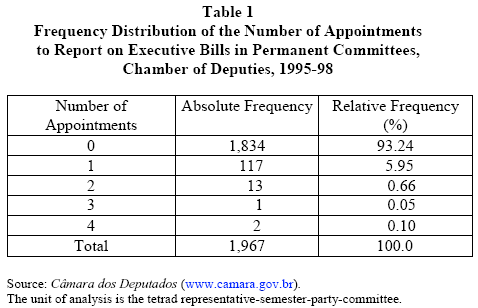
]]> The dependent variable is the number of rapporteurships of Executive bills computed in each tetrad. We restricted the sample to bills sent to the Chamber by the Executive during the 1995-98 legislature and for which at least a rapporteur was appointed in any permanent committee (except for the Committee on Constitution and Justice). Originally, we identified a total of 146 bills that fell into the criteria. We eliminated 18 whose matters we considered as plainly irrelevant from a partisan perspective.26 For the remaining 128 there were 166 rapporteur appointments in the committees. Of this set, we excluded 12 appointments of representatives who were substitutes in the committees.27 After this selection, the total number of appointments of representatives to report on Executive bills in permanent committees from 1995 to 1998 was 154. Table 1 presents that variable's frequency distribution.
The hypotheses in section 4.1 were tested through a negative binomial regression model which is appropriate for count variables, as the number of rapporteurships.28 Count data often present over-dispersion, i. e., conditional variance larger than the conditional mean. If the over-dispersion is not taken into account, the model is prone to predict counts of value zero with a frequency significantly lower than that observed. The negative binomial model includes an additional parameter (alpha) that measures the degree of over-dispersion of the data and, if it is there, deals with the under-prediction of zeros through an increase of the conditional variance, maintaining the conditional mean. However, as the sample has a very high number of values zero (see Table 1) it is likely that even the negative binomial model will present an under-prediction of zeros. Because of this, we estimated a version of this model, called ‘zero inflated' that corrects the impact of the excess of zeros through the reduction of the conditional mean by a factor corresponding to the proportion of zeros, estimated, for instance, through a logit model of the probability of a zero being observed in the sample (Cameron and Trivedi, 1998; Long, 1997, ch. 8; Zorn, 1998).
From a substantive perspective, our modeling of the excess of zeros is different from the usual models. The commonest assumption in the literature is that the excess of zeros derives from a qualitative difference (unknown to the analyst) among sample subjects, and this implies a probability equal to one of observing a zero value for a considerable part of the cases (Long, 1997, ch. 8; Zorn, 1998). In our specific problem, it amounts to assume that there are two (unknown) groups in the sample: one of them with representatives with zero probability of being appointed as rapporteurs, and the other with representatives with a positive probability. As our sample excludes all cases where there was a practical impossibility for the representative to take on a rapporteurship (for instance, for he was on leave or did not belong in the corresponding committee), however, this assumption does not apply. In truth, the zero excess in our sample derives both from the relatively low number of Executive bills and from our definition of the unit of analysis (which multiplies the number of representatives by legislative semester, party and committee). As a function of this, the number of zeros is not only inflated as it varies through legislative semester and committee.29 Then, instead of assuming a qualitative difference among representatives, we modeled the occurrence of zeros directly, as a function of the probability, defined a posteriori, of the occurrence of zero rapporteurships in each of the sample cases.
Our definition of the unit of analysis suggests, at first sight, a violation of the assumption of independence among the representatives of the same pair committee-semester. This is so because, given the number of projects sent to a particular committee in a given semester, the number of rapporteurships of a committee's representative must be negatively correlated to the number of rapporteurships of the other representatives in the same committee. However, while possibly a consequence of the way the data were organized, this problem does not derive of the process of data generation. This is so because the committees' chairmen choose the rapporteurs without previous knowledge of the total number of rapporteurships to be distributed during the legislative semester, as the projects are presented and sent to the committees through time, and not all at once. Thus, the number of rapporteurships of each of the committee members may be conceived as independent of the number of rapporteurships of the other members. On the other hand, there may be a correlation between the number of rapporteurships of a representative across semesters. This potential correlation is taken into account in the model through the use of robust standard errors (the traditional Huber-White formula) with clusters defined for each representative.
5.2. Measurement
The concepts used in the hypotheses were operationalized as follows.
]]> Distance from the cartel is our proxy for the representative's bias relative to the cartel's agenda. It measures the distance from the cartel's ideology and that of the representative's party. To compute this variable, we first defined the position of the congressional parties along a left-right axis, using our own judgment based on the literature and common sense. Figure 1 below shows the parties' positions and their respective values along that axis.30 From the values so determined, we defined the cartel's position in the axis as the mean of the values of the parties in the coalition, weighted by their respective sizes within the coalition. With that operational definition, the cartel's position in the axis equals 1.5 in 1995 and 2.5 from 1996 on (when the PPB entered the cartel). Finally, we defined distance from the cartel as zero for the representatives from parties in the cartel, and that practically means considering the governmental coalition as a single party.Committee loyalty is our proxy for the degree of divergence between the committee's median legislator and the cartel's leadership, expressed as the median of the loyalty rate to the cartel on the part of the committee's members. The loyalty rate to the cartel for each representative was computed for each legislative semester, being equal to the number of times the representative followed, in relevant nominal votes,31 the vote of the government's leadership, minus the number of times he did not follow it, divided by the number of relevant votes in which he took part. Committee loyalty has a theoretical minimum of –1 (most of the committee members did not follow the government's leadership in any vote) and a maximum of +1 (most of the members followed the government in every vote). In the actual sample, the committee loyalty's maximum value is 0.92 (observed in the Finance and Taxation Committee in 1998) and the minimum is –0.295 (in the Labor, Administration and Public Service Committee, in the first semester, 1996).
We did not use the ideological location of the committee's median legislator's party to operationalize the degree of divergence between this legislator and the cartel's leadership for the result would be practically a constant, given that the median legislator belonged to the PMDB in most committees. We considered the median of the loyalty rate a good approximation to the degree of divergence between the median legislator and the cartel's leadership for two complementary reasons. First, because of the expected theoretical relation of the two concepts, that is, that preference heterogeneity is a necessary condition for lower party loyalty. Second, because, given the decentralized organization and the high number of factions that form the median party in the Chamber, PMDB, that theoretical relation will also be one of sufficiency among that party's members.
Opposition chairs the committee is an indicator variable that takes on value 1 when the committee's chairman does not come from a cartel's party and value 0 when he is a Cartel's party member. The parties that were part of the majority coalition were PSDB, PFL, PMDB, PTB and, from the first semester of 1996 on, PPB.
From the first and second hypotheses, the effect of distance from the cartel is conditioned by committee loyalty and by opposition chairs the committee. In order to test for this conditional relationship, we included in the model interactions of distance from the cartel with each of these two variables, one at a time and both together. Specifically, from the first hypothesis, the postulated relation is that distance from the cartel has a negative effect on the number of the representative's rapporteurships, but if, and only if, committee loyalty is sufficiently smaller than 1 and if opposition chairs the committee equals zero. From the second hypothesis, the number of rapporteurships is a quadratic function of distance from the cartel, specifically a parabola with concavity directed upwards (i. e., in the form of an inverted U-shape), but if, and only if, committee loyalty is smaller enough than 1 and opposition chairs the committee equals 1. To test the quadratic relationship from the second hypothesis, we included in the model the square of distance from the cartel, alone, in interaction with opposition chairs the committee and in simultaneous interaction with this variable and committee loyalty.
Specialist is an indicator variable that takes on value 1 if the representative has specialized knowledge about some theme belonging to the committee's attributions, and zero if he does not have it. By specialized knowledge, we mean educational or professional experience. Thus, for instance, a representative in the Committee on Economy, Industry and Commerce – CEIC, is considered a specialist if he has a degree in Economics or if he is a director in a large enterprise. Non specialist with high educational level is also an indicator variable that has a value of 1 when the representative has completed higher education, but cannot be considered a specialist in any of the themes within the committee's attributions; otherwise its value is zero. From hypothesis 3, we expect both Specialist and Non-specialist with high educational level to have positive effects, but if, and only if, committee loyalty is lower enough than 1. We also expect the effect of the former variable to be larger than that of the latter.
We included other variables in the model, as controls. The main motivation for the use of controls comes from the alternative explanation to the cartel thesis: as well as the permanent committees' chairs and other relevant functions, rapporteurships of Executive bills may also be distributed among parties following the proportionality criterion. Thus, we expect that, the larger the number of party members of the representative's party in the committee the higher the likelihood of his being appointed rapporteur. Therefore, our first control variable is Party size, operationally defined simply as the percentage of committee members (except substitutes) that belong to the representative's party. Still with the idea that rapporteurships are attributed among parties according to their size, it is reasonable to expect that intra-party criteria of benefit distribution are equally relevant for all representatives. Two criteria are potentially relevant here: the representative's loyalty to his party and his seniority in it. Loyalty to the party was computed the same way as the cartel's loyalty rate, in this case taking into account the vote of the majority of the representative's party members (instead of that of the cartel's leadership). Seniority was operationalized as duration of party affiliation, in years, transformed to a logarithmic scale.32 If present, the effect of both variables should be positive.
Finally, in what respects the specification of the binary model, we operationalized the probability of zero rapporteurships in each case in the sample considering two variables: selection probability and committee's number of rapporteurships. The probability of a representative being selected at random by the committee's chairman is simply the inverse of the number of his committee's members (except substitutes). The number of the committee's rapporteurships is simply the total sum of appointments made by the chairman in the semester, while the representative exerted his term in office (thus being a potential candidate). The probability of not observing at least one rapporteurship of Executive bills in any representative-semester-party-committee tetrad is a decreasing function of selection probability and of the logarithm of committee's number of rapporteurships.
The descriptive statistics of the previously defined independent variables is presented in Table 2.
5.3 Results
]]> Our regression model's estimates of the number of appointments to report on Executive bills are presented in Table 3. We estimated two models, one with and the other without the control variables for the alternative explanation. As the negative binomial model's coefficients lack a substantive interpretation, we evaluated the substantive effects of the main independent variables through their impact on the predicted probability.First, let us look at how the selected statistical model fits the data. The estimate of the dispersion parameter (alpha) equals zero, and this allows one to conclude that the data are equally dispersed (variance equals mean). From a practical point of view, this implies that the coefficient estimates of the negative binomial model are equivalent to those of the simpler count model, the Poisson. Moreover, as the degrees of freedom are very high in this case, there is no relevant loss of efficiency, and this makes the results of both models practically the same.33 Our option for the ‘zero-inflated' version of the model was correct: we found strong evidence that in fact the excess of zeros derives to a good extent from the way we defined the unit of analysis (the tetrad representative-semester-party-committee). Selection probability and the logarithm of committee's number of rapporteurships both had negative and highly significant coefficients. We may then conclude that the chosen model fits the data well.
Let us now evaluate the fit of the model's specifications to the data, as measured by the Deviance pseudo R².34 The second model achieved a proportional reduction of error of 19.2%, a reduction that is slightly larger than that achieved by the first (17.8%), without the control variables. It is worth saying, however, that a great part of the error reduction is due to the specification of the binary model – the full logit model with the negative binomial model comprising only the constant reduces the prediction error by 14.1%. At first sight, this is an indication that the predictive power of the substantively interesting variables is low. On the other hand, we should keep in mind that the excessive number of zeros in the dependent variable or, in other words, the unusualness of the phenomenon under study, severely restricts its adequate prediction. As a function of this, and because there is no previous knowledge about the dependent variable, we cannot be conclusive on the model's specifications fit to the data.
Is the evidence consistent with our first hypothesis? Through the achieved results, the estimated linear coefficient of distance from the cartel is significantly lower than zero (at the 5% level)35 only when the value of opposition chairs committee equals zero, and that of committee loyalty is lower than 0.76 in model 1, and 0.26 in model 2, what confirms our expectation that both variables have a conditional effect. However, in what respects the conditional effect of the latter variable in the second model, the observed value (0.26) is very low. This means that, even when the median legislator is disloyal enough to the cartel (for instance, when he follows its leadership in less than half of the votes), one does not observe the expected effect of distance from the cartel, and this is not totally consistent with our first hypothesis. In order to understand the lower value found in model 2, we re-estimated it excluding one control variable each time. We found, then, that the difference in the results derives from the inclusion of party size.36 We may then conclude that, when the size of the representative's party in the committee is taken into account, the evidence only partly confirms hypothesis 1.
Let us now turn to the evidence on the second hypothesis. The tests showed that only when the value of opposition chairs the committee equals 1, and the value of committee loyalty is lower than 0.76 and 0.80, in models 1 and 2, respectively, the estimate of the linear coefficient of distance from the cartel is significantly larger than zero, and the estimate of its quadratic term's coefficient is significantly smaller than zero (both at the 5% level). This means that the relationship of distance from the cartel to number of rapporteurships takes the form of an inverted U-shape, with its left side steeper than the right. Substantively, it amounts to saying that the probability of the representative being appointed as rapporteur on an Executive bill increases with his distance from the cartel, taking on its maximum value before half the distance from the cartel to the more distant opposition party, and then decreasing as the distance increases.37 Summing up, "moderate" opposition representatives have a greater probability than others of being appointed as rapporteurs on Executive bills when the committee's chair belongs to the opposition and its median legislator is not very loyal to the cartel. We conclude thus that there is strong evidence for hypothesis 2.
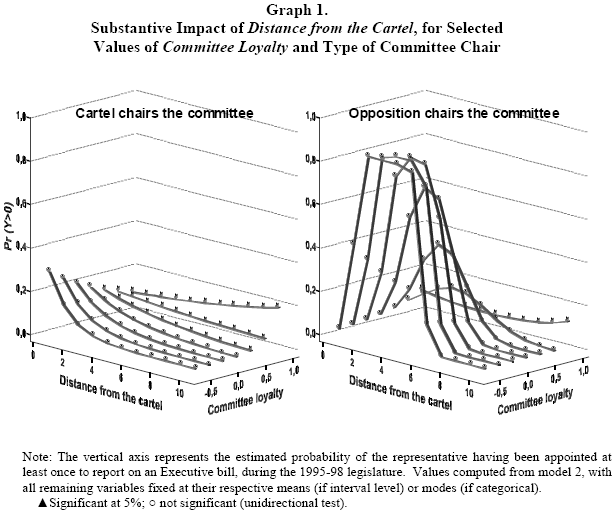
In order to evaluate the substantive impact of distance from the cartel we used the method of predicted probabilities.38 This method consists in the estimation, for each value of the selected independent variable, of the predicted probability that the event under study occurs when the values of all remaining independent variables are fixed at the analyst's criterion. In this particular application, we estimated, on the basis of model 2, the predicted probability of the representative being appointed at least once, along the 1995-98 legislature, as rapporteur of an Executive bill.39 Estimates were computed as a function of distance from the cartel and of the mediator variables, opposition chairs committee and committee loyalty,40 keeping the remaining variables in the model fixed at their respective means, when interval level, or modes, when categorical. Graph 1 below shows the results.
Notice, in the graph that shows the effect of distance from the cartel when the committee is chaired by a member of the government's base, that the relationship is not statistically significant for values of loyalty higher than 0.25. Now, in the graph that shows the effect of distance when the committee is chaired by an opposition's member (corresponding to the second hypothesis), it is clear that, only when loyalty takes on a high value (larger than 0.75) the relationship is not statistically significant. The quadratic effect can be clearly identified in the latter graph, it being so much stronger as committee loyalty decreases. Notice also that the maximum in each curve is reached for a value that, in the distance axis, corresponds to the notion of ‘moderate' opposition (in the case, a value of 3).
The impact of distance from the cartel on the predicted probability of the representative being chosen as rapporteur at least once is substantial. In the case in which the cartel chairs a totally ‘disloyal' committee (i. e., whose loyalty value is, say, 0.25) the probability of a representative of ‘moderate' opposition (distance of 3) being chosen rapporteur is only 0.05, against 0.15 for a member of the cartel (distance of zero). This effect is larger for lower levels of committee loyalty. When the committee is chaired by an opposition's member the effect is stronger: when loyalty equals 0.25, the increase of the value of distance from zero to 3 increases the predicted probability from 0.03 to 0.66! Even in the case of a slightly disloyal committee, with loyalty equal to, say, 0.25, that increase implies an impact on the predicted probability from 0.06 to 0.17.
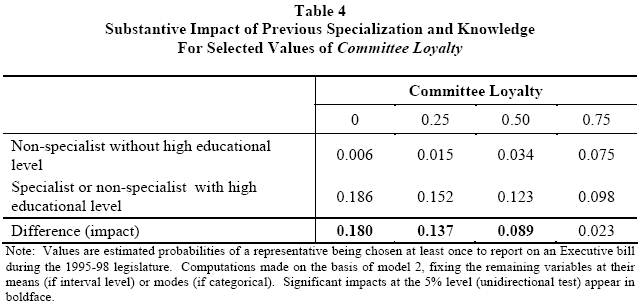
In what respects the third hypothesis, the tests relative to the estimated coefficients of specialist and non-specialist with high educational level show that both are significantly larger than zero (at the 1% level) in both models, but only for values of committee loyalty not higher than 0.71, for model 1, and to 0.68, for model 2. However, the evidence does not allow one to reject the null hypothesis that there is no significant difference between the estimates of the total coefficients, whatever the loyalty value. That is, the evidence corroborates the postulated effect of previous knowledge or ability of the representative on his chance of being appointed rapporteur of an Executive bill, but it indicates that this chance is equally affected either if the representative is a specialist in the matter, or if, not being a specialist, he has high educational level. Even not having found support for the postulated difference between specialists and non-specialists with higher educational level, we evaluate that the most important relationship for our thesis was duly corroborated, i. e., that these factors have a positive effect and that this effect only exists when there is an informational demand on the part of the committee's median legislator. Therefore, our evaluation is that hypothesis 3 was corroborated by the evidence, if not totally, at least in its main part.
The substantive effect of specialist and non-specialist with high educational level is presented in Table 4. As there is no significant difference in the coefficients of both variables and as their categories are mutually exclusive, we computed the impact for the case that either one or the other is true. Thus, for example, when committee loyalty equals zero, the fact that the representative is a specialist or a non-specialist with high educational level increases from 0.006 to 0.186 the estimated probability of his being chosen to report on an Executive bill. This impact decreases as loyalty increases: it goes from 0.034 to 0.123 when loyalty equals 0.5. From the size of the observed impacts, we can say that the effect of expertise is also substantial.
]]> As to the control variables, all the estimates of their respective coefficients were significant and in the expected direction. As either their party size in the committee, or their loyalty to the party, or still their time of affiliation to the party increase, the higher the probability of the representative being chosen to report on an Executive bill. The substantive effects of these variables on the estimated probability of the representative being chosen at least once during the legislature are shown in Table 5. In order to simplify, for each of these variables we present only their maximum potential impact and their mean standard impact.41 Through the values in Table 5, it is clear that, with the possible exception of seniority, these variables have substantively relevant impacts.In order to test for the sensitivity of the model estimates to our measure of representatives' preferences, we re-estimated model 2 using an alternative measure of distance from the cartel, constructed on the basis of NOMINATE estimates (Poole and Rosenthal, 1985) of the representatives' ideal points, produced by Leoni (2002).42 The new measure is equivalent to the absolute difference between the value of the NOMINATE estimate of the (opposition) representative and the weighted mean of the NOMINATE estimate of the cartel's parties. We found only two differences worthy of attention between the results reached with our original measure and those reached with the alternative. First, there was a reduction of the limiting value of committee loyalty after which the effect of distance from the cartel is significant and negative (when opposition chairs the committee equals zero), from 0.26 to zero. This means that, with the alternative measure, the evidence for hypothesis 1 is still more precarious. The second difference is that, when we use the alternative measure, the estimated coefficient for time of party affiliation is no more significant. There were no other differences, both in the substantive conclusions and in the statistical results, what leads us to conclude that the model is robust enough to both measures. Lastly, despite the fact of our measure not being able to capture variations of intra-party preferences, we consider that, for the purposes of this work, it is conceptually more appropriate than the NOMINATE estimates for, in this specific case, the latter reflect rather the representatives' position for or against the government than their policy preferences (Leoni, 2002: 382).
Therefore, we may conclude that both statistically and substantively, the evidence corroborates in a satisfactory way our thesis on the rapporteurs' selection, even if we did not find total support for our first hypothesis, and with the slight qualification we were forced to make as to the third one. Especially important is the fact that the evidence is strong for our second hypothesis, which is the central implication for our explanation for the systematic appointment of opposition's representatives to report on projects that are of interest to the cartel.
6. CONCLUSION
In this work, we proposed a non-conventional interpretation of the mechanism through which the rapporteur exerts his influence on the committee's final decision. Instead of formal powers, we argued that the rapporteur has a de facto power that consists in the possibility of making strategic use of information, which is expensive for the committee's median legislator. The rapporteur's function is, in our view, informational – he is a kind of ad hoc advisor to his peers.
For the relevance of our thesis, we argued that it adds explanatory power to a recent theoretical contribution on the way the Brazilian Legislative operated during Fernando Henrique Cardoso's first term in office. As we believe we have shown, the cartel's theory is only able to explain the systematic appointment of opposition's rapporteurs for bills of interest for the Executive when our perspective is adopted. Besides arguments, we also presented quantitative evidence as to the fact that the selection of rapporteurs for Executive bills during Fernando Henrique Cardoso's first term in office followed patterns that are consistent with our informational perspective. We found that the selection of opposition's rapporteurs, if, on the one hand, depended on the kind of committees' chairmen, on the other, reflected the informational needs of its median legislator, for it was conditioned by the latter's expectation relative to the quality of the recommendations made by the cartel and to the quality of the information produced by the eventual rapporteurs.
In our analysis, we only looked at a particular aspect of the process of public policy formulation: the selection of rapporteurs in the permanent committees. This, however, may be conceived as a stage in a wider game, where preceding and succeeding stages are also fundamental. In the specific context we studied, before the rapporteur's selection there is the Executive's decision as to what policy it is going to propose, and how. The Executive may decide to postpone, or even not to present some policy if it expects that the committee's final decision will be adverse. In addition, the Executive has the choice of issuing a decree, so preventing it from being examined by a committee where it expects to run into difficulties. After the committee's decision, and unless the committee was given a terminating power, the relevant player is the Chamber's floor. To what extent does the fact that our analysis ignores these other stages affect the validity of our inferences?
In what respects the Assembly's final decision, in order for it to affect the rapporteur's selection, the ideal points of the median legislators of both the committee and the Assembly must be sufficiently different. In the specific case we studied, this is more likely either if there is (1) a median legislator disloyal to the cartel in the committee and a loyal one in the Assembly or (2) vice-versa. Notice, however, that if the median legislator in the committee is loyal to the cartel the rapporteurship lacks strategic value and the degree of difference relative to the median legislator in the Assembly does not affect the rapporteur's selection. So, scenery 2 may be discarded for irrelevance. As to scenery 1, we know that if the committee's chairman is loyal to the cartel he will never choose a rapporteur that will lead the median legislator in the committee to decide against the Executive and therefore against the median legislator in the Assembly. Thus in this case too the selection of the rapporteur is not affected by the divergence between committee and Assembly. Only when the committee's chairman belongs to the opposition will the selection of the rapporteur be affected as the chairman will chose a representative closer to the Executive's proposal. And this because the chairman runs the risk that the Assembly either withdraws the project from the committee (recurring to urgency) or simply ignores the committee's recommendation. Summing up, our inference about hypothesis 2 must not be valid (only) when the median legislator in the Assembly is loyal to the cartel.
As to the Executive's decision on what projects he chooses and how it will deal with them, it implies that our results are conditioned to the set of bills effectively presented. This means that our analysis has a selection bias. The direction of this bias, however, is known: as it is reasonable to assume that the Executive will only send bills when it expects the committee's decision not to be too unfavorable, then our estimate of the probability of an opposition's representative being chosen to report on an Executive bill is under-evaluated – in other words, our sample eases the effect we postulate as existing. Thus, this aspect is not a threat; in fact, it reinforces the validity of our inferences.
]]> What does this article add to the current stage of the study of legislative behavior in Brazil? It goes a step further when it weights the thesis according to which, once constructed a majority coalition in support of the Executive's policies, all the Legislative agenda will serve the Executive's proposals. We argued that the "spirit" of the proportional "law" that rules over the country's party representation, a spirit incorporated both to the internal rules of the Chamber and to its practices, has important effects in this Chamber's decision-making processes, creating opportunities for opposition representatives to reach relevant positions, as, for instance, rapporteurships of Executive bills. Our argument also serves to moderate the theses according to which the presumed fragmentation of preferences and lack of party discipline (imagined consequences of proportional representation with open lists) make work in the Chamber a disperse and unpredictable task. We tried to show that there are systematic determinants of the choice of rapporteurs, even when they come from the opposition, and that such determinants may be defined through logically consistent and empirically testable propositions.The next steps in the research seem clear to us. We must establish, first, theoretical propositions that account for the Executive's decision-making process when it sends to the Legislative matters subjected to ordinary course, thus exposed to be reported on by opposition's representatives. It is then necessary to specify the fate of these matters in their remaining course. This is a crucial phase, for it will indicate to what extent the proportional component in the organization of the legislative activity is important not only as a representation and inclusion principle, but also as an institutional mechanism that is responsible for the production of systematic effects on Brazil's legal status quo.
NOTES
1 For a good analysis of the legislative process that changed the legal status quo in the telecommunications sector, see Velasco Jr. (2005).
2 The idea of the rapporteur as an informational agent to the committee appears also in Montenegro (2004).
3 For a summary of the two currents, see Shepsle and Weingast (1995).
4 Ames (2000), Carvalho (2003), Pereira and Muller (2002) e Samuels (2003) belong in the first group. Figueiredo and Limongi (1999), Meneguelo (1999), Pessanha (1997) e Santos (2003), in the second. For an evaluation of the application of the distributive and informational models to the decision-making process in the Chamber of Deputies, see Pereira and Muller (2000) and Ricci and Lemos (2004).
5 See Figueiredo and Limongi (1999), Meneguello (1998), Pereira and Mueller (2000) and Santos (2003).
6 With regard to the positions in the committees, a strong incentive against the permanence of representatives as members: the fact that the chairman's period in office is restricted to one year, reelection forbidden (Camara dos Deputados, 2004, art. 39). Many texts draw attention to the importance of seniority in the American Congress – good examples are Mayhew (1974), Fiorina (1977), Krehbiel (1991), Parker (1992), Shepsle (1979) and Weingast and Marshall (1983).
]]> 7 On careers, see Samuels (2003) and Santos (2003). On the determinants of representation and reelection in the Brazilian context, see Pereira and Rennó (2001).8 See Pessanha (1997) and Figueiredo and Limongi (1999).
9 Especially because congressmen have not formal power over both the choice and firing of ministers, what allows the Executive's head, when willing to grant their support, to select individuals that are in the congressmen indifference frontier.
10 The public hearing is mentioned in arts. 255 and 256 of the internal rules. To our knowledge, however, there is no academic work evaluating the frequency with which committees hold public hearings on themes related to bills under their scrutiny. We also do not know analyses of how do congressmen allocate their time among the various legislative and extra-legislative activities.
11 This is not the case in the special committees where the practice is that the chair and the rapporteurship be given to the two largest parties in the Chamber.
12 See articles 8, 27 and 39 of the internal rules on the choice of the Chamber's directing body, the committees' composition and election of the committees' chairmen, respectively. The linear regression coefficient of each party's percentage of chairs on their respective sizes is 0.98, showing a perfect proportionality.
13 This interaction corresponds to a signaling game. For an introduction, see Morrow (1994).
14 In what follows, by uncertainty we mean only ‘uncertainty regarding results.'
15 This is not in contradiction with the premise that, as a general rule, congressmen face an ‘informational problem.' Specialization, in this case, is previous, i. e., it derives either from the congressman's educational or from his professional experience, and not from his systematic performance in the committee (Santos, 2003: 101).
16 For simplicity's sake, we assume that information may be omitted, but not falsified.
]]> 17 As we argued in the previous section, the chairman is not freely chosen by the committee, and this increases the likelihood of his preference being different from that of the committee's median legislator.18 Restricting our analysis to projects originating in the Executive, we assume that they reflect the veto power of the cartel's members, generated as they were by the governmental coalition. In other words, we consider that the agenda is given when the Executive sends the bills.
19 On the rate of discipline, see Nicolau (2000). Alternatively to party discipline, the cartel's agenda may be implemented through ‘extraordinary powers', as the Executive's decree power (Amorim Neto et al, 2003: 551). As our sample includes only bills, we may conclude that we are analyzing cases in which the rate of discipline expected by the Executive was high enough. This means that the sample makes the demonstration of our argument more difficult.
20 The analysis included only committees chaired by the opposition and excluded bills for which the opposition supported the urgency request. The estimated beta of the logit regression of the urgency request on the kind of rapporteur was not significant. We also observed that the likelihood of the cartel requesting urgency for a bill did not increase with the number of committees chaired by the opposition to which the project had been sent. For an analysis of the determinants of the use of urgency, see Pereira and Muller (2000).
21 We understand that this finding represents a strong qualification to the premise according to which ‘the existence and functioning of the committee system are subordinated to the Executive's preferences.' (Pereira and Muller, 2000: 46).
22 We think it is reasonable to assume that the Executive is well informed with regard to the public policies it proposes.
23 This information comes from the website of the Câmara de Deputados (Chamber of Deputies). The dataset is available, through e-mail, from each of the authors.
24 3,542 cases = (513 representatives – 7 members of the directing body) ´ 7 legislative periods.
25 This was the case, for example, of the Foreign Relations Committee in 1995. There is still the case of the Financial Inspection and Control Committee that does not examine bills. We also excluded the cases of the rapporteurship of the Constitution and Justice Committee that usually does not examine the bills' content.
26 Bills that, like the 978/95, gave names to roads and viaducts, and bills that, like the 4505/98, attributed special allowances to individuals.
]]> 27 We decided not to include the committees' substitutes in the universe of potential rapporteurs because of the low frequency of their appointment. We thus avoided an excessive increase in the number of null cases in the dependent variable.28 For a rapid introduction to count models, see Long (1997, chapter 8).
29 The Labor, Administration and Public Service Committee appointed 26 rapporteurs in 1998, but only 11 in 1995. On the other hand, the Agriculture and Rural Policy Committee appointed only one rapporteur in each of the years 1995, 1996 and 1998.
30 Notice that our ordering of the larger parties is the same as that of Amorim Neto et al (2003).
31 We defined a vote as relevant if and only if its Carey Relevance Index – CRI is equal to or larger than 20. CRI = % present × [1 - ½% yes - % no½] (Carey, 1998).
32 The logarithmic transformation of variables that express duration is usual. The reason for this is that the marginal effect tends to be lower for higher values of the variable.
33 The negative binomial estimates are less efficient than the Poisson ones for the former model estimates one parameter (alpha) more than the latter.
34 As there is no consensus over a measure of fit for non-linear models, we decided to use the Deviance pseudo-R² for it is that which gets closer to the assumptions of the R² of a linear model. On this, see Cameron and Windmeijer (1996).
35 All significance levels utilized in hypothesis testing are unidirectional.
36 Distance from the cartel and party size are correlated, but not to the point of suggesting that their independent effects cannot be estimated with enough precision (r = -0.49, p < 0.001).
]]> 37 In our computations, the maximum is reached when distance is approximately 3, what is consistent with the notion of ‘moderate' opposition.38 All predicted probabilities were computed utilizing the Spost package (Long and Freese, 2003).
39 In fact, we estimated the probability q of observing zero rapporteurships in the tetrad representative-semester-party-committee and, then, we computed the probability p of the representative getting at least one rapporteurship during the entire legislature in the following way: p = 1 – q7, where the seventh power represents the number of legislative periods.
40 For loyalty, we selected only multiples of 0.25, the minimum being –0.50 and the maximum 1.0.
41 The former is the impact on the estimated probability deriving from the increase of the variable from its minimum to its maximum sample values. The latter derives from the increase of one standard deviation of the variable around its mean.
42 We thank Eduardo Leoni for the readiness with which he made his data available for our analysis. The model's result with the alternative measure may be gotten asking the authors.
REFERENCES
AMES, Barry. (2000), The Deadlock of Democracy in Brazil: Interests, Identities and Institutions in Comparative Perspective. Ann Arbor, The University of Michigan Press. [ Links ]
AMORIM NETO, octavio, COX, Gary W. and MCCUBBINS, Mathew D. (2003), "Agenda Power in Brazil's Câmara dos Deputados, 1989-98". World Politics, vol. 55, nº 4, pp. 550-578. [ Links ]
AUSTEN-SMITH, David and RIKER, William H. (1987), "Asymmetric Information and the Coherence of Legislation". American Political Science Review, vol. 81, nº 3, pp.897-918. [ Links ]
CALVERT, Randall L. (1985), "The Value of Biased Information: A Rational Choice Model of Political Advice". Journal of Politics, vol. 47, nº 2, pp. 530-555. [ Links ]
CÂMARA DOS DEPUTADOS. (2004), Regimento Interno da Câmara dos Deputados. Available through <http://www2.camara.gov.br/legislacao/regimentointerno.html> [ Links ]
CAMERON, A. Colin and TRIVEDI, Pravin K. (1998), Regression Analysis of Count Data. New York, Cambridge University Press. [ Links ]
CAMERON, A. Colin and WINDMEIJER, Frank A.G. (1996), "R-Squared Measures for Count Data Regression Models with Applications to Health Care Utilization". Journal of Business and Economic Statistics, vol. 14, pp. 209-220. [ Links ]
CAREY, John. (1998), "Electoral Reform and the Chilean Legislative Party System". Working Paper Series. Centro de Investigación y Docencia Económica, Mexico, D.F. [ Links ]
CARVALHO, Nelson Rojas. (2003), E no Início Eram as Bases: Geografia Política do Voto e Comportamento Legislativo no Brasil. Rio de Janeiro, Revan. [ Links ]
CRAWFORD, Vincent P. and SOBEL, Joel. (1982), "Strategic Information Transmission". Econometrica, vol. 50, Nº 6, pp.1431-51. [ Links ]
DUR, Robert and SWANK, Otto H. (2005), "Producing and Manipulating Information". The Economic Journal, vol. 115, pp.185-199. [ Links ]
FIGUEIREDO, Argelina C. and LIMONGI, Fernando. (1999), Executivo e Legislativo na Nova Ordem Constitucional. Rio de Janeiro, Fundação Getulio Vargas Editora. [ Links ]
FIORINA, Morris. (1977), Congress: Keystone of the Washington Establishment. New Haven, CT, Yale University Press. [ Links ]
GILLIGAN, Thomas W. and KREHBIEL, Keith. (1987), "Collective Decision-Making and Standing Committees: An Informational Rationale for Restrictive Amendment Procedures". Journal of Law, Economics, and Organization, vol. 3, nº 2, pp. 287-335. [ Links ]
___. (1989), "Asymmetric Information and Legislative Rules with a Heterogeneous Committee". American Journal of Political Science, vol. 33, nº 2, pp. 459-490. [ Links ]
___. (1997), "Specialization Decisions within Committee". Journal of Law, Economics, and Organization, vol. 13, nº 2, pp.366-386. [ Links ]
KREHBIEL, Keith. (1991), Information and Legislative Organization. Ann Arbor, The University of Michigan Press. [ Links ]
KRISHNA, Vijay and MORGAN, John. (2001), "A Model of Expertise". The Quarterly Journal of Economics, vol. 116, nº 2, pp. 747-775. [ Links ]
LEONI, Eduardo. (2002), "Ideologia, Democracia e Comportamento Parlamentar: A Câmara dos Deputados (1991-1998)". Dados, vol. 45, nº 3, pp. 361-386. [ Links ]
LONG, J. Scott. (1997), Regression Models for Categorical and Limited Dependent Variables. Thousand Oaks, CA, Sage Publications. [ Links ]
___ and FREESE, Jeremy. (2003), Regression Models for Categorical Dependent Variables Using Stata. College Station, TX, Stata Press. [ Links ]
MAYHEW, David R. (1974), Congress: The Electoral Connection. New Haven, CT, Yale University Press. [ Links ]
MENEGUELLO, Rachel. (1998), Partidos e Governos no Brasil Contemporâneo (1985-1997). São Paulo, Paz e Terra. [ Links ]
MILGRON, Paul and ROBERTS, John. (1986), "Relying on the Information of Interested Parties". Rand Journal of Economics, vol. 17, nº 1, pp.18-32. [ Links ]
MONTENEGRO, Nelson. (2004), Informação na Comissão de Economia, Indústria e Comércio. Paper presented to the 4º Encontro Nacional da Associação Brasileira de Ciência Política (4th National Meeting of the Brazilian Political Science Association), PUC-Rio, Rio de Janeiro, 21-24 julho. [ Links ]
MORROW, James D. (1994), Game Theory for Political Scientists. Princeton, NJ, Princeton University Press. [ Links ]
NICOLAU, Jairo. (2000), "Disciplina Partidária e Base Parlamentar a Câmara dos Deputados no Primeiro Governo Fernando Henrique Cardoso (1995-1998)". Dados, vol. 43, nº 4, pp.709-735. [ Links ]
PARKER, Glenn R. (1992), Institutional Change, Discretion, and the Making of Modern Congress: An Economic Interpretation. Ann Arbor, MI, The University of Michigan Press. [ Links ]
PEREIRA, Carlos and MUELLER, Bernardo. (2000), "Uma Teoria da Preponderância do Poder Executivo". Revista Brasileira de Ciências Sociais, vol. 15, nº 43, pp. 45-67. [ Links ]
___. (2002), "Comportamento Estratégico em Presidencialismo de Coalizão: As Relações entre Executivo e Legislativo na Elaboração do Orçamento Brasileiro". Dados, vol. 45, nº 2, pp. 265-301. [ Links ]
PEREIRA, Carlos and RENNÓ, Lúcio. (2001), "O que É que o Reeleito Tem? Dinâmicas Político-Institucionais Locais e Nacionais nas Eleições de 1998 para a Câmara dos Deputados". Dados, vol. 44, nº 2, pp. 323-361. [ Links ]
PESSANHA, Charles. (1997), Relações entre os Poderes Executivo e Legislativo no Brasil: 1946-1994. Doctoral Dissertation, USP, São Paulo. [ Links ]
POLSBY, Nelson W. (1968), "The Institutionalization of the U.S. House of Representatives". American Political Science Review, vol. 62, nº 2, pp. 144-168. [ Links ]
POOLE, Keith and ROSENTHAL, Howard. (1985), "A Spatial Model for Legislative Roll Call Analysis". American Journal of Political Science, vol. 29, nº 2, pp. 357-384. [ Links ]
RICCI, Paolo and LEMOS, Leany Barreiro. (2004), "Produção Legislativa e Preferências Eleitorais na Comissão de Agricultura e Política Rural da Câmara dos Deputados". Revista Brasileira de Ciências Sociais, vol. 19, nº 55, pp.107-130. [ Links ]
SAMUELS, David J. (2003), Ambition, Federalism, and Legislative Politics in Brazil. New York, Cambridge University Press. [ Links ]
SANTOS, Fabiano. (2003), O Poder Legislativo no Presidencialismo de Coalizão. Belo Horizonte, Editora UFMG. [ Links ]
SHEPSLE, Kenneth A. (1979), The Giant Jigsaw Puzzle. Chicago, The University of Chicago Press. [ Links ]
___ and WEINGAST, Barry R. (1995), "Positive Theories of Congressional Institutions", in K. A. Shepsle and B. R. Weingast (eds.), Positive Theories of Congressional Institutions. Ann Arbor, The University of Michigan Press. [ Links ]
VELASCO JR., Licínio. (2005), A Política Pública de Privatização no Presidencialismo de Coalizão Brasileiro. Doctoral Dissertation, IUPERJ, Rio de Janeiro. [ Links ]
WEINGAST, B. and MARSHALL, W. (1983), "The Industrial Organization of Congress; or, Why Legislatures, Like Firms Are Not Organized as Markets?" Journal of Political Economy, vol. 96, nº 1, pp.132-163. [ Links ]
ZORN, Christopher J.W. (1998), "An Analytic and Empirical Examination of Zero-Inflated and Hurdle Poisson Specifications". Sociological Methods and Research, vol. 26, nº 3, pp. 368-400. [ Links ]
ABOUT THE AUTHORS
Fabiano Santos, professor and researcher of the Instituto Universitário de Pesquisas do Rio de Janeiro – IUPERJ, is the author of O Poder Legislativo no Presidencialismo de Coalizão (Belo Horizonte/Rio de Janeiro, Editora UFMG/IUPERJ, 2003) and, with Fátima Anastasia and Carlos Ranulfo Melo, Governabilidade e Representação Política na América do Sul (São Paulo/Rio de Janeiro, Editora Unesp/Fundação Konrad Adenauer, 2004) (E-mail: fsantos@iuperj.br).
Acir Almeida holds a master's degree in Political Science from the University of Rochester, NY. His areas of interest are: comparative political institutions, legislative studies and applied econometrics (E-mail: acir.almeida@uol.com.br).
* Preliminary versions of this work were presented at the First National Meeting of the Associação Brasileira de Ciência Política (Brazilian Association of Political Science), in July, 2004, and at the XXIX Yearly Meeting of the Associação Nacional de Pós-Graduação e Pesquisa em Ciências Sociais (National Association for Graduate Studies and Research in the Social Sciences), in October, 2005. We thank Wanderley Guilherme dos Santos for his comments; we also thank one of the reviewers for Dados. Chamber of Deputies is a literal translation of Câmara dos Deputados, the lower house of the Brazilian Congress.
i Encaminhamento, from encaminhar, literally to route, in the case to route a vote attending to the internal rules and procedures.
ii Colégio de líderes, a leaders' body that congregates the leaders of all parties represented in the Chamber.