La réforme de la sécurité sociale en deux temps
A reforma da previdência em dois tempos
Carlos Ranulfo Melo; Fátima Anastasia
Translated by Alan Daniel Freire de Lacerda
Translation from Dados - Revista de Ciências Sociais, v.48, n.2, p.301-332, Apr./June 2005.
ABSTRACT
This article analyzes Brazilian social security reform during the Fernando Henrique and Lula Administrations. After comparing the contexts in which the different Constitutional Amendment proposals (PECs) were submitted and the behavior by Members of Congress during the two periods, we argue that a contextual change (namely a switch in places between government and opposition) affected the distribution of preferences and resources between the players and impacted the government in the various arenas in which the game was being played, and that as a result the reformist agenda has made more progress under the current Workers' Party administration.
Key words: Social security reform; Executive [Legislative relationship]; government [opposition].
RÉSUMÉ
Dans cet article, on analyse la réforme de la Sécurité Sociale brésilienne sous les gouvernements de Fernando Henrique et de Lula. Après avoir établi une comparaison entre les contextes où ont été avancées les différentes PECs (Propositions d'Amendement Constitutionnel) et le comportement des parlementaires à ces deux moments, on soutient qu'un changement de type contextuel, c'est-à-dire l'inversion entre majorité et opposition, en modifiant la distribution des préférences et des moyens entre les acteurs et en bouleversant la majorité dans les diverses arènes où se déroulait le jeu politique, a contribué pour que, en somme, le programme réformiste progresse davantage sous le gouvernement du président Lula.
Mots-clé: réforme de la Sécurité Sociale; rapports pouvoir exécutif/pouvoir législatif; majorité/opposition
]]> INTRODUCTION
This article intends to compare the process of social security reform in the Fernando Henrique Cardoso and Luiz Inácio Lula da Silva administrations. As a starting point we assume that: 1) due to its intrinsic characteristics, reforms such as these are hard to pass; 2) the outcome of the process, within the congressional arena, can only be understood when the situation in other related arenas is taken into account; 3) the combination of features conducive to decentralization of power with those that favor centralization, so typical of the Brazilian institutional arrangement, limits the chances of success of the executive branch in endeavors of this sort.
Our first point is based on a key assertion by Arnold (1990) which states that proposals of public policies that impose concentrated costs and yield diffuse benefits and, additionally, are submitted to a decision-making process where representatives are obliged to assume publicly their positions, may be characterized as "politically unfeasible". In the case of social security reform, as emphasized by Figueiredo and Limongi (1999) and Melo (2002), this feasibility problem is further aggravated by at least two factors. Firstly, while the costs to be imposed to certain groups are noticeable and immediate – a fact that tends to cause contrary movements endowed with intense preferences –, the benefits created for the society at large, if they do come up, are only medium-term or long-term ones. Such situations are liable to generate a high degree of uncertainty among actors, either because people do not trust promises from the executive or due to a belief that the administration itself does not control several factors that, once at play, may eliminate the promised benefits. Secondly, one should take into account the high level of "deconstitutionalization" required by this sort of proposal (Melo, 2002). For instance, the cancellation of individual retirement rights opens the way for judicial intervention. Besides, any negotiation is always complex and repeatedly puts the trust in the executive at risk. After all, the situation of those who had their rights redefined is now to depend on the future management of regulatory process.
Our second point is based on a key assertion by Tsebelis (1998) to the effect that rewards reaped in the main arena of a multiple arena game are influenced by the prevailing situation in other arenas. The number of "nested" arenas and the importance of specific games in each one of them are dependent not only on the content of the policy at issue, but also on the features pertaining to decision-making processes. In the case of social security reform, four additional arenas, beyond the congressional one, should be considered: 1) the several echelons of the executive branch, since what is at stake there is the adjustment of public spending, a desideratum around which the president can mobilize large patronage and budgetary resources, with the aim of influencing legislators' behavior in the main arena; 2) the judicial branch, which might turn into an actor with veto power if resorted to given the level of "deconstitutionalization" required for the proposal's approval; 3) the societal arena, in which "attentive publics" will be mobilizing as a direct consequence of the imposition of concentrated costs; 4) the electoral one, whose ordinary importance is reinforced by roll-call votes, which render impossible for congresspersons to erase signs of their participation in unpopular decisions.
As to the institutional design, one should acknowledge that a tendency towards decentralization of power is largely dominant in the formation of Brazilian decision-making bodies. To begin with, the electorate votes for two legislative houses using distinct electoral rules. Deputies are elected by proportional representation with open lists, districts of high magnitude and a kind of electoral threshold – the electoral quota – that may be easily circumvented through inter-party alliances. Either at the electoral level or at the congressional level – Senate included –, the party system is highly fragmented, displaying a large number of small and medium-sized parties. Finally, the federalist system opens the way for other actors within state arenas, or even in municipal ones, to express voters' preferences in the national landscape.
However, the picture is quite the reverse as regards the decision-making process, even though one can point out elements in the national institutions that favor decentralization, such as: a) symmetry between the two legislative chambers, which are thus turned into reviewing houses; b) the requirement of a qualified majority for constitutional changes, which gives veto power to the minority; c) the possibility of appeal to the judiciary against decisions perceived as unconstitutional. The reverse is represented by two factors which are, in the view of Figueiredo and Limongi (1995, 1996 e 1999), responsible for the striking differences in performance between current Brazilian presidential system and its previous version in the former democratic period (1945-1964): the concentration of legislative powers in the executive and the centralization of legislative proceedings in the hands of party leaders. Conjoined, these features form a landscape in which the president has enough resources to determine the agenda and the pace of proceedings within Congress, while leaders can get their caucuses to behave in a cooperative and disciplined fashion, a fact that would minimize, if not nullify, the veto power of the legislative over executive's actions. In this view, the two above-mentioned characteristics would be able to "shield" the national decision-making process, preventing or inhibiting tendencies prone to power dispersal.
As is generally known, the seminal work of Figueiredo and Limongi triggered a fruitful controversy: some authors argue that party discipline in the Chamber of Deputies depends on variables like ideology (Nicolau, 2000), or the pool of patronage resources and the duration of the presidential term (Amorim Neto and Santos , 2001). In their analysis of the congressional budget process, Pereira and Mueler (2002) come to the conclusion that the executive is constrained to make more concessions than what it would like in order to secure the support of its coalition. For Melo (2000; 2004), in his study of party switching, one cannot speak of cohesion for most parties in the Chamber, as long as deputies have another option than following their current leader to have access to patronage shares: seek for one better placed in the decision-making process. Based on attitudinal data from deputies, Carvalho (2003) strives to show that both the partisan and distributive approaches should be employed to understand deputies' behavior in Congress. Finally, authors such as Mainwaring and Linãn (1998), Mainwaring (2001), and Ames (2003) doubt whether the Brazilian presidential system has worked at all. According to Ames, the assertion that Congress is cooperative and disciplined is mistaken in the following counts: a) it does not take into account initiatives forsaken early by the executive out of fear of a legislative defeat; b) it is based exclusively on the observation of roll-calls, failing to pay attention to possible dissension in the negotiations that take place before the decision on the floor; c) it does not perceive that deputies' behavior is likely to have several causes and it would be far-fetched to explain it only as an effect of party leaders' power. Further, Ames asserts that the feature which best defines the Brazilian institutional arrangement is the excessive number of veto players, emerging from the electoral system and federalism1.
Our view may be expressed as follows. There is no denying the concentration of resources in the hands of the president and party leaders, but it does not seem judicious to ignore that the combined effects of several decentralizing institutions may make the passage of public policy a complex business. Then what is the key variable to specify the weightiest side of the Brazilian decision-making process? The distribution of preferences and resources among relevant actors, which may vary depending on the setting, will differ according to how these actors are positioned in the several arenas that, "nested", constitute the game. Figueiredo and Limongi (1999) argue, and rightly so, that even a minority government such as Collor de Mello (1990-1992) could pass most of its initiatives in Congress. However, the scenario would be entirely different had Lula been the winner in 1989. Also in a minority, Lula would have to face an obstacle that president Collor did not have to the same extent: the distance between his preferences, as well as the ones of his party's and grassroots, and those prevalent in the legislature 2. Such arenas could be easily dismissed by Collor.
In the following discussion, we seek to use this argument to explain why legislators' behavior towards social security reform changed from the Fernando Henrique Cardoso administration to the Lula one. Our key assertion is that a change of contextual character, the switch of forces in government and in opposition, caused a remarkable alteration in the distribution of preferences and resources among actors, which reflected on the floor behavior. From one administration to the other, parties like PT, PC do B, PSDB and PFL came to experience a situation that may be characterized by the fact that their previous preferences in relation to social security policy became contradictory with their positions in both governmental and congressional arenas.
The article is divided into three parts. In the first, we shall compare the contexts in which the proposals for reform were presented and discussed, with the aim of highlighting the factors responsible for the noticeable difference observed in the two processes of reform. In the second part, we turn our attention specifically to a comparison of patterns of behavior on the floor. In the third, we will show how the switch of places between governing forces and opposition affected their respective preferences, how the impact of such change bore upon other arenas in which the reform game was being played, and to what extent strategies and resources available in a given context were no longer so in the other. Finally, in our concluding comments, we shall resume our discussion about the Brazilian institutional arrangement in light of the analysis undertaken in this article.
]]>SOCIAL SECURITY REFORM IN TWO CONTEXTS
According to Arnold (1990), the examination of interaction patterns between three main actors – legislators, coalition leaders and citizens – is capable of explaining why a single legislator, in the same legislative term, may act along three distinct lines in different moments. He might pursue policies which serve diffuse and general interests, or support initiatives favored concentrated interests, or yet, fulfill demands from geographically defined constituencies. Starting with the question – "how legislators decide which side to support when a policy proposal is presented to Congress?" –, Arnold states that, in the diverse circumstances in which he has to make a decision, the legislator always asks first what are the likely impacts of the alternatives at hand on her chances for reelection and chooses the course of action that seems to be more consistent with the persecution of such a goal.
The choice of a strategy which maximizes congresspersons' electoral goals, among other available strategies, involves rather complex calculations from legislators to ascertain liaisons connecting resources and preferences – actual or potential – of citizens with their own actions. The congressperson should seek to evaluate citizens' ability – "attentive and inattentive publics" – to make sense of the causal chain linking their demands to policies passed in Congress and these policies to results actually produced.
Therefore, it is clear from the argument above that any decision taken in the legislative arena will be always "nested" (Tsebelis, 1998) with the game in progress in the electoral arena, which is, for politicians, the main one. Arnold argues that the legislator when deciding on policy should: a) identify all attentive and inattentive publics that might be concerned with the issue under discussion; b) estimate the direction and intensity of their actual and potential preferences; c) evaluate the probability that potential preferences should turn into actual ones; d) weight all these preferences according to the size of the several attentive and inattentive publics; e) give a special importance to the preferences of his most consistent supporters (Arnold, 1990:82).
The game of social security reform, in the two stages in which it was played in Brazil , is a "nested game"with the two meanings given by Tsebelis to the expression. It is all at once a multiple-arena bargain and an interaction involving institutional innovation, whose consequences imply a "deconstitutionalization" of rules and retirement rights (Melo, 2002). Hence any explanation of actors' behavior, their patterns of interaction and outcomes of the game demands an analysis of their preferences and resources, as well as the strategies available to them in the several arenas, during the two periods here considered.
For the president the crux of the matter is to pass with the least possible cost – which includes considerations about timing –, his proposals of reform. In order to achieve this, he will be willing to mobilize resources at his disposal in other arenas, such as patronage posts and budgetary resources, within the executive, and use of his popularity, in the societal arena. The particularities of decision-making surrounding the deliberation and passage of constitutional amendments plague the presidential agenda with high transaction costs, given the necessity of gathering supermajorities in the legislative arena (Anastasia, Melo and Santos , 2004).
For governors the key issue is to create favorable condition for the exercise of what they may consider "a good government". They are actors with intense preferences in relation to the problem of state public spending, which gives paramount importance to the social security issue. This relevance will be even greater if the game of social security reform compose a matrix of "nested" games, within which a cooperative behavior with the federal government may be rewarded elsewhere – for instance, in the game of tax reform.
For legislators the main concern is to pay attention to the audience, made up of attentive and inattentive publics. For them, the key game is to be reelected and their interactions with other players in other arenas will be informed by strategies that maximize their goals in the most important arena: the electoral one. Naturally, strategies and resources are different for each legislator, depending on his ideological persuasion, party affiliation and membership either in the governing coalition or in the opposition.
For coalition leaders, either within or outside Congress, the goal is to influence as much as they can the formation of public agenda and decisions pertaining to it. They are basically activists and party leaders of the governing coalition and of the opposition, the media, union leaders and other affected interest groups. For attentive publics of the social security reform – that are different, as we will see, in the two periods under analysis – the strongest effort is to press legislators into voicing their concerns in the congressional arena. At last, citizens expect that elected officials – either in the executive or in the legislative – be oriented towards the citizens' best interests. However, their perception of what is and where their "best interests" are depends on their structure of preferences and degree of informational asymmetry between the different actors – elected officials, coalition leaders and citizens. This is a crucial variable in the definition of citizens' ability to make sense of the causal chain linking demands to policies and the latter to results produced by the rulers.
]]> The reform game begun in Brazil with a proposal of constitutional amendment (PEC 33) sent by president Cardoso to Congress in April 1995. After an eventful passage in the Chamber of Deputies and a partial reconstruction in the Federal Senate, the proposal was finally passed in the former house in December 1998. The second step was taken in the Lula Administration, in the form of another attempt to change the 1988 Constitution, the PEC 40, which came to be promulgated by the National Congress on December 19, 2003.These two steps bear clear continuity with one another, but the mere need of another constitutional change, right after President Lula's rise to power, shows how limited was Cardoso's success in his dealings with the issue. Lula resumed the reform from the point his predecessor stopped, ultimately passing measures that meant severe losses for retired and working public servants, as well as for other pensioners of the state sector. Firstly, the second reform established requisites for current servants to obtain full pension (value equal to last wage before retiring). Secondly, it ended full pensions and defined a maximum pension to be paid – R$ 2,400, the same amount of private workers – to people who should enter into the public service after the reform's promulgation, allowing those who may wish a larger pay the option of investing in private, although closed by category of servants, supplementary pension funds. Thirdly, the amendment cancelled the parity then subsisting between raises paid to working and retired public servants, in the case of future public employees; this parity is to survive only for current servants who are to obtain full pensions. Fourthly, it ended proportional retirement and imposed a reduction factor of 5% (which took effect in 2006) of the pension's value for each year of retirement before the minimum age, should one decide to retire thus early. Fifthly, the measure instituted a contribution of 11% of the pension's value for retired federal servants who earned more than R$ 1,440, as well as for state and municipal employees who had pensions above R$ 1,200. Sixthly, it created a discount of 30% in the value of such pays as widow's pensions that come to be granted after the amendment's promulgation. Finally, the reform fixed a payment ceiling for the whole federal public service in the form of the greatest payment received by a Justice of the Supreme Court3. According to Zylberstajn (2004), "no attempt at social security reform achieved so much, in so short time".
From the comparison between the two reformist processes it is evident that: 1) Lula faced smaller obstacles and achieved greater success than Cardoso; 2) relevant actors had their behavior changed, reflecting strongly on the passage and voting of the two proposals of constitutional amendment.
As it was passed in 1998, the reform bore "little relation with the one initially planned by the executive" (Melo, 2002:146). The deliberations lingered on as the administration suffered eight defeats on the floor – all of them in petitions for separate voting (destaque para votação em separado – DVS) – and three setbacks in the Chamber Committee on Constitution and Justice. Defeated in its PEC, the administration summoned Congress extraordinarily and succeeded in passing the retirees' contribution through an ordinary bill, counting on the support of many non-reelected deputies (Figueiredo and Limongi, 1999; Melo, 2002). Lula, on the contrary, suffered no defeat in important votes and his proposal, after going rather rapidly through the Congress' channels, was passed without major changes.
How to explain this difference if, in both cases, we have the same kind of "politically unfeasible" proposal facing legislators involved by the same arenas and institutional arrangements, with the exception of rules for the use of DVSs? It might be added that both presidents started the reformist process under equally favorable conditions: honeymoon period, high popularity ratings, and absence of electoral constraints.
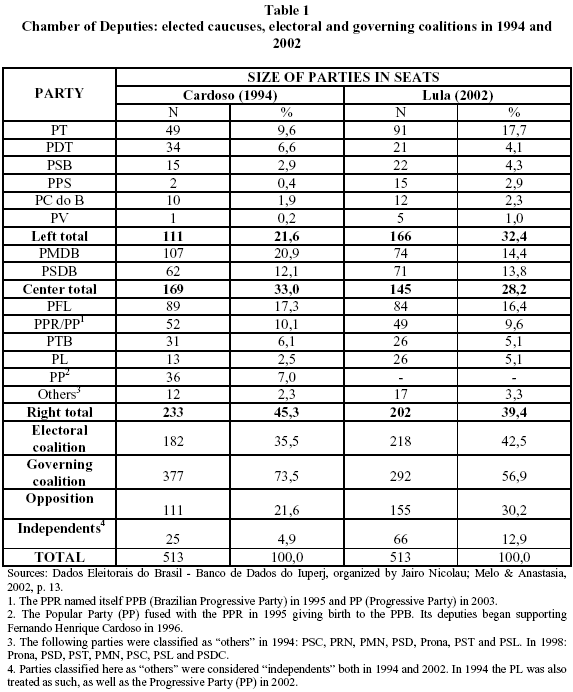
Such a difference could lie in the support mustered by each president in Congress in their respective periods. For instance, the electoral alliance formed by Fernando Henrique Cardoso, made up by PSDB, PFL and PTB, got only 182 seats in the 1994 election, an insufficient number to guarantee a majority to the presidential agenda. Once in power, Cardoso organized his cabinet by using patronage resources in order to enlarge his governing coalition. The centrist PMDB was co-opted into the cabinet still in 1995 and the then PPB followed suit in 1996, during key DVS votes of the social security reform in the Chamber of Deputies. Therefore, the governing coalition reached the impressive number of 377 deputies, or 73,5% of the seats, giving the administration more than enough to meet the qualified majority needed to pass constitutional changes (308 deputies). In reality, the governing caucus got even bigger with the migration of 39 deputies to its ranks, while only nine switched to the opposition (Melo, 2004).
In spite of the electoral growth of the left in general, and of his party specifically, Lula could not build in 2002 a majority coalition purely through electoral means. The parties that supported him throughout the campaign – PT/PC do B/PL –, together with PDT, PSB, PPS, PV and PTB, that joined Lula in the second round, got jointly 218 seats, 39 seats short of an absolute majority in the Chamber. In February 2003, when deputies were sworn in, the governing caucus had already grown to 248 seats due to party switching. In order to reach a qualified majority, the president resorted to patronage, attracting the PMDB to the administration4. The migratory flux towards pro-administration parties continued unabated in 2003, when 52 deputies were co-opted, especially by PTB and PL, against five that "deserted". By the beginning of the votes on PEC 40, the governing coalition possessed 327 members, having reached 332 by the second round. If one adds to the total the PP caucus, which declared themselves independent, but whose leadership in reality recommended voting with the government, Lula's base of support came to number 379 deputies. Table 1 shows the picture for both administrations, without computing the impact of party switching on the party caucuses.
Although both presidents were able to transform a minority electoral coalition into a majority congressional one, Lula's position in Congress was indeed more fragile. His parliamentary base of support only matches Cardoso's base of support once PP votes are considered, but this party was not formally incorporated within the coalition and, as we will shortly see, displayed a highly undisciplined behavior. Moreover, President Lula's coalition showed greater heterogeneity than the coalition organized by Cardoso, including politicians from across the entire political spectrum. Such a tendency had been already observed during the first round of the 2002 election, with the alliance between PT and PL, and consolidated in the second round through a deal with the PTB, an old ally of Cardoso, and the attraction of PMDB and PP throughout 2003.
It is nonsensical therefore to explain the superior outcome of the reformist process under Lula from the formation of the governing coalition in Congress. In our view, a sound explanation would have to take into account the following factors.
]]> Of all the six factors shown, the last was certainly the most relevant. If one considers the complicated nature of the reformist proposal and the stringent conditions for the passage of constitutional amendments – a two-chamber evaluation by a qualified majority rule of 3/5 with two rounds in each house, coupled with roll-call voting and no presidential veto –, one can easily rule out the expectation of strict discipline for both administrations. Therefore, the possibility of getting votes outside the governing coalition became a decisive variable for the success of the agenda under analysis.1. Composition of the executive's agenda. Overall, the agenda proposed by president Cardoso to Congress was overloaded with proposals of constitutional change. In addition to the social security measures, PECs regarding the economy, public administration and tax system were also discussed, having the administration won in the two former cases and being obliged to discard its proposal on the latter issue. Furthermore, the administration paid most of their attention to the passage of the reelection proposal in the first semester of 1996. It is worth recalling that this proposal was presented by the PFL in the first legislative day of 1995 and eventually came to be "the most important of all reforms". This "clearing" benefited the PT-led government, which could concentrate its efforts in two issues: the tax and social security reforms.
2.The proposals originally presented. One of the central features of the PEC initiated by Cardoso was its multidimensionality. Underestimating social and congressional resistances in Congress, "the reform proposed changes in pension funds, in the general regime of social security, and in the one of public servants" (Melo, 2002:134). The executive's measure, soon dismembered by the rapporteur of the Committee on Constitution and Justice (CCJ) into four different constitutional amendments (Figueiredo and Limongi, 1999; Melo, 2002), contributed for the union of the several coalition leaders in a large group against the reform and hampered administration's attempts to exploit differences between national union confederations and the public servants. Lula, on the contrary, focused on how to reform the public service's social security, thus isolating public servants, who had already lost an old ally – the PT itself – and drawing national labor confederations to his side, in the fight against "privileges" and in favor of equity. Hence while Cardoso united several attentive publics against his proposal, Lula sought to divide them.
3. Coordination with state governors. Lula first discarded the proposal formulated by the then social security minister, Ricardo Berzoini, adopting instead a draft made in agreement with governors, thus effectively making them partners in the reformist undertaking. Perhaps more importantly, the social security reform was "nested" with its tax counterpart. This strategy, organized by the federal executive, contributed greatly for the president to succeed in achieving, since the PECs first presentation to Congress, unrestricted support of all governors regardless of their party affiliation. Such a strategy was not available for the administration in the first stage of the reform, once the tax reform had been taken out of the legislative agenda by the then president.
4. Special committee's make-up. The Cardoso government paid a high price on not having control of the committee designed to evaluate PEC 33. For instance, the post of rapporteur fell on Euler Ribeiro, a PMDB deputy from Amazonas state, connected with public service unions, while the chairmanship was held by Jair Soares (PFL/RS), an outspoken opponent of the measure (Melo, 2002). Conversely, in the Lula Administration the new special committee was chaired by a deputy who openly favored the proposal, Roberto Brant (PFL/MG), while José Pimentel, from the governing PT, got the post of rapporteur.
5. Rules for the use of petitions for separate voting (DVS). Arguably, the opposition's chances of approving amendments to the text sent by the executive are slim given the need to muster 3/5 of votes on both houses. However, this situation is entirely inverted in the case of DVS. Through this procedure, the opposition parties can separate parts from the text passed for voting and force the government to expose its coalition in controversial roll-calls. As it is the executive's obligation to confirm a qualified majority, the minority raises its chances of vetoing certain topics by gathering only up to 2/5 + 1 of the votes. Throughout the first round of the reform under Cardoso, this was the principal strategy used by opposition parties. Tellingly, after votes were over and defeats accounted for, the administration passed a change in the standing rules which limited according to size criteria the number of petitions for separate voting entitled to each party (Figueiredo and Limongi 1999:78). Obviously, this alteration, the only with an institutional character between the two periods here analyzed, restricted significantly the procedural firepower of the opposition and proved beneficial later on to Lula.
6. Relations between government and opposition. Soon after its initial proposal had been dismembered into four constitutional amendments, the Cardoso administration implied that a negotiation with the opposition would be welcomed, but had this route blocked by the PT (Melo, 2002). President Lula, on the other hand, experienced a clearly distinct situation, since he relied on the support of governors elected by the two major opposition parties, PFL and PSDB, besides having the formal agreement of the latter in congressional votes. Only the PFL leadership recommended rejecting the measure, a course of action which did not prevent, as we will show, many of its deputies from voting in favor of the reform.
COMPARING DEPUTIES' BEHAVIOR ON THE FLOOR
Inversely to what happened during the Cardoso administration, Lula faced few votes until the final passage of his proposal and was not defeated in any of them. Two causes may be highlighted to explain why the PT-led administration had so few confrontations on the floor. On the one hand, the above-mentioned change in the rules regarding DVS, which significantly reduced opposition's latitude. On the other, the divergent paths followed by PSDB and PFL, since the latter party mobilized the bulk of the effort against the government's proposal. This does not mean, however, that the PEC 40 went through Congress unscathed. The administration made three key concessions in order to pass the amendment in the Chamber of Deputies: a) the discount to be applied on pensions left by public servants was reduced from 50% to 30%, when such pays exceed a ceiling of R$ 2,400; b) the period of permanence in the last job, one of the prerequisites for full pension, was diminished from ten to five years; c) the raise of the exemption ceiling for the payment of the retirees' and pensioners' contribution, from R$ 1,200 to R$ 1,440. In the Senate, differently, the government agreed with the draft of the so-called parallel PEC5.
Table 2 below presents data concerning deputies' behavior on the floor during the social security reform votes in the Lula Administration. As an indicator of party discipline, we use an index of fidelity to the party leader6.
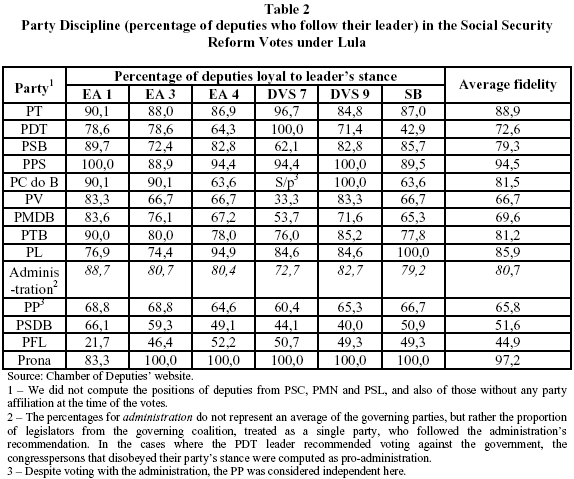
The first round of the reform took place from 6 to 13 August, 2003. Besides procedural votes, always won easily by the administration, deputies voted on six fusion amendments (emendas aglutinativas – EA), one of which was presented by the government (the fourth one), and four DVSs, being two brought up by the PTB and two initiated by the PFL. In the table we did not consider procedural votes. Furthermore, we listed only votes in which the opposition could gather at least 10% of the votes on the floor. This criterion eliminated the fusion amendments 7, 8 and 11, whose decisions were won by the administration by extremely large margins. The two DVSs presented by the PTB were likewise disregarded. One of them was passed by 436 votes against 3, with 19 abstentions. As to the DVS 3, which aimed at the exclusion of the so-called "indemnity funds" from the calculation of the public service's wage ceiling, it was defeated by 27 votes to 403, with PFL and PSDB siding with the administration. Finally, the table includes the second round, held on August 27, 2003.
]]> In all the roll-calls, the percentage of deputies who followed the party's recommendation was based on the caucus, not only on those present on the floor. Between the first and last votes in the Chamber, PSB and PSDB lost eight and four deputies respectively, due to party switching. On the other hand, PMDB and PTB gained eight and four members, respectively, for their ranks. These variations were considered in our calculation.By his leadership in the Chamber of Deputies, the administration recommended voting against the fusion amendments 1 and 3, opposing also DVSs 7 and 9, both presented by the PFL. The former petition aimed at the suppression of the retiree's contribution, while the latter targeted the reform's cut in the pensions left by deceased public servants. The government favored the fusion amendment 4, presented as a substitute for the whole PEC 40, and, naturally, the proposal in the second round. Of the parties that made up the governing coalition, the PDT sided against the executive in the deliberation about the DVS 7 and in the second round. Differently, the PC do B did not take sides in the issue of retiree's contribution, freeing its deputies to vote as they wished. In spite of its central place in the opposition, the PSDB favored the administration in all votes considered here. The same happened with the PP, although in this case the party defined itself as independent in relation to the government. Lastly, PFL and Prona recommended a "No" vote on all six occasions.
As we have already pointed out, the executive won all votes analyzed in this work. The scores were as follows: 378 to 76 (EA 1); 356 to 54 (EA 3); 358 to 126, with 28 abstentions (EA 4); 326 to 163, with 23 abstentions (DVS 7); 361 to 104, with 9 abstentions (DVS 9); and 357 to 123, with 6 abstentions (second round). In every single roll-call, the administration could count on some votes from PFL and PSDB, which were decisive in the passage of EA 4, in the rejection of DVS 7 and for the final passage of the reform in the second round. On the three occasions, the administration attracted 62, 57 and 60 PSDB-PFL deputies respectively. On the other hand, defections in the governing coalition were also large: 65, 89 and 82 deputies respectively voted against the government or absented themselves from the Chamber in the three key legislative battles.
Table 2 clearly shows that discipline rates were rather low for almost all parties in the voting process of PEC 40. In the ranks of Lula's allies, the average discipline as measured by the index of fidelity reached 80,7%, with the percentage of deputies following the executive's position ranging from 72,7% to 88,7%. The worst performance of the governing coalition, as expected, occurred in the decision on the retiree's contribution. Equally decisive on their own, the vote on EA 4 and the second round displayed a higher discipline, which in any case did not prevent 20% of deputies from being uncooperative with the Lula government.
So far there is no real novelty in this account: in the Cardoso government, according to Figueiredo and Limongi (1999), the governing coalition's average discipline went as high as 77,1% when voting the PEC 337. The members of the original electoral coalition exercised greater discipline than the parties that joined them later: PFL, PSDB and PTB presented rates of fidelity higher than PP and PMDB ones: 82,4%, 80,4% and 79,7% respectively for the former parties, while the latter two scored 74,6% and 70,3% respectively8. In the case of the Lula Administration, this distinction is not so clear, given the behavior of PDT and PV. Nonetheless this proviso, it is remarkable the difference between the fidelity of PMDB, which joined Lula's coalition during 20039, and the parties that supported the president either in the first or second round. Possibly because of its independent status, the PP showed more indiscipline in the Lula period than under Cardoso.
The point of change which must draw the attention of any researcher refers to the behavior of leftist deputies in comparison with their counterparts in PSDB and PFL. In the left's case, it is well known that PT, PDT and PC do B always were notorious for their highly disciplined caucuses. Data presented by Figueiredo and Limongi (1999:112) for the 1989/1999 period show an index of fidelity of 97,1% and 91,8% for the two former parties. According to Nicolau (2000:716), the PC do B exhibited discipline rates as high as 98,8% in roll-calls held between 1995 and 1998. In the votes under our scrutiny, this pattern simply breaks down. Only after strong pressures on nine deputies who had abstained in the EA 4 roll-call could the PT present again on the vote about DVS 7 a voting pattern similar to its days in the opposition. The PC do B faced yet stronger difficulties to get its legislators to cooperate: in the vote on the retiree's contribution (DVS 7), with deputies free to choose, only 36,3% of them favored the executive's proposal. Oddly enough, the PDT became disciplined only when voting the DVS 7, on which occasion its leadership recommended voting against the administration. At the end of the process, in the second round, the division of PDT members was evident: just 42,9% of deputies (6 out of 14) acceded to the party leader who, under direct pressure from the party boss Leonel Brizola and the National Executive, had favored the rejection of the reform altogether.
If Cardoso faced a disciplined and cohesive opposition during the votes on PEC 33, with Lula the picture greatly changed with the exception of Prona10. To begin with, PSDB and PFL split down the middle, regardless of the leader's recommendation at any time. This contrast is striking not only when one takes into account their highly disciplined behavior throughout the Cardoso administration, but also if one restricts the comparison to social security reform votes. For instance, PFL and PSDB presented fidelity rates of 82,4% and 80,4% respectively in the first reform votes, while in the second reform their respective rates were only 44,9% and 51,6%. Only on three votes could the PSDB leader have the support of the party majority for the executive's proposal. Deputy from Bahia José Carlos Aleluia (PFL) was even less successful as an unabashed opposition leader: his recommendations were backed by the party majority in only two out of six votes, and by narrow margins in both.
Additionally, the stance assumed by PFL is a case in point of state arena's influence, referred earlier in this article. The party's position in Congress collided with its governors' interests, all of them supporting the proposal sent by Lula. Breaking down by state the PFL votes, one can see that in five out of six roll-calls the presence of a PFL governor had a remarkable influence in the behavior of its deputies in the Chamber. In the states where the party headed the state government, 84,5% of deputies on average followed their respective governors and President Lula, against the party recommendation. On the other hand, in the states where the party had no governor, the percentage of supporters of the reformist proposal dropped to an average of 18,9%11. Only in the voting of EA 1 this distinction had no influence whatsoever in the behavior of PFL members: the party was relatively disciplined, following the leader's cue regardless of state origin.
The control of governorships had also a noticeable impact, albeit smaller than in the case of PFL, over PSDB deputies in two out of four votes – with the exceptions of EAs 1 and 3. In the remaining roll-calls, the caucus majority agreed with the party's stance – which coincided with the wishes of governors and favored the proposal presented by the administration – only in the states headed by PSDB members. In the other states, the PSDB majority decided to play the electoral arena game, disregarding recommendations from the party and opposing the federal executive12.
Lastly, it is worth describing briefly the reform's passage in the Senate. The proposal sent by the Chamber of Deputies was discussed for four months and ultimately passed in second round in December 2003. Again the government would face defeat were it not for the support of 13 senators from PSDB and PFL. With the exception of PTB, the party caucuses exhibited higher discipline rates than their counterparts in the Chamber. The most important vote took place on November 26 and resulted in the passage of the reform's basic text. Support for the administration on this issue reached the following percentages among pro-reform parties: PSB, PL and PPS, 100,0%; PT, 92,9%; PMDB, 85,7%; PTB, 66,7%; and PSDB, 54,5%. Both PDT and PFL leaders recommended against the proposal, having the agreement of 100,0% and 58,8% of their colleagues respectively. Tellingly, all PFL senators from states ruled by the party voted against their leader.
]]>THE 2002 ELECTIONS: CHANGING ACTORS' PREFERENCES AND RESOURCES
In our view, the changes observed in legislative behavior can be explained by the impact of the 2002 elections on the way actors were located within the solidarity and organized interests systems in the different decision-making arenas. By bringing about a new distribution of power inside executive and legislative branches, these elections altered preferences and resources across actors, redefined strategies available to each one of them and restructured the relationship between elected officials, coalition leaders and citizens.
We may begin an analysis of the above-mentioned changes by comparing more carefully the two stages of the reform game. After all, the proposal sent by Lula, PEC 40, expressed a more radical reform than PEC 33, the one sponsored by Cardoso and against which PT deputies voted cohesively, with discipline, on all occasions they could express themselves. What changed? Who changed?
The behavior of PT in regard to PEC 33 is easily accounted for by two variables, one of a programmatic nature and the other of a positional one. From a programmatic point of view, we should recall that the party, as well as its militants and consistent supporters, particularly its attentive publics, whose composition included mostly wage earners, and especially wage earners from the public service, were all together against Cardoso's proposal to reform social security. Even though a broad consensus had been built in Brazilian society concerning the inevitability of a reform, there were bitter controversies as to its extent, timing and on whom most costs should fall on.
Moreover, the PT was then the biggest opposition party and fully conscious of that role. An adversarial strategy in relation to the Cardoso administration was not only the most rational one, promising to pay off in electoral terms, but also a symbol of adherence to the PT program.
More complex is the explanation required for the behavior of Cardoso's supporters when voting PEC 33: although the proposal was entirely compatible with the biggest governing parties' world views – PSDB and PFL – and, therefore, of easy assimilation by militants and consistent supporters alike, its defense weakened in the face of electoral calculations from legislators. After all, PT people and the like could easily instigate lawmakers' constituencies, informing electors what deputies were supporting a "politically unfeasible" proposal. However strong presidential efforts and resources were, a cautious electoral logic prevailed for many deputies, bringing about a split in the governing coalition and scant results as to the issue in Congress.
When the Brazilian parliament set about examining the new proposal – PEC 40, chairs had literally switched places! It is worth while asking why a president elected by a party that had, thoroughly and cohesively, rejected the former administration's proposal presents a reform yet more distant from the preferences of his core supporters. And, more interestingly: how does he expect to see it approved and, ultimately in fact, succeeds!
To answer that question one needs firstly to take into account that the Lula Administration is not, and has never been an exclusively PT-led government. Even though the party has to be heard and considered, as the president's party and the largest governing caucus in 2003, the PT knew that it was not to rule alone and would be always in need of votes from other congressional forces backing Lula.
Secondly, in ascending to power, PT changed. To win the presidential election, the strategy followed by the party made clear the option for softening its own agenda. In a letter addressed to the nation, the then presidential candidate proclaimed clearly that, once in power, he would not launch the country in heterodox adventures in the economy, and would govern for all Brazilians, not only for his base of consistent supporters. Contrary to what many people state, the path followed by the current administration is not a "policy switch", but rather, to the displeasure of the most orthodox PT members, a faithful accomplishment of campaign commitments, without which Lula would not have mustered sufficient support to end up victorious in the second round.
]]> Interestingly enough, the change experienced by the party in the transition to power was not felt in the same way by the whole of its lawmakers. The nested game model may help us out again in understanding the underlying logic behind this difference: those congresspersons whose support comes mostly from attentive publics targeted by the reform were most reluctant to change their preferences, suffering in some cases punishments such as suspension and expulsion from the party. Hence the cohesive and disciplined party from opposition times simply split once in office. It should be highlighted that, besides electoral costs, the dissidents calculated the societal costs which an alignment with the presidential agenda would bring. They would have to explain, for instance, why previous comrades should be abandoned in the struggle against the government. All accounted for, some comrades opted to march with their people into this other arena.The case of PT allows us to further discuss the distinction between cohesion and discipline as proposed by Tsebelis (1997:103). According to him, cohesion "refers to the differentiation of political stances within a party before any discussion or voting on a given issue within the party itself", while discipline regards "the party's ability to control their members' votes in parliament". More than just disciplined, the PT – the reasoning is the same for PDT and PC do B – proved cohesive throughout its opposition span. The behavior of its deputies on the floor did not depend on the operation of institutional mechanisms exogenous to the party. The rise to power and the ensuing adoption of a reformist agenda caused a shock in the party's cohesion, forcing it to resort to the available disciplinary tools. This explains why nine deputies changed their position from the voting on substitutive global amendments (emenda substitutiva global) ESG 4, when they abstained, to the decision on DVS 7, when they ranked with the executive.
What about the opposition parties? The first puzzle to be solved is why the PSDB did not behave as opposition and paid the PT back for its behavior when out of office, as the PFL did when recommending its caucus to reject PEC 40? This strategy was simply not available to the party. It is known that in opposition it is always easier for any party to be consistent with its own ideology and program. One should also acknowledge that, in contrast with the PT, the PSDB had had in the social security reform one of the cornerstones of its ideology. How explain to militants and consistent supporters that in opposition the party should oppose to what it had always backed? The party does not have to bargain, yield, being flexible, or negotiate in the name of governability and other desiderata that haunt democratic rulers everywhere. The costs of opposing for the sake of opposing a reform that it tried to carry out and did not succeed would be higher than a recommendation favoring Lula's proposal, the course of action ultimately taken by PSDB even though its indiscipline went up, as we showed, in the states where the party had no governors.
Why such a strategy was available to PFL? Probably because its strong identification in the ideological spectrum as a rightist party allows it to fit more comfortably in the opposition, without undue political costs among its supporters, challenging frontally the PT as it always had done. It may be supposed that any alignment of PFL with the PT-led government would damage much more its image than the movement towards more substantive policy positions. Therefore the 2002 elections brought about an entirely new phenomenon in Brazilian politics, putting all forces sheltered under PFL, for decades in office, for the first time in opposition!
Not surprisingly, the key problem faced by PFL leaders in their congressional base was the strategy employed by President Lula in having all governors as partners in the social security reform, besides linking the latter with the tax reform. That move forced deputies to choose between their leadership in Congress and their respective governors, in the latter case perhaps with an eye to possible rewards in the state arena. As we showed in a previous section, the PFL split down the middle and, tellingly, where the party held governorships most deputies aligned themselves with the state government.
Finally, it is worth while noting that the split verified within the two largest opposition parties – PSDB and PFL – might be interpreted as a sign of their low cohesion about the issue. One could say that their rather disciplined behavior when they were in office was influenced chiefly by exogenous institutional mechanisms, having little to do with their actual degree of cohesion. This is a sharp contrast with the leftist parties' behavior in both periods.
Throughout the voting of both reforms, PSDB, PFL and PT had to deal concomitantly with actors inside the executive, attentive publics, consistent supporters and electors. However, the distribution of actors across the solidarity and interest systems, within decision-making arenas, determined differences in the strategies available to government and opposition forces in the two periods examined, given the sweeping changes in resources and preferences caused by the 2002 elections.
CONCLUSION
In Brazil , the method by which decision-making bodies are formed is consistent with decentralization of power: presidential system combined with proportional representation, multiparty competition, federalism, and bicameralism. With this mix, presidents find it difficult, if not impossible, to have a party majority at the end of the electoral race.
]]> As is generally known, this problem has been solved by the model of "coalition-based presidential system": if the coalition does not come out of the polls with a majority, it may be enlarged through cabinet appointments and patronage resources. This option has been frequently used by Brazilian presidents, who have thus been able to enjoy comfortable congressional majorities. Therefore the formation of a majority coalition occurs in two stages: the first is made up of electoral deals while the second is sewn up by cabinet negotiations. Evidently, the more coincident are the electoral and governing coalitions the better is not only for political stability, but also for representation and accountability.Once constituted the majority coalition, actors set about operating it. At this point, the impact of changes carried out in the executive-legislative relations and in the Chamber's standing rules after 1988 is more keenly felt (Figueiredo and Limongi, 1999). These changes led to the concentration of agenda powers in the hands of party leaders and the president, restricting significantly the discretion of other actors. Such factors, as the above-mentioned authors emphasize, allow the Brazilian institutional arrangement to become consistent with the stability of democratic order: party caucuses behave in a disciplined way, which increases the chances of passage for the presidential agenda, and Congress no longer works as a veto player.
The dynamics at play is largely as follows: democracy is an iterated game, played in multiple arenas. For decision-makers – elected officials and bureaucrats, inside executive and legislative branches – the game develops routinely in a continuous decision-making setting13, which brings about a flux of interdependent decisions and the production of reciprocal delayed rewards (Sartori, 1994).
As they act in a continuous decision-making setting, legislators tend to show a disciplined behavior because it seems to them that vote with their leader is the less costly choice. Especially where procedural strategies might be employed to cover up deputies' "footprints" in some actions, therefore preventing citizens to make sense of the causal chain linking their demands to policies passed in Congress and these policies to results actually produced. In these circumstances, the presidential agenda is passed and political stability is preserved, although shortcomings of representation and accountability may come up as another outcome of the game.
The setting is drastically altered, however, by the influx of proposals of constitutional amendment into the legislative agenda. An institutional design game implies discontinuity, given the exceptionality of rules pertaining to decision-making in such conditions: requisites of qualified majorities, roll-calls and two rounds in both chambers. In settings thus built party discipline is harder to come by. Driven by electors' concerns over their behavior, congresspersons' calculations may reinforce the perception that the costs of indiscipline are lower than vertical accountability costs, since roll-calls permit voters to blame individual legislators for the approval of "politically unfeasible proposals".
In other words, politically sensitive occasions like the reforms signal that betray your party or the administration may be actually less onerous than betraying your own electoral base. If, for legislators, the costs of indiscipline rise, for the president, the costs of desertion in his coalition increase exponentially.
Hence the "superlegislator"14 that initiated the proposal becomes afterwards a hostage to its strict rules of passage. In this regard, it is worth recalling that these rules do not allow the president to veto the final version of his proposal even if it has been changed in disagreement with presidential wishes. With the discontinuous setting, legislators can make new calculations and conclude that the costs of indiscipline pale in comparison with electoral costs highlighted by compromising roll-calls. The president is left with the option of mobilizing resources available in other arenas, such as patronage and budgetary expenditures, through which he may signal to members of Congress with some "selective incentives" to cooperation.
The two stages of social security reform analyzed in this article share all the features of discontinuous decision-making settings discussed above. Further, we could verify significant variations in the game outcomes and actors' behavior from one moment to the other. Lula fared definitely better than Cardoso and the key factor to explain this difference in performance was the ability to attract votes in the opposition, given the premise that both governing coalitions could not be highly disciplined under the circumstances. We sought to explain not only why leftist parties experienced such a drop in their cohesion rates, once they rose to power, in comparison with the Cardoso period, but also why the opposition, represented now by PSDB and PFL, was not able to join closely its ranks, as the PT once did, against the administration.
Our argument stresses that the switch of places between government and opposition, a contextual change caused by the 2002 elections, greatly affected preferences, available resources and strategies, and the behavior of each of the main actors concerned. It did so also by altering positions inside several "nested" arenas connected with the reform game.
Strategies that proved available for some actors in stage one – for instance, the PT acting as a cohesive and disciplined opposition – were not so for other actors in stage two. The PSDB could not adopt the same strategy due to the risk of incurring costs from reactions of militants, consistent supporters and attentive publics. When in office, the PSDB did not succeed as the PT did in stage two, in coupling the social security game with its tax reform counterpart. This move would later be the key to obtain governors' support regardless of their party persuasions.
]]>NOTES
1 A different criticism to the performance of the presidential system in Brasil has been made by Anastasia and Melo (2002), and Anastasia, Melo and Santos (2004). For these authors, the current institutional arrangement is unable to promote the equilibrium between desirable attributes of democracy such as stability, representation and accountability, since the prevalence of the first attribute has led to a poor performance of Brazilian democracy in the last two.
2 For an analysis of legislators' views in the legislative term 1991/1995, see Almeida and Moya (1997). Data presented by the authors show a pronounced dominance of opinions favorable to market-friendly reforms, which were at the time vehemently fought by the PT.
3 The so-called parallel PEC (227/2004) was the result of a negotiation of senators with the administration to the effect that the Senate could later on change points of the reform without meddling with the proposal approved in the Chamber. It proposes, among other points, the alteration of criteria for full pensions in the case of current servants, the possibility that each additional year of contribution could reduce the equivalent in the minimum age and the continuance of full parity for future pensioners who fulfill the requisites for full pensions. The proposal was passed in the Senate and the Chamber was evaluating it when this article was being written. Later on, the contribution paid by retirees came to be considered constitutional by the Supreme Court.
4 Then the PMDB no longer had the 74 deputies elected under its umbrella; only 69 were still affiliated with the party when they took office. Afterwards, with the entry of Anthony Garotinho, a regional boss in Rio de Janeiro , the party caucus grew again, although this did not have any favorable impact on the government's position, since most of the new members came from the ally PSB.
5 The parallel proposal was passed on December 17, 2003 by the Senate and sent to Chamber evaluation, where the special committee's rapporteur, deputy José Pimentel (PT/CE), chose to initiate a substitute proposal, through which only articles "compatible with the Constitutional Amendment 41" should be preserved (Rapporteur's report on the Chamber's website). His report has not been voted yet.
6 Other possible indicators are the Rice index, the index of party cohesion and the loyalty index (Mainwaring and Pérez-Linan, 1998; Nicolau, 2000). We chose the index of fidelity so as to permit comparison with other works such as Figueiredo and Limongi (1999), who adopted it in their analysis of the social security reform voting under Cardoso.
7 Calculation made by the authors based on the table presented in Figueiredo and Limongi (1999:216). Using the Rice index we obtained 54,2.
8 Using the Rice index: 64,8, 60,8 and 59,4 for PFL, PSDB and PTB respectively; 49,2 and 40,6 for PP and PMDB respectively. ]]>
9 The party's entry into the cabinet, however, took place only in 2004, in the first cabinet reshuffle carried out by President Lula.
10 Despite its almost perfect discipline on the floor, the Prona does not deserve grand compliments on its cohesion: soon after votes were over, four of its deputies switched to the São Paulo section of PP.
11 As a result of the 2002 elections, the PFL elected the governors of Sergipe, Tocantins, Bahia and Maranhão. In these states, in the votes on EA 3, EA 4, DVS 9, DVS 7, and in the second round, the percentages of PFL deputies who voted alongside the federal government, thus against party recommendations, were 69,2%, 89,3%, 88,9%, 85,7% and 89,3% respectively. In the other states, the percentages for the same decisions were 17,2%, 19,5%, 20,5%, 18,4% and 18,9%.
12 As a result of the 2002 elections, the PSDB elected the governors of Pará, Ceará, Paraíba, Goiás, Minas Gerais and São Paulo . In these states, in the votes on EA 4, DVS 9, DVS 7, and in the second round, the percentages of PSDB deputies who voted alongside the federal government, thus in favor of party recommendations, were 59%, 53,6%, 66,7% and 62,5% respectively. In the other states, the percentages for the same roll-calls were 39%, 35%, 15,8% and 40%. As one can gather from these data, the impact of governors on the party caucus in the Chamber was considerably smaller than in the case of PFL.
13 For the citizens the democratic game is arguably shaped as a discontinuous decision-making setting, since their intervention is mostly restricted to the electoral process.
14 An aspect little noted by analysts is that presidential agenda power is significantly greater than other actors' in relation to proposals of constitutional amendment. The chief executive does not have to deal, after all, with any of the heavy transaction costs that plague collective actors such as legislatures. A proposal presented by either the Chamber of Deputies or the Federal Senate has to be signed by at least one third of its members; the other alternative is a joint presentation by a majority of the state assemblies, backed by a plurality of the votes cast in each of them.
GLOSSARY OF POLITICAL PARTIES
PC do B – Partido Comunista do Brasil (Communist Party of Brazil)
PDT – Partido Democrático Trabalhista (Democratic Labour Party)
]]> PFL – Partido da Frente Liberal (Party of the Liberal Front)PL – Partido Liberal (Liberal Party)
PMDB – Partido do Movimento Democrático Brasileiro (Party of the Brazilian Democratic Movement)
PMN – Partido da Mobilização Nacional (Party of National Mobilization)
PP – Partido Progressista (Progressive Party)
PPB – Partido Progressista Brasileiro (Brazilian Progressive Party)
PPR – Partido Progressista Reformador (Reformer Progressive Party)
PPS – Partido Popular Socialista (Socialist Popular Party)
PRN – Partido da Reconstrução Nacional (Party of National Reconstruction)
Prona – Partido de Reedificação da Ordem Nacional (Party of Reconstruction of the National Order)
]]> PSB – Partido Socialista Brasileiro (Brazilian Socialist Party)PSC – Partido Social Cristão (Christian Social Party)
PSD – Partido Social Democrático (Social Democratic Party)
PSDB – Partido da Social Democracia Brasileira (Brazilian Party of Social Democracy)
PSDC – Partido Social Democrata Cristão (Social Democratic Christian Party)
PSL – Partido Social Liberal (Social Liberal Party)
PST – Partido Social Trabalhista (Social Labour Party)
PT – Partido dos Trabalhadores (Party of the Workers)
PTB – Partido Trabalhista Brasileiro (Brazilian Labour Party)
PV – Partido Verde (Green Party)
]]>REFERENCES
ALMEIDA, Maria H. T. and MOYA, Maurício. (1997), "A Reforma Negociada: O Congresso e a Política de Privatização". São Paulo, Revista Brasileira de Ciências Sociais, vol. 12, nº 34. [ Links ]
AMES, Barry. (2003), Os Entraves da Democracia no Brasil. Rio de Janeiro, Editora FGV. [ Links ]
AMORIM NETO, Octavio and SANTOS, Fabiano. (2001), "A Conexão Presidencial: Facções Pró e Antigoverno e Disciplina Partidária no Brasil". Rio de Janeiro, Dados, vol. 44, nº 2, p. 291-321. [ Links ]
ANASTASIA, Fátima and MELO, Carlos Ranulfo. (2002), "Accountability, Representação e Estabilidade Política no Brasil", in F. L. Abrucio and M. R. Loureiro (eds.). O Estado numa Era de Reformas: Os Anos FHC. Brasília, OCDE/OEA/Ministério do Planejamento. [ Links ]
____ and SANTOS, Fabiano. (2004), Governabilidade e Representação Política na América do Sul. Rio de Janeiro/São Paulo, Konrad-Adenauer/Unesp. [ Links ]
ARNOLD, Douglas. (1990), The Logic of Congressional Action. New Haven , Yale University Press. [ Links ]
CARVALHO, Nelson Rojas. (2003), E no Início Eram as Bases - Geografia Política do Voto e Comportamento Legislativo no Brasil. Rio de Janeiro, Revan. [ Links ]
FIGUEIREDO, Argelina and LIMONGI, Fernando. (1999), Executivo e Legislativo na Nova Ordem Constitucional. Rio de Janeiro, Editora FGV/Fapesp. [ Links ]
MAINWARING, Scott. (2001), Sistemas Partidários em Novas Democracias: O Caso do Brasil. Porto Alegre/Rio de Janeiro, Mercado Aberto/ Editora FGV. [ Links ]
____ and LINÃN, A. Perez. (1998), "Disciplina Partidária: O Caso da Constituinte". São Paulo, Lua Nova, nº 44, p. 107-136. [ Links ]
MELO, Carlos Ranulfo. (2000), "Partidos e Migração Partidária na Câmara dos Deputados". Rio de Janeiro, Dados, vol. 43, nº 2, p. 207-240. [ Links ]
____. (2004), Retirando as Cadeiras do Lugar: Migração Partidária na Câmara dos Deputados (1985-2002). Belo Horizonte, Editora UFMG. [ Links ]
MELO, Marcus André. (2002), Reformas Constitucionais no Brasil. Rio de Janeiro, Revan. [ Links ]
NICOLAU, Jairo. (2000), "Disciplina Partidária e Base Parlamentar na Câmara dos Deputados no Primeiro Governo Fernando Henrique Cardoso (1995-1998)". Rio de Janeiro, Dados, vol. 43, nº 4, p.709-736. [ Links ]
PEREIRA, Carlos and MUELLER, Bernardo. (2002), "Comportamento Estratégico em Presidencialismo de Coalizão: As Relações entre Executivo e Legislativo na Elaboração do Orçamento Brasileiro". Rio de Janeiro, Dados, vol. 45, nº 2, p. 265-302. [ Links ]
SARTORI, Giovanni. (1994), A Teoria da Democracia Revisitada. São Paulo, Ática. [ Links ]
TSEBELLIS, George. (1997), "Processo Decisório em Sistemas Políticos : Veto Players no Presidencialismo, Parlamentarismo, Multicameralismo e Pluripartidarismo". São Paulo, Revista Brasileira de Ciências Sociais, vol. 12, nº 34, p. 89-118. [ Links ]
____. (1998), Jogos Ocultos. São Paulo, Edusp. [ Links ]
Carlos Ranulfo Melo is Doctor in Political Science (Universidade Federal de Minas Gerais – UFMG), professor and researcher at the Political Science Department (UFMG). He is the author of Retirando as Cadeiras do Lugar: Migração Partidária na Câmara dos Deputados (Belo Horizonte, Ed. UFMG, 2004) and the co-author of Governabilidade e Representação Política na América do Sul (Rio de Janeiro/São Paulo, Konrad-Adenauer/Ed. UNESP, 2004.
Fátima Anastasia is Doctor in Political Science (Instituto Universitário de Pesquisa do Rio de Janeiro – Iuperj) and was visiting scholarin New York University. Professor and researcher at the Political Science Departament (UFMG). She is the co-author of Governabilidade e Representação Política na América do Sul (Rio de Janeiro/São Paulo, Konrad-Adenauer/Ed. UNESP, 2004.
]]>