Mécanismes budgétaires et comportement législatif: amendements individuels, appui au pouvoir exécutif et programmes de gouvernement
Processo orçamentário e comportamento legislativo: emendas individuais, apoio ao executivo e programas de governo
Fernando Limongi; Argelina Figueiredo
Translated by Sandra Gomes
Translation from Dados - Revista de Ciências Sociais, v.48, n.4, p.737-776, Oct./Dec. 2005.
ABSTRACT
The article challenges the contention that individual amendments are crucial for a system of exchanging favors with the Administration by members of Congress interested in distributive policies as a way of guaranteeing their reelection. By analyzing funds allocated through Congressional amendments, their distribution in different government programs, and roll-call votes in the Brazilian House of Representatives from 1996 to 2001, the authors show that: individual amendments are not prioritized either by Congress in the budget's approval or by the Administration in its implementation; there are no differences between the agenda dictated by the Administration and that of the legislators; and party affiliation explains both House floor votes and the implementation of individual amendments and is thus an explanatory variable in the Executive-Legislative relationship.
Key words: budget; Executive Branch; Legislative behavior; budget amendments.
RÉSUMÉ
Dans cet article, on s'oppose à la thèse selon laquelle les amendements individuels sont fondamentaux pour un système d'échanges d'appui au gouvernement de la part de parlementaires aspirant à des politiques distributives comme l'une des formes de garantir leur réélection. À partir de l'analyse des ressources qui ont été attribuées par la voie d'amendements parlementaires, de leur distribution dans les différents programmes gouvernementaux et du vote nominal à la Chambre des Députés entre 1996 et 2001, on montre ici que les amendements individuels ne sont pas privilégiés par le pouvoir législatif lors du vote du budget, ni par le pouvoir exécutif lors de son exécution; il n'y a pas de différences entre un programme dicté par l'exécutif et le programme des législateurs; l'affiliation aux partis peut expliquer non seulement les votes à la Chambre mais aussi l'exécution des amendements individuels, ce qui en fait une variable-clé pour expliquer la relation Exécutif-Législatif.
Keywords : budget; pouvoir exécutif; comportement législatif; amendements budgétaires.
]]> INTRODUCTION
Analyses of Executive-Legislative relations in Brazil assume the right of Congress to amend the budget as a central point. In these analyses, the participation of Congress in the budgetary process is reduced to the individual right to propose amendments to the budget. It is not difficult to understand why this part of the budget process attracts so much attention: individual amendments provide the elements that support the current interpretation about the modus operandi of the Brazilian political system. It provides, above all, the necessary evidence to argue that this system revolves around individualistic politicians, who are only interested in clientelistic and pork barrel distribution of public resources.
Individual amendments are supposed to be the central part of a complex system of political exchanges that can guarantee, in Congress, the support the government needs and, in the electoral arena, the resources that representatives seek to deliver to their constituencies. As the Executive has the final word regarding the authorization of spending, individual amendments are seen as a "political currency" available to politicians. The Executive could obtain support for his desired set of policies by providing resources for pork barrel policies that representatives want to deliver to their constituency. Therefore, this system would seal agreements among the electorate, legislators and the Executive. In this sense, analyzing individual amendments has been seen as the "lost link" that would join the electoral and legislative arenas in a single analytical body.
Concerning the electoral arena, the argument is based on the assumption that the basic need of any politician is to find the necessary means to guarantee their reelection. In order to do so, according to the current analysis textbook, there is a strategy that can guarantee the highest political return for politicians, i.e., to provide tangible benefits to clearly defined constituencies. Voters, in acknowledgement to or, more precisely, as a way of paying back for the provided services, would retribute with their votes. In other words, individual amendments to the budget would be part of an electoral strategy identified by the specialized literature as "the personal vote" (Cain, Ferejohn e Fiorina, 1987). The Brazilian "electoral connection" – to use another fashionable term – would be, therefore, dependent on the implementation of these amendaments1 . In fact, references to current concepts in North-American literature are not even necessary here. The caricatural portrayal of politicians is not different in the case of Brazil: they are individualistic and solely interested in getting votes and, in doing so, they would sacrifice public welfare.
Regarding the legislative arena, the argument follows similar patterns. It relies on the usual consequences attributed to presidentialism, i.e., a lack of mechanisms that could guarantee Presidents the political support needed to their legislative agenda. The Executive needs the votes of legislators but it does not have the means to gather them. Prime-ministers, on the contrary, could guarantee support by threatening to dissolve Parliament or to anticipate elections, putting at risk the tenure of legislators.
However - so the argument goes - as in Brazil the President controls budget execution, i.e. the budget approved by Congress is not mandatory, the Executive is able to exchange the resources that representatives want to deliver to their constituencies with votes to approve the government agenda. Authorizing the execution of budget resources, therefore, would be the way the Executive gathers support from Representatives.
It is quite frequent to hear in the Press and within the academic community, that there is a trade-off between the authorization to execute amendments and support to the Executive in roll-call votes. On the 27th of November 2003, when this article started to be written, the headlines of the newspaper O Estado de São Paulo concerning the approval, by the Senate, of a tax reform bill sent by the government informed that Senators would receive a compensation for approving what the government wanted by agreeing to authorize the spending of public resources demanded by legislators' electoral clienteles.
Academic views are no different. For Santos et alii (1997):
"In the budget game [...] is possible to identify two distinct logics: the Executive's, acting to approve bills of the government agenda and, in the contemporary context of economic stabilization, to cut expenses; and the Legislature's, which is primarily interested in maximizing the electoral gains of its members and, only secondarily, acting to approve bills that, representing general public welfare, do not bring immediate individual gains. […]. [During the phase of consideration of the Executive bill by Congress] the logic of the Legislature's game is predominant, forcing the Executive to negotiate with the Budget Committee the bills it wants to see approved. ]]> However, during the budget implementation stage, the Executive overturns this advantage. […] although deciding at the last moment of the process on this distributive conflict, the Executive is still not absolute sovereign as it is forced to negotiate vetoes, cuts, supplemental appropriations in exchange to parliamentary support to the policies that are priority to the governmental agenda." (idem: 118-119).
According to Pereira and Mueller (2002), the execution of individual amendments is "one of the most important mechanisms that the Executive has at its disposal to negotiate its preferences with the coalition in Congress". The control of the budget process by the Executive gives "a low-cost and extremely useful political means to be exchanged by political support from the government coalition in Congress" (idem:267). For these authors:
"The evidences presented […] show that the President rewards representatives who vote systematically to approve the bills government is interested in, authorizing the execution of their individual amendments, and, at the same time, punishes the ones that did not vote for these bills by simply not executing the amendments proposed by them" (idem:274).
In this article, we try to explore these arguments by looking not only at the empirical aspects involved but also at their theoretical assumptions. First, it is important to say that, independent of the point of view used to analyze these aspects, individual amendments are far from being the most important way that Congress participates in the budgetary process. Besides individual amendments, there are two other types of amendments: collective – that are signed by State or Regional caucuses or by Committees – and institutional – that are signed by the rapporteurs of the budgetary annual bill, either the general or partial rapporteurs. From the Congress point of view, individual amendments are not a priority. Congress allocates much more resources through the collective and the rapporteurs' amendments. Since the definition of the amount of resources allocated by each type of amendments is an internal decision of Congress, such evidence is enough to question the view that the budgetary process is oriented exclusively to respond to individual interests of representatives.
Nonetheless, given the central role normally attributed to the liberation of resources to individual amendments within Executive-Legislative relations, we look into the assumption that votes are exchanged by the execution of amendments and we show that it is not possible to establish this claimed causal relationship. In order to do so, we examine the approval and the execution rates of individual amendments for the 1996-2001 period2. What we find is that amendments can be executed without the expected voting behavior, and also votes are casted in support of the government without the expected matching part – i.e., authorization for spending. Given the high rates of turnover in the Brazilian Congress, there are cases in which to exchange votes for the execution of amendments is not even possible. There are countless cases of representatives voting according to the interests of the Executive but did not participate in the budgetary process, and there are others who participated in the budget consideration process, had their amendments executed but did not hold a tenure in Congress anymore.
We also discuss the behavioral assumptions involved in the "political exchange" argument. The argument that amendments are "a political currency" assumes that legislators have a common interest, i.e., to promote distributive policies. These policies are supposed to be the most appropriate way to raise the chances of representatives being reelected. Implicitly, individual amendments are seen as an opposite tool to the interests of the Executive as it is assumed that, if the Executive could allocate resources freely, it would not sponsor the policies proposed by legislators. According to this argument, when the President authorizes the outlay of resources allocated by individual amendments, he is forced to do it against his own priorities. Concerning the allocation of public resources, the Executive-Legislative relation could be characterized as a zero-sum game.
We argue that this view completely ignores party membership, which divides representatives in two fields: the ones supporting government and the opposition. From a political point of view, this division is previous and more profound than the participation in the budgetary process via individual amendments. Concerning specifically the budgetary process, such relation is based on the centralization of budget consideration. There is a delegation of power from backbenchers to party leaders represented, in this case, by the general rapporteur and his direct collaborators (Figueiredo and Limongi, 2002; 2003).
We show that there is no significant differences regarding the allocation of public resources by the two branches of government. Their priorities are not radically different. To put it differently, there is no conflict of agendas. When resources allocated by legislators are authorized to be executed, the Executive does not waver to political pressures and abdicates to implement its own agenda. The allocation of resources by legislators is rather complementary, not oppositional to the Executive and the reason for this is the control the Executive has over the budget process, which is much larger than normally assumed. The Executive is able to channel the demands of representatives and to accommodate them within its government program. Indeed, this explains why the Executive executes amendments proposed either by opposition or allied legislators who do not vote according to the interests of the government.
]]> BUDGET EXECUTION AND SUPPORT TO THE EXECUTIVE
The individual amendment is only one of the ways representatives can change the budget proposal sent by the Executive. Internal resolutions of the National Congress regulate the participation of legislators during the budget consideration process – i.e., internal resolutions of the Budget Committee – CMO, in Portuguese3 – which also foresees the presentation of collective and rapporteurs' amendments.
The relative participation of individual amendments in the total amount of resources allocated by the Legislature is quite small. In the analyzed period, the participation of individual amendments in all approved amendments made by Congress was only 17.4%. Put it conversely in order to emphasize this point: 82.6% of all resources allocated by Congress to public investments in the federal budget came from collective or institutional actors (rapporteurs). This is a decision made by Congress itself. Of all resources allocated in the budget, Congress opts to reserve the vast majority of them to collective forms of amendments. It is not easy to adapt such a fact to the usual emphasis on "personal vote" and the individualistic behavior of Brazilian politicians. If individual amendments are so crucial to reelection proposes, why to allocate the "lion's share" to other kinds of amendments?
It is also worth noting that when the Executive is authorizing the execution of the budget, the individual amendments of legislators are not a priority either. Individual amendments have the lowest execution rates: the overall average for the period is 59.6% in contrast with 78% of execution for Committees amendments, 62.2% for State caucuses amendments and 65.4% for the general budget rapporteur. If legislators had the bargaining power normally attributed to them, we would expect higher levels of concessions in comparison to what they actually get. Moreover, if individual amendments are so decisive for their political careers, why do they not rebel against the low rates of execution? Or, put it in a different way, if the government had the alleged difficulty in gathering support to his own agenda, we could expect the focus to be on individual amendments made by legislators.
In sum, whether we look into the allocations made by Congress or to the Executive's decision to execute the resources allocated by the Legislature, we cannot find support to the assumption that individual amendments are central in this process. In both parts of this process, collective amendments and the ones presented by rapporteurs are the priority. However, in spite of the fact that these figures are public and known, the public opinion, the Press and political scientists still believe that individual amendments are the central axis structuring the budget process. These interpretations are based on false theoretical conceptions and assumptions about the logic behind the Brazilian political system and we return to this point further on.
Given the importance normally attributed to individual amendments, in this paper we will not analyze the remaining types of amendments and will concentrate on the first one. Our objective is to show that even if they are analyzed alone – i.e., when the rest of the budgetary process is ignored – the execution of individual amendments does not support the argument that they are used as a "political currency" in order to obtain parliamentary support.
Since 1995, when an internal resolution of the Two-Houses Budget Committee (CMO) was approved – every year Congress defines ceilings to individual amendments, limiting the maximum number of amendments and the maximum amount of resources each legislator can appropriate. Therefore, in this respect, there is no differentiation among legislators. Throughout the whole period, a maximum of 20 amendments per representative per year was the rule. Regarding the amount of resource available in the appropriation bill, the ceiling has varied during the period. From 1996 to 1999, the ceiling was established at R$ 1,5 million, raising to R$ 2 million in 2000. In the 2001 budget, this amount was again reviewed, changing to R$ 2.5 million4. This means that, from the point of view of individuals, each legislator has the same capacity to influence the final allocation of resources in the appropriation bill. Party affiliation, the number of mandates, the position within the hierarchy in Congress, region or State origins, connections with the Executive, in sum, none of the legislators' characteristics affects their capacity to allocate resources.
As resources are distributed in such a uniform way, there is no point in investigating which group of legislators, whichever they might belong to, wins or looses with the allocations made. The adopted rules that distribute resources equally neutralize the influence that any other factor could have had to distinguish representatives politically. Therefore, it makes no sense to talk about political exchanges in order to get amendments approved. There is no support or interests to be exchanged. Each of them has their quota secured beforehand and they are not dependent on the votes of other legislators to get their interests secured. Universalism is the adopted rule, which is granted in the Preliminary Report written by the general rapporteur.
The adoption of this rule affects the relationship among legislators and between them and the rapporteurs. They are all treated as equal, a fact that neutralizes or, at least, diminishes the degree of conflict that the access to scarce resources might provoke. As far as it is known, before the adoption of this rule, the division of resources among legislators was quite unequal, favoring subgroups of legislators that had special access to the positions of power within the budgetary process. In the previous scheme, the group connected to legislators controlling the production of budget reports was in an advantageous position, giving rise to a huge scheme of corruption which was revealed to the public in 1992 and investigated by Congress in 1993.
The current uniform division of resources among legislators should be seen, thus, as part of a rationalization of legislative participation in the budgetary process, a rationalization that awarded an institutional role to rapporteurs as they became more subject to party leaders control and guarantees, therefore, the prevalence of the interests of the majoritarian coalition supporting the Executive. By guaranteeing a uniform distribution of resources to all representatives, the general rapporteurs of the budget can act more freely as they do not need to arbitrate internal disputes for resources. In this sense, this principle reduces the costs of approving the proposal of the rapporteur.
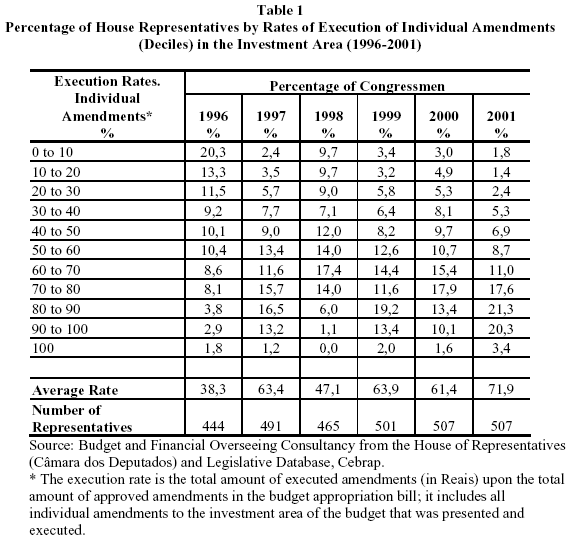
]]> Congressional internal conflict is transferred to another stage of the budgetary process: the execution or the authorization to spend budget items. During consideration of the budget proposal, the distribution of resources is uniform but, during execution, the logic is different. That is, the Executive, who has a wide degree of freedom to execute the budget, as it is not mandatory, especially concerning resources of the investment area, discriminate – or can discriminate – representatives. For this reason, outlays do not necessarily have to match the distribution of resources approved by legislators.There is a deep contrast concerning the participation of representatives in the authorization and execution stages. Table 1 shows that individual execution rates of legislators' amendments vary significantly5. For example, for the 1996 approved budget, among the 444 legislators that allocated resources for investment with individual amendments, 20.3% of them had an execution rate lower than 10%. In this same year, but on the other extreme of the distribution, only eight representatives (1.8% of the legislators that approved some amendment) had the full amount of their amendments executed by the Executive. It is noticeable, therefore, that execution, in opposition to authorization, differentiates legislators.
The final participation of legislators concerning the allocation of resources is quite heterogeneous, and this heterogeneity is the result of decisions made by the Executive to defer spending (to impound) or to authorize the execution of allocated resources. Given that the Executive has a high degree of freedom to choose which parts of the budget will be implemented, we should ask what are the criteria used by this branch to guide his decisions6. It is worth noting that annual execution rates varied throughout the period. The year that presented the lowest execution rates was 1996, when less than 40% of all approved individual amendments were executed, and over 50% of legislators had less than 40% of their amounts executed. 1998 was another poor year for representatives while 2001 was the most successful one. As we have argued elsewhere, we believe this variation does not depend on the pressure exercised by Congress. The overall rate is due to macroeconomic policies pursued by the government7.
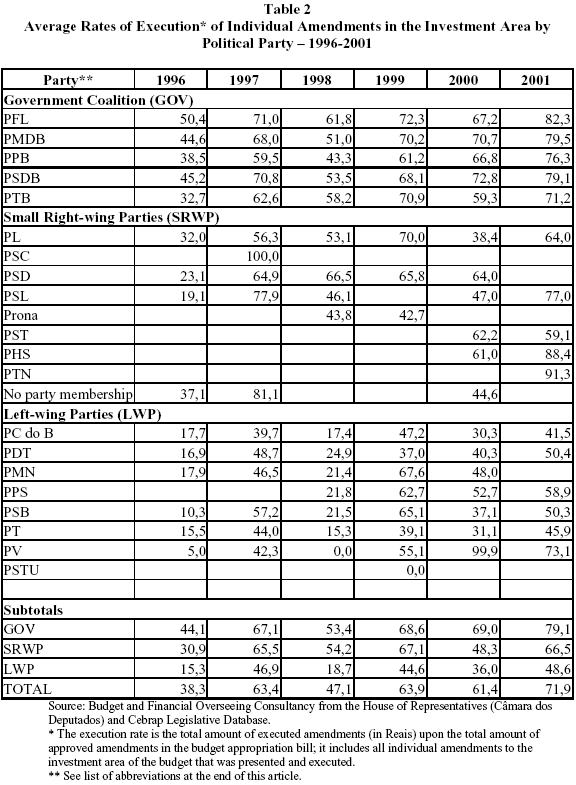
If execution rates are organized by groups of parties, as in Table 2 below, we have a better idea about the criteria used by the Executive to guide his decisions. Legislators belonging to center or right-wing parties that supported the governement8 are the ones who benefited most, while left-wing members – or opposition in the analyzed period – suffer the greatest losses. An obvious conclusion seems to emerge: the execution of individual amendments is dictated by partisanship criteria.
]]>
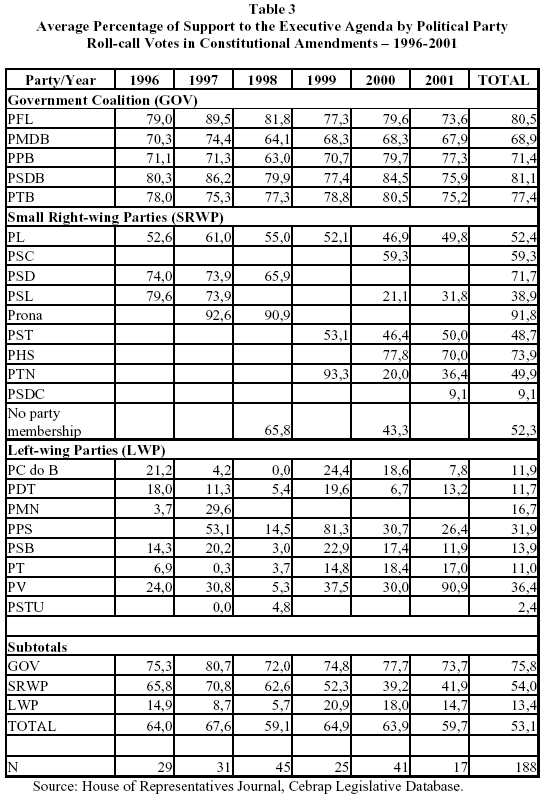
The support to the Executive agenda in roll-call votes follows the same pattern. Members of parties who belong to the government coalition support the government. The opposition does not. A roll-call is considered part of the Executive agenda if voting refers to a constitutional amendment and, at the same time, the government position – against or in favor – is made public. It is a stricter criterion than normally used and it allows a more accurate test of the hypothesis being explored here. As the approval of amendments to the Constitution demands a qualified majority, the vote of each legislator is more important to the Executive than in an ordinary, simple majority roll-call. If a legislator, for whatever reason, did not vote, his/her vote was classified as undisciplined if the Executive called for a 'yea' vote9. Only those legislators voting in 10 or more roll-calls within a year were included in the analysis. The number of roll-calls considered varied per year. In order to maintain the consistency in the analysis, the sample includes only legislators that presented amendments to the budget and that did not switch to parties from opposition to allied or vice-versa.
Table 3 shows clearly that voting in accordance to the government agenda is related to party affiliation. The average support rate of a government coalition party member is around 75% with some variation among parties10. Legislators who are members of PFL and PSDB tended to vote more united and consistently in comparison to legislators belonging to PPB and PMDB. In the latter two parties, in some issues or areas, there were few legislators whose voting behavior resembles opposition parties, which explains the fall in the average rates.
There is an obvious correlation between the execution of individual amendments and the behavior in roll-call votes. The execution of the resources allocated by individual amendments in the approved budget favors precisely the members of parties who vote in support of the legislative agenda of the Executive. There is, thus, strong evidence of a relationship between them. The thesis that asserts the execution of individual amendments is used as a "political currency" suggests that this relationship is the result of individual negotiations and that the President rewards or punishes legislators according to their voting behavior – whether in favor or against the government (Pereira and Mueller, 2002:274). If this is the case, we should conclude that the partisan correlation is spurious. Party affiliation, therefore, would not influence behavior on the floor or the execution of amendments. Legislators would be individually rewarded or punished by the Executive. What would count on this matter is their behavior on the floor, independent of the party they belong to.
It is no novelty to point out that a correlation, showed either by regression analysis or comparison of means, is not enough to demonstrate the existence of a causal association between two variables. The problem is to specify whether there is a relationship between the behavior on the floor and the execution of amendments that are independent of party affiliation. If we find low execution rates and low government support only among the representatives that belong to opposition parties and high rates of execution and higher support to the government only among the members of the government coalition parties, it will be difficult to distinguish between the explanations based on individual relationships and the ones based on party membership. Individual negotiations or negotiations centralized around party leaders would produce similar results. The point is, therefore, how to separate these two explanations. Given the correlation of both variables to party membership, it matters to distinguish what can be credited to the party and to individual negotiations. If we find cases of left-wing legislators with high execution rates and high rates of favorable votes to the Executive, and/or members of the coalition parties who vote against the government and present low execution rates, we would have strong evidences that negotiations are individual. Cases like this would suggest the existence of an individual bargain in spite of party affiliation.
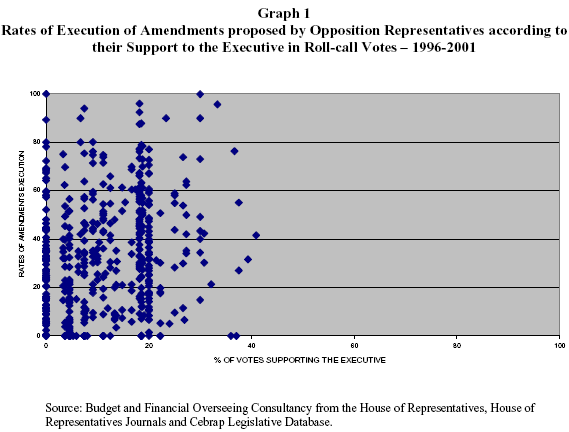
]]> Concerning the first possibility, as Graph 1 shows, there are no cases of opposition members voting systematically with the government. The variation of execution rates, though, is much higher than support to the government. Among these representatives, the norm is low scores in both variables. Having said that, we can still notice a few cases of medium to high rates of amendments execution but without the expected correspondence on roll-call votes – in fact, there are cases of legislators who gave no support at all to the government and had their amendments fully executed. We can conclude, then, that the authorization for spending, at least among left-wing party members, is not positively associated with voting with the government. Amendments are executed without votes being given to the Executive. For this subgroup of representatives, the variables present a reasonable degree of independence. However, what we can definitely say about the analyzed period is that left-wing members did not vote with the government.
When we turn to the case of members of the government coalition, as it can be seen in Graph 2, we find more cases that could fit the argument of "political currency for pork", as there are a considerable number of cases of low support to the government and low execution rates. Nonetheless, there is a similar number of cases with high execution rates but low government support – i.e., they are Representatives who voted systematically against the government and still had their amendments executed. The accumulation of cases of high support to the government and low execution rates is of greater concern. In other words, there are legislators who vote with the government although they do not receive, in retribution, the execution of their amendments. As these cases are not the exception, one can conclude that the disseminated assumption in the national political chronicle of a strategy of 'political currency for pork' is not the standard Executive-Legislative relation.
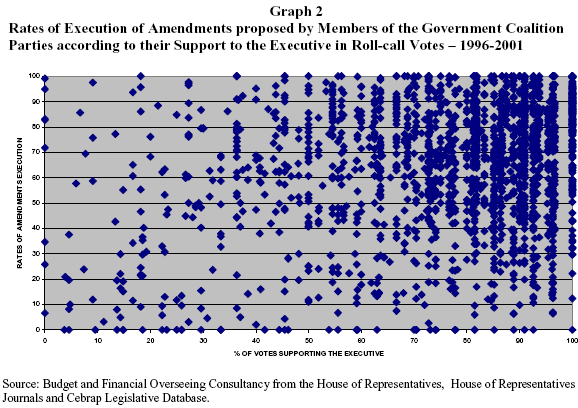
]]> Graph 2 shows that the distribution of cases is quite disperse. There is a concentration of cases on the right superior quadrant of the Graph. But it is clear that the distribution of support to the Executive is more homogenous and more concentrated in high values than the execution rates. Once again, we have indications that the behavior of both variables follows different paths. Party membership is a better predictor of voting behavior than the rates of execution of individual amendments.
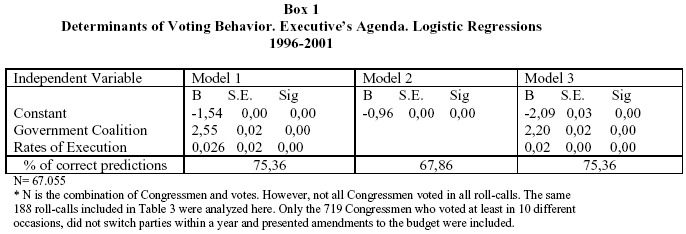
We tested the hypothesis that the partisan logic would determine both the behavior on the floor and the rates of execution for amendments. This hypothesis can be demonstrated by comparing results in three different models of logistic regression (Box 1). The first model used only one explanatory variable, a dummy variable identifying whether a representative belongs or not to the government coalition. The second model uses the rates of execution as the independent variable. The third one combines the two previous models, i.e., the rate of support to the Executive is explained by party membership and rates of amendments execution.
In the three models, the coefficients present the expected signals and are statistically significant, a result probably already anticipated by the ones familiarized with this type of analysis considering the evidences presented before and the number of cases included in the analysis. What we want to compare, though, is the explanatory capacity of each model to account for voting behavior on the floor. Therefore, this comparison takes as a baseline all the votes with the government, which represents 60.3% (40.459/67.055) of all votes given in the roll-calls included in the analysis. Thus, it is not even necessary any statistical model to arrive at a rate of correct prediction: if one simply "guesses" that all representatives will vote with the government, the rate of correct prediction will be 60.3% of the cases.
The first model, which uses one variable identifying whether the legislator is a member of the government coalition, predicts 75.36% of the votes correctly. The second model, whose independent variable is the rate of execution of individual amendments, predicts 67.86% of the votes correctly. The explanatory power of the rate of execution of amendments is smaller than the previously one and, even worse, it cannot improve the model results when added to the first estimation. The difference between the first and the third model is null11.
These results suggest that party membership explains both the voting behavior on the floor and the execution of amendments. This conclusion is reinforced when we look at the cases of representatives who voted, although they had no amendments to be executed and also the ones that had amendments executed without voting. In both cases, party membership can be used as an explanatory variable. In other words, there is a group of legislators whose behavior cannot be explained by the "political currency for pork" thesis. The budget is amended and approved in one year but executed throughout the following year. Because of the changes in the composition of the Lower House, the set of representatives that have their amendments approved are not necessarily the same ones that will be holding office when amendments are executed. As a result, there are legislators who amend the budget bill and do not hold any office (hence, cannot vote) in the year of execution and there are representatives who vote but did not participate in the consideration process of the budget and, thus, have no amendments to be executed. This last group should be a problem for the Executive. If the liberation of resources for individual amendments is the means by which the Executive can gather favorable votes to his agenda, how can support be obtained? In these cases, the Executive would not have the usual tool available to obtain support.
In post-electoral years, as it is the case of 1999 in our database, the difference between Congress composition at the time of approving the budget and executing amendments reaches the extreme as the rates of turnover are relatively high. From the point of view of the Executive, this should be an extremely difficult year in the legislative arena12.
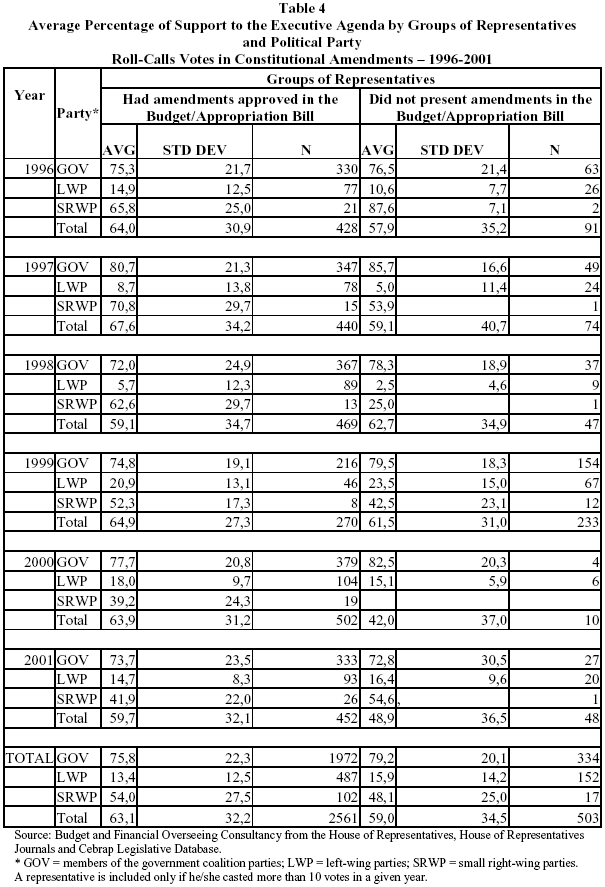
In this sense, comparing the behavior of these two groups of legislators on the floor – the ones with amendments to be executed and the ones with no amendments included in the budget– should reveal interesting differences. However, as Table 4 shows, the behavior of these two groups is not radically different. It is worth noting that the number of representatives who did not participate in the budget consideration process is quite large13.
This is especially the case of 1999, when a new elected Congress sworn in. In that year, 154 out of 370 members of the government coalition did not have the opportunity to present amendments to the budget14. Nevertheless, these representatives voted accordingly to their party membership. Legislators members of the government coalition followed the vote orientation announced by the leader of the government on the floor, independently of having or not amendments to be executed. How could the Executive have obtained these votes in these cases? If the government is always depending on the liberation of resources to govern, it would have been impossible to govern in 1999. The conclusion one reaches is straightforward: voting behavior on the floor is determined by party membership.
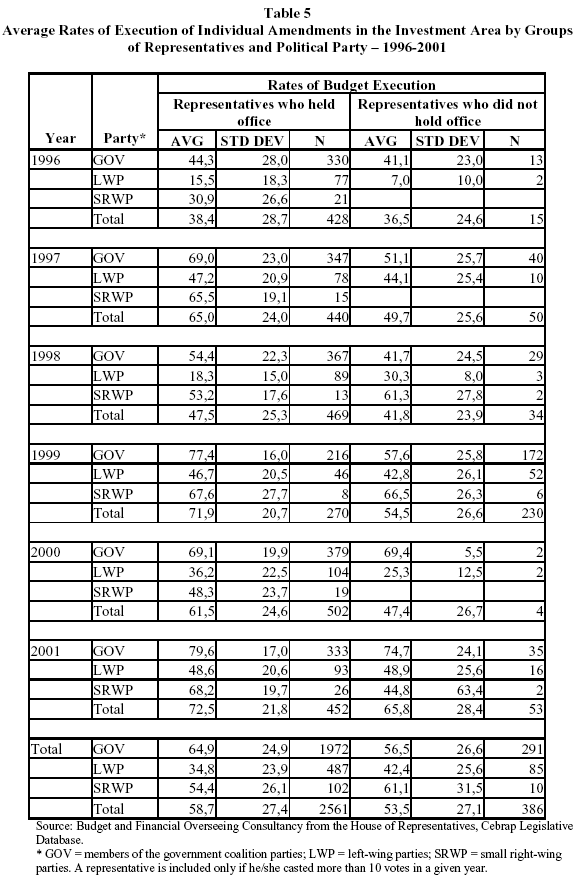
The opposite situation should also be considered, i.e., the cases of representatives who had amendments approved in the budget but were not members of Congress anymore at the time of execution. If the Executive cannot count on these votes anymore, one should expect the Executive not to execute these amendments. Table 5 compares these two groups of representatives and shows that the rates of amendment execution among legislators that hold office are higher in comparison to non-reelected legislators. However, such a difference is far from being radical. It calls the attention, above all, that amendments of representatives who did not cast a single vote in the entire period are, in fact, executed. Important to our argument here is that the rates of amendments execution among the members of the government coalition holding or not office are quite similar. Once again we conclude that party membership is crucial to understand Executive-Legislative relations.
]]>
The execution of amendments without the expected voting behavior or voting for the Executive without amendments being executed do not fit the 'political currency for pork' thesis. In these cases, by definition, the postulated 'exchanges' cannot take place. Party membership explains both cases. Support to the Executive occurs according to party lines even if amendments are not presented. Levels of individual amendments execution also follow the government/opposition divide irrespective of the possibility of the actual voting take place.
The notion that there is something to be traded –votes by budgetary resources - assumes that representatives and the Executive have independent, moreover, conflicting agendas. The representatives' agenda would be expressed by individual amendments and it is seen as a direct function of their electoral strategies. The outlay would only take place when representatives exert pressure on the Executive who ends up deviating resources from his own agenda to obtain the votes he needs to in order to get his agenda approved.
Each branch allocation pattern would follow the 'electoral connection' requirements, i.e., by the specific links they have with their electoral basis. This argument treats legislators as if they had homogenous interests – that is to say, as if all of them wanted to pursue the same type of policies. The Executive, in turn, would be the only political actor to bear in mind the general interests of the public. Each representative would only see their own electorate, their constituency. All of them would, in order to benefit their constituencies, use the same sort of policies, "delivering" to them tangible benefits. Individual amendments would be the means by which this electoral strategy becomes viable. In this sense, the execution of legislators' amendments is seen as a concession made by the Executive, who would respond to the particularistic interests of representatives in exchange to obtain, on the floor, and as compensation, the votes necessary to approve the government agenda.
However, why should we assume that the Executive and the Legislature are doomed to be in dispute? The fact that political parties play a role in this relation or, put it in a different way, there is a coalition of parties that support and another who opposes the government leads one to realize that legislators do not have homogenous interests, either concerning the policies they prefer or concerning the success of the government.
Before we start a more in-depth discussion about this point and its implications to understand the role played by individual amendments, it is important to summarize the main conclusions we have reached thus far. The connection between the analyzed variables – execution of amendments and support to the Executive in the legislative arena – is far from being direct. It is clear that one variable does not explain the other. Both are dictated by a common cause: the party position in relation to the government, although party membership does not perfectly predict the support to the Executive. Party membership profile works better to explain the behavior in roll-call votes than the rates of amendment execution, the reason being that the Executive does not execute individual amendments as compensation to the behavior of representatives. By the same token, it is not true that legislators only support the government if their amendments are executed.
BUDGET EXECUTION AND POLITICAL PREFERENCES
]]> When political scientists say that budget resources are allocated as a way of maximizing electoral returns for representatives, they bear in mind a specific model of electoral strategies pursued by politicians. In this kind of argument, politicians would only be interested in their offices or mandates. In other words, politicians are office-seeking and not policy-seeking, to use consolidated expressions in the area. It follows from this reasoning that policies pursued by legislators will be the ones that can maximize this end.North-American literature calls this strategy the "personal vote". Politicians, by pursuing this strategy, would prefer to create personal and individual connections with their electorate, links that would be possible by providing public policies that distribute tangible goods to specific groups. Thus, it follows from this assumption that reelection-seekers legislators will use their amendment prerogative in a uniform way. All of them would use amendments in the way the political science "textbook" tell us they would, i.e., to promote distributive policies in order to get, in exchange, crucial votes for their reelection.
If all of them adopted the same strategy, we would have to conclude that legislators cannot be distinguished based on their party membership. Shared interests, including distributive policies, would unite them against the interests of the Executive. The latter, given its electoral connection to a national electorate and the need to control macroeconomic effects of public spending, would be forced to take into consideration the general interests of the public.
Therefore, according to this argument, the execution of individual amendments would not contribute to the implementation of government programs. Any amount of individual amendment executed implies a reduction in the outlays the Executive would have preferred. By executing these amendments, the Executive would transfer the resources, originally allocated according to his priorities, to respond to the interests, necessarily local and partial, of representatives. Even risking being repetitive, we want to emphasize this point: the Executive would only execute amendments if he was forced to do it, that is, as a mean of gaining the necessary votes to approve his legislative agenda. Executive and Legislative would have mutually excluding priorities.
This thesis also assumes that the Executive has two separate agendas, a legislative and a budgetary one, and that these two are independent enough from each other to allow the support given to one of them to be compensated by the losses incurred in the other one. If you buy support in the legislative arena, you will sacrifice the budgetary agenda. The legislative agenda is seen as belonging to the spheres of policy choice while the decisions concerning the budget are seen as utility transfers without any connection between the two.
In order to make this argument valid, one would have to assume that either the two agendas, legislative and budgetary, are independent – i.e., decisions made regarding to one of them would not affect decisions on the other – or the actors could not see the inter-relations between the two types of agendas. It is difficult to believe in any of these two alternatives. How could be possible for representatives not to know that the legislative agenda of the Executive that they are approving – for example, the Law on Fiscal Responsibility – has consequences over the available budgetary resources? Or how can one assume that the Executive would authorize spending for small particularistic projects without noticing that the sum of all these tiny resources will generate deficit and, as a result, undermine its policy agenda? To assume that the Executive and the Legislature see the budgetary agenda as independent from the legislative agenda is to suppose that one or the other – or both – behave irrationally.
There are no trade-offs between an agenda dictated by representatives and another one dictated by the Executive. There are no exchanges because there are not two agendas. If there were two agendas, they would have to be the government and the opposition ones. But, in fact, from the point of view of individual amendments, there is only one agenda to be considered: the governmental one. Individual amendments are a small part inside this agenda but, and this is what it matters for this article, they are still part of the government agenda. By allowing the execution of some individual amendments, the Executive is still implementing its own agenda, which part of the legislators are politically associated with, including, obviously, the electoral arena. This is the next point to be discussed.
The right to present amendments is the opportunity legislators have to participate in the process of allocating resources within the budget bill, expressing their priorities concerning public policies. However, although they can count on a fixed and granted amount of appropriations, legislators cannot express their priorities with no restrictions at all. The structure of the budget process defines which programs or activities can be object of amendments. It is not possible to allocate resources to new programs or activities that were not presented in the original bill sent by the government. Moreover, if a legislator has the intention of seeing their amendment executed, they should take into account the priorities of the government and legislators are able to know what the priorities are. It is enough to look at the previous year rates of execution or the budget bill sent by the government to guess the Executive priorities.
Besides all the constitutional restrictions that protect the Bill sent by the Executive, it is also important to consider the way Congress organizes its own participation in the budget process. As we have already discussed in other articles (Figueiredo e Limongi, 2002; 2003), the decisions that, in reality, affect – or can affect – the essence of the budget are made by the general and the partial rapporteurs. That is to say that the consideration of a budgetary bill in Congress is highly centralized and follows party lines. Regarding specifically individual amendments – the decentralized part of the process – the amount of appropriations to be divided is proposed by the general rapporteur in the preliminary report. As these appropriations are defined normally by linear cuts in the original Bill sent by the Executive, the distribution of individual amendments by categories of spending (or any other unit that the budget may be structured) is defined at this point15. Legislators have restricted options on how to allocate resources that are granted to them.
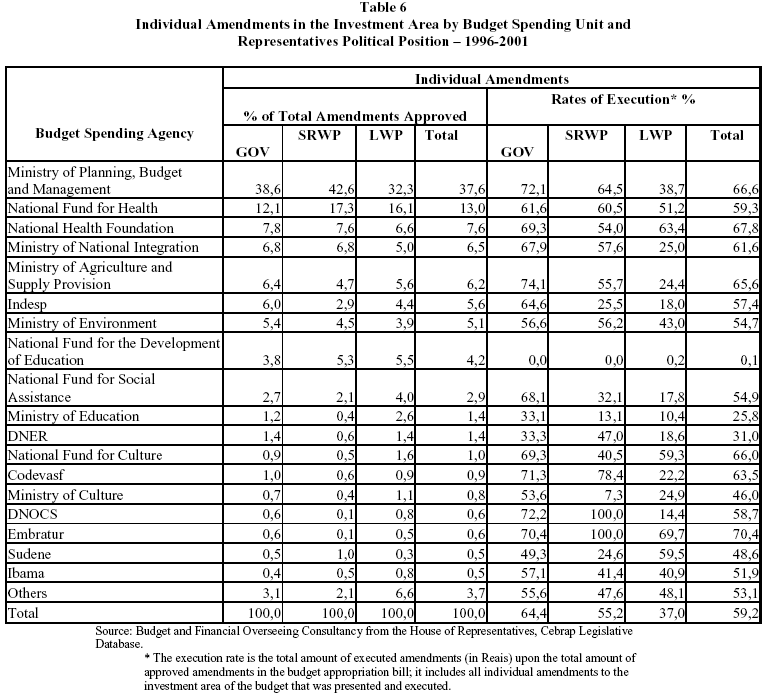
Consequently, there is no significant difference among political parties when we look at individual amendments by the Ministries/agencies responsible for the actual execution of the amendments or by government programs. Table 6 presents the distribution of amendments by different spending units (normally, a Ministry/Cabinet). The first four columns show the percentage of the total for each group of parties (government coalition, small-right-wing and left-wing) allocated to that unit. They show, thus, the priority that each political group has given to one of these units. When we compare the entries in each one of the political groups, it is clear that there is a convergence among legislators. The priorities assigned by left-wing parties do not differ from the ones assigned by government coalition members.
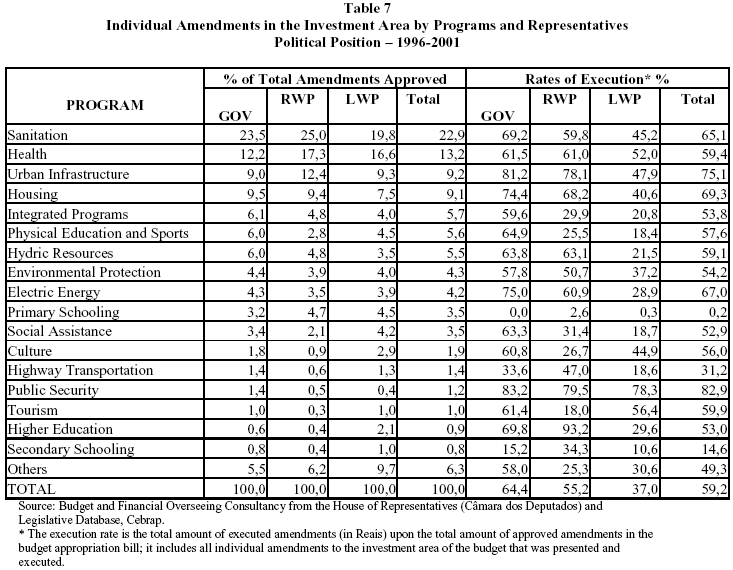
]]> The last four columns of Table 6 show the average execution rates of individual amendments for each unit analyzed. Clearly, the government favors legislators who are members of its coalition in all units of spending. In some units, this discrimination is smaller than in others. This is specially the case of spending in the Ministry of Health (the National Fund for Health and the National Health Foundation), which average rates of amendment execution are more balanced. It is worth noting that these units of spending concentrate around 20% of all resources allocated by individual amendments. On the other hand, the case of the Ministry of Planning, which 37.6% of the total amount of individual amendments is allocated to, shows marked differences concerning the rates of execution. In this Ministry, representatives who are members of the government coalition parties have 72.1% of their amendments executed in contrast with 38.7% for the opposition. Having said that, it is important to note that even for members of the coalition, execution rates varies with the specific category. The execution rate for an oppositionist at the Ministry of Planning, Budget and Management is higher than the one obtained by members of the coalition in the Ministry of Education.Similar findings are seen when data is organized by government programs. The differences among the groups of parties are smaller than the convergence among them. Once again, within all programs it is noticeable that execution rates are higher for legislators belonging to parties that support the government. However, the rates of execution do depend also on the program overall execution rate.
This data show that there is no clear divergence of agendas among legislators when they are grouped according to their position to the government. This reveals the capacity of the Executive and the budget rapporteurs to direct individual amendments to specific slots. The degree of freedom that representatives have is small. The opposition cannot use the budget process as a way to implement its agenda.
The data reinforces the conclusion reached before: execution of individual amendments is ruled by political criteria. Amendments proposed by members of the government coalition parties are more likely to be executed than the ones presented by the remaining legislators. Yet, part of the amendments proposed by members of the opposition is also executed and part of the amendments presented by representatives who voted with the government is not executed. Moreover, there is a significant variation in the rates of execution depending on the Ministries/agencies and programs. To a large extent, this variation is the result of linear cuts made by impoundment decrees. These cuts – issued by the Executive – follow the priorities of public policies defined by this Branch of government.
It may be true that parliamentary support to the Executive is crucial to the execution of amendments but not as the result of a political exchange for every single bill being voted on. The prospects for representatives getting their amendments executed depend on the political party they belong to. The same is true for voting behavior: party membership is a better predictor of the individual support to the Executive. In sum, individual bargaining does not define the pattern of public spending but party bargaining does.
CONCLUSIONS
]]> Individual amendments are not the priority of the Legislature. Internal resolutions of Congress guarantee that the vast majority of resources are channeled to collective and institutional amendments. Individual amendments represent a small portion of legislative intervention in the final allocation of resources (slightly above 15% of total amendments). And this happens without any intervention from the Executive. That is to say, as this is an internal decision of Congress, one has to be skeptical of the fact that the budget process is oriented simply to respond to local or particularistic interests of representatives' clienteles.Despite all this, given the central role normally attributed to the authorization of spending in the explanation of Executive-Legislative relations in Brazil, we examined in detail the hypothesis that execution of individual amendments are a 'political currency' used by the Executive to obtain votes on the floor. We concluded that is impossible to confirm the claimed causal relation. The authorization to execute individual amendments cannot explain the behavior of legislators in roll-call votes. Regression analyses show that party membership is a better predictor of voting than execution amendment rates. Careful observation of the data show a great number of members of the opposition that get their amendments executed without the expected retribution on the floor. On the other hand, there are members of the government coalition parties who behave "adequately" on the floor and do not see their amendments executed.
A more straightforward way to test the existence of a trade-off between the execution of resources and parliamentary support could be done by considering together both turnover rates in Congress and the budgetary cycles. Amendments approved at year t may or may not be executed only in year t+1. Hence, there are Congress members who are present at time t but are not in time t+1. If amendments were "a political currency" used to get support spending on pork, these amendments should not have been executed. We have shown that this is not the case. The amendments execution rates of members who were not present at time t+1, even considering members of the opposition, are not zero. There are also cases of representatives who swore in at time t+1 and did not present any amendments at time t. Hence, the Executive would not be able to buy the support of these "new" members as a "political currency". The Executive would simply not have a "political exchange tool" at its disposal in order to persuade these legislators to vote in support to the government agenda. As we show, these "new members" behave like the sophomores: they vote according to party lines.
The fundamental flaw of the "political currency" theses is due to its assumption, namely, that representatives have a common interest in promoting distributive policies that could grant (or would have the same positive effect to) their chances of reelection. By extension, the interests of representatives are seen as in frontal antagonism with the interests of the Executive as if there were two independent agendas. As regard to the policies they prefer, the two branches are supposed to be playing a zero-sum game. Therefore, when the Executive authorizes the execution of resources allocated by individual amendments, the President would do it at the expense of his own priorities.
These arguments miss a basic point: the structure of the conflict in the Brazilian political system is not between the two branches of government but rather is based on political party cleavages. Representatives are divided in two major groups: the ones supporting the Executive and the opposition. This distinction implies that the majority supporting the government approves the centralization of the budget process in Congress. There is a delegation of power from representatives to the general budget rapporteur and his direct collaborators. This delegation explains the reduced role individual amendments play in the budgetary process and the importance of macroeconomic variables for the rapporteurs' decisions. Above all, the budget aims to guarantee the success of governmental policies, especially the economic ones.
Regarding the priorities of both branches, captured by the allocation of budgetary resources, the differences are quite small. There are no conflictive agendas. More specifically, when the Executive authorizes the execution of resources allocated by legislators, it is not giving in to demands that harm the execution of its agenda. The allocation of resources made by representatives is complementary, not contrary to the Executive's. The latter is able to channel the demands of legislators and to accommodate them within the programs that represent the government priorities. When the Executive authorizes the execution of amendments proposed by members of the opposition and/or the government coalition members who have not voted with the government on the floor, it is simply because the Executive is executing its own agenda. The control of the budget process by the Executive is so extensive that not even opposition representatives have the ability to propose amendments that could form an alternative agenda to the one presented by the government.
The right to present individual amendments to the budget bill is an opportunity for representatives to express their priorities in terms of public policies. Although they can count on a guaranteed fixed amount of appropriations to allocate, representatives cannot, however, express their priorities without restrictions. What is given to them, basically, is the opportunity to complement an agenda that is defined by the government.
NOTES
1. These visions of the Brazilian system can be found, in different versions, in Ames (1995a; 1995b; 2001); Bezerra (1999); Pereira (2000a; 2000b); Pereira e Rennó (2001); Pereira e Mueller (2003). The consequences of this type of connection to the economy are discussed by Franco (1995) and Serra (1994).
]]> 2. The database used here covers the period after the reformulation of the budgetary process by the approval of Congress Resolution number 2/1995, a direct result of the installation of an Investigation Committee formed as a response to a corruption scheme that became public in 1992, involving members of the Budget Committee, which ended up with many representatives losing their election mandates. In reality, the participation of Congress in the 1994 and 1995 budgets was quite limited. There is data available for the years before the hyper-inflation-control Real Plan (1994) but it is virtually impossible to estimate rates of execution as it would be necessary to correct the data according to inflation based on the exact month of execution. The 2002 data were not available at the time this article was being written. Therefore, the period covered here correspond to the availability of data in order to test the hypothesis presented in the article. Information on the organization of the database and the construction of variables is presented at the Appendix.3. The official title of this Committee is "Comissão Mista de Planos, Orçamento e Fiscalização – CMPOF" or Two-Houses Committee of Planning, Budgeting and Overseeing. However, normally an abbreviated form of this title is used "Comissão Mista de Orçamento – CMO" or Joint Budget Committee. We adopt this last abbreviation – CMO – throughout this article.
4. The values used in this article were all corrected by inflation to values of 2001. Thus, the ceiling changed every year. It is important to notice that the consistency tests that we developed to control the data made some of the amendments that were registered as being approved to be excluded from our analysis. For this reason, some legislators appear in our database with amounts of values below the ceiling. Note also that some legislators did not exert the right of presenting individual amendments. An additional source of differences in the distribution of resources to each legislator is due to the decision of organizing data only for appropriations allocated to the investment area. Please, refer to the Appendix for detailed information about the adopted procedures.
5. It is important to say that for all analyzed years, the number of legislators that had their amendments approved was smaller than the total of members (513). Besides legislators that did not present amendments, there are cases which all members of a specific State preferred to transfer their individual resources to State caucuses amendments. Maybe it is not too much to say that these two types of behavior should not be observed if all legislators behaved in an individualistic and distributive manner as normally attributed to them.
6. It is important not to exaggerate this point of reasoning. The Executive's freedom is not complete. The decrees of impoundment define cuts on budget units according to the variations of revenues.
7. See Figueiredo e Limongi (2002; 2003).
8. It is worth mentioning that small right-wing parties do not appear to receive different treatment in comparison to larger ones that are members of the coalition supporting the government.
9. Unanimous roll-calls were excluded. Unanimous are all roll-calls that did not present conflict among party leaders announced positions and which the minority had less than 10% of total votes.
10. These findings differ from previous analysis (for example, Figueiredo and Limongi, 2000) as the criteria to consider a roll-call differ in two respects: analyses are restricted to constitutional amendments and the absenteeism is classified as indiscipline.
11. The same tests can be done to sub-samples based on different criteria – for example, the degree of voting conflict – without changing the results. In all models tested, the rate of execution of amendments does not improve the model based solely on party affiliation. Better results are obtained if absentees are not treated as non disciplined and excluded from the analysis as we usually do. The results of all models are far from being adequate. This problem is related to the structure of the data. The independent variables attach to each legislator do not vary throughout a specific year. Therefore, as the majority of members of the government coalition did vote with the government in the vast majority of the cases, the model predicts that every member of the coalition will vote with the government all time.
]]> 12. Following the same line of reasoning, 1995 should also have been an extremely difficult year for the Executive.13. The criteria to include these legislators in the analysis are the same ones adopted in the previous analysis.
14. Although the rates of reelection cannot be inferred from these figures, since they are also affected by leaves of absence and retirement, it is worth noting that these numbers should not be observed if rates of reelection were higher. And low reelection rates should not occur were the electoral strategies of legislators successful. The adaptation of the North-American model to the Brazilian reality misses this basic point. The classical books of Mayhew (1974) and Fiorina (1989) are all based on the observation that the reelection rates in the post-war United States are very high.
15. Individual amendments are also funded using the resources originally allocated to cover extraordinary outlays (Reserva de Contigência) and by reestimating revenues.
LIST OF ABBREVIATIONS
Codevasf – Companhia de Desenvolvimento dos Vales do São Francisco e do Parnaíba (Company for the Development of the São Francisco and Parnaíba Valleys)
DNER – Departamento Nacional de Estradas de Rodagem (National Department of Highways)
DNOCS – Departamento Nacional de Obras contra as Secas (National Department for Public Works against Drought)
Embratur – Instituto Brasileiro de Turismo (Brazilian Institute of Tourism)
]]> GOV – Members of the government coalition partiesIbama – Instituto Brasileiro do Meio Ambiente e dos Recursos Naturais Renováveis (Brazilian Institute of the Environment and Renewable Natural Resources)
Indesp – Instituto Nacional do Desenvolvimento do Desporto (National Institute for the Development of Sports)
LWP – Left-wing parties
PC do B – Partido Comunista do Brasil (Communist Party of Brazil)
PDT – Partido Democrático Trabalhista (Labor Democratic Party)
PFL –Partido da Frente Liberal (Liberal Front Party)
PHS – Partido Humanista da Solidariedade (Humanist Solidarity Party)
PL – Partido Liberal (Liberal Party)
PMDB – Partido do Movimento Democrático Brasileiro (Party of the Brazilian Democratic Movement)
]]> PMN – Partido da Mobilização Nacional (National Mobilization Party)PPB – Partido Progressista Brasileiro (Brazilian Progressive Party)
PPS – Partido Popular Socialista (Popular Socialist Party)
Prona – Partido da Reedificação da Ordem Nacional (National Order Reconstruction Party)
PSB – Partido Socialista Brasileiro (Brazilian Socialist Party)
PSC – Partido Social Cristão (Christian Social Party)
PSD – Partido Social Democrático (Social Democratic Party)
PSDB – Partido da Social Democracia Brasileira (Brazilian Social Democratic Party)
PSL – Partido Social Liberal (Social Liberal Party)
PST – Partido Social Trabalhista (Social Laborist Party)
]]> PSTU – Partido Socialista dos Trabalhadores Unificado (Unified Workers Socialist Party)PT – Partido dos Trabalhadores (Workers Party)
PTB – Partido Trabalhista Brasileiro (Brazilian Laborist Party)
PTN – Partido Trabalhista Nacional (National Laborist Party)
PV – Partido Verde (Green Party)
RWP – Right-wing parties
Sudene – Superintendência do Desenvolvimento do Nordeste (Office for the Superintendency of the Development of the Northeast Region)
REFERENCES
AMES, Barry. (1995a), "Electoral Rules, Constituency Pressures, and Pork Barrel: Bases of Voting in the Brazilian Congress". The Journal of Politics, vol. 57, nº 2, pp. 324-343. [ Links ]
_____. (1995b), "Electoral Strategy under Open-list Proportional Representation". American Journal of Political Science, vol. 39, nº 2, pp. 406-433. [ Links ]
_____. (2001), The Deadlock of Democracy in Brazil. Ann Arbor, University of Michigan Press. [ Links ]
BEZERRA, Marcos Otávio. (1999), Em Nome das Bases: Política, Favor e Dependência Pessoal. Rio de Janeiro, Relume Dumará. [ Links ]
CAIN, Bruce, FEREJOHN, John e FIORINA, Morris. (1987), The Personal Vote: Constituency Service and Electoral Independence. Harvard, Harvard University Press. [ Links ]
FIGUEIREDO, Argelina e LIMONGI, Fernando. (2000), "Presidential Power, Legislative Organization and Party Behavior in Brazil". Comparative Politics, vol. 32, nº 2, pp. 151-170. [ Links ]
_____. (2002), "Incentivos Eleitorais, Partidos Políticos e Política Orçamentária". Dados, vol. 45, nº 2, pp. 303-339. [ Links ]
_____. (2003), "O Legislativo e Âncora Fiscal", in F. Rezende e A. Cunha (eds.), O Orçamento e a Transição de Poder. Rio de Janeiro, Fundação Getulio Vargas Editora, pp. 55-91. [ Links ]
FIORINA, Morris P. (1989), Congress: The Keystone of Washington Establishment. New Haven, Yale University Press. [ Links ]
FRANCO, Gustavo Henrique Barroso. (1995), O Plano Real e outros Ensaios. Rio de Janeiro, Francisco Alves. [ Links ]
MAYHEW, David. (1974), The Electoral Connection. New Haven, Yale University Press. [ Links ]
PEREIRA, Carlos. (2000a), What Are the Conditions for the Presidential Success in the Legislative Arena? The Brazilian Electoral Connection. Doctorate Thesis, New School University, New York. [ Links ]
_____. (2000b), "Why Have Brazilian Legislators Decided to Clean up their Sidewalks? The Influence of the Brazilian Political Institutions on the Process of State Reform", in S. Nagel (ed.), Handbook of Global Political Policy. New York, Marcel Dekker, Inc. [ Links ]
_____ e RENNÓ, Lúcio. (2001), "O que É que o Reeleito Tem? Dinâmicas Político-Institucionais Locais e Nacionais nas Eleições de 1998 para a Câmara dos Deputados". Dados, vol. 44, nº 2, pp. 323-362. [ Links ]
PEREIRA, Carlos e MUELLER, Bernardo. (2002), "Comportamento Estratégico em Presidencialismo de Coalizão: As Relações entre Executivo e Legislativo na Elaboração do Orçamento Brasileiro". Dados, vol. 45, nº 2, pp. 265-301. [ Links ]
_____. (2003), "Partidos Fracos na Arena Eleitoral e Partidos Fortes na Arena Legislativa: A Conexão Eleitoral no Brasil". Dados, vol. 46, nº 4, pp. 735-771. [ Links ]
SANTOS, Maria Helena de Castro, MACHADO, Érica Massimo e ROCHA, Paulo Eduardo Nunes de Moura. (1997), "O Jogo Orçamentário da União: Relações Executivo-Legislativo na Terra do Pork-Barrel", in E. Diniz e S. Azevedo (eds.), Reforma do Estado e Democracia no Brasil. Brasília, Editora da UnB/ENAP. [ Links ]
SERRA, José. (1994), O Orçamento no Brasil: As Raízes da Crise. São Paulo, Atual Editora. [ Links ]
Argelina Figueiredo is associated professor of the Instituto Universitário de Pesquisas do Rio de Janeiro – Iuperj and coordinates the political and society research area of the Centro Brasileiro de Análise e Planejamento – Cebrap. She is the author of Democracia ou Reformas? Alternativas Democráticas à Crise Política (Rio de Janeiro, Paz e Terra, 1993), and the co-author, with Fernando Limongi, of Executivo e Legislativo na Nova Ordem Constitucional (Rio de Janeiro/São Paulo, Fundação Getúlio Vargas Editora/Fapesp, 1999).
]]> Fernando Limongi is professor at Universidade de São Paulo – USP and researcher of the Centro Brasileiro de Análise e Planejamento – Cebrap. He is the co-author, with Argelina Figueiredo, of Executivo e Legislativo na Nova Ordem Constitucional (Rio de Janeiro/São Paulo, Fundação Getúlio Vargas Editora/Fapesp, 1999), and, with Adam Przeworsi, Michael E. Alvarez and José Antonio Cheibub, of Democracy and Development: Political Institutions and Well-Being in the World, 1950-1990 (New York, Cambridge University Press, 2000).
APPENDIX
Notes on the Organization of the Federal Budget Database, Cebrap
The source of information of the data organized here is the database called "Execução Orçamentária da União" available on the Internet at the Comissão Mista de Orçamento e Fiscalização (Budget Committee) web site, organized by the Budget and Financial Overseeing Consultancy from the House of Representatives (Câmara dos Deputados) together with the Center of Informatics and Data Processing from the Federal Senate (Senado Federal) – Prodasen. This database was reorganized specifically for this research distinguishing the allocations in the smallest budget unit (called Rubrica) for the Executive and the Legislature, both for the Budget/appropriation bill and the execution of the Annual Budget Law [Budget databases].
The original databases give detailed information on each stage of the budgetary process: the project sent by the Executive, the amendments approved in Congress, the final appropriation bill, the presidential vetoes, the bill sanctioned by the President and, finally, the amounts executed, which, besides the figures allocated in the law, includes extra supplementary credits or cancellations that may change budget units originally set in the appropriation bill.
The first treatment of the original data aimed to give internal consistency between the database containing the parliamentary amendments and the database on the resources actually spent. For example, when in the database of parliamentary amendments the amount approved was higher than the same record in the appropriation bill database, corrections were done. Therefore, the original amount of resources (in Reais) recorded at the amendments database was reviewed based on the amount approved in the appropriation bill. It is very likely that these reviewed records are, in fact, errors as they could not have been executed if they were not recorded in the appropriation bill.
Additionally, it was necessary to identify the amendments made to the Investment area, which meant to identify the 'group/item of spending' (called GND, in Portuguese) of each amendment as this information was not readily available. A set of computer routines made the association between amendments and GND and only small corrections, for internal consistency, had to be done when computer routines was not enough to correct them. We built, therefore, parallel and integrated databases of all approved amendments for each year. The number of amendments varies each year from 5.000 to 10.000.
]]> In order to define the Executive part of the approved budget we simply subtracted the amount in the budget/appropriation bill approved by Congress and sanctioned by the Executive from the corrected amendments database, guaranteeing, once again, internal consistency of all databases.Another procedure adopted was to sum all sorts of possible cuts, reallocations and supplementary credits that take place into one single variable that we called 'supplements'. Then, we calculated the 'authorized' amount of Reais for every single amendment/GND (or the real amount authorized for execution), which was the difference between the appropriation bill and the 'supplements'. It is worth noting that a 'supplement' that cuts money from an approved amendment has a negative value.
Therefore, we could follow the execution of every amendment by different GNDs. Other corrections were done at this stage, to guarantee internal consistency among the databases, basically making sure that the executed amount would not be higher that the 'authorized' amount calculated previously and that there were no repetitions of cases.
Once the amount authorized for execution was ready, we could link this information to the approved amendments database and calculate the rate of execution for every single amendment. At this stage, there were cases we needed to infer the rate of execution because a budget item can received more than one amendment (to the same item). We chose, in these cases, to calculate the proportional contribution of each amendment to the total amount approved in an item and adopted the same (proportional) rule to estimate the amounts authorized for each amendment. So, for example, if a specific amendment contributed to 50% of the approved budget item, we inferred that 50% of the execution (of this same item) was from that specific amendment. Therefore, we could guarantee no double-counting records and maintained internal consistency of the databases.
Finally, we would like to note that the data organized in this way – in order to be able to have information disaggregated to the smallest budget unit possible and maintain consistency – present marginal differences when we compare the amounts sum up by ministries, agencies, programs etc. and that can be found in the Congress or government web sites.
]]>