Structure familiale et revenus du travail des riches
Estrutura familiar e rendimentos do trabalho dos ricos
Marcelo Medeiros
Translated by Deborah Neale
Translation from Dados - Revista de Ciências Sociais, Rio de Janeiro, v.47, n.2, p.365-382, 2004.
ABSTRACT
Fair distributive measures require good knowledge about the rich. To evaluate the extent to which persons are rich because they live in families of a specific composition I test three hypothesis about the inequalities between the rich and the non-rich that relate the better situation of the rich to: 1.a particular demographic structure (fertility levels, position in the life course, etc.); 2. a higher use of the available labor (workforce participation and employment rates, length of work shift); 3.to the occupation of better positions in the labor market (higher remuneration). The test of hypotheses is based on a decomposition of the per capita income of the families, using data from the Brazilian National Household Sample Surveys (PNADs) of 1997, 1998, and 1999. The results suggest that the existence of a rich elite in the country is explained mostly by inequalities in workers' remuneration rather than by the demographic profile of the population or by the participation and employment rates for workers of the families.
Keywords: elites; rich; wealth; social inequality; family structure
RÉSUMÉ
Pour réussir une meilleure redistribution des ressources, il faudra mieux connaître qui sont les riches. Dans le but d'évaluer si les individus sont riches grâce à une structure familiale distincte, on examine trois hypothèses à propos des inégalités entre riches et non riches, selon lesquelles les avantages des riches sont dus à: 1.une structure démographique particulière (niveaux de fécondité, situation dans le cycle de vie etc.); 2.plus d'embauche et de la main-d'œuvre disponible (taux d'activité et d'occupation, durée des journées de travail); 3.meilleurs postes dans le marché du travail (rémunérations plus élevées). On a obtenu ceci en effectuant une décomposition du revenu per capita du travail des familles, utilisant les données des PNADs de 1997, 1998 et 1999. Les résultats indiquent que l'existence d'une élite riche dans le pays est due surtout aux inégalités de rémunération des travailleurs et non pas au profil démographique de la population ou alors aux taux d'activité et d'occupation des travailleurs des diverses familles.
Mots-clé: élite; riches; richesse; inégalités sociales; structure familiale
]]> INTRODUCTION
Most of Brazil's extreme social inequality results from a small elite of the population owning most of the country's wealth. There are several different paths for diminishing this inequality, including redistributing the wealth of the rich elite to the poorer masses. To gauge the extent to which redistribution of the wealth of the rich to the non-rich is fair and achievable, we must understand better why some families are rich and others are not. One way of achieving this is to analyze how income levels in families are associated with some of their characteristics, such as the number of family members, their age, whether they work or not, and the earnings of the workers.
As far as the wealth generated by high income from employment is concerned, several factors affect the total available for distribution among family members. Amongst these, family structure, the family's organization in terms of labor and the level of pay of the workers stand out. The purpose of this study is to evaluate the role of each of these three factors in the difference between rich and non-rich families. This evaluation allows us to test three hypotheses concerning inequalities between the two groups. These hypotheses ascribe the better circumstances of the rich mainly to a particular demographic structure (levels of fertility, life-cycle stage, etc.), to higher employment rates and to the output of the available work force (rates of activity and occupation, number of working hours) or to holding better positions in the labor market (higher remuneration).
The weight of each one of these factors in the configuration of the strata is analyzed based on the decomposition of the per capita income earned from working of the families. Empirical results were obtained from the Brazilian National Household Sample Survey (PNADs) data for 1997, 1998 and 1999. The decomposition is used to compare the averages of the income components of each stratum and then to carry out an exercise in which the levels of mobility from one stratum to another are evaluated through eight simulations that assign the averages of the rich to the non-rich and vice-versa, for each component.
The article is divided into five sections, of which this introduction is the first. In the second section I discuss how per capita family income from work can be decomposed, by highlighting those situations in which a particular family might differentiate itself from others and become rich. In the third section I look at the methodological aspects of this decomposition and simulation procedures, using the PNAD data in order to assess the extent to which the wealth of families in Brazil can be ascribed to their age structure and organization in terms of work, or to the income of their workers. The fourth section shows the results of the decompositions and simulations and the final section brings the main conclusions reached.
The results indicate that the structure and organization of families in terms of work play a limited role in explaining the difference between the rich and the non-rich when compared with the weight that remuneration earned from working has on separating the two groups. In other words, the existence of a rich elite in the country can be largely explained by inequalities in workers' pay and not by the demographic profile of the population or by the rates of activity and occupation of the workers from the various families.
COMPONENTS OF THE PER CAPITA INCOME FROM WORK
The factors that lead a specific individual to hold a position in the richest stratum of society have been the subject of a long tradition in Social Sciences. Marx and Veblen, for instance, reject the argument that some people belong to superior strata in society because they lead a life of frugal consumption and hard work (Marx, 1973; 1975; 1978; 1981; Veblen, 1983). Embracing a different position, Weber and Pareto largely endorse the thesis that industry and frugality are important determinants in the economic performance of individuals in capitalist societies, but they also highlight differences in professional qualifications as one of the elements that provide individuals with their position in the social hierarchy (Weber, 1961; 1989; 1991; Pareto, 1964).
A characteristic of almost all these pioneering studies is a strong association between social stratification and the structuring of economic activity. This tendency has spread into modern studies, which tend to view the position of an individual in a particular social stratum as being determined to a greater or lesser extent by the person's position in the hierarchy of economic activities, which is generally evaluated using information about the occupation of workers, since a reasonable association between social inequality and occupational differences can be observed (Cromptom, 1995; Goldthorpe, 2000; Goldthorpe and Marshall, 1992; Savage, 2000; Wright, 2000; 2002; Breen, 2002). In stratifying society using information on the economic activity (in other words, on the occupation) of individuals, these theories come up against the problem of how to classify a large mass of people that are not economically active, as is the case of many children, the elderly and women. Invariably, the solution to this problem consists of extending the classification of individuals that are economically active to include the rest of their families.
]]> Assigning the social position of an economically active individual to members of his or her family implicitly embodies the notion that the family is a distributive entity, i.e., that it shares amongst its members what was obtained by some of them. This is precisely what is done by methods of stratification that use income received by some family members for classifying all the remaining members. The systems of stratification by income per capita, as is the case with some of the ones that define the poor and the rich, for instance, go further and assume that the income of some is, or could be, equally distributed to all members.The assumption that families equally distribute the income (or any other resources) they receive is probably not very realistic. Sen (1997)[1983] discusses this and argues that the existence of intra-family hierarchies, widely demonstrated in the literature on gender roles, for instance, is a strong reason to deny the existence of such egalitarian distribution. In fact, if intra-family distribution is carried out as a function of the different circumstantial needs, there is no reason to believe in the reality of this assumption. However, given the lack of more detailed information on intra-family distribution of income, some information on distribution needs to be imputed. In this case the best alternative is to deal with per capita income not as income actually received by each family member, but as the amount of income that would be available for each person if intra-family inequalities did not exist.
The income of families is not the only relevant dimension, undoubtedly, when it comes to defining their level of wealth and much less their social status. Income are flows and therefore expresses the circumstances of people at a specific point in time. The idea of wealth, however, is strongly associated with assets, which are stocks and therefore refer to a situation that, if not permanent, is at least long-term.
There are many reasons, nevertheless, for income levels to be instrumentally used as indicators of people's wealth and three, at least, merit highlighting. The first is essentially pragmatic: information on income from surveys of Brazilian households is easily found, fairly reliable and reasonably accurate, whereas this is not true of information on assets. The second has to do with comparability: the use of income indicators allows a certain degree of reference and comparison with many other available studies of a similar kind, including those on social stratification, which use income as one of the factors for creating a hierarchy of the status of occupations. The third is theoretical in nature: stratification systems have used income as an indicator of social position, based on the assumption that, on one hand, income received is an expression of the level of assets owned and, on the other, is an indicator of wealth, since these are assets accumulated from income flows (Sørensen, 2002).
It is obvious that a stratification system starting with per capita income does not take into account solely the total income of each family but also the number of people sharing it. Two families with the same total income may be in different strata if one of them has more members than the other. This fact gave rise to a series of arguments of Malthusian origin, according to which poverty resulted mainly from an excessive number of non-productive people in families. According to some theories, high dependency ratio largely explains the incidence of poverty in countries. Reactions to proposals of this kind argue that the main determinant of poverty is low income and not high dependency, as was shown by specialized literature analyses produced by Martinussen (1997) and Furedi (1997). In reality, however, both arguments may be correct and only empirical tests can say which of them is the more appropriate in any specific case.
Therefore, just as a family may be non-rich because it has a large number of dependents, earns low income or a combination of both, an individual may be rich because he belongs to a family that combines high income with a small number of dependents. This income can be classified by type and it is especially interesting to focus this study on income from work, not only because this is the bulk of Brazilian family income, but also because it gives us an idea of how the work force in a family is used.
Differences in per capita income from work either occur because the percentage of family members with some income differs from family to family, or because the average income of these people is different. In other words the difference between families occurs because the greater the number of family members working and/or the greater the remuneration of these workers, the higher is the family income. From an analytical standpoint, a family can differentiate itself from others and become rich because: (1) it has a higher percentage of workers; (2) the occupation rate of its work force is greater; (3) rich workers work longer hours; (4) rich worker earnings per hour are higher.
These characteristics are not mutually exclusive and may interact in determining the level of family income. The first item is a component of a demographic nature, connected with the age structure of the families, i.e., the percentage of the total number of family members who are of working age; this represents the ratio between the number of people available to work and the number of dependents. The second refers to how families employ this labor. It depends as much on intra-family decisions (which are not necessarily taken jointly) as on labor market characteristics (job availability). The third reflects the intensity of use of this work force in terms of number of hours worked per day and the fourth shows how the labor market remunerates the work supplied by the families.
It is therefore possible to decompose per capita family income from work into the following equation [1], which is a modified version of the equation proposed by Barros and Mendonça (1995:7):
[1] Rf = Af ·Tf ·Hf ·Sf
]]> where in family f, per capita income from work (Rf) is equal to the product of the proportion of people of active age (Af) times the number of people actually working (Tf), the average number of hours worked (Hf) and the average earnings per hour of the people who bring in work income (Sf). (Af ·Tf ·Hf) refers to the amount of labor and is related to the structure (number of children and adults, etc.) and organization (intensity and division of paid work) of the families. (Sf), which relates to the remuneration of the work force employed, depends on the qualifications of the workers and the characteristics of the labor market.
METHODOLOGY
The PNADs provide the data required for empirically measuring the extent to which the wealth of a family in Brazil can be ascribed to its age structure and organization in terms of work, or to the income it earns through its workers. In addition, this information allows us to isolate the elements that comprise the per capita income of families and determine their level of wealth, thus allowing one to evaluate the role of each one of them with regard to determining the income of rich families.
Starting with identity [1], the impact of each one of the components on total per capita family income can be analyzed via simulations that modify only one of these components, keeping the others constant. For instance, if we wanted to find out the average impact that differences in remuneration have on the inequalities in the total income of rich vs. non-rich families, we could attribute the average remuneration of rich workers to the non-rich and then see how many non-rich families become rich.
Simulations of this type may be not very realistic because they do not take into account the correlations between these components. Barros and Mendonça (1995), for instance, showed that in order to offset their low income the poorest families send a greater number of people into the labor market. To be realistic, a simulation should take this into account and vary the fraction of the family working (Tf) every time work remuneration (Sf) is simulated at a low level. In the absence of a fuller understanding of the relationships between all the components of per capita income of the various families, simulation results, especially those based on averages, should be interpreted as general indications of trends and not as forecasts intended to provide accurate results.
To analyze the role of each component in the difference between the total income of rich and of non-rich families, there are simple simulations that ca be done, such as attributing to one group the characteristics of another and then tracking the changes that occur in total family income. Simulations evaluate mobility between social strata (rich and non-rich) using the entry and exit flows in the strata, as measured by the proportion of the population moving in each stratum.
Simulation procedures may be divided into two categories. In the first I attribute the average characteristics of the non-rich to the rich. In the second the procedure is inverted and I attribute to the non-rich the average characteristics of the rich. In both cases only one component of the identity [1] (rate of occupation, income, etc.) is altered, the others remaining as observed. These exercises are complementary and are designed to make it easier to interpret the results.
The analysis uses microdata from the PNADs for 1997, 1998 and 1999. As the stratum of the rich population comprises a small fraction of the total population, there is a risk that the sample from one isolated PNAD may fail to properly represent it. To get around this problem, the records of the three PNADs were merged and subsequently treated as representative of a single population. Two survey aspects enabled this. First, the entire methodology remains constant for the three years, making the information comparable. Second, the PNAD sample design keeps the interviews from being repeated in a same household over consecutive years. Thus, the merger of information implies an expansion of the population interviewed and not a panel-type data. This guarantees a much greater sample of rich families than would be otherwise possible with a single survey.
As a result of this data merger, the results refer to the entire period under analysis, or more specifically, to the three segments conducted in the months of September (reference month of the PNADs) of the years being considered. This implicitly assumes that no radical changes have occurred in the structure of society during the time being analyzed, which seems reasonable for the period in question. To avoid over-representation of the most recent information, the expansion factors of the sample were adjusted so that the growth observed in the population over time would not affect the weight of each PNAD in the final results, meaning that the result of the expansion after the merger of data would reflect the population projected by the 1999 PNAD. To adjust the monetary values over time I used inflation as measured by the National Consumer Price Index – INPC, so that the adjusted records would represent the values as of September, 1999.
]]> The rich and non-rich strata were identified on the basis of an affluence line calculated by applying the methodology in Medeiros (2001) to the merged data of the PNADs from 1997 to 1999. The rich stratum corresponds to the top 0.9% richest people in the per capita income distribution. The value of the affluence line equals a monthly per capita family income of R$ 2,170.00 in terms current as of September 1999 (around US$ 1142). For applying the methodology, I used a relative extreme poverty line, in which the cut-off point of a third of the population was a monthly per capita income of R$80.97 (around US$ 43 in 1999 values). Therefore the affluence line corresponds to almost 27 times the poverty line. The advantage of using a relatively low affluence line such as this is that the results tend to be more robust (in other words, less sensitive to variations arising from the use of different definitions of wealth) than the results that might be obtained from the study of an extremely rich population.The "families" analyzed correspond to a group of people from households where there was some family relationship between them. The income from work is the result of the sum of the income from work from all sources of those people who were ten or more years old. The "income from work" refers to all types of labor remuneration, including salaries, the remuneration of the self-employed, etc. The division of this amount by the number people in the household generates Rf, the per capita income from working of each family f in Brazil. Following the methodology of the PNADs I considered active age population (AAP) as being all those on whom information about work had been collected, i.e. people who are ten or more years old. The active age population ratio in each family, Af, is computed by dividing the number of people ten or more old by the total number of people living in the household. The fraction of the work force actually working, Tf, corresponds to the number of family members occupied in the reference weeks of the PNADs divided by the active age population of the families. The average number of hours worked, Hf, is equal to the total monthly number of hours worked by those living in the household, divided by the number of those occupied. Finally, the average remuneration per hour of the people who receive work earnings, Sf, is a simple average of the amounts received by each person working in the family and is expressed in reais as of September, 1999.
RESULTS: THE EFFECT OF EACH COMPONENT
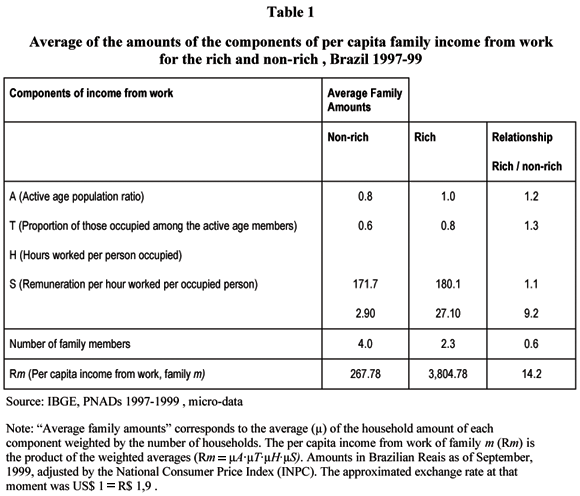
The first step when it comes to checking empirically why the per capita income of rich families is higher than that of non-rich families is to observe how, on average, the components of this income differ. In itself this observation allows us to evaluate to what extent the wealth of a family can be attributed to its age structure and organization for work or to the income produced by the family's working members. Table 1 shows the average of the amounts of the components of income from work of each of the Brazilian households for the rich and non-rich strata. The table also has a column showing the relationship between the values for the rich and non-rich, i.e. the result of the averages of the values for the rich divided by the averages for the non-rich.
The per capita income from work of a hypothetical family m, whose components of income from work were equal to the average of the non-rich, would be nearly R$267.78 in September, 1999 (US$ 140). If the same family were to have the average of the rich, their per capita income from work would be R$ 3,804.78 (US$ 2003), nearly 14.2 times more than the former figure. This is a very large inequality in which the values of all the components of the income favor the rich. The weight that each one of these components has on total inequality, however, varies much.
]]> The families of the rich are much smaller than the others. A rich family has on average 2.4 people, whereas the size of a non-rich family is roughly 4 people. Despite this, there are no great differences in the proportion of active age population (AAP) in the two groups, as shown in Table 1. The somewhat limited difference occurs because the larger size of the non-rich families is accompanied by a greater number of people available for work.The rich have a larger ratio of occupied people than the non-rich. To some extent this result is expected, given that unemployment affects total household income and that the chances of a family being included in the rich stratum decreases when one of the members becomes unemployed. However, an association between the age structure of the families and the differences between the rich and non-rich should not be entirely disregarded. It is obviously questionable whether people who are only a little over 10 can, in fact, be considered as "available work force". At this age the rates of participation in the labor market are much smaller than those of adults, a clear indicator that many restrictions exist, including those of a legal nature, with regard to employing these people in economic activities. It is entirely possible that the greater ratio of occupied people among the rich is related to the age structure of their families, but this seems to be of secondary importance in determining the differences between the strata.
The intensity of use of the occupied work force, i.e., the average number of hours worked by those people in the families who are occupied in each stratum, is practically the same. As is the case with rates of occupation, these averages are influenced by the tendency of families using available workers less intensely having lower income. However, the high and similar values for the rich and non-rich alike indicate that both types of family are employing their workers to their full capacity. As a matter of fact, this strengthens the argument that the rate of occupation difference between the two strata is due to the different age structures of their families. If all families keep their children from working, then part of the lower income of the non-rich is explained by their younger family structure and not by a less intense use of the resources available to them.
Regardless of the reasons that determine it, the particular composition of rich families is not sufficient to explain why they differ from the non-rich in terms of income per capita. Neither is it possible to indicate the organization and internal division of work of rich families as an explanation for this distinction, since work – in the sense of time dedicated to it – does not seem to play a relevant role in explaining differences between the rich and the non-rich. Most of the differences between the rich and non-rich can be found in the unequal way in which the workers from each group are remunerated.
The average remuneration per hour worked of the rich is 9.2 times greater than that of the non-rich. Whereas the non-rich receive roughly R$ 2.90 per hour worked, the rich receive some R$ 27.10 for same time span. This shows that even if the non-rich had exactly the same family composition and organization as the rich, the inequalities between the strata would persist. On average, remuneration differences are the main explanation for the difference in the groups.
The above results refer to average per capita income from working. The impact that the differences in these components have on total family income in the two strata of population is shown in Table 2, which presents the results of eight simulations on the mobility between strata of the rich and non-rich population. In the first four I analyze what would happen to non-rich families if the amount of each of the components of their work income were altered to the averages seen among the rich. In the subsequent simulations the results of assigning the averages for the non-rich to the rich families are evaluated.
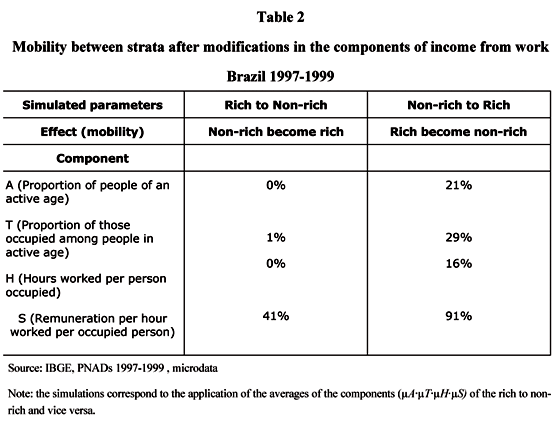
]]> Changes in the age structure of non-rich families would have no relevant effect on the stratification between rich and non-rich. If the average of the proportions of people of active age from rich families were to replace the actual figures of non-rich families, the proportion of non-rich that would become rich would be insignificant. This indicates that there is no basis to the argument that relies on the other extreme of the neo-Malthusian rationale, according to which the existence of a rich stratum in the country results from smaller family size. For instance, it is not high levels of fertility – or anything similar – that prevent many families from being rich.
Similar changes in the levels of activity and employment of the non-rich population would also have little impact. If the proportion of those occupied within the active age population of the families were raised to the average proportion of the rich, the income of only about 1% of the non-rich would rise enough for their families to become rich. There is also no basis for the idea that a large share of the wealth can be explained by longer work shifts. Even if non-rich workers were to increase their working hours to the average levels of the rich, very few would become rich.
The difference between the rich and the non-rich is not due to a greater availability of labor or its more intense use in families, but to the difference in remuneration between workers. When the remuneration of the rich is given to the non-rich, radical changes occur in the income of the non-rich population. The per capita income increases to such an extent that nearly 41% of the people in these groups become rich. Everything points to the fact that the isolated impact of assigning the remuneration of the rich to the non-rich on the mobility of this group would be greater among the non-rich than a combination of more jobs, longer work shifts and the increased occupation of women, children and the elderly.
When we attribute to the rich the averages of the components of non-rich work income, the proportional mobility of the rich population to the lower strata is far greater than we saw in the previous exercises. If we reduce the proportions of the AAP, of working family members as well as the number of hours worked of the rich families to the average levels of the non-rich, 21%, 29% and 16%, of the rich are pushed out of this group, respectively. When the average remuneration of the non-rich replaces the income of the rich, 91% of the latter move downward; it is likely that the 9% that remain in the stratum have the benefit of pensions or other sources of income, such as interests and rents.
The very significant impact of the simulations that attribute to the rich the averages found among the non-rich is related to the Brazilian income distribution. Proportionally speaking, the rich are much more concentrated near the affluence line that divides the two groups than the non-rich. The majority of Brazilian families have per capita incomes at least ten times lower than the affluence line, but only a small fraction of the rich have income higher than three times the affluence line. It is therefore natural that the simulations affect rich families more heavily.
It is important to note in Table 2 that family composition and its organization in terms of work have a limited influence on explaining the difference between the rich and the non-rich when compared to the weight of work-related pay. The existence of a rich elite therefore bears little relationship to the demographic profile of the population or even to the rates of activity and occupation of the workers. The component that best explains the difference between rich and non-rich families is inequality in income from work
CONCLUSIONS
A family may differentiate itself from others and become rich because it has proportionally more people working, because the occupation rate of its work force is higher, because rich workers have longer work shifts or because rich worker earnings (per hour) are higher. The results of the analysis carried out using the PNADs from 1997 to 1999 show that for each of these components of per capita work income, rich families produce better average figures. However, the impact of each component on total inequality is not the same.
Though rich families are smaller than the rest, there are no differences in the average proportion of people of active age or occupied in the two groups that can justify the major inequalities in income that exist. Neither does a supposed greater output among rich workers have any relevance in terms of explaining the inequalities between the two groups, since both types of family are essentially making use of the full capacity of their workers. This means that the composition, organization and internal division of work in rich families are not sufficient to explain why they are different from the non-rich in terms of per capita income. It is the unequal way in which the workers from each group are remunerated that accounts for the majority of the differences between the rich and non-rich.
]]> There is no foundation for the demographic basis argument when it comes to explaining the existence of a rich stratum in the country. It is not high fertility levels, for instance, that prevent many families from being rich, because simulation exercises show that modifications in the age structure of non-rich families would not have a significant effect on the volume of rich people in the whole population. Furthermore, the differences cannot be ascribed to lower levels of activity or high unemployment. Changes in the levels of activity and employment among the non-rich population would be insufficient to raise them to the higher stratum. There is also no foundation in the idea that much of the wealth can be explained by longer work shifts. Even if non-rich workers were to increase their working hours to the average levels of the rich, very few would become rich.The difference between the rich and the non-rich is not due to a greater availability of labor or its more intense use in families, but to the differences in remuneration between workers. If non-rich workers were to be paid for their work as the rich, major changes in the income of the non-rich population would occur. Apparently the role of work-related pay in positioning individuals in the strata is greater than the combination of all the other income components set together.
The results showed that in Brazil, when it comes to differentiating the rich from the non-rich, the role of family composition and its organization for work is limited when compared to the impact of work-related pay on this difference. There is little connection between the existence of a rich elite, the demographic profile of the Brazilian population and the rates of activity and occupation of the workers. Inequalities in the remuneration received from labor are the main explanation for the differences in income between rich and non-rich families.
BIBLIOGRAPHIC REFERENCES
BARROS, Ricardo Paes de e MENDONÇA, Rosane. (1995), "Pobreza, Estrutura Familiar e Trabalho". Texto para Discussão, nº 366, Brasília, IPEA. [ Links ]
BREEN, Richard. (2002), "Foundations of Class Analysis in the Weberian Tradition", in E. O. Wright (ed.), Alternative Foundations of Class Analysis. Manuscrito (em avaliação pela Cambridge University Press). [ Links ]
CROMPTOM, Rosemary. (1995), "Class and Stratification: An Introduction to Current Debates", in P. Joyce (ed.), Class. Oxford, Oxford University Press. [ Links ]
FUREDI, Frank. (1997), Population and Development. New York, St. Martin Press. [ Links ]
GOLDTHORPE, John H. (2000), On Sociology: Numbers, Narratives, and the Integration of Research and Theory. Oxford, Oxford University Press. [ Links ]
______ e MARSHALL, Gordon. (1992), "The Promising Future of Class Analysis: A Response to Recent Critiques". Sociology: Journal of the British Sociological Association, vol. 26, nº 3, pp. 381-400. [ Links ]
MARTINUSSEN, John. (1997), Society, State and Market: A Guide to Competing Theories of Development. London, Zed Books. [ Links ]
MARX, Karl. (1973), Grundrisse: Foundations of the Critique of Political Economy. Middlesex, Penguin Books. [ Links ]
______. (1975), O Capital: Crítica da Economia Política. Rio de Janeiro, Civilização Brasileira, Livro III. [ Links ]
______. (1978), "Manuscritos de París: Salario. Beneficios. Renta. Trabajo Enajenado. (Primer Manuscrito)", in K. Marx e F. Engels, Obras de Marx y Engels. Barcelona, Editorial Crítica, vol. 5. [ Links ]
______. (1981), "Letter from Marx to Adolf Cluss in Washington, London, 5 October 1853", in Marx and Engels Collected Works. New York, International Publishers. [ Links ]
MEDEIROS, Marcelo. (2001), "A Construção de uma Linha de Riqueza a partir da Linha de Pobreza". Texto para Discussão, nº 812, Brasília, IPEA. [ Links ]
PARETO, Vilfredo. (1964), Trattato di Sociologia Generale. Milano, Edizioni di Comunitá. [ Links ]
SAVAGE, Mike. (2000), Class Analysis and Social Transformation. Buckingham, Open University Press. [ Links ]
SEN, Amartya Kumar. (1997)[1983], "Economics and the Family", in Resources, Values and Development. Cambridge, MA, Harvard University Press. Publicado originalmente em Asian Development Review, no 1, pp. 14-26. [ Links ]
SØRENSEN, Aage. (2002), "Foundations of Neo-Ricardian Class Analysis", in E. O. Wright (ed.), Alternative Foundations of Class Analysis. Manuscrito (em avaliação pela Cambridge University Press). [ Links ]
VEBLEN, Thorstein Bunde. (1983), "A Teoria da Classe Ociosa: Um estudo Econômico das Instituições". Os Economistas. São Paulo, Abril Cultural. [ Links ]
WEBER, Max. (1961), História Económica General. México, Fondo de Cultura Económica. [ Links ]
______. (1989), A Ética Protestante e o Espírito do Capitalismo. São Paulo, Pioneira. [ Links ]
______. (1991), Economia e Sociedade. Brasília, Editora UnB, vol. 1. [ Links ]
WRIGHT, Erik Olin. (2000), "Varieties of Marxist Conceptions of Class Structure", in D. B. Grusky (ed.), Social Stratification: Class, Race, and Gender in Sociological Perspective. Boulder, Westview Press. [ Links ]
______. (2002), "A Framework of Class Analysis in the Marxist Tradition", in E. O. Wright (ed.), Alternative Foundations of Class Analysis. Manuscrito (em avaliação pela Cambridge University Press). [ Links ] ]]>